853
Copyright © 2014 The Korean Society of Fisheries and Aquatic Science pISSN:0374-8111, eISSN:2287-8815
서 론
참굴
(Crassostrea gigas)
은우리나라에서매우중요한양식대 상품종으로2013
년양식생산량은약24
만톤으로국내패류양 식생산량의80%
이상을차지하고있다(MOF, 2014).
그러나1960
년대이후지금까지50
여년동안지속된양식으로인하여 어장의노후화가갈수록심화되고있으며,
인구증가와산업의 발달에따른생활하수와산업폐수등으로양식환경이점차열 악해져가고있다.
또한근년에는정확한원인은규명되고있지 않고있으나,
이상기후,
생물학적및이화학적환경오염의부 가적작용에기인한유생의채묘부진현상과성패의비만도저 하등이지속적으로발생하여참굴양식어가에상당한경제적 인손실을초래하고있다.
지금까지 우리나라에서는 양성용 참굴 인공종묘는
2
배체(diploid)
에국한하여생산되어져왔으나,
최근염색체조작에의한
3
배체굴양식은미국,
프랑스,
호주,
중국등많은나라에 서각광받고있다.
그이유는3
배체(triploid)
참굴은2
배체에비 해질병내성이강하며,
생물학적으로불임이기때문에성숙에 필요한에너지를성장과육질부비만에이용할수있으며,
또한 주산란철인여름철에도수확이가능하기때문이다(Guo et al., 1996; Park et al., 1999).
따라서3
배체참굴양식은현재와같 이열악해져가는양식환경에서보다높은생산성과수익성을 기대해볼수있다. 3
배체굴은1980
년대Stanley et al. (1981)
에 의해버지니아굴(Crassostrea virginia)
에서최초로유도된 바있으며, 1990
년대말까지주로cytochalasin B
처리로제2
극체를억제하는방법으로생산되었는데,
이후로는4
배체(tet- raploid)
굴이생산됨에따라정상2
배체와4
배체를교배하여3
배체를생산하고있다(Guo et al., 1996; Eudeline et al., 2000a, 2000b). 3
배체생산시화학적인방법과비교해볼때, 2
배체와4
배체의교배에의한방법은100%
신뢰할수있으며,
또한높4배체 참굴(Crassostrea gigas)의 정자 동결보존
박미선·민병화*·임현정·허영백·도용현·명정인
국립수산과학원 양식관리과, 1서해수산연구소 해역산업과, 2남동해수산연구소
Sperm Cryopreservation of Tetraploid Pacific Oysters Crassostrea gigas
Mi Seon Park, Byung Hwa Min*, Hyun-Jeong Lim
1
, Young baek Hur2
, Yong Hyun Do and Jeong-In MyeongAquaculture Management Division, National Fisheries Research and Development Institute, Busan 619-902, Korea
1
West Sea Fisheries Research Institute, National Fisheries Research and Development Institute, Incheon 400-420, Korea
2
Southeast Sea Fisheries Research Institute, National Fisheries Research and Development Institute, Tongyoung 650-943, Korea The goal of this study was to evaluate the effects of cryoprotectants [dimethyl sulfoxide (DMSO), methanol, poly- ethylene glycol, and propylene glycol], cryoprotectant concentrations (10% and 20%), equilibration time (3, 10, and 30 min), cooling rate (3°, 5°, 7°, and 10°/min), and straw size (0.25 and 0.5 mL) for sperm cryopreservation of tetraploid Pacific oysters. There was a significant difference among the four cryoprotectants, with 10% DMSO yield- ing the highest post-thaw survival and activity index of sperm. A significant relationship was observed between the cryoprotectant and its concentration. The sperm with equilibration times of 30 min yielded higher post-thaw survival and activity indices than those with 3 and 10 min equilibration times. The sperm cooled at a rate of 5°/min yielded the highest post-thaw survival and activity index, and the results were significantly different from those observed for cooling at 7° and 10°/min. Post-thaw survival and activity indices of sperm using a 0.25-mL straw were significantly higher than those using a 0.5-mL straw.
Key words: Tetraploid, Pacific oyster, Crassostrea gigas, Sperm, Cryopreservation
This is an Open Access article distributed under the terms of the Creative Commons Attribution Non-Commercial Licens (http://creativecommons.org/licenses/by-nc/3.0/)which permits unrestricted non-commercial use, distribution, and reproduction in any medium, provided the original work is properly cited.
http://dx.doi.org/10.5657/KFAS.2014.0853 Kor J Fish Aquat Sci 47(6) 853-859, December 2014
Received 12 September 2014; Revised 24 November 2014; Accepted 9 December 2014
*Corresponding author: Tel: +82. 51. 720. 2432 Fax: +82. 51. 720. 2439
E-mail address: [email protected]
은생존율을보인다
(Guo and Allen, 1994; Wang et al., 1999).
따라서
4
배체의육종혈통을이용하는것은3
배체생산에있어 매우중요하며,
이를위한4
배체참굴정자의냉장·
동결보존은4
배체참굴육종을위한결정적인기술중의하나가될수있다.
현재우리나라에서는국립수산과학원에서
3
배체참굴생산을 위하여4
배체참굴을자체적으로소량생산하고있으나,
아직 까지는미국으로부터4
배체모패를대부분들여오고있는실정 이다.
그러나이들모패(
수컷)
의수입은그과정(
수송,
검역등)
에서건강및번식생리상태에악영향을미쳐성숙·
방정이원활 하지않을수있으며,
이는최종적으로2
배체와의교배를어렵 게만드는데, 4
배체참굴정자동결보존은이를해결하기위한 방법이될수있다.
2
배체참굴의정자동결보존은국내외적으로그기술이확립 되어져왔으나(McFadzen, 1995; Adams et al., 2004; park et al., 2013), 4
배체의경우Dong et al. (2005a, 2006)
연구를제 외하고는거의찾아볼수없는실정이며,
또한이들연구의결 과, 4
배체정자를동결보존하여해동하였을때운동성,
수정률 및부화율이2
배체정자보다현저히낮은것으로나타나,
아직4
배체정자의동결보존에대한연구가더이루어져야할것으 로여겨진다.
따라서본연구에서는4
배체참굴정자동결보존 의확립에기여하고자적정동해방지제,
평형시간,
냉각속도등 을탐색하였다.
재료 및 방법
실험 모패 및 정자 현탁액
4
배체참굴모패는2014
년3
월20
일에미국4Cs Breeding Technologies, Inc.
로부터구입하여국립수산과학원남동해수 산연구소남해센터의1
톤FRP
에유수식으로수용하였다.
구입당시모패는미성숙상태였으며
,
모패의성숙을위해Tetra- selmis suecica, Phaeodactylum tricornutum, Nitzschia closte- rium
을혼합하여먹이로매일5
톤씩공급하였다. 7
월25
일모패를무작위로잡아패각에
3 mm
구멍을내어암수구별및성숙상태를확인하였으며
,
총3
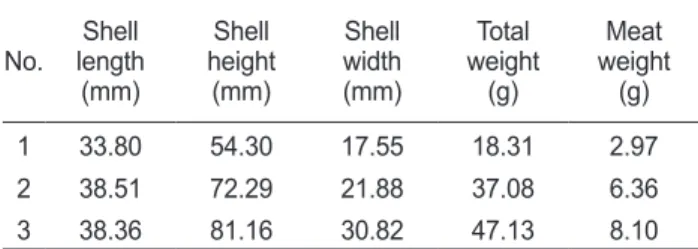
마리의수컷을선별하여국립수산 과학원양식관리과실험실로옮겨정자동결보존에사용하였다(Fig. 1)(Table 1).
수송직후각개체의생체로부터정소를적출한후
Calcium- free Hanks’balanced salt solution (C-F HBSS: 450 mM NaCl, 18 mM KCl, 3 mM MgSO
4·7H
2O, 1 mM Na
2HPO
4·7H
2O, 1 mM KH
2PO
4, 14 mM NaHCO
3,18 mM glucose)
와1:10 (w/v)
으로혼합하여정자현탁액을만들어4℃
에보관하면서실험 에사용하였다.
동해방지제
4
배체정자동결보존에사용된동해방지제는dimethyl sulf- oxide (DMSO), methanol (MeOH), polyethylene glycol (PEG, weights of 200), propylene glycol (PG)
총4
가지를사 용하였으며,
동해방지제농도는동결보존할총량(
동해방지제+
정자현탁액량)
의10%
와20%
로하였다.
본실험에사용된모든 Table 1. Basic parameters of tetraploid Pacific oyster Crassostrea gigas used for this experimentsNo. Shell length
(mm)
Shell height
(mm)
Shell width (mm)
Total weight
(g)
Meat weight
(g)
1 33.80 54.30 17.55 18.31 2.97
2 38.51 72.29 21.88 37.08 6.36
3 38.36 81.16 30.82 47.13 8.10
Fig. 1. Testis development of tetraploid Pacific oyster Crassostrea gigas, used in this experiments.
시약은
Sigma-Aldrich Co.
의제품을사용하였다. 평형시간
동결보존시평형시간조건을구명하기위하여정자현탁액을 동해방지제종류별
,
농도별로혼합한다음평형시간을3, 10, 30
분으로설정하였다.
이때정자냉각속도는-80℃
까지분당3℃
로냉각시킨후
,
액체질소(-196℃)
로옮겼다. 냉각방법 및 속도
평형시간노출이후냉각은프로그램동결기
(Computer Con-
trolled Rate Freezer 14S, SY-LAB, Austria)
를이용하여4
가지 의속도(
냉각률)
로하였다:
실온→ -80℃ (3, 5, 7, 10℃/
분)→
액 체질소).
동해방지제및평형시간은각각10% DMSO
및30
분 으로하였으며, 0.25 mL straw
를사용하였다.
Straw
동결보존시적정
straw
의크기를조사하기위하여0.25
및0.5 mL
의2
가지straw (Cassou, IMV, France)
를사용하였다.
이때 동해방지제및평형시간은각각10% DMSO
및60
분으로하 였으며,
동결은-80℃
까지분당3℃
로냉각시킨후,
액체질소(-196℃)
로옮겼다.
동결보관 및 해동
정자동결후액체질소에서
24
시간보관하였으며,
이후straw
를30℃
항온수조에서7
초간급속해동한다음정자의생존율 및운동성을측정하였다.
정
자 생존율 및 운동성
정자의생존및운동성은동결전
·
후의정자현탁액2 μL
를C-F HBSS 40 μL
와섞어정자운동성관찰용슬라이드글라스(Teflon Printed Glass Slide; 21 wells; diameter of each well, 4 mm; Funakoshi Co., Japan)
에2 μL
를분주하여광학현미경(Axio Scope A1, Carl Zeiss, Germany)
으로관찰하였다.
운동 성을가지는모든정자는생존한것으로간주하였으며,
생존율 이1%
이하는1%
로나타내었다.
정자운동성은운동지수(Ta- ble 2)
에따라점수를부여하고,
각각의운동점수와운동정자의 비율에따라Strüssmann et al. (1994)
의방법을변형하여정자 활성지수(sperm activity index, SAI)
로나타내었다.
통계분석
모든 실험은
3
회반복으로 수행하였으며,
결과값은 평균±
표준편차로 나타내었다.
유의차는SPSS-
통계패키지(version
18.0)
를 이용하여one or two way ANOVA-test (Duncan's multiple range test)
및t-test
의해검정하였다(P<0.05).
결 과
정자 생존율 및 정자활성지수
3
마리의4
배체참굴정자의동결보존전생존율은88.8±2.1- 92.6±1.2%
였으며,
정자활성지수(SAI)
는2.7±0.1-2.8±0.1
로개체간의유의적차이를보이지않았다(Table 3).
평형시간에 따른 정자의 해동후 생존율 및 SAI
동결보존시 평형시간별 동해방지제에 따른 정자의 해동후 생존율및SAI
를조사한결과,
평형시간이3
분일때,
모든동 해방지제에서 해동후생존율이1%
이하, SAI
는0.01
로나타 났다(Table 4).
평형시간이10
및30
분일 때,
해동후생존율은
DMSO
가 다른동해방지제보다유의하게 높았으며,
또한DMSO
와MeOH
의10%
가20%
보다높았다(Fig. 2).
해동후SAI
는생존율과동일한양상으로나타났다.
실험에사용한
10%
동해방지제를대상으로평형시간별해동후생존율및
SAI
의유의차를검증한결과, DMSO
및MeOH
에서는10
및30
분이3
분보다유의하게높았으며, PEG
와PG
에서는30
분이3
및10
분보다유의하게높았다(Table 4).
냉각속도 따른 정자의 해동후 생존율 및 SAI
동해방지제로
10% DMSO
를,
평형시간은30
분, 0.25 mL
straw
를사용하였을때,
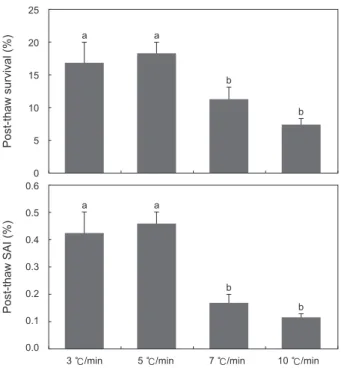
냉각속도에따른정자의해동후생존율및
SAI
는Fig. 3
에나타내었다.
냉각속도가분당3, 5℃/
분 일때생존율은각각17.0±3.1%, 18.4±1.8%
로7, 10℃/
분의11.4±1.9%, 7.6±0.7%
보다유의하게높았다.
또한SAI
역시 생존율과유사한경향을보였다.
Straw 크기에 따른 정자의 해동후 생존율 및 SAI
동해방지제로10% DMSO
를,
평형시간은30
분,
냉각속도는 Table 2. Score for the evaluation of sperm activity index (SAI)Score Motility characteristics 3 Sperm display forward movement rapidly 2 Sperm display forward movement slowly 1 Sperm display forward movement moderately 0 Immobile sperm
SAI = score × % motile sperm/100.
Table 3. The survival and activity index (SAI) of sperm from 3 tetraploid Pacific oyster Crassostrea gigas before the cryopreservation
Survival SAI
No.1 No.2 No.3 No.1 No.2 No.3
88.8±3.6 91.1±3.9 92.6±2.1 2.7±0.1 2.7±0.1 2.8±0.1
3℃/
분을사용하였을때, straw
크기에따른정자의해동후생 존율및SAI
는0.25 mL
에서각각17.0±3.1%, 0.43±0.08
로0.5 mL
의2.1±0.5%, 0.01±0
보다유의하게높았다(Fig. 4).
고 찰
4
배체참굴의정자동결보존은이미Dong et al. (2005a, 2006)
이시도한바있으나,
해동후운동성은2
배체에비해매우떨어 지는것으로나타나고있다.
본연구는Dong et al. (2006)
이확 립한동결보존방법을바탕으로동해방지별농도,
평형시간,
동 결속도등의조건을보다확장하여해동후운동성에어떠한영 향을미치는지조사하였다.
동해방지제는정자의동결보존시가장중요한요소로세포
내삼투질농도와빙결정형성등을완화
·
조절하는역할을한다(Jamieson, 1991).
따라서동해방지제는중성물질이어야하며,
친수성이강하고,
세포막에대한투과성이높고,
세포에대한 독성이적어야한다(Kuwano and Saga, 2000).
그러나각어 종의정자는동해방지제의종류에따라종특이성을보이기때 문에모든어류에서공통적으로사용할수있는동해방지제는 아직밝혀진바없으며,
동해방지제가세포동결시세포를보 호하는자세한메카니즘에관해서도아직알려지지않고있다(Kho, 2007).
또한동해방지제는세포에독성을나타내므로정 자의동결보존시적정동해방지제종류및농도를찾는것은매 우중요하다.
동해방지제는크게투과성과비투과성으로나눌 수있는데(Meryman, 1971),
본연구에서는투과성인DMSO,
25 20 15 10 5 0 0.6 0.5 0.4 0.3 0.2 0.1 0.0
Post-thaw survival (%) Post-thaw SAI (%)
*
* a
a
b
ET = 10 min
d
* *
a b c
ET = 10 min
d
DMSO
10% 20%
MeOH
10% 20%
PEG
10% 20%
PG
10% 20%
*
* a
c
b
ET = 30 min
c
*
* a
c
b
ET = 30 min
c
DMSO
10% 20%
MeOH
10% 20%
PEG
10% 20%
PG
10% 20%
Fig. 2. Post-thaw survival and activity index (SAI) of sperm suspended in 4 cryoprotectant agents (CPAs) at equilibration time of 10 and 30 min. ET: equilibration time. Different letters indicate significant differences between CPA groups (P<0.05). *Significant difference between 10% and 20% of CPAs (P<0.05).
Table 4. Post-thaw survival and activity index (SAI) of sperm suspended in various cryoprotectant agents (CPAs) of 10% at equilibration time of 3, 10 and 30 min
DMSO MeOH PEG PG
Equilibration
time (min) 3 10 30 3 10 30 3 10 30 3 10 30
Survival (%) 1±0a 14.5±1.8b 17.7±1.9b 1±0a 7.8±0.6b 6.1±1.1b 1±0a 3.3±0.7b 12.3±0.3c 1±0a 1±0a 3.1±0.3b ASI 0.01±0a 0.07±0.01a0.44±0.03b 0.01±0a 0.04±0.01b 0.06±0.01c 0.01±0a 0.02±0a0.18±0.01b 0.01±0a 0.01±0a 0.03±0a Different letters indicate significant differences between equilibration time of each CPA (P<0.05).
DMSO, dimethyl sulfoxide; MeOH, methanol; PEG, polyethylene glycol; PG, propylene glycol.
MeOH, PEG, PG
를사용하여4
배체참굴의정자를동결한결 과, 10% DMSO
가가장적합한것으로나타났다. Park et al.
(2013)
에따르면2
배체참굴의정자동결보존역시DMSO
가가 장적합한동해방지제로보고하였으며,
그농도가15, 10, 20%
순으로나타났다
.
본연구에서는정액량의부족으로15%
농도 를설정하지는못하였지만,
아마도15% DMSO
이적정농도 의가능성도배제할수는없다.
그러나2
배체및4
배체참굴의 정자동결보존시20%
의DMSO
농도는정자에독성을미치는 것으로확인되었다. Dong et al. (2006)
은4
배체참굴정자동 결보존시동해방지제2
가지를혼합하였을때(4% DMSO+6%
PEG),
해동후운동성이가장높았으나,
동해방지제단독사용시에는
10% DMSO
가가장양호하다고보고하여본연구와유사하였다
.
일반적으로DMSO
이외에도MeOH
은수서생물의 정자동결보존에광범위하게사용되는동해방지제로알려져있 지만(Tiersch, 2000),
굴에서는MeOH
을동해방지제로적합하 지않은것으로도보고된바있다(Smith et al., 2001).
그러나Dong et al. (2005b)
은2
배체참굴정자동결보존시동해방지제로
MeOH
이나MeOH+PEG
를혼합이가장적합하다고발표하였다
. Arctic charr Salvelinus alpinus
의정자동결보존시동 해방지제로20% glycerol
이10% DMSO
보다낫다고알려져 있지만(Piironen, 1993),
다른연구에서는반대의결과가나타 나고있다(Richardson et al., 2000).
이처럼동일종에서조차적 정동해방지제가다르게나타나는현상이종종나타나실험적 방법에대한논란이되고있지만,
아직이에대한정확한이유 는알려져있지않다.
정자의동결전평형시간은동해방지제가정자에침투하는데 필요하며
,
독성을최소화해야한다.
일반적으로적정평형시간 은어종,
동해방지제와동해방지제종류,
온도에따라달라진 다(Christensen and Tiersch, 1996; Billard and Zhang, 2001;
Sansone et al., 2002).
본연구에서는10% DMSO
를동해방지 제로사용하였을때,
평형시간이3
분인경우해동후생존율및SAI
가각각1%
이하, 0.01
이하로매우낮았던반면30
분일때 에는생존율및SAI
가각각17.7%, 0.44
로가장높았으나, Park et al. (2013)
은2
배체에서는평형시간이3
분일때10% DMSO
에서생존율이60%
이상, SAI
는2
이상으로보고하여본연구 의4
배체와는다른결과를보였다. 4
배체의정자동결보존시적 정평형시간이2
배체보다긴이유는4
배체정자의세포막이2
배체보다두꺼워동해방지제가침투하는시간이더소요되기 때문인것으로추정된다.
실제로4
배체정자의첨체,
정자머리,
미토콘드리아,
꼬리는2
배체의것보다유의하게크므로(Dong et al., 2005c),
이는막의두께또한클가능성을뒷받침해준다.
정자의동결보존시적정냉각속도는동해방지제의종류와농 도뿐만 아니라희석액,
평형시간,
냉각방법에따라 좌우된다(Babiak et al., 1999).
굴의정자동결보존을위한냉각속도는1℃/min
부터액체질소로바로냉각하는것까지광범위하게보고된바있다
(Hughes, 1973; Hwang and Chen, 1973; Dong et
25 20 15 10 5 0
a a
b
b
0.6 0.5 0.4 0.3 0.2 0.1 0.0
a
3 ℃/min 5 ℃/min 7 ℃/min 10 ℃/min a
b
b
25 20 15 10 5 0
*
0.6 0.5 0.4 0.3 0.2 0.1 0.0
0.25 mL Straw 0.5 mL Straw
*
Post-thaw survival (%) Post-thaw SAI (%) Post-thaw survival (%) Post-thaw SAI (%)
Fig. 3. Post-thaw survival and activity index (SAI) of sperm sus- pended in 10% DMSO at equilibration time of 30 min using 4 cooling rate. Different letters indicate significant differences be- tween cooling methods (P<0.05).
25 20 15 10 5 0
a a
b
b
0.6 0.5 0.4 0.3 0.2 0.1 0.0
a
3 ℃/min 5 ℃/min 7 ℃/min 10 ℃/min a
b
b
25 20 15 10 5 0
*
0.6 0.5 0.4 0.3 0.2 0.1 0.0
0.25 mL Straw 0.5 mL Straw
*
Post-thaw survival (%) Post-thaw SAI (%) Post-thaw survival (%) Post-thaw SAI (%)
Fig. 4. Post-thaw survival and activity index (SAI) of sperm sus- pended in 10% DMSO, equilibration time of 30 min in 0.25 mL or 0.5 mL straw. *Significant difference in straw size (P<0.05).
al., 2006).
본연구에서는냉각속도를분당3, 5, 7, 10℃
로설정 하였으며, 5℃
에서가장해동후생존율및SAI
가높았으나3℃
와는유의한차이를보이지않았으며
,
냉각속도가빠를수록생 존율은낮아지는것으로나타났다. Dong et al. (2006)
역시4
배 체참굴의정자동결보존시적정냉각속도는분당5℃
로보고한 바있으며,
본연구와일치하였다.
수서생물의 정자동결보존시사용되는 다양한크기의
straw
또는cryovial (
동결보존용기)
은그목적에따라다르게사용되 는데,
일반적으로대용량용기는주로현장에서종묘생산에사 용되며(Richardson et al., 2000; Cabrita et al., 2001), 0.25 mL
straw
와같은소용량용기는정자량이 제한적인어종에주로사용된다
(Huang et al., 2004).
정자동결보존시straw
의 용량 이작을수록해동후운동성이높다는결과가무지개송어(On- chorhynchus mykiss) (0.5 mL vs. 1.8 mL vs. 5.0 mL straw) (Cabrita et al., 2001), yellowtail flounder Pleuronectes ferru- gineus (0.25 mL vs. 1.7 mL straws) (Richardson et al., 1999),
채널메기(Ictalurus punctatus) (0.25 mL vs. 0.5 mL straws) (Christensen and Tiersch, 1997).
본연구에서도0.25 mL straw
를사용하였을때해동후생존율이0.5 mL straw
보다8
배정도 높았다.
이처럼소용량의straw
에서더나은결과가나오는것 은소용량의straw
는대용량의straw
보다용량에대한표면적 비율이더높아냉각또는해동시에열전달이균일하고빠르 기때문이다(Pickett and Berndtson, 1974).
그러나Dong et al.
(2006)
은4
배체참굴의정자동결보존시0.25
및0.5 mL straw
사용시해동후운동성에유의한차이가없다고하여본연구와 는다른결과를보였는데,
이는straw
크기에대한효과가아마 도동해방지제,
냉각속도,
해동방법에따라달라질수있음을 의미한다.
이상의결과를종합해보면
, 4
배체참굴정자동결보존시적정 동해방지제및농도는10% DMSO
이며,
평형시간은30
분,
냉 각속도는분당5℃, straw
크기는0.25 mL
로나타났다.
그러나 이때의해동후생존율및SAI
는각각18.4%
및0.46
으로2
배 체참굴정자의해동후와비교해볼때4
배정도낮은것으로비 교되었다.
이러한이유는4
배체참굴정자가2
배체보다그크기 가커므로4
배체정자에서는동결보존시동해방지제침투가원 활하지않아동해를많이받았기때문인것으로추정되며,
추후 이에대한현미경적관찰이필요할것으로보인다.
앞으로4
배 체정자의해동후생존율및운동성을향상시키기위해서는다 양한동해방지제를대상으로그농도,
평형시간,
냉각및해동 속도에대한연구가더많이이루어져야할것으로사료된다.
사 사
본연구는국립수산과학원
"
해역특화 생태통합양식(IMTA)
기술개발"
과제(RP-2014-AQ-114)
의연구비지원에의해수 행되었다.
References
Adams SL, Smith JF, Roberts RD, Janke AR, Kaspar HF, Tervit HR, Pugh PA, Webb SC and King NG. 2004. Cryopreser- vation of sperm of the Pacific oyster (Crassostrea gigas):
development of a practical method for commercial spat pro- duction. Aquaculture 242, 271-282.
Babiak I, Fraser L, Dobosz S, Goryczko K, Kuzminski H and Strzezek J. 1999. Computercontrolled freezing of rainbow trout Oncorhnchus mykiss (Walbaum) spermatozoa for rou- tine programmes. Aquacult Res 30, 707-710.
Billard R and Zhang T. 2001. Techniques of genetic resource banking in fish. In: Cryobanking the Genetic Resource:
Wildlife Conservation for the Future. Walson PF and Holt WV, eds. Taylor & Francis, New York, USA, 143-170.
Cabrita E, Robles V, Alvarez R and Herraez MP. 2001. Cryo- preservation of rainbow trout sperm in large volume straws:
application to large scale fertilization. Aquaculture 201, 301- Christensen JM and Tiersch TR. 1996. Refrigerated storage of 314.
channel catfish sperm. J World Aquacult Soc 3, 340-346.
Christensen JM and Tiersch TR. 1997. Cryopreservation of channel catfish spermatozoa: effect of cryopreservation, straw size, and formulation of extender. Theriogenology 47, 639-645.
Dong Q, Eudeline B, Huang C, Allen Jr SK and Tiersch TR.
2005a. Commercial-scale sperm cryopreservation of diploid and tetraploid Pacific oyster, Crassostrea gigas. Cryobiol- ogy 50, 1-16.
Dong Q, Huang C, Eudeline B, Allen Jr SK and Tiersch TR.
2006. Systematic factor optimization for sperm cryopreser- vation of tetraploid Pacific oyster, Crassostrea gigas. The- riogenology 66, 387-403.
Dong Q, Huang C, Eudeline B and Tiersch TR. 2005b. Sys- tematic factor optimization for cryopreservation of shipped sperm samples of diploid Pacific oyster, Crassostrea gigas (Thunberg). Cryobiology 51, 176-197.
Dong Q, Huang C and Tiersch TR. 2005c. Spermatozoal ultra- structure of diploid and tetraploid Pacific oyster. Aquacul- ture 249, 487-496.
Eudeline B, Allen Jr SK and Guo X. 2000a. Optimization of tet- raploid induction in Pacific oysters, Crassostrea gigas, us- ing first polar body as a natural indicator. Aquaculture 187, 73-84.
Eudeline B, Allen Jr SK and Guo X. 2000b. Delayed meiosis and polar body release in eggs of triploid Pacific oysters,
Crassostrea gigas, in relation to tetraploid production. J Exp
Mar Biol Ecol 248, 151-161.Guo X and Allen Jr SK. 1994. Viable tetraploids in the Pacific oyster (Crassostrea gigas Thunberg) produced by inhibition of polar body I in eggs from triploids. Mol Mar Biol and Biotechnol 3, 42-50.
Guo X, Debrosse G and Allen Jr SK. 1996. All-triploid Pacific oysters (Crassostrea gigas Thunberg) produced by mating tetraploids and diploids. Aquaculture 142, 149-161.
Huang C, Dong Q, Walter RB and Tiersch TR. 2004. Sperm cryopreservation of green swordtail Xiphophorus helleri, a fish with internal fertilization. Cryobiology 48, 295-308.
Hughes JB. 1973. An examination of eggs challenged with cryo- preserved spermatozoa of the American oyster, Crassostrea
virginica. Cryobiology 10, 342-344.
Hwang SW and Chen HP. 1973. Fertility of male oyster gametes after freeze-thawing. Chinese-American Joint Commission on Rural Reconstruction Fisheries Series 15, 1-5.
Jamieson BGM. 1991. Fish evolution and systematics: Evidence from spermatozoa. With a survey of lophophorate, echi- nodern and photochordate sperm and an account of gamete cryopreservation. Cambridge University Press, Cambridge, xiv 319.
Kho KH. 2007. Effects of cryoprotectants and diluents on cryo- preservation of the red seabream, Pagrus major sperm. Ko- rean J Ichthyol 19, 173-177.
Kuwano K and Saga N. 2000. Cryopreservation of marine al- gae: Cryopreservation of marine algae: Applications in biotechnology. In: Recent advances in marine biotechnol- ogy. Figerman M and Nagabhusshanam R, eds. Volume 4:
Aquaculture. Part A, Seaweeds and invertebrates. Science Pubulishers Inc., New Hampshire, 23-40.
McFadzen IRB. 1995. Cryopreservation of sperm of the Pacific oyster Crassostrea gigas. In: Cryopreservation and Freeze- Drying Protocols. Day JG and McLellan MR, eds. Humana Press, Totowa, New Jersey, U.S.A., 145-149.
Meryman HT. 1971. Cryoprotective agents. Cryobiology 8, 173-183.
Park MS, Lim HJ and Lee TS. 1999. Biological and chemical characterization of triploid Pacific oyster (Crassostrea gi-
gas) in the waters of Tongyoung, Korea. Bull Fish Res Dev
Agency 55, 31-40.Park MS, Min BH, Park JJ, Lim HJ, Myeong JI and Jeong MH.
2013. Cryopreservation of Pacific oyster, Crassostrea gigas sperm. Korean J Malacol 29, 251-258.
Pickett BW and Berndton WE. 1974. Preservation of bovine spermatozoa by freezing in straws: A review. J Dairy Sci 57, 1287-1301.
Piironen J. 1993. Cryopreservation of sperm from brown trout (Salmon trutta m. lacustris L.) and Arctic charr (Salvelinus
alpinus L.). Aquaculture 116, 275-285.
Richardson GF, Miller TL and McNiven MA. 2000. Cryo- preservation of Arctic charr, Salvelinus alpinus (L.), semen in various extenders and in three sizes of straw. Aquacult Res 31, 307-315.
Richardson GF, Wilson CE, Crim LW and Yao Z. 1999. Cryo- preservation of yellowtail flounder (Pleuronectes ferrugin-
eus) semen in large straws. Aquaculture 174, 89-94.
Sansone G, Fabbrocini A, Ieropoli S, Langellotti A, Occidente M and Matassino D. 2002. Effects of extender composition, cooling rate, and freezing on the motility of sea bass (Dicen-
trarchus labrax, L.) spermatozoa after thawing. Cryobiol-
ogy 44, 229-239.Stanley JG, Hidu H and Allen Jr SK. 1984. Growth of Ameri- can oysters increased by polyploidy induced by blocking meiosisⅠbut not meiosisⅡ. Aquaculture 37, 147-155.
Strüssmann CA, Renard P, Ling H and Takashima F. 1994. Mo- tility of pejerrey Odontesthes bonariensis spermatozoa. Fish Sci 60, 9-13.
Tiersch TR. 2000. Introduction. In: Cryopreservation in Aquatic Species. Tiersch TR and Mazik PM, eds. World Aquaculture Society, Baton Rouge, Louisiana. 19-26.
Wang Z, Guo X, Allen Jr SK and Wang R. 1999. Aneuploid Pacific oyster (Crassostrea gigas Thunberg) as incidentals from triploid production. Aquaculture 173, 347-357.