Policy Recommendation for New Regional Industrial Policy in the Fourth Industrial Revolution Era
Daeshik Lee
Department of Economics, College of Economics and Commerce, Pusan National University, Professor
4차 산업혁명시대의 새로운 지역산업정책방향에 대한 정책제언
이대식
부산대학교 경제통상대학 경제학부 교수
Abstract This study analyzes the current status and performance of regional industrial policy in the face of the weakening industrial competitiveness under the global trend of the 4th industrial revolution and suggests the policy direction that regional industrial policy as a new national growth strategy. This study focuses on the suggestion of new regional industrial policy framework under new policy environment based on literature review. We propose a new industrial policy framework that simultaneously pursues equality between regions and efficiency within the region at the same time. As a core policy recommendation, we suggest first, establishing the region-centered industrial policy governance, second, strengthening planning function of local government through human resource development and institutionalized national government consulting, and the third, constructing lifestyle industry-ecosystem based on cultural asset and identity of region, fourth, utilizing Smart City, as a platform for participatory innovation, entrepreneurial and capital attraction, and cultivating new industry based on public procurement and data. Main suggestions of this study would be a new guideline coping with the declining industrial competitiveness and the Fouth Industrial Revolution. Details would be necessary.
Key Words : Fourth Industrial Revolution, Regional Industrial Policy Framework, Innovation Ecosystem, Local Governance, Smart City
요 약 본 연구는 4차 산업혁명의 글로벌 추세하에서 한국의 산업경쟁력약화라는 현실에 직면하여, 지역산업정책의 현황과 성과를 분석하고 향후 새로운 국가성장전략으로서의 지역산업정책이 지향해야 할 정책방향을 제시하고자 함에 목적이 있다. 이를 위하여 본 연구는 문헌연구에 기초하여 변화된 정책환경에 부합되는 새로운 지역산업정책의 틀을 구상함에 주안점을 두었다. 먼저, 큰 틀의 정책방향으로 권역 간 형평과 권역 내 효율의 동시적 추구라는 산업정책틀을 제시한다. 이를 위한 구체적 정책방안으로 첫째, 지역주도 지역산업정책 거버넌스의 구축, 둘째, 인력양성중심, 중앙정부컨설 팅을 법제화한 지역산업정책 기획, 셋째, 지역고유의 문화와 정체성에 기초한 라이프 스타일 산업 생태계 조성을 통한 지역전 략산업 육성 넷째, 4차 산업혁명기술의 종합시현장인 스마트시티를 참여형 혁신플랫폼, 창업 및 자본유치 플랫폼, 공공조달과 데이터에 기반 한 신산업육성 플랫폼으로 활용할 것을 제안한다. 본 연구는 4차 산업혁명의 전개와 기존산업의 경쟁력 상실이 라는 새로운 환경에 대한 대처전략의 제시에 의의가 있으며, 향후 세부적인 실천방안에 대한 추가연구가 요구된다.
주제어 : 4차 산업혁명, 지역산업정책틀, 혁신생태계, 지역주도 거버넌스, 스마트시티
*This study was supported by the Fund for Humanities & Social Studies at Pusan National University 2015
Received May 1, 2019 Revised May 27, 2019
Accepted June 20, 2019 Published June 28, 2019
1. Introduction
The global economy has continued to suffer so-called "New Normal Economy," which has characterized as a vicious cycle of low growth, low employment and low price since the global financial crisis in 2008. As a global response for this, industries and firms begin econo-technological paradigm shift through adopting newly evolved high technologies, like AI, Big data, Cloud, and Iot etc.
Some of them are Germany's Industry 4.0 plan and the GE's digital twin platform using industrial Internet in U.S.. Klaus Schwab calls this “the advent of the Fourth Industrial Revolution Era”[1]
in the World Economic Forum (WEF).
In Korean economy, as experiencing the new reality of weakening the competitiveness of the core manufacturing industries such as shipbuilding, steel and automobiles, the issues of industrial restructuring are emerging again. Also, the Korea’s regional economy, as the production bases of Korea's major manufacturing industries, is taking a huge blow. In addition, the U.S.-led global trade friction and the burden of national finance due to the aging of low birthrates are new environments facing Korean economy.
Under this new global and local environment, the effectiveness of traditional macroeconomic and industrial policies is seriously damaging.
Accordingly, the creation of employment and value-added through the revitalization and rationalization of local unused potentials and resources, has emerged as a new alternative to national economic growth strategy. International organizations such as the OECD, the EU and the World Bank are also advocating the importance of a territorial innovation strategy[2].
In particular, the Korean government set up a
"five-year regional development plan" based on the
"Special Act on Balanced National Development" in 1999 and put local industrial competitiveness into its main national agenda, investing nearly 10 trillion won during last 10 years. But local
industries are still suffering the decline of competitiveness. This shows that there is a serious problem with the existing regional industrial policy framework. Therefore, it is necessary to take a critical look at the results of regional industrial policies and to figure out new strategies for regional industries in preparation for the new global economic environment and the technological shift, so-called the Fourth Industrial Revolution. Since the basic nature of business and economy is changing due to the introduction of new technologies such as AI, IoT, and Blockchain etc., we need a new theoretical backgrounds for industrial policies.
This study first examines the changes that the Fourth Industrial Revolution brings, especially new trends in space, innovation and consumption, and recent theoretical changes in regional policies Second, we assess the innovation ecosystem and the effectiveness of existing policy framework for regional industrial policies.
And finally, we would like to propose long-term policy directions and some short-term measures to revitalize the local economy under new econo-technological paradigm shift era.
2. Changing Industrial Structure and the Spatial Structure of Innovation
The industrial environment has been facing innovative changes, including the collapse of industrial boundaries due to the recent progress of the fourth industrial revolution, the transformation from pipeline economies to platform-based ones, and the servitization of manufacturing industries. Only a decade ago, petro-chemicals and financial companies topped the global market capitalization list, but now Google, Apple, Microsoft, Amazon and Facebook are the top five companies in the so-called platform business. In other words, a new
industrial ecosystem is being created that provides customized products and services not only in traditional retail but also in convergence of various manufacturing industries such as self-driving cars, finance, healthcare and so on[3].
The changes in the spatial structure caused by the fourth industrial revolution needs to be examined. First, the traditional importance of locational factor dependence has been reduced due to the characteristics of hyper-connection and super-intelligence phenomena of fourth industrial revolution[4]. Secondly, due to the effect of platformization, large-scale production activities are moving to smaller size production clusters of inside of urban or urban areas. In addition, as the importance of creative technological workforce in industrial competitiveness grows, urban functions are being combined and smartened.
Therefore, the "urbanization" will intensify and all areas in the future are expected to expand into “mega-city region”. Barthlet and Cohendet describes this as a transition from "People flow work to a Job flow people[5]." The acceleration of the fourth industrial revolution is expected to deepen the concentration of space and spatial inequality, warning of the danger of widening the gap between capital areas and provincial areas in Korean society[6].
Next is the change in geographical patterns of innovation as a result of this new spatial patterns.
Geographical trends of innovation are also shifting from the classical industrial zones and suburban industrial clusters to urban-centered "Innovation District[7]." Some other scholars and practitioners describe innovation district as ‘new industrial cluster within the inner city’, ‘new century city developments’, and ‘urban knowledge parks’ etc[8,9].
Kats and Wagner describes innovation district as follows: ‘...Innovation Districts are geographic areas where leading-edge anchor institutions and companies cluster and connect with start-ups, business incubators, and accelerators. They are also physically compact, transit-accessable, and
technically- wired and offer mixed-use housing, office, and retail...
In other words, in case of a city center, the proximity to the core human resources is assured and the density of the workforce is high.
“Proximity” and “Density of workforce” are two key concepts for working innovation. Innovation district researchers describe it as a link between economy-shaping, place-making, and social-networking.
We confirm this trend by recently moving the core of Silicon-Valley from Palo Alto, a suburb of Silicon Valley, to San Francisco inner city, or by the fact that one of the main future vision of Research Triangle Park, North Carolina, is “the urbanization of RTP for the next 50 years”.
Another new trends in response to the revolutionary change in technology, the advent of the fourth industrial revolution, is the emergence of new consumer culture centered on de-materialism and lifestyle. "The more advanced technology develops, the more human emotional and empirical stimuli are needed, and so modernity requires an ideal combination of high-tech (technical) and high-touch(emotional)," says futurist John Naisbitt. In the same vein, Daniel Pink said, "The post-information age will shift from the left to the right-brained era and core competence for future talent would be “High Concept(creativity) and High Touch(emotion)”[10].
In the era of the Fourth Industrial Revolution, culture rooted in the region, identity based on it, and lifestyle are expected to play an important role in future industrial competitiveness.
3. Assessment of Regional Industrial Ecosystem
In order to strengthen the competitiveness of local industries, more than 500 supporting agencies have been established to promote various areas of business activities due to the
Function
total capital manpower R&D facility knowledge startup-support infrastructure
Central area 52 62 70 59 132 9 56 205
Chung-cheong area 32 40 46 48 61 8 19 84
West-southern area 35 29 36 39 51 6 19 77
East-northern area 29 41 43 43 46 6 34 90
East-southern area 20 24 25 29 33 11 11 61
total 168 196 220 217 323 40 139 517
Source: Rearranged from [11] p. 169
Table 1. Industry Supporting Agencies By Region
SCI publication
Domestic patent enrollment
Overseas patent enrollment
Royalty Commercialization
National R&D project 171,306 56,743 5,564 540,994
Per 1 billion Won 1.82 0.6 0.06 4.35
Local R&D project 1,129 1,539 57 235 5,488
Per 1 billion Won 0.49 0.67 0.02 0.1 2.39
Source: NTIS (2015), recited from [12], p. 39
Table 2. Comparison of Local R&D outcomes with National R&D government's policy efforts, for last 10 more
years as shown in table 1. However, there has been a growing regional bias for the metropolitan area and Chungcheong provinces in terms of amount invested and human resources for technology R&D. Moreover, public R&D, which should rectify the imbalance in private R&D investment, also has been concentrated in Seoul and Daejeon by more than 80 percent[11]. The concentration of core technical personnel in the metropolitan area is more serious than the imbalance of R&D investment, so the technological workforce has continued to concentrate on the capital area over the last 10 years. This is called the "straw effect" in the metropolitan area, where 92.7 percent of college graduates from the metropolitan area remain in the region, while only 50 percent of those in Gangwon and Chungcheong provinces are in the range. The serious mismatch in human resources of korean provinces is causing a simultaneous occurrence of high-end manpower shortage and lack of job opportunities in the provinces, which has a strong ties with region’s sluggish growth.
Comparing the performance of the government's regional R&D with that of the overall R&D, quality
index of regional R&D such as overseas patents registration ratio and royalty fees was very poor, as shown in table 2. Secondly, it was surprised that there shows no significant difference in the growth tendency of companies that supported by the government compared with those without any external aid. Finally, in terms of the degree of specialization of target industry for R&D support, the match rate with the existing specialized industry of the region found to be within 50 percent. That means regional industrial policy so far in terms of R&D support has not been properly reflecting the region’s industrial characteristics[12].
Let's look at the reasons why local industrial policies haven’t been working properly. In other words, why hasn't the local growth engine industries developed and gained competitiveness with last 10 years’ policy endeavor! The limitations of the central government-led regional industrial policy, namely inappropriate policy governance problem, was most serious factor. For example, there is no communication or coordination channel between the “National Science & Technology Review Committee”, which is the government's main R&D agency, and the
“Regional Development Committee”, which is the core government agency for regional industrial development. Also, it has been rare to do frequent cooperations among main government ministries such as the Ministry of Science and Technology, Ministry of Commerce, Industry and Energy and Ministry of SMEs and Startups.
Secondly, since most local innovation centers, such as TPs(Techno-Parks), industrial promotion agencies, and Small Business Promotion Agency, are under the central government’s control, it is difficult to reflect the opinions and demands of local businesses and local governments to innovation supporting agencies of regions. Third, there is a serious problem that local supporting agencies, both at scale and at the level of manpower, are falling short of the critical mass that can elicit substantial aid for regional industries.
According to estimates of earlier study, the average number of researchers of the supporting institutions in the region as of 2016 was 4.69 persons, and average budget/year was 18.5 billion[13].
Especially, the support of the central government is not focused on the "manpower", rather, it was given to the test analysis, authentication evaluation and prototype production
etc. Manpower is the key factor for the technological competence and innovation. Some even pointed out that the central government's support has turned into seed for the survival of many established agencies, rather than a real source for substantial outcome of local industries. Finally, the innovation capability established in local governments, local public sectors and local business is far behind of critical mass for working of innovation ecosystem. In particular, the so-called "picking winner syndrome," which stems from the competition for budget-taking by local governments, in line with the excessive discretion power given to local agencies of central government, is forming an inefficient vicious circle[14].
4. Basic Direction of New Regional Industrial Policy
4.1 Regional Growth as a Core Strategy for National Economic Growth
We suggest that Korea’s new industrial policy should transform into the "region-centered growth paradigm“, which drives the growth of the national economy through mutual competition and complementation among local economies with independent regional industrial bases. In the past, our industrial policy was focused on large corporations, corporation groups and metropolitan centers, where regions only played as dependent production bases for center. Nowadays, the situation of the world economic environment, which enabled the Korean model of economic growth in the past, changed rapidly and that the past korean growth model is no longer valid.
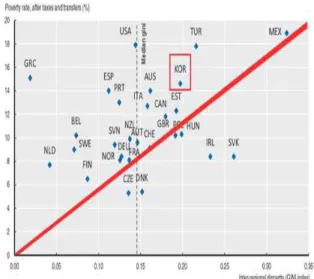
Under the past model, polarization has been intensifying and the existing industrial competitiveness is rapidly depleting. As is shown in Figure 1, the overall trends of OECD countries show that the lower inter-regional disparity, the higher national growth measured by poverty rate.
This implies that the creation of jobs and value–
added through mobilization and efficient allocation of local resources based on the fusion of locally embedded culture and local innovation base is the only alternative to national economic growth.
4.2 Pursuit of Inter-Regional Balance and Intra-Regional Efficiency
The Korean economy needs to adopt a spatial policy that pursues efficiency through competition within regions, and at the same time targets national balances among regions. OECD statistics[15] shows inter-regional balance within a nation is positively related national prosperity(Figure1).
Five Korean regions happen to be very similar with some Scandinavian small but strong
countries in terms of territorial and population size. It will be possible to simultaneously achieve political and social goals through inter-regional balance at the same time, growth of nation through pursuit of efficiency within region.
For this purpose, we propose that central government provide new legal framework, namely,
‘Special Purpose Law for Regional Industrial Growth Policy,’ for providing new governance of regional industrial policy including new regulations, institutions, organization and budgets etc.
Fig. 1. The Relationship between National Growth and Balanced Development
Source: OECD(2016), p. 61
5. Policy recommendations to revitalize local industries
Recently building a smart specialization and smart regional innovation ecosystem was proposed as a new regional industrial policy framework[16,17]. However, since these proposals are mainly conceptual, we propose more concrete policy measures for current local industries.
First, the central government should introduce region-oriented industrial policy governance. In other words, the central government should focus on the overall control of regional industrial
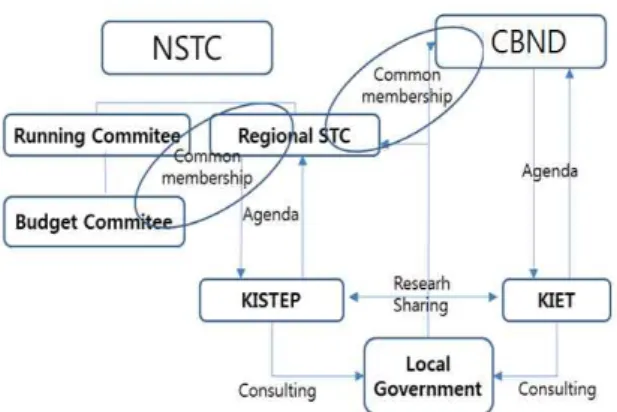
policies through ex-ante consulting and ex-post evaluation of policy programs. On the contrary, the local governments should transform into the entrepreneurial government, based on responsibility and autonomy through combining the local industrial capabilities, academia and local research institutions. In particular, the local government needs to restructure to prepare for the era of decentralization, aiming at an entrepreneurial business-oriented local government. For example, as shown in figure 2, NSTC(National Science and Technology Committee) and CBND(Committee for Balanced National Development) and local government should be coordinated through membership, research and consulting sharing[18].
Second, the central government should place policy focus on securing the workforce-centered technological infrastructure of supporting local industries. In other words, the existing equipment-oriented R&D support (this is a method for ease of management) should be reorganized into the workforce-centered R&D support framework. In particular, the government should expand the autonomy of local supporting institutions to enable high manpower mobility and workforce exchange among local companies, universities and technology hubs and to resolve the problems of technology accumulation and technical mismatches. At the heart of the worldwide success story of the Fraunhofer Foundation in Germany and the UTC in Rolls Royce in U.K., is the "human training system"
that accumulates technology. In particular, several key technology bases related to the fourth industrial revolution must be secured. For these purposes, central government institutionalize to provide consulting services, pilot projects and the reverse matching of central government R&D, in order to enhance planning power of local governments. Following figure suggest new governance structure.
Fig. 2. Governance Structure of New Regional Industrial Policy Framework
Source: re-arranged from [18], p. 17
Third, local industrial development strategies should be adopted through the creation of a lifestyle industry ecosystem based on the unique culture and identity of the region. According to Mo Jong-rin, the city is "a city that utilizes its unique lifestyle as a business model, marketing and competitiveness of its industries and businesses[19]." In response to the progress of technological innovation in the future, the consumption culture of de-materialist identity will be expanded. Already, many regions are experiencing a virtuous cycle between the formation of a lifestyle and the creation of an industry based on it. You can think of Palo Alto and Google, Seattle and Starbucks, the Bordeaux and wine industries, and Korea Jeju and naturalism industries. The model of fostering urban industries through human resources inflows, localization of large enterprises, partnership and related startups based on core cultural assets and lifestyle in each region will operate very efficiently.
Fourth, the government is rapidly developing the smart city project in order to show and feel the change of the fourth industrial revolution to the public[20]. We propose that the smart city project, which is currently underway to efficiently resolve urban issues and test-beds of various technologies related to the fourth industry, should be expanded as a “Digital New
Deal policy” of Korean economy. In other words, expanding and promoting smart city as a platform for industrial innovation and new growth engines. More specifically, smart city can play as a data-based inventive platform, venture and capital inducement platform and new industry incubation platform through procurement and data base for city infrastructure[21-23].
6. Conclusion
The Fourth Industrial Revolution is a future that has already begun in Korea. Compared to advanced countries such as the US, Germany, and Japan, we are far behind.
The Korean economy will inevitably decline if it does not change its past growth model. Simply put, since our economy has already grown, past clothes does not fit. The competitiveness of the nation should be realized within the national territory. It is necessary to construct infrastructures that will enable all national territory to compete globally. That is why we need a new regional industrial policy framework. In this sense, we propose the new direction of territorial industrial policy to pursuit “both inter-regional balance and intra-regional efficiency.” Under this basic guideline we proposed four major policy recommendations for revitalization of regional industries. Further study is necessary for details of policy recommendation.
REFERENCES
[1] K. Schwab. (2016). The Fourth Industrial Revolution.
Geneva: World Economic Forum
[2] R. Gabriel, H. Fernando, S. Milena & J. Koen. (2017).
Place-based Innovation Ecosystems, JRC science for policy report, Luxemburg: EU
[3] D. J. Jackson. (2015). What is an Innovation Ecosystem?
National Science Foundation, Arlington : VA.
[4] Y. S. Kim. (2017). Fourth Industrial Revolution and
Direction of Regional Industrial Development.
Indusrial Economy, 2, KIET, 7-15.
[5] H. Bathelet & P. Cohendet. (2014). The Creation of Knowledge: local building, global accessing and economic development-toward an agenda. Journal of Economic Geography, 14, 869-882.
[6] C. M. Jeong. (2017). Prospects of Urban Structural Change and Policy Agenda in the era of Fourth Industrial Revolution. Planning and Policy, 424, 11-16.
[7] B. Kats & J. Wagner. (2014). The Rise of Innovation Districts: A New Geography of Innovation in America.
Brookings
[8] T. Hutton. (2004). The New Economy of the Inner City. Cities, 21(2), 89-108.
[9] M. Jaroff, D. Frenchman & F Rojas. (2009). New Century City Developments Creating Extraordinary Value. Cambridge: MIT
[10] D. H. Pink. (2011). A Whole New Mind: Why Right-Brainners Will Rule the Future. The Daily Telegraphy, UK.
[11] Y. S. Kim, S. B. Kim, H. W. Kim & N. H. Choi. (2015).
Industrial Innovation Ecosystem Building Measures in the Korean Region. KIET.
[12] K. Y. Huh. (2016). Evaluation of Regional Industrial Competitiveness Reinforcement Program. National Assembly Budget Office.
[13] D. Lee. (2018). Regional Industrial Competitiveness.
Response for Crisis of Korean Industry. 3rd Global Industry Competitiveness Forum, IGIC. Seoul.
[14] K. B. Nam. (2016), The End of ‘Selection and Concentration’: Towards a New Post-Cluster Regional Industrial Policies. Journal of the Economic Geographical Society of Korea, 19(4), 764-781.
[15] OECD (2016). OECD Regions at a Glance 2016, Paris : OECD Publishing.
[16] S. Jang (2016). Direction of Regional Strategic Industry Development in the Era of the 4th Industrial Revolution. Gwangju-Junnam Yeongu, GERI, 1-27.
[17] S. B. Kim. (2017). New Regional Industrial Development Strategy: Establishment of Smart Regional Innovation Ecosystem. KIET Industrial Economy, 04, 65-73.
[18] S. J. Kim. (2017). Establishment of Self-Directed Regional R&D Innovation System by Decentralization.
Issue Weekly, KISTEP, 215, 1-22.
[19] J. R. Mo. (2018). The Future of City and Commercial Sphere. PPT presentation Yonsei Univ.
[20] K. B. Kim, G. C. Kim & H. J. Cho. (2018). Status and Prospects of Smart City in the Fourth Industrial Revolution Era. Journal of the Korea Convergence Society, 9(9), 191-197.
[21] L. Errichiello & A. Marasco. (2014). Open Service
Innovation in Smart Cities: A framework for Exploring Innovation Networks in the Development of New City Services. Advanced Engineering, 11, 115-124
[22] N. Walravens, J. Breuer & P. Ballon. (2014). Open Data as a Catalyst for the Smart City as a Local Innovation Platform. Digital Economic Journal, 96(4), 15-33.
[23] K. A. Paskaleva. (2011). The Smart City: A nexus of Open Innovation?. Intelligent Building International, 3(3), 153-171.
이 대 식(Lee, Dae Shik) [정회원]
· 1978 2월 : 연세대학교 경제학과(경 제학사)
· 1982 8월 : 연세대학교 대학원 경제 학과(경제학 석사)
· 1988 6월 : 미국 버지니아주립대학 경제학과(경제학 박사)
· 1988년 4월 ~ 현재 : 부산대학교 경 제학부 교수
· 관심분야 : 기술혁신, 지역경제
· E-Mail : [email protected]