한수지 50(1), 092-097, 2017
Korean J Fish Aquat Sci 50(1),092-097,2017
Note
서 론
멸치
(Engraulis japonicus)
는 청어목(Clupeiformes),
멸치과
(Engraulidae)
에속하는어류로표층에서군집생활을하고(Kim et al., 2005),
주산란기는3
월에서6
월이며분리부성란 을산란하는특성을가진다(Chyung, 1977).
멸치는전세계적 으로식품으로이용되는어류중하나로경제적가치가매우높 은상업성어종이기때문에이들을지속적으로이용하기위해 서는초기생활사에대한연구가필요할것이다.
멸치를대상으로수행된선행연구를살펴보면요각류를주 로섭식한광양만후기자어멸치에관한연구
(Park and Cha,
1995),
특정 환경에서의 변화하는 먹이이용성에 관한 연구(Takahashi and Watanabe, 2005),
만각류등의섭식비율이높 은멸치성어에관한연구(Kim et al., 2013),
어란과자치어의 분포및수송에관한연구(Kim and Pang, 2015),
초기성장과발 달에관한연구(Lee and Go, 2003)
등이알려져있다.
향후수 산자원관리를위한가입량등에대한기초자료를확보하기위 해서는멸치자치어에대한생태학적연구가기본이되어야하는데
,
본연구지역인진해만동부해역에출현하는멸치자치어 의식성연구는미비한실정이다.
또한진해만동부해역은거가 대교,
부산신항만건설등과같은개발이지속적으로이루어지 고있는지역이며향후진해만동부해역의멸치자치어생태에 도영향을있을것으로생각된다.
본연구의목적은멸치자치어를대상으로주먹이생물을파 악하고
,
성장에따른먹이생물조성의변화,
일주기섭식율,
월 별먹이생물조성을바탕으로진해만동부해역에우점하여분 포하는멸치자치어의식성을알아보고자한다.
이는이후본해 역에출현하는멸치자치어생태변화를파악하는데도움이되 고,
진해만동부해역의멸치자원을지속적으로이용하기위한 자료로제공될것이다.
재료 및 방법
멸치자치어는
2010
년10
월, 2011
년6
월에서9
월에채집되었 으며,
채집은RN80
네트(
망구0.8 m,
망목330 µm)
를이용하여 약5
분간수평채집하였다(Fig. 1).
진해만 동부해역에 분포하는 멸치(Engraulis japonicus) 자치어의 식성
김현지·정재묵 1 ·박종혁·백근욱
경상대학교 해양식품생명의학과/해양산업연구소, 1국립수산과학원 연근해자원과
Feeding Habits of Larval Japanese Anchovy Engraulis japonicus in Eastern Jinhae Bay, Korea
Hyeon Ji Kim, Jae Mook Jeong
1
, Jong Hyeok Park and Gun Wook Baeck*Department of Seafood and Aquaculture Science/Institute of Marine Industry/Marine Bio-Education and Research Center, Gyeon- sang National University, Tongyeong 53064, Korea
1Coastal Water Fisheries Resources Research Division, National Institute of Fisheries Science, Busan 46083, Korea
The feeding habits of larval Engraulis japonicas (3.2-11.0 mm SL) were examined based on 414 individuals, collected in October 2010, and from June to September 2011, in the coastal waters of Eastern Jinhae Bay, Korea. E. japonicus , fed mainly on copepods 62.6% IRI and tintinnid were the second-largest dietary component. E. japonicus diet also included small quantities of rotifers, eggs and diatoms. The results of analysis of ontogenetic changes showed that E.
japonicus of small size classes (≤4 mm) fed primarily on tintinnids. The dietary percentage of copepods decreased, as fish size increased, and monogeneans became increasingly important as size class increased above 4-6 mm. The highest rate of daily feeding E. japonicusi took place during the day.
Key words : Larval fishes, Engraulis japonicus , Feeding habits, Daily feeding rate
This is an Open Access article distributed under the terms of the Creative Commons Attribution Non-Commercial Licens (http://creativecommons.org/licenses/by-nc/3.0/) which permits
http://dx.doi.org/10.5657/KFAS.2017.0092 Korean J Fish Aquat Sci 50(1) 092-097, February 2017
Received 14 October 2016; Revised 16 January 2017; Accepted 8 February 2017
*Corresponding author: Tel: +82. 55. 772. 9156 Fax: +82. 55. 772. 9159
채집된시료는현장에서
5%
중성포르말린으로고정하여실 험실로운반하였으며,
각개체의척색장(notochord length)
을1 mm
까지측정하였다.
이후,
현미경아래에서소화관전체를분리한뒤
,
소화관내용물을70%
젖산으로이물질을제거한후
,
분석하였다(Youn et al., 2010).
소화관내용물은가능한종 수준까지동정하였으며, Yoo et al. (1991), Chang (2010), Soh (2010)
을이용하여요각류, Yamaji (1984)
를이용하여요각류 를비롯한동물플랑크톤을동정하였다.
요각류의경우전체적 형태뿐만아니라,
분류학적형질들을자세히관찰하였다.
동정 한먹이생물은종류별로크기(
가로,
세로)
를측정하고개체수를 계수하였으며이후Takatu et al. (2007)
의부피계산식을참고 하여부피를계산하였다.
소화관내용물분석결과는각먹이생 물의출현빈도(%F),
개체수비(%N)
그리고부피비(%V)
로나 타내었으며,
다음식을이용하여구하였다.
%F=A
i/N×100
%N=N
i/N
total×100
%V=V
i/V
total×100
여기서
, A
i는소화관내용물중해당먹이생물이발견된자치 어의개체수이고, N
은먹이를섭식한자치어의총개체수, N
i(V
i)
는해당먹이생물의개체수(
부피), N
total(V
total)
은전체먹이 개체수(
부피)
이다.
먹이생물의상대중요성지수(index of rela- tive importance, IRI)
는Pinkas et al. (1971)
의식을이용하여 구하였다.
IRI=(%N+%V)×%F
상대중요성지수는 백분율로 환산하여 상대중요성지수비
(%IRI)
로나타내었다.
멸치자치어의일주기섭식양상을살펴보기위해채집된모든개체를오전
6
시부터자정까지3
시 간간격[6 h:40N, 9 h:34N, 12 h:116N, 15 h:6N, 18 h:35N, 21 h:43N, 24 h:138N (h:
시간, N:
개체수)]
으로채집후,
섭식율을 알아보았다(Choi et al., 2015).
또한척색장별먹이조성의변 화를파악하기위하여≤4 mm, 4-6 mm, 6-8 mm, 8 mm<
의4
개크기군으로구분하였으며,
크기군별개체당평균먹이생물 개체수(Mean number of preys per gut, mN/Gut),
개체당평균 먹이생물부피(Mean volume of preys per gut, mW/Gut)
를구 하였으며,
크기군별먹이생물의개체수와부피차이를분산분 석(Analysis of variance, ANOVA)
으로유의성을검정하였다.
결과 및 고찰
멸치자치어식성연구를위하여사용된시료를살펴보면
(Fig.
2)
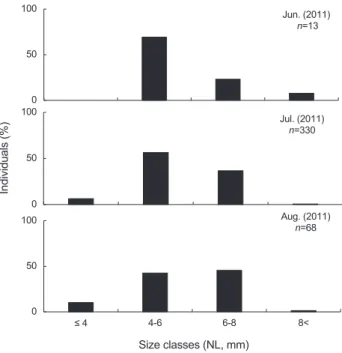
총411
개체가출현하였다. 6
월에13
개체, 7
월에330
개체, 8
월에68
개체가출현하였으며, 7
월에가장많이출현하였고, 6
월 에가장적게출현하였다.
척색장분포를살펴보면6
월에5.0- 9.8 mm
의출현범위를나타냈으며4-6 mm
크기군에서69.2%
로가장많이출현하였으며
, 7
월에3.2-11.0 mm
의출현범위를 나타냈으며, 4-6 mm
크기군에서56.4%
로가장많이출현하였 다. 8
월에3.3-8.1 mm
의출현범위를나타냈으며, 6-8 mm
크기 군에서45.6%
로가장많이출현하였다.
본연구기간동안출현한멸치자치어는총
411
개체중공복인Gadeok-do Sampling Site
128º46’E 128º50’E 128º54’E
35º00’N 35º02’N 35º04’N
Korea 3
4
5
6 7
8 9 10
2 1
0 50 100
0 50 100
≤ 4 4-6 6-8 8<
0 50 100
Jun. (2011)
n=13Jul. (2011)
n=330Aug. (2011)
n=68Individuals (%)
Size classes (NL, mm)
0 50 100
≤4 4-6 6-8 8<
IRI (%)
Size classes (NL, mm) Copepods Tintinnids Rotifera Eggs Diatom
n=12 n=122 n=84 n=3
0 50 100
6 9 12 15 18 21 24
Feeding incidence (%)
Time (h) Size classes (NL, mm)
0.0000 0.0005 0.0010
0.0 0.5 1.0 1.5 2.0
≤4 4-6 6-8 8<
mN/Gut mV/Gut
mV/Gut (mm
3)
mN/Gut
Fig. 1. Location of sampling sites in the Eastern Jinhae Bay Oct.
2010, from Jan to Sep. in 2011.
Gadeok-do Sampling Site
128º46’E 128º50’E 128º54’E
35º00’N 35º02’N 35º04’N
Korea 3
4
5
6 7
8 9 10
2 1
0 50 100
0 50 100
≤ 4 4-6 6-8 8<
0 50 100
Jun. (2011)
n=13Jul. (2011)
n=330Aug. (2011)
n=68Individuals (%)
Size classes (NL, mm)
0 50 100
≤4 4-6 6-8 8<
IRI (%)
Size classes (NL, mm) Copepods Tintinnids Rotifera Eggs Diatom
n=12 n=122 n=84 n=3
0 50 100
6 9 12 15 18 21 24
Feeding incidence (%)
Time (h) Size classes (NL, mm)
0.0000 0.0005 0.0010
0.0 0.5 1.0 1.5 2.0
≤4 4-6 6-8 8<
mN/Gut mV/Gut
mV/Gut (mm
3)
mN/Gut
Fig. 2. Monthly size frequency of Engraulis japonicus collected in the Eastern Jinhae Bay.
김현지
ㆍ
정재묵ㆍ
박종혁ㆍ
백근욱94
190
개체를제외한221
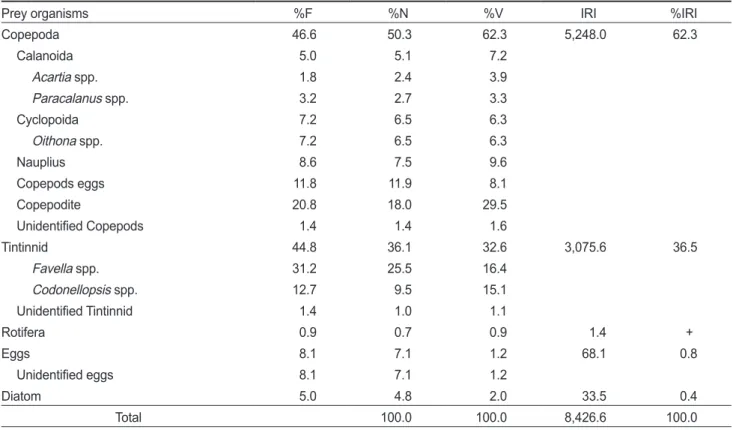
개체를대상으로소화관내용물을분석한결과
(Table 1),
요각류(Copepoda)
가출현빈도46.6%,
개체 수비50.3%,
부피비62.3%,
상대중요성지수비62.3%
로가장 중요한먹이생물이었다.
요각류중요각류후기유생(Copepo- dite)
이출현빈도20.8%,
개체수비18.0%,
부피비29.5%
로가 장많이섭식되었으며,
그다음으로요각류난(Copepods eggs)
이출현빈도11.8%,
개체수비11.9%,
부피비8.1%
로두번째 로많이섭식된먹이생물이었다.
요각류다음으로많이섭식된 먹이생물은유종섬모충류(Tintinnid)
로출현빈도44.8%,
개체 수비36.1%,
부피비32.6%,
상대중요성지수비36.5%
를나타 내었다.
이외에윤충류(Rotifera),
난(Eggs),
규조류(Diatom)
를 섭식되었지만출현량은매우적었다.
멸치자치어의식성연구결과
,
요각류가가장우점한먹이생 물로나타났는데이는크기가작은요각류를입크기가작은자 치어가섭식하기용이하고,
표영생태계에서차지하는비율이 높아최소한의노력으로쉽게섭식할수있기때문인것으로생 각된다(Huh and Kwak, 1997).
광양만
, Ariake Bay,
남해안, Toyama bay, Kii Channel
등의 해역에서출현하는멸치자치어의먹이생물역시요각류가가 장우점한먹이생물로나타났다.
이와같이다른해역에서도멸 치자치어의우점먹이생물이요각류로나타난것은본연구결과와매우유사하다는것을알수있었다
(Park and Cha, 1995;
Islam and Tanaka, 2009; Yasue et al., 2010; Kim, 2012).
멸치 자치어는 요각류 중에서도 긴노요각목
(Calanoida)
에 속하는Acartia spp.
의 비율이높게나타났다. Soh and Choi
(2004)
의선행연구에의하면본연구해역인진해만주변해역에
Acartia spp.
종들이우점하여출현한다고보고하였는데,
멸치자치어가진해만에풍부하게서식하는
Acartia spp.
를우점먹이생물로선택하였을것으로생각된다
.
멸치자치어의두번째우점먹이생물은유종섬모충류로나타 났다
.
유종섬모충류는많은해산자치어에서먹이생물로중요 한분류군이고(Jenkins, 1987; Govoni and Chester, 1990; Choi et al., 2015c, 2015d),
유종섬모충류를비롯한섬모충류는상위 소비자에게에너지를효율적으로전달하는부유생물로알려져 있으며,
해양생태계의먹이사슬에서도중요한역할을차지하 고있다(Yoo et al., 1988; Kim and Jang, 2008).
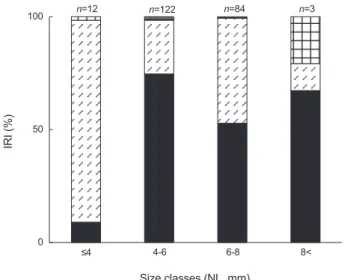
멸치자치어는성장에따른먹이생물의변화를알아보기위하 여
≤4 mm, 4-6 mm, 6-8 mm, 8 mm<
의4
개의크기군으로나 누었다(Fig. 3). 4 mm
이하의크기군은12
개체가출현하였으며 유종섬모충류가89.5%
를차지하여가장우점하였고요각류가9.0%
를차지하였으며,
규조류가1.5%
를차지하였다. 4-6 mm
의크기군에서는122
개체가출현하였으며,
요각류가72.7%
로Table 1. Composition of the gut contents of Engraulis japonicus by frequency of occurrence, number, volume and index of relative impor- tance (IRI)
Prey organisms %F %N %V IRI %IRI
Copepoda 46.6 50.3 62.3 5,248.0 62.3
Calanoida 5.0 5.1 7.2
Acartia spp. 1.8 2.4 3.9
Paracalanus spp. 3.2 2.7 3.3
Cyclopoida 7.2 6.5 6.3
Oithona spp. 7.2 6.5 6.3
Nauplius 8.6 7.5 9.6
Copepods eggs 11.8 11.9 8.1
Copepodite 20.8 18.0 29.5
Unidentified Copepods 1.4 1.4 1.6
Tintinnid 44.8 36.1 32.6 3,075.6 36.5
Favella spp. 31.2 25.5 16.4
Codonellopsis spp. 12.7 9.5 15.1
Unidentified Tintinnid 1.4 1.0 1.1
Rotifera 0.9 0.7 0.9 1.4 +
Eggs 8.1 7.1 1.2 68.1 0.8
Unidentified eggs 8.1 7.1 1.2
멸치 자치어의 식성
95
증가하여가장우점하였고유종섬모충류가
25.7%
로감소하여 두번째로우점하였으며,
난이1.4%
를차지하였다. 6-8 mm
의 크기군에서는84
개체가출현하였으며,
요각류는51.6%
로감 소하였지만가장우점하였고유종섬모충류가47.7%
로증가하였다
. 8 mm<
의크기군에서3
개체가출현하였으며요각류가71.0%
로증가하여가장우점하였고규조류가17.1%
를차지하여두번째로우점하였으며
,
유종섬모충류가11.9%
를차지하 였다.
그외먹이생물은전크기군에서0.1%
이하의작은수준 을나타내었다.
본연구에서멸치자치어의성장에따른먹이생물변화를알 아본결과
,
멸치자치어는가장작은크기군에서유종섬모충류 의비율이높았다가이후유종섬모충류의비율은줄어들고요 각류의비율이증가하는먹이전환이일어났다.
유종섬모충류 는자치어기의소화관내용물에서출현하여초기먹이생물로 중요한역할을한다고알려져있지만(Jenkins, 1987, Govoni and Chester, 1990; Zhang et al., 2002)
대부분의크기군에서 요각류의비율이높게나타났다.
남해안에출현하는멸치자치 어의경우도작은크기군에서요각류가주로출현하다가크기 가증가할수록십각류(Decapoda),
만각류(Cirriped)
와같은먹 이생물의비율이증가했으나여전히요각류의비율이더높은것을확인할수있었다
(Kim, 2012).
또한광양만에출현하는후기자어멸치의경우는전크기군에서요각류의비율이높았 다
(Park and Cha, 1995).
이와같은결과들을보았을때,
멸치 는대부분의크기군에서요각류를주로섭식하는것으로판단 된다(Chyung, 1977).
멸치자치어의크기군별먹이생물의평균개체수
(mN/Gut),
평 균부피(mV/Gut)
를알아본결과(Fig. 4),
척색장이증가하면서평균먹이생물개체수는증가하였으며
(ANOVA, F
3,288=3.397, P<0.05),
평균먹이생물부피는감소하는경향을보였다(ANO- VA, F
3,288=0.627, P>0.05).
어류의성장에따른먹이생물평균개체수와부피를살펴보 면일반적으로성장하면서평균먹이생물개체수와부피모두 가증가하는경향
,
평균먹이생물개체수는증가하지만부피는 감소하는경향,
평균먹이생물개체수는감소하지만부피는증 가하는경향과같은세가지경향이있는데,
이는성장에따른 영양학적효율성을위한섭식전략의한양상이다.
본연구결과,
멸치자치어는성장하면서평균먹이생물개체수는증가하지 만평균먹이생물의부피는감소하는경향을확인할수있었다.
일본의
Kii Channel
에출현한멸치의경우도성장하면서먹이생물개체수는증가하지만
,
먹이생물의크기는뚜렷한증가를 보이지않아본연구결과와유사하였다(Yasue et al., 2010).
이 는성장하면서전크기군에서먹이생물의크기보다는개체수 의증가로영양학적효율성을높이기때문인것으로판단된다.
멸치자치어의일주기섭식양상을살펴본결과(Fig. 5), 9 h
시간대에47.1%
에서부터12 h 72.4%
로증가하면서15 h
시Gadeok-do Sampling Site
128º46’E 128º50’E 128º54’E
35º00’N 35º02’N 35º04’N
Korea 3
4
5
6 7
8 9 10
2 1
0 50 100
0 50 100
≤ 4 4-6 6-8 8<
0 50 100
Jun. (2011)
n=13Jul. (2011)
n=330Aug. (2011)
n=68Individuals (%)
Size classes (NL, mm)
0 50 100
≤4 4-6 6-8 8<
IRI (%)
Size classes (NL, mm) Copepods Tintinnids Rotifera Eggs Diatom
n=12 n=122 n=84 n=3
0 50 100
6 9 12 15 18 21 24
Feeding incidence (%)
Time (h) Size classes (NL, mm)
0.0000 0.0005 0.0010
0.0 0.5 1.0 1.5 2.0
≤4 4-6 6-8 8<
mN/Gut mV/Gut
mV/Gut (mm
3)
mN/Gut
Fig. 3. Ontogenetic changes in composition of gut contents of En- graulis japonicus by percentage of IRI.
Gadeok-do Sampling Site
128º46’E 128º50’E 128º54’E
35º00’N 35º02’N 35º04’N
Korea 3
4
5
6 7
8 9 10
2 1
0 50 100
0 50 100
≤ 4 4-6 6-8 8<
0 50 100
Jun. (2011)
n=13Jul. (2011)
n=330Aug. (2011)
n=68Individuals (%)
Size classes (NL, mm)
0 50 100
≤4 4-6 6-8 8<
IRI (%)
Size classes (NL, mm) Copepods Tintinnids Rotifera Eggs Diatom
n=12 n=122 n=84 n=3
0 50 100
6 9 12 15 18 21 24
Feeding incidence (%)
Time (h) Size classes (NL, mm)
0.0000 0.0005 0.0010
0.0 0.5 1.0 1.5 2.0
≤4 4-6 6-8 8<
mN/Gut mV/Gut
mV/Gut (mm
3)
mN/Gut
Fig. 4. Variation of mean number of preys per gut (mN/Gut) and mean volume of prey per gut (mV/Gut) of Engraulis japonicus among size classes.
Gadeok-do Sampling Site
128º46’E 128º50’E 128º54’E
35º00’N 35º02’N
Korea 5
6 7
8 9 10
2 1
0 50 100
0 50 100
≤ 4 4-6 6-8 8<
0 50 100
Jun. (2011)
n=13Jul. (2011)
n=330Aug. (2011)
n=68Individuals (%)
Size classes (NL, mm)
0 50 100
≤4 4-6 6-8 8<
IRI (%)
Size classes (NL, mm) Copepods Tintinnids Rotifera Eggs Diatom
n=12 n=122 n=84 n=3
0 50 100
6 9 12 15 18 21 24
Feeding incidence (%)
Time (h) Size classes (NL, mm)
0.0000 0.0005 0.0010
0.0 0.5 1.0 1.5 2.0
≤4 4-6 6-8 8<
mN/Gut mV/Gut
mV/Gut (mm
3)
mN/Gut
Fig. 5. Daily feeding rate in gut of Engraulis japonicus in the East- ern Jinhae Bay.
김현지
ㆍ
정재묵ㆍ
박종혁ㆍ
백근욱96
간대에섭식율이
83.3%
로가장높게나타났으며,
이후18 h
시 간대에62.9%, 21 h
시간대37.2%, 24 h
시간대37.2%
로점차 감소했다.
Urtizberea et al. (2008)
연구에서도멸치자치어의섭식은대 부분낮시간대에이루어진것으로나타나본연구결과와유사 한경향을나타내었으며,
광양만에출현한멸치자치어역시15
h
시간대에가장높은섭식율을나타내본연구와일치하는결과를나타내었다
(Park and Cha, 1995).
이러한경향으로보아 멸치자치어는다른해역이나다른환경과같이다른물리적상 황에서도크게영향받지않고시각을사용하여섭식하는것을 알수있었으며,
시각적섭식자로판단된다.
하지만더다양한 물리적상황에대한지속적인연구가필요할것으로생각된다.
References
Chang CY. 2010. Invertebrate Fauna of Korea-Continental Harpacticoida, NIBR, Korea 21, 246.
Choi HC, Han IS, Suh YS and Huh SH. 2015a. Feeding Hab- its of Larval Konosirus punctatus from the Nakdong River Estuary, Korea. Korean J Fish Aquat Sci 48, 752-759. http://
dx.doi.org/10.5657/kfas.2015.0752.
Choi HC, Huh SH, Park JM, Baeck GW and Suh YS. 2015b.
Feeding Habits of Larval Liparis tanakae from the Nakdong River Estuary, Korea. Korean J Fish Aquat Sci 48, 368-376.
http://dx.doi.org/10.5657/kfas.2015.0368.
Chyung MK. 1977. The Fishes of Korea. Ilji Publishing, Seoul, Korea.
Govoni JJ and Chester AJ. 1990. Diet composition of lar- val Leiostomus xanthurus in and about the Mississippi River plume. J Plankton Res 12, 819-830. http://dx.doi.
org/10.1093/plankt/12.4.819.
Han KH, Lee SH, Hwang JH, Yeon IH, Kim HJ and Oh SJ.
2011. Early developmental morphology of the Pacific her- ring, Clupea pallasii. Bull Fish Sci Inst Chonnam Nat Univ 19, 17-22.
Huh SH and Kwak SN. 1997. Feeding habits of Pholis nebu-
losa. Korean J Ichthyol 9, 22-29.
Islam MS and Tanaka M. 2009. Diet and prey selection in lar- val and juvenile Japanese anchovy Engraulis japonicus in Ariake Bay, Japan. Aquat Ecol 43, 549-558. http://dx.doi.
org/10.1007/s10452-008-9207-6.
Jenkins GP. 1987. Comparative diets, prey selection, and predatory impact of co-occuring larvae of two flounder species. J Exp Mar Biol Ecol 110, 147-170. http://dx.doi.
org/10.1016/0022-0981(87)90025-6.
Kim IS, Choi Y, Lee CH, Lee YJ, Kim BJ and Kim JH. 2005.
Illustrated Book of Korean Fishes. Kyohak Publ, Seoul, Ko-
Kim MJ, Youn SH, Kim JY and Oh CW. 2013. Feeding Charac- teristics of the Japanese Anchovy, Engraulis japonicus Ac- cording to the Distribution of Zooplankton in the Coastal Waters of Southern Korea. Korean J Environ Biol 31, 275- 287. http://dx.doi.org/10.11626/kjeb.2013.31.4.275.
Kim SH and Pang IC. 2015 Distribution and Characteristic of Transport Mechanism of Eggs and Larvae of Anchovy, En-
graulis japonicus in the Southwestern Sea of Korea in July
and November, 2001. J Korean Fish Soc 38, 331-341. http://dx.doi.org/10.5657/kfas.2005.38.5.331.
Kim YO and Jang MC. 2008. Temporal Distribution of Plank- tonic Ciliates in Jangmok Bay, South Coast of Korea.
Ocean Polar Res 30, 419-426. http://dx.doi.org/10.4217/
opr.2008.30.4.419.
Lee SJ and Go YB. 2003. Development of Trunk Musculature and Fins in the Early Growth of Anchovy, Engraulis japoni-
cus Korean J Ichthyol 15, 45-52.
Park KJ and Cha SS. 1995. Food Organisms of Postlarvae of Japanese Anchovy(Engraulis japonicus) in Kwangyang Bay. J Korean Fish Soc 28, 247-252.
Pinkas L, Oliphant MS and Iverson ILK. 1971. Food habits of albacore, bluefin tuna and bonito in California waters. Fish Bull 152, 1-105.
Soh HY. 2010 Invertebrate fauna of Korea-Marine Planktonic Copepods. NIBR, 21, 199.
Soh HY and Choi SD. 2004. Species composition and occur- rence patterns of zooplankton in Jinhae Bay. Korean J Envi- ron Biol 22, 43-56.
Takatsu T, Suzuki Y, Shimizu A, Imura K, Hiraoka Y and Shiga N. 2007. Feeding habits of stone flounder Platichthys bicol-
oratus larvae in Mutsu Bay, Japan. Fish Sci 73, 142-155.
http://dx.doi.org/10.1111/j.1444-2906.2007.01312.x.
Urtizberea A, Fiksen Ø, Folkvord A and Irigoien X. 2008. Mod- elling growth of larval anchovies including diel feeding pat- terns, temperature and body size. J Plankton Res 30, 1369- 1383. http://dx.doi.org/10.1093/plankt/fbn090.
Yamaji I. 1984. Illustration of the Marine Plankton of Japan.
Hoikusha publishing Co., Ltd. Tokyo, Japan, 538.
Yasue N, Doiuchi R, Yoshimoto Y and Takeuchi T. 2010. Diet of late larval Japanese anchovy Engraulis japonicus in the Kii Channel, Japan. Fish Sci 76, 63-73. http://dx.doi.
org/10.1007/s12562-009-0181-2.
Yoo GI, Hue HK and Lee WC. 1991. Taxonomical revision on the genus Acartia (copepoda : calanoida) in the Korean Wa- ters. Bull Korean Fish Soc 24, 255-265.
Yoo KI, Kim YO and Kim DY. 1988. Taxonomical Studies on Tintinnids (Protozoa: Ciliata) in Korean Coastal Waters - 1.
Chinhae Bay. Korean J Syst Zool 4, 67-90.
Youn SH, Oh GS and Chung MH. 2010. Zooplankton Commu-
Sun S and Choi JK. 2002. Spatial distribution of ciliates, copepod nauplii and eggs, Engraulis japonicus post-larvae and microzooplankton herbivorous activity in the Yellow Sea, China. Aquat Microb Ecol 27, 249-259. http://dx.doi.
org/10.3354/ame027249.