한수지 50(5), 616-620, 2017
616
Copyright © 2017 The Korean Society of Fisheries and Aquatic Science
pISSN:0374-8111, eISSN:2287-8815Korean J Fish Aquat Sci 50(5),616-620,2017
Note
서 론
자치어는부화직후에서난황흡수까지의전기자어기
,
난황 흡수후각지느러미가형성되기까지의후기자어기,
자어기이 후체형,
반문등이성어와구별이되는치어기로세분화할수 있다(Kim et al., 2005; Okiyama, 2014).
자치어기에는먹이생 물포획능력이발달되지않아기아상태로사망할확률이매우 높은시기이다.
특히치어기와는다르게난황흡수후외생섭식 을에너지원으로사용하기시작하는후기자어기의먹이생물연 구는생태계지위를파악하는데중요한역할을한다.
청베도라치는농어목
(Perciformes)
청베도라치과(Blenniidae)
에 속하는 어류로 해안이나 조간대의 바위지역에 서식한다(Kim et al., 2005).
청베도라치의 산란시기는6
월로 관찰되 었으며,
진주담치,
굴과같은패각에산란하는특성을가진다(Kim et al., 1992).
청베도라치는수산자원으로의 이용가치는낮지만우리나라와일본연안에널리분포하는것으로알려 져있다
(Kimura et al., 1999; Kwak et al., 2013; Yamato and
Shoji, 2016).
이처럼연안생태계에서출현이잦고널리분포하는청베도라치에대한연구는자치어기형태발달에관한연 구
(Kim et al., 1992),
청베도라치과어류의식성(Kotrschal and Thomson, 1986; Hundt et al., 2014)
등과같이미비하게이루 어져있으며,
초기먹이습성등과같은생태에관한연구는매우 부족한실정이다.
초기먹이생물의파악은어류의생존및가입 에밀접한영향을끼치기때문에그에대한연구는매우중요하 다(Choi et al., 2015).
따라서본연구의목적은청베도라치후기자어의주요먹이생 물을알아보고
,
성장에따른크기군별먹이생물조성의변화및 시간별일주기섭식율을알아보기위해진해만동부해역에출 현하는청베도라치후기자어의소화관내용물을분석하였다.
진해만 동부 주변해역에 출현하는 청베도라치(Parablennius yatabei) 후기자어의 소화관 내용물 조성
김현지·정재묵
1·박종혁
2·백근욱
2·허성회
3*
국립수산과학원 연근해자원과, 1국립수산과학원 수산자원연구센터, 2경상대학교 해양식품생명의학과·해양산업연구소·해양생물교육연구센터,
3부경대학교 해양학과
Gut Composition of Post-larval Yatabe Blenny Parablennius yatabei in the Coastal Waters of Eastern Jinhae Bay
Hyeon Ji Kim, Jae Mook Jeong1, Jong Hyeok Park2, Gun Wook Baeck2 and Sung-Hoi Huh3*
Coastal Water Fisheries Research Division, National Institute of Fisheries Science, Busan 46083, Korea
1Fisheries Resources Research Center, National Institute of Fisheries Science, Tongyeong 53064, Korea
2Department of Seafood & Aquaculture Science/Institute of Marine Industry·Marine Bio-Education & Research Center, Gyeon- sang National University, Tongyeong 53064, Korea
3Department of Oceanography, Pukyong National University, Busan 48513, Korea
The feeding habits of post-larval Yatabe blenny Parablennius yatabei (2.0-9.8 mm SL) were examined on the basis of 158 individuals collected from June to October in the coastal waters of eastern Jinhae Bay, South Korea. Based on the index of relative importance ( IRI ), post-larval P. yatabei fed 94.4% on copepods and 5.6% on tintinnids. The preference of post-larval P. yatabei for copepods to other prey items results from ontogenetic changes. The dietary percentage of copepods increased as fish size increased and tintinnids became less important. The feeding rate of post-larval P. yatabei was consistent at all times of day.
Key words: Yatabe blenny Parablennius yatabei, Post-larval, Eastern Jinhae Bay
This is an Open Access article distributed under the terms of the Creative Commons Attribution Non-Commercial Licens (http://creativecommons.org/licenses/by-nc/3.0/) which permits unrestricted non-commercial use, distribution, and reproduction in any medium, provided the original work is properly cited.
https://doi.org/10.5657/KFAS.2017.0616
Korean J Fish Aquat Sci 50(5) 616-620, October 2017
Received 28 June 2017; Revised 26 July 2017; Accepted 8 September 2017
*Corresponding author: Tel: +82. 51. 629. 6570 Fax: +82. 51. 629. 6568
E-mail address: [email protected]
청베도라치 후기자어 소화관 내용물 조성
617
재료 및 방법
본연구에사용된청베도라치후기자어는
2010
년10
월, 2011
년6
월에서9
월까지매월1
회, 3
시간간격으로진해만동부해 역에서24
시간동안채집되었다(Kim et al., 2017).
후기자어는RN80(
망목330 μm)
네트를이용하여 채집하였으며,
채집즉 시현장에서5%
중성포르말린으로고정시켜운반하였다.
각 개체의척색장(notochord length)
을0.1 mm
까지측정한뒤,
현 미경아래에서해부침을이용하여소화관전체를분리후가능 한종수준까지동정하고,
종류별로계수하였으며, Takatu et al.
(2007)
의부피계산식으로부피를계산하였다.
소화관내용물조사를위한충분한표본크기를결정하기위하여누적먹이곡 선
(cumulative prey curve)
을사용하였으며(Ferry and Cailliet, 1996),
많이출현한8
개의분류군으로구분하여100
번무작위 화한뒤,
평균과표준편차를그래프상에나타내었다.
이때곡 선의점근선은소화관내용물분석을위한최소표본크기를나 타낸다.
각각의먹이생물은출현빈도
(%F),
개체수비(%N)
그리고부 피비(%V)
로나타내었으며,
다음과같은식을이용하여구하였 다.
% F = A
i/ N × 100
% N (V) = N (V)
i/ N (V)
total×100
그리고아래의
Pinkas et al. (1971)
의식을이용하여상대중 요성지수(index of relative importance, IRI)
를구한뒤백분율 로환산하였다.
%IRI = [(%N +%V) × %F] ×100
성장에따른먹이조성의변화를파악하기위하여
1 mm
단위 로척색장별먹이생물의상대중요성지수비를구하였으며,
자 치어의시간별섭식율변화를알아보기위하여3
시간간격으로 채집된청베도라치후기자어전개체를대상으로시간별채집 개체수당섭식개체수를백분율로환산하여 섭식발생율(feed- ing incidence)
을산정하였다.
결과 및 고찰
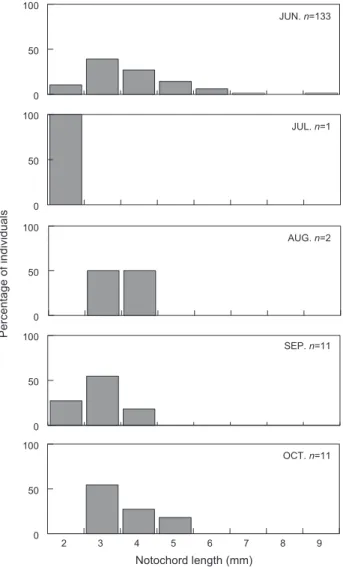
청베도라치후기자어소화관내용물연구를위하여사용된시 료를살펴보면
(Fig. 1)
총158
개체가채집되었으며, 6
월에2.1- 9.8 mm
범위의133
개체, 7
월에2.0 mm 1
개체, 8
월에3.0 mm, 4.3 mm
의2
개체가출연하였다. 9
월, 10
월에는각각11
개체로9
월에2.6-4.3 mm, 10
월에3.0-5.2 mm
의출현범위를나타냈 었다.
이러한출현양상은청베도라치의주산란기와일치하는 경향을보였으며(Kim et al., 1992),
이후부화한개체들이채집 된것으로판단된다.
본연구기간동안채집된청베도라치후기자어는총
158
개체 로그중공복인개체를제외한91
개체를대상으로소화관내용 물을분석하였으며,
소화관내용물이발견된91
개체를대상으 로조사한누적먹이곡선은61
개체에서점근선에근접하였다(Fig. 2).
따라서본연구의청베도라치후기자어의표본크기는소화관내용물을설명하기에충분하였다
.
청베도라치후기자어소화관내용물분석결과
(Table 1),
요 각류(Copepoda)
가출현빈도74.4%,
개체수비76.7%,
부피비96.8%,
상대중요성지수비94.4%
로 가장우점한먹이생물이었다
.
미확인요각류(Unidentified Copepods),
요각류후기유 생(Copepodite)
의비율이비교적높았으며,
긴노요각목(Cala- noida),
검물벼룩목(Cyclopoida)
이출현하였다.
또한유종섬모 충류(Tintinnida)
는출현빈도31.1%,
개체수비21.5%,
부피비3.0%,
상대중요성지수비5.6%
를나타내며 차우점하였다.
이0 50 100
2 3 4 5 6 7 8 9
0 50 100 0 50 100 0 50
100 JUN. n=133
JUL. n=1
AUG. n=2
OCT. n=11 0
50
100 SEP. n=11
Percentage of individuals
Notochord length (mm)
Number of gut samples
Cumulative number of prey taxa
0 2 4 6 8 10
0 20 40 60 80
( 61 )
0 50 100
2 3 4 5 6 7 8 9
Calanoida Copepods eggs
Copepodite Tintinnids
Naulpii Cyclopoida
Rotifera Unidentified copepods
4 37 24 15 7 2 2
Percentage of
IRINoctord length (mm)
Percentage of feeding incidence
0 50 100
6 9 12 15 18 21 24
Time (h)
Fig. 1. Monthly size frequency of post-larval Yatabe blenny Para- blennius yatabei collected in the eastern Jinhae Bay.
김현지
ㆍ
정재묵ㆍ
박종혁ㆍ
백근욱ㆍ
허성회618
외에윤충류
(Rotifera)
가섭식되었지만출현량은매우적었다.
청베도라치후기자어는요각류를가장높은비율로섭식하였 다.
요각류중에서는긴노요각목,
검물벼룩목에속하는요각류 가출현했는데이러한종들은표층성요각류로서전일생을부 유하는것으로알려져있다(Atkinson, 1998).
청베도라치후기 자어역시표층을부유하며서식지에서섭식이용이한요각류 를주로섭식한것으로판단된다(Kim et al., 2013).
같은청베도라치과에속하는
Omobranchus sp.
자어는주로 식물플랑크톤을섭식하여본연구와다른먹이생물출현양상 을보였으나(Ara et al., 2016), Omobranchus sp.
자어역시분 포하고있는서식지주변에번성하고많이출현하는먹이생물 을섭식한것으로판단된다.
그이유는두연구에서사용된개 체들은매우유사한형태학적특징을지니고있으며,
크기또 한유사하여그들의포식능력이비슷해주먹이생물이유사할 것으로생각되었으나두연구에서나타난주먹이생물은상이 하게나타났기때문이다.
따라서주먹이생물의차이는서식지 먹이생물의조성차이로인해기인된것으로생각된다.
본연 구에사용된청베도라치후기자어는연안에서채집되었지만,
Omobranchus sp.
자어는맹그로브와해조류가많이자생하는지역에서 채집되었으며
,
맹그로브와해조류가많이자생하는 지역은식물플랑크톤번성에크게영향을미치는것으로알려 져있다
(Ara et al., 2016).
이를바탕으로볼때두연구모두주 변에많이출현하고섭식이용이한먹이생물을주로섭식하는 특성을보이는것을알수있다.
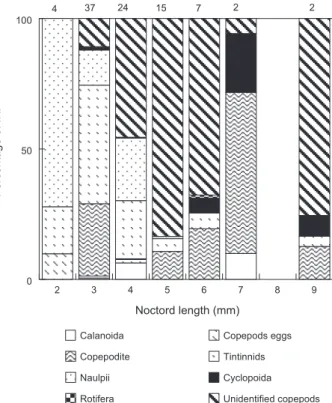
청베도라치후기자어의성장에따른먹이생물의조성을알아
보기위하여
1 mm
단위척색장별먹이생물의%IRI
를비교하였다
(Fig. 3). 2 mm
는4
개체채집되었고요각류유생이72.2%
로 가장 우점 하였으며
, 3 mm
는37
개체로유종섬모충류가45.5%
출현하여우점하였다. 4, 5, 6 mm
는각각24, 15, 7
개체 Table 1. Prey item of post-larval of Yatabe blenny Parablenniusyatabei in gut contents by frequency of occurrence, number, vol- ume and percentage index of relative importance (IRI)
Prey organisms %F %N %V %IRI
Copepoda 74.4 76.7 96.8 94.4
Calanoida 5.6 3.1 8.8
Acartia spp. 4.4 2.5 8.1
Paracalanus parvus s.l. 1.1 0.6 0.7
Cyclopoida 8.9 6.7 12.0
Corycaeus affinis 1.1 0.6 0.7
Oithona sp. 8.9 6.1 11.3
Nauplii 18.9 11.7 2.3
Copepods eggs 5.6 3.1 0.1
Copepodite 18.9 22.1 24.0
Unidentified Copepods 28.9 30.1 49.7
Tintinnida 31.1 21.5 3.0 5.6
Favella spp. 27.8 19.6 2.4
Codonellopsis spp. 3.3 1.8 0.6
Rotifera 2.2 1.8 0.2 +
Total 100.0 100.0 100.0
+, less than 0.1.
0 50 100
2 3 4 5 6 7 8 9
0 50 100 0 50 100 0 50
100 JUN. n=133
JUL. n=1
AUG. n=2
OCT. n=11 0
50
100 SEP. n=11
Percentage of individuals
Notochord length (mm)
Number of gut samples
Cumulative number of prey taxa
0 2 4 6 8 10
0 20 40 60 80
( 61 )
0 50 100
2 3 4 5 6 7 8 9
Calanoida Copepods eggs
Copepodite Tintinnids
Naulpii Cyclopoida
Rotifera Unidentified copepods
4 37 24 15 7 2 2
Percentage of
IRINoctord length (mm)
Percentage of feeding incidence
0 50 100
6 9 12 15 18 21 24
Time (h)
Fig. 2. Cumulative prey curves of prey taxa per gut contents of post-larval Yatabe blenny Parablennius yatabei in the collected in the eastern Jinhae Bay. Dashed line represents standard deviation after 100 permutations.
0 50 100
2 3 4 5 6 7 8 9
0 50 100 0 50 100 0 50
100 JUN. n=133
JUL. n=1
AUG. n=2
OCT. n=11 0
50
100 SEP. n=11
Percentage of individuals
Notochord length (mm)
Number of gut samples
Cumulative number of prey taxa
0 2 4 6 8 10
0 20 40 60 80
( 61 )
0 50 100
2 3 4 5 6 7 8 9
Calanoida Copepods eggs
Copepodite Tintinnids
Naulpii Cyclopoida
Rotifera Unidentified copepods
4 37 24 15 7 2 2
Percentage of
IRINoctord length (mm)
Percentage of feeding incidence
0 50 100
6 9 12 15 18 21 24
Time (h)
Fig. 3. Ontogenetic changes in composition of gut contents of post- larval Yatabe blenny Parablennius yatabei by percentage of IRI.
청베도라치 후기자어 소화관 내용물 조성
619
가출현하였고미확인요각류가각각
45.5, 83.5, 67.7%
출현하 여우점하였으며, 7 mm
는2
개체로요각류후기유생이61.8%
로우점하였다
. 8 mm
에해당하는청베도라치후기자어는채 집되지않았으며, 9 mm
는2
개체로미확인요각류가75.5%
출 현하였다.
청베도라치후기자어의성장에따른먹이생물변화를알아본 결과
,
척색장이증가하면서긴노요각목과윤충류가각각0.5%
에서
9.9%
까지, 0.3%
에서1.2%
까지증가하였으며,
요각류후 기유생,
검물벼룩목,
미확인요각류는증감의변동이약간있 었지만전체적으로는증가한경향을보였다.
또한요각류유생(Nauplii)
이72.1%
에서0.84%
까지감소하였고,
요각류난과 유종섬모충류는증감의변동이있었지만비교적감소하는경향 을보였다.
전체적으로는모든크기에서대부분요각류에속하 는분류군이우점하였다.
청베도라치는잡식성식자(omnivores feeder)
로알려져있는데(Kotrschal and Thomson, 1986),
본연 구대상인청베도라치후기자어의경우대부분의개체가요각 류를주로섭식한것으로나타나잡식성식자의경향이나타나 지않았다.
주로잡식성식자로나타난개체들은20 mm
가넘는 개체였으며,
이들은본연구대상인10 mm
이하의청베도라 치후기자어보다성장하면서유영능력이증가하여선택가능 한서식지가늘어나고,
소화력또한증가했을것으로생각된다(Thorisson, 1994).
따라서다양한먹이생물을섭식할수있는 기회가생기고,
요각류보다영양학적으로우월한먹이생물을 섭식하는것이가능했을것이라판단된다.
청베도라치 후기자어의 시간별섭식 양상을 살펴보면
(Fig.
4),
하루동안35.8-70.0%
의 섭식율범위를보였는데, 9
시에35.8%
로가장낮게나타났으며, 15
시에섭식율70.0%
로가장 높게나타났다.
그이후18
시에64.7%, 21
시에66.7%, 24
시에56.5%
로섭식율이점차감소했다.
대부분의어류는시각적섭식자로낮시간대에주로섭식이
이루어진다고알려져있다
(Hunter, 1981).
본연구대상종인청 베도라치후기자어는전시간대에걸쳐섭식하였는데, 9
시부터15
시까지섭식율이점차증가하고, 15
시이후는감소하는경향을나타내주섭식시간은
9
시부터15
시까지의낮시간임을알 수있다.
하지만전시간대에서비교적높은비율의섭식이이루 어진것을확인할수있는데,
이는초기생존율을높이는데중요 한현상으로생각된다.
이처럼지속적으로섭식율이높은것은 청베도라치후기자어가높은탐식성으로시각적섭식활동이매 우어려운상황에서미량의빛으로도섭식활동을이어갔을것 으로생각된다.
이러한양상은자치어기의몇몇어종에서도나타나고있다
(Rao, 2003).
하지만청베도라치후기자어의일섭식양상의보다정확한파악을위해서다양한환경에서의분석 이필요할것으로생각된다
.
사 사
이논문은부경대학교자율창의학술연구비
(2016)
에의하여 연구되었습니다.
References
Ara R, Arshad A, Amin SMN and Ghaffar MA. 2016. Food and feeding habits of Omobranchus sp. (Blenniidae: Omo- branchini) larvae in the Seagrass-Mangrove ecosystem of Johor Strait, Malaysia. J Env Bio 37, 735-743.
Atkinson A. 1998. Life cycle strategies of epipelagic copepods in the Southern Ocean. J Mar Sys 15, 289-311. https://
dx.doi.org/10.1016/S0924-7963(97)00081-X.
Choi HC, Huh SH, Park JM, Baeck GW and Suh YS. 2015.
Feeding habits of larval Liparis tanakae from the Nakdong River estuary, Korea. Korean J Fish Aquat Sci 48, 368-376.
https://dx.doi.org/10.5657/KFAS.2015.0368.
Ferry LA and Cailliet GM. 1996. Sample size and data analy- sis : Are we characterizing and comparing diet properly, In:
MacKinlay D, Shearer K (eds) Feeding ecology and nutri- tion in fish, symposium proceedings, San Francisco, U.S.A., 71-80.
Hundt PJ, Nakamura Y and Yamaoka K. 2014. Diet of comb- tooth blennies (Blenniidae) in Kochi and Okinawa, Japan.
Ichthyol Res 61, 76-82. https://dx.doi.org/10.1007/s10228- 013-0366-7.
Hunter JR. 1981. Feeding ecology and predation of marine fish larvae. Marine fish larvae: morphological, ecology, and re- lation to fisheries. University of Washington Press, Seattle, U.S.A., 343-355.
Kim HJ, Jeong JM, Park JH and Baeck GW. 2017. Feeding habits of larval Japanese anchovy Engraulis japonicus in Eastern Jinhae Bay, Korea. Korean J Fish Aquat Sci 50, 92- 97. https://dx.doi.org/10.5657/KFAS.2017.0092.
Kim IS, Choi Y, Lee CH, Lee YJ, Kim BJ and Kim JH. 2005.
0 50 100
2 3 4 5 6 7 8 9
0 50 100 0 50 100 0 50
100 JUN. n=133
JUL. n=1
AUG. n=2
OCT. n=11 0
50
100 SEP. n=11
Percentage of individuals
Notochord length (mm)
Number of gut samples
Cumulative number of prey taxa
0 2 4 6 8 10
0 20 40 60 80
( 61 )
0 50 100
2 3 4 5 6 7 8 9
Calanoida Copepods eggs
Copepodite Tintinnids
Naulpii Cyclopoida
Rotifera Unidentified copepods
4 37 24 15 7 2 2
Percentage of
IRINoctord length (mm)
Percentage of feeding incidence
0 50 100
6 9 12 15 18 21 24
Time (h)
Fig. 4. Feeding incidence in gut contents of post-larval Yatabe blenny Parablennius yatabei in the eastern Jinhae Bay.
김현지
ㆍ
정재묵ㆍ
박종혁ㆍ
백근욱ㆍ
허성회620
Illustrated Book of Korean Fishes. Kyohak Publication, Seoul, Korea, 615.
Kim MJ, Youn SH, Kim JY and Oh CW. 2013. Feeding charac- teristics of the Japanese anchovy, Engraulis japonicus ac- cording to the distribution of zooplankton in the coastal wa- ters of Southern Korea. Korean J Environ Biol 31, 275- 287.
http://dx.doi.org/10.11626/kjeb.2013.31.4.275.
Kim YU, Myoung JG, Han KH and Kang CB. 1992. Morphol- ogy of larvae, egg development and spawning behavior of the blenniid fish, Pictiblennius yatabei. Korean J Ichthyol 4, 44-54.
Kimura S, Okada M, Yamashita T, Taniyama I, Yodo T, Hirose M and Kimura F. 1999. Eggs, larvae and juveniles of the fishes occurring in the Nagara River estuary, central Japan.
Bull Fac Bioresour-Mie Univ 23, 37-62.
Kotrschal K and Thomson DA. 1986. Feeding patterns in east- ern tropical Pacific blennioid fishes (Teleostei: Tripterygi- idae, Labrisomidae, Chaenopsidae, Blenniidae). Oecologia, 70, 367-378. https://dx.doi.org/10.1007/BF00379499.
Kwak SN, Huh SH and Kim HW. 2013. Temporal and spatial variations and species composition of ichthyoplanktons in a Sea Area, with the construction of artificial upwelling struc- ture. J Kor Soc Mar Environ Saf 19, 309-314. https://dx.doi.
org/ 10.7837/kosomes.2013.19.4.309.
Okiyama M. 2014. An atlas of the early stage fishes in Japan, second edition. Tokai University Press, Tokyo, Japan.
Pinkas L, Oliphant MS and Iverson ILK. 1971. Food habits of albacore, bluefin tuna and bonito in California waters. Fish Bull 152, 1-105.
Rao TR. 2003. Ecological and ethological perspectives in lar- val fish feeding. J Appl Aquacult 13, 145-178. http://dx.doi.
org/10.1300/J028v13n01_06.
Takatsu T, Suzuki Y, Shimizu A, Imura K, Hiraoka Y and Shiga N. 2007. Feeding habits of stone flounder Platichthys bicol-
oratus larvae in Mutsu Bay, Japan. Fisheries Sci 73, 142-
155. http://dx.doi.org/10.1111/j.1444-2906.2007.01312.x.Thorisson K. 1994. Is metamorphosis a critical interval in the early life of marine fishes. Environ Biol Fish 40, 23-36.
Yamamoto M and Shoji J. 2016. Seasonal changes in species composition of a demersal fish community in the shallow waters near a sandy beach in eastern Hiuchi-nada, central Seto Inland Sea, Japan. Aquaculture Sci 64, 53-61. http://
dx.doi.org/10.11233/aquaculturesci.64.53.