─ 104 ─ eISSN 2287-1683
pISSN 1738-8767
Journal of Trauma and Injury Vol. 28, No. 3, September, 2015
� Original Article �
� Address for Correspondence : Hojong Park, M.D.
Division of Trauma Surgery, Department of Emergency Medicine, Ulsan University Hospital, University of Ulsan College of Medicine, 877 Bangeojinsunhwando-ro, Dong-gu, Ulsan, Korea
Tel : 82-52-250-7109, Fax : 82-52-250-8093, E-mail : [email protected] Submitted : June 7, 2015 Revised : August 24, 2015 Accepted : October 4, 2015
외상환자의 초기 호흡 부전에 대한 흡입산화질소의 적용
울산대학교병원 외과 김병성, 경규혁, 박호종
- Abstract -
Therapeutic Role of Inhaled Nitric Oxide for Acute Respiratory Failure in the Early Phase of Trauma
Byoung Sung Kim, M.D., Kyu-Hyouck Kyoung, M.D., Hojong Park, M.D.
Department of Surgery, Ulsan University Hospital, University of Ulsan College of Medicine, Ulsan, Korea
Purpose: Nitric oxide (NO) is a vasodilator and inhaled NO (iNO) is used in acute respiratory distress syndrome (ARDS) to improve alveolocapillary gas exchange. The mechanism to improve oxygenation is likely to redistribute blood flow from unventilated areas to ventilated areas. Though improvement of oxygenation, iNO therapy has not been shown to improve mortality and considered as only rescue therapy in severe hypoxemia. We conducted the study to investigate an efficacy of iNO in trauma patients with severe hypoxemia.
Methods: We reviewed the trauma patients who underwent iNO therapy retrospectively from 2010 to 2014. Degree of hypoxemia was represented as PaO2/FiO2ratio (PFR) and the severity of patient was represented with sequential organ failure assessment (SOFA) score. Patients were divided into the survivor group and non-survivor group according to the 28-day mortality.
Results: A total of 20 patients were enrolled. The mortality of 28-day was 40%. There were no significant differences between survivor and non-survivor group in age, sex, severity of injury, PFR and SOFA score. There was significant dif- ference in initiation time of iNO after injury (p=0.047). Maximum combinations of sensitivity and specificity for timing of iNO therapy were observed using cut-off of 3-day after injury with a sensitivity of 88% and specificity of 75%.
Conclusion: Though iNO therapy does not influence the mortality, iNO therapy may decrease the mortality caused by respiratory failure in the early phase of trauma. [ J Trauma Inj 2015; 28: 104-107 ]
Key Words: Trauma, Inhaled nitric oxide, Respiratory failure, Acute respiratory distress syndrome
─ 105 ─
Byoung Sung Kim, et al.: Therapeutic Role of Inhaled Nitric Oxide for Acute Respiratory Failure in the Early Phase of Trauma
I. 서 론
급성호흡부전증후군은 급성으로 발현하여 진행하며 흉부 영상에서 양측성 침윤을 동반한 저산소증의 병적 상태로 정 의된다.(1) 저산소증의 정도에 따라 PaO2/FiO2(PF) 비율을 기준으로 300 이하의 경증, 200 이하의 중등도, 100 이하의 중증 급성호흡부전증후군으로 분류되며,(2) 36.6% 의 사망 률을 보이나,(3) 중증에서는 45% 의 사망률을 보이는 심각한 질환이다.(2) 급성호흡부전증후군의 위험 인자는 폐렴, 위내 용물의 흡인 및 폐둔상 등의 직접적인 원인과 패혈증, 췌장 염 및 화상 등의 흉부 외의 원인에 의한 간접적인 원인으로 분류된다.(4) 외상 환자에서 급성호흡부전증후군의 발병률은 14% 로 보고되어 있으며 26.6%~51% 사망률을 보여 외상 사망의 주요 원인이 되고 있다.(5,6) 외상 환자의 급성호흡부 전증후군 역시 직접적인 흉부 외상 없이도 발생하는 경우가 많아 폐둔상과 같은 직접적인 흉부 외상 외에도 대량 수혈, 높은 injury severity score (ISS) 및 저혈압 등의 흉부 외 의 요인들도 주요 위험 인자가 된다.(7) 급성호흡부전증후군 의 치료로 높은 호기말양압의 적용, 스테로이드 및 체외막 산화기 등이 사용되고 있으며,(8) 산화질소의 흡입은 생존율 증가와 관련이 없는 것으로 알려져 권장되지 않고 있으 며,(8,9) 체외막 산화기 등의 방법을 적용할 수 없는 상황에 서 제한적으로 사용되고 있다. 그러나 흡입산화질소의 효과 에 대한 기존의 연구는 일반적인 급성호흡부전증후군 환자를 대상으로 시행되었으며, 외상 환자군을 대상으로 한 연구는 거의 없는 실정으로 외상 후 발생한 호흡부전의 치료에 흡입
산화질소가 미치는 효과를 확인하고자 본 연구를 진행하였다.
II. 대상 및 방법
2010년 1월부터 2014년 12월까지 외상으로 입원하여 흡 입산화질소 치료를 시행받은 21명의 환자 중 재원 기간이 1 년 이상인 1명을 제외한 20명를 대상으로 의무기록을 후향적 으로 분석하였다.
환자군은 생존군과 사망군으로 분류하여 분석하였으며, 흡 입산화질소 투여 시작 후 28일 생존을 기준으로 하였다. 호 흡부전의 정도는 PF 비율로 나타내었으며, 외상의 정도는 abbreviated injury scale 및 ISS로, 환자의 중증도는 sequential organ failure (SOFA) 점수로 나타내었다.
통계 분석은 SPSS 21 (SPSS inc. Chicago, IL)을 사용 하여 시행하였다. 연속 변수에 대해서는 평균값±표준편차로 나타내었고, Mann-Whitney U test를 이용하였으며, 범주 형 변수는 카이 제곱 검정 및 피셔의 정확한 검정을 시행하 였다. 또한 receiver operating curve (ROC)를 이용하여 절단값, 민감도 및 특이도를 분석하였다. 유의 수준은p값이 0.05 미만인 경우로 정의하였다.
III. 결 과
총 20명의 환자 중 남자가 15명(75%)였고, 평균 나이는 55세였으며 모두 둔상이었다. 흡입산화질소를 투여하게 된 원인은 급성호흡부전증후군 11명(55%)이었고, 폐부종, 폐색
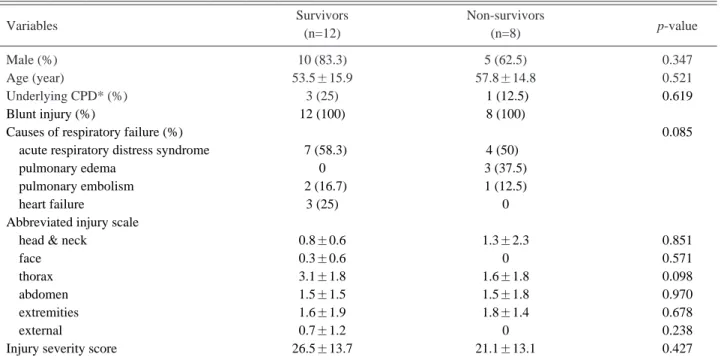
Table 1. Baseline characteristics of the patients.
Variables Survivors Non-survivors
p-value
(n=12) (n=8)
Male (%) 10 (83.3) 5 (62.5) 0.347
Age (year) 53.5±15.9 57.8±14.8 0.521
Underlying CPD* (%) 3 (25) .1 (12.5) 0.619
Blunt injury (%) 12 (100) 8 (100)
Causes of respiratory failure (%) 0.085
acute respiratory distress syndrome 07 (58.3) 4 (50)0
pulmonary edema 0 3 (37.5)
pulmonary embolism 02 (16.7) 1 (12.5)
heart failure 3 (25) 0
Abbreviated injury scale
head & neck 0.8±0.6 1.3±2.3 0.851
face 0.3±0.6 0 0.571
thorax 3.1±1.8 1.6±1.8 0.098
abdomen 1.5±1.5 1.5±1.8 0.970
extremities 1.6±1.9 1.8±1.4 0.678
external 0.7±1.2 0 0.238
Injury severity score 26.5±13.7 21.1±13.1 0.427
* CPD: cardiopulmonary disease
전증 및 심부전이 각각 3명씩(15%)이었다. ISS는 24.4±
13.4점이었으며, 흡입산화질소 투여 후 28일 이내에 사망한 환자는 8명으로 40%의 사망률을 보였다. 생존군과 사망군 사이에 성별, 나이, 기저질환, 흡입산화질소 투여 원인, 신체 부위별 수상 정도 및 ISS에는 차이가 없었다(Table 1).
흡입산화질소 투여와 관련하여 생존군과 사망군 사이에 투 여 농도, 투여 시작 직전 PF 비율 및 SOFA 점수에는 차이가 없었으며, 사망군에서 수상 후 흡입산화질소 투여 시작까지의 기간이(p=0.047) 유의하게 증가된 결과를 보였다(Table 2).
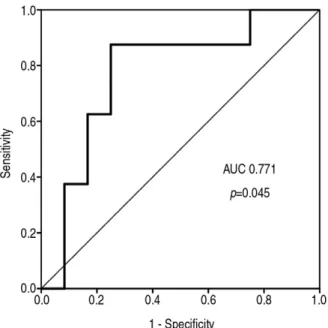
수상 후 흡입산화질소 투여까지의 시간과 사망과의 관계를 ROC 커브로 분석하였을 때 area under curve는 0.771 (p=0.045)였고, 수상 후 흡입산화질소 투여까지의 기간 3일을 절단값으로 88%의 민감도와 75%의 특이도를 보였다(Fig. 1).
IV. 고 찰
Palmer 등의 연구에 의해 1987년 산화질소가 혈관 확장
물질임이 밝혀졌으며,(10) 흡입산화질소는 폐동맥고혈압을 비롯하여 호흡-관류 불균형을 개선하기 위한 치료로 다양한 폐질환에 사용되었다.(11,12) 이후 Rossaint 등은 급성호흡 곤란증후군의 치료에 대한 흡입산화질소를 적용하여 월등한 치료 효과를 보고하였다.(13) 그러나 이후 진행된 연구들에 서 흡입산화질소 치료가 사망률 감소에 효과가 없음이 알려 지고,(9,14,15) 급성신부전 발생의 위험을 증가시키는 결과 들이 보고되면서(16,17) 급성호흡부전증후군의 치료에 더 이 상 권장되지는 않고 있다.
본 연구의 결과도 40%의 사망률을 보여 기존 연구들의 사 망률과 큰 차이를 보이지는 못하였다.(5,6) 그러나 본 연구의 환자군은 ISS가 24.4점으로 중증의 급성호흡곤란증후군 외 에도 신체 각 부위의 심각한 손상을 동반한 고도의 중증외상 환자군이라는 점에서 일반 인구를 대상으로 한 기존 연구들의 사망률과의 단순 비교는 어려우며 외상 환자에서도 흡입산화 질소 치료가 도움이 되지 않는다라는 결론은 적절하지 않다.
이와 관련하여 본 연구에서 제시하고자 하는 것은 흡입산 화질소 치료가 어떤 경우에 효과적인가 하는 것이다. 산화질 소의 흡입 농도, 투여 직전 PF 비율 및 SOFA 점수에 두 군 간의 차이가 없었으나, 외상 후 흡입산화질소 투여까지의 시 간이 생존군에서 더 짧았던 것은 외상 후 급격하게 진행된 호흡부전에서 더 효과적이라는 것을 보여 준다. 본 연구에서 외상 후 3일 이내에 흡입삽화질소를 투여한 환자들의 생존율 은 80%이었으며 흡입산화질소의 투여 효과가 시기와 관련되 어 있음을 나타낸다.
외상 환자의 후기 사망의 주요 원인이 패혈증 및 다장기부 전으로 알려져 있고,(18) 이 현상은 보상적항염증반응증후군 (compensatory anti-inflammatory response syn- drome)에 의한 면역 저하로 설명될 수 있다.(19) 반면 외상 초기의 호흡부전을 포함한 장기부전은 외상에 의한 직접적인 손상 및 전신적염증반응(systemic inflammatory response syndrome)이 주요 원인이 되며,(20) 이는 정점을 지나면 시 간의 경과에 따라 완화되는 해결 가능성이 높은 원인이기 때 문으로 보인다. 또한 흡입산화질소 치료가 급성호흡부전증후 군의 사망률 감소시키지 못하지만 투여 후 2~3일의 기간 동 안 동맥혈 산소분압이 상승되는 효과를 보이는 것과 관련하 여(11,15) 본 연구의 결과는 흡입산화질소 치료가 외상 초기
─ 106 ─
- Journal of Trauma and Injury Vol. 28, No. 3 -
Table 2. Comparison between survivors and non-survivors related with iNO therapy.
Variables Survivors Non-survivors
p-value
(n=12) (n=8)
Concentration of NO* >10 ppm (%) 6 (50) 5 (62.5) 0.670
Initiation time of NO after Injury (days) 5.5±9.8 11.1±9.0 0.047
PF** ratio before NO initiation 95.5±48.3 064.4±19.1 0.181
SOFA score before NO initiation 9.3±2.6 11.3±3.0 0.135
iNO: inhaled nitric oxide, PF: PaO2/FiO2, SOFA: sequential organ failure assessment Fig. 1. Receiver operating curve of interval for predicting 28-day
mortality with timing of iNO initiation.
Fig. 1. AUC: area under curve, iNO: inhaled nitric oxide
─ 107 ─
Byoung Sung Kim, et al.: Therapeutic Role of Inhaled Nitric Oxide for Acute Respiratory Failure in the Early Phase of Trauma
전신적염증반응으로 부터의 급성기 생존에 긍정적인 영향을 미치는 것으로 분석된다.
이 연구의 제한점은 환자군의 호흡 부전의 원인이 급성호 흡부전증후군 외에도 폐동맥색전증, 심부전 등으로 다양하나 외상 환자의 다양한 원인의 호흡 부전을 대상으로 한 기존의 연구가 거의 없어, 급성호흡부전증후군만을 대상으로 했던 기존 연구의 사망률과 비교하여 정확한 결과 비교가 되지 못 하였다는 점이다. 또한 적은 환자군으로 시행한 후향적 연구 로 인해 연구 결과에 대한 통계적인 힘은 크지 못하지만 외 상 환자의 호흡 부전에 대한 흡입산화질소 치료는 저자들이 조사한 바에는 국내에서 연구된 바 없으며 중증 외상의 급성 기 치료의 유용한 도구로서 흡입산화질소 치료를 재조명하는 데 의의가 있다.
V. 결 론
흡입산화질소 치료의 효과는 외상 후 발생 시기에 따라 차 이를 보이고, 외상 초기 발생하는 중증의 호흡 부전에서 생 존율을 증가시킬 수 있으며 이에 대한 대규모의 전향적 연구 가 필요하겠다.
REFERENCES
01) Koh Y. Update in acute respiratory distress syndrome. J Intensive Care 2014; 2: 2.
02) ARDS Definition Task Force, Ranieri VM, Rubenfeld GD, Thompson BT, Ferguson ND, Caldwell E, Fan E, Camporota L, Slutsky AS. Acute respiratory distress syndrome: the Berlin Definition. JAMA 2012; 307: 2526-33.
03) Papazian L, Forel JM, Gacouin A, Penot-Ragon C, Perrin G, Loundou A, Jaber S, Arnal JM, Perez D, Seghboyan JM, Constantin JM, Courant P, Lefrant JY, Guérin C, Prat G, Morange S, Roch A; ACURASYS Study Investigators.
Neuromuscular blockers in early acute respiratory distress syndrome. N Engl J Med 2010; 363: 1107-16.
04) Modrykamien AM, Gupta P. The acute respiratory distress syndrome. Proc (Bayl Univ Med Cent) 2015; 28: 163-71.
05) Goss CH, Brower RG, Hudson LD, Rubenfeld GD; ARDS Network. Incidence of acute lung injury in the United States.
Crit Care Med 2003; 31: 1607-11.
06) Silverboard H, Aisiku I, Martin GS, Adams M, Rozycki G, Moss M. The role of acute blood transfusion in the develop- ment of acute respiratory distress syndrome in patients with severe trauma. J Trauma 2005; 59: 717-23.
07) Miller PR, Croce MA, Kilgo PD, Scott J, Fabian TC. Acute respiratory distress syndrome in blunt trauma: identification of independent risk factors. Am Surg 2002; 68: 845-50.
08) Dellinger RP, Levy MM, Rhodes A, Annane D, Gerlach H, Opal SM, et al. Surviving sepsis campaign: international guidelines for management of severe sepsis and septic shock:
2012. Crit Care Med 2013; 41: 580-637.
09) Bream-Rouwenhorst HR, Beltz EA, Ross MB, Moores KG.
Recent developments in the management of acute respiratory distress syndrome in adults.Am J Health Syst Pharm 2008; 65:
29-36.
10) Palmer RM, Ferrige AG, Moncada S. Nitric oxide release accounts for the biological activity of endothelium-derived relaxing factor. Nature 1987; 327: 524-6.
11) Griffiths MJ, Evans TW. Inhaled nitric oxide therapy in adults. N Engl J Med 2005; 353: 2683-95.
12) Gayat E, Mebazaa A. Pulmonary hypertension in critical care.
Curr Opin Crit Care 2011; 17: 439-48.
13) Rossaint R, Falke KJ, López F, Slama K, Pison U, Zapol WM. Inhaled nitric oxide for the adult respiratory distress syn- drome. N Engl J Med 1993; 328: 399-405.
14) Taylor RW, Zimmerman JL, Dellinger RP, Straube RC, Criner GJ, Davis K Jr, Kelly KM, Smith TC, Small RJ;
Inhaled Nitric Oxide in ARDS Study Group. Low-dose inhaled nitric oxide in patients with acute lung injury: a ran- domized controlled trial. JAMA 2004; 291: 1603-9.
15) Michael JR, Barton RG, Saffle JR, Mone M, Markewitz BA, Hillier K, Elstad MR, Campbell EJ, Troyer BE, Whatley RE, Liou TG, Samuelson WM, Carveth HJ, Hinson DM, Morris SE, Davis BL, Day RW. Inhaled nitric oxide versus conven- tional therapy: effect on oxygenation in ARDS. Am J Respir Crit Care Med 1998; 157: 1372-80.
16) Adhikari NK, Burns KE, Friedrich JO, Granton JT, Cook DJ, Meade MO. Effect of nitric oxide on oxygenation and mortali- ty in acute lung injury: systematic review and meta-analysis.
BMJ 2007; 334: 779.
17) Ruan SY, Huang TM, Wu HY, Wu HD, Yu CJ, Lai MS.
Inhaled nitric oxide therapy and risk of renal dysfunction: a systematic review and meta-analysis of randomized trials. Crit Care 2015; 19: 137.
18) Sobrino J, Shafi S. Timing and causes of death after injuries.
Proc (Bayl Univ Med Cent) 2013; 26: 120-3.
19) Hietbrink F, Koenderman L, Rijkers G, Leenen L. Trauma:
the role of the innate immune system. World J Emerg Surg 2006; 1: 15.
20) Stoecklein VM, Osuka A, Lederer JA. Trauma equals dan- ger--damage control by the immune system. J Leukoc Biol 2012; 92: 539-51.