• 검색 결과가 없습니다.

The Effect of the PNF Pattern Combined with Whole-Body Vibration on Muscle Strength, Balance, and Gait in Patients with Stroke Hemiplegia

N/A
N/A
Protected

Academic year: 2021

Share "The Effect of the PNF Pattern Combined with Whole-Body Vibration on Muscle Strength, Balance, and Gait in Patients with Stroke Hemiplegia"

Copied!
10
0
0

로드 중.... (전체 텍스트 보기)

전체 글

(1)

| Abstract |

Purpose: The purpose of this study was to prove the effects of the PNF patterns combined with whole-body vibration (PWBV) training on muscle strength, balance, walking speed, and endurance in stroke patients.

Methods: Sixteen subjects were randomly assigned to the PWBV group (n=8) and the whole-body vibration (WBV) group (n=8). The PWBV group performed PNF pattern exercises using sprinter combined with WBV, while the WBV group performed using squatting for 30 minutes. Both groups performed therapeutic interventions five days per week over a period of four weeks.

The manual muscle test, timed up and go test (TUG), 10-meter walk test (10MWT), and six-minute walk test (6MWT) were used to assess the muscle strength, balance, and gait of the participants. The SPSS Ver. 19.0 statistical program was used for data processing. Statistical analysis included a pared t-test to compare the pre- and post-intervention, and an independent t-test was used to compare groups. The significance level was set as 0.05.

Results: The PWBV group and WBV group showed significant improvements in the TUG, 10MWT, and 6MWT (P <0.05).

Significant differences between the PWBV and WBV groups were found (P <0.05).

Conclusion: The PWBV improved muscle strength, balance, gait speed, and endurance in stroke patients. Thus, PWBV may be suggested as a therapeutic intervention in patients with stroke hemiplegia.

Key Words: Stroke, Proprioceptive neuromuscular facilitation, Whole body vibration, Muscle strength, Balance, Gait

†Corresponding Author : Gwan-Cheol Maeng ([email protected])

Original Article Open Access

전신진동자극훈련을 병행한 PNF 결합패턴 훈련이 뇌졸중환자의 근력, 균형 및 보행에 미치는 효과

최광용⋅정희연⋅맹관철

1†1)

국립교통재활병원,

1

미추홀재활전문병원

The Effect of the PNF Pattern Combined with Whole-Body Vibration on Muscle Strength, Balance, and Gait in Patients with Stroke Hemiplegia

Kwang-Yong Choi⋅Hee-Yeon Jeong⋅Gwan-Cheol Maeng

1†

Department of Physical Therapy, National Traffic Injury Rehabilitation Hospital

1

Department of Physical Therapy, Michuhall Hospital

Received: April 27, 2017 / Revised: May 30, 2017 / Accepted: May 31, 2017

ⓒ 2017 Journal of Korea Proprioceptive Neuromuscular Facilitation Association

This is an Open Access article distributed under the terms of the Creative Commons Attribution Non-Commercial License

(http://creativecommons.org/licenses/by-nc/3.0) which permits unrestricted non-commercial use, distribution, and reproduction

in any medium, provided the original work is properly cited.

(2)

Ⅰ. 서 론

뇌졸중은 갑작스런 경색 및 출혈로 인해 죽거나 혹은 생존 시 감각손상, 운동제한 및 인지장애를 유발 하며(Bohannon, 2007), 독립적인 자조활동 능력의 감 소와 사회적 활동의 제약을 갖게 된다(Shumway-Cook

& Woollacott, 2007). 뇌졸중 후 궁극적인 재활의 목표 는 사회 구성원으로 참여 할 수 있도록 하는 것이며 , 특히 보행능력의 회복은 지역사회의 구성원으로 살아 가는 인간의 중요한 행위 중 하나로 재활의 일차적 목표가 된다(Ada et al., 2009; Eng & Tang, 2007). 뇌졸 중 환자는 독립적인 일상생활활동의 기본이 되는 보 행에서 많은 어려움을 호소하며 , 뇌졸중 환자의 85%

에서 근력의 좌⋅우 불균형 , 체중 이동 및 지지 능력의 비대칭성, 자세조절의 어려움으로 인한 비효율적인 보행형태를 갖는다(Duncan et al., 2005; Ikai, 2003). 신 경손상환자의 균형능력과 보행과의 관계에서 균형능 력이 증진된 환자는 보행능력이 함께 향상된다고 보 고하였으며, 뇌졸중 환자의 보행능력 향상 및 기능회 복을 위해 균형훈련이 매우 중요하다고 하였다 (Gill-Body et al., 2000; Wall & Turnbull, 1986). 뇌졸중 환자는 다양한 외부 환경으로부터 자세를 유지하고 움직임의 정보를 수용 및 전달하는 역할을 하는 고유 수용성감각의 손상으로 근 위축이 발생하고 정적⋅동 적 균형능력이 저하 될 뿐만 아니라 기능적 활동 수행 에 제한을 갖게 된다 (van Nes et al., 2006). 따라서 고유 수용성감각의 개선은 뇌졸중 환자의 균형 및 보행능 력을 개선시킬 수 있는 효율적 방법이 될 수 있다 (Lebedev & Poliakov, 1990).

뇌졸중 환자의 재활에 있어 균형 및 보행능력 개선 을 위한 고전적인 치료 방법뿐만 아니라 최근에는 전 신진동자극훈련(Tankisheva et al., 2014), 과제 지향적 훈련 (Outerman et al., 2010), 시각적 피드백 훈련(Kumar et al., 2016)과 청각적 피드백 훈련(Park et al., 2016), 가상현실 훈련(Laver et al., 2015) 등 여러 가지 방법이 사용된다. 그 중 van Nes 등(2006)은 뇌졸중 환자의 근력 및 균형 회복을 위한 고유수용성감각 자극의 효

과를 제시하였으며, 전신진동자극훈련을 통해 성취할 수 있다고 하였다 . Tankisheva 등(2014)은 정적⋅동적 스쿼트를 병행한 전신진동자극훈련을 통해 뇌졸중 환 자의 무릎관절 폄근과 무릎관절 굽힘근의 근력과 자 세조절에 효과가 있다고 보고하였으며, Becker 등 (2015)은 전신진동자극훈련을 통해 균형뿐만 아니라 이동성에 효과가 있다고 보고하였다. Dietz (2009)는 PNF 결합패턴을 통해 보행을 분석하고 치료할 수 있 다고 하였으며, 이러한 PNF 결합패턴은 인간의 움직 임을 보다 효율적이며 기능적으로 만든다고 하였다.

또한 PNF 결합패턴은 체간의 안정성을 증가시키고 사지의 고유수용성감각을 증가시키며 협응된 움직임 을 촉진한다고 하였다 . 기능적 과제 수행에 있어 회전 토크를 동반한 다관절 움직임 훈련은 근육의 협응력 을 증가 시키고 관절의 안정성을 증가시켜 보다 효율 적인 움직임을 갖는다고 하였다.

최근 들어 뇌졸중 환자들을 대상으로 전신진동자 극훈련을 통한 근력 , 균형 및 보행능력에 대한 효과를 알아보고자 하는 연구들이 보고되고 있으나 동적인 과제를 병행한 연구는 매우 부족한 실정이다.

이에 본 연구에서는 뇌손상환자를 대상으로 전신 진동자극훈련을 병행한 PNF 결합패턴 훈련이 근력, 균형 및 보행능력에 어떠한 영향을 미치는지를 확인 하여 뇌손상환자의 재활에 효과적인 치료방법인지를 확인하고자 한다.

Ⅱ. 연구 방법

1. 연구 대상

본 연구의 대상자는 뇌졸중으로 인하여 편마비로

진단받고, 경기도 Y군 소재의 N병원에 입원하여 재활

치료를 받고 있는 환자를 대상으로 연구윤리에 위배

되지 않으며 보행이 가능한 뇌졸중환자 16명을 대상

으로 하였다. 대상자는 무작위로 전신진동자극훈련을

병행한 PNF 결합패턴 훈련(PNF patterns combined with

whole body vibration, PWBV) 그룹 8명과 전신진동자

(3)

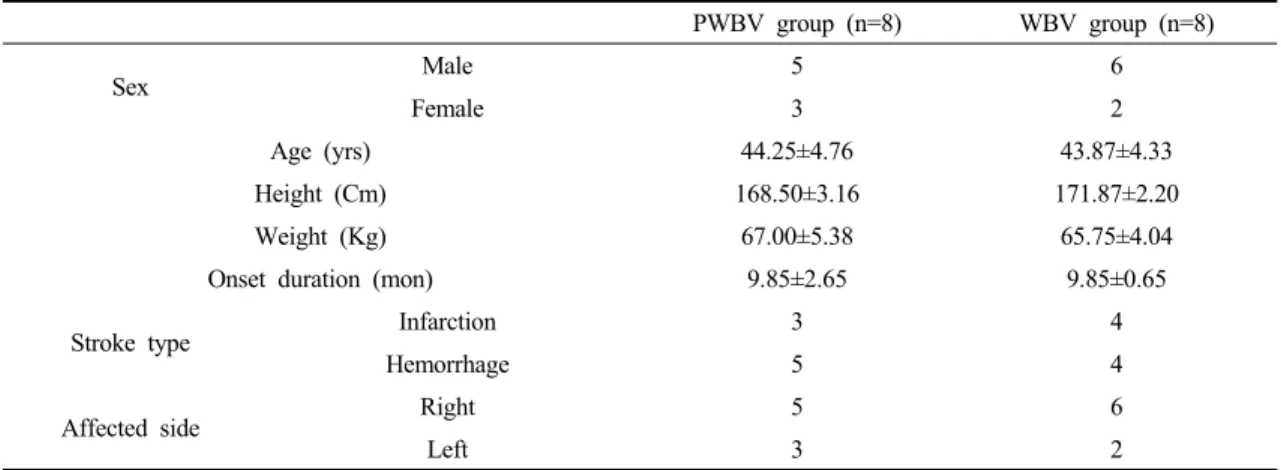
극훈련(whole body vibration, WBV) 그룹 8명으로 나누 어 중재를 실시하였다. 연구대상자의 선정기준은 다 음과 같으며 신체적 특징은 Table 1과 같다.

- 전산화단층촬영이나 자기공명영상촬영에 의해 편측 뇌손상으로 진단받고 6개월이 경과한 자 - 편측무시를 포함한 시⋅지각 능력에 장애가 없다

고 판명된 자

- 독립적으로 10m 이상 보행이 가능한 자 - 30분 이상 훈련이 가능한 자

- 다른 의학적 견해에 이상이 없는 자

- 본 연구에 영향을 줄 수 있는 약물을 복용하지 않는 자

- 연구내용을 이해하고 수행할 수 있는 인지력을 가진 한국판 간이정신상태 검사 (mini mental status examination-Korea, MMSE-K) 점수가 24점 이상인 자 - 연구에 동의한 자

2. 측정 방법 및 도구

1) 도수 근력 검사(manual muscle test, MMT) 근력을 측정하기 위하여 전자근력계(Electric Manual Muscle Tester, J-Tech, USA)를 사용하였다. 측정은 짧

게 앉은 자세에서 무릎관절 폄근을 측정하였으며 3번 의 최대 등척성 수축을 유도 후 그 평균값을 기록하였 으며 각각의 측정 후 근 피로를 없애기 위하여 10초의 휴식을 하였다(Bohannon & Andrews, 1987).

2) 일어나 걸어가기 검사(timed up and go test, TUG) 동적 균형을 측정하기 위하여 일어나 걸어가기 검 사를 사용하였다. 일어나 걸어가기 검사는 노인뿐만 아니라 뇌졸중 , 파킨슨병, 관절염 질환 등을 갖는 대상 자들의 균형능력과 기능적인 이동성을 평가하여 낙상 위험을 예측하기 위한 검사 도구이다 . 측정은 팔걸이 가 있는 의자에 앉아 3m를 걸어간 후 되돌아와서 다시 앉는 방법으로 3회 측정하여 그 평균값을 기록하였으 며 , 안전을 위하여 1명의 물리치료사가 환자의 옆에서 넘어지는 것에 대비하였다(Podsiadlo & Richardson, 1991)

3) 10미터 보행 검사(10 meter walk test, 10MWT) 보행속도를 측정하기 위하여 10미터 보행 검사를 사용하였다. 10미터 보행 검사는 신경학적 손상 환자 의 보행 속도 평가에 일반적으로 많이 이용되는 방법 으로 측정은 총 14m를 편안한 속도로 걷게 하였으며,

PWBV group (n=8) WBV group (n=8)

Sex Male 5 6

Female 3 2

Age (yrs) 44.25±4.76 43.87±4.33

Height (Cm) 168.50±3.16 171.87±2.20

Weight (Kg) 67.00±5.38 65.75±4.04

Onset duration (mon) 9.85±2.65 9.85±0.65

Stroke type Infarction 3 4

Hemorrhage 5 4

Affected side Right 5 6

Left 3 2

Values=

a

Means±SD

PWBV: PNF combined with whole body vibration WBV: whole body vibration

Table 1. General characteristics of study subjects

(n=16)

(4)

가속과 감속을 감안하여 처음과 끝에 각각 2m씩 모두 4m를 측정에서 제외하였다. 3회 측정하여 그 평균값 을 기록하였으며, 안전을 위하여 1명의 물리치료사가 환자의 옆에서 넘어지는 것에 대비하였다(Alkandari, 2011).

4) 6분 보행 검사(six minute walk test, 6MWT) 보행지구력을 측정하기 위하여 6분 보행 검사를 사용하였다. 6분 보행은 검사는 대상자가 6분 동안 최대로 걸을 수 있는 거리를 측정하는 평가 도구로 일반적으로 심혈관계 및 폐질환 환자의 기능 평가 및 사망률 예측에 사용된다(Douwes et al., 2016). 측정은 바닥에 5m 간격으로 마커를 표시하고 100m의 직선 보행로를 도움 없이 6분 동안 왕복 보행한 거리를 측정 하였으며, 안전을 위하여 1명의 물리치료사가 환자의 옆에서 넘어지는 것에 대비하였다(Pohl et al., 2002)

3. 실험 절차

보행 및 균형에 제한이 있는 뇌손상 환자 16명을 선정한 후 전신진동자극훈련을 병행한 PNF 결합패턴 훈련 그룹 8명, 전신진동자극훈련 그룹 8명을 무작위 로 배치한 후 하루 30분 일주일에 5회 4주간 각각 운동 을 실시하였다.

1) 전신진동자극훈련을 병행한 PNF 결합패턴 훈련 군(PNF patterns combined with whole body vibration, PWBV)

전신진동자극훈련을 병행한 PNF 결합패턴 훈련은 진동폭 3mm, 진동주파수 25Hz, 3분 적용을 1세트로 총 8세트 적용하였으며, 1, 8세트는 각각 준비훈련과 정리훈련으로 10Hz를 적용하였고 준비훈련을 제외한 세트 간 1분의 휴식을 하였다(Tihanyi et al., 2007; van Nes et al., 2004). 훈련자세는 진동판 위에 마비측 발을 위치한 후 무릎관절 굽힘 각도는 30°를 유지하도록 하였으며 (Escamilla et al., 2009), 비마비측 발은 무릎관 절을 완전히 편 상태로 진동판 밖에 위치하였다 . PNF 결합패턴 훈련은 Dietz (2009)에 의해 소개되었던 스프 린터(sprinter) 패턴으로 비마비측의 어깨뼈는 후방하 강 , 다리이음관절은 전방거상의 움직임으로 수행하였

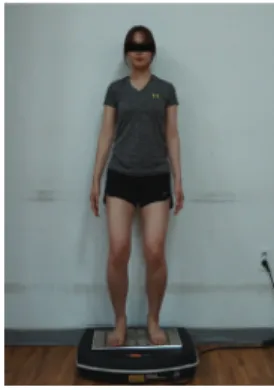
Fig. 3. Whole Body Vibration, WBV.

Fig. 1. PNF patterns combined with whole body vibration, PWBV using the table.

Fig. 2. PNF patterns combined with Whole Body Vibration,

PWBV using the gym stick.

(5)

으며 , 마비측 어깨뼈는 전방거상, 다리이음관절은 후 방하강의 움직임으로 수행하였다. 이 때 비마비측의 발은 끝 범위에서 발판위에 위치하도록 하였다(Fig.

1, 2). 또한 대상자의 적응 정도에 따라 발판의 높이를 포함한 보조정도를 조정하여 수행하였다(Fig. 1, 2).

대상자가 훈련 시 불안정한 부분에서 치료사가 보조 를 실시하였고, 대상자가 할 수 있는 최대 능력까지만 적용하였다 . 훈련 중 대상자가 통증이나 호흡 및 어지 러움이 나타나는 경우에는 중재를 중지하였으며 모든 훈련의 과정은 PNF 국제교육과정을 이수한 물리치료 사 3명이 수행하였다.

2) 전신진동자극훈련군(whole body vibration, WBV) 전신진동자극훈련은 진동폭 3mm, 진동주파수 25Hz, 3분 적용을 1세트로 총 8세트 적용하였으며, 1, 8세트는 각각 준비훈련과 정리훈련으로 10Hz를 적 용하였고 준비훈련을 제외한 세트 간 1분의 휴식을 하였다(Tihanyi et al., 2007; van Nes et al., 2004). 훈련자 세는 전신진동운동기구의 발판 위에 양쪽 발을 편안 하게 위치한 바로 선 자세에서 대상자는 발판 위에

엉덩관절 , 무릎관절, 발목관절을 약간 굽힌 미니 스쿼 트(mini-squat) 자세를 유지시켰다. 이때 무릎관절 굽 힘의 각도는 30°를 유지하도록 하였다(Escamilla et al., 2009)(Fig. 3). 훈련 중 대상자가 통증이나 호흡 및 어지 러움이 나타나는 경우에는 중재를 중지하였으며 모든 훈련의 과정동안 구두명령과 보조를 위해 물리치료사 1명이 수행하였다.

4. 자료 분석

본 연구의 통계학적 분석은 SPSS 19.0 ver.을 이용하 여 평균(M)과 표준편차(SD)로 나타내었다. 실험군과 대조군의 훈련 전과 후의 비교를 위해 대응표본 t-검정 (paired t-test)을 실시하였으며, 그룹 간의 차이를 비교 하기 위해 독립표본 t-검정(independent t-test)을 실시하 였다 . 모든 통계적 유의 수준은 α=0.05로 설정하였다.

MMT (kg)

pre-test post-test t (p)

PWBV group (n=8) 31.95±3.34 42.10±4.37 -5.69(0.00

*

)

WBV group (n=8) 38.01±3.87 43.56±4.12 -3.30(0.01

*

)

1.88(0.08

*

) Values=

a

Means±SD

*

p<0.05

MMT: manual muscle test

Table 2. Groups comparison before and after the intervention in MMT

TUG (sec)

pre-test post-test t (p)

PWBV group (n=8) 23.78±3.15 17.33±2.14 4.50(0.00

)

WBV group (n=8) 25.72±2.06 23.35±1.87 4.78(0.00

)

2.70(0.02

) Values=

a

Means±SD

p<0.05

TUG: timed up and go test

Table 3. Groups comparison pre and post the intervention in TUG

(6)

Ⅲ. 연구 결과

1. 도수 근력 검사(manual muscle test, MMT) 도수 근력 검사의 무릎관절 폄근에서 PWBV 그룹 은 중재 전 31.95±3.34(kg)에서 중재 후 42.10±4.37(kg) 로 유의한 증가를 보였으며(P<0.05), WBV 그룹에서 도 중재 전 38.01±3.87(kg)에서 중재 후 43.56±4.12(kg) 로 유의한 증가를 보였다(P<0.05)(Table 2). 훈련 방 법에 따른 그룹 간 차이 비교에서 유의한 차이는 없었다.

2. 일어나 걸어가기 검사(timed up and go test, TUG)

일어나 걸어가기 검사에서 PWBV 그룹은 중재 전 23.78±3.15(sec)에서 중재 후 17.33±2.14(sec)로 유의 한 감소를 보였으며(P<0.05), WBV 그룹에서도 중재 전 25.72±2.06(sec)에서 중재 후 23.35±1.87(sec)로 유 의한 감소를 보였다(P<0.05)(Table 3). 훈련 방법에 따른 그룹 간 차이 비교에서 유의한 차이가 있었다 (P<0.05).

3. 10미터 보행 검사(10 meter walk test, 10MWT) 10미터 보행 검사에서 PWBV 그룹은 중재 전 20.11±2.47(sec)에서 중재 후 14.02±1.57(sec)로 유의한 감소를 보였으며(P<0.05), WBV 그룹에서도 중재 전 23.63±2.52(sec)에서 중재 후 21.30±2.27(sec)로 유의한 감소를 보였다(P<0.05)(Table 4). 훈련 방법에 따른 그 룹 간 차이 비교에서 유의한 차이가 있었다 (P<0.05).

4. 6분 보행 검사(six minute walk test, 6MWT) 6분 보행 검사에서 PWBV 그룹은 중재 전 175.12±

15.13(m)에서 중재 후 216.75±14.83(m)로 유의한 증가 를 보였으며 (P<0.05), WBV 그룹에서도 중재 전 145.87±20.77(m)에서 중재 후 166.50±21.26(m)로 유의 한 증가를 보였다(P<0.05)(Table 5). 훈련 방법에 따른 그룹 간 차이 비교에서 유의한 차이가 있었다(P<0.05).

Ⅳ. 고 찰

뇌손상 환자는 아급성기 이후에 선택적인 근 위축 10MWT (sec)

pre-test post-test t (p)

PWBV group (n=8) 20.11±2.47 14.02±1.57 4.20(0.00

)

WBV group (n=8) 23.63±2.52 21.30±2.27 3.81(0.01

)

2.39(0.04

) Values=

a

Means±SD

p<0.05

10MWT: 10 meter walk test

Table 4. Groups comparison before and after the intervention in 10MWT

6MWT (m)

pre-test post-test t (p)

PWBV group (n=8) 175.12±15.13 216.75±14.83 -7.50(0.00

)

WBV group (n=8) 145.87±20.77 166.50±21.26 -4.99(0.00

)

3.03(0.01

) Values=

a

Means±SD

p<0.05

6MWT: six minute walk test

Table 5. Groups comparison before and after the intervention in 6MWT

(7)

이 발생하며, 계속적인 약화로 인해 신체적 좌⋅우 근력의 불균형 및 균형능력, 보행능력, 지구력의 저하 를 동반 한 기능적 활동 제한을 갖는다(Bohannon, 2007; Kirker et al., 2000). 특히 보행능력의 증진은 뇌손 상 환자의 재활에 있어 일차적 목표로 근력 , 운동감각, 고유수용성감각, 체성감각, 협응, 균형 등의 복합적인 운동기능의 결과이며(Norkin & Levangie, 1992), 운동 학적으로 체간과 사지의 협응된 움직임을 통해 보다 적절한 보행이 이루어진다고 하였다(Horak et al., 1997)

전신진동자극훈련은 긴장성 진동반사를 기전으로 진동 자극을 받는 동안 척수 반사의 촉진작용이 일어 나고 이를 통한 근육길이의 변화는 Ⅰα와 Ⅱ구심성 신경섬유를 자극시키고 양쪽의 대뇌반구에 가소적 변 화를 발생시킨다 (Lebedev & Poliakov, 1992). 특히 전신 진동자극훈련은 급성 및 만성 뇌졸중 환자의 무릎관 절 폄근 및 굽힘근의 근력 증가에 효과적이며 자세조 절 향상으로 인한 정적⋅동적 균형 또한 증가한다고 하였다(Tankisheva et al., 2014; Tihanyi et al., 2010).

Chan 등(2012)은 23명의 만성 뇌졸중 환자를 대상으로 고전적 치료와 전신진동자극훈련을 동반하였을 시, 발목관절 굽힘근의 근경직을 감소시키고 보행 속도 및 이동성에 보다 효과적이라고 하였다. 또한 Shin (2015)은 30명의 만성 뇌졸중 환자를 대상으로 편측 전신진동자극훈련을 통해 양측 전신진동자극훈련 보 다 무릎관절 폄근 및 기능적 근력이 증가하고 버그-균 형 척도, 일어나 걸어가기 검사를 통해 정적⋅동적 균형의 증가를 확인 하였고, 10m 보행 검사를 통해 보행 속도가 증가 하는 것을 확인하였다. Yang 등 (2006)은 보행주기 중 중간입각기 시 엉덩관절 폄근, 무릎관절 폄근의 영향으로 반대측 다리의 보폭과 보 속의 변화가 생기며 보행 속도가 증가한다고 하였다.

Horak 등(1997)은 뇌졸중 환자의 일상생활에 있어 보 행속도 증가는 재활의 일차적 목표가 되며 이는 체간 과 사지의 협응된 움직임을 통해 성취할 수 있다고 하였다. Kim (2012)은 PNF의 결합 패턴인 스프린터, 스케이터 훈련이 보행 과정 중 연속적인 상호교대적

상하지 협응 패턴이 보행의 질을 향상 시킨다고 하였 으며, Lim (2014)은 22명의 뇌졸중 환자를 대상으로 PNF 결합패턴 훈련을 통하여 정적⋅동적 균형 및 보 행능력에 효과가 있다고 보고하였다. 또한 Kim 등 (2015)은 20명의 뇌졸중 환자를 대상으로 수중에서의 PNF 협응패턴을 적용한 결과 버그-균형 척도, 일어나 걸어가기 검사에서 정적⋅동적 균형 증가 및 10m 보 행 검사에서 보행속도가 증가 한다고 하였다.

본 연구에서 보행이 가능한 뇌손상 환자를 대상으 로 전신진동자극훈련을 병행한 PNF 결합패턴 훈련과 전신진동자극훈련을 4주간 적용한 후 각각 도수 근력 검사, 일어나 걸어가기 검사, 10미터 보행 검사, 6분 보행 검사를 통해 효과가 있는지 알아보았다 . 무릎관 절 폄근을 평가한 연구결과에서 두 군 모두 유의한 증가가 있었으나, 그룹 간 차이에서 유의한 차이가 없었다. Tankisheva 등(2014)은 전신진동자극훈련 시 무릎관절을 30°굽힌 미니 스쿼트 자세에서 적용하며 역학적 전신진동자극은 넙다리네갈래근의 근활성도 를 증가시키고 20Hz 이상의 주파수는 근력증가에 보 다 효과적이라고 보고하였다. 본 연구에서도 그룹 간 마비측 다리의 무릎관절 폄근에서 유의한 차이가 없 었던 것은 두 그룹 모두 무릎관절을 굽힌 상태가 무릎 관절 폄근 증가에 영향을 미쳤기 때문이라고 생각한 다. 또한 일어나 걸어가기 검사, 10미터 보행 검사, 6분 보행 검사를 평가한 연구결과에서 두 군 모두 유의 한 증가가 있었으며 , 그룹 간 차이에서도 유의한 차이 가 있었다. Dean 등(2000)은 기립자세에서 기능적 과 제수행을 병행한 훈련은 체간과 사지의 협응된 움직 임을 학습시키고 전신의 회전근들을 활성화 시키며 선행적 자세조절 능력을 증가시킨다고 하였으며, Adler 등(2002)은 PNF의 패턴 훈련은 인간의 움직임을 효율적으로 만든다고 하였다 . 또한 Bohannon 등(2007) 은 마비측 다리의 체중지지 향상 및 안정성 증가는 보행의 속도 및 지구력에 영향을 미친다고 하였다.

본 연구에서도 전신진동자극훈련을 병행한 PNF 결합

패턴 훈련에서 전신진동자극의 역학적 진동자극과 함

께 체간과 사지의 협응된 스프린터 훈련이 동적 균형

(8)

및 보행능력에 효과가 있다는 점에서 선행연구의 결 과와 일치하였다 . 따라서 본 연구의 두 집단 간 보행능 력의 유의한 차이를 보인 것은 마비측 다리의 무릎관 절 폄근 증가와 동적 균형능력의 향상이 보행 능력에 서도 유의한 차이를 보였다고 생각된다.

본 연구의 제한점으로는 4주간의 비교적 짧은 훈련 기간과 실험 대상자의 수가 많지 않아 결과에 대한 해석을 일반화하기 어렵고 , 뇌졸중 환자를 대상으로 한 선행 연구가 미미하여 연구 결과에 대한 비교가 어려웠다. 또한 환자 선정에 있어 세밀한 기준을 제시 하지 않았다. 그렇기 때문에 추후 연구에서는 과제를 수행하는 동안 체중이동에 대한 세밀한 분석이 필요할 것으로 생각된다. 추후 이러한 제한점들을 보완하여 연구한다면 뇌손상 환자의 근력, 균형 및 보행에 대한 중재를 위한 체계적인 자료가 될 것이라 생각된다.

Ⅴ. 결 론

본 연구는 뇌손상 환자를 대상으로 전신진동자극 훈련을 병행한 PNF 결합패턴 훈련 그룹과 전신진동자 극훈련 그룹으로 나누어 4주후 대상자의 근력, 균형 및 보행능력의 차이를 비교하여 전신진동자극훈련을 병행한 PNF 결합패턴 훈련이 뇌손상환자의 근력, 균 형 및 보행에 어떠한 영향을 미치는지를 알아보고자 하였다.

본 연구를 통해 전신진동자극훈련을 병행한 PNF 결합패턴 훈련이 뇌손상 환자의 근력, 균형 및 보행능 력에 긍정적인 영향을 미치는 것으로 나타났다 . 이와 같은 결과를 통해 뇌손상 환자에게 전신진동자극훈련 을 병행한 PNF 결합패턴 훈련의 활용을 제안하고자 한다.

Reference

Ada L, Dorsch S, Canning CG. Strengthening interventions

increase strength and improve activity after stroke:

a systematic review. Australian Journal of Physiotherapy.

2006;52(4):241-248.

Adler SS, Becker D, Buck M. PNF in practice: an illustratedguide, 2nd ed. Berlin. Springer. 2002.

Alkandari S. Evaluation of walking speed in patients with chronic hemiparesis after at least 3 consecutive botulinum neurotoxin injections while patients follow a guided self-rehabilitation contact. Annals of Physical and Rehabilitation Medicine. 2011;54(1):243.

Becker BJ. The effects on strength, balance and mobility when combining whole body vibration and traditional rehabilitation for stroke patients. Windsor University.

Dissertation of Master’s Degree. 2015.

Bohannon RW, Andrews AW. Interrater reliability of hand-held dynamometry. Physical Therapy. 1987;67(6):931-933.

Bohannon RW. Muscle strength and muscle training after stroke.

Journal of Rehabilitation Medicine. 2007;39(1):14-20.

Chan KS, Liu CW, Chen TW, et al. Effects of a single session of whole body vibration on ankle plantarflexion spasticity and gait performance in patients with chronic stroke: a randomized controlled trial. Clinical Rehabilitation. 2012;26(12):1087-1095.

Dean CM, Richards CL, Malouin F. Task-related circuit training improves performance of locomotor tasks in chronic stroke: a randomized, controlled pilot trial. Archives of Physical Medicine and Rehabilitation. 2000;81(4):

409-417.

Dietz B. Let’s sprint, let’s skate: Innovation Tm PNF-konzept.

Berlin. Springer. 2009.

Duncan PW, Zorowitz R, Bates B, et al. Management of adult stroke rehabilitation care. Stroke. 2005;36(9):e100- e143.

Eng JJ, Tang PF. Gait training strategies to optimize walking ability in people with stroke: a synthesis of the evidence. Expert Review of Neurotherapeutics.

2007;7(10):1417-1436.

(9)

Escamilla R, Zheng N, Macleod T, et al. Patellofemoral joint force and stress during the wall squat and one-leg squat. Medicine Science in Sports Exercise.

2009;41(4):879.

Gill-Body KM, Beninato M, Krebs DE. Relationship among balance impairments, functional performance, and disability in people with peripheral vestibular hypofunction. Physical Therapy. 2000;80(8):748.

Horak FB, Henry SM, Shumway-Cook A. Postural perturbations: new insights for treatment of balance disorders. Physical Therapy. 1997;77(5):517-533.

Ikai T, Kamikubo T, Takehara I, et al. Dynamic postural control in patients with hemiparesis. American journal of physical medicine & rehabilitation. 2003;82(6):

463-469.

Kim K, Lee DK, Jung SI. Effect of coordination movement using the PNF pattern underwater on the balance and gait of stroke. The Journal of the Korean Society of Physical Medicine. 2015;27(12):3699-3701.

Kim SJ. The effect of sprinter and skater pattern training of PNF on balance and gait ability in patient with stroke.

Daegu University. Dissertation of Master’s Degree.

2012.

Kirker SG, Jenner JR, Simpson DS, et al. Changing patterns of postural hip muscle activity during recovery from stroke. Clinical Rehabilitation. 2000;14(6):618-626.

Kumar D, Verma S, Bhattacharya S, et al. Audio-visual stimulation in conjunction with functional electrical stimulation to address upper limb and lower limb movement disorder. European Journal of Translational Myology. 2016;26(2):140-144.

Laver KE, George S, Thomas S, et al. Virtual reality for stroke rehabilitation. Stroke. 2015;43(2):20-21.

Lebedev MA, Polyakov AV. Analysis of surface EMG of human soleus muscle subjected to vibration. Journal of Electromyography and Kinesiology. 1992;2(1):

26-35.

Lim CG. The effect of proprioceptive neuromuscular facilitation pattern exercise using the sprinter and the skater on balance and gait function in the stroke patients. The Journal of the Korean Society of Physical Medicine.

2014;26(4):249-256.

Norkin CC, Levangie PK. Joint structure and function, 2nd ed. Philadelphia. FA Davis Co. 1992.

Outermans JC, van Peppen RP, Wittink H, et al. Effects of a high-intensity task-oriented training on gait performance early after stroke: a pilot study. Clinical Rehabilitation. 2010;24(11):979-987.

Park JH, Chung Y. The effects of providing visual feedback and auditory stimulation using a robotic device on balance and gait abilities in persons with stroke: a pilot study. Physical Therapy Rehabilitation Science.

2016;5(3):125-131.

Podsiadlo D, Richardson S. The timed “Up & Go”: a test of basic functional mobility for frail elderly persons.

Journal of the American Geriatrics Society. 1991;39 (2):142-148.

Pohl PS, Duncan PW, Perera S, et al. Influence of stroke-related impairments on performance in 6-minute walk test.

Journal of Rehabilitation Research and Development.

2002;39(4):439.

Shin SH. Unilateral whole body vibration training to improve muscle strength and dynamic balance in patients with chronic post-stroke hemiplegia. Shamyook University. Dissertation of Master’s Degree. 2015.

Shumway-Cook A, Woollacott MH. Motor control: translating research into clinical practice. New York. Lippincott Williams & Wilkins. 2007

Stevens JA, Stoykov MEP. Using motor imagery in the rehabilitation of hemiparesis. Archives of Physical Medicine and Rehabilitation. 2003;84(7):1090-1092.

Tankisheva E, Bogaerts A, Boonen S, et al. Effects of intensive

whole-body vibration training on muscle strength and

balance in adults with chronic stroke: a randomized

(10)

controlled pilot study. Archives of Physical Medicine and Rehabilitation. 2014;95(3):439-446.

Tihanyi JD, Giminiani R, Tihanyi T, et al. Low resonance frequency vibration affects strength of paretic and non-paretic leg differently in patients with stroke.

Acta Physiologica Hungarica. 2010;97(2):172-182.

Tihanyi T K, Horváth M, Fazekas G, et al. One session of whole body vibration increases voluntary muscle strength transiently in patients with stroke. Clinical Rehabilitation. 2007;21(9):782-793.

van Nes IJ, Geurts AC, Hendricks HT, et al. Short-term effects of whole-body vibration on postural control in unilateral chronic stroke patients: preliminary

evidence. American Journal of Physical Medicine

& Rehabilitation. 2004;83(11):867-873.

van Nes IJ, Latour H, Schils F, et al. Long-term effects of 6-week whole-body vibration on balance recovery and activities of daily living in the postacute phase of stroke. Stroke. 2006;37(9):2331-2335

Wall JC, Turnbull GI. Gait asymmetries in residual hemiplegia.

Archives of Physical Medicine and Rehabilitation.

1986;67(8):550-553.

Yang YR, Wang RY, Lin KH, et al. Task-oriented progressive resistance strength training improves muscle strength and functional performance in individuals with stroke.

Clinical Rehabilitation. 2006;20(10);860-870.

수치

Table 1. General characteristics of study subjects
Fig. 2. PNF patterns combined with Whole Body Vibration, PWBV using the gym stick.
Table 2. Groups comparison before and after the intervention in MMT
Table 5. Groups comparison before and after the intervention in 6MWT

참조

관련 문서

The effect of Combined Exercise program on Body composition, Physical fitness and thickness of subcutaneous fat in. Obese

In the change of physical strength, The exercise group showed statistically significant differences in muscle strength(right), muscle strength(left),

The purpose of this study was to compare the remineralization effect of Silver Diamine Fluoride (SDF) on demineralized enamel over time with those of fluoride varnish..

The purpose of this study was to investigate how the Da Vinci body board exercise program affects the body balance and physical stress of women with body imbalance.. For

The purpose of this study was to examine the parents' perceptions on the current status, effects and satisfaction of personal assistant service for students

12 weeks of combined exercise (body strength exercise and aerobic exercise) was applied to measure health fitness (muscle strength, muscular endurance,

The purpose of this study was to investigate the lower extremity muscle strength and student health of male middle school students. Twenty middle school

The purpose of this study was to analyze the impaction pattern of the impacted mandibular third molar and the relationship with the inferior alveolar nerve