| Abstract |
Purpose: The purpose of this study is to determine the effects of visual biofeedback training on the recovery of balance function in stroke patients.
Methods: A total of 30 patients with stroke were chosen as the subjects of this study. The subjects were randomly divided into either the visual biofeedback balance training group (experimental group; n=15) or the general balance training group (control group; n=15). The visual biofeedback balance training and general balance training were implemented for 30 minutes a day, three times a week, for a total of four weeks. The subjects’ balance ability was measured before and after the interventions.
Results: The shift length and surface area of the center of the body decreased in both the experimental group and the control group, with the difference being statistically significant. The shift length and surface area of the center of the body both decreased more in the experimental group than in the control group, and there was a statistically significant between-group difference.
Conclusion: The experimental group showed a greater improvement in terms of the balance ability of patients with stroke than the control group. Therefore, we believe that visual biofeedback balance training can be effectively applied for the improvement of balance ability in patients with stroke.
Key Words: Visual biofeedback, Stroke, Balance
*본 연구는 대한고유수용성신경근촉진법학회 부산시회 학술연구비 지원에 의해 수행되었음
†Corresponding Author : Jae-Yong Kim ([email protected])
Original Article Open Access
시각적 바이오피드백 균형 훈련이 뇌졸중 환자의 균형 회복에 미치는 영향*
김재용†⋅김대경11)
부산의료원 재활센터, 1대한고유수용성촉진법학회 부산시회
The Effect of Visual Biofeedback Exercise on the Recovery of Balance in Stroke Patients
Jae-Yong Kim†⋅Dae-Kyung Kim1 Rehabilitation Center, Busan Medical Center
1Korea Proprioceptive Neuromuscular Facilitation Association Busan Branch
Received: May 12, 2017 / Revised: June 5, 2017 / Accepted: June 5, 2017
ⓒ 2017 Journal of Korea Proprioceptive Neuromuscular Facilitation Association
This is an Open Access article distributed under the terms of the Creative Commons Attribution Non-Commercial License (http://creativecommons.org/licenses/by-nc/3.0) which permits unrestricted non-commercial use, distribution, and reproduction in any medium, provided the original work is properly cited.
Ⅰ. 서 론
뇌졸중 환자의 시각 장애는 보행 및 독립적인 일상 생활을 방해하고, 편측무시와 거리판단에 문제를 일 으키며 새로운 행동의 습득 능력에 지장을 준다 (Gordon et al., 1985; Rosenthal et al., 1983). 시각 능력은 편마비 환자들의 일상생활동작 회복과 예후를 결정하 는 인자이고, 균형유지 능력에 영향을 미친다(Hong et al., 2005; Skilbeck et al., 1983). 따라서 뇌졸중 환자의 보행과 일상생활능력 향상을 위한 재활에 있어 균형 과 시각 능력의 향상은 중요하다(Walker et al., 2000).
균형은 주어진 환경에서 기립자세 및 좌우자세를 유지하기 위해 계획하고 수행하는 과정으로, 기저면 위에 중력중심을 유지하는 능력을 말하며 안정성과 운동성이 조화된 역동적인 현상이다(O’sullivan &
Schmitz, 1994; Umphred, 1995). 균형 능력은 기능적인 보행 능력과 일상생활활동의 기능적인 수행에 매우 중요한 요소이고(Turnbull et al., 1995), 균형 조절을 위해서는 전정계, 시각계, 체성감각의 통합과 함께 운 동조절 시스템, 인지능력과 근골격계의 상호작용이 요구된다(Laufer et al., 2003; Wernicke-Robinson et al., 1999).
뇌졸중은 뇌혈관 손상으로 인한 국소 뇌조직 병변 이상으로 발생되는 신경학적 기능 장애로, 생존자 90% 이상이 운동, 감각, 지각 및 인지기능 등에 장애를 보이게 된다(Pedretti & Early, 2001). 가장 일반적인 특징인 운동기능 장애는 좌우 불균형을 초래하고 비 대칭적인 자세를 초래한다. 이러한 비대칭적 자세는 중심을 유지하는 능력을 감소시키고 정위반응, 평형 반응에 영향을 주어 자세조절에 문제를 야기하며, 운 동발달학적 측면의 기능저하와 일상생활동작 능력에 문제가 나타난다(Ikai et al., 2003; Kisner & Colby, 2007). 편마비 환자의 균형 회복을 위한 방법으로 측방 체중이동 방법(Davies, 1985), 공을 이용한 방법(Edwards, 1996), 일정 높이의 발판에 건측 발을 올리는 방법 (Bohannon & Larkin, 1985)과 시각적 자극으로부터의 피드백을 통한 환자의 자세나 동작을 교정하고 조절
하게 하는 고유수용성신경근촉진법을 이용한 방법 (Adler et al., 2014), 바이오피드백훈련(Cheng et al., 2001; Woollacott et al., 1986)이 있다.
바이오피드백 치료는 정신생리학과 학습이론에 기 초를 둔 행동수정의 일종으로 심장의 활동, 근육활동, 피부의 전기 활동, 뇌의 전기적 활동 등과 같은 신경생 리학적 반응에 대한 수의적 조절력을 높이기 위해 전 기 또는 기계적 장치의 도움으로 시행착오를 통한 반 복 학습 훈련으로 정의된다(Bazanova et al., 2009; Schwartz
& Andrasik, 2015). 균형과 체중이동 훈련을 하는 동안 전정감각, 체성감각, 시각의 추가적인 감각이 바이오 피드백으로 제공되면 중추신경계의 감각 운동 통합을 활성화되어 균형 훈련에 더욱 효과적이다(Day et al., 2002; Dozza et al., 2007; Vuillerme et al., 2008).
바이오피드백 훈련 방법은 전정감각, 시각, 체감각 과 청각 피드백을 많이 사용하고 있으며, 그 중 시각적 피드백을 이용한 바이오피드백 운동학습법이 가장 많 이 사용된다(Zijlstra et al., 2010). 시각은 다른 감각보다 정확하게 정보를 제공받을 수 있어 고유수용성감각이 나 전정기능이 약화될 때 대체될 수 있다(Karnath &
Boretz 2003). 이러한 시각적 바이오피드백 훈련이 뇌 졸중 환자의 균형 능력 향상에 효과적이라는 근거는 선행연구들을 통해 알 수 있다(Badke et al., 2011;
Varoqui et al., 2011). 또한 시각적 바이오피드백 훈련 은 균형 능력 향상뿐만 아니라 시지각 능력을 향상시 킨다. Lee와 Lee (2009)는 시각적 피드백 훈련이 뇌졸 중 환자의 균형과 시지각 능력 향상에 효과적이라고 보고하였고, Song 등(2011)은 시각적, 청각적 피드백 을 제공하는 가상현실 훈련이 뇌졸중 환자의 상지기 능, 상지근력과 시지각 능력 향상을 보였다고 보고하 였다. 그러나 임상환자를 대상으로 한 시각적 바이오 피드백 연구는 부족하여 이 부분에 대한 추가적인 연 구가 필요하다. 따라서 본 연구의 목적은 시각적 바이 오피드백 훈련이 뇌졸중 환자의 균형에 어떤 영향을 미치는지에 대해 알아보고자 한다.
Ⅱ. 연구 방법
1. 연구 대상
본 연구의 대상자는 부산광역시에 소재한 D의료원 에서 전문의에 의해 뇌졸중으로 진단을 받고 기능회복 을 위해 물리치료 및 작업치료를 받는 편마비 환자를 대상으로 하였다. 대상자는 뇌졸중으로 진단을 받고 발병한지 6개월 이상 된 자로 한국판 간이정신상태 검사(MMSE-K)에서 25점 이상인 자, 보조 장구의 사용 여부와 상관없이 독립적인 기립과 10m 보행이 가능한 자, 시력에 장애가 없고 대화가 가능한 자로 측정도구 의 검사가 모두 수행이 가능한 자, 기타 신경계 질환, 골절 및 구축 등의 근골격계 질환이 없는 자를 대상으 로 하였다. 연구 목적에 대한 충분한 설명을 하였고 동의서를 작성한 30명을 대상으로 시각적 바이오피드 백 균형 훈련를 실시한 실험군(n=15)과 일반적 균형 훈련을 실시한 대조군(n=15)으로 무작위 배정하였다.
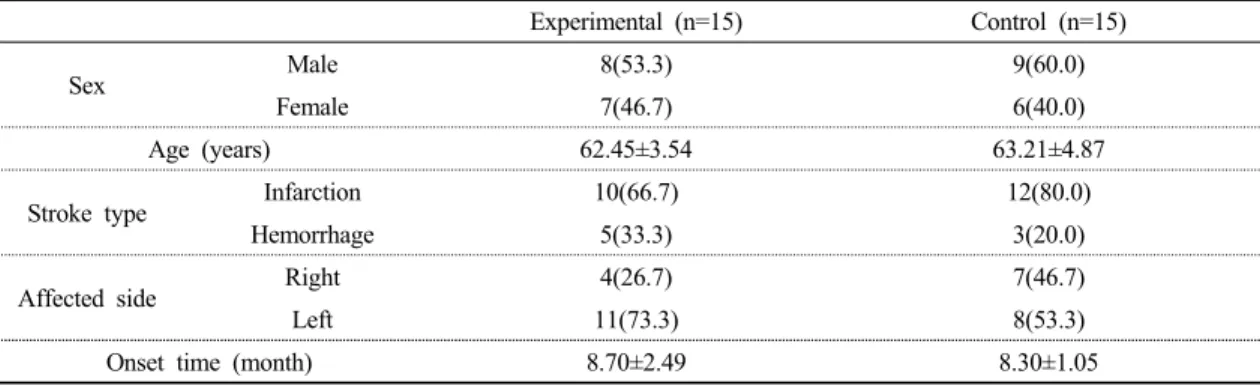
연구 대상자들의 일반적 특성은 다음과 같다(Table 1).
2. 연구도구 및 측정방법
1) 균형 능력 측정기(BioRescue)
균형 및 이동 능력을 측정하기 위해 균형 능력 측정 및 훈련 시스템인 BioRescue (RM INGENIERIE, France)를 이용하여 균형 능력을 측정하였다. 균형 능
력 측정 및 훈련 시스템은 환자 및 일반인, 운동선수를 대상으로 균형 능력을 정적 및 동적으로 측정하기에 적합한 장비이며, 특정한 움직임 동안 압력 중심점 (center of pressure, COP)의 이동 경로선을 관찰하여 이동 경로선의 거리(㎜), 평균속도(㎝/s), 면적(㎟)을 알 수 있다. 그리고 COP의 이동거리는 균형 능력의 체중심 이동경로에 대한 척도로 쓰이고 있다(Michaelson et al., 2003).
정적 균형을 검사하기 위해 피검자는 바로 선 자세 에서 30°정도 다리를 벌리고 전방을 주시하게 한 후 측정방법을 모니터의 동영상을 보며 설명한 뒤, 평가자 가 먼저 시범을 보이고 실시하였다. 선 자세에서의 눈 을 뜬 상태에서 1분 동안 중심을 유지하도록 한 후 압력 중심점의 총 이동거리와 이동면적을 측정하였다.
3. 실험방법
1) 시각적 바이오피드백 균형 훈련
시각적 바이오피드백 균형 훈련 및 균형 능력 측정 은 BioRescue (RM INGENIERIE, France)를 이용하였 다. BioRescue는 1,600개의 센서와 소프트웨어가 내장 된 플랫폼과 함께 구성되었으며 환자 및 일반인, 운동 선수를 대상으로 균형 능력을 측정하고 다양한 균형 능력 훈련 프로그램을 통해서 재활치료 하는데 사용 된다. 시각적 바이오피드백 균형 훈련은 압력을 감지 Experimental (n=15) Control (n=15)
Sex Male 8(53.3) 9(60.0)
Female 7(46.7) 6(40.0)
Age (years) 62.45±3.54 63.21±4.87
Stroke type Infarction 10(66.7) 12(80.0)
Hemorrhage 5(33.3) 3(20.0)
Affected side Right 4(26.7) 7(46.7)
Left 11(73.3) 8(53.3)
Onset time (month) 8.70±2.49 8.30±1.05
Mean±SD
Table 1. General characteristics of subjects
(N=30)
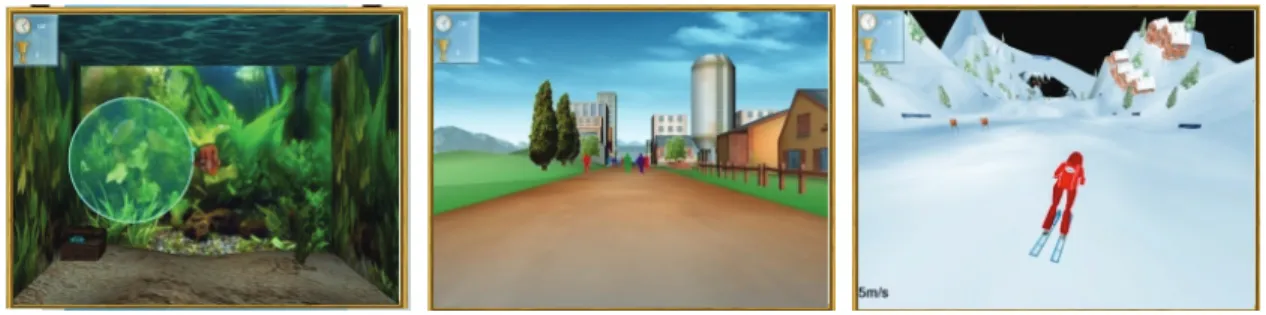
하는 플랫폼의 센서를 통해 보드 위 사용자의 움직임 과 화면내의 움직임을 조절하는 다양한 게임형식의 바이오피드백 훈련으로 훈련 동안 스스로 학습할 수 있는 내재적 피드백이 가능하다. 본 연구에서 균형 훈련은 컴퓨터 프로그램에 내장된 여러 가지 방법 중 에 안정성을 목적으로 하는 "Bubble", 체중 이동을 목 적으로 하는 "City Walk", 안정성과 체중 이동을 동시 에 목적으로 하는 "Downhill Ski"를 수행하였다.
"Bubble"은 대상자가 체중 이동하여 물고기를 여러 방향을 움직이는 물방울 안으로 집어넣어야 한다.
"City Walk"는 거리를 지나는 사람들 사이로 체중을 이동하여 부딪치지 않고 지나가야 한다. "Downhill Ski"는 대상자가 실제처럼 스키 스로프에서 여러 방향 의 장해물을 체중 이동하며 통과해야 한다. 하나의 과제는 10분 동안 실시되었고, 총 30분의 균형 훈련을 주 3회, 총 4주 동안 시행하였다(Fig. 1).
2) 일반적 균형 훈련
일반적 균형 훈련은 모두 선 자세에서 단단한 바닥 위에서 과제 지향 운동, 밸런스 패드 위에서 과제 지향 운동, 한발 서기 운동을 실시하였다(Carr & Shepherd, 2004; Rhee, 2009). 하루 30분씩 주3회 4주간 균형운동 을 실시하였고 운동 수행 시 대상자의 안전을 위해 보호관찰 하였다. 단단한 바닥위에서 과제 지향 운동 은 단단한 바닥 위에서 선 자세로 양 손 깍지 끼고 다양한 전⋅후⋅좌⋅우 방향으로 고리를 끼운다. 밸 런스 패드 위에서 과제 지향 운동은 밸런스 패드 위에
서 선 자세로 양 손 깍지 끼고 다양한 전⋅후⋅좌⋅우 방향으로 고리를 끼운다. 이 때 환자의 안정성 한계를 벗어나지 않는 범위 내에서 실시한다. 한발 서기 운동 은 15㎝ 높이의 발판에 양발을 교대로 올리는 운동으로 독립적으로 할 수 없는 경우에는 치료사가 보조한다.
4. 통계 처리
본 연구에서 수집된 자료는 SPSS 22.0 for Window 통계 프로그램을 이용하여 수집된 자료를 분석하였다. 각 집단 내에 전과 후의 차이를 알아보기 위해 Wilcoxon signed rank test를 실시하였고, 집단 간에 전과 후의 차이를 알아보기 위해 Mann-Whitney U test를 실시하였 다. 통계학적 유의 수준 α는 0.05로 설정하였다.
Ⅲ. 연구 결과
1. 집단내 실험 전⋅후 실험군과 대조군의 신체중심 이동거리와 이동면적 비교
집단내 실험 전⋅후 실험군과 대조군의 신체중심 이동거리와 이동면적에 대한 측정 결과는 Table 2와 같다.
집단내 실험군의 신체중심 이동거리는 실험 전 46.50±13.43㎜에서 실험 후 29.22±7.57㎜으로 이동거 리가 감소되었고 통계적으로 유의한 차이가 있었다 (p<0.05)(Table 2). 대조군에서도 신체중심 이동거리는 실험 전 37.17±12.65㎜에서 실험 후 34.40±11.80㎜으로
A. Bubble B. City walk C. Downhill ski
Fig. 1. Visual biofeedback training.
이동거리가 감소되었고 통계적으로 유의한 차이가 있 었다(p<0.05)(Table 2). 신체중심 이동면적에서도 실험 전 253.20±185.69㎟에서 실험 후 130.06±107.23㎟으로 이동면적이 감소되었고 통계적으로 유의한 차이가 있 었다(p<0.05)(Table 2). 대조군에서도 신체중심 이동면 적은 실험 전 308.40±170.34㎟에서 실험 후 294.80±
162.34㎟으로 이동면적이 감소되었고 통계적으로 유 의한 차이가 있었다(p<0.05)(Table 2).
2. 집단간 실험 전⋅후 실험군과 대조군 사이의 신 체중심 이동거리와 이동면적의 변화량 비교 집단간 실험 전⋅후 실험군과 대조군의 신체중심 이동거리와 이동면적에 대한 측정 결과는 Table 3과 같다.
집단간 이동거리 변화량은 실험군은 17.28±8.87㎜, 대조군은 2.77±1.57㎜으로 통계적으로 유의한 차이를 보였다(p<0.05)(Table 3). 이동면적의 변화량은 실험군 은 123.13±95.04㎟, 대조군은 13.60±16.03㎟ 통계적으 로 유의한 차이를 보였다(p<0.05)(Table 3).
Ⅳ. 고 찰
뇌졸중 환자에서 환측 하지의 체중 부하 감소로 인한 비대칭적 자세는 기능적인 능력을 감소시켜 환 자의 일상생활동작과 운동성의 회복을 방해한다 (Michael et al., 2005; Tyson et al., 2006). 따라서 뇌졸중 환자의 수행 능력의 결함을 보상하기 위해 적절한 자 세와 균형 조절 능력이 중요하다(Nichols et al., 1995).
시각적 방법을 이용한 훈련은 고유수용성감각 정 보를 재입력시켜 비정상적인 자세를 교정하는 방법으 로(Sackley & Lincoln, 1997) 시각적 바이오피드백 훈련 은 뇌졸중 환자의 자세 조절과 균형 기능을 향상시키 는데 효과적이며(Van Peppen et al., 2006), 또한 선행 연구에서 뇌졸중 환자의 균형 훈련 방법으로 사용되 어지고 치료 효과가 입증되고 있다(De Seze et al., 2001;
Geurts et al., 2005; Laufer et al., 2003). 이에 따라 본 연구는 시각적 바이오피드백 훈련이 일반적 균형운동 과 비교하여 뇌졸중 환자의 균형 능력에 미치는 영향 에 대해 알아보았다.
시각적 바이오피드백 균형 훈련군과 일반적 균형
Pre-test Post-test z
Experimental (n=15)
Displacement (㎜) 46.50±13.43 29.22±7.57 -3.41*
Area (㎟) 253.20±185.69 130.06±107.23 -3.40*
Control (n=15)
Displacement (㎜) 37.17±12.65 34.40±11.80 -3.41*
Area (㎟) 308.40±170.34 294.80±162.34 -3.42*
Mean±SD
*p<0.05
COP: center of pressure
Table 2. A comparison of COP displacement and area between pre-test and post-test in the group
Experimental (n=15) Control (n=15)
Pre-Post Pre-Post z
Displacement (㎜) 17.28±8.87 2.77±1.57 -4.63*
Area (㎟) 123.13±95.04 13.60±16.03 -4.30*
Mean±SD
*p<0.05
COP: center of pressure
Pre-Post: the value of difference between pre-test and post-test
Table 3. Comparison of COP displacement and area between groups
훈련군 모두 실험 후에 신체중심 이동거리와 이동면 적이 감소되었다. 그리고 시각적 바이오피드백 균형 훈련군이 일반적 균형 훈련군보다 신체중심 이동거리 와 이동면적이 더욱 감소되었으며 시각적 바이오피드 백 균형 훈련이 균형 능력 향상에 더욱 효과적인 것으 로 나타났다. 이러한 결과는 Winstein 등(1989)이 뇌졸 중 환자를 대상으로 시각적 바이오피드백을 이용한 균형 훈련과 전통적인 균형 훈련의 차이를 비교한 연 구에서 시각적 바이오피드백을 이용한 군이 서 있는 자세에서 정적 균형이 더욱 개선되었다는 결과와 일 치한다. 또한 Sackley와 Lincoln (1997)은 시각적 바이 오피드백을 이용한 실험군과 위상적 바이오피드백을 적용한 대조군과의 차이를 비교한 결과 실험군에서 선 자세에서 대칭적 자세유지, 일상생활동작 수준이 향상되고 자세 동요가 감소되었다고 보고하였다.
Kim (2005)의 시각적 바이오피드백 훈련이 내장되어 있는 프로그램으로 가상현실 과제를 통한 뇌졸중 환자 의 균형과 보행에 대한 연구에서는 일반적인 재활만 받은 대조군과의 균형을 비교한 결과 시각적 바이오피 드백 훈련을 받은 실험군의 균형이 더욱 개선되었다. 이러한 결과는 시각적 바이오피드백이 공간의 지각력 과 신체의 비정상적인 자세를 스스로 인지하여 과제 수행의 결과를 즉시 확인할 수 있는 내재적 피드백이 향상된 것이다(Dault et al., 2003; Rizzo et al., 2006).
시각 능력은 정적인 자세와 균형 유지에 매우 큰 영향을 미치며, 시각 훈련을 통한 뇌졸중 환자의 균형 능력에 대한 효과는 여러 문헌을 통해 알 수 있다 (Dornan et al., 1978). 그리고 시각 자극은 머리와 몸 동작의 상호작용을 이용하여 정확한 협응을 도와주고 올바른 자세와 동작 그리고 자세조절을 도와준다 (Adler et al., 2014). 본 연구에서도 시각적 바이오피드 백 균형 훈련을 한 실험군과 일반적 균형 훈련을 한 대조군과의 전⋅후 차이를 비교한 결과 실험군에서 뇌졸중 환자의 균형 능력 향상에 더 효과가 있었지만, 시각적 훈련을 통해 균형 능력뿐만 아니라 시지각 능 력 또한 개선되었을 것으로 사료된다. 아직까지 시지 각 능력에 따른 균형 능력 향상의 효과에 대한 연구는
미비한 상태이다. 따라서 향후 시지각 능력에 따른 시각적 바이오피드백 균형 훈련의 효과에 대한 연구 도 필요할 것으로 사료된다.
본 연구의 제한점은 연구 대상자가 적고 치료 기간 이 짧아 일반화시키기에는 한계가 있다. 또한 연구 설계상 실험군에서 균형 장비에 관한 학습 효과가 나 타날 수 있다. 실험군은 동일한 균형 장비로 평가와 훈련이 실시되었으나 대조군은 측정시에만 사용하였 기 때문에 장비가 더욱 익숙한 실험군에서 더 나은 결과를 보일 수 있다. 또 다른 제한점으로는 행동학적 균형 측정 도구가 실시되지 않았다. 특히, 동적인 균형 검사가 이루지지 않아, 균형 능력에 관한 통찰적인 해석이 불가능하다. 향후 연구 대상자의 수를 늘리고 장기간의 치료 기간과 균형 장비를 통한 평가뿐만 아 니라 다양한 균형 능력 평가가 이뤄져야 할 것이다.
Ⅴ. 결 론
본 연구는 시각적 바이오피드백 균형 훈련이 균형 능력에 어떠한 영향을 미치는지 알아보았다. 연구 결 과, 시각적 바이오피드백 균형 훈련군과 일반적 균형 훈련군 모두 신체중심 이동거리와 이동면적이 감소되 었다. 또한 시각적 바이오피드백 균형 훈련군이 일반 적 균형 훈련군보다 신체중심 이동거리와 이동면적이 감소되었다. 본 연구 결과를 통해 시각적 바이오피드 백 균형 훈련이 일반적 균형 훈련보다 뇌졸중 환자의 균형 능력 향상에 더 효과적임을 알 수 있었다. 이를 통해 시각적 바이오피드백 균형 훈련이 뇌졸중 환자 의 균형 능력 향상을 위해 효과적으로 적용될 수 있을 것이라 사료된다.
Reference
Adler S, Becker D, Buck M. PNF in Practice. An IIIustrated Guide, 4th ed. Berlin. Springer. 2014.
Badke MB, Sherman J, Boyne P, et al. Tongue-based biofeedback for balance in stroke: results of an 8-week pilot study. Archives of Physical Medicine and Rehabilitation. 2011;92(9):1364-1370.
Bazanova OM, Mernaya EM, Shtark MB. Biofeedback in psychomotor training. Electrophysiological basis.
Neuroscience and Behavioral Physiology. 2009;39 (5):437-447.
Bohannon RW, Larkin PA. Lower extremity weight bearing under various standing conditions in independently ambulatory patients with hemiparesis. Physical Therapy. 1985;65(9):1323-1325.
Carr JH, Shepherd PB. Strokes rehabilitation: guidelines for exercise and training to optimize motor skill. Boston.
Butterworth-Heinemann. 2004.
Cheng PT, Wu SH, Liau MY, et al. Symmetrical body-weight distribution training in stroke patients and its effect on fall prevention. Archives of physical medicine and rehabilitation. 2001;82(12):1650-1654.
Dault MC, de Haart M, Geurts, AC, et al. Effects of visual center of pressure feedback on postural control in young and elderly healthy adults and in stroke patients.
Human Movement Science. 2003;22(3):221-236.
Davies PM. Step to follow: a guide to the treatment of adult hemiplegia. Berlin. Springer-Verlag. 1985.
Day BL, Guerraz M, Cole J. Sensory interactions for human balance control revealed by galvanic vestibular stimulation. Advances in Experimental Medicine and Biology. 2002;508:129-137.
De Seze M, Wiart L, Bon-Saint-Come A, et al. Rehabilitation of postural disturbances of hemiplegic patients by using trunk control retraining during exploratory exercises. Archives of Physical Medicine and Rehabilitation. 2001;82(6):793-800.
Dornan J, Fernie GR, Holliday PJ. Visual input: its importance in the control of postural sway. Archives of Physical Medicine and Rehabilitation. 1978;59(12):586-591.
Dozza M, Horak FB, Chiari L. Auditory biofeedback substitutes for loss of sensory information in maintaining stance.
Experimental brain research. 2007;178(1):37-48.
Edward S. Neurological physiotherapy: a problem-solving approach. New York. Churchill Livingstone. 1996.
Geurts AC, de Haart M, van Nes IJ, et al. A review of standing balance recovery from stroke. Gait and Posture.
2005;22(3):267-281.
Gordon WA, Hibbard MR, Egelko S, et al. Perceptual remediation in patients with right brain damage: A comprehensive program. Archives of Physical Medicine and rehabilitation. 985;66(6):353-359.
Hong SY, Lee JW. The relationship between visual perception ability and balance ability in herniplegic patient.
Journal of Korean Society of Occupational Therapy.
2005;13(2):63-71
Ikai T, Kamikubo T, Takehara I, et al. Dynamic postural control in patients with hemiparesis. American journal of physical medicine & rehabilitation. 2003;82(6):463- 469.
Karnath HO, Broetz D. Understanding and treating pusher syndrome. Physical therapy. 2003;83(12):1119-1125.
Kim JH. The effects of virtual reality program on balance, gait and brain activation patterns in stroke patients.
Daegu University. Dissertation of Doctorate Degree.
2005.
Kisner C, Colby LA. Therapeutic exercise: foundation and techniques, 5th ed. Philadelphia. FA Davis. 2007.
Laufer Y, Sivan D, Schwarzmann R, et al. Standing balance and functional recovery of patients with right and left hemiparesis in early stages of rehabilitation.
Neurorehabilitation and neural repair. 2003;17(4):
207-213.
Lee DJ, Lee WH. The effects of visual feedback training on balance and visual perception in stroke patients.
Korean Society For Health Promotion And Disease Prevention. 2009;9(2):154-160.
Michael KM, Allen JK, Macko RF. Reduced ambulatory activity after stroke: the role of balance, gait, and cardiovascular fitness. Archives of Physical Medicine and Rehabilitation.
2005;86(8):1552-1556.
Michaelson P, Michaelson M, Jaric S, et al. Vertical posture and head stability in patient with chronic neck pain.
Journal of Rehabilitation Medicine. 2003;35(5):
229-235.
Nichols DS, Glenn TM, Mutchinson KJ. Changes in the mean center of balance during balance testing in young adults. Physical Therapy. 1995;75(8):699-706.
O’sullivan S, Schmitz TJ. Physical rehabilitation: assessment and treatment, 3rd ed. Philadelphia. FA Davis. 1994.
Pedretti LW, Early MB. Occupational therapy: practice skills for physical dysfunction, 5th ed. St. Louis. MO.
Mosby. 2001.
Rhee MH. Video game based exercise for locomotion of stroke patients. Catholic University of Pusan. Dissertation of Master’s Degree. 2009.
Rizzo AA, Bowerly T, Buckwalter JG, et al. A virtual reality scenario for all seasons: the virtual classroom. CNS Spectrums. 2006;11(1):35-44.
Rosenthal M, Griffith ER, Bond MR. Rehabilitation of the head injured adult. Philadelpia. FA. Davis. 1983.
Sackley CM, Lincoln NB. Single blind randomized controlled trial of visual feedback after stroke: Effects on stance symmetry and function. Disability and Rehabilitation.
1997;19(12):536-546.
Schwartz MS, Andrasik F. Biofeedback: A practitioner’s guide, 5th ed. New York. Guilford Publications. 2015.
Skilbeck CE, Wade DT, Hewer RL, et al. Recovery after stroke. Journal of Neurology, Neurosurgery and Psychiatry. 1983;46(1):5-8.
Song CH, SEO SM, Lee KJ, et al. Video game-based exercise for upper-extremity function, strentgth, visual perception of stroke patients. Journal of Special Education & Rehabitation Science. 2011;50(1):155-180
Turnbull GI, Charteris J, Wall JC. A comparison of the range of walking speeds between normal and hemiplegic subjects. Scandian Journal of Rehabilitation Medicine.
1995;27(3):175-182.
Tyson SF, Hanley M, Chillala J, et al. Balance disability after stroke. Physical Therapy. 2006;86(1):30-38.
Varoqui D, Froger J, Pélissier JY, et al. Effect of coordination biofeedback on (re) learning preferred postural patterns in post-stroke patients. Motor Control. 2011;15(2):187-205.
Van Peppen RP, Kortsmit M, Lindeman E, et al. Effects of visual feedback therapy on postural control in bilateral standing after stroke: a systematic review. Journal of Rehabilitation Medicine. 2006;38(1):3-9.
Vuillerme N, Pinsault N, Chenu O, et al. Sensory supplementation system based on electrotactile tongue biofeedback of head position for balance control. Neuroscience Letters. 2008;431(3):206-210.
Walker C, Brouwer BJ, Culham EG. Use of visual feedback in retraining balance following acute stroke. Physical Therapy. 2000;80(9):886-895.
Wernicke-Robinson M, Krebs DE, Giorgetti MM. Functional reach: does it really measure dynamic balance.
Archives of physical medicine and rehabilitation.
1999;80(3):262-269.
Winstein CJ, Gardner ER, Mcneal DR, et al. Standing balance training: effects on balance and locomotion in hemiparetic adults. Archives of Physical Medicine and Rehabilitation. 1989;70(19):755-762.
Woollacott M, Shumway-Cook A, Nashner LM. Aging and posture control: changes in sensory organization and muscular coordination. The international journal of aging & human development. 1986;23(2):97-114.
Zijlstra A, Mancini M, Chiari L, et al. Biofeedback for training balance and mobility tasks in older populations: a systematic review. Journal of NeuroEngineering and Rehabilitation, 2010;9(7):58.