• 검색 결과가 없습니다.

Theoretical Foundation of the Maker Movement for Education: Learning Theories and Pedagogy of the Maker Movement

N/A
N/A
Protected

Academic year: 2021

Share "Theoretical Foundation of the Maker Movement for Education: Learning Theories and Pedagogy of the Maker Movement"

Copied!
9
0
0

로드 중.... (전체 텍스트 보기)

전체 글

(1)

I. Introduction: Why is the maker movement important?

1)

A growing number of people engaged in creative making projects and product sharing(Dougherty, 2012). The increasing attention to the maker movement coincides with long-standing educational calls to cultivate creative and innovative talents of students(Bilkstein, 2013; Halverson &

Sheridan, 2014; Martin, 2015). The U.S. and international governments have accordingly initiated the school-based maker movement as a framework for educational innovation.

Given this increased interest and governmental support, the U.S. and Korean K-12 schools have introduced the maker movement as a platform for school innovation.

The current enthusiasm for the maker movement in education coincides with the challenges of contemporary

Received January 8, 2018; Revised January 29, 2018 Accepted January 31, 2018

† Corresponding Author: [email protected]

engineering and technology education. Many college engineering graduates enter the industry lacking practical knowledge and skills due to their theory-driven curricula (Clough, 2004; Sheppard, Macatangay, Colby & Sullivan, 2008). In addition, many high-performing students lose interest in the STEM fields due to the mathematics- and science-oriented programs; as a result, many high performing students choose a non-STEM career pathway(National Research Council, 2002).

Bilkstein(2017) argued that the maker movement did not appear spontaneously, but was a result of many centuries of educational reforms. In this paper, the author drew the following four research questions to identify the pedagogy and implications of the maker movement for education:

1. What is the maker movement?

2. What is the nature of societal interests in the maker movement?

3. Which learning theories are associated with the maker movement?

Theoretical Foundation of the Maker Movement for Education:

Learning Theories and Pedagogy of the Maker Movement

Sung, Eui Suk

Engineering and Technology Teacher Education, Purdue University

메이커 교육 운동의 이론적 기초: 메이커 운동의 학습 이론과 교육 사상
성의석

퍼듀대학교 공학기술교육학과

ABSTRACT

The author investigated the momentum of the maker movement and its educational implications with the following four research questions:

1. What is the maker movement? 2. What is the nature of our societal interest in the maker movement? 3. Which learning theories are associated with the maker movement? 4. What are the educational implications of the maker movement? The author reviewed the history of education in terms of the maker movement and concluded that Papert’s learning-by-making approach provided a theoretical foundation of the maker movement. The maker movement aims to engage participants in Do-It-Yourself(DIY) activities, the spirit of tinkering, and a hands-on approach. Also, the maker movement meets the educational demands of fostering students’ 21st-century abilities and technological literacy. Lastly, the author anticipated the issues that may arise following the introduction of the maker movement in K-12 schools. In conclusion, the author discussed the challenges of the school maker education movement and suggested the bottom-up approach to utilize the school resources of technology and engineering education.

Keywords: Maker movement, Makerspace, Technology education, Maker education, Learning-by-making, Engineering education

(2)

4. What are the educational implications of the maker movement?

To answer these research questions, the author analyzed related engineering and technology education papers and books. Thereafter, the author offered suggestions for the maker movement in education.

II. What is the maker movement?

Halverson and Sheridan(2014) defined the maker movement as a phenomenon of a “growing number of people who are engaged in the creative production of artifacts in their daily lives and how to find physical and digital forums to share their processes and products with others”(p. 496).

Martin(2015) noted that the maker phenomenon has two distinct features: 1) the use of digital and physical fabrication tools; and 2) a collective mindset of playful, growth-oriented, failure-positive, and collaborative activities. Dale Dougherty(2012), the founder of Maker Magazine and Maker Faires, described the goal of the maker movement as “We all are makers:

as cooks preparing food for our families, as gardeners, as knitters”(Dougherty, 2012, p. 11). Likewise, Fleming(2015) suggested two critical roles of the maker movement: 1) transforming people from consumers to creators; and 2) turning knowledge into action. The maker movement calls people to engage in making activities while building and using their knowledge with others.

The literature of the maker movement agreed that it is an umbrella term appropriate for all kinds of makers, including hobbyists, experts, novices, designers, hackers, engineers, and children engaged in productive activities for the sake of enjoying, sharing, and collaborating with other makers.

Also, the movement can be distinguishable from similar movements by the use of digital fabrication tools, sustainable maker communities, and the inclusion of all types of people.

1. Related terms: Making, Hacking, Tinkering, and DIY

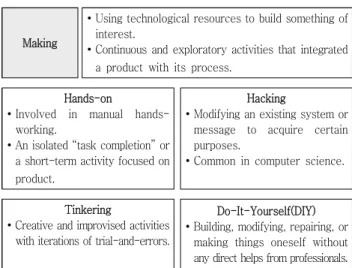
Martin(2005) noted that while the maker movement is a recent phenomenon, similar terms existed prior to the maker movement(see Fig. 1).

Making

∙ Using technological resources to build something of interest.

∙ Continuous and exploratory activities that integrated a product with its process.

Hands-on

∙ Involved in manual hands- working.

∙ An isolated “task completion” or a short-term activity focused on product.

Hacking

∙ Modifying an existing system or message to acquire certain purposes.

∙ Common in computer science.

Tinkering

∙ Creative and improvised activities with iterations of trial-and-errors.

Do-It-Yourself(DIY)

∙ Building, modifying, repairing, or making things oneself without any direct helps from professionals.

Fig. 1 Definitions of making, hands-on, hacking, tinkering, and DIY.

Making is a synonym for building, creating, or fabricating, all fundamental human activities required to produce things to be used(Schon et al., 2014). Chu et al.(2015) argued the differences of the maker movement from hands-on activities.

First, making is associated with technologies, while hands-on often refers to a purely artistic or craft activity. Hands-on implies an activity involved in manual handiwork. Second, making indicates a continuous exploratory activity of both process and product, while a hands-on activity usually refers to an isolated task or short-term action primarily focused on producing an artifact. Therefore, making within the maker movement represents a continuous activity that incorporates technologies to create new products, services, and processes. Similarly, the term maker in the maker movement refers to a wide array of people including hobbyists, engineers, designers, inventors, and technicians who engaged in any types of making activities.

The term hacking is often used in the field of computer science to illustrate an activity that modifies an existing system or steals a message to achieve particular purposes (Martin, 2015). The word hacking is familiarized with the maker movement. However, hacking often refers to an activity that related to computer technologies, such as software development or network security.

Tinkering is a branch of making that creates things, but emphasizes creative and improvised activities based on multiple iterations of the making process(Bevan et al., 2014).

Tinkering plays a vital role in the maker movement that

(3)

encourages makers to engage in making activities until the specific goal of making is achieved through the iterations of defining, questioning, designing, developing, prototyping, and testing.

DIY is an abbreviation for Do-It-Yourself, which refers to an activity where the participants build, modify, or repair something without direct help from professionals(Kuznetsov

& Paulos, 2010). DIY shares a fundamental basis with the maker movement which is a transition from consumer to creator; however, DIY is more so oriented towards hands-on activities for hobby or, leisure(Watson & Shove, 2008).

2. Maker Faires: Spreading around the world

The inaugural Maker Faire was held in San Mateo, California in April 2006(Dougherty, 2012). The purpose of the Maker Faire was to bring together inventors, hobbyists, engineers, and educators in one place to present, develop, and share their creative projects. Since this first Faire, Maker Faires have expanded to many U.S. states and other countries, including England, Germany, Italy, Spain, China, Japan, and South Korea. According to Maker Media, Inc.(2016), more than 1.44 million people in 38 countries attended various Maker Faires in 2016. Particularly, In 2014, the U.S. White House hosted the first Maker Faire which ignited research and developments of educational programs; as a result, a variety of maker education programs and makerspaces are now operating in libraries, museums, and schools(Office of the Press Secretary of The White House, 2016).

3. Makerspaces as community of practice

Makerspaces are an integral part of the maker movement.

Makerspaces provide a physical or virtual platform for the maker movement in which people share, collaborate, play, and make things. There are many community spaces similar to makerspaces, but the spirit and operation of makerspaces are distinct. Fab Lab was initiated by the Grassroots Invention Group and Media Lab at the Massachusetts Institute of Technology(MIT) (Mikhak et al., 2002). The Fab Lab program was designed to facilitate digital fabrication and has stringent operational regulations governed by the MIT Media Lab.

However, makerspaces are relatively flexible and less

structured. Burke(2015) asserted that makerspaces are cultivators of maker culture, where people can focus on playing, enjoying, sharing, and fabricating their innovative ideas; therefore, the corresponding maker communities can build their roles and facilities based on local requests.

III. What brought the maker movement?

1. Change of Maker identity

Dale Dougherty(2016) suggested that humans have a maker DNA, called homo faber. In Latin, homo refers to man and faber is a smith or worker of hard materials. Literally, homo faber is the man maker. On the other hand, Homo sapiens called ‘wise men’ are often considered as a counter characteristic of a human being to homo faber. However, Ferrarin(2000) noted that the definition of homo faber is not opposed to homo sapiens because making is not separable from knowing.

In 2002, the U.S. National Research Council(2002) published a research report “Technically Speaking: Why All Americans Need to Know More About Technology“ The report argued that although most Americans live technology-dependent lifestyles, they were not equipped the decision-making or critical thinking abilities about technology. The report has resonated U.S. engineering and technology education and contributed to the national recognition that technology is necessary for all. The key ideas of the maker movement are not vastly different from the conclusion of this report. Dougherty(2012) argued that the maker movement is not for “inventors” but for all people to enjoy, make, and understand technological products, which is technological literacy. In sum, this body of the literature showed that the maker movement coincides with the personal and social needs of technological literacy that understands, uses, manages, and creates technology.

2. Democratization of technology

In recent few decades, the development of high technologies led democratization of technology(Bilkstein, 2013; Peppler

& Bender, 2013). The democratization of technology refers

(4)

to the phenomena that lay people can access technologies by enhancing the accessibility of technological products and services. For example, just a decade ago, only a few engineers and technicians was able to access to 3D printers because the machines were expensive and their instructions were complicated. Nowadays, however, 3D printers have become less expensive and much easier to operate, so more people can easily access the machines at a low cost(Bilkstein, 2017).

Therefore, the democratization of technology has led more people to engage in making activities.

The advent of digital fabrication tools has contributed significantly to the maker movement(Martin, 2015). The development of digital fabrication tools, such as laser cutters, micro-controllers, or mini-computers, enables people to fabricate products through a low-cost manufacturing process. Recently, Raspberry Pi, often called a single-board computer or mini-computer, allows developers to easily access and control digital computer using a straightforward programming language and graphical user interfaces such as Scratch or Python.

IV. Learning theories and the maker movement

In order to investigate why the maker movement is quickly spreading in education and to examine its potential influence on education, the author reviewed the history of education in terms of the maker movement.

1. Segregation of making from knowing

The ancient Greek philosopher Plato claimed that practical knowledge is inferior to theoretical knowledge. Plato believed that clear distinctions exist between the usefulness of knowledge and three categories of practitioners(Billett, 2010;

Hager & Hyland, 2003). Plato’s idea developed into the segregated education system where, for example, the upper class should learn mathematics, science, history, and philosophy, while the lower classes needed to learn laborious physical activities(Nodding, 2011). Plato's thought has influenced education systems in which hands-on or physical activities were considered vocational and differentiated from general education programs.

2. Establishing the pedagogy of the maker movement:

Rousseau, and Pestalozzi

Following the Christian era and Middle Ages, many educators provided progressive education theories which became the foundation of the maker movement in education.

Jean-Jacques Rousseau(1712-1778) questioned how people should be educated to maintain their natural goodness (Rousseau, 1984). According to Rousseau, children should learn knowledge and skills according to their interests.

Rousseau emphasized the importance of hands-on learning (Nodding, 2011), which became a fundamental component of the maker movement.

Rousseau’s ideas resonated with progressive educators, including Johann Heinrich Pestalozzi(Nodding, 2011).

Pestalozzi followed Rousseau’s ideas and created an educational approach called “Object Lesson” where students observe an object and describe how it works(Hakim, 2015).

The object lesson informed that learning via an object not only leads participants to engage in their learning actively, but also facilitates a deeper understanding of the concepts related to the object.

3. Learning-by-doing and cognitive learning theories:

Dewey, Piaget, and Vygotsky

John Dewey(1859-1952), the proponent of learning- by-doing , is one of the leading scholars of the twentieth century. Dewey emphasized children’s interest and educational experience in learning(Dewey, 2007). Dewey believed that even if students are given the same learning opportunity, they perform differently based on their interests and abilities. He viewed education is synonymous with growth and experience leads to growth(Dewey, 1916). Dewey presented four principles of learning: making things, finding out, expressing themselves artistically, and communicating.

Dewey asserted that when exploring a problem, students

should adopt nagging senses to trigger creativity and critical

thinking; and educators should provide an inquisitive learning

environment. His ideas became the basis of current project-

and problem-based learning methodologies, scientific

inquiry, and student-centered learning, which provide the

basis of the maker movement in education.

(5)

In the mid-twentieth century, Piaget(1896–1980) applied cognitive psychology to education and developed constructivism (Tudge & Winterhoff, 1993). The premise of constructivism is that learners actively construct knowledge, rather than passively perceive facts. Piaget emphasized the learners should actively engage in their learning by interacting with their environment. Meanwhile, the Soviet psychologist, Vygotsky's(1896-1934), addressed social constructivism which asserted learners construct knowledge by responding to the social context. Social constructivism stressed that learners build knowledge through interactions with the learning environment and other people(Vygotsky, 1978).

Piaget’s constructivism informed that the maker education should provide learners with an appropriate learning environment to actively engaging in making activities.

Additionally, Vygotsky’s social constructivism informs that maker education should focus on building learning communities to collaborate with others.

4. Learning-by-Making: Seymour Papert

Seymour Papert(1928-2016) is one of the most influential educators of the maker movement. Papert(1980) worked under Piaget for four years and then established a learning theory, constructionism (Bilkstein, 2013). He advocated for learning-by-making , which is slightly different from Dewey’s learning-by-doing . Papert developed constructionism based on Piaget’s constructivism , but he emphasizes the construction of knowledge through physical activities.

Learning-by-making does not imply that making leads to a construction of knowledge. Instead, it stresses the role of making, which is to facilitate a cognitive development of learners via making activities. Papert described the process of knowledge construction as “the process of making it involves learning to think in terms of the actions and reactions of linked moving objects”(Papert, 1980, p. 131). Based on this idea, he worked with his colleagues to develop LOGO , an educational programming language designed to learn mathematics using computers, and Lego Mindstorms , which allowed young students to learn robotics with simple programming.

V. Conclusion

The maker movement was initiated outside of school, but rapidly spreading to K-12 education with the promise that it will meet the long-term demands of K-12 education(Martin, 2015).

1. Innovation in student learning

Through the literature review, the author found that the maker movement coincides with the demands of more than 100 years of education reforms to meet the needs of the future generation. Dougherty(2012) noted that the hallmarks of the maker movement are emergence, creativity, innovation, and entrepreneurial spirit which can be obtained through making, sharing, creating, supporting, collaborating, and enjoying. These keywords are consistent with contemporary K-12 educational standards. The International Society for

Table 1 International Society for Technology in Education Standards for Students(ISTE, 2016, retrieved from www.iste.org/standards/for-students)

Category Description

Empowered Learner

Students leverage technology to take an active role in choosing, achieving and demonstrating competency in their learning goals, informed by the learning sciences.

Digital Citizen

Students recognize the rights, responsibilities and opportunities of living, learning and working in an interconnected digital world, and they act and model in ways that are safe, legal and ethical.

Knowledge Constructor

Students critically curate a variety of resources using digital tools to construct knowledge, produce creative artifacts and make meaningful learning experiences for themselves and others.

Innovative Designer

Students use a variety of technologies within a design process to identify and solve problems by creating new, useful or imaginative solutions.

Computational Thinker

Students develop and employ strategies for understanding and solving problems in ways that leverage the power of technological methods to develop and test solutions.

Creative Communicator

Students communicate clearly and express themselves creatively for a variety of purposes using the platforms, tools, styles, formats and digital media appropriate to their goals.

Global collaborator

Students use digital tools to broaden their perspectives

and enrich their learning by collaborating with others

and working effectively in teams locally and globally.

(6)

Technology in Education(ISTE) announced the ISTE Standards for Students (ISTE, 2016). The standards consist of 7 core ideas: 1) Empowered Learner, 2) Digital Citizen, 3) Knowledge Constructor, 4) Innovative Designer, 5) Computational Thinker, 6) Creative Communicator, and 7) Global Collaborator(see Table 1). Moreover, the National Education Association(NAE) presented the 4Cs —Creativity, Collaboration, Communication, and Critical Thinking—as a set of core skills valued by the global society of the 21st century(National Education Association, 2012).

2. Pedagogy of the maker movement for education

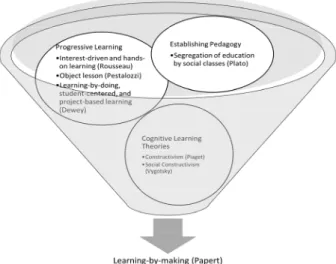
The author confirmed that the pedagogy of the maker movement is aligned with the progressive learning theories and Papert’s constructionism (Bilkstein, 2013; Halverson &

Sheridan, 2014; Martin, 2015) (see Fig. 2). Dewey's learning-by-doing informs that the maker movement provides inquisitive learning experiences which enable students to actively engage in making, exploring, expressing, and communicating ideas. Papert’s learning-by-making supports that tinkering facilitates active learning by providing appropriate cognitive loads and rewards. Papert’s constructionism also provides the insight that a making activity itself leverages the acquisition of new concepts by providing cognitive experience. In fact, some people believe that the act of making is less effective for the development of high-order thinking abilities, and suggest that conceptual

Fig. 2 Theoretical foundation of the maker movement

learning is more efficient for secondary school students.

However, Papert's theory indicates that making not only meets the advanced goals of education but also supports continuous cognitive developments of learners.

VI. Discussion

1. Aligning the maker movement with school curriculum

When bringing the maker movement into school, teachers and school leaders need to align it with integrated STEM or STEAM(added A for arts). Integrated STEM/STEAM education has been initiated with the recognition of education and global issues, such as growing concerns regarding climate change, public health, resource management, declining energy and water sources, the declining student interest in STEM learning, and the future shortages in the STEM workforce(Sanders, 2009; Thomasian, 2011). The school maker movement provides a learning platform for integrated STEM education. Halverson and Sheridan(2014) claimed that learning through making, particularly using digital technologies, helps students to achieve the interdisciplinary goals of STEM learning. Engagement in a maker project enables students to use a variety of knowledge and skills across multiple disciplines, such as electronics, design, engineering, economics, and the liberal arts. Bilkstein(2017) also noted that the alignment with national curricula and standards has two potential advantages: 1) rewards to teachers and students; and 2) financial benefit with additional funding opportunities.

However, when aligning the maker movement with STEM/STEAM learning in K-12 schools, educators should consider how to preserve the core values of the maker movement: innovation, creativity, flexibility, collaboration, communication, and playfulness. Many research studies concluded that creative ideas arise when people spend more time to define and understand open-ended problems, and subsequently create their own frame of reference for a conceptual structure(Christiaans, 1992; Dorst & Cross, 2001;

Kelley & Sung, 2017). However, traditional school systems

often do not allow students to become creative subjects

due to the systematic school cultures and well-structured

curricula, which disable creativity and flexibility of students.

(7)

To adopt the maker education in school, Bilkstein(2017) introduced a “curriculum factory” model. The model demonstrated that the maker movement sustainably integrates with existing school curriculum. The schools officially assigned a maker teacher who is in charge of the school maker space. The other school teachers brought their lesson plans to the maker teacher, and the maker teacher redesigned the lesson plans to utilize the school maker resources more efficiently. Thus, when bringing the maker movement to school, teachers and researchers might consider adopting practical approaches like the “curriculum factory” model.

2. Use grassroots approach with technology education

Literature indicates that key to the success of the maker movement is igniting the grassroots power in school, particularly technology education. Among the K-12 school subjects, technology education has a similar root with the maker movement. The philosophical background of technology education is the hands-on based learning approach featuring interest-driven, object lessons, and learning by doing(ITEA/ITEEA, 2000/2002/2007; Ryu, 2000).

Even though the history of technology education shared the root with career and vocational education(National Research Council, 2002), technology researchers and teachers have worked to separate the disciplines over past few decades (Sanders, 2001). Accordingly, the technology education standards, Standards for Technological Literacy(STL) (ITEA/ITEEA, 2000/2002/2007), defined technology as “how people modify the natural world to suit their own purposes”

(p. 2). In fact, technology education uses hands-on, DIY, tinkering as a core instructional methodology. Accordingly, when initiating a school maker movement, school leaders need to consider utilizing available school resources from technology teachers and education facilities.

3. Build Makerspace in School: The Maker Infrastructure

Fleming(2015) mentioned, “schools are filled with creativity”(p. 12). The Makerspace is the essence of the maker movement, where the community members create their own making culture. When schools build a makerspace, they should reflect on the ultimate goal of the maker movement

and the way to build a sustainable make culture. Schools already have various types of specialized rooms such as art rooms, science laboratories, and technology classrooms.

In fact, some technology classrooms are already equipped with many digital fabrication tools, such as 3D printers, laser cutters, and hands-on tools. However, educators may need to decide whether the arrangement and accessibility of the space intrigue all students regardless majors and preferences. Weber and Custer(2005) claimed that traditional maker-type spaces, particularly technology classrooms, were designed for men like a machine shop. Hynes and Hynes (2017) studied the preferences of makerspaces in college students and concluded that aesthetic design, clean spaces, and enough storage and seating are necessarily for the success of makerspaces. In most cases, schools have limited budgets and space; therefore, recycling or expanding existing school maker type spaces, such as technology laboratories, may be a good alternative. If a school recycles existing classrooms, the makerspace can easily align with the school curriculum or standards.

When building a makerspace in schools, bottom-up approach will be a solution to handle realistic issues. In public school settings, a large group of students uses a limited school makerspace for a limited time, while professional makers freely move around multiple spaces for an extended period. These inconsistencies yield an inefficiency in decision-making when planning a makerspace. To address this issue, Bilkstein suggested that the bottom-up approach produced better results than a top-down model. The configuration of makerspaces depends on the purpose of the makerspace, the interests of students, and the availability of funding. Therefore, school members should lead the planning and decision-making of the makerspace. Before creating a school makerspace, the school should identify the needs and interest of teachers, students, and community members, and then build a clear and sustainable roadmap to maintain the maker culture in the school.

Finally, further research and discussion are necessary on the successful integration of the maker movement in schools.

The author believes that empirical research based on the

observations or experience is imperative to the successful

incorporation of the maker movement in schools.

(8)

Reference

1. Bevan, B., Petrich, M., & Wilkinson, K.(2014). Tinkering is serious play. Educational Leadership, 72 (4), 28-33.

2. Billett S.(2010). The Practices of learning through occupations.

In Billett S. (Eds). Learning Through Practice (pp. 59-81).

Dordrecht, Netherlands: Springer.

3. Blikstein, P.(2013). Digital fabrication and ‘Making’ in education: The Democratization of Invention. In J.

Walter-Herrmann & C. Buching (Eds.), Fab Labs: Of Machines, Makers and Inventors . Bielefeld, Germany: Transcript Publishers.

4. Blikstein, P.(2017). The history and prospects of the maker movement in education. In de Vries, M. J. (Eds.), Handbook of Technology Education, Springer International Publishing . doi: 10.1007/978-3-319-38889-2_33-1.

5. Burke, J.(2015, March). Making sense: Can makerspaces work in academic libraries? [Electronic version]. ACRL Conference Proceedings . Portland, Oregon.

6. Christiaans, H. H. C. M.(1992). Creativity in design: the role of domain knowledge in designing . Utrecht, Netherlands:

Uitgeverij LEMMA BV.

7. Clough, G. W.(2004). The engineer of 2020: Visions of engineering in the new century . Washington, DC: National Academy of Engineering.

8. Dewey, J.(1916) Education as growth. In J.J. McDermott, (Ed.), The Philosophy of John Dewey (2nd. Ed., pp. 483-93). Chicago, IL: University of Chicago Press.

9. Dewey, J.(2007). Experience and education . New York, NY:

Simon and Schuster.

10. Dorst, K., & Cross, N.(2001). Creativity in the design process:

co-evolution of problem –solution. Design Studies, 22 (5), 425-437.

11. Dougherty, D.(2012). The maker movement. Innovations, 7 (3), 11-14.

12. Dougherty, D.(2016). Free to make: how the maker movement is changing our schools, our jobs, and our minds . Thousand Oaks, CA: North Atlantic Books.

13. Fleming, L.(2015). Worlds of making: Best practices for establishing a makerspace for your school . CA: Corwin Press.

14. Ferrarin, A.(2000). Homo faber, homo sapiens, or homo politicus? Protagoras and the myth of Prometheus. The Review of Metaphysics , 54 (2), 289-319.

15. Hager, P. and Hyland, T.(2003). Vocational education and training. In Blake, N., Smeyers, P. Smith, R. and Standish, P.(Eds.), The Blackwell guide to the philosophy of education

(pp. 271-287). New Jersey, NJ: Blackwell Publishing Limited.

16. Hakim, L.(2015). Object Lessons: Making, knowing, and growing things. Huntington Library Quarterly, 78 (1), 127-136.

17. Halverson, E. R., & Sheridan, K.(2014). The maker movement in education. Harvard Educational Review, 84 (4), 495-504.

18. Hynes, M. M., & Hynes, W. J.(2017). If you build it, will they come? Student preferences for Makerspace environments in higher education. International Journal of Technology and Design Education , doi: 10.1007/s10798-017-9412-5 19. International Society for Technology in Education.(2016).

ISTE Standards for Students . Retrieved from www.iste.org/

standards/for-students#startstandards

20. International Technology Education Association(ITEA/

ITEEA). (2000/2002/2007). Standards for technological literacy:

Content for the study of technology . Reston, VA: Author.

21. Kelley, T. R., & Sung, E.(2017). Design fixation. Engineering Technology Teacher , 77(3), 15-19.

22. Kuznetsov, S., & Paulos, E.(2010, October). Rise of the expert amateur: DIY projects, communities, and cultures. In Proceedings of the 6th Nordic Conference on Human-Computer Interaction:

Extending Boundaries (pp. 295-304). Reykjavik, Iceland:

ACM.

23. Office of the Press Secretary of The White House.(2016, June 17). New Commitments in Support of the President’s Nation of Makers Initiative to Kick Off 2016 National Week of Making . Retrieved from https://obamawhitehouse.archives.

gov/sites/whitehouse.gov/files/images/Blog/2016%20Nation al%20Week%20of%20Making%20Fact%20Sheet.pdf

24. Maker Media, Inc.(2016). Fast fact: Maker faire global 2016 . Retrieved from https://makerfaire.com/media-center/#fast- facts

25. Martin, L.(2015). The promise of the maker movement for education. Journal of Pre-College Engineering Education Research (J-PEER), 5 (1), 30-39.

26. Mikhak, B. et al.(2002, December). Fab Lab: an alternate model of ICT for development. In 2nd International Conference on Open Collaborative Design for Sustainable Innovation.

27. National Education Association.(2012). Preparing 21st century students for a global society: An educator’s guide to the “Four Cs.” Alexandria, VA: National Education Association.

28. National Research Council.(2002). Technically speaking: Why all Americans need to know more about technology.

Washington, DC: National Academies Press.

29. Nodding, N.(2011). Philosophy of education (3rd ed.) . Boulder,

CO: Westview Press.

(9)

30. Papert, S.(1980). Mindstorms: Children, computers, and powerful ideas. New York, NY: Basic Books.

31. Peppler, K., & Bender, S.(2013). Maker movement spreads innovation one project at a time. Phi Delta Kappan, 95 (3), 22-27.

32. Resnick, M. et al.(2009). Scratch: programming for all.

Communications of the ACM, 52 (11), 60-67.

33. Rousseau, J. J.(1984). A discourse on inequality . London, UK:

Penguin.

34. Ryu, C.(2000). Foundation of technology education . Daejoen, KR: Chungnam National University Press.

35. Sanders, M.(2001). New paradigm or old wine? The status of technology education practice in the United States. Journal of Technology Education, 12 (2), 35-55. Doi: 10.21061/

jte.v12i2.a.3

36. Sanders, M. (2009). STEM, STEM Education, STEMmania.

The Technology Teacher, 68 (4), 20-26.

37. Schon, S., Ebner, M., & Kumar, S.(2014). The maker movement.

Implications of new digital gadgets, fabrication tools and spaces for creative learning and teaching. Learning Papers, 39 , 14-25.

38. Sheppard, S. D. et al.(2008). Educating engineers: Designing for the future of the field (Vol. 2) . San Francisco, CA:

Jossey-Bass.

39. Tanenbaum, J. G. et al.(2013, April). Democratizing technology: pleasure, utility and expressiveness in DIY and maker practice. In Proceedings of the SIGCHI Conference on Human Factors in Computing Systems (pp. 2603-2612).

Paris, France: ACM.

40. Thomasian, J.(2011). Building a science, technology, engineering, and math education agenda: An update of state actions . Washington, DC: National Governors Association Center for Best Practices.

41. Tudge, J., & Winterhoff, P.(1993). Vygotsky, Piaget, and Bandura: Perspectives on the relations between the social world and cognitive development. Human Development , 36, 61-81.

42. Vygotsky, L.(1978). Interaction between learning and development. Readings on the development of children, 23 (3), 34-41.

43. Watson, M., & Shove, E.(2008). Product, competence, project and practice: DIY and the dynamics of craft consumption.

Journal of Consumer Culture, 8 (1), 69-89.

44. Weber, K., & Custer, R.(2005). Gender-based preferences toward technology education content, activities, and instructional methods. Journal of technology education, 16 (2), 55-71.

성의석 (Sung, Eui Suk)

2006년: 충남대학교 컴퓨터공학교육학과 졸업 2012년: 서울대학교 대학원 농산업교육학과 석사 2014년~현재: 퍼듀대학교 공학기술교육학과 박사과정 관심분야: Engineering design, design cognition, design thinking, maker movement

E-mail: [email protected]

수치

Fig. 1 Definitions of making, hands-on, hacking, tinkering,  and  DIY.
Table  1  International  Society  for  Technology  in  Education  Standards  for  Students(ISTE,  2016,  retrieved  from  www.iste.org/standards/for-students)
Fig.  2  Theoretical  foundation  of  the  maker  movement

참조

관련 문서

If both these adjustments are considered, the resulting approach is called a bootstrap-BC a -method (bias- corrected-accelerated). A description of this approach

③ A student who attended Korean course at KNU Korean Language Program and holds TOPIK Level 3 or a student who completed Korean course Level 4 at the KNU Korean Language

· 50% exemption from tuition fee Ⅱ for the student with a TOPIK score of level 3 or higher or completion of level 4 or higher class of the Korean language program at the

웹 표준을 지원하는 플랫폼에서 큰 수정없이 실행 가능함 패키징을 통해 다양한 기기를 위한 앱을 작성할 수 있음 네이티브 앱과

_____ culture appears to be attractive (도시의) to the

Common corporate digital crimes include piracy, financial fraud, espionage, and theft of services.. _______________________________________ such as

The index is calculated with the latest 5-year auction data of 400 selected Classic, Modern, and Contemporary Chinese painting artists from major auction houses..

S국은 국내법에 따라 과세할 권리를 기지고 있 지 않기 때문에 , 그리고 조세조약에 따라 소득이 귀속될 S국에 있는 Tco가 S국에 고정사업장을 가지고 있지