42(7), 997~1002(2013) http://dx.doi.org/10.3746/jkfn.2013.42.7.997
음료 농축액 및 퓨레의 항산화 활성
김단비1․신기해1․조주현2․백순옥2․이옥환1†
1강원대학교 식품생명공학과
2(주)휴럼 중앙연구소
Antioxidant Activities of Beverage Concentrates and Purees
Dan Bi Kim1, Gi Hae Shin1, Ju Hyun Cho2, Soon Ok Baik2, and Ok-Hawn Lee1†
1Dept. of Food Science and Biotechnology, Kangwon National University, Gwangwon 200-701, Korea
2Hurum Central Research Institute, Chungbuk 363-880, Korea
ABSTRACT This study investigated the physicochemical properties (pH, Brix), total phenol content, antioxidant activ- ities (DPPH radical scavenging activity and oxygen radical absorbance capacity (ORAC)), and nitrite scavenging activity of beverage concentrates and purees. All concentrates and purees were produced from natural materials and have been used as the main ingredients in health-related beverages. Our results show that the pH values and Brix of all concentrates and purees ranged from 2.81 to 5.12 and 1.70 to 70.30 Brix, respectively. The highest total phenol content (182.71 mg GAE/mL), DPPH radical scavenging activity (69.88%) and nitrite scavenging activity (28.19%) were ob- tained from acai berry puree. The concentrate from wild blueberry had the highest ORAC value (27,514 μM TE/mL).
Among the correlation coefficient data, the total phenol content exhibited a high correlation coefficient (r=0.9099) and DPPH radical scavenging activity. These results suggest that concentrates and purees from natural materials contrib- ute to antioxidant activities in healthy beverages.
Key words: healthy beverage, concentrates and purees, physicochemical properties, antioxidant activity, oxygen radical absorbance capacity
Received 4 March 2013; Accepted 3 April 2013
†Corresponding author.
E-mail: [email protected], Phone: 82-33-250-6454
서 론
현대사회는 급속한 경제성장으로 생활수준은 향상되었으 나 환경오염, 일상생활에서의 스트레스, 서구화된 식생활 및 각종 생활양식의 변화로 인하여 비만, 뇌혈관 질환, 심장병, 고혈압 등의 만성퇴행성질환의 발병률이 증가하였다(1). 만 성퇴행성질환의 주요 원인은 체내 생물학적 연소 과정에서 생성되는 reactive oxygen species(ROS)로써 superoxide (O2-), singlet oxygen(O21), hydrogen peroxide(H2O2) 등 이 포함되며 체내에 과량 존재할 경우 세포의 주요 구성 성 분인 지질, 단백질, DNA 등의 손상을 일으켜 산화적 스트레 스를 유발하게 된다(2,3).
최근 소비자들의 질병에 대한 불안감이 ‘웰빙(well-be- ing)’이라는 시대적 트렌드와 맞물려 기능성, 안전성을 갖추 는 건강지향적인 제품으로 소비패턴이 변화하고 있으며, 이 에 따라 식품에서도 건강 지향적 소재개발 및 다양한 종류의 가공품에 대한 연구가 활발히 진행되고 있다(4-9). 특히 건 강 지향적 가공품 중에서 건강음료는 소비자들에게 간편성,
기호성 및 기능성을 바탕으로 소비되는 제품으로, 소비자는 음료를 선택하는 과정에서 생리활성을 가지는 영양 성분을 매우 중요한 선택요소로 활용하는 것으로 알려져 있다(9).
건강음료의 주원료가 되는 과일 및 채소 등의 농축액 및 퓨레에는 페놀성 화합물과 flavonoids, dietary fibers, 항산 화성 비타민류(vitamin C & E) 등이 풍부하다고 알려져 있 으며, 이들 성분들은 체내 산화적 스트레스를 저감하는 것으 로 연구된 바 있다(10-12). 국내 건강음료 시장에서 많이 사용되는 원료인 블루베리, 아사이 베리, 석류, 홍삼 등은 항산화(13), 항암(14,15), 항비만(16) 등의 생리활성을 가 지며, 특히 석류 농축액, 홍삼 농축액 등을 첨가한 제품류의 항산화(17), 품질특성(18)에 대한 연구도 진행되고 있다. 또 한, 최근 커피, 주스 및 음료 등에 건강 콘셉트의 마케팅 차원 에서 항산화 성분(총 페놀 함량), 항산화활성(ORAC value), 비타민 함량 등을 표기한 제품들이 상품화 되고 있으며, 천 연물을 비롯한 기능성 소재를 이용하여 항산화음료, 스포츠 드링크와 같은 건강음료에 대한 연구가 진행된 바 있다(19).
하지만 건강음료 개발에 주요 원료로 사용되는 천연물 유래 농축액 및 퓨레에 대한 기초자료 및 항산화 활성에 대한 연 구는 아직 초기단계에 머물러 있다.
따라서 본 연구에서는 최근 건강음료의 주원료로 이용되 고 있는 천연물 유래 음료 농축액 및 퓨레 8종을 선별하여
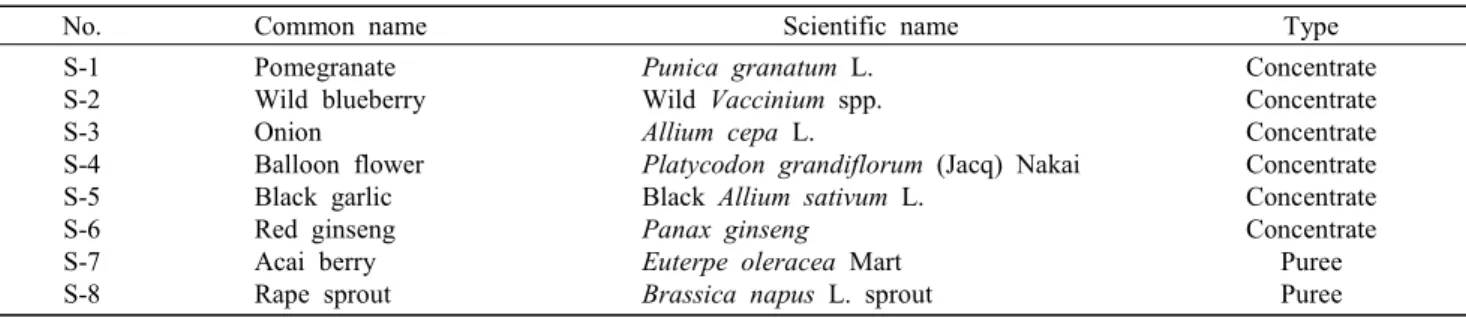
Table 1. The list of beverage concentrates and purees evaluated in this experiment
No. Common name Scientific name Type
S-1 S-2 S-3 S-4 S-5 S-6 S-7 S-8
Pomegranate Wild blueberry Onion
Balloon flower Black garlic Red ginseng Acai berry Rape sprout
Punica granatum L.
Wild Vaccinium spp.
Allium cepa L.
Platycodon grandiflorum (Jacq) Nakai Black Allium sativum L.
Panax ginseng Euterpe oleracea Mart Brassica napus L. sprout
Concentrate Concentrate Concentrate Concentrate Concentrate Concentrate
Puree Puree
이화학적 특성(pH 및 Brix), 총 페놀 함량, 항산화 효능 (DPPH radical scavenging activity, ORAC assay) 및 아 질산염 소거능을 비교 평가함으로써 이들 농축액 및 퓨레에 대한 건강 음료 개발 시 기초자료를 제시하고자 하였다.
재료 및 방법
실험재료 및 시약
본 연구에 사용된 천연물 유래 농축액 및 퓨레는 대형마트 에서 건강음료로 판매되고 있는 8종 음료의 농축액 및 퓨레 를 선별하였다. 총 8종의 농축액 및 퓨레는 Table 1과 같이 석류 농축액, 블루베리 농축액, 양파추출 농축액, 도라지추 출 농축액, 발효 흑마늘 농축액, 홍삼 농축액, 아사이베리 퓨레 및 새싹유채 퓨레를 사용하였고 건강음료 제조업체인 (주)휴럼 중앙 연구소(Cheongwon, Korea)에서 제공받아 사용하였다. Sodium carbonate, Folin-Ciocalteu's phe- nol reagent, gallic acid, 2,2-diphenyl-1-picrylhydrazyl (DPPH), sodium phosphate dibasic, 2,2'-azobis(2-ami- dinopropane) dihydrochloride(AAPH), acetic acid, gri- ess reagent, 6-hydroxy-2,5,7,8,-tetramethylchroman- 2-carboxylic acid(Trolox), sodium nitrite 등은 Sigma- Aldrich Co.(St. Louis, MO, USA)에서 구입하였으며, po- tassium phosphate monobasic, fluorescein(sodium salt) 는 Junsei Chemical(Tokyo, Japan)에서 구입하여 사용하 였다.
pH 및 Brix 측정
음료 농축액 및 퓨레의 pH 측정은 석류 농축액, 블루베리 농축액, 양파추출 농축액, 도라지추출 농축액, 발효 흑마늘 농축액 및 홍삼 농축액 2.5 g을 증류수 47.5 g에 녹여 pH meter(pH510, EUTECH Co., Anyang, Korea)를 이용하 여 3회 반복 측정 후 평균값을 나타내었고 아사이베리 퓨레, 새싹유채 퓨레액은 원액 그대로 사용하였다. Brix는 당도계 (PAL-α Brix 0~85%, Atago, Tokyo, Japan)를 이용하여 3회 반복 측정 후 평균치를 나타내었다.
총 페놀 함량 측정
총 페놀 함량은 Folin-Ciocalteu's phenol reagent가 시
료의 페놀성 화합물에 의해 몰리브덴 청색으로 환원되는 원 리로 측정하였다(20). 시료는 석류 농축액, 블루베리 농축 액, 양파추출 농축액, 도라지추출 농축액, 발효 흑마늘 농축 액 및 홍삼 농축액은 3 g을 1,000 mL volumetric flask에 녹여 3배 희석하여 사용하였으며, 아사이베리 퓨레, 새싹유 채 퓨레는 원액 그대로 사용하였다. 각 시료 1 mL에 2%
Follin-Ciocalteu's phenol regent 1 mL 및 10% Na2CO3 용액을 1 mL 첨가하여 혼합한 후 상온에서 1시간 동안 방치 하였다. 그리고 상등액을 microplate reader(Molecular Devices LLC, Sunnyvale, CA, USA)를 이용하여 750 nm 에서 흡광도를 측정하였다. 표준물질은 gallic acid를 이용 하였으며 표준 검량 곡선(y=10.555x-0.0806, r2=0.9948)으 로부터 총 페놀 함량을 계산하였다.
DPPH 라디칼 소거능 측정
DPPH 라디칼 소거능 측정은 Stagos 등(21)의 방법을 변 형하여 측정하였으며, 시료는 총 페놀 함량 측정과 동일하게 사용하였다. 시료 0.2 mL에 ethanol로 용해한 0.4 mM DPPH 용액 0.8 mL를 첨가하여 혼합한 후 상온에서 10분간 반응하였다. 그리고 microplate reader를 사용하여 490 nm에서 흡광도 값을 측정한 후 다음 식(1)을 이용하여 결과 값을 나타내었다.
DPPH radical
scavenging activity (%)=
(
1- AAExperiment)
×100Control
(1)
Oxygen radical absorbance capacity(ORAC) 본 실험에서 시료, 표준물질의 농도별 희석 및 시약의 제 조는 75 mM phosphate buffer(pH 7.4)를 이용하였다.
Black well plate에 시료 25 μL, 40 nM fluorescein 150 μL를 첨가하고 측정 직전에 150 mM AAPH 25 μL를 첨가 한 다음 fluorescence microplate reader(Spectramax GEMINI EM, Molecular Devices LLC)를 이용하여 485 nm에서 전자여기 후 535 nm에서 방출되는 조건으로 37°C 에서 90분간 3분마다 fluorescence의 감소율을 측정하였 다. 결과 값은 시료 첨가구와 무 첨가구의 area under curve (AUC)값을 나타낸 후 Trolox를 이용하여 작성한 검량선 (y=1.8019x+0.5619, r2=0.9979)에 대입하여 나타내었다 (22).
Table 2. pH and Brix of beverage concentrates and purees
Samples pH Brix
S-1 S-2 S-3 S-4 S-5 S-6 S-7 S-8
2.81±0.001) 3.22±0.00 5.12±0.00 4.85±0.00 3.98±0.00 4.70±0.00 4.05±0.00 3.95±0.00
62.70±0.00 58.90±0.00 55.10±0.00 49.40±0.00 57.00±0.00 70.30±0.00 9.30±0.00 1.70±0.00
1)Each value is mean±SD (n=3).
11.30e 182.71a
17.58c 15.28d 9.18fg 8.80g 21.09b 9.66f 0 20 40 60 80 100 120 140 160 180 200
S-1 S-2 S-3 S-4 S-5 S-6 S-7 S-8
Total phenolic content (mg GAE/mL) .
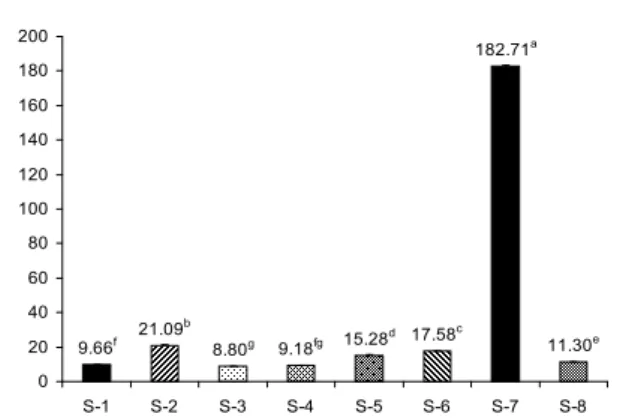
Fig. 1. Total phenol content of beverage concentrates and purees.
Total phenol content expressed as gallic acid equivalent (mg GAE/mL). Each bar represents the mean±SD of triplicate deter- minations, n=3. a-gMeans not sharing a common letter are sig- nificantly different (P<0.05) by Duncan's multiple test. S-1, pomegranate; S-2, wild blueberry; S-3, onion; S-4, balloon flow- er; S-5, black garlic; S-6, red ginseng; S-7, acai berry; S-8, rape sprout.
Area under curve(AUC)=1+f1/f0+f2/f0+f3/f0+4/f0+ ...f/31/f0
아질산염 소거능 측정
아질산염 소거활성 측정은 Kato 등(23)의 방법을 변형하 여 사용하였으며, 시료는 항산화 실험과 동일한 시료를 사용 하였다. 시료 1 mL에 1 mM NaNO2 용액 1 mL를 첨가한 뒤 0.1 N HCl을 이용하여 pH 1.2로 보정한 다음 37°C에서 1시간 반응시킨 후 반응액 1 mL를 취하여 2% acetic acid 5 mL와 Griess reagent 0.4 mL를 첨가하고 잘 혼합한 뒤 상온에서 15분간 방치하였다. 그리고 microplate reader를 사용하여 520 nm에서 흡광도를 측정하고 다음 식(2)에 대 입하여 값을 백분율로 나타내었다.
Nitrite scavenging
activity (%) =
(
1- AAExperiment)
×100Control (2)
통계분석
총 페놀 함량, 항산화 활성 및 아질산염 소거능 결과값의 통계처리는 SAS version 9.2(SAS institute Inc., Cary, NC, USA)를 이용하여 분석하였다. 유의성 분석은 ANOVA 검정을 실시하였으며 Duncan의 다중범위 검정법(Dun- can's multiple range test)으로 유의성은 P<0.05 수준에서 검정하였다. 상관관계는 SigmaPlot(Ver 9.0, Systat, San Jose, CA, USA)의 linear regression을 이용하여 분석하였 다.
결과 및 고찰
이화학적 특성 및 총 페놀 함량
석류 농축액, 블루베리 농축액, 양파추출 농축액, 도라지 추출 농축액, 발효 흑마늘 농축액, 홍삼 농축액, 아사이베리 퓨레 및 새싹유채 퓨레의 pH 및 Brix를 측정한 결과는 Table 2와 같다. pH는 양파추출 농축액이 5.12로 가장 높았 고 도라지추출 농축액(4.85), 홍삼 농축액(4.70) 순이었으 며 석류 농축액이 2.81로 가장 낮았다. 석류 농축액의 경우, 석류에 함유된 유기산류에 의해 가장 낮은 pH를 나타낸 것 으로 사료되었다. 이는 Kim과 Eun(17)의 연구에서 석류 농 축액의 pH가 2.67로 측정된 것과 유사한 결과를 보였다.
한편 농축액의 Brix는 홍삼 농축액에서 70.30 Brix로 가장 높았고 석류 농축액도 62.70 Brix로 높았다. 반면 아사이베 리 퓨레 및 새싹유채 퓨레의 Brix는 각각 9.30 및 1.70 Brix 이었다.
페놀성 화합물은 식물계에 널리 분포되어 있는 물질로 다 양한 구조와 분자량을 가지며 페놀성 화합물의 phenolic hydroxyl기가 수소공여와 페놀 고리 구조의 공명안정화를 일으켜 항산화 활성을 나타낸다는 연구가 보고되었다(24).
음료 농축액 및 퓨레의 총 페놀 함량은 Fig. 1과 같다. 총 페놀 함량은 아사이베리 퓨레가 182.71 mg GAE(gallic acid equivalent)/mL로 유의적으로 가장 높은 함량을 보였 고 블루베리 농축액도 21.09 mg GAE/mL로 높은 함량을 나타내었다. 베리류(아사이베리 퓨레 및 블루베리 농축액) 에는 stilbene 계열의 resveratrol을 비롯하여 tannins, el- lagitannins, quercetin, gallic acid, anthocyanins, cyani- dins과 같은 페놀성 화합물이 풍부하다고 보고(25)되어 페 놀성 화합물에 의한 항산화 활성이 기대된다.
DPPH 라디칼 소거능 및 ORAC 지수
DPPH 라디칼 소거능은 시료의 항산화 활성을 간단하게 측정 가능하여 항산화 활성 평가에 많이 활용되는 방법 중 하나이다. 실험에 이용되는 시약인 DPPH는 비교적 안정한 free radical로써 항산화물질과 반응 시 radical이 소거되어 짙은 보라색에서 노란색으로 탈색되는 원리를 이용하여 항 산화 활성을 측정하는데 사용된다(26). 음료 농축액 및 퓨레 의 DPPH 라디칼 소거능을 측정한 결과는 Fig. 2와 같이, 아사이베리 퓨레에서 DPPH 라디칼 소거능이 69.88%로 가 장 높았고 다음으로 블루베리 농축액이 42.53%로 높았다.
이는 총 페놀 함량의 결과와 유사한 것으로 페놀성 화합물에 존재하는 hydroxyl group(-OH)에 의한 전자공여능에 기인 한 것으로 총 페놀 함량이 높은 아사이베리 퓨레 및 블루베
c a
f d f g b
e
0 10 20 30 40 50 60 70 80
S-1 S-2 S-3 S-4 S-5 S-6 S-7 S-8
DPPH radical scavenging activity (%) .
Fig. 2. DPPH radical scavenging activity of beverage concen- trates and purees. Each bar represents the mean±SD of triplicate determinations, n=3. a-gMeans not sharing a common letter are significantly different (P<0.05) by Duncan's multiple test. S-1, pomegranate; S-2, wild blueberry; S-3, onion; S-4, balloon flow- er; S-5, black garlic; S-6, red ginseng; S-7, acai berry; S-8, rape sprout.
g d c b
e f a
f
0 5000 10000 15000 20000 25000 30000
S-1 S-2 S-3 S-4 S-5 S-6 S-7 S-8
ORAC value (μM TE/mL) .
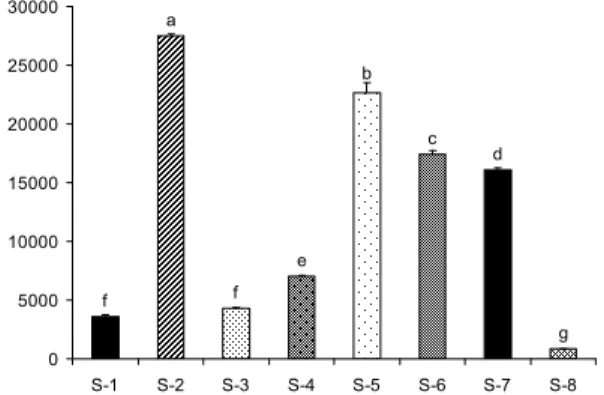
Fig. 3. ORAC value of beverage concentrates and purees. ORAC values expressed as Trolox equivalents (μM TE/mL). Each bar represents the mean±SD of triplicate determinations, n=3. a-gMeans not sharing a common letter are significantly different (P<0.05) by Duncan's multiple test. S-1, pomegranate; S-2, wild blue- berry; S-3, onion; S-4, balloon flower; S-5, black garlic; S-6, red ginseng; S-7, acai berry; S-8, rape sprout.
b a
d c c
d d d
0 5 10 15 20 25 30
S-1 S-2 S-3 S-4 S-5 S-6 S-7 S-8
Nitrite scavenging activity (%) .
Fig. 4. Nitrite scavenging activity of beverage concentrates and purees. Each bar represents the mean±SD of triplicate determi- nations, n=3. a-dMeans not sharing a common letter are sig- nificantly different (P<0.05) by Duncan's multiple test. S-1, pomegranate; S-2, wild blueberry; S-3, onion; S-4, balloon flow- er; S-5, black garlic; S-6, red ginseng; S-7, acai berry; S-8, rape sprout.
리 농축액에서 다른 시료에 비해 높은 항산화 활성을 나타낸 것으로 판단되었다. Jeong 등(27)은 블루베리와 라즈베리 중에 총 페놀 함량을 많이 함유한 블루베리 추출물의 DPPH 라디칼 소거능이 라즈베리 추출물에 비해 높게 나타났다는 결과와 유사한 경향을 나타냈다.
ORAC assay는 radical chain reaction의 주요 단계인 수 소 전자 전달과 연관하여 항산화 성분의 free radical 소거 능을 측정하는 방법으로 hydrophobic 성분과 hydrophilic 성분에 모두 반응하기 때문에 전자전달이론과 관련된 항산 화 활성 실험 방법들보다 높은 반응감도로 정확도를 높일 수 있는 실험이다(28-30). 음료 농축액 및 퓨레의 ORAC 지수를 측정한 결과 Fig. 3과 같이 ORAC 지수는 블루베리 농축액에서 27,514 μM TE/mL로 가장 높았고 그 다음으로 발효 흑마늘 농축액에서 22,626 μM TE/mL로 나타났다.
Speisky 등(31)의 연구에서 건조된 블루베리의 ORAC 지수
는 블루베리 품종에 따라 다르며, aurora종은 26,642 μM TE/100 g, bluecrop종은 27,412 μM TE/100 g, bluegold 종은 33,677 μM TE/100 g, brigitta종은 21,304 μM TE/
100 g으로 보고하였고, Feeney(32)는 성인 일일 ORAC 권 장량을 약 3,000~5,000 ORAC 지수로 제시한바 있다. 즉 ORAC 지수가 높은 블루베리 농축액, 흑마늘 농축액, 홍삼 농축액 및 아사이베리 퓨레 등을 이용하여 음료를 제조 시 성인 일일 권장량에 충족하는 ORAC 지수를 함유한 항산화 음료, 항산화 주스 등의 건강음료 개발이 가능할 것으로 판 단된다.
아질산염 소거능
아질산염은 일정 농도 이상 섭취할 경우 혈중에서 hemo- globin의 산화를 일으켜 methemoglobin을 형성하며 이는 methemoglobin증 등의 각종 중독증상을 발생시키는 것으 로 알려져 있다. 또한 식품 중에서 2급, 3급 amin과 결합하 여 발암물질인 nitrosoamine을 생성할 수 있으므로 아질산 염 소거능 평가를 통하여 시료의 항암작용 여부를 간접적으 로 확인할 수 있다(33,34). 음료 농축액 및 퓨레의 아질산염 소거능을 측정한 결과 Fig. 4와 같이 아사이베리 퓨레에서 28.19%로 가장 높았다. 본 연구의 결과는 페놀성 물질이 아질산염의 니트로화 반응을 억제한다는 보고(35-37)와 유 사한 경향을 보였으며, 총 페놀 함량이 가장 높았던 아사이 베리 퓨레에서 아질산염소거능이 높게 나타났다. 이상의 결 과로 볼 때, DPPH 라디칼 소거능, ORAC assay, 아질산염 소거능은 각각 측정원리 및 반응 메커니즘이 다르기 때문에 항산화성분 및 항산화 활성 간에 상관관계 분석이 요구되어 진다. 따라서 음료 농축액 및 퓨레의 항산화성분(총 페놀 함량) 및 다양한 항산화 평가모델(DPPH 라디칼 소거능, ORAC 지수, 아질산염 소거능)에서의 상관관계를 조사하였 다.
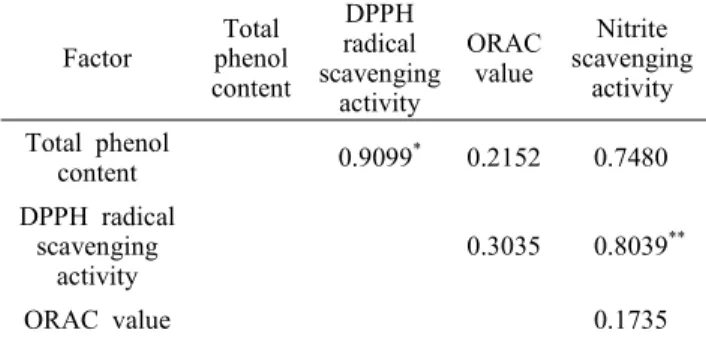
Table 3. Correlation coefficients among total phenol content, DPPH radical scavenging activity, ORAC value, nitrite scaveng- ing activity of beverage concentrates and purees
Factor
Total phenol content
DPPH radical scavenging
activity
ORAC value
Nitrite scavenging
activity Total phenol
content 0.9099* 0.2152 0.7480 DPPH radical
scavenging activity
0.3035 0.8039**
ORAC value 0.1735
Significantly different at *P<0.01, **P<0.05.
상관관계 분석
음료 농축액 및 퓨레 8종의 총 페놀 함량, DPPH 라디칼 소거능, ORAC 지수, 아질산염 소거능에 대한 상관관계를 분석한 결과 Table 3과 같다. 총 페놀 함량과 DPPH 라디칼 소거능과의 상관성은 0.9099로 유의적(P<0.01)으로 높은 상관관계를 나타냈다. Maisuthisakul 등(38)이 자생식물을 이용하여 총 페놀 함량과 DPPH 라디칼 소거능의 상관관계 를 분석하였을 때 상관계수가 0.83으로 비교적 높은 결과를 나타낸 것과 본 연구에서의 결과는 유사한 경향을 보였다.
총 페놀 함량과 ORAC 지수 연관성은 0.2151, 아질산염 소 거능과의 상관성은 0.7480이었다. DPPH 라디칼 소거능과 ORAC 지수 간의 상관성은 0.3035, 아질산염 소거능과의 연관성은 0.8039이었으며 ORAC 지수와 아질산염 소거능 의 상관계수는 0.1735로 가장 낮은 상관성을 나타내었다.
ORAC 지수와의 상관계수가 대체적으로 낮은 수치를 나타 낸 것은 ORAC 분석법에 의한 항산화 활성은 페놀성 화합물 이외에도 수용성 비타민류, 유기산 및 일부 비 페놀성 화합 물에도 ORAC 지수에 영향을 주는 것으로 알려져 있다(31).
본 연구에 사용된 발효 흑마늘 농축액의 경우 총 페놀 함량 은 15.28 mg GAE/mL로 다른 시료에 비하여 낮았으나 ORAC 지수는 22,626 μM TE/mL로 높은 경향을 나타내었 으며 이는 마늘의 유효성분으로 알려진 allicin이 마늘조직 이 파괴될 때 S-allylcysteine, S-allylmercaptocysteine 등의 수용성 유황화합물로 분해되어 효능을 나타낸다는 보 고(39)에 따라 페놀성 화합물 이외에 다른 성분들도 ORAC 지수에 영향을 주는 것으로 사료된다. 이상의 결과로 볼 때 천연물 유래 농축액 및 퓨레는 다양한 모델에서 항산화 활성 을 나타내며 이들 농축액 및 퓨레를 이용하여 항산화 활성을 갖는 건강음료의 개발이 가능할 것으로 사료된다.
요 약
본 연구에서는 음료 농축액 및 퓨레로 사용되는 석류 농축 액, 블루베리 농축액, 양파추출 농축액, 도라지추출 농축액, 흑마늘 농축액, 홍삼 농축액, 아사이베리 퓨레, 새싹유채 퓨
레의 이화학적 특성, 총 페놀 함량, 항산화 효능(DPPH rad- ical scavenging, ORAC) 및 아질산염 소거능을 분석하였 다. pH는 석류 농축액이 2.81로 가장 낮았으며 양파추출 농축액이 5.12로 가장 높은 수치를 나타냈다. Brix는 홍삼 농축액이 70.30으로 가장 높았고 새싹유채 퓨레가 1.70으 로 가장 낮았다. 총 페놀 함량은 아사이베리 퓨레에서 182.71 mg GAE/mL로 다른 시료에 비하여 높은 수치를 나타냈고 양파추출 농축액이 8.80 mg GAE/mL로 가장 낮 았다. DPPH 라디칼 소거능 측정은 총 페놀 함량과 마찬가지 로 아사이베리 퓨레에서 69.88%로 가장 높은 활성을 나타 내었다. ORAC 지수는 블루베리 농축액에서 27,514 μM TE/mL로 가장 높게 나타났으며 아질산염 소거능도 아사이 베리 퓨레에서 28.19%로 유의적으로 높은 활성을 보였다.
이상의 연구 결과로부터 천연물 유래 농축액 및 퓨레는 다양 한 항산화 평가모델에서 항산화 활성을 나타내었으며 이들 농축액 및 퓨레를 이용한 항산화 활성을 갖는 건강음료의 원료로서 활용이 가능할 것으로 사료된다.
감사의 글
본 연구는 지식경제부 광역경제권 선도산업 육성사업과제 로 수행한 연구의 일부로 이에 감사드립니다.
REFERENCES
1. Dröge W. 2002. Free radicals in the physiological control of cell function. Physiol Rev 82: 47-95.
2. Halliwell B, Aeschbach R, Löliger J, Aruoma OI. 1995. The characterization of antioxidants. Food Chem Toxicol 33:
601-617.
3. Valko M, Leibfritz D, Moncol J, Cronin MT, Mazur M, Telser J. 2007. Free radicals and antioxidants in normal physiological functions and human disease. Int J Biochem Cell Biol 39: 44-84.
4. Stella SP, Ferrarezi AC, dos Santos KO, Monteiro M. 2011.
Antioxidant activity of commercial ready-to-drink orange juice and nectar. J Food Sci 76: C392-C397.
5. Albertazzi P, Steel SA, Clifford E, Bottazzi M. 2002. Atti- tudes towards and use of dietary supplementation in a sam- ple of postmenopausal women. Climacteric 5: 374-382.
6. Park SH, Hwang HS, Han JH. 2004. Development of drink from composition with medicinal plants and evaluation of its physiological function. Korean J Nutr 37: 364-372.
7. Shin EH. 2009. Component analysis and antioxidant activity of Pueraria flos. J Korean Soc Food Sci Nutr 38: 1139- 1144.
8. Shin SY, Chung L. 2007. The preference and frequency of beverages related to health factor in university students.
Korean J Food Culture 22: 420-433.
9. Solheim R, Lawless HT. 1996. Consumer purchase proba- bility affected by attitude towards low-fat foods, liking, pri- vate body consciousness and information on fat and price.
Food Quality and Preference 7: 137-143.
10. Velioglu YS, Mazza G, Gao L, Oomah BD. 1998. Antiox- idant activity and total phenolics in selected fruits, vegeta- bles, and grain products. J Agric Food Chem 46: 4113-4117.
11. Thaipong K, Boonprakob U, Crosby K, Cisneros-Zevallos L, Hawkins Byrne D. 2006. Comparison of ABTS, DPPH, FRAP, and ORAC assays for estimating antioxidant activity from guava fruit extracts. J Food Compos Anal 19: 669-675.
12. Nijveldt RJ, van Nood E, van Hoorn DE, Boelens PG, van Norren K, van Leeuwen PA. 2001. Flavonoids: a review of probable mechanisms of action and potential applications.
Am J Clin Nutr 74: 418-425.
13. Su MS, Silva JL. 2006. Antioxidant activity, anthocyanins, and phenolics of rabbiteye blueberry (Vaccinium ashei) by- products as affected by fermentation. Food Chem 97: 447- 451.
14. Seeram NP, Adams LS, Zhang Y, Lee R, Sand D, Scheuller HS, Heber D. 2006. Blackberry, black raspberry, blueberry, cranberry, red raspberry, and strawberry extracts inhibit growth and stimulate apoptosis of human cancer cells in vitro. J Agric Food Chem 54: 9329-9339.
15. Rocha A, Wang L, Penichet M, Martins-Green M. 2012.
Pomegranate juice and specific components inhibit cell and molecular processes critical for metastasis of breast cancer.
Breast Cancer Res Treat 136: 647-658.
16. Lee SK, So SH, Hwang EI, Koo BS, Han GH, Ko SB, Kim NM. 2008. Effect of ginseng and herbal plant mixtures on anti-obesity in obese SD rat induced by high fat diet. J Korean Soc Food Sci Nutr 37: 437-444.
17. Kim BH, Eun JB. 2012. Physicochemical and sensory char- acteristics of makgeolli with pomegranate (Punica granatum L.) juice concentrate added. Korean J Food Sci Technol 44: 417-421.
18. Kim DK, Baik MY, Kim HK, Hahm YT, Kim BY. 2012.
Manufacture of the red ginseng vinegar fermented with red ginseng concentrate and rice wine, and its quality evaluation.
Korean J Food Sci Technol 44: 179-184.
19. Park JH, Kim SY, Kang MG, Yoon MS, Lee YI, Park EJ.
2012. Antioxidant activity and safety evaluation of juice containing Protaetia brevitarsis. J Korean Soc Food Sci Nutr 41: 41-48.
20. Duval B, Shetty K. 2001. The stimulation of phenolics and antioxidant activity in pea (Pisum sativum) elicited by ge- netically transformed anise root extract. J Food Biochem 25: 361-377.
21. Stagos D, Portesis N, Spanou C, Mossialos D, Aligiannis N, Chaita E, Panagoulis C, Reri E, Skaltsounis L, Tsatsakis AM, Kouretas D. 2012. Correlation of total polyphenolic content with antioxidant and antibacterial activity of 24 ex- tracts from Greek domestic Lamiaceae species. Food Chem Toxicol 50: 4115-4124.
22. Roy MK, Koide M, Rao TP, Okubo T, Ogasawara Y, Juneja LR. 2010. ORAC and DPPH assay comparison to assess antioxidant capacity of tea infusions: relationship between total polyphenol and individual catechin content. Int J Food Sci Nutr 61: 109-124.
23. Kato H, Lee IE, Chuyen NV, Kim SB, Hayase F. 1987.
Inhibition of nitrosamine formation by nondialyzable mela- noidins. Agric Biol Chem 51: 1333-1338.
24. Rice-Evans C, Miller N, Paganga G. 1997. Antioxidant pro-
perties of phenolic compounds. Trends Plant Sci 2: 152-159.
25. Huang WY, Zhang HC, Liu WX, Li CY. 2012. Survey of antioxidant capacity and phenolic composition of blueberry, blackberry, and strawberry in Nanjing. J Zhejiang Univ Sci B 13: 94-102.
26. Bondet V, Brand-Williams W, Berset C. 1997. Kinetics and mechanisms of antioxidant activity using the DPPH free radical Method. LWT-Food Sci Technol 30: 609-615.
27. Jeong CH, Choi SG, Heo HJ. 2008. Analysis of nutritional compositions and antioxidative activities of Korean com- mercial blueberry and raspberry. J Korean Soc Food Sci Nutr 37: 1375-1381.
28. Huang D, Ou B, Prior RL. 2005. The chemistry behind anti- oxidant capacity assays. J Agric Food Chem 53: 1841-1856.
29. Prior RL, Hoang H, Gu L, Wu X, Bacchiocca M, Howard L, Hampsch-Woodill M, Huang D, Ou B, Jacob R. 2003.
Assays for hydrophilic and lipophilic antioxidant capacity (oxygen radical absorbance capacity (ORACFL)) of plasma and other biological and food samples. J Agric Food Chem 51: 3273-3279.
30. Prior RL, Wu X, Schaich K. 2005. Standardized methods for the determination of antioxidant capacity and phenolics in foods and dietary supplements. J Agric Food Chem 53:
4290-4302.
31. Speisky H, López-Alarcón C, Gómez M, Fuentes J, Sandoval- Acuña C. 2012. First web-based database on total phenolics and oxygen radical absorbance capacity (ORAC) of fruits produced and consumed within the south Andes region of South America. J Agric Food Chem 60: 8851-8859.
32. Feeney MJ. 2004. Fruits and the prevention of lifestyle-re- lated diseases. Clin Exp Pharmacol Physiol 2: S11-S13.
33. Massey RC, Crews C, Davies R, McWeeny DJ. 1978. A study of the competitive nitrosations of pyrrolidine, ascorbic acid, cysteine and p-cresol in a protein‐based model system.
J Sci Food Agric 29: 815-821.
34. Jin Q, Park JR, Kim JB, Cha MH. 1999. Physiological activ- ity of Zizyphus jujaba leaf extracts. J Korean Soc Food Sci Nutr 28: 593-598.
35. Cooney RV, Ross PD, Bartolini GL. 1986. N-nitrosation and N-nitration of morpholine by nitrogen dioxide: inhibition by ascorbate, glutathione and alpha-tocopherol. Cancer Lett 35: 83-90.
36. Lee GD, Chang HG, Kim HK. 1997. Antioxidative and ni- trite-scavenging activities of edible mushrooms. Korean J Food Sci Technol 29: 432-436.
37. Kim SM, Cho YS, Sung SK. 2001. The antioxidant ability and nitrite scavenging ability of plant extract. Korean J Food Sci Technol 33: 626-632.
38. Maisuthisakul P, Suttajit M, Pongsawatmanit R. 2007. As- sessment of phenolic content and free radical-scavenging capacity of some Thai indigenous plants. Food Chem 100:
1409-1418.
39. Mayeux PR, Agrawal KC, Tou JS, King BT, Lippton HL, Hyman AL, Kadowitz PJ, McNamara DB. 1998. The phar- macological effects of allicin, a constituent of garlic oil.
Agents Actions 25: 182-190.