386
and Safety
Available online at http://www.foodhygiene.or.kr
https://doi.org/10.13103/JFHS.2016.31.5.386
표고 균사에 의한 탈지 대두박 생물전환 발효물의 이소플라본, 베타글루칸 함량 및 항산화활성
정태동·신기해·김재민·최선일·이진하·이상종1·허인영1 박선주1·오세관2·우관식2·임재각3·이옥환*
강원대학교 식품생명공학과, 1(주)에스티알바이오텍
2국립식량과학원 수확후이용과, 3한국산업기술대학교 생명과학공학과
Isoflavone, β-Glucan Content and Antioxidant Activity of Defatted Soybean Powder by Bioconversion with Lentinula edodes
Tae-Dong Jung, Gi-Hae Shin,Jae-Min Kim, Sun-Il Choi, Jin-Ha Lee, Sang Jong Lee1, In Young Heo1, Seon Ju Park1, Sea-Kwan Oh2, Koan-Sik Woo2, Jae Kag Lim3,and Ok-Hwan Lee*
Department of Food Science and Biotechnology, Kangwon National University, Chuncheon 24341, Korea
1STR biotech Co., LTD, Chuncheon 24232, Korea
2Crop Post-harvest Technology Division, National Institute of Crop Science, RDA, Suwon 16429, Korea
3Department of Chemical Engineering and Biotechnology, Korea Polytechnic University, Gyeonggi 15073, Korea (Received July 8, 2016/Revised August 3, 2016/Accepted August 18, 2016)
ABSTRACT
- This study investigated the isoflavone content, total phenol content, antioxidant activities (DPPH radical scavenging and oxygen radical absorbance capacity) and β-glucan content of defatted soybean extracts by bio- conversion. Soybean was fermented with Lentinula edodes using submerged liquid fermentation system. Defatted soybean powder prepared by hexane (HDS; hexane defatted soybean) and ethanol (EDS; ethanol defatted soybean).The major components of non-fermented HDS (NFHDS) and EDS (NFEDS) were glucoside, such as daidzin, glycitin and genistin. During the bioconversion processing, isoflavone glucoside converted into aglycone such as daidzein, glycitein and genistein. The highest total isoflavone contents of fermented HDS (FHDS) were 2577.96μg/mL, and the lowest total isoflavone contents of NFEDS were 428.27μg/mL. The highest total phenol contents of fermented EDS (FEDS) was 42.34 mg GAE/g. DPPH radical scavenging and ORAC value were 31.30 to 59.92% and 247.48 to 786.36μM TE/g in non-fermented defatted soybean and fermented soybean, respectively. β-Glucan contents were 0.09 to 0.11% in non-fermented defatted soybean and fermented soybean, respectively. These results indicate that fer- mented soybean could be used as natural antioxidants for the development of functional foods.
Key words : glycine max(L.), isoflavone, defatted soybean, antioxidant activity, bioconversion
대두(Glycine max L.)는 많은 아미노산과 단백질 함량이 높아 영양학적 가치가 우수한 식품으로 우리나라에서는 된장, 간장, 청국장 등의 발효식품이나 두부 및 대두유 등 의 제조에 이용된다1). 대두의 주요 생리활성 물질로는 isoflavone, proanthocyanidins, phenolic acids, caffeic acid 및 ferulic acid 등으로 보고되었다2). 이러한 생리활성 물
질 중 isoflavone은 당이 붙어있는 배당체(daidzin, glycitin, genistin) 및 비배당체(daidzein, glycitein, genistein) 형태로 구분되며 항암, 항산화, 폐경기 증후군, 골다공증, 유방암, 전립선암 등의 질병에 효능을 나타낸다고 알려져 있다3). 하지만 자연 상태의 대두 중 isoflavone은 대부분 배당체 형태로 존재하는데, 이러한 배당체는 체내에서 분해되지 않고 대장에서 미생물에 의해 가수분해 되어 비배당체 형 태로 전환된 후 체내에서 흡수되기 때문에 흡수율이 매우 낮다고 보고되었다4). 이러한 점을 보완하기 위해 배당체 를 비배당체 형태로 전환하는 생물전환 연구가 진행되고 있다5).
*Correspondence to: Ok-Hwan Lee, Department of Food Science and Biotechnology, Kangwon National University, Chuncheon 24341, Korea
Tel: 82-33-250-6454, Fax: 82-33-259-5565 E-mail: [email protected]
생물전환(Bioconversion)은 미생물 및 효소를 이용한 일 종의 발효공정으로 전구물질에서 원하는 산물을 생산, 제 조하는 기술을 뜻한다. 기존의 발효공정은 상대적으로 간 단한 원료물질에서 출발하는 반면, 생물전환 공정은 미생 물 또는 효소의 기질에 대한 선택성을 이용하여 기존 물 질의 구조적 변화를 통해 유효성분의 함량 및 흡수율 증 가 등의 생물학적 변화를 유도하는 기술로 현대 의약품 및 화장품 분야에서 여러 가지 방법으로 수행되고 있다6). Kim 등7)의 여러 가지 버섯균사체를 이용하여 발효한 천 년초의 항산화활성(DPPH 및 ABTS 소거능) 측정 결과, 표 고버섯균사체에 의한 발효물에서 가장 높은 활성을 나타 내었으며, 표고균사에 의한 대두의 생물전환을 통해 이소 플라본 함량 및 항산화활성을 평가한 Jung 등8)의 연구에 의하면 배당체의 이소플라본은 생물전환공정 중에 비배당 체로 전환되며 항산화활성(FRAP, ORAC)도 증가하는 것 으로 보고되었다. 또한 표고버섯 균사체 발효로 생성된 다 당체 성분은 면역 증진 및 항암 작용을 나타낸다고 알려 져 있지만, 이와 같은 효능을 나타내는 표고균사에 의한 대두 가공 부산물인 탈지 대두박의 생물전환 연구는 시도 된 바 없다.
체내의 산화적 스트레스에 의해 생성되는 활성 산소종 (reactive oxygen species, ROS)은 체내에 과다하게 존재할 경우 세포의 DNA, 단백질, 지질 등에 손상을 일으켜 암, 노화, 심장병 등을 유발하게 된다9). 체내에는 이러한 활성 산소종에 방어하는 역할의 항산화 효소인 superoxide dis- mutase (SOD), catalase (CAT), glutathione peroxidase (GPx), glutathione reductase 등을 가지고 있지만, 현대인의 경우 과도한 스트레스와 환경 호르몬의 노출 빈도가 높아 활성 산소종을 억제하기 위하여 butylated hydroxytoluene (BHT), butylated hydroxyanisole (BHA), tertiary butylhydroquinone (TBHQ), propyl gallate (PG) 등의 합성 항산화제를 사용 하여 왔으나 많은 연구결과에 의하면 합성 항산화제는 암, 돌연변이 등의 부작용을 나타낸다고 보고되고 있어10-11) 최 근 이러한 합성 항산화제를 대체할 수 있는 천연 항산화 제에 대한 연구가 활발히 이루어지고 있다.
따라서, 본 연구에서는 hexane과 ethanol로 탈지한 대두 박을 이용하여 생물전환 발효물을 제조한 후, isoflavone 함량, 총 페놀 함량, 항산화능(DPPH radical scavenging 및 ORAC) 및 β-glucan 함량을 비교 평가하였다.
Materials and Methods
실험재료 및 시약
본 연구에 사용한 대두는 2014년 10월에 수확된 진풍 (Jinpoung) 품종을 국립식량과학원(Milyang, Korea)에서 제 공받아 사용하였다. 표준물질 isoflavone (Daidzin, Glycitin, Genistin, Daidzein, Glycitein, Genistein), Folin-Ciocalteu's
phenol reagent, sodium carbonate, gallic acid, acetic acid, 2,2-diphenyl-1-picrylhydrazyl (DPPH), 2,2'-azobis (2-methyl- propionamidine) dihydrochloride (AAPH), 6-hydorxy-2,5,7, 8-tetramethylchroman-2-carboxylic acid (Trolox) 등은 Sigma Aldrich Co. (St. Louis, Mo, USA)에서 구입하였으며, fluorescein sodium salt은 Junsei Chemical (Tokyo, Japan) 에서 구입하여 사용하였다. HPLC용 용매 methanol, acetic acid는 J.T. Baker (Phillipsburg, NJ, USA)에서 구입하였으 며 β-glucan 분석에 사용된 kit는 megazyme (The Bray Co., Wicklow, Ireland)에서 구입하여 사용하였다.
대두의 탈지 및 추출
일정하게 분쇄한 대두 50 g에 각각 hexane, ethanol을 250 mL 씩 가하여 실온에서 shaker (SI-4000R, Jeio Tech, Co., Ltd, Seoul, Korea)를 이용하여 150 rpm으로 3시간 교 반추출 후 상등액을 제거하여 침전물을 분리, 건조 후 생 물전환공정을 거쳐 대두 발효물을 수득하였다. 본 연구의 구성은 탈지를 하지 않은 대두 원물, hexane 탈지 대두박 비발효물, hexane 탈지 대두박 발효물, ethanol 탈지 대두 박 비발효물, ethanol 탈지 대두박 발효물 총 5가지로, 각 2.5 g의 시료에 50 mL methanol을 첨가 하여 30분간 Sonicator (JAC Utrasonic, KODO, Hwaseong, Korea)를 사용하여 추 출하였다. 추출 후 고형성분의 제거를 위해 원심분리기 (3,000 rpm, 10 min)을 이용하여 상등액을 분리하여 −20oC 에서 보관하며 사용하였다.
탈지 대두박의 생물전환
탈지 대두박은 효소 처리 및 멸균 과정을 거쳐 배양배 지화 한 후 표고균사를 접종하여 생물전환 발효공정을 통 해 1차 대두 발효물을 생산하였다. 그 후 2차 생물전환 효 소 처리공정을 실시하였다. 표고버섯 균사의 접종량과 배 양시간을 최적화하기 위하여 종균배양의 growth curve fitting을 통해 각 발효미생물의 배양 상태를 확인하고 cell mass 농도에 따라 3 point를 선정하고, 접종량을 각각 10%, 20%로 하여 본 발효배양에 접종하여 배양시간 및 접종량 을 비교하여 최적화를 진행하였다. 효소처리 최적화를 위 하여 배양 기질인 대두와 발효 배양산물인 배양 균사체의 세포벽을 구성하고 있는 유용물질을 세포벽으로부터 효율 적으로 추출하기 위하여 β-glucanase, cellulase, hemi- cellulase, pectinase, β-glucosidase, amylase, protease 등의 다양한 효소를 사용하여 공정 최적화 실험을 진행하였다.
사용된 효소는 0.1~2%로 첨가하여 50~60oC 조건에서 1~3 시간 동안 shaker를 이용하여 250 rpm에서 효소/기질반응 을 수행하였다.
Isoflavone 분석
Isoflavone의 분석은 대두 추출물을 methanol에 녹여
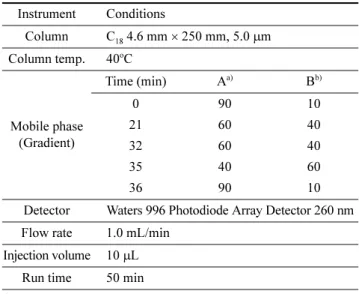
0.45μm syringe filter (Whatman, Maidstone, Kent, UK)로 여과 후 HPLC 분석에 사용하였다. Isoflavone 6종의 분석 은 식품의약품안전처 건강기능식품의 기준 및 규격 대두 이소플라본 제1법12)을 변형하여 실험하였다(Table 1). 분 석에 사용한 기기는 Waters 2695 Separation Module HPLC system과 Waters 996 Photodiode Array Detector (Waters Co., Milford, MA, USA)이며 분석용 column으로는 Capcell pack C18 MG (4.6 mm× 250 mm, 5 μM, Shiseido Co., Ltd.
Tokyo, Japan)을 사용하여 분석하였다.
총 페놀 함량 측정
총 페놀 함량은 Ismail 등13)의 방법을 변형하여 측정하 였다. 시료 1 mL에 10% folin-ciocalteu's phenol reagent 1 mL을 첨가 후 2% Na2CO3 용액 1 mL을 첨가하여 혼합한 후 암소에서 1시간 동안 반응시켰다. 그 후 반응액을 microplate reader (Spectramax i3, Molecular Device, Sunnyvale, CA, USA)를 이용하여 750 nm에서 흡광도를 측정하였다. 표준물질로 gallic acid를 이용하여 표준 검량 선(y = 15.557x − 0.0317, R2= 0.9950)으로부터 총 페놀 함 량을 계산하였다.
DPPH radical 소거능 측정
DPPH radical 소거능은 Mensor 등14)의 방법을 변형하여 측정하였다. 각 시료 0.2 mL에 0.4 mM DPPH 용액 0.8 mL 을 첨가하여 혼합한 뒤 암소에서 10분간 반응하였다. 그 후 반응액을 microplate reader를 이용하여 517 nm에서 흡 광도를 측정하였다. DPPH radical 소거능은 다음 식에 의 하여 나타내었다.
DPPH radical scavenging (%) =
ORAC value 측정
ORAC value는 Wang 등15)의 방법을 변형하여 측정하였 다. 표준물질과 시료의 희석은 75 mM phosphate buffer (pH 7.4)를 이용하였다. 시료 25 μL와 40 nM fluorescein 150μL를 black well plate에 첨가하고 측정 직전에 144 mM AAPH 25μL를 첨가하여 fluorescence microplate reader (Spectramax i3, Molecular Devices)를 이용하여 37oC에서 전자여기 485 nm, 전자방출 535 nm의 조건으로 90분 동 안 3분 간격으로 형광의 감소율을 측정하였다. ORAC value 의 결과 값은 area under curve (AUC) 값을 나타낸 후, 표 준물질인 trolox를 이용하여 작성한 표준 검량선(y = 1.235x + 0.5745, R2= 0.9946)에 대입하여 나타내었다.
β-Glucan 함량 측정
β-Glucan 함량은 mixed-linkage beta-glucan kit (Megazyme Ltd.)를 이용하여 측정하였다16). 시료 50 mg에 50% ethanol 0.1 mL, 20 mM sodium phosphate buffer (pH 6.5) 2 mL을 첨가하여 100oC에서 3분간 교반시킨 후 다시 50oC에서 5 분간 방치 후 lichanase 0.1 mL을 가하여 50oC에서 1시간 동안 효소 처리를 하였다. 효소처리 후 200 mM sodium acetate buffer (pH 4.0) 2.5 mL을 첨가하고 5분간 식혀 반 응을 종료시킨 후 원심분리기(3,000 rpm, 10분)를 이용하 여 얻은 상등액 0.05 mL에 β-glucosidase 0.05 mL를 첨가 하여 50oC에서 10분간 반응시켰다. 반응 후 용액의 glucose 정량을 위하여 GOPOD (glucose oxidase/peroxidase) 1.5 mL을 가하여 50oC에서 20분간 반응시키고 spectrophotometer (Optizen POP, Mecasys Co., Ltd., Daejeon, Korea)를 사용 하여 510 nm에서 흡광도를 측정하여 β-Glucan 함량을 계 산하였다.
통계처리
결과 값의 통계처리는 SAS version 9.4 (SAS institute Inc., Cary, NC, USA)를 이용하여 분석하였다. 통계적 유 의성은 one-way ANOVA 분석을 실시하였으며, Duncan의 다중범위 검정법(Duncan's multiple range test)으로 유의성 은 P < 0.05 수준에서 검정하였다.
Results and Discussion
Isoflavone 함량 변화
생물전환에 의한 탈지 대두박 발효물의 isoflavone을 HPLC로 분석한 결과는 Table 2와 같다. 배당체인 daidzin, glycitin, genistin은 hexane 탈지 대두박 비발효물과 ethanol 탈지 대두박 비발효물에서 모두 검출 되었으며 비배당체 인 daidzein, glycitein, genistein은 생물전환된 탈지 대두박 발효물에서만 검출되었다. 대두 비발효물의 total isoflavone 의 함량은 ethanol 탈지 대두박 비발효물에서 428.27 μg/g 1 AExperiment
Acontrol
---
⎩ – ⎭
⎨ ⎬
⎧ ⎫×100
Table 1. HPLC condition of isoflavone analysis for soybean extracts Instrument Conditions
Column C18 4.6 mm× 250 mm, 5.0 μm Column temp. 40oC
Mobile phase (Gradient)
Time (min) Aa) Bb)
0 90 10
21 60 40
32 60 40
35 40 60
36 90 10
Detector Waters 996 Photodiode Array Detector 260 nm Flow rate 1.0 mL/min
Injection volume 10μL Run time 50 min
a)water/MeOH/acetic acid (88:10:2)
b)MeOH/acetic acid (98:2)
을 보여 탈지를 하지 않은 대두 원물인 474.98 μg/g보다 낮게 나타났으며 hexane 탈지 대두박 비발효물의 total isoflavone은 522.79 μg/g으로 대두 원물보다 높은 함량을 나타내었다. 대두 발효물의 total isoflavone은 ethanol 탈지 대두박 발효물 2453.02 μg/g, hexane 탈지 대두박 발효물 2577.96μg/g으로 생물전환에 의한 대두 발효시 배당체가 비배당체롤 전환되어 total isoflavone의 함량이 약 4배 이 상 증가하는 것을 확인하였으며 total isoflavone 함량은 비 발효물과 마찬가지로 hexane으로 탈지한 대두 발효물에서 더 높은 함량을 나타내었다. 대두 isoflavone은 식품 중 배 당체 형태로 존재하여 체내흡수율이 매우 낮기 때문에 비 배당체로의 전환이 요구되고 있으며5), 이러한 isoflavone 비배당체의 효능으로는 UV-B에 의해 유도된 피부세포의 항노화 효과17), 고지방 식이 흰쥐의 체중 증가 억제 효과4), 인체위암세포 성장 억제 효능18)등이 보고되었다.
총 페놀 함량
페놀성 화합물은 식물성 식품에 널리 분포되어 있는 방 향족 화합물로써 페놀성 화합물에 포함된 hydroxyl group (-OH)이 free radical에 수소 원자를 환원하여 항산화, 항 염 및 항알러지 등의 다양한 생리활성을 나타낸다고 알려 져 있다19). 대두 추출물의 총 페놀 함량 분석 결과(Fig. 1), 탈지를 하지 않은 대두 원물의 총 페놀 함량은 39.44 mg GAE (gallic acid equivalent)/g을 보여 ethanol 탈지 대두 박 비발효물 및 hexane 탈지 대두박 비발효물의 27.07, 27.75 mg GAE/g 보다 높은 값을 나타냈다. 생물전환된 대 두의 총 페놀 함량은 hexane 탈지 대두박 발효물이 41.61 mg GAE/g, ethanol 탈지 대두박 발효물은 42.34 mg GAE/
g으로 비발효물에 비해 약 1.5배 가량 증가하는 경향을 나 타냈다. 이러한 결과는 Lee 등20)의 영지버섯을 이용한 생 물전환된 지실 추출물에서 총 페놀 함량이 약 1.75배 증
가한다는 연구결과와 유사한 경향을 나타낸다. 따라서 본 연구의 생물전환된 대두 추출물의 총 페놀 함량의 증가는 버섯균사에 의한 불용성 페놀 화합물의 분해로 사료된다.
DPPH radical 소거능 및 ORAC 지수
DPPH radical 소거능은 비교적 안정한 자유 라디칼인 DPPH 시약이 phenol, flavonoid와 같은 항산화물질과 반 응 시 라디칼이 소거되며 노란색으로 탈색되는 원리를 이 용하여 측정하였다21). 대두 추출물의 DPPH radical 소거 능 측정 결과(Fig. 2), 31.30~59.92% 범위의 DPPH radical 소거 활성을 보였다. 대두 원물에서 51.10%의 소거능을 보였으며 hexane 탈지 대두박 비발효물에서 50.51%의 소 거능을 보여 대두 원물과 비슷한 소거능을 나타냈으나, 생 Fig. 1. Total phenol contents of non-fermented soybean extracts and fermented soybean extracts. Each value represents means ± SD (n = 3). a-cMeans (bar value) not sharing a common letter are significantly different (P < 0.05). UDS: un-defatted soybean.
NFHDS: non-fermented hexane-defatted soybean. FHDS: fer- mented hexane-defatted soybean. NFEDS: non-fermented etha- nol-defatted soybean. FEDS: fermented ethanol-defatted soybean.
Table 2. The content of daidzin, glycitin, genistin, daidzein, glycitein, genistein and total isoflavone for non-fermented soybean extracts and fermented soybean extracts
Sample Glycoside Aglycone Total isoflavone
(μg/g) Daidzin (μg/g) Glycitin (μg/g) Genistin (μg/g) Daidzein (μg/mL) Glycitein (μg/g) Genistein (μg/g)
UDS1) 147.10 ± 8.176) 90.56 ± 1.96 237.31 ± 6.66 ND ND ND 474.98 ± 15.77
NFHDS2) 159.64 ± 6.57 100.80 ± 3.26 262.35 ± 10.14 ND ND ND 522.79 ± 16.30
FHDS3) ND7) ND 044.82 ± 0.27 875.05 ± 0.85 165.32 ± 0.26 1492.77 ± 1.62 2577.96 ± 2.40
NFEDS4) 135.75 ± 8.88 69.43 ± 1.98 223.09 ± 14.66 ND ND ND 428.27 ± 25.46
FEDS5) ND ND ND 833.95 ± 4.74 141.46 ± 2.41 1477.61 ± 6.76 2453.02 ± 5.00
1)UDS, Un-defatted soybean.
2)NFHDS, Non-fermented hexane-defatted soybean.
3)FHDS, Fermented hexane-defatted soybean.
4)NFEDS, Non-fermented ethanol-defatted soybean.
5)FEDS, Fermented ethanol-defatted soybean.
6)Value are mean ± SD in triplicate. (n = 3)
7)Not detect.
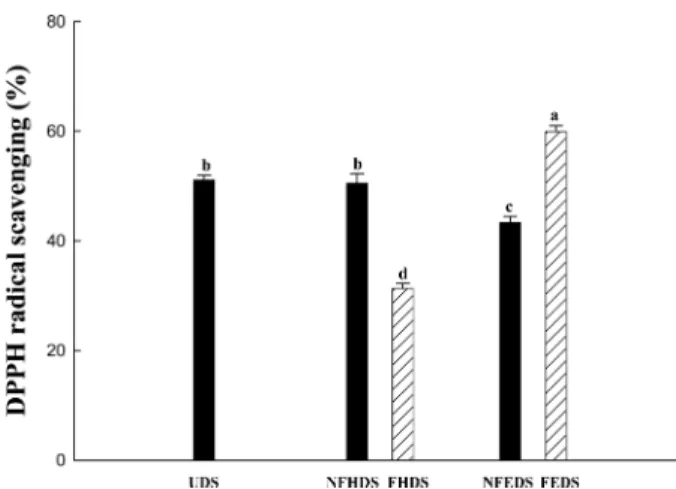
물전환된 hexane 탈지 대두박 발효물에서 31.30%로 가장 낮은 DPPH radical 소거능을 보였다. 이는 Kim 등22)의 연 구결과인 상백피 추출물의 생물전환 후 DPPH radical 소 거능이 감소됨과 유사한 경향을 나타내었다. Ethanol 탈지 대두박 비발효물의 경우 43.27%의 소거 활성을 보였으며, 생물전환된 ethanol 탈지 대두박 발효물에서 59.92%로 radical 소거 활성이 증가됨을 보여 hexane으로 탈지한 대 두 추출물과는 반대의 경향을 나타내었다.
대두 추출물의 ORAC 지수의 측정 결과는 Fig. 3과 같 다. 대두 원물에서 384.47 μM TE/g의 ORAC 지수를 나타 냈으며, hexane 탈지 대두박 비발효물 및 ethanol 탈지 대 두박 비발효물은 각 318.52, 247.48 μM TE/g으로 대두 원 물보다 낮은 ORAC 지수를 보였으나 hexane 탈지 대두박 발효물에서 786.36 μM TE/g으로 비발효물에 비해 약 2배 이상 증가하였으며 ethanol 탈지 대두박 발효물은 721.96 μM TE/g으로 비발효물에 비해 약 3배 이상 증가함을 확 인하였다.
β-Glucan 함량
β-Glucan은 보리, 밀 및 귀리 등의 곡식이나 버섯 등의 세포벽을 구성하고 있는 다당체로 항암 효과23), 콜레스테 롤 저하24), 면역활성 증진25) 등의 생리활성을 나타낸다. 대 두의 β-glucan 함량 분석 결과는 Fig. 3과 같다. 대두 원 물과 ethanol 탈지 대두박 발효물에서 가장 높은 0.11%의 함량을 나타냈으며 hexane 탈지 대두박 비발효물과 hexane 탈지 대두박 발효물은 0.09%로 가장 낮은 β-glucan 함량 을 보였다. Xu 등26)의 진공 동결 건조한 해송이 버섯의 β- glucan 함량은 0.11%로 나타나 대두의 β-glucan 함량과 유
사하게 나타났다. 또한 Lee 등27)의 여러 가지 버섯균사체 를 배양한 대두의 β-glucan 함량은 1.06~12.60%으로 나타 났으나, 표고버섯을 접종한 대두에서는 β-glucan이 정량되 지 않았다고 보고하였다. 따라서 본 연구의 표고균사를 이 용한 생물전환 대두의 β-glucan 분석 결과도 마찬가지로 β-glucan 함량의 증감은 뚜렷한 경향을 나타내지 않았다.
상관관계
총 페놀 함량, DPPH radical 소거능, ORAC 지수, isoflavone 함량 및 β-glucan 함량에 대한 상관관계를 분석한 결과 (Table 3), isoflavone 함량과 ORAC 지수 사이의 상관관계 Fig. 3. ORAC value of non-fermented soybean extracts and fer- mented soybean extracts. Each value represents means ± SD (n = 3). a-eMeans (bar value) not sharing a common letter are signifi- cantly different (P < 0.05). UDS: un-defatted soybean. NFHDS:
non-fermented hexane-defatted soybean. FHDS: fermented hex- ane-defatted soybean. NFEDS: non-fermented ethanol-defatted soybean. FEDS: fermented ethanol-defatted soybean.
Fig. 4. β-glucan content of non-fermented soybean and fermented soybean. Each value represents means ± SD (n = 3). a-bMeans (bar value) not sharing a common letter are significantly different (P <
0.05). UDS: un-defatted soybean. NFHDS: non-fermented hex- ane-defatted soybean. FHDS: fermented hexane-defatted soy- bean. NFEDS: non-fermented ethanol-defatted soybean. FEDS:
fermented ethanol-defatted soybean.
Fig. 2. DPPH radical scavenging activity of non-fermented soy- bean extracts and fermented soybean extracts. Each value repre- sents means ± SD (n = 3). a-dMeans (bar value) not sharing a common letter are significantly different (P < 0.05). UDS: un- defatted soybean. NFHDS: non-fermented hexane-defatted soy- bean. FHDS: fermented hexane-defatted soybean. NFEDS: non- fermented ethanol-defatted soybean. FEDS: fermented ethanol- defatted soybean.
가 0.9997로 가장 높게 나타났다. 총 페놀 함량과 ORAC 지수 및 isoflavone 함량과의 상관관계는 0.7149, 0.6989로 다소 높은 값을 나타내어 대두의 항산화능은 isoflavone과 의 밀접한 관계를 갖는 것으로 생각된다. β-Glucan 함량 과 ORAC 지수 및 isoflavone 함량과의 상관관계는 0.0049, 0.0028로 매우 낮은 상관관계를 나타냈다. DPPH radical 소거능과 총 페놀 함량과의 상관관계는 0.0006으로 가장 낮은 상관관계를 나타내었는데, 일반적으로 DPPH radical 소거능과 총 페놀 함량과의 상관관계는 비교적 높은 편으 로 알려져 있으나28), 추출 용매별 표고버섯의 총 페놀 함 량과 DPPH radical 소거능과의 상관관계는 보이지 않는 것으로 보고되었다29). 이는 시료 중 추출되는 페놀성 화합 물 종류에 따라 DPPH radical 소거능의 차이가 있는 것으 로 생각된다.
Acknowledgement
본 연구는 2015년도 농림축산식품부 고부가가치식품기 술사업(과제번호 314076-3)에 의해 이루어진 것이며 이에 감사드립니다.
국문요약
본 연구는 생물전환된 대두의 isoflavone 함량, 총 페놀 함량, 항산화능(DPP radical 소거능, ORAC 지수) 및 β- Glucan 함량을 측정하였다. Isoflavone의 경우 추출용매에 상관없이 배당체가 모두 비배당체로 전환되는 것을 확인 하였다. Total isoflavone 함량의 경우 hexane 탈지 대두박 발효물에서 2577.96 μg/mL으로 가장 높은 값을 나타냈으 며, ethanol 탈지 대두박 비발효물에서 428.27 μg/mL으로 가장 낮은 값을 나타내었다. 총 페놀 함량은 대두 원물에 서 39.44 mg GAE/g으로 나타났으며, ethanol 탈지 대두박 비발효물 및 hexane 탈지 대두박 비발효물은 27.07, 27.75 mg GAE/g으로 대두 원물보다 다소 낮은 값을 나타냈다.
생물전환된 대두의 총 페놀 함량은 hexane 탈지 대두박 발효물 41.61 mg GAE/g, ethanol 탈지 대두박 발효물 42.34 mg GAE/g으로 비발효물에 비해 약 1.5배 가량 증 가된 함량을 보였다. DPPH radical 소거능의 경우 대두 원
물에서 51.10%의 소거능을 나타내었고 hexane 탈지 대두 박 비발효물에서 50.51%, ethanol 탈지 대두박 비발효물은 43.27%의 소거능을 나타냈다. 생물전환된 ethanol 탈지 대 두박 발효물에서 59.92%로 radical 소거능이 증가되었지만 hexane 탈지 대두박 발효물은 31.30%로 비발효물에 비해 낮은 radical 소거활성을 보였다. ORAC 지수는 대두 원물 이 384.47 μM TE/g을 보였으며, hexane 탈지 대두박 비발 효물 및 ethanol 탈지 대두박 비발효물은 318.52, 247.48 μM TE/g으로 나타났다. 생물전환된 hexane 탈지 대두박 발효 물은 786.36 μM TE/g, ethanol 탈지 대두박 발효물에서 721.96μM TE/g으로 비발효물에 비해 ORAC 지수가 증 가하는 것으로 나타났다. β-Glucan 함량은 0.09~0.11%의 범위로 나타났으며 대두 원물과 ethanol 탈지 대두박 발효 물에서 가장 높은 0.11%를 보였고 hexane 탈지 대두박 비 발효물과 hexane 탈지 대두박 발효물에서 0.09%로 가장 낮은 β-glucan 함량을 보였지만, 추출용매 및 생물전환에 따른 β-glucan 함량의 큰 차이는 나타나지 않았다.
References
1. Kim, J.A., Jung, W.S., Chun, S.C., Yu, C.Y., Ma, K.H., Gwag, J.G. and Chung, I.M.: A correlation between the level of phenolic compounds and the antioxidant capacity in cooked-with-rice and vegetable soybean (Glycine max L.) varieties. Eur Food Res Technol., 224, 259-270 (2006).
2. Malen i , D., Popovi , M. and Miladinovi , J.: Phenolic con- tent and antioxidant properties of soybean (Glycine max (L.) Merr.) seeds. Molecules, 12, 576-581 (2007).
3. Jeon, S.H., Lee, K. and Byoun, K.E.: Studies on changes of isoflavone and nutrients during germination of soybean vari- eties. Korean J Human Ecology, 14, 485-489 (2005).
4. Lim, A.K., Jung, M.J., Kim, D.W., Hong, J.H., Jung, H.K., Kim, K.S. and Kim, D.I.: An Extrapolation Concentration Decision Effect Antihyperlipidemic of Aglycone Isoflavone from Biotransformation Soybean on the Fed High-Fat Diet Rats. J Korean Soc Food Sci Nutr., 38, 1167-1173 (2009).
5. Kim, I.B., Shin, S., Lim, B.L., Seong, G.S. and Lee, Y.E.:
Bioconversion of soybean isoflavone by Lactobacillus plan- tarum and Bifidobacterium longum. Korean J Food Cookery Sci., 26, 214-219 (2010).
6. Lee, K.J., Gu, M.J., Roh, J.H., Jung, P,M. and Ma, J.Y.: Quan- c
ê
c′ c′ ′c
Table 3. Correlation coefficients among total phenol content, DPPH radical scavenging, ORAC value, isoflavone content and β-glucan of soybean extracts
TPC DPPH radical scavenging ORAC value Isoflavone β-Glucan
TPC 1
DPPH radical scavenging 0.0006 1
ORAC value 0.7149 0.0293 1
Isoflavone 0.6989 0.0326 0.9997 1
β-Glucan 0.2578 0.5368 0.0049 0.0028 1
titative Analysis of Bioconversion Constituents of Insam- peadock-san Using Various Fermented Bacteria. Yakhak Hoeji., 57, 167-172 (2013).
7. Kim, M.H.: Biological Activity of Ethanol extracts from Fer- mented Opuntia humifusa with 3 Different Mushroom Myce- lia. J Korean Soc Food Sci Nutr., 28, 620-627 (2015).
8. Jung, T.D., Shin, G.H., Kim, J.M., Choi, S.I., Lee, S.J., Heo, I.Y,, Park, S.J., Kim, H.T., Kang, B.K. and Lee, O.K.:
Assessment of Validation Method for Bioactive Contents of Fermented Soybean Extracts by Bioconversion and Their Antioxidant Activities. J Korean Soc Food Sci Nutr., 45, 680- 689 (2016).
9. Halliwell, B., Aeschbach, R., Lliger, J. and Aruoma, O.I.: The characterization of antioxidants. Food Chem Toxicol., 33, 601- 617 (1995).
10. Larson, R.A.: The antioxidants of higher plants. Phytochem- istry, 27, 969-978 (1988).
11. Saito, M., Sakagami, H. and Fujisawa, S.: Cytotoxicity and apoptosis induction by butylated hydroxyanisole (BHA) and butylated hydroxytoluene (BHT). Anticancer Res., 23, 4693- 4701 (2002).
12. KFDA. Health Functional Food Code. Korea Food & Drug Administration, Seoul, Korea. pp. 340-343 (2013).
13. Ismail, A., Marjan, Z.M. and Foong, C.W.: Total antioxidant activity and phenolic content in selected vegetables. Food Chem., 87, 581-586 (2004).
14. Mensor, L.L., Menezes, F.S., Leito, G.G., Reis, A.S., Santos, T.C.D., Coube, C.S. and Leitão, S.G.: Screening of Brazilian plant extracts for antioxidant activity by the use of DPPH free radical method. Phytotherapy Res., 15, 127-130 (2001).
15. Wang, H., Cao, G. and Prior, R.L.: Total antioxidant capacity of fruits. J Agric Food Chem., 44, 701-705 (1996).
16. McCleary, B.V. and Glennie-Holmes, M.: Enzymic quantifi- cation of (1-3)(1-4)-β-D-glucan in barley and malt. J Inst Brew., 91, 285-295 (1985).
17. Wang, Y.N., Wu, W., Chen, HC. and Fang, H.: Genistein pro- tects against UVB-induced senescence-like characteristics in human dermal fibroblast by p66Shc down-regulation. J der- matological Sci., 58, 19-27 (2010).
18. Jeong, E.J., Kim, J.Y., Moon, S.H. and Park, K.Y.: Character- istics, Antioxidative Activities and Growth Inhibitory Effects in AGS Human Gastric Adenocarcinoma Cells of Soymilk Fermented by Bacillus subtilis KC-3 during Fermentation. J
Korean Soc Food Sci Nutr., 39, 1113-1118 (2010).
19. Shin, D.B., Lee, D.W., Yang, R. and Kim, J.A.: Antioxida- tive properties and flavonoids contents of matured Citrus peel extracts. Food Sci Biotechnol., 15, 357-362 (2006).
20. Lee, G.W., Park, S.M., Yoo, Y.C. and Cho, Y.H.: Effect of ponciri fructus extracts fermented with ganoderma lucidum on the collagen synthesis and expression of matrix metallo- proteinase-1. KSBB Journal, 28, 106-114 (2013).
21. Foti, M.C., Daquino, C. and Geraci, C.: Electron-transfer reaction of cinnamic acids and their methyl esters with the DPPH radical in alcoholic solutions. J Org Chem., 69, 2309- 2314 (2004).
22. Kim, E.J., Moon, J.S. and Choe, T.B.: Inhibition of tyrosi- nase by bio-conversion Morus alba extract. Kor J Aesthet Cosmetol., 11, 845-854 (2013).
23. Lee, J.S., Lee, S.H., Jang, Y.M., Lee, J.D., Lee, B.H. and Jung, J.Y.: Macrophage and anticancer activities of feed additives on β-glucan from Schizophyllum commune in breast cancer cells. J Korean Soc Food Sci Nutr., 40, 949-955 (2011).
24. Newman, R.K., Lewis, S.E., Newman, C.W., Boik, R.J. and Ramage, R.T.: Hypocholesterolemic effect of barley foods on healthy men. Nutr Rep Int., 39, 749-760 (1989).
25. Park, H.J., Kim, Y.B., Kang, T.S., Jung, I.S., Kim, K.Y. and Jeong, H.S.: Immunomodulatory activities of oat bran extracts with different extraction conditions. Korean J Food Sci Technol., 37, 103-107 (2005).
26. Xu, X.M., Jun, J.Y. and Jeong, I.H.: A study on the antioxidant activity of Hae-Songi mushroom (Hypsizigus marmoreus) hot water extracts. J Korean Soc Food Sci Nutr., 36, 1351-1357 (2007).
27. Lee, H.D. and Lee, G.S.: β-glucan and glucosamine contents in various cereals cultured with mushroom mycelia. Korean J Mycol., 37, 167-172 (2009).
28. Dudonne, S., Vitrac, X., Coutiere, P., Woillez, M. and Méril- lon, J.M.: Comparative study of antioxidant properties and total phenolic content of 30 plant extracts of industrial inter- est using DPPH, ABTS, FRAP, SOD, and ORAC assays. J Agric Food Chem., 57, 1768-1774 (2009).
29. Kim, M.J., Chu, W.M. and Park, E.J.: Antioxidant and antigenotoxic effects of shiitake mushrooms affected by dif- ferent drying methods. J Korean Soc Food Sci Nutr., 41, 1041- 1048 (2012).