I. Introduction
In modern society, with its extreme levels of
competition, medical institutions are working hard to increase their competitiveness, and in particular, the managerial practices are to
간호사의 조직몰입과 이직의도에 대한 예측변인으로서 간호단위의 사회연결망
Social Networks of Nursing Units as Predictors of Organizational Commitment and Intent to Leave of Nurses
백석문화대학교 간호학과원효진
Hyo-Jin Won([email protected]) 요약
본 연구는 간호단위의 사회연결망을 과업조언 연결망과 친교연결망으로 구분하여 구조적 특성을 파악하고, 간호사의 조직몰입, 이직의도와의 관계를 분석하기 위해 시도되었다. 4개 병원, 30개 간호단위에서 근무하는 420명의 일반간호사를 대상으로 하였으며, 자료는 UCINET 6.0, SPSS 20.0과 HLM 7.0을 이용하여 분석되 었다. 과업조언 연결망에서는 수간호사의 연결정도 중심성이 조직몰입에, 간호단위의 밀도가 이직의도에 영향 을 미치는 것으로 나타났다. 친교연결망에서는 수간호사의 근접중심성과 책임간호사의 매개중심성이 조직몰 입에, 간호단위의 밀도와 책임간호사의 매개중심성이 이직의도에 영향을 미치는 것으로 나타났다. 본 연구 결 과를 통한 간호사들 사이에 형성되는 사회연결망에 대한 이해를 바탕으로, 적절한 인력 배치를 위한 연결망 구조와 기회, 조건을 개발하고 다양한 형태의 전략을 수립하기 위한 이론적 근거를 제공할 수 있을 것이다.
■ 중심어 :∣사회연결망∣간호사∣조직몰입∣이직의도∣
Abstract
This study attempted to examine the structural characteristics of the social network of nursing units by dividing them into a job-related advice network and a friendship network, and to analyze the relationship between nurse organizational commitment and intent to leave. The subjects were 420 nurses working in 4 hospitals and 30 nursing units. Data were analyzed using UCINET 6.0, SPSS 20.0 and HLM 7.0. In job-related advice networks, degree centrality of head nurse contributed to organizational commitment. Network density contributed to intent to leave. In friendship networks, closeness centrality of head nurses and betweenness centrality of charge nurse contributed to organizational commitment. Density and betweenness centrality of charge nurses contributed to intent to leave. Accordingly, it is necessary to foster good relationships between nurses and to develop various types of strategies for building effective networks.
■ keyword :∣Social Networks∣Nurses∣Organizational Commitment∣Intent to Leave∣
접수일자 : 2020년 03월 16일
수정일자 : 2020년 04월 06일 심사완료일 : 2020년 04월 06일
교신저자 : 원효진, e-mail : [email protected]
improve the performance of human resources that underpin the core competencies of the organization[1]. Of these human resources, nurses form the largest group of professionals in hospitals, and increasing the quality of services provided by nurses is an essential factor in improving hospital efficiency and competitiveness. In particular, at the level of the unit in which nursing work is performed, it is essential to promote communication among the members of such nursing units through interaction, in order to provide high quality nursing care to patients. Likewise, it is very important to understand the influence of relationships among members on an organization’s performance. The structure of interactions among group members spontaneously forms a network containing specific patterns. Specifically, the types of network that are commonly encountered among group members in such organizations include job-related advice networks, which provide counseling services offering information and resources related to particular tasks, and friendship networks, which promote psychological well-being and provide social support[2].
Hospitals are some of the most complex organizations in modern society, in which the diversity and heterogeneity of their members are prominent, and interdependence and cooperativeness among members, as a group of human beings organized around medical services for patients, are prominently required [3]. Commitment to the workplace is a considerable predictor of several performance outcomes of employee[4]. An individual with high organizational commitment tends to follow organizational values and goals. Kim[5] argued that when employees and leaders’ values in terms
of organizational commitment are congruent, employees evaluate the organization’s objectives and values positively and feel a sense of belonging and importance, which leads to an improvement in individuals’ willingness to work and organizational commitment. Since it is an important task for organizations to secure a good workforce, the management of employees who may wish to leave the organization is also very important in terms of maintaining human resources. Turnover of nurses may prevent patients from receiving good quality nursing services, and if nurses are not fully informed and integrated, this may lead to an accident that may present a direct risk to a patient's life.
It is reported that nurses who lack organizational support from colleagues have a high risk of job turnover intention[6], and that the more negative the relationship between a supervisor and their subordinate staff, the higher the likelihood of staff considering turnover[7].
Social network theory focuses on the position of actors ‘embedded’ within a particular type of network, affecting their consciousness, utility or even reward for action[8]. Social network analysis verifies the structure of the network created, maintained, and transformed by interactions between individuals, and examines its influence on individual behavior. In other words, from the perspective of organization management, networks are a tool to depict, diagnose, and analyze complex systems[9].
There are active moves being made to study the
complicated problem of human resources using
social network analysis, but studies connecting
structural and social characteristics from the
perspective of human resource management of
hospital nurses are still quite insufficient.
Siciliano and Thompson[10] stated that as degree centrality increases, organizational commitment increases. A study by Mossholder et al.[11] found that the higher the centrality of members, the lower their intention to leave.
The present study aimed to examine to what degree individual nurses are located at the center of their social networks, and the cohesion of nursing units in terms of interaction between members, by dividing the social network found within the nursing unit into a job-related advice network and a friendship network. Furthermore, we aimed to analyze how the centrality of members in the network and the cohesion of nursing units are related to nurses’ organizational commitment, and intent to leave. Thus, this study would provide empirical information conceptualizing the relationships among nurses in each nursing unit of a hospital in order to contribute to a theoretical basis for proper nursing staffing.
Ⅱ. Methods 1. Study Design
This study is a descriptive correlational study aiming to identify the structural characteristics of the social networks of nursing units by dividing them into job-related advice networks and friendship networks, and to analyze the relationships of these networks with organizational commitment and intent to leave of nurses.
2. Samples and Data Collection
In order to protect the participants, I collected data for this study in accordance with the procedure approved by the institutional
review board of the Seoul National University. I selected 4 hospitals, each with 300–500 beds, that agreed to participate in the study, and obtained a convenience sample of nurses from their nursing units. A total of 420 nurses working in 30 nursing units were included.
Individual participants filled out questionnaires after completing a written consent form, and after the questionnaires were completed, they were sealed in a questionnaire envelope with pre-attached double-sided tape. A total of 450 copies were distributed, of which 420 were recovered (response rate: 93.3%).
3. Measures
3.1 General Characteristics
The general characteristics questionnaire covered the demographic and work-related characteristics of nurses working in hospitals.
There were 4 demographic items (gender, age, marital status, and educational level), and 3 work-related items (career present unit, working on their preferred unit, and shift pattern).
3.2 Social Networks
The items in the questionnaire used to assess participants’ job-related advice networks and friendship networks were adapted from those used by Bell[12]. In the case of the job-related advice network, the questionnaire asked about
“nurses, head nurses, and charge nurses from whom you obtain information and advice in relation to your job within your current nursing unit.” For friendship networks, the questionnaire asked about “nurses, head nurses, and charge nurses with whom you discuss sensitive issues or have a lot of friendly conversations in your current nursing unit.”
In this study, the density represents the sum
of the connection weights divided by the total number of possible connections in the network [13]. Network centrality is a concept showing to what degree a given person is central to the entire network. Degree centrality is the degree to which one node affects other nodes: it quantifies the extent to which an actor is located at the center of the network according to how connected it is to other actors, and it is given by the sum of actors directly connected to the actor in question. Closeness centrality provides information about how close one node is to another node and is calculated by taking the reciprocal of the sum of all the shortest path distances connecting the two actors.
Betweenness centrality measures the degree to which one node is located between other nodes in the network and refers to the degree to which this node acts as an intermediary or
“bridge” in connecting the network to other nodes. In this article, this term refers to the value measured using UCINET 6.0.
3.3 Organizational Commitment
I used the Copenhagen Psychosocial Questionnaire (COPSOQ) II, developed by Pejtersen et al.[14], in the form of a Korean version (COPSOQ-K), a modification and supplementation of the original by June and Choi[15]. This measure consisted of 4 items rated on a 5-point Likert scale from 1 (strongly disagree) to 5 (strongly agree); ratings were assigned the scores 0, 25, 50, 75, and 100. The higher the average score, the higher the degree of organizational commitment. In the study by June and Choi[14], the reliability of the instrument (Cronbach's α) was .77, and in this study, it was .74.
3.4 Intent to Leave
I used a intent to leave measurement tool that was developed by Mobley[16] and modified and supplemented by Kim[17] through expert verification after modifying the vocabulary to suit the hospital environment and the nurse. It consisted of 6 items rated on a 5-point Likert scale from 1 (strongly disagree) to 5 (strongly agree), and the higher the average score, the higher the degree of intent to leave. In the study by Kim[16], the reliability of the instrument (Cronbach's α) was .76, and in this study, it was .87.
4. Data Analysis
Nurses’ general characteristics, organizational commitment, and intent to leave were analyzed through frequency analysis using SPSS 20.0. The structural characteristics of their social networks were analyzed through social network analysis using UCINET 6.0, after dividing the nursing units’ social networks into a job-related advice network and a friendship network. The associations between nurses’ general characteristics and their organizational commitment and intent to leave were analyzed using t-tests and analysis of variance (ANOVA). Finally, multilevel analysis using HLM 7.0 was employed to determine the factors influencing nurses’ organizational commitment and intent to leave. The size of the sample for multi-level analysis is ideal to be composed of 30 or more people, but less than 30 is not a problem[18], and when at least 5 people are collected, bias is reduced, so it can be used as a group data[19]. Since the sample of this study has a minimum of 10, it can be considered that multilevel analysis is possible.
The intraclass correlation(ICC) of the basic
model applied to this study was found to be
more than 0.05(5%) so it was shown that multilevel analysis was necessary. The model fit is considered to be a more suitable model as the value of the deviation between models is less. All explanatory models analyzed in this study were found to be suitable.
Ⅲ. Results
1. Organizational Commitment and Intent to Leave by General Characteristics
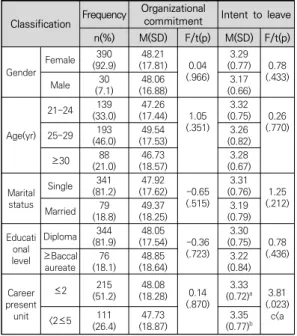
The general characteristics of the participants are shown in [Table 1]. Working on one’s preferred unit was associated with stronger organizational commitment (t = 3.89, p < .001).
Working on one’s preferred unit was associated with a weaker intent to leave (t = -3.79, p <
.001), and career present unit was associated with a difference in intent to leave (F = 3.81, p
= .023).
Table 1. Organizational Commitment and Intent to Leave by General Characteristics (N=420)
2. Multilevel Analysis of Social Networks of Nursing Units, Organizational Commitment, and Intent to leave
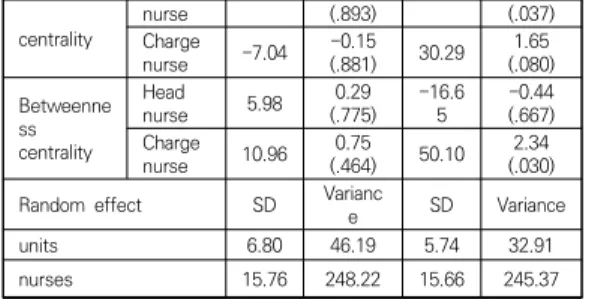
The effects of network characteristics on organizational commitment are shown in [Table 2].
In job-related advice networks, the organizational commitment of staff nurses differed significantly according to the degree centrality of head nurses (t = 2.25, p =. 036). In friendship networks, the organizational commitment of staff nurses differed significantly according to the closeness centrality of head nurses (t = 2.23, p = .037) and the betweenness centrality of charge nurses (t = 2.34, p = .030).
Table 2. Multilevel Analysis on Social Networks of Nursing Units and Organizational Commitment Classification Frequency Organizational commitment Intent to leave
n(%) M(SD) F/t(p) M(SD) F/t(p) Gender Female 390
(92.9) 48.21 (17.81) 0.04
(.966)
(0.77)3.29 0.78 (.433)
Male 30
(7.1) 48.06
(16.88) 3.17
(0.66) Age(yr)
21-24 139
(33.0) 47.26 (17.44) 1.05
(.351)
(0.75)3.32 0.26 (.770)
25-29 193
(46.0) 49.54
(17.53) 3.26
(0.82)
≥30 88
(21.0) 46.73
(18.57) 3.28
(0.67) Marital
status
Single 341
(81.2) 47.92 (17.62) -0.65
(.515)
(0.76)3.31 1.25 (.212) Married 79
(18.8) 49.37
(18.25) 3.19
(0.79) Educati
onal level
Diploma 344
(81.9) 48.05 (17.54) -0.36
(.723)
(0.75)3.30 0.78 (.436)
≥Baccal aureate 76
(18.1) 48.85
(18.64) 3.22
(0.84) Career
present unit
≤2 215
(51.2) 48.08 (18.28) 0.14
(.870)
(0.72)3.33a 3.81 (.023)
c<a
<2≤5 111
(26.4) 47.73
(18.87) 3.35
(0.77)b
>5 94
(22.4) 49.00
(15.01) 3.09
(0.83)c Working
on one’s preferred
unit
Yes 238
(56.6) 51.16 (16.88) 3.89
(<.001)
(0.70)3.16 -3.79 (<.001)
No 18
2(43.4) 44.43
(18.24) 3.45
(0.81)
Shift pattern
3 shifts 298
(71.0) 48.55 (18.44) 1.17
(.312)
(0.78)3.25 1.26 (.284) 2 shifts 34
(8.0) 43.75
(15.23) 3.34
(0.59)
Fixed 88
(21.0) 48.71
(15.98) 3.39
(0.77)
Classification
Organizational commitment Job-related
advice network Friendship network
β t(p) β t(p)
Individual-level
Degree centrality 0.20 0.34
(.740) -0.64 -0.88 (.386) Closeness centrality -0.63 -0.82
(.419) 0.18 0.21
(.834) Betweenness centrality -0.09 -0.16
(.876) 0.43 0.88
(.385) Unit-level
Density 18.80 0.54
(.596) -5.80 -0.24 (.813) Degree
centrality Head
nurse 45.73 2.25
(.036) -36.9
7 -1.28
(.214) Charge
nurse 12.79 0.73
(.476) -1.45 -0.07 (.944)
Closeness Head 6.92 0.14 50.01 2.23
The effects of network characteristics on intent to leave are shown in [Table 3]. In job-related advice networks, the intent to leave of staff nurses differed significantly according to network density (t = -2.35, p = .030). In friendship networks, the intent to leave of staff nurses differed significantly according to network density (t = -2.04, p = .047) and the betweenness centrality of charge nurses (t = -2.81, p = .011).
Table 3. Multilevel Analysis on Social Networks of Nursing Units and Intent to Leave
Ⅳ. Discussion
This study attempted to examine the structural characteristics of the social network of nursing units by dividing them into a job-related advice network and a friendship network, and to analyze the relationship between nurse organizational commitment and intent to leave. The centrality of nurses did not have a statistically significant effect on their organizational commitment or intent to leave.
This is a different result to those found by Kim[7], where individual betweenness centrality in a work-related communications network had a negative influence on organizational commitment and intent to leave, and in an everyday communication network had a positive influence on organizational commitment and intent to leave. As a possible explanation for this disparity, Kim[7] conducted a single-level analysis of 100 people from 9 teams in a small business in Seoul, whereas in the present study, I considered not only centrality on the individual level, but also the influence of the group level. Another possible interpretation is that different results were obtained because the participants were different. Therefore, it is necessary to conduct further research to verify these findings by applying social network analysis to nurses.
Greater cohesiveness of the nursing unit was found to have a negative effect on intent to turnover in both the job-related advice network and the friendship network. Members of a team with high cohesiveness are frequently provided with emotional support through frequent interaction, and because this creates strong attachment and bonds among members[20], this can be interpreted as the reason for the
centrality nurse (.893) (.037)
Charge
nurse -7.04 -0.15
(.881) 30.29 1.65 (.080) Betweenne
ss centrality Head
nurse 5.98 0.29
(.775) -16.6
5 -0.44
(.667) Charge
nurse 10.96 0.75
(.464) 50.10 2.34 (.030)
Random effect SD Varianc
e SD Variance
units 6.80 46.19 5.74 32.91
nurses 15.76 248.22 15.66 245.37
Classification
Intent to leave Job-related
advice network Friendship network
β t(p) β t(p)
Individual-level
Degree centrality 7.98 0.58
(.567) 7.32 0.42
(.678) Closeness centrality 12.91 0.78
(.443) 4.67 0.21
(.835) Betweenness centrality -2.02 -0.16
(.872) -8.66 -0.69 (.496) Unit-level
Density -3.08 -2.35
(.030) -2.87 -2.04 (.047) Degree
centrality
Head
nurse 1.92 2.01
(.058) 1.18 0.73
(.477) Charge
nurse -1.49 -1.80
(.086) 0.44 0.39
(.704) Closeness
centrality
Head
nurse 0.85 0.35
(.730) -1.14 -0.90 (.379) Charge
nurse -0.54 -0.25
(.806) 1.35 1.30
(.208) Betweenne
ss centrality Head
nurse -0.62 -0.63
(.534) -0.71 -0.33 (.747) Charge
nurse 0.40 0.59
(.564) -3.35 -2.81 (.011)
Random effect SD Varianc
e SD Variance
units 0.34 0.12 0.37 0.14
nurses 0.65 0.42 0.66 0.44
associated decrease in intent to leave. It is important to form communities with deep bonds between nurses in order to nurture nurses’ willingness to remain attached to the ward in which they work and to remain a ward nurse; to this end, a plan should be sought to encourage active communication and cooperation among group members. In addition, if a program is developed that can enhance support for nurses’ growth or community formation and this is applied to the nursing field, it can be expected that this will enhance nurses’ ability to conduct patient care and make more attachment and dedication to the nursing unit to which they belong.
On the other hand, greater influence of head nurses was found to enhance nurses’
commitment to the workplace. This is consistent with the results of previous studies showing that a high quality of leader-member exchange is linked to a positive impact of the level of organizational commitment[1] and job performance[21]. In terms of work, when a superior assists in problem-solving and the actual completion of a task, this not only provides resources that improve the performance of the members of the organization, but also promotes career development, allows superiors to act as mentors, and provides core feedback. This support increases the satisfaction of the nurses who perform nursing tasks and encourages them do their best when nursing their patients; thus, the efficiency of nursing work can be increased.
Furthermore, it was shown that betweenness centrality of charge nurses improved organizational commitment and lowered intent to leave. Previous work in nursing care research has only paid attention to the role of head
nurses as managers and leadership figures.
However, as observed in the present study, charge nurses also play an important role in supporting staff nurses as their superiors, encouraging active nursing of the patient, and stimulating and fostering the potential to raise nursing capacity. Therefore, it is necessary to recognize the important role of charge nurses, which has received relatively little focus compared to the focus on head nurses, and we propose that it is necessary to create conditions that enable charge nurses to develop their capabilities as leaders and to demonstrate their abilities.
The results of the present study showed that group-level variables had high explanatory power. This suggests that in terms of organizational management, it is necessary to take into account the influence not only of individual-level factors but also of group-level factors. Until now, education and policy on human resource management have been based on information obtained at the level of individual, and information available at the group or organization level has been neglected.
As shown by the results of this study, group-level factors are involved in individuals’
perceptions and attitudes, and it will be necessary to consider the influence of these factors in the future before implementing education systems or practical programs in nursing departments.
Ⅴ. Conclusion
The study aimed to demonstrate the
relationship between individuals and group
members objectively through social network
analysis technique, to verify empirically the effect of social network in nursing units, which has not yet been systemized. This study highlights the fact that even if individuals are members of the same group, the nature of the relationship between them varies depending on how they construct this relationship. By dividing the overall social network into a job-related advice network and a friendship network, I have attempted to explain the relationship of such network structures with the perceptions and attitudes of individuals. Based on the understanding of the social network formed among the nurses through the results of this study, it will be possible to provide the theoretical basis for developing the network structure, opportunities, and conditions for proper manpower deployment and establishing various types of strategies.
Regarding the limitations of this study, first, it draws on a limited participant pool of nurses from 4 hospitals and 30 nursing units, and is therefore limited in the possibility of generalizing these results to all nursing units.
Second, there were limitations preventing all nurses in each nursing unit from participating because participation was voluntary.
The following suggestions are made. First, it is necessary to generalize these findings on the social network characteristics of nursing units through further research. Second, it is necessary to explore various group-level variables that may affect the results. Third, in future work, the social network structure of the entire hospital should be revealed by expanding to other nursing units and occupations within the hospital, rather than limiting responses to nurses in the same nursing department, so that the structure of the social network of the whole
hospital can be clarified. Fourth, it is necessary to explore causal relationships using a longitudinal research method that can show how network structure and structural effects change over time.
* This manuscript is a revision of the author's doctoral dissertation from Seoul National University.
참 고 문 헌
[1] K. T. Tran, P. V. Nguyen, T. Dang, and T. Ton,
“The impacts of the high-quality workplace relationships on job performance: A perspective on staff nurses in Vietnam,”
Behavioral sciences, Vol.8, No.12, pp.109;1-21, 2018. http://doi.org/10.3390/bs8120109 [2] D. E. Gibbons, “Friendship and advice
networks in the context of changing professional values,” Administrative Science Quarterly, Vol.49, No.2, pp.238-262, 2004.
http://doi.org/10.2307/4131473
[3] H. N. Lee, S. Y. Lee, and M. A. Lee, “A study of nurses’ job satisfaction,” Journal of East-West Nursing Research, Vol.15, No.2, pp.91-101, 2009.
[4] M. M. Sloan, “Gender differences in commitment to state employment: The role of coworker relationships,” Public Personnel Management, Vol.46, No.2, pp.170-187, 2017.
http://doi.org/10.1177/0091026017702612 [5] S. Y. Kim, The effects of communication
network characteristics on job satisfaction, organizational commitment, and the turnover intent in organizations, Kyunghee University, Unpublished master’s thesis, 2009.
[6] W. Liu, S. Zhao, L. Shi, Z. Zhang, X. Liu, L. Li, X. Duan, G. Li, F. Lou, X. Jia, L. Fan, T. Sun, and X. Ni, “Workplace violence, job satisfaction, burnout, perceived organizational support and their effects on turnover intention
among Chinese nurses in tertiary hospitals: a cross-sectional study,” Health Policy Research, Vol.8, No.6, pp.1-11, 2018.
http://dx.doi.org/10.1136/bmjopen-2017-019525 [7] Y. H. Kim, J. H. Choi, and K. E. Kim, “The
impact of job overload, relationship with senior on nurses’ intention to quit their jobs – Mediating role of emotional exhaust-,” The Journal of Korean Nursing Administration Academic Society, Vol.15, No.3, pp.372-381, 2009.
[8] Y. H. Kim, Social network analysis, Parkyoungsa, 2007.
[9] S. D. Brun and E. McAuliffe, “Social network analysis as a methodological approach to explore health systems: A case study exploring support among senior managers/executives in a hospital network,” International Journal of Environmental Research and Public Health, Vol.15, No.3, pp.511;1-11, 2018.
http://doi.org/10.3390/ijerph15030511 [10] M. D. Siciliano and J. R. Thompson, “If you
are committed, then so am I: The role of social networks and social influence on organizational commitment,” Administration and Society, Vol.50, No.7, pp.916-946, 2018.
http://doi.org/10.1177/0095399715617987 [11] K. W. Mossholder, R. P. Settoon, and S. C.
Henegan, “A relational perspective on turnover: Examining structural, attitudinal, and behavioral predictors,” Academy of Management Journal, Vol.4, pp.607-618, 2005.
http://doi.org/10.5465/amj.2005.17843941 [12] G. G. Bell, “Clusters, networks, and firm
innovativeness,” Strategic Management Journal, Vol.26, No.3, pp.287-295, 2005.
http://doi.org/10.1002/smj.448
[13] D. W. Son, Social network analysis, Kyungmoonsa, 2002.
[14] J. H. Pejtersen, T. S. Kristensen, V. Borg, and J. B. Bjorner, “The second version of the Copenhagen psychosocial questionnaire,”
Scandinavian Journal of Public Health, Vol.38,
No.3, pp.8-24, 2010.
http://doi.org/10.1177/1403494809349858 [15] K. J. June and E. S. Choi, “Reliability and
validity of the korean version of the copenhagen psyco-social questionnaire scale,”
Korean Journal of Occupational Health Nursing, Vol.22, No.1, pp.1-12, 2013.
http://dx.doi.org/10.5807/kjohn.2013.22.1.1 [16] W. H. Mobley, Employee turnover: Cause,
consequences and control, Reading, MA:
Addison-Wesley, 1982.
[17] M. R. Kim, “Influential factors on turnover intention of nurses: The effect of nurse’s organizational commitment and career commitment to turnover intention,” The Journal of Korean Nursing Administration Academic Society, Vol.13, No.3, pp.335-344, 2007.
[18] J. O. Hwang, T. Y. Yoo, and T. Y. Han, “The effect of team personality and team OCB norm on team member’s OCB: A multilevel construct validation approach,” The Korena Journal of Industrial and Organizational Psychology, Vol.19, No.2, pp.259-284, 2006.
[19] P. D. Bliese, “Group size, icc values, and group-level correlations: a simulation,”
Organizational Research Methods, Vol.1, pp.355-373, 1988.
[20] E. W. Morrison, “Newcomers’ relationships:
The role of social network ties during socialization,” Academy of Management Journal, Vol.45, No.6, pp.1149-1160, 2002.
http://doi.org/10.5465/3069430
[21] G. Regt, E. Molleman, and H. J. Brake, “The impact of leader-member exchange on follower performance in light of the larger social network,” Human Relations, Vol.23, pp.1-27, 2018.
http://doi.org/10.1177/0018726718806351
저 자 소 개
원 효 진(Hyo-Jin Won) 정회원
▪2014년 8월 : 서울대학교 간호학과 (간호학박사)
▪2015년 3월 ~ 현재 : 백석문화대학 교 간호학과 교수
<관심분야> : 간호조직, 간호교육