J Lung Cancer 2010;9(1):20-23
20
Primary Acinic Cell Carcinoma of the Lung: A Case Report
Primary acinic cell carcinoma (ACC) of the lung is very rare and this tumor is thought to arise from pluripotent cells of the submucosal glands of the tracheobronchial tree. We report here on a case of primary ACC of the lung in a 68-year-old man who had a solitary pulmonary nodule in the left lower lobe. The patient was symptomless and the lesion was found on a chest X-ray taken during a regular health checkup. The video assisted thoracoscopic surgery wedge resection revealed an ovoid yellow tan solid mass that was 1.8 cm at the largest diameter. Microscopically, the neoplastic cells grew in solid sheets of round cells with eccentric nuclei and abundant basophilic granular cytoplasm. There were no mitotic figures or areas of pleomorphic or anaplastic cells. Immunohistochemical staining for cytokeratin (AE1/AE3) was positive, but the staining for chromogranin A and CD56 was negative.
Ultrastructural examination revealed polyhedral cells with many zymogen granules of varying electron density. The patient is well 4 months postoperatively. (J Lung Cancer 2010;9(1):20 23)
Key Words: Acinar cell carcinoma, Lung neoplasms, Solitary pulmonary nodule
Junhun Cho, M.D.1, Taeeun Kim, M.D.1, Joungho Han, M.D.1, Kwhanmien Kim, M.D.2 and Tae Sung Kim, M.D.3
Departments of 1Pathology, 2Thoracic Surgery and 3Radiology, Samsung Medical Center, Sungkyunkwan Univer- sity School of Medicine, Seoul, Korea Received: May 7, 2010
Revised: May 10, 2010 Accepted: May 22, 2010 Address for correspondence Joungho Han, M.D., Ph.D.
Department of Pathology, Samsung Medical Center, 50, Irwon-dong, Gang- nam-gu, Seoul 135-710, Korea Tel: 82-2-3410-2765
Fax: 82-2-3410-0025 E-mail: [email protected]
Tracheobronchial and pulmonary tumors that resemble salivary gland neoplasm are rare. Among these, adenoid cystic carcinoma and mucoepidermoid carcinoma are relatively common. Salivary gland-type mixed tumors are next in frequency, but primary acinic cell carcinoma (ACC) is extremely rare (1). Since the first case of the primary ACC of the lung was described by Fechner in 1972 (2), only 18 cases have been reported in the English medical literature (1-13). To the best of our knowledge, no such case has been previously reported in Korea. ACC of the lung is thought to arise from pluripotent cells of the submucosal serous and mucous glands of the tracheobronchial tree, which are histologically analogous to the major and minor salivary glands, and the histologic features of ACC of the lung are almost identical to that of the salivary glands. Herein we report on a unique case of ACC in a man who presented with a solitary pulmonary nodule.
CASE REPORT
A 68-year-old man who was a never-smoker with no
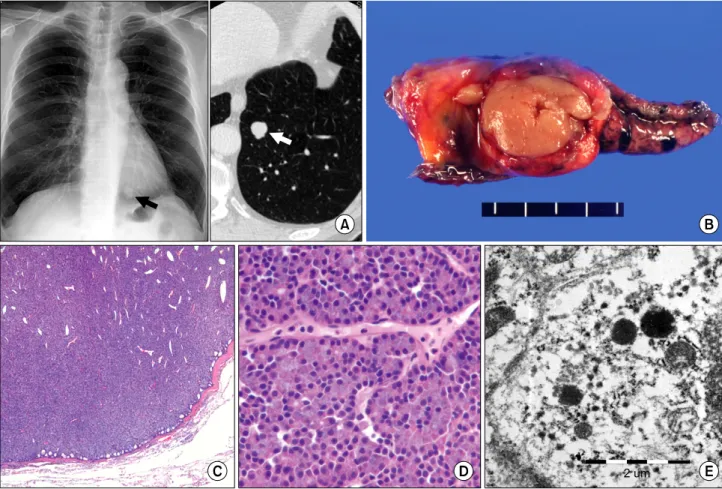
significant past medical history was incidentally found to have a nodule in the left lower lobe on a routine chest X-ray (Fig.
1A). A CT scan confirmed the presence of a well enhancing nodule in the left lower lobe, and no radiographic hilar or mediastinal lymphadenopathy was observed. There was no previous history of respiratory disease or salivary gland neoplasm. No abnormal cells were found on the sputum cytologic examination, and the pulmonary function test was within the normal range. A bronchoscopic examination was not performed because of low accessibility. On the video assisted thoracoscopic surgery wedge resection specimen, there was a well demarcated round yellow tan mass that measured 1.8×1.4 cm (Fig. 1B). Microscopically, the mass showed a sheet-like growth pattern. Almost all the tumor areas were solid, but the peripheral area revealed a focal microcystic pattern. The tumor cells were large and polygonal. Some cells revealed eosino- philic cytoplasm, but the majority of cells had basophilic, granular cytoplasm with round nuclei (Fig. 1C, D). Immunohis- tochemical studies were performed such as cytokeratin (AE1/
AE3, 1:130, DAKO), chromogranin A (1:200, DAKO),
Pulmonary Acinic Cell Tumor 21
Fig. 1. (A) The chest PA X-ray and CT show an ovoid pulmonary nodule (1.3 cm, arrows) in the left lower lobe of lung. (B) On the VATS wedge resection, the cut surface of the lung shows a well demarcated round yellow tan solid mass without necrosis or hemorrhage. (C) The tumor has a fibrous pseudocapsule and it is composed of sheets of round or ovoid uniform cells with a peripheral microcystic pattern (H&E stain, ×50). (D) The tumor cells have eosinophilic or basophilic granular cytoplasm with round to oval nuclei (H&E stain, ×400). (E) On ultrastructural examination of the formalin-fixed, paraffin-embedded tissue, the cytoplasm of the tumor cells has many well-developed organelles, including many mitochondria, endoplasmic reticulum, ribosomes and glycogen granules. Several membrane bounded electron dense secretory granules are also identified.
CD56 (1:100, Novocastra), and Ki-67 antigen (1:200, DAKO). The tumor cells were positive for AE1/AE3, they were focally immunoreactive for Ki-67 antigen (about 5%), but they showed no immunoreactivity for chromogranin A and CD56.
The ultrastructural examination of the formalin-fixed, paraffin- embedded tissue revealed that a portion of the mass showed round and polygonal cells that had round nuclei with euchromatin. The cytoplasm of the tumor cell had many well-developed organelles, including many mitochondria, ER (endoplasmic reticulum), ribosomes and glycogen granules.
Several membrane bounded electron dense secretory granules were also found (Fig. 1E). The patient is doing well 4 months after the operation.
DISCUSSION
Acinic cell carcinoma (ACC) is a malignant epithelial neoplasm that demonstrates serous acinar cell differentiation.
ACC most commonly arises in the salivary glands, and the majority of cases of this neoplasm occur in the parotid gland (80%), and it less frequently occurs in the submandibular and sublingual glands. Several reports have demonstrated its origin in other sites such as minor salivary glands of the nasal mucosa (14), larynx (15,16), breast (17) and ectopic salivary gland tissue of lymph nodes (18). Primary ACC of the lung is a very rare neoplasm, with only a few such cases having been reported to date, although the lung is the most common site of distant metastasis of ACC arising in a salivary gland. This neoplasm is thought to originate from the tracheobronchial submucosal
22 J Lung Cancer 2010;9(1):20-23
glands, and it is histologically analogous to the ACC of the salivary glands. The majority of reported cases of primary ACC of the lung were treated by surgical resection or lobectomy, and almost all the patients were alive and well at an average of 31 months of follow-up (1). Regional lymph node metastasis is uncommon. Only two cases were reported with metastasis in the hilar and interlobar nodes (1,9). Our case has been free of evidence of recurrent tumor or distant metastasis for 4 months after wedge resection. We acknowledge that this follow-up period is not enough to assess the prognosis of our patient.
Histologically, ACC shows a mixture of acinar, intercalated ductal, vacuolated, clear and non-specific glandular cells, which form solid/lobular, microcystic, papillary-cystic and follicular patterns. Our case demonstrated predominant solid areas that recapitulated salivary gland acinar differentiation, while the peripheral microcystic areas appeared to recapitulate the terminal duct-acinar unit. The immunohistochemical results of our case, including the reactivity to cytokeratin (AE1/AE3), were identical to the reported results of ACC of the salivary gland. The absence of immunohistochemical reactivity to CD56 and chromogranin A enabled us to exclude carcinoid tumor in the differential diagnosis, which has histologic features that are similar to those of ACC. The Ki-67 Ag, which is a cell proliferation marker, is one of the most predictive markers of ACC’s biological behavior. No recurrences of ACC were seen when the percentage of positively immunostained tumor cells was below 5%, whereas most patients with ACC in the salivary glands and those tumor indices were above 10% had unfavor- able outcomes. Because about 5% of the tumor cells revealed immunohistochemical reactivity to Ki-67 antigen in our case, we expected a good prognosis for our patient, unless the biological behavior of ACC of the lung is distinct from that of the salivary gland. The ultrastructural examination of our case demonstrates several round and electron dense secretory granules in the cytoplasm. Rough endoplasmic reticulum and numerous mitochondria were also identified. These features are characteristics of acinar type cells, which is consistent with acinic cell carcinoma.
Primary ACC of the lung is a rare neoplasm that makes up less than 1% of all primary lung tumors (19). ACC is definitely a malignant tumor, although the biologic behavior of the reported cases has so far been favorable, and the early
detection, diagnosis and treatment are very important to the prognosis of these patients. Thus, ACC should be considered in the differential diagnosis when a solitary pulmonary nodule is found.
REFERENCES
1. Ukoha OO, Quartararo P, Carter D, Kashgarian M, Ponn RB.
Acinic cell carcinoma of the lung with metastasis to lymph nodes. Chest 1999;115:591-595.
2. Fechner RE, Bentinck BR, Askew JB Jr. Acinic cell tumor of the lung: a histologic and ultrastructural study. Cancer 1972;
29:501-508.
3. Katz DR, Bubis JJ. Acinic cell tumor of the bronchus. Cancer 1976;38:830-832.
4. Heard BE, Dewar A, Firmin RK, Lennox SC. One very rare and one new tracheal tumour found by electron microscopy:
glomus tumour and acinic cell tumour resembling carcinoid tumours by light microscopy. Thorax 1982;37:97-103.
5. Gharpure KJ, Deshpande RK, Vlshweshvara RN, Raghu CR, Bhargava MK. Acinic cell tumour of the bronchus (a case report). Indian J Cancer 1985;22:152-156.
6. Moran CA, Suster S, Koss MN. Acinic cell carcinoma of the lung (“Fechner tumor”): a clinicopathologic, immunohisto- chemical, and ultrastructural study of five cases. Am J Surg Pathol 1992;16:1039-1050.
7. Horowitz Z, Kronenberg J. Acinic cell carcinoma of the trachea. Auris Nasus Larynx 1994;21:193-195.
8. Ansari MA, Marchevsky A, Strick L, Mohsenifar Z. Upper airway obstruction secondary to acinic cell carcinoma of the trachea: use of Nd:YAG laser. Chest 1996;110:1120-1122.
9. Lee HY, Mancer K, Koong HN. Primary acinic cell carcinoma of the lung with lymph node metastasis. Arch Pathol Lab Med 2003;127:e216-e219.
10. Sabaratnam RM, Anunathan R, Govender D. Acinic cell carcinoma: an unusual cause of bronchial obstruction in a child. Pediatr Dev Pathol 2004;7:521-526.
11. Tsukayama S, Omura K, Kanehira E, et al. Acinic cell carcinoma of the trachea: report of a case. Surg Today 2004;34:764-768.
12. Watanabe K, Ono N, Hoshi T, Hanzawa M, Ishida T.
Fine-needle aspiration cytology of bronchial acinic cell carcinoma: a case report. Diagn Cytopathol 2004;30:359-361.
13. Chuah KL, Yap WM, Tan HW, Koong HN. Recurrence of pulmonary acinic cell carcinoma. Arch Pathol Lab Med 2006;130:932-933.
14. von Biberstein SE, Spiro JD, Mancoll W. Acinic cell carcinoma of the nasal cavity. Otolaryngol Head Neck Surg 1999;120:759-762.
15. Crissman JD, Rosenblatt A. Acinous cell carcinoma of the larynx. Arch Pathol Lab Med 1978;102:233-236.
16. Kallis S, Stevens DJ. Acinous cell carcinoma of the larynx.
J Laryngol Otol 1989;103:638-641.
17. Schmitt FC, Ribeiro CA, Alvarenga S, Lopes JM. Primary
Pulmonary Acinic Cell Tumor 23
acinic cell-like carcinoma of the breast: a variant with good prognosis? Histopathology 2000;36:286-289.
18. Minic AJ. Acinic cell carcinoma arising in a parotid lymph
node. Int J Oral Maxillofac Surg 1993;22:289-291.
19. Moran CA. Primary salivary gland-type tumors of the lung.
Semin Diagn Pathol 1995;12:106-122.