Ⅰ. Introduction
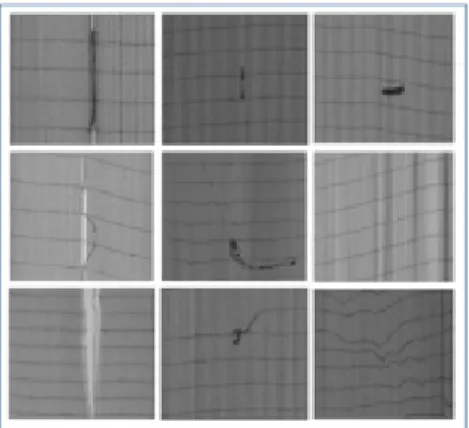
Fabric defect classification is a quality control process that aims to identifying defect type on textile. Currently, much of the fabric inspection is done essentially by the worker. Stress and weakness appears to the worker due to inspection in case quicker and higher productivity. In the textile industries have defined more than 70 types of defects [1]. Figure 1 shows nine kinds of common defects. If there are defects in fabric then the price is reduced approximately 2 times. Therefore, fabric defect classification and detection is an important step for quality control in textile manufacturing.
* corresponding author
Figure 1. Example fabric defective images illustrating that nine kind of different fabric defects.
직물 결함영역을 표시한 영상에 대한 실험적 고찰
Rakhmatov Shohruh · 최현영 · 고재필
* 금오공과대학교Experimental Remarks on Manually Attentive Fabric Defect Regions
Rakhmatov Shohruh · Hyeon-yeong Choi · Jaepil Ko
* Kumoh National Institute of TechnologyE-mail : [email protected] / [email protected] / [email protected]
요 약
직물결함 분류는 원단 품질관리에 있어 중요한 문제이다. 하지만, 다양한 결함의 종류를 영상으로 식 별하기 어렵기 때문에 자동화가 어렵다. 따라서 직물결함 분류는 대부분 사람에게 의존하고 있다. 본 논문에서는, 이를 해결하기 위해 직물결함 분류 문제에 CNN을 적용한다. 또한 CNN의 학습을 보다 쉽 게 하기 위하여, 사람이 영상에 결함 영역을 표시하는 방법을 제안한다. 본 논문에서는 제안방법과 원 본영상에 대한 비교실험을 수행하여, 제안방법이 학습에 효과가 있다는 것을 확인하였다.
ABSTRACT
Fabric defect classification is an important issue in fabric quality control. However, automated classification is difficult because it is hard to identify various types of defects in images. classification of fabric defects mostly rely on human ability. In this paper, to solve this problem we apply Convolutional Neural Networks (CNN) for fabric defect classification. To make training CNN easier, we propose a method that is manually attentive defect regions in images.
we compare the proposed method with the original image and confirm that the proposed method is effective for learning.
키워드
Deep Learning, Febric Defect Classification, Convolutional Neural Network, Manual Attention
442
한국정보통신학회 2019년 춘계 종합학술대회 논문집
The task of classification in automatic learning includes of extracting features from a set of labelled examples in order to acquire the ability to predict the correct label of any given instance. Moreover, a basic attitude of a proper classifier is its capability of learning and generalizing on new data [2].
Furthermore, it has not been possible for the architectures alone of the CNN models proposed, to achieve good classification accuracy on any dataset.
Ⅱ. Methodology
In methodology section, we will inform you about manually attentive fabric defective regions and also how to build convolution neural network.
First, we collect texture defective images within 9 classes. Our dataset consists of 515 images and also all images divided into classes imbalanced.
Therefore, it is difficult for classification and detection. To increase classification accuracy on fabric images we manually colored defective regions in the images. This is because if we show defective part more dark to the neural network, we can achieve better classification result as compared to classification result with original images. Figure 2 shows nine kinds of image examples.
Figure 2. Example of manually attentive defective regions on fabric images.
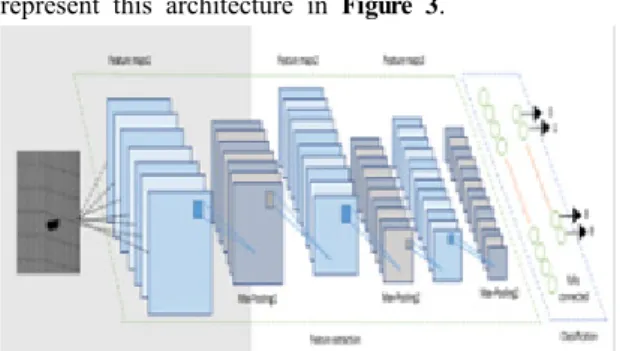
Network model: We established the Convolution neural network (CNN) architecture for both original and attentive images.
CNN has 3 layers and convolution layer and pooling layer combined, fully connected layer and sigmoid function used as activation. We will
represent this architecture in Figure 3.
Figure 3. The CNN architecture convolution layers and pooling layers grouped together. This networks are adapted to extract knowledge from images.
Table 1. Structural configuration of the compact CNN
Ⅲ. Experiments
In this paper we compared two classification results: first we did classification with original images then second we did classification with attentive images which are manually attentive defect regions with dark color.
The total of 50 epochs was used for the train by the network model. We compared according to test accuracy (Table 2).
Table 2. The comparison of classification test accuracy in terms of fabric defect classification
Table 3. The comparison of classification test loss in terms of fabric defect classification
443
한국정보통신학회 2019년 춘계 종합학술대회 논문집
Ⅳ. Conclusion
From the results that we achieved, we conclude t hat manually attentive defective regions on fabric i mage data with darker color achieves the best perfo rmance for convolution neural network as compared to original image data.
We have also noticed that with the test loss of c lassification with re-generated image data was notice able lower than original data.
In short, results demonstrate that manually attentiv e defective regions on fabric defective images showe d better results regarding on both accuracy and loss.
References
[1] Jun-Feng Jing, Hao Ma and Huan-Huan Zhang,
"Automatic fabric defect detection using deep convolution neural network", 2019.
[2] Y. LeCun, Y. Bengio, and G. Hinton. "Deep learning". Nature, 521(7553):436-444, 2015.