INTRODUCTION
Urologic diseases are more prevalent in geriatric hos
pitals than in other hospitals. Dementia, stroke, cerebral
Prevalence and management status of urologic diseases in geriatric hospitals in South Korea: A field research
Sang Heon Lee1, Jungyo Suh1, Hyung Suk Kim2, Young Ju Lee1, Sang Rim Lee3, Khae Hawn Kim4, Chang Wook Jeong1
1Department of Urology, Seoul National University College of Medicine, Seoul, 2Department of Urology, Dongguk University Ilsan Medical Center, Goyang, 3Community Nursing Science, Seoul National University College of Nursing, Seoul, 4Department of Urology, Gachon University Gil Medical Center, Incheon, Korea
Purpose: We aimed to investigate the current management status of urologic diseases in geriatric hospitals in South Korea.
Materials and Methods: Questionnaire surveys and in-depth person-to-person interviews were conducted at 13 hospitals within the Seoul and Incheon areas.
Results: The study was carried out from July to December 2014; 75.6% of patients (1,858/2,458) and 77.5% (779/1,031) of medical personnel responded to our survey. All surveys and interviews were performed by urology specialists, fellows, residents, or nurses.
The hospitals included in the study had an average of 215.2 beds (range, 110–367), 189.1 patients (range, 90–345), and 40.2 nurses (range, 10–83). The average number of physicians was 6.2 (range, 3–11), but none of these were certified urologists. Only 4 hospi- tals provided consultation services for urological disorders. In total, 64% of patients had urological disorders, although only 20.7%
of patients were receiving medication. Most patients were being treated using urological interventions; diapers (49.7%), indwelling catheters (19.5%), clean intermittent catheters (12.2%), and external collection urinary drainage (7.9%). However, most interven- tions were inadequately implemented, and only 17% of the patients had been examined by a certified urologist. Urological com- plications were found in 20.2% of patients, and secondary complications occurred in 18.8%. Excluding redundant cases, the total prevalence of urological complications was 39.0%.
Conclusions: Urologic diseases are poorly managed, and no certified urologists work in geriatric hospitals. Therefore, more desig- nated urologists are needed in geriatric hospitals.
Keywords: Health services for the aged; Patient care management; Surveys and questionnaires; Urinary incontinence; Urological diseases
This is an Open Access article distributed under the terms of the Creative Commons Attribution Non-Commercial License (http://creativecommons.org/licenses/by-nc/4.0) which permits unrestricted non-commercial use, distribution, and reproduction in any medium, provided the original work is properly cited.
Received: 8 September, 2016 • Accepted: 18 November, 2016 Corresponding Author: Chang Wook Jeong
Department of Urology, Seoul National University Hospital, 101 Daehak-ro, Jongno-gu, Seoul 03080, Korea TEL: +82-2-2072-3899, FAX: +82-2-742-4665, E-mail: [email protected]
ⓒ The Korean Urological Association, 2017
infarction, and spinal disc herniation are common diagnoses in geriatric hospitals, and these conditions cause concomitant neurogenic bladder and other voiding difficulties [1,2]. In addition, most patients in geriatric hospitals have difficulty
www.icurology.org
Investig Clin Urol 2017;58:70-76.
https://doi.org/10.4111/icu.2017.58.1.70 pISSN 2466-0493 • eISSN 2466-054X
walking or are bedridden [36], which also contributes to the prevalence of urologic diseases.
To manage urologic disease properly, a urologist must be involved. Indeed, one study showed that urologists are critical in improving urinary continence after bladder training [7]. Despite this, of the 3,326 medical specialists working in geriatric hospitals in December 2013, only 38 were urologists [8]. Such a paucity of urologists leads to poor management of voiding problems. In fact, according to previous research of South Korea, 84.4% of patients in geriatric hospitals received inadequate management for urinary incontinence [9]. Improper management of voiding disorders decreases quality of life and can even exacerbate existing conditions and comorbidities in the long term. The primary goal of geriatric hospitals is not to treat acute illness, but rather to manage chronic disorders and prevent the decline of daily function. To this end, it is essential that these hospitals manage voiding disorders properly.
Recently, no field studies have been carried out into urologic disease management in South Korean geriatric hospitals. Furthermore, given that the number of geriatric hospitals has risen exponentially, and that few such institutions employ an inhouse urologist, voiding disorders in geriatric hospitals may not be well managed. On a different note, data from the National Health Insurance Service (NHIS) provide limited information, because they represent medical insurance data rather than the actual state of the field. For these reasons, we aimed to assess, using a field survey, the actual management status of urologic diseases in South Korean geriatric hospitals.
MATERIALS AND METHODS
1. Data acquisition
We analyzed 13 hospitals, of which 2 were in Seoul and 11 were in Incheon. We conducted patient surveys and indepth interviews with medical personnel, between January 2014 to December 2014. The surveys and persontoperson interviews were all performed by urology specialists, fellows, residents, or nurses. Basic information regarding the hospitals and patients was gathered using a written questionnaire, and interviews with medical personnel were conducted in the same way (Supplementary materials 1–3). Importantly, we did not gather any information that identified the patients or medical staff. The persontoperson interviews were given by the patients themselves, except when they were unable to communicate; in such cases, the interviews were given by caregivers or nurses on the patients’ behalf.
2. Ethics statement
This study was approved by the Institutional Review Board of Seoul National University Hospital (approval number: E1410080618).
3. Statistical analysis
We used IBM SPSS Statistics ver. 19.0 (IBM Co., Armonk, NY, USA) for statistical analysis. The following additional information was also surveyed: the availability of urological consultation and outsourced medical care, as well as the number of (1) hospital beds, (2) staffed beds, (3) medical staff members, (4) geriatric care workers, and (5) physicians (numbered according to their medical specialties). The patient assessment included medical history, history of urological diagnoses, current urogenital problems, voiding symptoms, and urological intervention. Indepth interviews with medical personnel consisted of questions about the current management of urological disorders, as well as possible strategies for improvement.
RESULTS
1. Characteristics of participating geriatric hospitals We included geriatric hospitals that were established between 2006 and 2014: 2 in Seoul and 11 in Incheon. Ten of the 13 institutions were certified geriatric hospitals; the mean hospital capacity was 215.2 beds (range, 110–367), with an average of 189.1 patients (range, 90–345) at the time of the study. Regarding healthcare staff, the hospitals had an average of 6.2 doctors (range, 3–11), and 40.2 nurses (range, 10–83). Of the 80 medical specialists across all institutes, there were no certified urologists. Only four of the hospitals (30.8%) provided routine urological consultation services, while 8 (61.5%) provided outsourced consultation on an as
needed basis (Table 1).
2. Patient Information
A total of 1,858 patients were enrolled in this study, among whom there were 358 (19.3%) in Seoul and 1,500 (80.7%) in the Incheon province. Nine hundred 2 patients (48.5%) were men, 955 (51.4%) were women, and 1 was of undetermined sex. The mean age was 69.6±15.1 years, and the average hospital stay was 10.0±9.1 months. The primary complaints upon admission were stroke (37%), dementia (26%), and gait disturbance (17%). There were also degenerative neurological disorders (8%), organic neurological disorders (6%), fractures (3%), pulmonary disease (2%), and neuro
psychiatric disorders (1%). Common comorbidities were hypertension (62.0%), diabetes (49.4%), cardiac disorders
(9.6%), spinal disorders (5.9%), and hepatic disorders (1.9%).
Only 418 patients (22.5%) could walk unsupported; 515 (27.7%) required either a wheelchair or braces, and 252 (13.6%) required assistance from at least one person, and 644 (34.7%) were bedridden. On admission, 531 patients (28.6%) had at least one diagnosed urological disorder, such as urinary tract infection (UTI), benign prostatic hyperplasia, or neurogenic bladder.
3. Prevalence of urological disorders and treat- ment pattern
With regard to the prevalence of urological disorders, 900 patients (48.4%) had voiding difficulty, 930 (50.1%) had urinary incontinence, and 1,190 (64%) had both conditions.
Almost half of incontinence patients (45.8%) suffered severe incontinence; requiring at least five pads per day.
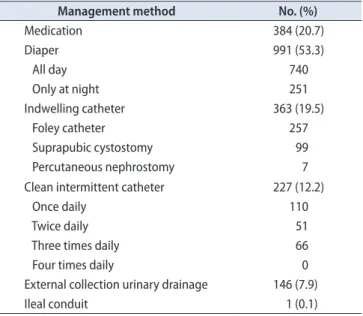
Three hundred eightyfour patients (20.7%) were on voiding disorderrelated medications, and 1,109 patients (59.7%) were managed using a urinary intervention; namely diapers, indwelling catheters, clean intermittent catheters (CICs), or External collection urinary drainage (Table 2). Only 7% of patients were managed by urologist and 83% of patient had no medical advice for voiding problems (Fig. 1).
4. Frequency of complications
Urologic complications related to voiding difficulty were found in 375 patients (20.2%), and 350 patients (18.8%) had secondary complications related to urological disease.
The total prevalence of urological complications was 39.0%, including duplicates (Table 3).
Table 1. List of participating hospitals HospitalLocationEstablishment yearCertification Bed coun
tAverage No. of hospitalized patientsNo. of doctorsNo. of nursesNo. of geriatric care workersSpecialtyUrologic consultantsRegular consultation referrals
Referral centers for severe urologic problems Hospital ASeoul2014No27826074242IM, NR, RM, FM, KMNoNoYes Hospital BSeoul2010No110903100GS, FM, KMNoNoYes Hospital CIncheon2012Yes26225097080IM, RM, KMNoNoYes Hospital DIncheon2006Yes21217054542IM, NRNoNoNo Hospital EIncheon2008No18916064025FM, NS, KM, OthersNoNoYes Hospital FIncheon2012Yes36734511830IM, GS, NR, RM, FM, OS, KMNoNoNo Hospital GIncheon2009Yes25223085580GS, NR, RM, FM, OS, KM, GY NoYesYes Hospital HIncheon2011Yes125853180IM, GS, RM, NS, OSNoNoNo Hospital IIncheon2011Yes21619875040IM, GS, RM, FM, KMNoNoNo Hospital JIncheon2010Yes28520062035IM, GS, NP, FM, NS, OSNoYesYes Hospital KIncheon2013Yes19218564820IM, RM, KMNoYesYes Hospital LIncheon2007Yes19017551245IM, FM, OS, KMNoYesYes Hospital MIncheon2010Yes12011042920IM, GS, KMNoNoNo IM, internal medicine; NR, neurology; RM, rehabilitation medicine; FM, family medicine; KM, Korean medicine; GS, general surgery; NS, neurosurgery; OS, orthopedic surgery; GY, gynecology; NP, neu- ropsychiatry.
Table 2. Urologic disorder treatment patterns (n=1,858)
Management method No. (%)
Medication 384 (20.7)
Diaper 991 (53.3)
All day 740
Only at night 251
Indwelling catheter 363 (19.5)
Foley catheter 257
Suprapubic cystostomy 99
Percutaneous nephrostomy 7
Clean intermittent catheter 227 (12.2)
Once daily 110
Twice daily 51
Three times daily 66
Four times daily 0
External collection urinary drainage 146 (7.9)
Ileal conduit 1 (0.1)
5. Medical personnel survey results
A total of 779 medical personnel participated in our survey, with a mean age of 40.1±8.5 years (range, 22–62 years). Most participants was female (90.4%) and 2 were of unknown sex. With regard to occupation, nurses (58.3%) and geriatric care givers (27.3%) were most common. About 43.5% of medical personnel recognized “over half” of patients in geriatric hospitals has urologic problem, but only 29.8%
were planned routinely checkup by urologist. None of the patients received care from a certified urologist employed in the same hospital. Surprisingly, 0.9% of medical personnel replied that either the patient or their personal care giver were responsible for genitourinary care. Medical personnel reported that patient’s genitourinary problems were relatively well managed. However, almost all of them agreed to needs of urologist (Table 4).
DISCUSSION
From 13 geriatric hospitals in the Seoul and Incheon areas, 1,858 patients and 779 medical caregivers participated in our survey. The reply rate among patients was 75.6%
(1,858/2,458), while that among medical personnel was 77.5%
(779/1,031). Considering many patients in geriatric hospitals either have difficulty communicating or cooperate poorly because of their coexisting medical condition, the present study was quite well encompassing. To increase response rate, we simplified questions and sometimes discuss with
Fig. 1. Twenty percent of patients replied that patients take urologic diag- nosis before urologic intervention. However, there was no certified urolo- gist working in geriatric hospitals we surveyed. So, only 7% of patients that consulted by urologist in other institution were exactly take urologic examination before treatment.
Management pattern of urologic disease in geriatric hospital Within the respective institute
Consultation to urologist No medical advice
Unknown 5% 5%
7%
83%
Table 3. Frequency of complications
Complication No. (%)
Urologic complications 375 (20.2) Urinary tract infection 233 Acute urinary obstruction 105
Chronic renal failure 31
Urolithiasis 10
Secondary complications 350 (18.8)
Pressure sore 131
Dermatitis 264
Table 4. Medical personnel survey results (n=779)
Variable Value
Age (y), mean±SD (range) 40.1±8.5 (22–62)
Sex
Male 73 (9.4)
Female 704 (90.4)
Unidentified 2 (0.3)
Occupation
Hospital director 2 (0.3)
Physician 60 (7.7)
Nurse 454 (58.3)
Geriatric care worker 213 (27.3)
Others 50 (6.4)
Estimated prevalence of urologic disease
≥5 of 10 339 (43.5)
3–4 of 10 281 (36.1)
1–2 of 10 91 (11.7)
<1 of 10 68 (8.7)
Management pattern of urologic disease
By in-hospital urologist 0 (0)
By routinely visited urologist 7 (0.9) By patient visit to urologist 225 (28.9) As-needed basis through consultation or transfer 535 (68.7) Do not manage urologic problem 12 (1.5) Effectiveness of genitourinary management
Not effective 0 (0)
Less effective 28 (3.6)
Moderate effective 357 (45.8)
Effective 387 (49.7)
Very effective 7 (0.9)
Needs of urologist
Not need 0 (0)
Less need 35 (4.5)
Moderate need 304 (39.1)
Much need 422 (54.2)
Surely need 17 (2.2)
Not answer 1 (0.1)
Values are presented as number (%) unless otherwise indicated.
SD, standard deviation.
patient’s family and caregiver. For example, we evaluated the prevalence of voiding disorders and incontinence using the following simple questions: “Have (you) experienced voiding difficulty or problems during the last 1 month?”, and
“Have (you) experienced incontinence, regardless of selfwill, during the last 1 month?”
We discovered several problems with the management of voiding dysfunctions in geriatric hospitals. Firstly, urinary incontinence was too often managed using urological interventions. Current literature recommend that geriatric patients be treated using behavior modification or bladder relaxant medication [2,10,11]. Special undergarments such as diapers are only useful for patients with refractory incontinence [12]. In this study however, about a half of all admitted patients used a diaper to manage voiding problems. Secondly, the urologic interventions were not properly preformed. For instance, CICs can relieve urinary incontinence in the elderly, but they are inadequately used in geriatric hospitals. It is recommended that the CIC be used at a minimum of every 4 to 6 hours to minimize bacterial dwell time [13]; however, none of patients in the present study catheterized more than 3 times a day. Moreover, 16.2%
of the patients performed inadequate external collection urinary drainage by tying a plastic bag around the penile glans, primarily to prevent diaper expenditure.
Furthermore, the incidence of complications was much higher in the present investigation than in other studies, which have reported a point prevalence of 1.5%–1.6% in long
term care facilities [14,15]. In the current study, about one
third of patients experienced voiding problems related to complications, and 12.5% suffered from a UTI. Indeed, UTI is the most common bacterial infection in the elderly, and the risks of sepsis and septic shock are higher than in younger patients [16]. In addition, cognitive impairment increases UTI risk in the elderly [17], and vice versa [18]. For this reason especially, it is important that UTIs be managed properly in geriatric hospitals. The duration of urinary catheterization is a wellknown risk factor for catheterassociated UTIs [19], and suprapubic catheterization prevents catheterassociated bacteremia more effectively. Despite this, 19.5% of inpatients are subjected to longterm indwelling catheterization, and most catheterized patients have an indwelling urethral catheter. On a different note, dermatitis is associated with improper management of diapers or external collection urinary drainage. Indeed, incontinenceassociated dermatitis can be reduced by changing pads more often, as well as by using the proper pad type [20].
Relatedly, few urologists work in geriatric hospitals.
According to the 2013 statistics of South Korea [21], only 1.6%
of doctors working in geriatric hospitals were urologists, which is much lower than the average 7.5% among the eight major specialties. Indeed, gynecologists (4.5%) and practitioners of Korean medicine (6.8%) each comprised a much higher proportion. The present field study revealed that, among patients who required urological care, 83% did not receive treatment; moreover, fewer than 5% of urological disorders were diagnosed, and the diagnosis was always carried out by a nonurologist. Medical personnel agreed that more urologists were needed. Of the 779 medical personnel surveyed, 56.4% replied either “yes” or “highly required”
when asked if they thought a urologist would benefit their patients. The diagnosis and management of UTIs and incontinence are complicated in the elderly population, and inadequate treatment increases patient mortality [22].
The simplest and most efficient solution to this would be to employ certified urologists in geriatric hospitals around the nation. Failing that, we believe that there are limits to a hospital’s ability to outsource consultations, and that routine visits from an urologist provide a more realistic solution. In addition, including urological assessment criteria in current hospital accreditation systems, or in the Health Insurance Review and Assessment, may provide sufficient incentives to selfimplement such systems. For example, The Korean Urological Association Insurance Committee suggested adding queries regarding “incontinence improvement rate,” “UTI incidence,” and “diaper usage” to the 2015 6th Korean National Health Insurance Value Incentive Program. Similarly, urological problems could be evaluated by including categories like “urinary catheterization rate,”
“assessment of voiding function,” “Foley indwelling catheter rate,” and “consultation rate for urological problems”; such changes would likely improve healthcare. Furthermore, these criteria could standardize the quality of urological management in geriatric hospitals, and would probably be useful in establishing longterm medical policy.
Previously our group reported of 11 hospitals survey report within capital area [23], about knowledge and management pattern of urinary incontinence who work in geriatric hospitals. This study based on same cohort with additional 2 hospitals medical personnel and all 13 hospitals patients survey reports. The current study includes actual field data and provides insight into the current incidence of voiding disorders, as well as their management in geriatric hospitals. The data may inform medical policy decisions in future. The purpose of our study was to assess the current management of urological disorders in geriatric hospitals in South Korea, and to improve the quality of care for patients who are denied basic urological treatment. If geriatric
hospitals continue improper management, the prevalence of complications will increase, leading to decreased quality of life and unnecessary suffering. More importantly, neglect of voiding disorders leads to poor hygiene, essentially stripping patients of their right to proper medical care.
Because field studies were limited to hospitals located in the SeoulIncheon areas, our data may not accurately represent care in geriatric hospitals around the nation.
On the other hand, even fewer medical specialists are employed in the provincial areas, and we therefore fear that management may be even worse there. Previous literature has shown that research based solely upon data requested from hospitals is limited, especially when assessing disease prevalence and patient management. Nonetheless, we believe that this study may provide useful reference data in the assessment of urological disorders throughout the nation.
CONCLUSIONS
Twothirds of patients in geriatric hospitals suffer from urological problems and above half of these are undergoing a urological intervention; however, none of them are managed by a certified urologist. We believe that assigning more urologists will improve the management of urologic diseases in geriatric hospitals.
SUPPLEMENTARY MATERIALS
Scan this QR code to see the supplementary materials, or visit http://www.icurology.org/src/sm/icurology5870s001.pdf.
ACKNOWLEDGMENTS
This study was supported by the Research Foundation for Korean Urological Association in 2014 (FKUA2014001).
REFERENCES
1. Lee SH, Cho ST, Na HR, Ko SB, Park MH. Urinary inconti- nence in patients with Alzheimer's disease: relationship be- tween symptom status and urodynamic diagnoses. Int J Urol 2014;21:683-7.
2. Jung HB, Kim HJ, Cho ST. A current perspective on geriatric lower urinary tract dysfunction. Korean J Urol 2015;56:266-75.
3. Kupelian V, Fitzgerald MP, Kaplan SA, Norgaard JP, Chiu GR, Rosen RC. Association of nocturia and mortality: results from the Third National Health and Nutrition Examination Survey.
J Urol 2011;185:571-7.
4. Kirshen AJ. Urinary incontinence in the elderly: a review. Clin Invest Med 1983;6:331-9.
5. Ogama N, Yoshida M, Nakai T, Niida S, Toba K, Sakurai T.
Frontal white matter hyperintensity predicts lower urinary tract dysfunction in older adults with amnestic mild cogni- tive impairment and Alzheimer's disease. Geriatr Gerontol Int 2016;16:167-74.
6. Chung RY, Leung JC, Chan DC, Woo J, Wong CK, Wong SY.
Lower urinary tract symptoms (LUTS) as a risk factor for de- pressive symptoms in elderly men: results from a large prospec- tive study in Southern Chinese men. PLoS One 2013;8:e76017.
7. Kim MS, Lee SH. Prevalence rate and associated factors of urinary incontinence among nursing home residents. J Korean Acad Nurs 2008;38:92-100.
8. Health Insurance Review & Assessment Service. 2013 Hand- book of health insurance review & assessment service. 2014 [Internet]. Wonju: Health Insurance Review & Assessment Service; [2016] [cited 2016 Jul 5]. Available at http://www.hira.
or.kr/
9. Lee SH, Kang JS, Kim JW, Lee SJ. Incontinence pad usage in medical welfare facilities in Korea. Int Neurourol J 2013;17:
186-90.
10. Resnick NM. Voiding dysfunction and urinary incontinence.
In: Beck JC, editor. Geriatric review syllabus: a core curriculum in geriatric medicine. New York, American Geriatrics Society;
1991. p. 141-54.
11. Lee HS, Seo JT. Urinary incontinence and overactive bladder. J Korean Med Assoc 2015;58:886-91.
12. Resnick NM, Tadic SD, Yalla SV. Geriatric incontinence and voiding dysfunction. In: Kavoussi LR, Novick AC, Partin WA, Peters CA, editors. Campbell-Walsh urology. 10th ed. Philadel- phia (PA), W.B. Saunders; 2011. p. 2204-22.
13. Cespedes RD, Gerboc JL. Other therapies for storage and emp- tying failure. In: Kavoussi LR, Novick AC, Partin WA, Peters CA, editors. Campbell-Walsh urology. 10th ed. Philadelphia (PA), W.B. Saunders; 2011. p. 2186-203.
14. Tsan L, Langberg R, Davis C, Phillips Y, Pierce J, Hojlo C, et al. Nursing home-associated infections in Department of Vet- erans Affairs community living centers. Am J Infect Control 2010;38:461-6.
15. Cotter M, Donlon S, Roche F, Byrne H, Fitzpatrick F. Health- care-associated infection in Irish long-term care facilities:
results from the First National Prevalence Study. J Hosp Infect 2012;80:212-6.
16. Koh H. Urinary tract infection in the elderly. J Korean Geriatr
Soc 2002;6:243-52.
17. Caljouw MA, den Elzen WP, Cools HJ, Gussekloo J. Predictive factors of urinary tract infections among the oldest old in the general population. A population-based prospective follow-up study. BMC Med 2011;9:57.
18. Eriksson I, Gustafson Y, Fagerström L, Olofsson B. Urinary tract infection in very old women is associated with delirium.
Int Psychogeriatr 2011;23:496-502.
19. Foxman B. Epidemiology of urinary tract infections: incidence, morbidity, and economic costs. Am J Med 2002;113 Suppl 1A:5S-13S.
20. Fujimura T, Makino M, Takagi M, Maki K, Murakami E, Ta- saka Y, et al. The influence of incontinence on the character- istic properties of the skin in bedridden elderly subjects. Int J Dermatol 2016;55:e234-40.
21. Korean Statistical Information Service. Number of medical personnel by specialized subjects [Internet]. Daejeon: Statistics Korea; 2016 [cited 2016 May 3]. Available from: http://kosis.kr/
statHtml/statHtml.do?orgId=354&tblId=DT_HIRA4K&vw_
cd=&list_id=&scrId=&seqNo=&lang_mode=ko&obj_var_
id=&itm_id=&conn_path=K1&path=#
22. Esparcia A, Artero A, Eiros JM, Balaguer M, Madrazo M, Al- berola J, et al. Influence of inadequate antimicrobial therapy on prognosis in elderly patients with severe urinary tract infec- tions. Eur J Intern Med 2014;25:523-7.
23. Jang Y, Kwon BE, Kim HS, Lee YJ, Lee S, Kim SJ, et al. Knowl- edge and practice behaviors regarding urinary incontinence among korean healthcare providers in long-term care hospi- tals. Int Neurourol J 2015;19:259-64.