• 검색 결과가 없습니다.

Esophageal Endoscopic Vacuum Therapy with Enteral Feeding Using a Sengstaken-Blakemore Tube

N/A
N/A
Protected

Academic year: 2021

Share "Esophageal Endoscopic Vacuum Therapy with Enteral Feeding Using a Sengstaken-Blakemore Tube"

Copied!
5
0
0

로드 중.... (전체 텍스트 보기)

전체 글

(1)

Received: August 2, 2017, Revised: September 17, 2017, Accepted: September 18, 2017, Published online: February 5, 2018

Corresponding author: Kun Woo Kim, Department of Thoracic and Cardiovascular Surgery, Gachon University Gil Medical Center, 21 Namdong-daero 774beon-gil, Namdong-gu, Incheon 21565, Korea

(Tel) 82-32-460-8922 (Fax) 82-32-460-3117 (E-mail) [email protected]

© The Korean Society for Thoracic and Cardiovascular Surgery. 2018. All right reserved.

This is an open access article distributed under the terms of the Creative Commons Attribution Non-Commercial License (http://creativecommons.org/

licenses/by-nc/4.0) which permits unrestricted non-commercial use, distribution, and reproduction in any medium, provided the original work is properly cited.

Early diagnosis followed by primary repair is the best treatment for spontaneous esophageal perforation.

However, the appropriate management of esophageal leakage after surgical repair is still controversial.

Recently, the successful adaptation of vacuum-assisted closure therapy, which is well established for the treatment of chronic surface wounds, has been demonstrated for esophageal perforation or leakage.

Conservative treatment methods require long-term fasting with total parenteral nutrition or enteral feeding through invasive procedures, such as percutaneous endoscopic gastrostomy or a feeding jejunostomy. We re- port 2 cases of esophageal leakage after primary repair treated by endoscopic vacuum therapy with con- tinuous enteral feeding using a Sengstaken-Blakemore tube.

Key words: 1. Esophageal perforation 2. Endoscopy

3. Vacuum therapy 4. Enteral nutrition

5. Sengstaken-Blakemore tube

Case reports

1) Case 1

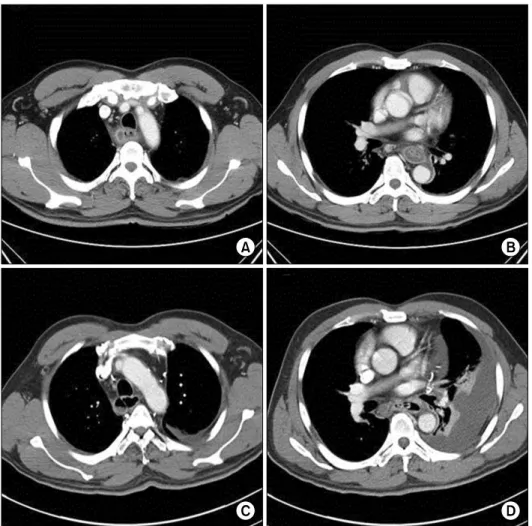
A 52-year-old man was referred to emergency de- partment of Gachon University Gil Medical Center with a febrile sensation, sore throat, and pain from the neck to the anterior chest for the previous 5 days. A physical examination revealed tachycardia and fever. Blood test results identified leukocytosis and elevated C-reactive protein. He had no history of foreign body ingestion, vomiting, chest trauma, or esophagogastroscopy. Initial chest computed tomog- raphy (CT) showed a 1.5-×1-cm submucosal abscess in the upper thoracic esophagus (Fig. 1A) and diffuse

esophageal wall thickening (Fig. 1B). After the admin- istration of broad spectrum antibiotics and nil per os (NPO) with total parenteral nutrition (TPN) for 10 days, follow-up chest CT showed an increase in the size of the submucosal abscess with areas of air den- sity (Fig. 1C). A large amount of left pleural effusion with passive atelectasis was also detected (Fig. 1D).

We suspected a hidden esophageal injury and plan-

ned surgical drainage of the abscess. In a right ex-

ploratory posterolateral thoracotomy, serous effusion

and mediastinal thickening around the esophagus

were observed. After esophageal myotomy, pus-like

material was drained and the submucosal layer was

irrigated with normal saline. Chest tubes were in-

(2)

Fig. 1. (A) Chest CT showed a 1.5-×1-cm submucosal abscess of the esophagus in the upper thoracic esophagus and (B) diffuse esoph- ageal wall thickening. (C) Chest CT after 10 days showed an increase in the size of the submucosal abscess and newly developed collections of fluid with areas of air density in the submucosal layer, and (D) a large amount of left pleural effu- sion with passive atelectasis. CT, computed tomography.

serted at the completion of the procedure. In the left thoracoscopic exploration, the left pleural cavity was filled with a large amount of serous effusion and the distal esophagus was adhered to the left lower lobe due to severe inflammation. The esophagus was per- forated approximately 3 cm above the gastro- esophageal (GE) junction. Debridement and primary repair of the perforated esophagus were attempted.

Chest tubes were positioned and the operation was completed. Since the primary repair had b een de- layed for more than 24 hours, successful repair of the defect was thought to be relatively unlikely, so esophagography was delayed until 21 days after surgery. Esophagography showed contrast leakage at the perforated left lower esophagus (Fig. 2A).

Repeating primary repair was no longer a meaningful option because the initial operation had been delayed and the defect of the esophageal tissue was observed during the initial operation to have severe necrotic

changes. Therefore, we decided to use intraluminal endoscopic vacuum therapy (EVT), which has been reported to be a successful treatment for esophageal leakage before esophagectomy and esophageal recon- struction. Furthermore, we devised a way to use a Sengstaken-Blakemore (S-B) tube for simultaneous enteral feeding during long-term fasting. Endoscopy revealed an esophageal defect at the site of the pre- viously repaired defect (35 cm from the incisors).

Under conscious sedation, a polyurethane sponge measuring 1.5×1.5×5 cm was fixed with a suture at the esophageal aspiration opening of the S-B tub e.

The sponge was placed onto the defect under con-

stant endoscopic visual guidance. After placement of

the sponge, a vacuum device was connected to the

S-B tube and set to a continuous negative pressure

of 125 mm Hg. We assessed the suitability of EVT by

monitoring pressure maintenance and drainage pat-

terns. Meanwhile, enteral nutrition was started through

(3)

Fig. 2. Esophagographic changes in the first case. (A) Twenty-one days af- ter surgery, esophagography showed contrast leakage at the perforated left lower esophagus (arrow). (B) After the fourth round of intraluminal EVT, esophagography showed no con- trast leakage into the pleural space or stenosis. Esophagographic changes in the second case. (C) Seven days post-surgery, esophagography showed contrast leakage at the lower esoph- agus, 3 cm above the gastroeso- phageal junction (arrow). (D) After the second round of intraluminal EVT, esophagography did not show any contrast leakage. EVT, endoscopic vacuum therapy.

the gastric aspiration opening of the S-B tube. The vacuum sponge was changed once, on day 7. After the fourth round of intraluminal EVT, fresh gran- ulation tissue had developed and the defect had nearly disappeared. Follow-up esophagography showed no more contrast leakage into the pleural space or stenosis (Fig. 2B). The patient gradually b egan to eat and had no difficulty swallowing. He was discharged 39 days after the post-intraluminal EVT and was fol- lowed up for 6 months without any symptoms.

2) Case 2

A 56-year-old man had hematemesis following 8 hours of vomiting prior to admission at his local hospital. He was a chronic alcoholic who drank 1 b ottle (375 mL) of soju every day; he had no other relevant medical history. He underwent gastroscopy and was diagnosed with esophageal perforation at

the GE junction. He was transferred to Gachon University Gil Medical Center and a left exploratory thoracotomy was performed 4 hours after admission.

In the left pleural cavity, the effusion had an odd smell and a dark brown color, and approximately 300 mL had accumulated. There was an esophageal perforation approximately 4 cm above the GE junc- tion, and active bleeding in a small artery of the per- forated esophageal muscle layer. Primary repair and saline irrigation were performed and chest tubes were positioned when the operation was completed.

He was maintained on NPO with TPN and received antibiotics for 6 days after the operation, and esoph- agography was performed 7 days after surgery.

Approximately 1 cm of contrast leakage was ob-

served 3 cm above the GE junction (Fig. 2C). After

10 days, contrast leakage was still present on eso-

phagography. Therefore, we decided to apply intra-

(4)

Fig. 3. (A) Intraluminal endoscopic vacuum therapy using a Sengstaken-Blakemore tube. The sponge (arrow) was fixed at the esophageal aspiration opening by a suture. (B) The sponge drainage was placed intraluminally into the defect. The sponge was long enough to cover the esophageal defect completely. Secretions were drained intraluminally, and the continuous suction force resulted in temporary com- plete occlusion of the intestinal passage. This contributed to the healing of the defect.

luminal EVT using an S-B tub e. There was no con- trast leakage in the follow-up esophagography after a second intraluminal EVT (Fig. 2D). He was dis- charged 22 days after the post-intraluminal EVT, at which time he was eating normally without any complications.

Discussion

Esophageal perforations are a life-threatening con- dition associated with a 13.2% mortality rate [1].

Delays in treatment for more than 24 hours are as- sociated with a 3-fold increase in mortality rates [1].

The primary principle for the management of esoph- ageal perforations is an aggressive surgical approach to remove the septic focus and to prevent further contamination with effective drainage. This should be followed by the administration of antibiotics, and proper nutrition should be provided while maintain- ing an NPO status [1]. If primary repair fails, re- section or exclusion of the esophagus with a cervical esophagostomy, gastrostomy, feeding jejunostomy, or delayed reconstruction is recommended [1,2]. Recently, conservative endoscopic therapeutic methods have been introduced for esophageal perforation, such as clipping, stents, fibrin glue injection, endoscopic su- turing devices, and EVT [1-3].

In vacuum-assisted closure, the vacuum-sealed sponge continuously removes wound secretions and reduces interstitial edema by applying negative pres- sure to the wound. This also improves micro- circulation, and thereby induces the accelerated for-

mation of granulation tissue, resulting in closure of the infected wound [4]. Intraluminal EVT was first performed in 2008 by Weidenhagen et al. [5] to treat anastomotic leakages after anterior rectal resections.

Based on this experience, intraluminal EVT was in- troduced in 2008 to treat anastomotic leakages after esophagectomy and gastrectomy [6]. Since then, re- cent studies have found EVT to be a more effective and less invasive treatment option for esophageal leakage after esophageal resection or perforation [2-4]. In some cases in healthy patients with minor leakage and no accumulation of contaminated effu- sion, observation without EVT could produce similar results. Therefore, in our cases, the patients were ob- served without EVT for 21 days and 17 days, respectively. Nevertheless, the leakage did not resolve. Therefore, we decided to apply EVT.

In clinical settings, early enteral nutrition is known to reduce postoperative complications and to im- prove wound healing compared with TPN. An animal study showed that total enteral nutrition may facili- tate wound healing compared with parenteral nu- trition by preventing intestinal atrophy, suppressing inflammation, and maintaining protein anabolism [7].

Additionally, early enteral feeding has been shown to

reduce anastomotic leakage, wound infection, pneu-

monia, and mortality compared with TPN after gas-

trointestinal surgery [8]. Some clinical settings, such

as uncontrolled life-threatening hypoxemia, hyper-

capnia, acidosis, and bowel ischemia or obstruction,

require delayed enteral nutrition rather than early

enteral nutrition. However, in our cases, the patients

(5)

cases, unlike previous studies, we used an S-B tube instead of an NG tube (Fig. 3A). The S-B tube con- sists of 4 lumina and has openings at different levels:

a gastric balloon, a gastric aspiration opening, an esophageal balloon, and an esophageal aspiration opening. By using a multiluminal S-B tube, we were able to apply intraluminal EVT via the esophageal as- piration opening and support stable enteral nutrition via the gastric aspiration opening without concurrent additional invasive surgery or procedures (Fig. 3B).

Complications, including aspiration and failure to maintain suction, did not occur. However, the diame- ter of the S-B tub e was larger than that of an NG tube. Therefore, the both patients felt discomfort. To the best of our knowledge, this is the first case in the literature of intraluminal EVT applied with an S-B tube for enteral feeding.

In conclusion, intraluminal EVT is a conservative treatment option for cases in which esophageal per- foration is not successfully treated by primary surgi- cal repair. Furthermore, using the S-B tube, intra- luminal EVT and enteral nutrition can be supplied to the patient simultaneously and non-invasively. This may accelerate the healing of the injured esophagus

atic review and meta-analysis of 75 studies. World J Surg 2013;37:1051-9.

2. Bludau M, Holscher AH, Herbold T, et al. Management of upper intestinal leaks using an endoscopic vacuum-assisted closure system (E-VAC). Surg Endosc 2014;28:896-901.

3. Heits N, Stapel L, Reichert B, et al. Endoscopic endolumi- nal vacuum therapy in esophageal perforation. Ann Thorac Surg 2014;97:1029-35.

4. Ahrens M, Schulte T, Egberts J, et al. Drainage of esoph- ageal leakage using endoscopic vacuum therapy: a pro- spective pilot study. Endoscopy 2010;42:693-8.

5. Weidenhagen R, Gruetzner KU, Wiecken T, Spelsberg F, Jauch KW. Endoscopic vacuum-assisted closure of anasto- motic leakage following anterior resection of the rectum:

a new method. Surg Endosc 2008;22:1818-25.

6. Wedemeyer J, Schneider A, Manns MP, Jackobs S. Endosco- pic vacuum-assisted closure of upper intestinal anasto- motic leaks. Gastrointest Endosc 2008;67:708-11.

7. Suzuki Y, Kawasaki N, Urashima M, Odaira H, Noro T. Total enteral nutrition facilitates wound healing through pre- venting intestinal atrophy, keeping protein anabolism and suppressing inflammation. Gastroenterology Res 2009;2:

224-31.

8. Lewis SJ, Egger M, Sylvester PA, Thomas S. Early enteral

feeding versus “nil by mouth” after gastrointestinal sur-

gery: systematic review and meta-analysis of controlled

trials. BMJ 2001;323:773-6.

수치

Fig. 1. (A) Chest CT showed a  1.5-×1-cm submucosal abscess of  the esophagus in the upper thoracic  esophagus and (B) diffuse  esoph-ageal wall thickening
Fig. 2. Esophagographic changes in  the first case. (A) Twenty-one days  af-ter surgery, esophagography showed contrast leakage at the perforated  left lower esophagus (arrow)
Fig. 3. (A) Intraluminal endoscopic vacuum therapy using a Sengstaken-Blakemore tube. The sponge (arrow) was fixed at the esophageal  aspiration opening by a suture

참조

관련 문서

1 John Owen, Justification by Faith Alone, in The Works of John Owen, ed. John Bolt, trans. Scott Clark, "Do This and Live: Christ's Active Obedience as the

Method We obtained blood samples from 49 patients who underwent surgical treatment for esophageal squamous cell cancer (ESCC) We performed ctDNA analysis with

Specifically, the prevalence and incidence rates of cancer among chronic diseases are continuously increasing, while early diagnosis and treatment of cancer

Therefore depending on the size of the fracture in the veneering porcelain, intraoral repair methods using surface treatment and composite resins may

"Guidelines for the early management of adults with ischemic stroke: a guideline from the American Heart Association/American Stroke Association Stroke

For establishing appropriate treatment plans and prognosis, the estimated value of the correlation between the change in hard and soft tissues is required,

Guidelines for the early management of adults with ischemic stroke: a guideline from the American Heart Association/American Stroke Association Stroke Council,

Endoscopic papillary large balloon dilation(EPLBD) involves endoscopic biliary sphincterotomy followed by balloon dilation using 12-20mm balloon to remove large