Copyright © 2019 The Korean Society for Bone and Mineral Research
This is an Open Access article distributed under the terms of the Creative Commons Attribution Non-Commercial Li- cense (http://creativecommons.org/licenses/by-nc/4.0/) which permits unrestricted non-commercial use, distribu- tion, and reproduction in any medium, provided the original work is properly cited.
Risk of Osteoporotic Fractures after Thyroid- stimulating Hormone Suppression Therapy in Patients with Thyroid Cancer
Youjin Lee1*, Byung-Ho Yoon2*, Seeyoun Lee3, Youn Kyung Chung4, Young-Kyun Lee5
1Department of Internal Medicine, Center for Thyroid Cancer, National Cancer Center, Goyang;
2Department of Orthopaedic Surgery, Inje University College of Medicine, Seoul Paik Hospital, Seoul;
3Department of Surgery, National Cancer Center, Goyang;
4Department of Obstetrics and Gynecology, National Cancer Center, Goyang;
5Department of Orthopaedic Surgery, Seoul National University Bundang Hospital, Seongnam, Korea
Background: The effects of subclinical hyperthyroidism on fracture risk induced by thy- roid-stimulating hormone (TSH) suppression therapy in patients with thyroid cancer still remains controversial. We performed a meta-analysis and systematic review to evaluate the effects of TSH suppression therapy on osteoporotic fracture in patients with thyroid cancer. Methods: We performed a systematic search to identify studies which included osteoporotic fractures (hip fracture and vertebral fracture) in patients on TSH suppres- sion therapy for thyroid cancer. Main outcome measures were occurrence and risk of os- teoporotic fractures including hip and vertebral fractures between patients and controls.
Results: A systematic search yielded a total of 8 studies appropriate for review which in- cluded osteoporotic fracture outcome in patients on TSH suppression therapy for thy- roid cancer. Studies with larger number of subjects showed the higher risk of osteopo- rotic fracture in group with TSH suppression therapy, although studies with smaller sam- ple size presented a similar risk of fracture with control group. Conclusions: Although studies were limited by small numbers, results suggested possible association between chronic TSH suppression therapy and the increased risk of osteoporotic fractures in pa- tients with thyroid cancer.
Key Words: Osteoporotic fractures · Thyroid neoplasms · Thyrotropin
INTRODUCTION
Thyroid hormones have physiological stimulatory effects on bone remodeling and mineralization, and normal euthyroid status during childhood and adoles- cence is required for acquisition of peak bone mass.[1] However, elevated level of thyroid hormone can excessively stimulate a bone remodeling, consequent bone loss, decrease of bone mineral density (BMD), and increase of osteoporotic frac- ture risk.[2,3]
Majority of thyroid cancer is differentiated thyroid cancer (DTC) raised from thy- roid follicular epithelial cells. DTC expresses thyroid-stimulating hormone (TSH) receptor on the cell membrane and TSH stimulates cell growth rate.[1] Suppres- Corresponding author
Young-Kyun Lee
Department of Orthopaedic Surgery, Seoul National University Bundang Hospital, 82 Gumi-ro, 173 beon-gil, Bundang-gu, Seongnam 13620, Korea
Tel: +82-31-787-7204 Fax: +82-31-787-4056 E-mail: [email protected] Received: January 28, 2019 Revised: February 3, 2019 Accepted: February 7, 2019
No potential conflict of interest relevant to this article was reported.
* Youjin Lee and Byung-Ho Yoon equally contributed to this work, and should be considered co-first authors.
sion of TSH by supraphysiologic doses of L-thyroxine (L-T4) is commonly used to treat patients with DTC with the pur- pose of decreasing the risk of cancer recurrence after thy- roidectomy for thyroid cancer.[4]
On the other hands, this TSH suppression therapy, that is the chronic subclinical hyperthyroidism, may be associated with undesired adverse effects, such as atrial fibrillation, ma- jor cardio vascular events, and osteoporosis.[5,6]
Thus, patients who underwent thyroidectomy for thyroid cancer could be subject vulnerable to loss of bone mass and decreased BMD, osteoporosis.[5,7-9]
However, the influence of TSH suppression therapy fol- lowing thyroidectomy on fracture risk in patients with thy- roid cancer has not been adequately addressed.
Therefore, the purpose of this study was to determine whether TSH suppression therapy in patients with thyroid cancer increase a risk of osteoporotic fractures from the lit- erature review.
METHODS
This study was exempted from Institutional Review Board (IRB) review because it did not involve human subjects.
1. Search strategy and selection criteria
Searches of PubMed-Medline, EMBASE, and Cochrane Library were conducted by using key terms (“thyroid can- cer or thyroidectomy” and “osteoporosis or osteoporotic fracture”) The last search was conducted on September 26, 2018.
Two authors independently screened the titles and ab- stracts. They also checked the reference lists of all poten- tially eligible studies and review papers to find out addi- tional relevant publications. Among the searched publica- tions, we selected studies, which met predefined inclusion criteria. The inclusion criteria were (1) published as an orig- inal article in English; (2) included TSH suppression therapy
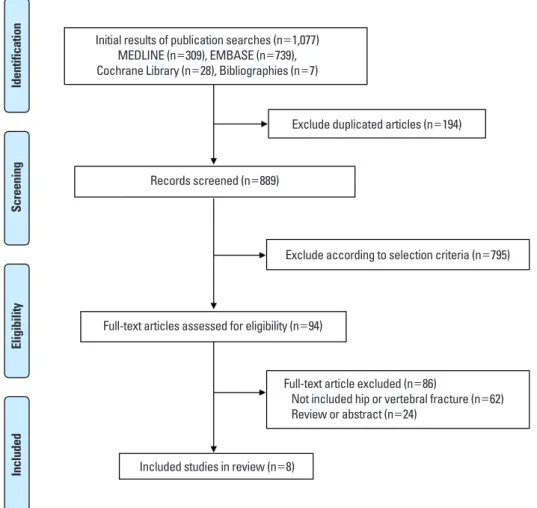
Fig. 1. Preferred Reporting Items for Systematic reviews and Meta-Analysis flow diagram details the process of relevant study selection.
Initial results of publication searches (n=1,077) MEDLINE (n=309), EMBASE (n=739), Cochrane Library (n=28), Bibliographies (n=7)
Exclude duplicated articles (n=194)
Records screened (n=889)
Exclude according to selection criteria (n=795)
Full-text articles assessed for eligibility (n=94)
Full-text article excluded (n=86)
Not included hip or vertebral fracture (n=62) Review or abstract (n=24)
Included studies in review (n=8)
IdentificationScreeningEligibilityIncluded
in patients with thyroid cancer; and (3) evaluated the os- teoporotic fractures (vertebral and hip fractures).
Exclusion criteria were (1) not included hip or vertebral fracture as outcomes; and (2) reviews and collection of ab- stracts for conference meeting.
Two authors (YL and YKL) reviewed the retrieved full man- uscripts to determine whether osteoporotic fractures (ver- tebral and hip fractures) had been reported. Finally, only original studies with osteoporotic fracture fractures in pa- tients with TSH suppression therapy for thyroid cancer were included and reviewed to determine the influence of TSH suppression therapy on the risk of osteoporotic fractures.
RESULTS
From the PubMed-Medline, EMBASE, and Cochrane Li- brary, a total of 1,077 published articles were searched for osteoporotic fracture in patients with TSH suppression ther- apy for thyroid cancer (Fig. 1). Of these 1,077 articles, 194 were excluded because of the duplicated articles. Eight hundred seventy seven were excluded because they did not meet our inclusion criteria (Fig. 1).
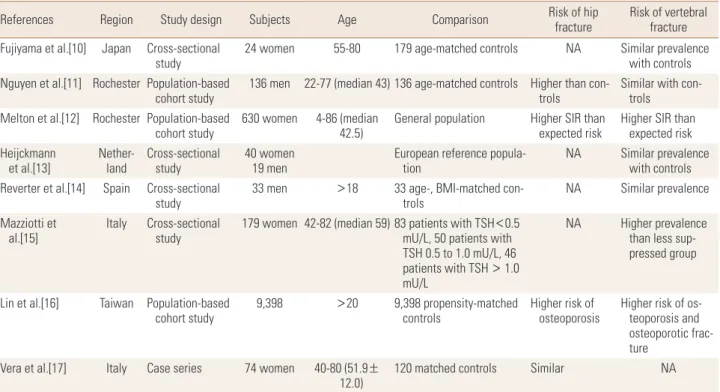
The remaining 8 studies fulfilling all inclusion criteria were reviewed (Table 1).[10-17] Two was from Rochester, USA, 2
from Italy, 1 from Spain, 1 from Netherland, 1 from Japan, and 1 from Taiwan.
Fujiyama et al.[10] performed a cross-sectional, prospec- tive study to determine whether suppressive doses of thy- roxine have any adverse effects on bone in 24 postmeno- pausal women who underwent total thyroidectomy for DTC. They compared several bone metabolic markers and incidence of vertebral deformity between the suppressed TSH group (TSH<0.1 mU/L; n=12) and non-suppressed TSH group (TSH>0.1 mU/L; n=12). There was no signifi- cant difference of the incidence of vertebral deformity be- tween the suppressed group (0.111±0.06/year/person) and the non-suppressed group (0.146±0.150/year/per- son). They presented that long-term TSH suppression ther- apy has no significant adverse effects on risk of vertebral fracture.
Nguyen et al.[11] performed population-based cohort study to assess the risk of fractures among the 136 men who underwent thyroidectomy between 1935 and 1979, comparing with that of age-matched control men from the community (Rochester, MN, USA). With 2,194 person- years of follow-up in each group, the cumulative incidence of any new fracture of the vertebra, proximal humerus, dis- tal forearm, pelvis or proximal femur was similar in both
Table 1. Risk of osteoporotic fracture in patients with thyroid-stimulating hormone suppression therapy for thyroid cancer
References Region Study design Subjects Age Comparison Risk of hip
fracture Risk of vertebral fracture Fujiyama et al.[10] Japan Cross-sectional
study 24 women 55-80 179 age-matched controls NA Similar prevalence
with controls Nguyen et al.[11] Rochester Population-based
cohort study 136 men 22-77 (median 43) 136 age-matched controls Higher than con-
trols Similar with con- trols
Melton et al.[12] Rochester Population-based
cohort study 630 women 4-86 (median
42.5) General population Higher SIR than
expected risk Higher SIR than expected risk Heijckmann
et al.[13] Nether-
land Cross-sectional
study 40 women
19 men European reference popula-
tion NA Similar prevalence
with controls Reverter et al.[14] Spain Cross-sectional
study 33 men >18 33 age-, BMI-matched con-
trols NA Similar prevalence
Mazziotti et
al.[15] Italy Cross-sectional
study 179 women 42-82 (median 59) 83 patients with TSH<0.5 mU/L, 50 patients with TSH 0.5 to 1.0 mU/L, 46 patients with TSH > 1.0 mU/L
NA Higher prevalence than less sup- pressed group
Lin et al.[16] Taiwan Population-based
cohort study 9,398 >20 9,398 propensity-matched
controls Higher risk of
osteoporosis Higher risk of os- teoporosis and osteoporotic frac- ture
Vera et al.[17] Italy Case series 74 women 40-80 (51.9±
12.0) 120 matched controls Similar NA
BMI, body mass index; TSH, thyroid-stimulating hormone; SIR, standardized incidence ratios; NA, not applicable.
groups (P=0.23), and the relative risk of any of these frac- tures in thyroidectomized men was not significantly higher than that of control group (95% confidence interval [CI], 0.7-3.2). Although the observed number of hip fracture was small, the risk of hip fracture (8/136) after thyroidecto- my was significantly higher than that (0/136) in control group (P<0.001). They suggested that further studies are needed to evaluate the increased risk of hip fractures after thyroidectomy.
Melton et al.[12] performed population-based retrospec- tive cohort study to evaluate the risk of fractures among the 630 Rochester, MN, USA women who underwent thy- roidectomy between 1950 and 1974. With 12,804 person- years of follow-up, 261 women sustained 601 different fractures. They calculated standardized incidence ratios (SIR), comparing the number of fractures that were ob- served at each site to the expected number of fracture in the cohort during their follow-up in the community. There was no increase in overall fracture risk (SIR, 0.9; 95% CI, 0.8- 1.00). On the other hands, the risk of vertebral fracture (SIR, 2.8, 95% CI, 2.3-3.3) and hip fracture (SIR, 1.3; 95% CI, 1.01- 1.8) were significantly increased, respectively, while there was no increase in SIR of wrist fracture (SIR, 1.1; 95% CI, 0.8-1.4). However, they concluded that the long-term influ- ence of thyroidectomy on overall fracture risk is negligible in women, because fracture risk was associated with ad- vancing age and with the presence of the diseases associ- ated with secondary osteoporosis but not with a history of hyperthyroidism, extent of thyroid surgery, or subsequent use of thyroid replacement therapy.
Heijckmann et al.[13] performed a cross-sectional, retro- spective study to compare the prevalence of vertebral frac- ture in 59 patients, who underwent thyroidectomy for DTC, by using vertebral fracture assessment in dual energy X- ray absorptiometry. The prevalence of vertebral fracture was 7% (4/59), which was not higher than that (12%) of European reference population. They concluded that pa- tients with DTC did not have a higher prevalence of verte- bral fracture.
Reverter et al.[14] conducted a cross-sectional, retrospec- tive study to compare the prevalence of vertebral fracture between 33 Caucasian men (mean±standard deviation age, 56±14 years) under treatment for DTC and 33 healthy age- and body mass index-matched male volunteers. Pa- tients were treated for a mean duration of 15±5 years. No
differences were found between patients and controls in bone turnover biomarkers or areal BMD, T-scores or Z-scores in all sites evaluated. No earlier fractures or pain episodes were registered in either group and the incidence of as- ymptomatic vertebral fractures did not differ significantly between patient (18.8%) and control groups (16.7%), (P=0.9).
They concluded that long-term TSH suppression treatment with levothyroxine in men with DTC does not appear to ex- ert deleterious effects on BMD or increase the prevalence of vertebral fracture.
Mazziotti et al.[15] performed a cross-sectional study to evaluate the prevalence and associated factors of radiologi- cal vertebral fractures in 179 women who receive L-thyrox- ine therapy following thyroidectomy for DTC. They also com- pared the prevalence of radiological vertebral fractures and change of BMD according to the level of TSH (<0.5 mU/L, Group 1 [n=83]; 0.5-1.0 mU/L, Group 2 [n=50]; >1.0 mU/L, Group 2 [n=46]). Vertebral fractures were found in 51 pa- tients (28.5%), with significantly (P<0.001) higher preva- lence in Group 1 (44.6%) as compared with Group 2 (24.0%) and Group 3 (4.3%). They presented that older age, osteo- porosis in BMD, TSH level <1.0 mU/L, and duration of L- thyroxine therapy were significantly and independently associated with vertebral fracture in the study population.
They concluded that the prevalence of vertebral fractures was high in women with DTC who were undergoing long- term, suppressive L-thyroxine therapy.
Lin et al.[16] performed a nationwide retrospective cohort study to compare the risk of osteoporosis among 9,398 thyroid cancer patients with levothyroxine use (n=538), those (n=8,860) without levothyroxine use and propensi- ty-score-matched non-thyroid controls (n=9,398) between 1999 and 2011. In this population-based cohort study, the incidence of osteoporotic fracture in the thyroid cancer co- hort (1.15/1,000 person-years) was similar with that in the non-thyroid-cancer cohort (0.95/1,000 person-years), with an adjusted hazard ratio [HR] of 1.32 (95% CI, 0.93-1.87).
However, the incidence of osteoporosis in the thyroid can- cer cohort (7.54/1,000 person-years) was higher than in the non-thyroid-cancer cohort (5.65/1,000 person-years), with an adjusted HR of 1.4 (95% CI, 1.22-1.61). And, the in- cidence of osteoporosis and osteoporotic fracture in the thyroid cancer cohort (8.69/1,000 person-years) was high- er than that in the non-thyroid-cancer cohort (6.60/1,000 person-years), with an adjusted HR of 1.39 (95% CI, 1.22-
1.58). Thyroid cancer patients with levothyroxine use showed a significantly higher risk of osteoporosis than non-thyroid- cancer patients (adjusted HR, 1.42; 95% CI, 1.24-1.64), while thyroid cancer patients not using levothyroxine did not have significant higher risks than non-thyroid-cancer pa- tients. (adjusted HR, 0.67; 95% CI, 0.39-1.14) After duration- response and dose-response relationships, they demon- strated that long duration of levothyroxine use and high cumulative dose of levothyroxine were significantly associ- ated with an increased risk of osteoporosis in thyroid can- cer patients following thyroidectomy. They concluded that thyroid cancer patients receiving levothyroxine have a high- er risk of osteoporosis and suggested that close monitor- ing and primary prevention of osteoporosis are warranted in thyroid cancer patients using levothyroxine.
Vera et al.[17] performed simulation study to compare BMD and fracture risk assessed by fracture risk assessment tool (FRAX) between 74 women with DTC (mean age, 51.9±
12.0 years) and 120 euthyroid women, who were matched for age, BMI, and menopausal status, at baseline, 3 years and 5.5 years (median). The risks of major osteoporotic frac- ture and hip fracture were similar in DTC patients and in controls. They presented that there was no correlation be- tween L-thyroxine dosage, duration of L-thyroxine therapy, free thyroxine level and FRAX in DTC women with well-con- trolled disease on therapy. They concluded that FRAX in- crease is a multi-factorial and age-related phenomenon.
DISCUSSION
Clinical implications of long-term TSH suppression ther- apy on bone metabolism are critical, because it is associat- ed with the favorable prognosis of thyroid cancer.[18] How- ever, the potential adverse effects of TSH suppression ther- apy on bone remain controversial. Our purpose was to re- view the literature on the effects of TSH suppression thera- py on fracture risk focusing on reported occurrence of os- teoporotic fracture.
Subclinical thyroid dysfunction has been known to be associated with increased risk of hip fracture,[19] but the influence of chronic subclinical hyperthyroidism, TSH sup- pression therapy, on fracture risk in patients who under- went thyroidectomy for thyroid cancer is unclear.
After review of these four population-based cohort stud- ies, three cross-sectional studies and 1 case series, the ef-
fects of TSH suppression therapy on fracture risk still re- main unclear.
Several studies have reported an effect of TSH suppres- sion therapy on BMD in postmenopausal women, although these effects are not clear in men and premenopausal wom- en.[20-22] Menopause, estrogen deprivation in women, is the most important cause of osteoporosis in women. The removal of the physiologic block by sex steroid hormones allows the release and production of receptor activator of nuclear factor-κB ligand, which activates the proliferation of osteoclasts.[23] This effect could be enhanced by the subclinical hyperthyroid state resulting from TSH suppres- sion therapy.[23,24]
There is a lack of studies addressing this issue so that we have systematically categorized studies according to pre- defined criteria in an attempt to reach a clearer conclusion.
Although we set to conduct a structural meta-analysis, too small number of the included studies did not allow us to do so. However, through systematic review, we found that some studies with larger number of subjects showed the higher risk of osteoporotic fracture in group with TSH sup- pression therapy,[12,16] although studies with smaller sam- ple size presented a similar risk of fracture with control group.
[10,13,14]
CONCLUSIONS
Overall, although studies were limited by small numbers, results suggested possible association between chronic TSH suppression therapy and the increased risk of osteo- porotic fractures in patients with thyroid cancer. And, it is clear that larger-scale, better-designed studies that report occurrence of osteoporotic fracture after THS suppression therapy are needed in the future to determine the influence of TSH suppression therapy on the risk of osteoporotic frac- ture in thyroid cancer.
ACKNOWLEDGMENTS
This research was supported by a grant of the Korea Health Technology R&D Project through the Korea Health Industry Development Institute (KHIDI), funded by the Ministry of Health & Welfare, Republic of Korea (grant number: HI18- C0284).
REFERENCES
1. Williams GR, Bassett JHD. Thyroid diseases and bone health.
J Endocrinol Invest 2018;41:99-109.
2. Tuchendler D, Bolanowski M. The influence of thyroid dys- function on bone metabolism. Thyroid Res 2014;7:12.
3. Williams GR. Actions of thyroid hormones in bone. Endok- rynol Pol 2009;60:380-8.
4. Haugen BR, Alexander EK, Bible KC, et al. 2015 American thyroid association management guidelines for adult pa- tients with thyroid nodules and differentiated thyroid can- cer: The American thyroid association guidelines task force on thyroid nodules and differentiated thyroid cancer. Thy- roid 2016;26:1-133.
5. Rosario PW, Carvalho M, Calsolari MR. Symptoms of thyro- toxicosis, bone metabolism and occult atrial fibrillation in older women with mild endogenous subclinical hyper- thyroidism. Clin Endocrinol (Oxf) 2016;85:132-6.
6. Karunakaran P, Maharajan C, Chockalingam R, et al. The effect of total thyroidectomy on the recovery of bone min- eral density in subjects with hyperthyroidism. Surgery 2019;
165:80-4.
7. Abrahamsen B, Jørgensen HL, Laulund AS, et al. The ex- cess risk of major osteoporotic fractures in hypothyroid- ism is driven by cumulative hyperthyroid as opposed to hypothyroid time: an observational register-based time- resolved cohort analysis. J Bone Miner Res 2015;30:898- 905.
8. Gurlek A, Gedik O. Effect of endogenous subclinical hyper- thyroidism on bone metabolism and bone mineral densi- ty in premenopausal women. Thyroid 1999;9:539-43.
9. Kim CW, Hong S, Oh SH, et al. Change of bone mineral den- sity and biochemical markers of bone turnover in patients on suppressive levothyroxine therapy for differentiated thyroid carcinoma. J Bone Metab 2015;22:135-41.
10. Fujiyama K, Kiriyama T, Ito M, et al. Suppressive doses of thyroxine do not accelerate age-related bone loss in late postmenopausal women. Thyroid 1995;5:13-7.
11. Nguyen TT, Heath H 3rd, Bryant SC, et al. Fractures after thyroidectomy in men: a population-based cohort study.
J Bone Miner Res 1997;12:1092-9.
12. Melton LJ 3rd, Ardila E, Crowson CS, et al. Fractures follow- ing thyroidectomy in women: a population-based cohort
study. Bone 2000;27:695-700.
13. Heijckmann AC, Huijberts MS, Geusens P, et al. Hip bone mineral density, bone turnover and risk of fracture in pa- tients on long-term suppressive L-thyroxine therapy for differentiated thyroid carcinoma. Eur J Endocrinol 2005;
153:23-9.
14. Reverter JL, Colome E, Holgado S, et al. Bone mineral den- sity and bone fracture in male patients receiving long-term suppressive levothyroxine treatment for differentiated thyroid carcinoma. Endocrine 2010;37:467-72.
15. Mazziotti G, Formenti AM, Frara S, et al. High prevalence of radiological vertebral fractures in women on thyroid- stimulating hormone-suppressive therapy for thyroid car- cinoma. J Clin Endocrinol Metab 2018;103:956-64.
16. Lin SY, Lin CL, Chen HT, et al. Risk of osteoporosis in thyroid cancer patients using levothyroxine: a population-based study. Curr Med Res Opin 2018;34:805-12.
17. Vera L, Gay S, Campomenosi C, et al. Ten-year estimated risk of bone fracture in women with differentiated thyroid cancer under TSH-suppressive levothyroxine therapy. En- dokrynol Pol 2016;67:350-8.
18. McGriff NJ, Csako G, Gourgiotis L, et al. Effects of thyroid hormone suppression therapy on adverse clinical outcomes in thyroid cancer. Ann Med 2002;34:554-64.
19. Lee JS, Buzková P, Fink HA, et al. Subclinical thyroid dys- function and incident hip fracture in older adults. Arch In- tern Med 2010;170:1876-83.
20. Heemstra KA, Hamdy NA, Romijn JA, et al. The effects of thyrotropin-suppressive therapy on bone metabolism in patients with well-differentiated thyroid carcinoma. Thy- roid 2006;16:583-91.
21. Kung AW, Lorentz T, Tam SC. Thyroxine suppressive thera- py decreases bone mineral density in post-menopausal women. Clin Endocrinol (Oxf) 1993;39:535-40.
22. Uzzan B, Campos J, Cucherat M, et al. Effects on bone mass of long term treatment with thyroid hormones: a meta- analysis. J Clin Endocrinol Metab 1996;81:4278-89.
23. Hofbauer LC, Kluger S, Kuhne CA, et al. Detection and char- acterization of RANK ligand and osteoprotegerin in the thyroid gland. J Cell Biochem 2002;86:642-50.
24. Hofbauer LC, Hamann C, Ebeling PR. Approach to the pa- tient with secondary osteoporosis. Eur J Endocrinol 2010;
162:1009-20.