ABSTRACT
Background: Aromatase inhibitors (AIs) play an important role in the endocrine therapy of postmenopausal breast cancer patients, with a recent tendency to extend the duration of their use. However, AIs may increase the risk of osteoporotic bone fractures. This meta-analysis evaluated the risk of osteoporotic fractures of the hip, spine, and other locations in breast cancer patients using AIs.
Methods: We performed a systematic search to identify randomized controlled clinical trials that investigated osteoporotic fractures in breast cancer patients on AI therapy. The main outcomes were the incidence and risk of osteoporotic fractures in general and of hip, vertebral, and non-vertebral fractures in AI users and controls.
Results: The systematic review found a total of 30 randomized controlled trials including 117,974 participants. The meta-analysis showed a higher incidence of osteoporotic fracture in AI users: The crude risk ratio for all osteoporotic fractures was 1.35 (95% confidence interval [CI], 1.29–1.42; P < 0.001), for hip fractures 1.18 (95% CI, 1.02–1.35; P < 0.001), for vertebral fractures 1.84 (95% CI, 1.36–2.49; P < 0.001), and for non-vertebral fractures 1.18 (95% CI, 1.02–1.35; P < 0.001), respectively, compared to the controls.
Conclusion: Our meta-analysis suggested an increased risk of osteoporotic fractures for AI therapy in patients with breast cancer that was most expressed for vertebral fractures. Breast cancer patients on AIs need to be monitored for osteoporosis and osteoporotic fractures, and active prevention measures should be implemented.
Keywords: Aromatase Inhibitors; Hip Fractures; Breast Malignant Neoplasm; Meta-analysis;
Osteoporosis, Post-menopausal; Spinal Fractures
Original Article
Young-Kyun Lee ,1* Eun-Gyeong Lee ,2* Ha Young Kim ,3 Youjin Lee ,4 Seung-Mi Lee ,5 Dong-Churl Suh ,6 Jun-Il Yoo ,7 and Seeyoun Lee 2
1Department of Orthopedic Surgery, Seoul National University Bundang Hospital, Seongnam, Korea
2Center for Breast Cancer, Research Institute and Hospital, National Cancer Center, Goyang, Korea
3 Department of Internal Medicine, Gangneung Asan Hospital, University of Ulsan College of Medicine, Gangneung, Korea
4Department of Internal Medicine, Center for Thyroid Cancer, National Cancer Center, Goyang, Korea
5College of Pharmacy, Daegu Catholic University, Gyeongsan, Korea
6Department of Pharmacy, Chung-Ang University College of Pharmacy, Seoul, Korea
7 Department of Orthopedic Surgery, Gyeongsang National University Hospital, Gyeongsang National University School of Medicine, Jinju, Korea
Osteoporotic Fractures of the Spine, Hip, and Other Locations after
Adjuvant Endocrine Therapy with
Aromatase Inhibitors in Breast Cancer Patients: a Meta-analysis
Received: May 11, 2020 Accepted: Sep 14, 2020 Address for Correspondence:
Jun-Il Yoo, MD, PhD
Department of Orthopedic Surgery, Gyeongsang National University Hospital, Gyeongsang National University School of Medicine, 79 Gangnam-ro, Jinju 52727, Republic of Korea.
E-mail: [email protected] Seeyoun Lee, MD, PhD
Center for Breast Cancer, Research Institute and Hospital, National Cancer Center, 323 Ilsan-ro, Ilsandong-gu, Goyang 10408, Republic of Korea.
E-mail: [email protected]
*Young-Kyun Lee and Eun-Gyeong Lee contributed equally to this work.
© 2020 The Korean Academy of Medical Sciences.
This is an Open Access article distributed under the terms of the Creative Commons Attribution Non-Commercial License (https://
creativecommons.org/licenses/by-nc/4.0/) which permits unrestricted non-commercial use, distribution, and reproduction in any medium, provided the original work is properly cited.
ORCID iDs Young-Kyun Lee
https://orcid.org/0000-0001-6564-4294 Eun-Gyeong Lee
https://orcid.org/0000-0002-5345-8846 Ha Young Kim
https://orcid.org/0000-0002-0651-2213 Youjin Lee
https://orcid.org/0000-0002-1224-0875
Musculoskeletal Disorders,
Rehabilitation & Sports
Medicine
Seung-Mi Lee
https://orcid.org/0000-0001-9373-9135 Dong-Churl Suh
https://orcid.org/0000-0002-2304-8037 Jun-Il Yoo
https://orcid.org/0000-0002-3575-4123 Seeyoun Lee
https://orcid.org/0000-0002-7576-1512 Funding
This research was supported by a grant from the Korea Health Technology R&D Project through the Korea Health Industry Development Institute (KHIDI), funded by the Ministry of Health & Welfare, Republic of Korea (grant No. HI18C0284).
Disclosure
The authors have no potential conflicts of interest to disclose.
Author Contributions
Conceptualization: Lee YK, Lee EG, Yoo JI, Lee S. Data curation: Lee YK. Formal analysis:
Lee YK, Yoo JI. Funding acquisition: Lee YK.
Supervision: Yoo JI, Lee S. Writing - original draft: Lee YK, Lee EG. Writing - review &
editing: Kim HY, Lee Y, Lee SM, Suh DC, Lee S.
INTRODUCTION
Breast cancer is the most frequently diagnosed cancer and the leading cause of cancer mortality among women.1 Hormone receptor (HR)-positive breast cancer (estrogen receptor- and/or progesterone receptor-positive) is the most common subtype of breast cancer, comprising about 80% of all breast cancers.2 Over the last decade, aromatase inhibitors (AIs) have been the standard adjuvant endocrine treatment for postmenopausal women with HR-positive breast cancer and metastases.3,4 AIs have been shown to improve disease-free survival and overall survival compared with tamoxifen therapy alone.5,6 Furthermore, there is a growing body of evidence supporting the benefit of extending the treatment with AIs beyond the initially recommended five years to up to ten years in patients at high-risk of long- term recurrence, including those with positive axillary lymph nodes.7
AIs control plasma estrogen levels by inhibiting or inactivating aromatase, the enzyme regulating the peripheral conversion of androgens to estrogens.8 Since this conversion is the primary source of endogenous estrogens in postmenopausal women,9 AIs relatively rapidly lower the levels of circulating estrogen.8 At the same time, AI treatment significantly increases the levels of bone turnover markers compared to patients not on treatment, indicating a negative bone balance caused by severe estrogen depletion.10 AIs result in significantly higher bone loss than the physiologic postmenopausal bone loss7,11 and increase the risk of osteoporotic fractures.12,13 In a meta-analysis13 of seven trials comparing AIs with tamoxifen in postmenopausal women with early-stage breast cancer, AIs significantly raised the risk of bone fractures (7.5% vs. 5.2% for tamoxifen; odds ratio [OR], 1.47; 95% confidence interval [CI], 1.34–1.61). Once AI treatment is concluded, bone turnover normalizes, and bone mineral density (BMD) and fracture risk can improve in some women.12,13 The recent introduction of extended AI therapy has consequently led to growing concerns about the fracture risk in these breast cancer patients.14,15
Osteoporotic fractures frequently occur in the vertebrae, hip, wrist, and humerus.16 According to the location, the prognosis and severity of these fractures differ. Although fractures of the spine are frequent, hip fractures have the higher mortality rate among these fractures. While previous study15 showed an increased fracture risk in women taking AI, there is little data on the specific fracture risk for different locations in these patients.
The objective of this meta-analysis was to assess whether AIs affect the risk of osteoporotic fractures in breast cancer patients differently depending on the location.
METHODS
Search methods for the identification of studies
This meta-analysis was carried out according to the updated guidelines of the Preferred Reporting Items for Systematic Review and Meta-Analysis.17 MEDLINE (PubMed), Embase, and Cochrane Library databases were used to search the studies to August 2020. An overview of the search strategy is presented in the Supplementary Table 1.
Two authors independently screened the titles and abstracts to identify studies on osteoporotic fractures in breast cancer patients treated with AIs. Disagreements were resolved by discussion with a third party to reach consensus. The reasons for ineligibility or exclusion of studies were recorded and described.
Study selection criteria
The systematic review was designed to answer the following question: Does AI treatment affect the risk of osteoporotic fractures differently depending on the location in breast cancer patients? The PICOS18 method was used to define the selection criteria as follows:
the P (population) was patients with breast cancer; I (intervention) was treatment with AIs, including anastrozole, exemestane, and letrozole; C (comparison) was patients with breast cancer who did not receive AIs; O (outcome) was the incidence of osteoporotic fractures in specific locations (hip, vertebral, and non-vertebral fractures); and S (study type) was randomized controlled studies only.
The exclusion criteria were as follows: 1) treated osteoporosis, 2) treated with chemotherapy or hormone replacement, and 3) review, case report, or in-vitro study.
Two authors reviewed the retrieved full manuscripts to detect whether the fractures existed after AI treatment in patients with breast cancer. They also examined the reference lists of all potentially eligible studies and review articles to find additional related publications. Articles that met the selection criteria were included in the meta-analysis.
Outcome measures and data extraction
Two authors independently extracted the following data from each included article into predesigned data collection forms in Microsoft Excel (Microsoft Corporation, Redmond, WS, USA): 1) study identification: first author's name, year of publication, and country; 2) study design; 3) participants: sample size; 4) interventions: details about the diagnostic criteria for osteoporotic fracture; 5) primary outcome measure for the meta-analysis was the difference in the incidence of osteoporotic fractures (hip, vertebral, and non-vertebral fractures) between cases and controls. The risk of fractures was also evaluated for the different sites of fractures (hip, vertebral fracture, and non-vertebral fracture); and 6) measuring tools.
Disagreements were resolved by discussion with a third party to reach consensus.
Quality assessment and publication bias
Two authors independently evaluated the quality of all studies using the Cochrane
Collaboration's tool19 for assessing the risk of bias in randomized trials. Disagreements were resolved in discussion with a third party aimed at consensus.
This tool19 assesses six sources of bias: random sequence generation, allocation concealment, blinding of participants and personnel, blinding of outcome assessment, incomplete outcome data, selective reporting, and other potential bias. Overall risk assessments (high, unclear, and low) were based on the approach presented in the Cochrane Handbook. We evaluated the presence of publication bias using Begg's funnel plot20 and Egger's test.21
Statistical analysis
The primary analysis involved a proportion meta-analysis of the data from all relevant studies that reported the incidence of osteoporotic fractures. For the subgroup analyses according to the fracture location in the spine, hip or other (binary outcomes), the effect sizes were calculated as risk ratios (RR), and the studies were weighted according to the number of included patients.
A fixed-effects or random-effects model was used to quantify the pooled effect size of the included studies, depending on the heterogeneity of the data. Heterogeneity between
comparable studies was tested using the χ2 and I2 test; P > 0.1 and I2 < 50%, respectively, were used as established criteria to determine statistical heterogeneity. All statistical analyses were performed using R software (R Foundation for Statistical Computing, Vienna, Austria).22 Ethics statement
This study was exempted from Institutional Review Board review since it did not involve any human subjects.
RESULTS
Description of the included studies
The primary search of the databases yielded 1,116 records. After 145 duplicates were removed, 971 articles were screened by title and abstract. As a result, 146 full-text articles were selected and reviewed for eligibility. A total of 30 studies (117,974 participants) were finally included in the systematic review (Fig. 1 and Table 1).
Of the 30 studies, only 28 papers reported the incidence of osteoporosis fractures, and only 6 studies reported the incidence of fractures by location (hip, vertebral, non-vertebral).
Therefore, 28 studies were included in the meta-analysis of the incidence of osteoporotic fractures in breast cancer patients treated with AIs, and 6 studies were used in the meta- analysis of the location-specific osteoporotic fracture incidence (Table 1).
Exclude duplicated articles (n = 145)
Exclude according to selection criteria (n = 825)
Full-text articles excluded Not RCT (n = 12)
review, case report or in vitro study (n = 104) Initial results of publication searches (n = 1,116)
MEDLINE (n = 163), Embase (n = 733) Cochrane Library (n = 220)
Records screened (n = 971)
IdentificationScreeningEligibilityIncluded
Full-text articles assessed for eligibility (n = 146)
Included studies in review (n = 30)
Fig. 1. Preferred Reporting Items for Systematic Reviews and Meta-Analysis flow diagram for the study selection in this meta-analysis of the risk of osteoporotic fractures in breast cancer patients on aromatase inhibitor treatment.
RCT = randomised controlled trial.
Table 1. Osteoporotic fractures in patients with aromatase inhibitor for breast cancer StudyYearCountryFollow-up durationNo. of patientsNo. of fracture occurrence, intervention/control)Fracture typeIntervention groupControl group Gnant et al.362009Austria48 mon1,80311 (T + Z [4]/A + Z [7])1. Goserelin + tamoxifen + zoledronic acid (449)1. Goserelin + tamoxifen (451) 10 (T [6]/A [4])2. Goserelin + anastrozole + zoledronic acid (450)2. Geserelin + anastrozole (453) Boccardo et al.372005Italia3 yr4484 (2/2)Anastrozole 1 mg/day (223)Tamoxifen 20 mg/day (225) Aihara et al.382010Japan42 mon69614 (5/9)Tamoxifen → Anastrozole 1 mg/day (347)Tamoxifen 20 mg/day (349) Gnant et al.392011Austria62 mon1,80325 (T [8]/T + Z [4]/ A [7]/A + Z [6])1. Goserelin + tamoxifen + zoledronic acid (450)1. Goserelin + tamoxifen (450) 2. Goserelin + anastrozole + zoledronic acid (450)2. Geserelin + anastrozole (453) Boccardo et al.402013Italia128 mon4484Tamoxifen → Anastrozole (223)Tamoxifen (225) Kaufmann et al.412007Germany30 mon89720 (10/10)Tamoxifen → Anastrozole (445)Tamoxifen (452) Mamounas et al.422008USA4 yr1,56248 (28/20)Exemenstane (783)Placebo (779) Forbes432008UK100 mon6,1865.7%/4.0%1. LetrozoleTamoxifen 2. Tamoxifen → Letrozole 3. Letrozole → Tamoxifen Coombes et al.442004Multinational31 mon4,634125 (72/53)Exemenstane (2,305)Tamoxifen (2,329) Goss et al.452003USA30 mon5,149140 (77/63)Letrozole (2,577)Tamoxifen (2,572) Goss et al.462008USA1.1 yr2,383107 (82/25)Hip 4/38Placebo → Letrozole (1,579)Placebo (804) Vertebral 8/3 Non-vertebral 74/22 Goss et al.72005USA5 yr5,170256 (137/119)Hip 5/8Letrozole (2,583)Placebo (2,587) Vertebral 15/10 Non-vertebral 122/110 Lønning et al.472005Norway2 yr1479 (4/5)Exemestane (73)Placebo (74) Gesler et al.482006Norway3 yr1479 (4/5)Exemenstane (73)Placebo (74) Thürlimann et al.492005Multinational26 mon7,567384 (225/159)Letrozole (3,579)Tamoxifen (3,988) Buzdar et al.502002Multinational33 mon9,366440 (183/142/115)Hip 11/131. Anastrozole (3,125)Tamoxifen (3,116) Vertebral 23/102. Anastrozole + Tamoxifen (3,125) Non-vertebral 162/108 Paganiet al.512014Multinational68 mon4,643278 (158/120)Exemenstane + Ovarian suppression (2,318)Tamoxifen + Ovarian suppression (2,325) Coleman et al.122007UK58 mon4,658331 (188/143)Hip 14/9Exemenstane (2,320)Tamoxifen (2,338) Vertebral 14/5 Non-vertebral 148/110 Baum et al.522003UK42 mon9,366440 (183/142/115)Hip A (11)/A + T (10)/T (13)1. Anastrozole (3,125)Tamoxifen (3,116) Vertebral A (23)/A + T (14)/T (10)2. Anastrozole + Tamoxifen (3,125) Non-vertebral A (36)/A + T (27)/T (25) Crivellari et al.532008Multinational40 mon4,89535.4%/33.9%Letrozole (2,448)Tamoxifen (2,447) Coates et al.62007Multinational51 mon4,895352 (211/141)Letrozole (2,448)Tamoxifen (2,447) Rabaglio et al.542009Switzerland60 mon4,895388 (228/160)Letrozole (2,448)Tamoxifen (2,447) Mouridsen et al.552009Multinational71 mon8,0289.8%/7.3%Letrozole (1,540)Tamoxifen (1,534) Colleoni et al.562011Multinational74 mon4,895409 (244/165)Letrozole (2,448)Tamoxifen (2,447) (continued to the next page)
StudyYearCountryFollow-up durationNo. of patientsNo. of fracture occurrence, intervention/control)Fracture typeIntervention groupControl group Bliss et al.572012Multinational91 mon4,657261 (144/117)Exemenstane (2,319)Tamoxifen (2,338) Howell et al.232005UK68 mon6,186Hip 340/237Anastrozole (3,092)Tamoxifen (3,094) Vertebral 45/27 Non-vertebral 295/210 Goss et al.582016USA10 yr1,918221 (133/88)Hip 7/6Letrozole 2.5mg (959)Placebo (959) Vertebral 17/9 Non-vertebral 116/79 Goss et al.592011Multinational5 yr4,560292 (149/143)Exemestane (2,285)Placebo (2,275) Neuneret al.602011USA36 mon2,748Hip Fx. (AI [1.7%]/T [0.5%]/N [2.0%])Aromatase inhibitor (775)Neither (1,209) Non-vertebral Fx. (AI [8.8%]/T [6.8%]/N [8.1%])Tamoxifen (764) Jakesz et al.612005Germany28 mon3,22450 (34/16)Anastrozole 1mg (1,618)Tamoxifen 20, 30 mg (1,606) T + Z = Tamoxifen + Zoledronic acid, A + Z = Anastrozole + Zoledronic acid, T = Tamoxifen, A = Anastrozole, A + T = Anastrozole + Tamoxifen, AI = aromatase inhibitor, N = neither.
Table 1. (Continued) Osteoporotic fractures in patients with aromatase inhibitor for breast cancer
Incidence of osteoporotic fractures
The analysis of 28 studies, involving a total of 99,395 (50,059 cases and 49,336 controls) patients, showed that the incidence of osteoporotic fractures was higher in AI users than that in non-users. The pooled estimate of the crude RR for osteoporotic fractures was 1.35 (95%
CI, 1.29–1.42; P < 0.001) (Fig. 2). There was considerable heterogeneity across the studies (I2
= 94%, P < 0.01).
Incidence of osteoporotic hip fractures
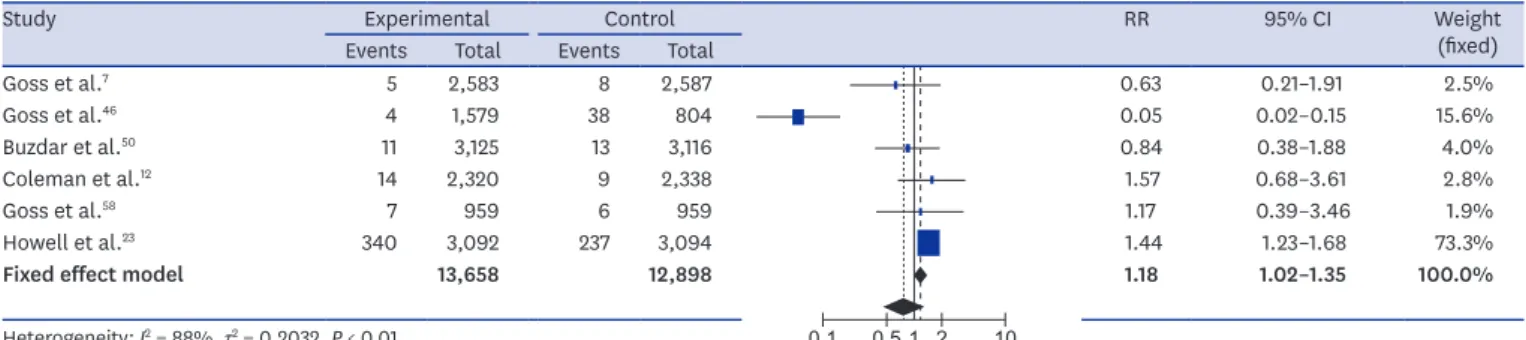
The analysis of six studies involving a total of 26,556 (13,658 cases and 12,898 controls) patients showed that the incidence of hip fractures was higher in AI users than that in non-users. The pooled estimate of the crude RR for osteoporotic hip fractures was 1.18 (95% CI, 1.02–1.35; P <
0.001) (Fig. 3). There was considerable heterogeneity across the studies (I2 = 88%; P < 0.01).
Incidence of osteoporotic vertebral fractures
The analysis of these six studies involving 26,556 (13,658 cases and 12,898 controls) patients showed that the incidence of vertebral fractures was higher in AI users than that in non-users.
The pooled estimate of the crude RR for osteoporotic vertebral fractures was 1.83 (95% CI, 1.35–
2.47; P < 0.001) (Fig. 4). There was limited heterogeneity across the studies (I2 = 0%, P = 0.90).
0.01 0.1 1 10 100
Study Experimental Control RR 95% CI Weight
(fixed) Events Total Events Total
Gnant et al.36 1 453 59 451 0.02 0.00–0.12 2.2%
Boccardo et al.37 2 223 115 225 0.02 0.00–0.07 4.3%
Aihara et al.38 5 347 119 349 0.04 0.02–0.10 4.4%
Gnant et al.39 7 453 88 450 0.08 0.04–0.17 3.3%
Boccardo et al.40 4 223 88 225 0.05 0.02–0.12 3.3%
Kaufmann et al.41 10 445 75 452 0.14 0.07–0.26 2.8%
Mamounas et al.42 20 783 25 779 0.80 0.45–1.42 0.9%
Forbes43 91 3,092 59 3,094 1.54 1.12–2.13 2.2%
Coombes et al.44 71 2,305 54 2,329 1.33 0.94–1.88 2.0%
Goss et al.45 93 2,577 28 2,572 3.31 2.18–5.04 1.0%
Goss et al.46 82 1,579 28 804 1.49 0.98–2.27 1.4%
Goss et al.7 137 2,583 1 2,587 137.21 19.21–980.32 0.0%
Lønning et al.47 4 73 5 74 0.81 0.23–2.90 0.2%
Gesler et al.48 4 73 5 74 0.81 0.23–2.90 0.2%
Thürlimann et al.49 225 3,975 116 3,988 1.95 1.56–2.42 4.3%
Buzdar et al.50 185 3,125 137 3,116 1.35 1.09–1.67 5.1%
Pagani et al.51 158 2,318 120 2,325 1.32 1.05–1.66 4.5%
Coleman et al.12 162 2,320 115 2,338 1.42 1.13–1.79 4.3%
Baum et al.52 222 3,125 137 3,116 1.62 1.31–1.99 5.1%
Crivellari et al.53 196 2,448 132 2,447 1.48 1.20–1.84 4.9%
Coates et al.6 211 2,448 159 2,447 1.33 1.09–1.62 5.9%
Rabaglio et al.54 228 2,448 160 2,447 1.42 1.17–1.73 6.0%
Mouridsen et al.55 150 1,540 112 1,534 1.33 1.06–1.69 4.2%
Colleoni et al.56 244 2,448 54 2,447 4.52 3.38–6.03 2.0%
Bliss et al.57 248 2,319 189 2,338 1.32 1.10–1.58 7.0%
Howell et al.23 340 3,092 3 3,094 113.41 36.43–352.99 0.1%
Goss et al.58 133 959 88 959 1.51 1.17–1.95 3.3%
Goss et al.59 409 2,285 400 2,275 1.02 0.90–1.15 15.0%
Fixed effect model 50,059 49,336 1.35 1.29–1.42 100.0%
Heterogeneity: I2 = 94%, τ2 = 0.3469, P < 0.01
Fig. 2. Forest plots of the effect of aromatase inhibitors on osteoporotic fractures in women with breast cancer determined by fixed-effects meta-analysis.
RR = risk ratio, CI = confidence interval.
Incidence of osteoporotic non-vertebral fractures
The analysis of these six studies involving 26,556 (13,658 cases and 12,898 controls) patients showed that the incidence of non-vertebral fractures was higher in AI users than that in non- users. The pooled estimate of the crude RR for osteoporotic non-vertebral fractures was 1.38 (95% CI, 1.25–1.53; P < 0.001) (Fig. 5). There was low evidence of heterogeneity across the studies (I2 = 0%, P = 0.50).
Quality assessment and publication bias
The study quality assessment of the included randomized clinical trials by the Cochrane Risk- of-Bias Tool is shown in the Supplementary Table 2. The Begg's funnel plot was symmetrical, and the P values for bias were not significant for all outcomes (Supplementary Fig. 1).
0.5 1 2
Study Experimental Control RR 95% CI Weight
(fixed) Events Total Events Total
Goss et al.7 122 2,583 110 2,587 1.11 0.86–1.43 15.2%
Goss et al.46 74 1,579 22 804 1.71 1.07–2.74 4.4%
Buzdar et al.50 162 3,125 108 3,116 1.50 1.18–1.90 17.0%
Coleman et al.12 148 2,320 110 2,338 1.36 1.07–1.72 16.8%
Goss et al.58 116 959 79 959 1.47 1.12–1.93 13.1%
Howell et al.23 295 3,092 210 3,094 1.41 1.19–1.67 33.5%
Random effects model 13,658 12,898 1.38 1.25–1.53 --
100.0%
Heterogeneity: I2 = 0%, τ2 = 0, P = 0.50
Fig. 5. Forest plots of the effect of aromatase inhibitors on non-vertebral fractures in women with breast cancer determined by random-effects meta-analysis.
RR = risk ratio, CI = confidence interval.
0.1 0.5 1 2 10
Study Experimental Control RR 95% CI Weight
(fixed) Events Total Events Total
Goss et al.7 5 2,583 8 2,587 0.63 0.21–1.91 2.5%
Goss et al.46 4 1,579 38 804 0.05 0.02–0.15 15.6%
Buzdar et al.50 11 3,125 13 3,116 0.84 0.38–1.88 4.0%
Coleman et al.12 14 2,320 9 2,338 1.57 0.68–3.61 2.8%
Goss et al.58 7 959 6 959 1.17 0.39–3.46 1.9%
Howell et al.23 340 3,092 237 3,094 1.44 1.23–1.68 73.3%
Fixed effect model 13,658 12,898 1.18 1.02–1.35 100.0%
Heterogeneity: I2 = 88%, τ2 = 0.2032, P < 0.01
Fig. 3. Forest plots of the effect of aromatase inhibitors on hip fractures in women with breast cancer determined by fixed-effects meta-analysis.
RR = risk ratio, CI = confidence interval.
0.2 0.5 1 2 5
Study Experimental Control RR 95% CI Weight
(fixed) Events Total Events Total
Goss et al.7 15 2,583 10 2,587 1.50 0.68–3.34 14.4%
Goss et al.46 8 1,579 3 804 1.36 0.36–5.10 5.2%
Buzdar et al.50 23 3,125 10 3,116 2.29 1.09–4.81 16.7%
Coleman et al.12 14 2,320 5 2,338 2.82 1.02–7.82 8.8%
Goss et al.58 17 959 9 959 1.89 0.85–4.22 14.2%
Howell et al.23 45 3,092 27 3,094 1.67 1.04–2.68 40.7%
Random effects model 13,658 12,898 1.83 1.35–2.47 --
100.0%
Heterogeneity: I2 = 0%, τ2 = 0, P = 0.90
Fig. 4. Forest plots of the effect of aromatase inhibitors on vertebral fractures in women with breast cancer determined by random-effects meta-analysis.
RR = risk ratio, CI = confidence interval.
DISCUSSION
This meta-analysis examined whether AI treatment is associated with an increased risk of osteoporotic fractures in patients with breast cancer who are treated with AIs differs depending on the location. It compared the reported occurrence of osteoporotic fractures between breast cancer patients using AIs and those not using AIs. The results show that the risk is highest for vertebral fractures. This complies with the results of previous studies that showed that postmenopausal breast cancer patients with AIs treatment are at increased fracture risk, and patients taking AIs had a particularly high-risk of vertebral fractures.23,24 Estrogen deficiency results in an increased number of multicellular bone units and enhanced bone turnover.25 The effects of estrogen deficiency on bone remodeling are primarily mediated through osteoclasts, with greater effects on trabecular than on cortical bone.26 Vertebrae are largely composed of trabecular bone, which is metabolically active and consequently rapidly affected by estrogen deficiency. Therefore, vertebral fractures are the most common osteoporotic fractured in the general population.27 In the United States, about 700,000 vertebral compression fractures are reported each year, which is two times the number of hip fractures.28 Our meta-analysis showed that the risk of vertebral fractures increases compared with hip and non-vertebral fractures in breast cancer patients treated with AIs.
Hip fractures as severe complications of osteoporosis commonly occur in the eighth decade of life, and the average mortality rate within one year is 20%.29 However, a recent study showed that hip fractures in breast cancer survivors treated with AIs occur at an earlier age, result in clinically more relevant functional decline, and happen at a higher BMD than in women with postmenopausal osteoporosis.30 Lee et al.11 also reported that AI treatment in early postmenopausal women with HR-positive breast cancer is associated with a deterioration of proximal hip BMD and geometry, reducing bone strength. In this meta- analysis, we found an increase in hip fractures similar to that study. Hip fractures in younger patients contribute to a deterioration in the functional status and loss of quality of life that leads to a higher socioeconomic burden than fractures in elderly patients.
Non-vertebral fractures are more frequently related to trauma and cause higher mortality rates and costs than vertebral fractures. The incidence of non-vertebral fractures increases rapidly in postmenopausal women.31 In our study, the cause of non-vertebral fractures could not be identified, but the second high-risk was found in women receiving AIs treatment.
Furthermore, the increasing use of extended AI treatment in patients at higher risk of long- term recurrence may be associated with a further increased fracture risk in the relatively young. It is important to identify these high-risk patients and to prevent bone loss in breast cancer patients taking AIs.
Some guidelines on bone health have been published for patients with breast cancer.32,33 Recently, seven international societies issued a joined position statement that provides different strategies using a stepwise algorithm.34 The statement suggests that the risk of fractures in women on AIs is comparable to the use of glucocorticoids and recommends a baseline BMD assessment and evaluation of risk factors. Each patient considered for AI treatment should be assessed for their individual fracture risk when treatment is initiated, and this risk should be re-evaluated in adequate intervals.
Pharmacological intervention is recommended for women with a T-score ≤ −2, those with a T-score < −1.5 who have one additional risk factor, and those with at least two clinical risk factors for fractures. It should be combined with vitamin D supplementation and adequate calcium intake. If anti-resorptive treatment is indicated, either denosumab or bisphosphonates are suggested as the first-line treatment to reduce AI-induced bone loss.
The treatment of osteoporosis in breast cancer patients should be continued at least until the adjuvant treatment is complete, or even longer in those patients with the highest baseline risk of fracture.35
The strength of our meta-analysis was that we analyzed osteoporotic fractures according to their location. Vertebral fractures occurred more frequently in AI users than in those not using them. However, there were several limitations. First, our study is a literature- based meta-analysis. Thus, we could not evaluate comorbidities and the intake of other medications. Second, because the data were extracted from reports with various follow- up durations, we could not analyze the time that elapses until the occurrence of the first osteoporotic fracture. Third, the inclusion criteria for the studies were different. Some patients received two- or three-year treatment with AIs, while others received AIs for five years before tamoxifen therapy, making the patients included in the meta-analysis a heterogeneous population in this aspect. Regardless, this study establishes the basis for the development of osteoporosis and fracture management in breast cancer patients receiving AI treatment. Fourth, the overall fracture incidence rates in this study were highly variable between studies. Therefore, care must be taken when interpreting the results.
In conclusion, our meta-analysis of osteoporotic fractures under AI treatment of breast cancer confirmed that osteoporotic fractures become more frequent with therapy. In particular, AIs may increase the risk of fractures in breast cancer patients based on the analyzed studies, which were low heterogeneity. Therefore, breast cancer patients using AIs need active fracture prevention and supplemental treatment. Furthermore, larger-scale, high- quality studies reporting the effects of AI treatment on BMD are needed in the future to more accurately determine the influence of AI treatment on osteoporotic fracture risk in breast cancer patients.
SUPPLEMENTARY MATERIALS
Supplementary Table 1
The detailed search strategy per database for the identification of studies on the effect of aromatase inhibitors on osteoporotic fractures in women with breast cancer
Click here to view
Supplementary Table 2
The quality assessment of each study on the effect of aromatase inhibitors on osteoporotic fractures in women with breast cancer according to the Cochrane Collaboration's tool for assessing risk of bias in randomised trials19
Click here to view
Supplementary Fig. 1
Begg's funnel plot (A) Total osteoporotic fracture, (B) osteoporotic hip fracture, (C) osteoporotic vertebral fracture, (D) osteoporotic non-vertebral fracture. The Begg's funnel plot shows a potential publication bias for each outcome. The symmetry suggests that there is no significant publication bias for each outcome.
Click here to view
REFERENCES
1. Yap YS, Lu YS, Tamura K, Lee JE, Ko EY, Park YH, et al. Insights into breast cancer in the East vs the West:
a review. JAMA Oncol. Forthcoming 2019. DOI: 10.1001/jamaoncol.2019.0620.
PUBMED | CROSSREF
2. Howlader N, Altekruse SF, Li CI, Chen VW, Clarke CA, Ries LA, et al. US incidence of breast cancer subtypes defined by joint hormone receptor and HER2 status. J Natl Cancer Inst 2014;106(5):dju055.
PUBMED | CROSSREF
3. Dowsett M, Cuzick J, Ingle J, Coates A, Forbes J, Bliss J, et al. Meta-analysis of breast cancer outcomes in adjuvant trials of aromatase inhibitors versus tamoxifen. J Clin Oncol 2010;28(3):509-18.
PUBMED | CROSSREF
4. Mauri D, Pavlidis N, Polyzos NP, Ioannidis JP. Survival with aromatase inhibitors and inactivators versus standard hormonal therapy in advanced breast cancer: meta-analysis. J Natl Cancer Inst 2006;98(18):1285-91.
PUBMED | CROSSREF
5. Early Breast Cancer Trialists' Collaborative Group (EBCTCG). Aromatase inhibitors versus tamoxifen in early breast cancer: patient-level meta-analysis of the randomised trials. Lancet 2015;386(10001):1341-52.
PUBMED | CROSSREF
6. Coates AS, Keshaviah A, Thürlimann B, Mouridsen H, Mauriac L, Forbes JF, et al. Five years of letrozole compared with tamoxifen as initial adjuvant therapy for postmenopausal women with endocrine- responsive early breast cancer: update of study BIG 1-98. J Clin Oncol 2007;25(5):486-92.
PUBMED | CROSSREF
7. Goss PE, Ingle JN, Martino S, Robert NJ, Muss HB, Piccart MJ, et al. Randomized trial of letrozole following tamoxifen as extended adjuvant therapy in receptor-positive breast cancer: updated findings from NCIC CTG MA.17. J Natl Cancer Inst 2005;97(17):1262-71.
PUBMED | CROSSREF
8. Winer EP, Hudis C, Burstein HJ, Wolff AC, Pritchard KI, Ingle JN, et al. American Society of Clinical Oncology technology assessment on the use of aromatase inhibitors as adjuvant therapy for
postmenopausal women with hormone receptor-positive breast cancer: status report 2004. J Clin Oncol 2005;23(3):619-29.
PUBMED | CROSSREF
9. Smith IE, Dowsett M. Aromatase inhibitors in breast cancer. N Engl J Med 2003;348(24):2431-42.
PUBMED | CROSSREF
10. Becker T, Lipscombe L, Narod S, Simmons C, Anderson GM, Rochon PA. Systematic review of bone health in older women treated with aromatase inhibitors for early-stage breast cancer. J Am Geriatr Soc 2012;60(9):1761-7.
PUBMED | CROSSREF
11. Lee SJ, Kim KM, Brown JK, Brett A, Roh YH, Kang DR, et al. Negative impact of aromatase inhibitors on proximal femoral bone mass and geometry in postmenopausal women with breast cancer. Calcif Tissue Int 2015;97(6):551-9.
PUBMED | CROSSREF
12. Coleman RE, Banks LM, Girgis SI, Kilburn LS, Vrdoljak E, Fox J, et al. Skeletal effects of exemestane on bone-mineral density, bone biomarkers, and fracture incidence in postmenopausal women with early breast cancer participating in the Intergroup Exemestane Study (IES): a randomised controlled study.
Lancet Oncol 2007;8(2):119-27.
PUBMED | CROSSREF
13. Amir E, Seruga B, Niraula S, Carlsson L, Ocaña A. Toxicity of adjuvant endocrine therapy in postmenopausal breast cancer patients: a systematic review and meta-analysis. J Natl Cancer Inst 2011;103(17):1299-309.
PUBMED | CROSSREF
14. Taxel P, Faircloth E, Idrees S, Van Poznak C. Cancer treatment-induced bone loss in women with breast cancer and men with prostate cancer. J Endocr Soc 2018;2(7):574-88.
PUBMED | CROSSREF
15. Melton LJ 3rd, Hartmann LC, Achenbach SJ, Atkinson EJ, Therneau TM, Khosla S. Fracture risk in women with breast cancer: a population-based study. J Bone Miner Res 2012;27(5):1196-205.
PUBMED | CROSSREF
16. Yoo JH, Moon SH, Ha YC, Lee DY, Gong HS, Park SY, et al. Osteoporotic fracture: 2015 position statement of the Korean Society for Bone and Mineral Research. J Bone Metab 2015;22(4):175-81.
PUBMED | CROSSREF
17. Moher D, Liberati A, Tetzlaff J, Altman DG; PRISMA Group. Preferred reporting items for systematic reviews and meta-analyses: the PRISMA statement. PLoS Med 2009;6(7):e1000097.
PUBMED | CROSSREF
18. Schardt C, Adams MB, Owens T, Keitz S, Fontelo P. Utilization of the PICO framework to improve searching PubMed for clinical questions. BMC Med Inform Decis Mak 2007;7(1):16.
PUBMED | CROSSREF
19. Higgins JP, Altman DG, Gøtzsche PC, Jüni P, Moher D, Oxman AD, et al. The Cochrane Collaboration's tool for assessing risk of bias in randomised trials. BMJ 2011;343:d5928.
PUBMED | CROSSREF
20. Begg CB, Mazumdar M. Operating characteristics of a rank correlation test for publication bias. Biometrics 1994;50(4):1088-101.
PUBMED | CROSSREF
21. Egger M, Davey Smith G, Schneider M, Minder C. Bias in meta-analysis detected by a simple, graphical test. BMJ 1997;315(7109):629-34.
PUBMED | CROSSREF
22. R Core Team. R: a Language and Environment for Statistical Computing. Vienna: R Foundation for Statistical Computing; 2020.
23. Howell A. Adjuvant aromatase inhibitors for breast cancer. Lancet 2005;366(9484):431-3.
PUBMED | CROSSREF
24. Body JJ. Increased fracture rate in women with breast cancer: a review of the hidden risk. BMC Cancer 2011;11(1):384.
PUBMED | CROSSREF
25. Khosla S, Oursler MJ, Monroe DG. Estrogen and the skeleton. Trends Endocrinol Metab 2012;23(11):576-81.
PUBMED | CROSSREF
26. Venken K, Callewaert F, Boonen S, Vanderschueren D. Sex hormones, their receptors and bone health.
Osteoporos Int 2008;19(11):1517-25.
PUBMED | CROSSREF
27. Park C, Ha YC, Jang S, Jang S, Yoon HK, Lee YK. The incidence and residual lifetime risk of osteoporosis- related fractures in Korea. J Bone Miner Metab 2011;29(6):744-51.
PUBMED | CROSSREF
28. Cooper C, Atkinson EJ, Jacobsen SJ, O'Fallon WM, Melton LJ 3rd. Population-based study of survival after osteoporotic fractures. Am J Epidemiol 1993;137(9):1001-5.
PUBMED | CROSSREF
29. Yoon HK, Park C, Jang S, Jang S, Lee YK, Ha YC. Incidence and mortality following hip fracture in Korea. J Korean Med Sci 2011;26(8):1087-92.
PUBMED | CROSSREF
30. Edwards BJ, Raisch DW, Shankaran V, McKoy JM, Gradishar W, Bunta AD, et al. Cancer therapy associated bone loss: implications for hip fractures in mid-life women with breast cancer. Clin Cancer Res 2011;17(3):560-8.
PUBMED | CROSSREF
31. Cummings SR, Melton LJ. Epidemiology and outcomes of osteoporotic fractures. Lancet 2002;359(9319):1761-7.
PUBMED | CROSSREF
32. Hillner BE, Ingle JN, Chlebowski RT, Gralow J, Yee GC, Janjan NA, et al. American Society of Clinical Oncology 2003 update on the role of bisphosphonates and bone health issues in women with breast cancer. J Clin Oncol 2003;21(21):4042-57.
PUBMED | CROSSREF
33. Rizzoli R, Body JJ, DeCensi A, Reginster JY, Piscitelli P, Brandi ML, et al. Guidance for the prevention of bone loss and fractures in postmenopausal women treated with aromatase inhibitors for breast cancer: an ESCEO position paper. Osteoporos Int 2012;23(11):2567-76.
PUBMED | CROSSREF
34. Hadji P, Aapro MS, Body JJ, Gnant M, Brandi ML, Reginster JY, et al. Management of aromatase inhibitor- associated bone loss (AIBL) in postmenopausal women with hormone sensitive breast cancer: joint position statement of the IOF, CABS, ECTS, IEG, ESCEO IMS, and SIOG. J Bone Oncol 2017;7:1-12.
PUBMED | CROSSREF
35. Baatjes KJ, Apffelstaedt JP, Kotze MJ, Conradie M. Postmenopausal breast cancer, aromatase inhibitors, and bone health: what the surgeon should know. World J Surg 2016;40(9):2149-56.
PUBMED | CROSSREF
36. Gnant M, Mlineritsch B, Schippinger W, Luschin-Ebengreuth G, Pöstlberger S, Menzel C, et al. Endocrine therapy plus zoledronic acid in premenopausal breast cancer. N Engl J Med 2009;360(7):679-91.
PUBMED | CROSSREF
37. Boccardo F, Rubagotti A, Puntoni M, Guglielmini P, Amoroso D, Fini A, et al. Switching to anastrozole versus continued tamoxifen treatment of early breast cancer: preliminary results of the Italian Tamoxifen Anastrozole Trial. J Clin Oncol 2005;23(22):5138-47.
PUBMED | CROSSREF
38. Aihara T, Takatsuka Y, Ohsumi S, Aogi K, Hozumi Y, Imoto S, et al. Phase III randomized adjuvant study of tamoxifen alone versus sequential tamoxifen and anastrozole in Japanese postmenopausal women with hormone-responsive breast cancer: N-SAS BC03 study. Breast Cancer Res Treat 2010;121(2):379-87.
PUBMED | CROSSREF
39. Gnant M, Mlineritsch B, Stoeger H, Luschin-Ebengreuth G, Heck D, Menzel C, et al. Adjuvant endocrine therapy plus zoledronic acid in premenopausal women with early-stage breast cancer: 62-month follow- up from the ABCSG-12 randomised trial. Lancet Oncol 2011;12(7):631-41.
PUBMED | CROSSREF
40. Boccardo F, Guglielmini P, Bordonaro R, Fini A, Massidda B, Porpiglia M, et al. Switching to anastrozole versus continued tamoxifen treatment of early breast cancer: long term results of the Italian Tamoxifen Anastrozole trial. Eur J Cancer 2013;49(7):1546-54.
PUBMED | CROSSREF
41. Kaufmann M, Jonat W, Hilfrich J, Eidtmann H, Gademann G, Zuna I, et al. Improved overall survival in postmenopausal women with early breast cancer after anastrozole initiated after treatment with tamoxifen compared with continued tamoxifen: the ARNO 95 Study. J Clin Oncol 2007;25(19):2664-70.
PUBMED | CROSSREF
42. Mamounas EP, Jeong JH, Wickerham DL, Smith RE, Ganz PA, Land SR, et al. Benefit from exemestane as extended adjuvant therapy after 5 years of adjuvant tamoxifen: intention-to-treat analysis of the National Surgical Adjuvant Breast And Bowel Project B-33 trial. J Clin Oncol 2008;26(12):1965-71.
PUBMED | CROSSREF
43. Forbes JF. The use of early adjuvant aromatase inhibitor therapy: contributions from the BIG 1-98 letrozole trial. Semin Oncol 2006;33(2 Suppl 7):S2-7.
PUBMED | CROSSREF
44. Coombes RC, Hall E, Gibson LJ, Paridaens R, Jassem J, Delozier T, et al. A randomized trial of exemestane after two to three years of tamoxifen therapy in postmenopausal women with primary breast cancer. N Engl J Med 2004;350(11):1081-92.
PUBMED | CROSSREF
45. Goss PE, Ingle JN, Martino S, Robert NJ, Muss HB, Piccart MJ, et al. A randomized trial of letrozole in postmenopausal women after five years of tamoxifen therapy for early-stage breast cancer. N Engl J Med 2003;349(19):1793-802.
PUBMED | CROSSREF
46. Goss PE, Ingle JN, Pater JL, Martino S, Robert NJ, Muss HB, et al. Late extended adjuvant treatment with letrozole improves outcome in women with early-stage breast cancer who complete 5 years of tamoxifen. J Clin Oncol 2008;26(12):1948-55.
PUBMED | CROSSREF
47. Lønning PE, Geisler J, Krag LE, Erikstein B, Bremnes Y, Hagen AI, et al. Effects of exemestane administered for 2 years versus placebo on bone mineral density, bone biomarkers, and plasma lipids in patients with surgically resected early breast cancer. J Clin Oncol 2005;23(22):5126-37.
PUBMED | CROSSREF
48. Geisler J, Lønning PE, Krag LE, Løkkevik E, Risberg T, Hagen AI, et al. Changes in bone and lipid metabolism in postmenopausal women with early breast cancer after terminating 2-year treatment with exemestane: a randomised, placebo-controlled study. Eur J Cancer 2006;42(17):2968-75.
PUBMED | CROSSREF
49. Breast International Group (BIG) 1-98 Collaborative Group, Thürlimann B, Keshaviah A, Coates AS, Mouridsen H, Mauriac L, et al. A comparison of letrozole and tamoxifen in postmenopausal women with early breast cancer. N Engl J Med 2005;353(26):2747-57.
PUBMED | CROSSREF
50. Buzdar AU; ATAC trialists' group. ‘Arimidex’ (anastrozole) versus tamoxifen as adjuvant therapy in postmenopausal women with early breast cancer--efficacy overview. J Steroid Biochem Mol Biol 2003;86(3- 5):399-403.
PUBMED | CROSSREF
51. Pagani O, Regan MM, Walley BA, Fleming GF, Colleoni M, Láng I, et al. Adjuvant exemestane with ovarian suppression in premenopausal breast cancer. N Engl J Med 2014;371(2):107-18.
PUBMED | CROSSREF
52. Baum M, Buzdar A. The current status of aromatase inhibitors in the management of breast cancer. Surg Clin North Am 2003;83(4):973-94.
PUBMED | CROSSREF
53. Crivellari D, Sun Z, Coates AS, Price KN, Thürlimann B, Mouridsen H, et al. Letrozole compared with tamoxifen for elderly patients with endocrine-responsive early breast cancer: the BIG 1-98 trial. J Clin Oncol 2008;26(12):1972-9.
PUBMED | CROSSREF
54. Rabaglio M, Sun Z, Price KN, Castiglione-Gertsch M, Hawle H, Thürlimann B, et al. Bone fractures among postmenopausal patients with endocrine-responsive early breast cancer treated with 5 years of letrozole or tamoxifen in the BIG 1-98 trial. Ann Oncol 2009;20(9):1489-98.
PUBMED | CROSSREF
55. BIG 1-98 Collaborative GroupMouridsen H, Giobbie-Hurder A, Goldhirsch A, Thürlimann B, Paridaens R, et al. Letrozole therapy alone or in sequence with tamoxifen in women with breast cancer. N Engl J Med 2009;361(8):766-76.
PUBMED | CROSSREF
56. Colleoni M, Giobbie-Hurder A, Regan MM, Thürlimann B, Mouridsen H, Mauriac L, et al. Analyses adjusting for selective crossover show improved overall survival with adjuvant letrozole compared with tamoxifen in the BIG 1-98 study. J Clin Oncol 2011;29(9):1117-24.
PUBMED | CROSSREF
57. Bliss JM, Kilburn LS, Coleman RE, Forbes JF, Coates AS, Jones SE, et al. Disease-related outcomes with long- term follow-up: an updated analysis of the intergroup exemestane study. J Clin Oncol 2012;30(7):709-17.
PUBMED | CROSSREF
58. Goss PE, Ingle JN, Pritchard KI, Robert NJ, Muss H, Gralow J, et al. Extending aromatase-inhibitor adjuvant therapy to 10 years. N Engl J Med 2016;375(3):209-19.
PUBMED | CROSSREF
59. Goss PE, Ingle JN, Alés-Martínez JE, Cheung AM, Chlebowski RT, Wactawski-Wende J, et al. Exemestane for breast-cancer prevention in postmenopausal women. N Engl J Med 2011;364(25):2381-91.
PUBMED | CROSSREF
60. Neuner JM, Yen TW, Sparapani RA, Laud PW, Nattinger AB. Fracture risk and adjuvant hormonal therapy among a population-based cohort of older female breast cancer patients. Osteoporos Int 2011;22(11):2847-55.
PUBMED | CROSSREF
61. Jakesz R, Jonat W, Gnant M, Mittlboeck M, Greil R, Tausch C, et al. Switching of postmenopausal women with endocrine-responsive early breast cancer to anastrozole after 2 years' adjuvant tamoxifen: combined results of ABCSG trial 8 and ARNO 95 trial. Lancet 2005;366(9484):455-62.
PUBMED | CROSSREF