| Abstract |
1)PURPOSE: The purpose of this study is to determine the differences between the muscle activity of cranio-cervical flexion and extension muscles according to the types of tools used through a short-term intervention of cranio-cervical static stabilization exercises using small tools.
METHODS: A total of fifteen male and female adults in their 20s who showed forward head posture in the overall body posture measurement system participated in this study. Each subject performed cranio-cervical static stabilization exercises about flexion and extension while using a sling, a foam roller, a TOGU ball, and without tools separately, and the muscle activity of the sternocleidomastoid muscle, scalenus anterior and splenius capitis was measured. Each value was measured for 10 seconds a total of three times. The maximum voluntary isometric contraction value was computed using the average during the middle four seconds.
RESULTS: Cranio-cervical flexion exercises using various tool types, the average activity of the sternocleidomastoid and
†Corresponding Author : [email protected]
This is an Open Access article distributed under the terms of the Creative Commons Attribution Non-Commercial License (http://creativecommons.org/licenses/by-nc/3.0) which permits unrestricted non-commercial use, distribution, and reproduction in any medium, provided the original work is properly cited.
scalenus anterior muscles was significantly higher when applying the TOGU ball (p<.05). According to the results of implementing cranio-cervical flexion exercise using various tools, the maximum muscle activity of the sternocleidomastoid muscle was significantly higher for the TOGU ball (p<.05).
CONCLUSION: Based on these results, the provision of an unstable surface using small tools rather than a stable surface is recommended as an exercise scheme for proprioceptive stimulation in a forward head posture.
Particularly, we recommend using the TOGU ball for the provision of an unstable surface to increase the muscle activity of the sternocleidomastoid muscle and scalenus anterior.
Key Words: EMG, Foam roller, Forward head posture, Head-neck muscle, TOGU
Ⅰ. Introduction
Forward head posture generates mechanical stress of the neck and head by structurally moving the central line of the head forward and upward (Waris, 1979). As the weight of the head that the neck supports increases, relative
Research Article Open Access
Effects of the Cranio-cervical Static Stabilization Exercises among the Using Small Tools
Won-Sik Bae, MS, PT⋅Keon-Cheol Lee, PhD, PT
†⋅Hyun-Ok Lee, PhD, PT
1Department. of Physical Therapy, Kyungnam College of Information & Technology
1
Department. of Physical Therapy, Catholic University of Pusan Received: June 23, 2016 / Revised: July 4, 2016 / Accepted: August 10, 2016
ⓒ 2016 J Korean Soc Phys Med
compensation is incurred, including increased extension in the linkage between the skull and the neck, abnormal and continuous muscle contraction of the muscles under the back of the head, the neck muscles, and shoulder muscles.
This induces change in the linkage between the head and neck (Harrison et al., 2003) and hence is pointed out as an important cause of musculoskeletal pain symptoms (Cailliet, 1998).
Small tools that provide unstable surfaces are frequently used in improving proprioceptive sensations (Creager, 1996). Recently, exercise therapy schemes that use small tools for the neck have received increasing attention; a sling, a TOGU, a gym ball, a foam roller, and a biofeedback stabilizer are mainly used. These somesthesia-motor training tools are proven to be effective in improving posture control (Lim, 2012). Since these exercises are performed on a trembling surface, they awaken the brain by activating the proprioceptive receptors to quicken information processing speed, which improves physical agility and power as well as coordination power.
Somesthesia-motor control means the controllability of the central nervous system on motion, balancing, posture, and joint stability (Franklin and Wolpert, 2011). The muscle spindles (Banks, 2006) in all skeletal muscles are the most important origin of proprioception (Proske and Gandevia, 2012), and they are diversely distributed in body. In particular, the muscles of the neck under the back of the head have high muscle spindle density due to the role of neck vertebra in head-eye movement control (Liu et al., 2003). Agility, joint stability, coordination, and balancing during neck movement are controlled by the proprioceptive system (Milner et al., 2007).
In another study, a regular sling bridge exercise was found to reduce the pain of patients with back pain and increase overall muscle activity more than other tools (Jeong et al., 2013). The findings of another study indicated that abdominal muscle exercise using a sling and a Swiss ball on an unstable surface increased abdominal muscle
activity (Lee and Kim, 2014), and in a study that examined the muscle activity of the body trunk according to posture change in a bridge exercise with a gym ball reported a significant difference (Son et al., 2009). Moreover, it was proven that using a gym ball as an exercise tool to strengthen core muscles can increase trunk joint flexibility and muscle strength, as it develops spinal stability and flexibility (Jespersen and Potvin, 2000). Moreover, Jung et al. (2010) reported that a one-foot holding position exercise using a foam roller increased the thickness of the deep abdominal muscles more than on a stable surface, as the muscle activity increased.
However, comparison studies examining the characteristics of small tools that provide unstable surfaces are scarce. Hence, this study attempts to compare the differences in the muscle activity of cranio-cervical flexion and extension muscles according to the specific tools used in a short-term intervention of cranio-cervical static stabilization exercises using small tools.
Ⅱ. Method
1. Study subjects
A total of 15 male and female college students in their 20s who were enrolled in University K located in Busan Metropolitan City, Korea were selected as study subjects.
They had no neurologic or musculoskeletal disease history or functional defects that could affect the study results.
Those who were not doing regular or systematic exercise
at the time of subject selection and those who showed
forward head posture over 2.5cm in the overall body posture
measurement system were chosen as the subjects
(Salahzadeh et al., 2014). All the subjects were provided
with a sufficient explanation about the study content and
participated in the study after signing a consent form.
2. Measurement tools and method
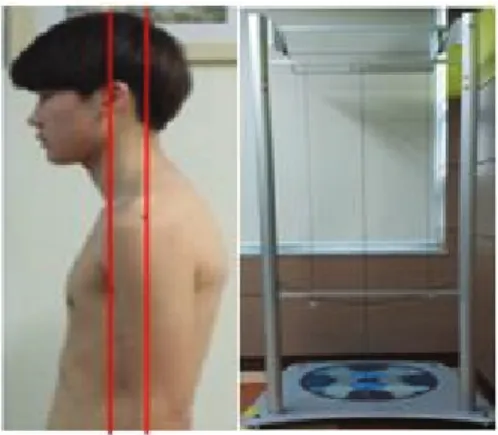
1) Overall body posture measurement system In this study, the overall body posture measurement system (GPS400, Chinesport, Italy) was used as an experimental device for measuring forward head posture (Fig. 1). Images are captured from a fixed location 3m away for the posture measurement. A sticker was attached to the acromion, and the distance between the central line of the meatus acusticus externus and a vertical line with the acromion as an axis was measured (Lee, 2011).
Fig. 1. Forward head posture measurement
2) Electromyogram measurement tool
A surface electromyogram device (Telemyo - DTS, NORAXON, USA) was used to measure the muscle activity of the sternocleidomastoid muscle, scalenus and splenius capitis of the study subjects (Fig. 2). Electrodes were attached after wiping alien substances off the skin using alcohol cotton to minimize the development of resistance created in the skin against the electromyogram signal. Record electrodes were attached to the left side of the sternocleidomastoid muscle and splenius capitis and the right scalenus. The sample extraction rate of the electromyogram signal was set at 1024 Hz. As for the frequency bandwidth, a frequency band-pass filter of the Bagnoli EMG system of 10350 Hz and a notch filter of 60 Hz was used. The root mean square (RMS) was analyzed following full-wave
rectification of the collected muscle activity signal during cranio-cervical flexion and extension using the Acquisition and Analysis Software (Delsys, U.S.A.) program, and it was quantified to maximal voluntary isometric contraction (MVIC).
Fig. 2. Electromyogram measurement tool
3) Measurement method
(1) Scalenus anterior and sternocleidomastoid muscle For the scalenus anterior, an electrode was attached to the triangular point formed by the back of the sternocleidomastoid muscle, above the clavicle and the upper trapezius. For the sternocleidomastoid muscle, an electrode was attached to the middle point of the mastoid and the upper notch in the sternum (O’Leary et al., 2011).
The subjects were in a prone position, and the tool was placed near their forehead. With Halvorsen (2010) method, subjects contracted for 10 seconds isometrically with chin-tuck (Fig. 3). In a repeated measurement three times,
Fig. 3. Measurement position
a resting time of 10 second was applied between each measurement to minimize fatigue (Yun and Kim, 2013) and the MVIC was computed using the average during the four seconds in the middle.
(2) Splenius capitis
For the splenius capitis, a surface electrode was attached to the center between the sternocleidomastoid muscle and upper trapezius at the second and third neck bone height (Falla et al., 2008). The subjects were in a supine position, and the tool was placed near their occipital bone. With Halvorsen (2010) method, subjects contracted for 10 seconds isometrically with chin-tuck. In a repeated measurement three times, a resting time of 10 second was applied between each measurement to minimize fatigue (Yun and Kim, 2013), and MVIC was computed using the average during the four seconds in the middle.
3. Exercise tools
1) Sling
A sling (Sling, Green TESMA, Korea) is an exercise tool using the movement of a hanging point, control of the length of a sling string and the principle of levers.
It is possible to change the treatment intensity by altering the length of sling-mechanical joint, the manual resistance of the therapist, the applied weight, and the use of an elastic band (Chae, 2002).
2) Foam roller
A foam roller (Tratac foam roller, XTRATAC, Korea) is a small, lightweight tool that is made of rubber. It has excellent impact-absorbing power or a high-quality sponge
(made with EVA). It generally has a cylindrical shape in a long circular stick or semicircular shape.
3) TOGU ball
A TOGU ball is a ball injected with air (TOGU, DYN Air Ballkissen, Germany) that is used as a tool for sensory exercise that activates muscles that are generally not used during daily activity. This sensory training control activates small muscles instead of large muscles and enhances energy consumption.
4. Analysis method
The SPSS ver. 22.0 program for Windows (SPSS, Chicago, IL, USA) was used for the statistical analysis of the data. One-way ANOVA was used to compare the differences between the muscle activity of cranio-cervical flexion and extension muscles. The statistical significance level was set at α=.05.
Ⅲ. Results
1. General characteristics of the research subjects The general characteristics of the research subjects are summarized in Table 1. A total of 15 subjects participated in this study, whose average age was 21.67±1.55, height was 167.2±7.43cm, and weight was 62.29±9.58kg.
2. Muscle activity in the cranio-cervical flexion exercise
In the cranio-cervical flexion exercise, the average muscle activity of the sternocleidomastoid muscle and scalenus anterior was significantly higher when applying
Sex (Male/Female) (n=15) Age (years) Body weight (kg) Height (cm)
M ± SD M ± SD M ± SD
8/7 21.67±1.55 62.29±9.58 167.2±7.43
Table 1. General characteristics of subjects
(N=33)
the TOGU ball (p<.05). According to the post-hoc test results based on LSD test method, the TOGU showed a significant difference compared to the use of no tool (p<.05) (Table 2).
The maximum muscle activity of the sternocleidomastoid muscle in the cranio-cervical flexion exercise was significantly higher when the TOGU ball was used (p<.05).
According to the post-hoc test results based on LSD test method, the TOGU ball and foam roller showed significant differences compared to the use of no tool (p<.05). The maximum muscle activity of the scalenus anterior was the highest for the TOGU ball, but this was not significant (Table 3).
3. Muscle activity in the cranio-cervical extension exercise
In the cranio-cervical extension exercise, the average and maximum muscle activities of the splenius were highest for the TOGU ball, but this was not significant.
Ⅳ. Discussion
This study applied a sling, foam roller, and TOGU ball to adults in their 20s who have forward head posture and compared the differences in their neck muscle activity during cranio-cervical static stabilization exercises.
The results indicated the highest average and maximum muscle activities of the sternocleidomastoid muscle and scalenus anterior when a TOGU ball was applied during the cranio-cervical flexion exercise. Moreover, the splenius capitis also showed the highest muscle activity with the use of the TOGU ball during the extension exercise, despite no statistical significance. In terms of previous studies, Oh (2012) applied a TOGU exercise program to 20 elderly people and reported that standing position TOGU exercises improved their balancing ability. Kim and Lee (2012) reported that subjects’ overall body balance ability enhanced following a TOGU exercise regimen. Based on these results, it is surmised that TOGU exercise induces lateral flexion and rotation of the head and neck to stimulate proprioception in the neck, which consequently improves balance and agility. It is conjectured that providing a more unstable surface than a foam roller and sling resulted in the stimulation of proprioception, inducing larger muscle activity.
In cranio-cervical flexion exercise, the maximum muscle activity of the sternocleidomastoid muscle was also significantly higher in the case of using a foam roller compared to no tool. A foam roller, which is a small tool for rehabilitation exercise, is being used on unstable surfaces to strengthen balancing reactions against rotational movement on a horizontal surface (Jung et al., 2010).
Moreover, foam rollers can also be used for the purpose
Muscle Sling Foam roller TOGU No device F p
SCM 170.21±80.68 189.50±95.38 220.59±103.71 126.53±60.17 3.10 .03* Ant. Scalenus 115.96±51.63 129.42±54.32 148.03±62.82 93.60±39.59 2.83 .04* Table 2. Comparison of the mean EMG activity among the using device in the anterior muscle
(unit: %MVIC)
Muscle Sling Foam roller TOGU No device F p
SCM 236.86±115.32 269.97±133.09 301.11±140.99 175.09±85.52 3.00 .04* Ant. Scalenus 171.26±77.11 180.40±80.63 214.42±96.16 150.43±75.21 1.56 .21 Table 3. Comparison of the peak EMG activity among the using device in the anterior Muscle
(unit: %MVIC)