Factors Affecting Length of Hospital Stay and Mortality in Infected Diabetic Foot Ulcers Undergoing Surgical Drainage without Major Amputation
This study aimed to investigate factors affecting length of hospital stay and mortality of a specific group of patients with infected diabetic foot ulcer who underwent surgical drainage without major amputation, which is frequently encountered by orthopedic surgeons. Data on length of hospital stay, mortality, demographics, and other medical information were collected for 79 consecutive patients (60 men, 19 women; mean age, 66.1 [SD, 12.3] yr) with infected diabetic foot ulcer who underwent surgical drainage while retaining the heel between October 2003 and May 2013. Multiple linear regression analysis was performed to determine factors affecting length of hospital stay, while multiple Cox regression analysis was conducted to assess factors contributing to mortality.
Erythrocyte sedimentation rate (ESR, P = 0.034), glycated hemoglobin (HbA1c) level (P = 0.021), body mass index (BMI, P = 0.001), and major vascular disease
(cerebrovascular accident or coronary artery disease, P = 0.004) were significant factors affecting length of hospital stay, whereas age (P = 0.005) and serum blood urea nitrogen (BUN) level (P = 0.024) were significant factors contributing to mortality. In conclusion, as prognostic factors, the length of hospital stay was affected by the severity of
inflammation, the recent control of blood glucose level, BMI, and major vascular disease, whereas patient mortality was affected by age and renal function in patients with infected diabetic foot ulcer undergoing surgical drainage and antibiotic treatment.
Keywords: Diabetic Foot; Foot Ulcer; Length of Stay; Mortality Tae Gyun Kim,1* Sang Young Moon,2*
Moon Seok Park,3 Soon-Sun Kwon,4 Ki Jin Jung,5 Taeseung Lee,6 Baek Kyu Kim,7 Chan Yoon,3 and Kyoung Min Lee3
1Department of Orthopaedic Surgery, Konyang Universtiy Hospital, Daejon; 2Department of Orthopaedic Surgery, Hallym University Cheuncheon Sacred Heart Hospital, Chuncheon; 3Department of Orthopaedic Surgery, Seoul National University Bundang Hospital, Seongnam; 4Department of Mathematics, Ajou University, Suwon; 5Department of Orthopaedic Surgery, Soonchunhyang University Cheonan Hospital, Cheonan; 6Department of Surgery, Seoul National University Bundang Hospital, Seongnam; 7Department of Plastic Surgery, Seoul National University Bundang Hospital, Seongnam, Korea
Received: 9 January 2015 Accepted: 18 September 2015 Address for Correspondence:
Kyoung Min Lee, MD
Department of Orthopaedic Surgery, Seoul National University Bundang Hospital, 82 Gumi-ro 173-beon-gil, Bundang-gu, Seongnam 13620, Korea
Tel: +82.31-787-7203, Fax: +82.31-787-4056 E-mail: [email protected]
http://dx.doi.org/10.3346/jkms.2016.31.1.120 • J Korean Med Sci 2016; 31: 120-124
INTRODUCTION
Diabetic foot ulcer is a common and serious complication of diabetes mellitus (DM), which may require amputation or may lead to death (1-7). Concurrent infection with diabetic foot ul- cer often aggravates disease progression and impedes wound healing and recovery, affecting patient prognosis (3). This con- dition frequently requires surgical drainage and subsequent antibiotic treatment, resulting in prolonged hospital stay; and despite these medical efforts and resources, treatment often re- sults in death.
Orthopedic surgeons often encounter grave patients with di- abetic foot ulcers and concomitant infections, requiring surgi- cal treatment. Previous studies have reported that the length of hospital stay, as a surrogate of recovery time, and mortality are important outcomes of diabetic foot ulcers (2,3). However, fac- tors affecting these outcomes have not been investigated in de- tail in patients with infected diabetic foot ulcers, requiring sur-
gical treatment. Knowledge of these factors would enable or- thopedic surgeons to better predict patient prognosis and to provide such patients with clinical information on controllable prognostic factors. These measures would help reduce a con- siderable sociomedical burden since DM is increasing in inci- dence, and infected diabetic foot ulcer is a serious complication of DM frequently requiring hospital admission.
Therefore, the aim of our study was to investigate factors af- fecting the length of hospital stay and mortality of patients with infected diabetic foot ulcers requiring surgical drainage.
MATERIALS AND METHODS Subjects and data collection
Consecutive patients with diabetic foot ulcers were enrolled in our hospital between October 2003 and May 2013; of these, pa- tients with infected diabetic foot ulcers who underwent surgical drainage were selected. Patients without apparent infections
and those who had undergone immediate primary below-knee amputations were excluded from the study. Electronic patient medical records were reviewed, and data were collected on age, sex, body mass index (BMI), length of hospital stay, mortality, Wagner ulcer classification (Wagner stage), operative proce- dures (incision and debridement or primary major amputa- tion), major vascular disease (cerebrovascular accident [CVA]
or coronary artery disease [CAD]), ankle-brachial index [ABI]
using Doppler, bacterial culture reports, and blood test results obtained on hospital admission (including hemoglobin, white blood cell count, total protein, erythrocyte sedimentation rate [ESR], C-reactive protein [CRP], blood urea nitrogen [BUN], se- rum creatinine [Cr], aspartate aminotransferase [AST], alanine aminotransferase [ALT], fasting blood glucose [Glu], and gly- cated hemoglobin [HbA1c]). When blood samples were obtain- ed, they were immediately processed, refrigerated (if necessary), and transported to the central testing department in our hospi- tal, where they were immediately analyzed.
The length of hospital stay was defined as the duration from the day of admission to the day of discharge, related only to the diagnosis and treatment of infected diabetic foot ulcers. We in- cluded Wagner stages III, IV, and V because stages I and II are not concurrent with infection according to the definition (6,8).
We defined major amputation as amputation performed above the ankle level, such as Syme’s amputation, below-knee ampu- tation, and above-knee amputation.
Surgical debridement and drainage were performed by elim- inating all infected and nonviable tissues under spinal or gen- eral anesthesia. Intraoperative bacterial culture was performed using the tissue debris. If the toes were not viable, they were amputated at the time of debridement. Either a Penrose drain was placed to enhance postoperative drainage or the surgical wound remained open. Patients with suspicious ischemic foot were referred to the vascular surgery department preoperative- ly, and concurrent vascular intervention or bypass surgery was performed at the time of orthopedic surgery, based on the vas- cular surgeon’s decision and ABI test.
Intravenous antibiotics were administered postoperatively according to the bacterial culture and antibiotic-sensitivity re- ports. Patients were discharged when the surgical wound was stable with minimal or no oozing, and blood test results (ESR and CRP) showed continuous improvement in inflammation.
Statistical analysis
To summarize patient demographics, descriptive statistics such as mean, SD, and proportion were used. The Kolmogorov-Smir- nov test was used to verify the normality of the distribution of continuous variables. Multiple regression analysis with stepwise selection was performed to examine the effects of the baseline variables, in which length of hospital stay was used as the de- pendent variable. To determine the survival rate and the hazard
ratio of mortality, we performed multiple Cox proportional haz- ards analysis with stepwise selection. The following factors were included in the analysis as possible predictors or confounders:
age, sex, length of hospital stay, mortality, Wagner stage, ABI, ESR, CRP, BUN, Cr, AST, ALT, Glu, HbA1c, BMI, CVA, and CAD.
All statistics were 2-tailed, and P values of < 0.05 were consid- ered significant. All analyses were performed using SPSS Statis- tics 20.0 for Windows (IBM Corporation, Armonk, NY, USA).
Ethics statement
This retrospective study was approved by the institutional re- view board of Seoul National University Bundang Hospital (IRB No. B-1308/216-109). The board waived the patients’ informed consent.
RESULTS
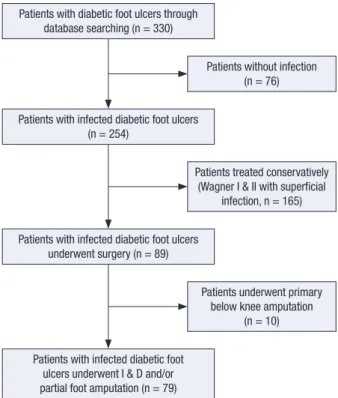
A total of 330 patients with diabetic foot ulcers were enrolled based on electronic medical records; of these, 76 were excluded because they had no sign of infection and were assigned to Wag- ner stage I or II. Of the 254 patients with infected diabetic foot ulcers, 165 were treated conservatively without surgery were excluded, which were assigned to Wagner stage I and II with superficial infection. Ten patients who underwent primary be- low-knee amputation also were excluded, leaving 79 patients (60 men, 19 women; mean age, 66.1 [SD, 12.3] yr) with infected diabetic foot ulcers to be included in the data analyses (Fig. 1).
Fig. 1. This flowchart shows the strategy to identify patients with infected diabetic foot ulcers who require surgical drainage.
Patients with diabetic foot ulcers through database searching (n = 330)
Patients with infected diabetic foot ulcers (n = 254)
Patients with infected diabetic foot ulcers underwent surgery (n = 89)
Patients with infected diabetic foot ulcers underwent I & D and/or partial foot amputation (n = 79)
Patients without infection (n = 76)
Patients treated conservatively (Wagner I & II with superficial
infection, n = 165)
Patients underwent primary below knee amputation
(n = 10)
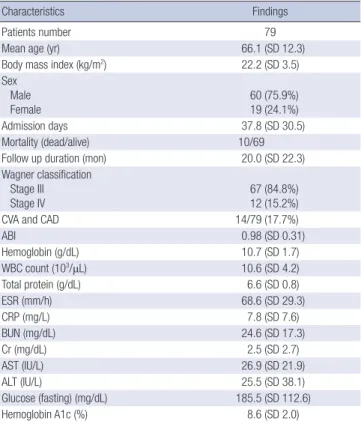
The average length of hospital stay and the follow-up period were 37.8 (SD, 30.5) days and 20.0 (SD, 22.3) months, respec- tively. During the follow-up period, 10 patients (12.7%) died.
The cause of deaths were pneumonia in three patients, CVA in two, heart failure in two, CAD in one, sepsis in one, and lung cancer in one. The survival rates at 12- and 28-months postop- eratively were found to be 88.8% and 80.9%, respectively. There were 67 patients assigned to Wagner stage III and 12 to Wagner stage IV (Table 1). Bacterial culture reports revealed 58 patients had monomicrobial infection, 4 had polymicrobial infection, and 17 had sterile culture. Overall, 79 bacteria were isolated from 62 patients. Staphylococcus aureus was the most common patho- gen isolated, followed by Pseudomonas aeruginosa, Morganella morganii, and Escherichia coli. Antibiotics that showed high sen- sitivity rate for Gram negative bacteria were; amikacin (92.9%), imipenem (92.9%), piperacillin/tazobactam (88.1%), ceftazidime (81.0%), cefotaxime (80.6%), and aztreonam (78.6%). Antibiot- ics that showed high sensitivity rate for Gram positive bacteria were; vancomycin (100%), teicoplanin (100%), rifampin (100%), trimethoprim/sulfamethoxazole (90.9%), and chloramphenicol (87.5%).
In multiple linear regression analysis, BMI (P = 0.001), pres- ence of major vascular disease (CVA or CAD) (P = 0.004), HbA1c (P = 0.021), and ESR (P = 0.034) were found to be significant in-
dependent factors affecting the length of hospital stay (Table 2).
Multiple Cox regression analysis showed that age (P = 0.005) and serum BUN (P = 0.024) were significant independent fac- tors affecting mortality (Table 3).
DISCUSSION
This study investigated factors affecting the length of hospital stay and mortality in the management of infected diabetic foot ulcers requiring orthopedic surgery without major amputation.
Our study involved a different cohort than that used in previous studies investigating the prognosis of diabetic foot ulcers in that, our patients underwent orthopedic surgery (drainage and/or partial foot amputation) for infected diabetic foot ulcers. Our results showed that the length of hospital stay was affected by the severity of inflammatory reaction (ESR), the recent control of blood glucose level (HbA1c), BMI, and major vascular dis- ease (CVA or CAD). Patient mortality was affected by age and renal function (BUN).
In this study, length of hospital stay was used as a surrogate of recovery time from infected diabetic foot ulcer. Our study showed a greater length of hospital stay than that reported in other studies (2,7). This is because our cohort included severer diabetic foot ulcers with concomitant infection than that taken in a previous study (2), and we endeavored to salvage the limb without major amputation, which required subsequent intra- venous antibiotic treatment causing prolonged hospital admis- sion compared with that in another study (7). On the other hand, it should be considered that the length of hospital stay can be Table 1. Patient demographics and characteristics
Characteristics Findings
Patients number 79
Mean age (yr) 66.1 (SD 12.3)
Body mass index (kg/m2) 22.2 (SD 3.5)
Sex Male
Female 60 (75.9%)
19 (24.1%)
Admission days 37.8 (SD 30.5)
Mortality (dead/alive) 10/69
Follow up duration (mon) 20.0 (SD 22.3)
Wagner classification Stage III
Stage IV 67 (84.8%)
12 (15.2%)
CVA and CAD 14/79 (17.7%)
ABI 0.98 (SD 0.31)
Hemoglobin (g/dL) 10.7 (SD 1.7)
WBC count (103/μL) 10.6 (SD 4.2)
Total protein (g/dL) 6.6 (SD 0.8)
ESR (mm/h) 68.6 (SD 29.3)
CRP (mg/L) 7.8 (SD 7.6)
BUN (mg/dL) 24.6 (SD 17.3)
Cr (mg/dL) 2.5 (SD 2.7)
AST (IU/L) 26.9 (SD 21.9)
ALT (IU/L) 25.5 (SD 38.1)
Glucose (fasting) (mg/dL) 185.5 (SD 112.6)
Hemoglobin A1c (%) 8.6 (SD 2.0)
CVA, cerebrovascular accident; CAD, coronary artery disease; ABI, ankle brachial in- dex; ESR, erythrocyte sedimentation rate; CRP, C-reactive protein; BUN, blood urea nitrogen; Cr, serum creatinine; AST, aspartate aminotransferase; ALT, alanine amino- transferase. Normally distributed data recorded as mean (standard deviation).
Table 2. Effects of BMI, CVA&CAD, HbA1c and ESR on hospital stay in multiple linear regression model with stepwise selection method
Dependent variable
(hospital stay) Beta Standard error t P value
Constant -115.525 26.293 -4.394 0.001
BMI 4.016 0.848 4.736 0.001
CVA and CAD 24.368 6.635 3.673 0.004
HbA1c 2.839 1.041 2.728 0.021
ESR 0.223 0.091 2.457 0.034
Age 0.243 - 1.558 0.154
Sex 0.177 - 1.123 0.291
AST -0.192 - -1.122 0.291
R2= 0.742. BMI, body mass index; CVA and CAD, cerebrovascular accident and cor- onary artery disease; ESR, erythrocyte sedimentation rate.
Table 3. Effects of age and BUN on mortality in multiple Cox regression model with stepwise selection method
Dependent variable
(mortality) HR 95% CI SE P value
Age 1.557 1.141 to 2.216 0.159 0.005
BUN 1.112 1.014 to 1.220 0.047 0.024
BMI 0.867 0.671 to 1.120 0.130 0.274
HR, hazard ratio; SE, standard error; CI, confidence interval; BUN, blood urea nitrogen.
affected by differences in medical care and socioeconomic sys- tems used in different hospitals (1,9). This study was performed in South Korea, where more than 95% of the population are in- sured by Natioal Health Insurance System and are considered to easily access medical system.
In our study, length of hospital stay was affected by severity of inflammatory reaction (ESR), the recent control of blood glu- cose level (HbA1c), BMI, and major vascular disease (CVA or CAD) at the time of hospital admission. These results are concur- rent with those of a previous study, which reported that HbA1c level is an independent predictor for length of hospital stay in diabetic patients with sepsis (10). Another previous study showed that BMI was associated with immunologic dysfunction (11), which could explain our result that the patients with higher BMI showed longer length of hospital stay in our infected diabetic foot cohort. There is little supportive evidence on whether the presence of major vascular disease (CVA or CAD) increases the length of hospital stay in patients with infected diabetic foot ul- cers. One possible explanation for this result is that patients with major vascular diseases are likely to take anticoagulant medica- tion, which can increase the incidence of excessive oozing and hematoma at the surgical site, providing a media for bacterial growth and impeding infection control, as observed in other orthopedic surgeries (4,12). Another explanation could be the higher incidence of concurrent peripheral arterial disease in patients with CVA and CAD, which impedes wound healing progression (13). However, this issue requires further investiga- tion in patients with diabetes.
The mortality rate of patients with infected diabetic foot ul- cers was associated with age and renal function (BUN) in our study, which is supported by the results of a previous study (14).
Regarding renal function, Lewis et al. (15) showed that the pres- ence of end-stage renal disease and chronic kidney disease were independent risk factors for the development of diabetic foot ulcers, and patients with renal diseases also had higher mortal- ity rates than patients without renal diseases. Previous studies have reported that patients with diabetic foot ulcers may expe- rience higher mortality rates than expected (16,17). Boyko et al.
(18) noted that diabetic foot ulceration serves as a marker for other associated diseases that increase mortality risks.
Our bacterial culture specimens were obtained intraopera- tively to reduce the contamination of normal skin flora. A con- siderable portion of our specimens showed sterile culture, but this is comparable to the results of a previous study reporting sterile culture in 21% of the patients (19). This high rate of sterile culture might have been caused by preoperative exposure to antibiotic treatment before the culture specimens were obtained.
The most common pathogens identified were Staphylococcus aureus and Pseudomonas aeruginosa, which suggests that they should be the targets of empirical antibiotic treatment for dia- betic foot infection. However, the culture results did not affect
the length of hospital stay or mortality of patients with infected diabetic foot ulcers in this study. Antibiotics sensitivity test show- ed amikacin (92.9%) and imipenem (92.9%) were drug of choice for Gram negative bacteria, and vancomycin (100%), teicoplanin (100%), and rifampin (100%) were that for Gram positive bacte- ria. Amikacin and vancomycin need to be used cautiously for patients with diabetic nephropathy.
There are some limitations to be addressed in this study. First, this study was retrospective; therefore, the data were not strictly controlled, and the accuracy of the clinical data depended on medical record review. Second, our hospital is a tertiary referral center for complex foot and ankle diseases; therefore, our re- sults may not be applied to the general diabetic population. Third, the follow-up period was somewhat short, which could have affected accurate analysis of mortality data. Fourth, data on dia- betic neuropathy was not included in the data analysis, which is considered to be one of important factor in the development and progression of diabetic foot ulcer.
The length of hospital stay was affected by the severity of in- flammation (ESR), the recent control of blood glucose level (HbA1c), BMI, and major vascular disease (CVA or CAD). Pa- tient mortality was affected by age and kidney function (BUN).
These results provide useful clinical information regarding the prognosis of patients with infected diabetic foot ulcers who un- dergo surgical drainage and antibiotic treatment.
ACKNOWLEDGMENTS
The authors wish to thank Mi Seon Yoo, BS, Seoul National Uni- versity Bundang Hospital and Hyun Mi Kim, BS, Seoul National University Bundang Hospital for their technical support and advice.
DISCLOSURE
The authors have no potential conflicts of interest to disclose.
AUTHOR CONTRIBUTION
Conception and coordination: Kim TG, Park MS, Lee KM, Lee TS, Kim BK. Acquisition of data: Kwon SS, Yoon C, Jung KJ, Lee TS, Kim BK. Analysis of data: Moon SY, Park MS, Kwon SS, Yoon C, Jung KJ. Manuscript preparation: Kim TG, Moon SY, and Lee KM. Manuscript approval: all authors.
ORCID
Tae Gyun Kim http://orcid.org/0000-0003-1073-4211 Sang Young Moon http://orcid.org/0000-0001-6936-9234 Moon Seok Park http://orcid.org/0000-0002-2856-7522 Soon-Sun Kwon http://orcid.org/0000-0002-3344-1609
Ki Jin Jung http://orcid.org/0000-0003-0510-4186 Taeseung Lee http://orcid.org/0000-0001-6425-5924 Baek Kyu Kim http://orcid.org/0000-0001-9974-5165 Chan Yoon http://orcid.org/0000-0002-7640-6096 Kyoung Min Lee http://orcid.org/0000-0002-4692-3164 REFERENCES
1. Borghans I, Kool RB, Lagoe RJ, Westert GP. Fifty ways to reduce length of stay: an inventory of how hospital staff would reduce the length of stay in their hospital. Health Policy 2012; 104: 222-33.
2. Frykberg RG, Piaggesi A, Donaghue VM, Schipani E, Habershaw GM, Navalesi R, Veves A. Difference in treatment of foot ulcerations in Bos- ton, USA and Pisa, Italy. Diabetes Res Clin Pract 1997; 35: 21-6.
3. Ogbera AO, Chinenye S, Onyekwere A, Fasanmade O. Prognostic indi- ces of diabetes mortality. Ethn Dis 2007; 17: 721-5.
4. Nelson JP. Deep infection following total hip arthroplasty. J Bone Joint Surg Am 1977; 59: 1042-4.
5. Pollard J, Hamilton GA, Rush SM, Ford LA. Mortality and morbidity af- ter transmetatarsal amputation: retrospective review of 101 cases. J Foot Ankle Surg 2006; 45: 91-7.
6. Sun JH, Tsai JS, Huang CH, Lin CH, Yang HM, Chan YS, Hsieh SH, Hsu BR, Huang YY. Risk factors for lower extremity amputation in diabetic foot disease categorized by Wagner classification. Diabetes Res Clin Pract 2012; 95: 358-63.
7. Wukich DK, Hobizal KB, Brooks MM. Severity of diabetic foot infection and rate of limb salvage. Foot Ankle Int 2013; 34: 351-8.
8. Sharp CS, Bessman AN, Wagner FW Jr, Garland D. Microbiology of deep tissue in diabetic gangrene. Diabetes Care 1978; 1: 289-92.
9. Perelman J, Shmueli A, Closon MC. Deriving a risk-adjustment formula
for hospital financing: integrating the impact of socio-economic status on length of stay. Soc Sci Med 2008; 66: 88-98.
10. Gornik I, Gornik O, Gasparović V. HbA1c is outcome predictor in diabet- ic patients with sepsis. Diabetes Res Clin Pract 2007; 77: 120-5.
11. Ilavská S, Horváthová M, Szabová M, Nemessányi T, Jahnová E, Tulin- ská J, Líšková A, Wsolová L, Staruchová M, Volkovová K. Association between the human immune response and body mass index. Hum Im- munol 2012; 73: 480-5.
12. McDougall CJ, Gray HS, Simpson PM, Whitehouse SL, Crawford RW, Donnelly WJ. Complications related to therapeutic anticoagulation in total hip arthroplasty. J Arthroplasty 2013; 28: 187-92.
13. Ahn S, Park YJ, Min SI, Kim SY, Ha J, Kim SJ, Kim HS, Yoon BW, Min SK.
High prevalence of peripheral arterial disease in Korean patients with coronary or cerebrovascular disease. J Korean Med Sci 2012; 27: 625-9.
14. Morbach S, Furchert H, Gröblinghoff U, Hoffmeier H, Kersten K, Klauke GT, Klemp U, Roden T, Icks A, Haastert B, et al. Long-term prognosis of diabetic foot patients and their limbs: amputation and death over the course of a decade. Diabetes Care 2012; 35: 2021-7.
15. Lewis S, Raj D, Guzman NJ. Renal failure: implications of chronic kidney disease in the management of the diabetic foot. Semin Vasc Surg 2012;
25: 82-8.
16. Lee JS, Lu M, Lee VS, Russell D, Bahr C, Lee ET. Lower-extremity ampu- tation. Incidence, risk factors, and mortality in the Oklahoma Indian Diabetes Study. Diabetes 1993; 42: 876-82.
17. Moulik PK, Mtonga R, Gill GV. Amputation and mortality in new-onset diabetic foot ulcers stratified by etiology. Diabetes Care 2003; 26: 491-4.
18. Boyko EJ, Ahroni JH, Smith DG, Davignon D. Increased mortality asso- ciated with diabetic foot ulcer. Diabet Med 1996; 13: 967-72.
19. Tiwari S, Pratyush DD, Dwivedi A, Gupta SK, Rai M, Singh SK. Microbi- ological and clinical characteristics of diabetic foot infections in north- ern India. J Infect Dev Ctries 2012; 6: 329-32.