Received: April 21, 2021•Revised: June 15, 2021•Accepted: July 8, 2021
Corresponding Author: Raghavendra Havale, B.D.S, M.D.S, Professor, Department of Pediatric and Preventive Dentistry, AME’s Dental College and Hospital, Raichur- 584103, India
Tel: +91-9448407300 E-mail: [email protected] Copyrightⓒ 2021 Journal of Dental Anesthesia and Pain Medicine
Comparative evaluation of pain perception following topical application of clove oil, betel leaf extract, lignocaine gel, and ice prior to intraoral injection in children aged 6-10 years: a randomized control study
Raghavendra Havale, Dhanu G Rao, Shrutha S P, Kanchan M Tuppadmath, Namratha Tharay, Irin Mathew, Kausar E Taj
Department of Pediatric and Preventive Dentistry, Academy of Medical Education Dental College and Hospital, Raichur, India
Background: In the field of dentistry, topical anesthetics play an important role in reducing pain during needle pricks. The anesthetic property of betel leaves remain unexplored, even though they have been widely used for the treatment of various ailments. The purpose of this study was to compare and evaluate pain perception following topical application of lignocaine gel, clove gel, ice, and newly developed betel leaf extract gel during intraoral injection in children.
Methods: Sixty children aged 6-10 years who met the inclusion criteria were divided into four groups. Topical anesthetic agents, 2% lignocaine (Lox-2% Jelly, Neon, Mumbai, India), 4.7% clove gel (Pain Out Dental Gel, Colgate Palmolive India Ltd, Solan, India), 10% betel leaf extract gel, and ice were applied to each group for one min, followed by administration of infiltration anesthesia. Pain perception was analyzed during needle insertion.
The Wong Bakers FACES pain rating scale (WBFPRS) was used for subjective assessment and the Sound, Eye, Motor (SEM) scale for objective assessment. Recorded values were tabulated and subjected to appropriate statistical analysis using SPSS software with a P value set at 0.05.
Results: The clove oil and betel leaf groups demonstrated the highest WBFPRS scores, followed by the ice and lignocaine groups. The clove, betel leaf extract, and ice groups showed equal and highest SEM scores, followed by the lignocaine group. The mean WBFPRS and mean SEM scores were statistically significant.
Conclusion: Betel leaf extract gel is effective in reducing pain and can act as an alternative topical anesthetic agent.
Keywords: Children; Clove Oil; Ice; Lignocaine; Pain Perception.
This is an Open Access article distributed under the terms of the Creative Commons Attribution Non-Commercial License (http://creativecommons.org/licenses/by-nc/4.0/) which permits unrestricted non-commercial use, distribution, and reproduction in any medium, provided the original work is properly cited.
INTRODUCTION
Administering local anesthesia to patients, especially children, is one of the most difficult parts of dental procedures. Poor pain control adds to the anxiety and fear
of the needle, which might interfere with the acceptance of local anesthesia and lead to inappropriate dental treatment management [1].
Topical anesthetics are the gold standard method among the various methods used to alleviate pain [2].
Benzocaine and lignocaine gels are the most widely used
agents. The application of ice before and after painful procedures has been practiced for years and is a potent source of local anesthesia and analgesia [3]. The use of plant extracts and their incorporation into dental materials for various purposes has shown promising results. Herbal anesthesia is an unexplored field in dentistry. It has been found that a wide range of plants have anesthetic and analgesic properties [4], including clove and betel leaves.
Clove (Syzygium aromaticum) used in our day-to-day life has potent health benefits and has been used since the ages to relieve toothache. The use of betel leaf (Piper betel Linn) can be traced back to two thousand years [5].
It exhibits significant therapeutic properties and nutritional value [6], with little or no significant adverse effects. It is a common observation that betel leaf chewing causes numbness of oral cavity, indicating a possible local anesthetic effect [7]. To our knowledge, there are very few studies on animals and no human studies that have investigated the topical anesthetic action of betel leaves.
Hence, this is the first study that aimed to evaluate the topical anesthetic properties of newly developed betel leaf extract gel and compare it with lignocaine gel, clove-based gel, and precooling site with ice in children before administration of local anesthesia. The null hypothesis was that neither intervention had any influence on pain perception while administering local anesthesia.
METHODS
1. Preparation of betel leaf extract gel
Leaves were collected from a local market, and were washed and shade-dried for 15 days. Dried leaves were ground into a coarse powder and sieved. The topical gel was prepared in two stages.
Stage 1: Soxhlet extraction
Approximately 40 g of dried betel leaf powder was placed in a thimble made of filter paper, which was placed in a Soxhlet chamber. Approximately 400 ml of ethanol (1:10 ratio), which acts as menstrum, was placed in the
receiving flask. The setup was kept in a water bath, and the solvent was heated at a controlled temperature.
Vapors of ethanol travel through the distillation arm reaching the chamber, causing the liquid level to rise in the siphon tube. When the liquid level in the siphon tube is equal to the extract level, it is drawn into the receiving flask. This process was continued for 6 h (approximately 20-30 siphon cycles) until complete extraction of the active constituents could be obtained. The obtained extract in the receiving flask was subjected to solvent evaporation on a hot plate unit, and the desired soft extract was obtained [8].
Stage 2: Gel preparation
The leaf extract was incorporated into a 1:1 w/w carbopol gel. During the gel preparation, 100 mg of carbopol was transferred into a clean beaker containing 10 ml of distilled water and stirred to disperse the agent.
The mixture was sonicated for 5-6 min to dissolve the carbopol. The resultant solution was neutralized by adding triethanolamine dropwise to attain the desired pH, as indicated by the formation of a transparent clear gel.
Approximately 1 g of extract was slowly lavigated with carbopol gel to obtain the desired consistency.
2. Procedure
The current study is a four-arm, single-center, prospective, and pragmatic, with a parallel design and balanced allocation ratio.
Institutional Ethical Clearance (AME/DC/378/2019-20) from the institutional review board was obtained before starting the study. Trail registration in the Indian Clinical Trials Registry was performed (CTRI/2020/12/029937).
The study was carried out at the Department of Pediatric and Preventive Dentistry, AME’s Dental College and Hospital, Raichur, Karnataka from December 26, 2020 to January 9, 2021.
Children aged 6-10 years, requiring administration of maxillary buccal infiltration anesthesia irrespective of treatment with Frankl’s rating 3 and 4, good general health (American Society of Anesthesiology I), and no
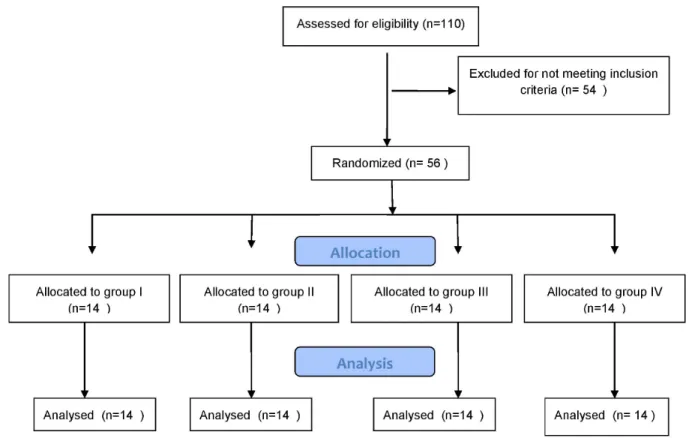
Fig. 1. CONSORT paticipant flow chart
previous history of local anesthesia injection were included in the study. Children with special health care needs, systemic illness, anxiety disorder and phobia, allergy to lignocaine, abscess, space infection, subjects taking medication that could alter pain perception, and active pathology at the application site were excluded from the study.
The procedure, possible discomfort or risks, and benefits were fully explained to parents/legal guardians and children. Informed consent from parents/legal guardians and informed consent from the child were obtained.
A power analysis was performed using G*power, version 3.0.1(Franz Fauluniversitat, Kiel, Germany). A sample size of 56 subjects would yield 90% power to detect significant differences, with an effect size of 0.22, and a significance level of 0.05. Subjects were randomly assigned to four groups with groups I, II, III, and IV being lignocaine gel, clove oil gel, ice, and betel leaf gel, respectively. Randomization was performed using computer-generated random sequences.
Once the child was allotted into the respective group (Fig. 1), the site of application of the topical anesthetic agent was inspected and isolated with cotton rolls and suction tip and dried with sterile cotton gauze. Ice cones were customized by filling with portable water in the little finger of the latex gloves and freezing at -40°C. The selected topical gel was applied to the determined site using a cotton applicator, and ice was placed in contact with the mucosa. The application time was standardized for one min in all the four groups. Following application, a short 1- inch (25 mm) 27-gauge syringe was gently inserted into the mucosa until it came into contact with the bone, and 2% lignocaine was slowly deposited (1 ml/min) after double aspiration.
The patient’s behavior was evaluated for pain perception during insertion of the needle using the SEM scale by the trained personnel present in the dental operatory. The SEM scale is an objective pain assessment scale with scores ranging from 1 to 4, depicting comfort to severe discomfort based on sounds, eye, motor parameters, and total scores ranging from 3 to 12.
Table 2. Pair wise comparison of each group with the other based on WBFPRS using Mann Whitney U test
Groups Minimum Maximum Mean ± SD P value
I II 0 6 3.53 ± 1.79 < 0.001*
III 0 6 3.53 ± 1.79 < 0.001*
1V 0 8 3.46 ± 1.96 < 0.001*
II III 2 8 4.93 ± 1.63 0.947
IV 2 8 4.86 ± 1.35 0.836
III IV 2 8 4.856 ± 1.87 0.896
*P < 0.05 is statistically significant. SD, standard deviation; WBFPRS, Wong Bakers FACES pain rating scale.
Table 1. Comparison of WBFPRS using Kruskal Wallis test
Groups N Minimum Maximum Mean Standard deviation P value
I 15 0.00 4.00 2.1333 1.18723
< 0.001*
II 15 4.00 6.00 4.9333 1.03280
III 15 2.00 8.00 4.9333 2.12020
IV 15 2.00 8.00 4.8000 1.65616
*P < 0.05 is statistically significant. WBFPRS, Wong Bakers FACES pain rating scale.
Table 3. Comparison SEM score using Kruskal Wallis test
Groups N Minimum Maximum Mean Standard deviation P value
I 15 3.00 8.00 4.9333 1.43759
0.045*
II 15 3.00 9.00 6.6667 2.22539
III 15 3.00 9.00 6.6667 2.22539
IV 15 3.0 9.00 6.6667 1.98806
*P < 0.05 is statistically significant. N, number; SEM, Sound, Eye, Motor scale.
After the local anesthesia procedure, children were immediately presented with the Wong Bakers FACES pain rating scale (WBFPRS) and were asked to point out the facial expression corresponding to the level of pain they experienced, and the score was recorded. The WBFRS is a subjective pain assessment scale with scores of 0, 2, 4, 6, 8, and 10, with zero indicating no pain and 10 indicating the worst pain. The collected data were tabulated and subjected to statistical analyses.
3. Statistical analysis
Data were tabulated in Microsoft Excel 2010.
Statistical analyses were performed using SPSS version 21.0. The Kruskal Wallis test was used to compare the mean WBFPRS and SEM scores. Further, the Mann- Whitney U test was used for pairwise comparisons between groups in both the scales. Statistical significance was set at P < 0.05.
RESULTS
1. Demographic data
In a total of 56 subjects included in the study, 34 were boys and 22 were girls with a mean age of 9.2 years.
2. Subjective pain assessment
The mean values of the WBFPRS score (Table 1) showed the greatest reduction in pain in the lignocaine group with a mean value of 2.13, followed by the betel leaf with a mean score of 4.8, and the last clove and ice group with the same mean value of 4.93. A highly significant difference (P<0.05) among the four groups was noted.
A pairwise comparison of the WBFPRS score (Table 2) showed that there was a statistically significant difference between groups I and II, I and III, and I and IV. However, no statistically significant difference was
Table 4. Pair wise comparison of each group with the other based on SEM score using Mann Whitney U test
Groups Minimum Maximum Mean ± SD P value
I II 3 9 5.80 ± 2.04 0.026*
III 0 9 5.80 ± 2.04 < 0.001*
IV 3 9 5.80 ± 1.91 0.014*
II III 3 9 6.66 ± 2.18 1.000
IV 3 9 6.66 ± 2.07 0.866
III IV 3 9 6.66 ± 2.07 0.866
*P < 0.05 is statistically significant. SD, standard deviation; SEM, Sound, Eye, Motor scale.
seen among groups II and III, II and IV, and III and IV.
3. Objective pain assessment
The mean values of the SEM score (Table 3) showed a greater reduction in pain in the lignocaine group with a mean score of 4.93, followed by clove, betel leaf, and ice with the same mean value of 6.66. Statistically, there was a significant difference (P < 0.05) among the four groups.
Pairwise comparison of SEM scores (Table 4) showed that there was a statistically significant difference between groups I and II, I and III, and I and IV. However, no statistically significant difference was observed between groups II and III, II and IV, and III and IV.
DISCUSSION
Fear and anxiety are the most prevalent problems in pediatric dentistry. Needle phobias most precisely, fear of pain due to needle prick is most frequently encountered in a child, which compromises their dental health [9].
Hence, various pharmacological and non-pharmaco- logical methods have been developed to overcome this problem. Topical anesthetics are the most common and easily available.
In the current study, age groups of six and above were selected because of improved cognitive ability. Different agents were applied to different individuals in order to avoid bias in pain perception because of the foreseen pain that can occur at the second appointment. Only subjects who required maxillary buccal infiltration were chosen
because of reduced tissue trauma and decreased needle penetration depth as compared to nerve block during local anesthesia administration. In addition, proper isolation can be acquired as gels need to stay in contact with the mucosa for a longer time without being mixed or carried away by saliva. The same person applied the agent and gave injections in all groups in order to avoid inter- examiner bias while handling the injection technique.
The WBFPRS and SEM scales used in the present study were previously evaluated in many studies [2,3,9].
WBFPRS was used because it is simple to understand and can be used easily in younger age groups. The SEM scale enables the assessment of the relationship between pain and the reactions that are generated in the patient’s eyes, bodily movements, and verbal expressions of discomfort, as well as the degree of intensity of the sensation of pain.
Whatever may be the concentration, topical anesthetics are drugs with various adverse effects such as allergic reactions [10], swelling of soft tissues [11], anaphylaxis [12], and toxic reactions [13]. Anesthetic agents are detectable in the plasma after intraoral use [14, 15]. An increase in the dosage could lead to high plasma concentration levels and eventually cause serious effects [16]. Hence, the constant search for alternatives reverted us back to an age-old technique of ice application.
In the current study, lignocaine showed greater pain reduction than ice, although statistically significant results were obtained. This is in contrast with studies by Hindocha et al. [17] and Bhansal et al. [18], who found that ice had better efficacy than lignocaine. The probable cause for lignocaine to be better than ice, as seen in the
present study, could be that children were not comfortable and tolerant with continuous application of ice. Hence, in most cases, intermittent application for one min was performed, rather than continuous application. Moreover, anesthetic action did not last for a longer duration.
Plants have been used for years as food and medicine to prevent and cure diseases. Ayurveda, primarily practiced in India, has a history of 5000 years [19]. Herbal medicine is the mainstay of approximately 75–80% of the world’s population. This is mainly because herbal drugs have no side effects apart from being locally available and cost effective. According to the World Health Organization (WHO), the use of herbal remedies exceeds two to three times that of conventional drugs [20].
Owing to the drawbacks of synthetic anesthetics, the horizon has now moved from conventional to traditional setup. A wide variety of plants, such as coca, cinchona, spilanthes, and valerian, have anesthetic and analgesic properties [4]. Clove and betel are the most popular and widely used spices in India and have various biologically active compounds that are responsible for their medicinal and anesthetic properties. Therefore, we selected both spices for this study for these characteristics.
Clove (Syzygium aromaticum) is one of the most valuable spices with the richest source of phenolic compounds [21]. The commercial use of clove is for the production of clove oil, which contains active constituents such as eugenol, eugenyl acetate, and gallic acid, which have antimicrobial, anti-inflammatory, antifungal, antithrombotic, antidiabetic, analgesic, and anesthetic action [22]. The mechanism involved in analgesic activity has been attributed to the activation of calcium and chloride channels in ganglionar cells [23]. Raghavenra et al. [24] stated that the analgesic effect of eugenol is attributed to its ability to inhibit prostaglandins and other inflammatory mediators. The peripheral analgesic activity of eugenol was reported by Daniel et al., who showed significant activity at doses of 50, 75, and 100 mg/kg [25].
Clove oil has been used in hatcheries and marine research studies for the immobilization of fish. Studies
by Wagner et al. [26], Gomulka et al. [27], and Keene et al. [28] suggested that clove oil can be used as a potent anesthetic agent in fish species. When used at doses less than 1500 ppm, clove, clove oil, and eugenol are all designated as generally recognized as safe (GRAS) in humans by the US Food and Drug Administration in 1978 [29].
In the present study, clove oil showed comparable pain reduction to that of ice. This finding is in contrast with the study by Anantharaj et al. [2]. A study by Alqareer et al. [30] found that homemade clove gel and benzocaine gel significantly lowered the mean pain score, and no significant difference was observed between them.
Similarly, when clove oil was compared with lignocaine in the present study, it was observed that clove oil was more potent.
Piper betel Linn commonly known as betel leaf is an evergreen, perennial creeper belonging to the Piperaceace family and is native to South India and Malaysia [31].
The leaves of this plant are the most valued parts and are chewed with areca nut and slacked lime. It is so widely prevalent that it ranks next to consumption of alcohol, coffee, and smoking [32]. It has vast medicinal properties and is a potent antifungal, antioxidant, anti-platelet, antipyretic, anti-inflammatory, immuno- modulatory, antimicrobial, antidiabetic, astringent, aphrodisiac, laxative, gastroprotective, and euphoric [33].
The chief constituents of the leaves are volatile oil, betel oil, two phenols, namely, chavibetol and chavicol, alkaloid called arakene, which has properties similar to cocaine, eugenol, allyl pyrocatechin, terpene, cineol, caryophyllene, cadinene, and menthone [33]. Alkaloid arakene and eugenol may be responsible for the anesthetic action of the leaf.
In the present study, the 10% betel leaf extract gel showed pain reduction. This is in agreement with an animal study by Jayashree et al. [34] on rabbit cornea, where 6% and 12% alcoholic extract of betel leaf showed significant surface anesthetic activity comparable to 2%
xylocaine. Another study by Krishnakumar et al. [31]
tested the surface anesthetic effect on the cornea of
rabbits and guinea pigs, and the results showed that betel leaf extract had an onset and duration of action comparable to 2% xylocaine.
It was noted that three out of 14 children complained of burning sensation, and one developed ulcer on application of betel leaf extract. No other problems were noted in any of the other groups.
This study has three main limitations. First, blinding of neither patients nor clinician was possible because of the temperature difference, physical state, and method of application between gels and ice, which increased the risk of bias. Second, control, such as placebo, was not used due to ethical considerations. Lastly, physiologic parameters (heart rate and blood pressure) were not measured, which have a strong correlation with pain perception. This could have made our results more accurate and powerful. Further research is required with variations in concentration and larger samples.
Based on our findings, we conclude that all four topical agents can reduce pain sensation and betel leaf extract can be an alternative topical anesthetic agent.
AUTHOR ORCIDs
Raghavendra Havale: https://orcid.org/0000-0001-8811-3445 Dhanu G Rao: https://orcid.org/0000-0002-4032-4582 Shrutha S P: https://orcid.org/0000-0002-9426-2719
Kanchan M Tuppadmath: https://orcid.org/0000-0002-9485-5493 Namratha Tharay: https://orcid.org/0000-0002-2380-8868 Irin Mathew: https://orcid.org/0000-0002-0781-3835 Kausar E Taj: https://orcid.org/0000-0001-6920-6486
AUTHOR CONTRIBUTIONS
Raghavendra Havale: Investigation, Project administration, Supervision, Writing – original draft
Dhanu G Rao: Methodology, Project administration Shrutha S P: Supervision, Writing – original draft
Kanchan M Tuppadmath: Data curation, Investigation, Methodology, Project administration, Writing – original draft
Namratha Tharay: Writing – original draft, Writing – review & editing Irin Mathew: Data curation, Investigation, Writing – original draft Kausar E Taj: Data curation, Investigation
ACKNOWLEDGMENT: We would like to thank Dr. Anand
Kumar, Head of Department, Department of Pharma- ceutics, Vutkoor Laxmaiah College of Pharmacy, Raichur for their help.
DECLARATION OF INTEREST: There are no conflicts of interest to declare.
FUNDING: No financial support or sponsorship to declare.
REFERENCES
1. Aminah M, Nagar P, Singh P, Bharti M. Comparison of topical anesthetic gel, pre- cooling, vibration and buffered local anaesthesia on the pain perception of pediatric patients during the administration of local anaesthesia in routine dental procedures. Int J Contemp Med Res 2017;
4: 400-3.
2. Anantharaj A, Sabu JM, Ramakrishna S, Jagdeesh RB, Praveen P, Shankarappa PR. A comparative evaluation of pain perception following topical application of benzocaine gel, clove-papaya based anesthetic gel and precooling of the injection site before intraoral injections in children.
J Indian Soc Pedod Prev Dent 2020; 38: 184-9.
3. Lathwal G, Pandit IK, Gugnani N, Gupta M. Efficacy of different precooling agents and topical anesthetics on the pain perception during intraoral injection: A Comparative clinical study. Int J Clin Pediatr Dent 2015;
8: 119-22.
4. Jadhav VM, Thorat RM, Kadam VJ, Sathe NS. Herbal anesthetics. J Pharm Res 2009; 2: 1242-4.
5. Hossain MF, Anwar M, Akhtar S, Numan SM. Uses impact of betel leaf (PiperbetleL.) on public health. Sci J Publ Health 2017; 5: 408-10.
6. Sengupta R, Banik JK. A review on betel leaf (pan). Int J Pharm Sci Res 2013; 4: 4519-24.
7. Chopra RN, Chopra IC, Handa KL, Kapur LD. Chopra’s Indigenous Drugs of India.Culcutta: UN Dhur& Sons Pvt.
Ltd; 1958: p-371.
8. Gopalasatheeskumar K. Significant role of Soxhlet extraction process in phytochemical research. Mintage J Pharm Med Sci 2018; 7: 43-7.
9. Mohite VA, Baliga S, Thosar N, Rathi N, Khobragade P, Srivastava R. Comparative evaluation of a novel herbal
anesthetic gel and 2% lignocaine gel as an intraoral topical anesthetic agent in children: bilateral split-mouth, single-blind, crossover in vivo study. J Indian Soc Pedod Prev Dent 2020; 38: 177-83.
10. Amado A, Sood A, Taylor JS. Contact allergy to lidocaine:
a report of sixteen cases. Dermatitis 2007; 18: 215-20.
11. Yaman Z, Kişnişci RS. Idiopathic swelling of the lower lip associated with topical anaesthesia. Report of three cases. Aust Dent J 1998; 43: 324-7.
12. Kumar DM. Management of anaphylaxis in dental office an update. Int J Pharm Bio Sci 2015; 6: 401-7.
13. Mohite V, Baliga S, Thosar N, Rathi N. Role of dexmedetomidine in pediatric dental sedation. J Dent Anesth Pain Med 2019; 19: 83-90.
14. Cannell H, Walters H, Beckett AH, Saunders A. Circulating levels of lignocaine after peri-oral injections. Br Dent J 1975; 138: 87-93.
15. Taylor SE, Dorris RL. Modification of local anaesthetic toxicity by vasoconstrictors. Anesth Prog 1989; 36: 79-87.
16. World Health Organization. General Guidelines for Methodologies on Research and Evaluation of Traditional Medicine. Geneva, World Health Organization. 2000. p 74.
17. Hindocha N, Manhem F, Bäckryd E, Bågesund M. Ice versus lidocaine 5% gel for topical anaesthesia of oral mucosa – a randomized cross-over study. BMC Anesthesiol 2019; 19: 227.
18. Bansal D, Mahajan M, Mathur S. A comparative evaluation of ice and topical anesthetic gel in the reduction of pain before the injection: a clinical trial. SRM J Res Dent Sci 2020; 11: 6-10.
19. Dev S. Ancient-modern concordance in ayurvedic plants:
Some examples. In: Development of Plant-Based Medicines: Conservation, Efficacy and Safety. Dordrecht, Springer Netherlands. 2001, pp 47-67.
20. Verma S, Singh SP. Current and future status of herbal medicines. Veterinary World 2008; 1: 347-50.
21. Cortés-Rojas DF, de Souza CR, Oliveira WP. Clove (Syzygium aromaticum): a precious spice. Asian Pac J Trop Biomed 2014; 4: 90-6.
22. Milind P, Deepa K. Clove: a champion spice. Int J Res Ayurveda Pharm 2011; 2: 47-54.
23. Healthcare T. PDR for herbal medicines. 4th ed. Montvale,
Thomson Healthcare. 2004.
24. Raghavenra H, Diwakr BT, Lokesh BR, Naidu KA.
Eugenol--the active principle from cloves inhibits 5-lipoxygenase activity and leukotriene-C4 in human PMNL cells. Prostaglandins Leukot Essent Fatty Acids 2006; 74: 23-7.
25. Daniel AN, Sartoretto SM, Schimidt G, Caparroz-Assef SM, Bersani-Amado CA, Cuman RK. Anti-inflamatory and antinociceptive activities of eugenol essential oil in experimental animal models. Rev Bras Farmacogn 2009;
19: 212-17.
26. Wagner GN, Singer TD, McKinley RS. The ability of clove oil and MS-222 to minimize handling stress in rainbow trout (Oncorhynchus mykiss Walbaum). Aquacult Res 2003; 34: 1139-46.
27. Gomulka P, Wlasow T, Velíšek J, Svobodová Z, Chmielinska E. Effects of eugenol and MS-222 anaesthesia on siberian sturgeon acipenserbaerii brandt. Acta Vet Brno 2008; 77: 447-53.
28. Keene JL, Noakes DL, Moccia RD, Soto CG. The efficacy of clove oil as an anaesthetic for rainbow trout, Oncorhynchus mykiss (Walbaum). Aquac Res 1998; 29:
89-101.
29. US Food and Drug Administration. Scientific Literature Review of Eugenol and Related Substances in Flavor Usage. 1978: 1-134.
30. Alqareer A, Alyahya A, Andersson L. The effect of clove and benzocaine versus placebo as topical anesthetics. J Dent 2006; 34: 747-50.
31. Krishnakumar S, Geetha VS, Kuruvilla A . Determination of local anesthetic action of betel leaf extract alone and with betel nut using infiltration and surface anesthesia. J Natr Remed 2010; 1: 28-32.
32. Norton SA. Betel: consumption and consequences. J Am Acad Dermatol 1998; 38: 81-8.
33. Chauhan ES, Aishwarya J, Singh A, Chauhan ES, Aishwarya J, Singh A, et al. A review: Nutraceuticals properties of piper betle (Paan). Am J Phytomed Clin Ther 2016; 4: 28-41.
34. Jayasree T, Ubedulla S, Harini K. Evaluation of surface anesthetic action of aqueous extract of piper betel leaf on rabbit cornea. Int J Pharm Sci Res 2014; 5: 402-5.