ABSTRACT
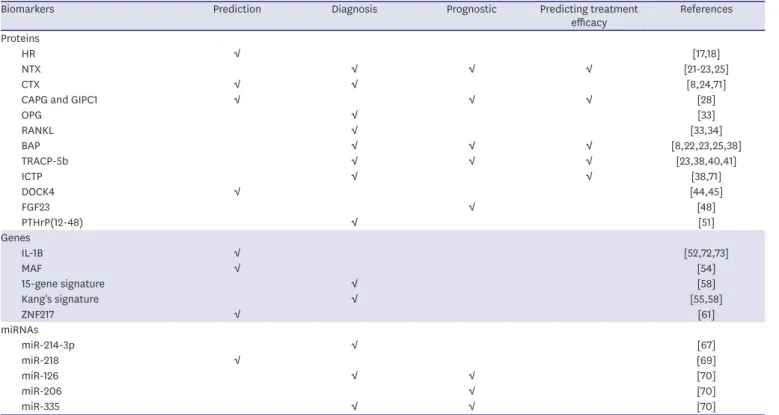
The most common metastatic site of breast cancer is the bone. Metastatic bone disease can alter the integrity of the bone and cause serious complications, thereby greatly reducing health-related quality of life and leading to high medical costs. Although diagnostic methods and treatments for bone metastases (BM) are improving, some patients with early breast cancer who are at high risk of BM are not diagnosed early enough, leading to delayed intervention. Moreover, whole-body scintigraphy cannot easily distinguish BM from non- malignant bone diseases. To circumvent these issues, specific gene and protein biomarkers are being investigated for their potential to predict, diagnose, and evaluate breast cancer prognosis. In this review, we summarized the current biomarkers associated with BM in breast cancer and their role in clinical applications to assist in the diagnosis and treatment of BM in the future.
Keywords: Biomarkers; Bone neoplasms; Breast neoplasms; Prognosis
INTRODUCTION
Breast cancer is one of the most common and most fatal neoplastic diseases affecting women worldwide [1]. In 2017, there were a total of 252,710 newly diagnosed breast cancer cases reported in the United States alone [2]. Although the cure rate for breast cancer has been rising in Western countries, it remains the leading cause of cancer-related death in women [3]. The most common site of metastasis is the bone, which has been shown to occur in 50%–70% of the patients with breast cancer [4]. Due to the increased osteoclast activity and bone destruction, tumor-associated bones can cause skeleton-related events, which have been reported to significantly reduce health-related quality of life and result in high medical costs [5]. Bone metastases (BM) can often result in bone pain, spontaneous fractures, systemic hypercalcemia-induced metabolic consequences, and paraplegia (if the metastatic sites are present in the vertebrae) [6,7]. To date, whole-body scintigraphy is considered the gold standard for determining, quantifying, and describing the location and extent of BM;
however, this method lacks specificity though it offers high sensitivity [8]. Furthermore, the rapid diagnosis of BM is impaired by the similarities between BM and non-malignant bone diseases in terms of imaging results. In addition, with the passage of time and combined with the action of anti-reabsorption drugs, the radiological appearance of BM may spontaneously
Review Article
Received: May 6, 2020 Accepted: Aug 23, 2020 Correspondence to Yanqiu Song
Department of Cancer Center, The First Hospital of Jilin University, No. 1 Xinmin Street, Chaoyang District, Changchun 130021, China.
E-mail: [email protected]
*These authors contributed equally to this work.
© 2020 Korean Breast Cancer Society This is an Open Access article distributed under the terms of the Creative Commons Attribution Non-Commercial License (https://
creativecommons.org/licenses/by-nc/4.0/) which permits unrestricted non-commercial use, distribution, and reproduction in any medium, provided the original work is properly cited.
ORCID iDs Feiqi Liu
https://orcid.org/0000-0003-2287-1758 Jianji Ke
https://orcid.org/0000-0001-5199-0436 Yanqiu Song
https://orcid.org/0000-0002-1326-1416 Conflict of Interest
The authors declare that they have no competing interests.
Author Contributions
Software: Ke J; Supervision: Song Y; Writing - original draft: Liu F; Writing - review & editing:
Ke J.
Feiqi Liu
1,*, Jianji Ke
2,*, Yanqiu Song
11
Department of Cancer Center, The First Hospital of Jilin University, Changchun, China
2