INTRODUCTION
Atrial fibrillation (AF) is a complex arrhythmia assumed to result from multiple reentry circuits, which in some ins- tances might be several decades old. The ‘‘Cox’’ Maze proce- dure has become the standard AF surgery (1-5). Numerous modifications to the original Maze procedure have since been described, reporting high sinus conversion rates (6-19). The concepts regarding the mechanism of AF have further evolved with studies indicating that intermittent AF originates from ectopic focuses in the pulmonary veins. Catheter ablation techniques or surgery involving isolation of mainly the pul- monary veins have been founded on these concepts (17-20).
Because fibrillation surgery is an additional procedure to the main cardiac procedure, cardiopulmonary bypass and cross clamp times might be prolonged. Therefore, it is important that the selected energy source not only be capable of produc- ing complete transmural lesion but also achieve it in the short- est time possible. Recently, radiofrequency and microwave energies have been extensively studied to investigate their suitability as alternative energy sources to cryothermia (21- 30). An energy source that can be applied epicardially on the beating heart has the potential to not only minimize endo- cardial trauma but also to significantly reduce the aortic cross clamping time that would otherwise be necessary with conven- tional techniques (8, 28-31). Microwave is one such energy source that fits this description and as such it is currently being used to perform epicardial ablative surgery, either in the on- or off-pump state on patients undergoing cardiac surgery.
Specifically it has been found to be useful in patients with AF undergoing off-pump beating-heart coronary artery bypass grafting (OPCAB) or in patients with lone AF, which previ- ously would have otherwise been considered an over-invasive treatment option. Although some reports, despite these advan- tages, might point to a possibly lower success rate with epi- cardial ablation when comparing it to conventional endocar- dial cryothermia (9, 24, 25, 29), it has been well demonstrated that complete linear transmural thermal lesions can be cre- ated with either microwave or radiofrequency ablation pro- vided proper techniques are employed (30).
The purpose of the present study was to compare the results of AF surgery with epicardial microwave ablation combined with or without routine valvular surgery and the cryosurgi- cal Maze operation.
MATERIALS AND METHODS
Between July 1997 and June 2003, 280 patients received the Maze procedure using cyrothermia (Cryo group, Frig- itronics Cardiac Cryosurgical System 200; Frigitronics, Inc, Coopersurgical, Shelton, CT, U.S.A.) with or without con- comitant mitral procedures. Since July 2003, 14 patients underwent epicardial microwave maze (Epi-MW group) using the Flex 4 microwave antenna (Afx Inc, Fremont, CA, U.S.A.).
The selected 28 hospital survivors who were the subjects of the present study were divided into 14 matched pairs. The patients were matched for age, sex, duration of AF, cardio-
Sang Kwon Lee, Suk Jung Choo*, Kyung Sun Kim*, Jae Won Lee*
Department of Thoracic and Cardiovascular Surgery, Pusan National University Hospital, Busan;
Department of Thoracic and Cardiovascular Surgery*, Asan Medical Center and University of Ulsan, Seoul, Korea
Address for correspondence Jae Won Lee, M.D.
Department of Thoracic and Cardiovascular Surgery, Asan Medical Center, 388-1 Pungnap-2 dong, Songpa-gu, Seoul 138-736, Korea Tel : +82.2-3010-3584, Fax : +82.2-3010-6966 E-mail : [email protected]
727
Epicardial Microwave Application in Chronic Atrial Fibrillation Surgery
The search for alternative epicardial energy sources in the treatment of nonvalvular atrial fibrillation (AF) is a relatively new aspect of the evolving spectrum of Maze oper- ations. We tested the hypothesis that epicardial microwave ablation produces iden- tical results to those of the standard cryosurgical Maze. Fourteen consecutive patients with chronic AF underwent on-pump epicardial Maze procedures after routine car- diac surgery. The results were compared with those of 14 control patients selected from our Maze database of 280 patients. There were no differences in age, sex, car- diothoracic ratio, duration of AF, pump time, intensive care unit or hospital stays.
The aortic cross clamp time with epicardial microwave was, however, shortened from 110 to 65 minutes (p=0.011). The recurrence rate of AF after discharge showed no significant difference between the two groups (14% vs. 15%, p=0.841). Epicar- dial microwave ablation might be a valuable alternative to the conventional cryosur- gical Maze procedure, especially for those patients without associated mitral valve disease.
Key Words : Arrhythmia; Atrial Fibrillation; Microwaves
Received : 25 August 2004 Accepted : 18 April 2005
728 S.K. Lee, S.J. Choo, K.S. Kim, et al.
thoracic ratio, preoperative left atrial dimension, incidence of fine AF, and concomitant cardiac conditions (Table 1, 2).
To prevent selection bias, the patients were matched only by the preoperative variables, not taking into consideration the postoperative results.
The procedures, which were followed by transesophageal echocardiography, were performed by a single surgeon. Sub- sequent echocardiographic data were collected at 1 week, 3 and 6 months, and 1 yr after surgery.
Standard anesthetic and monitoring techniques
Surgical ablation was performed under total cardiopulmo- nary bypass with aortobicaval cannulation followed by open- ing of the left atrial and vena caval pericardial reflection. Micro- wave energy was applied with FLEX 4 microwave ablation probes (Afx Inc, Fremont, CA, U.S.A.). The energy level used was 65 watts with the duration of ablation of 90 sec for epi- cardial ablation in the beating-heart condition and 45 sec for endocardial and epicardial ablation in the arrested-heart state. With epicardial ablation in patients undergoing non- open-heart cardiac surgery, the left and right pulmonary veins were separately isolated and connected to each other with a connecting lesion. The left atrial appendage was amputated or stapled off, after which another ablation line was created epicardially to connect to the pulmonary venous ablation lines. Pulmonary venous epicardial pacing was performed within the area of the isolated pulmonary veins to confirm elec- trical conduction block. A right atrial ablation line was formed by creating a thermal lesion extending from the superior vena cava to the inferior vena cava (crista terminalis). In those patients undergoing AF surgery concomitant to open heart surgery, cardiopulmonary bypass was performed after double venous cannulation. AF surgery was initiated with a long right atrial incision from the tip of the right atrial appendage to the fossa ovalis. The right atrial isthmus and the line from the atrial incision to the tricuspid valve were then ablated. The left atrial procedure was initiated with a standard left atriotomy incision along the Waterston groove, and extended toward the left inferior pulmonary vein, constituting the superior con- necting lesion between the two pulmonary veins. The lines
toward the mitral annulus (left atrial isthmus) and coronary sinus were then ablated either endocardially or epicardially.
A temporary epicardial pacing wire was placed at the transi- tional junction of the superior vena cava and the right atrium or at the left atrial roof. The second pacing wire was placed at the right atrial appendage close to the interventricular sep- tum. The pacing wires were used to evaluate the atrial p-wave activity for the presence of conduction block as well as for detecting the appearance or onset of the p-wave in the post- operative period. The atrial pacing wires were also used to induce atrial fibrillation by rapid atrial pacing.
Postoperative management
Amiodarone was used to treat supraventricular premature beats as well as to treat either recurrent AF or flutter. A loading atrial intravenous dose of 300 mg was initially administered followed by a continuous infusion of 900 mg every 24 hr.
Maintenance amiodarone of 200-400 mg was administered orally every 12 hr until discharge. Although a small routine dose of diuretics was sometimes necessary to maintain fluid balance, with preservation of the right atrial appendage in the latter part of the series, frank pulmonary edema was no longer detected. Warfarin was used routinely except in epi- cardial off-pump beating heart Maze procedures in which left atrial incision was not performed.
Statistical analysis
The focus of this study was to provide observational data on a new or modified method of performing the Maze pro-
*, independent t-test; �, Fisher’s exact test.
AF, atrial fibrillation; CTR, cardiothoracic ratio; CPB, cardiopulmonary bypass time; Epi-MW, microwave epicardial ablation; Cryo, cryoabla- tion; LAD, Left atrial dimension.
Groups Epi-MW Cryo p value
Age (yr) 52.4±11.7 50.3±8.9 0.59*
Sex (M/F) 14 (8/6) 14 (10/4) 0.69�
AF duration (yr) 3.7±3.6 (10-1) 4.8±7.7 (30-1) 0.76*
CTR* (%) 57.9±6.6 (73-47) 54.8±5.7 (69-47) 0.22*
LAD (mm) 55.1±151.2 (88-38) 53.1±76.9 (69-39) 0.31*
Fine AF (n) 7 8 0.36�
Table 1.Patient’s demographics
*, independent t-test.
ACC, aortic cross clamp time; Epi-MW, microwave epicardial ablation;
CABG, coronary artery bypass graft; Cryo, cryoablation; OPCAB, off- pump coronary artery bypass; MVP, mitral valvuloplasty; PDA, patent ductus arteriosus; MVR, mitral valve replacement; AVR, Aortic valve replacement; TVP, tricuspid valvuloplasty; VSD, ventricular septal defect;
ASD, atrial septal defect; Beating CAB, On pump beating heart CABG;
AAR, ascending aorta replacement.
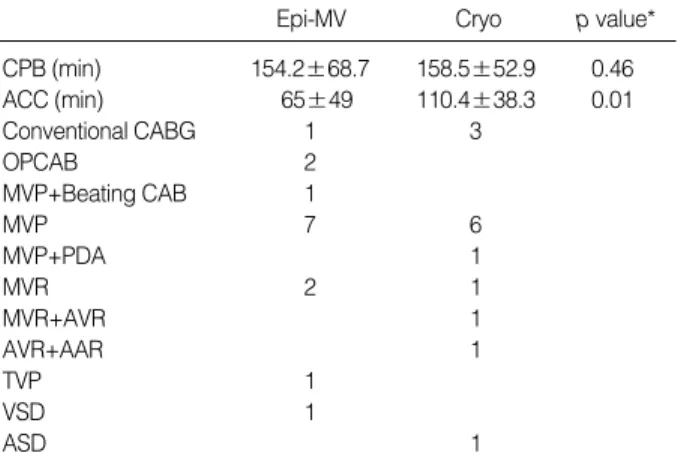
Epi-MV Cryo p value*
CPB (min) 154.2±68.7 158.5±52.9 0.46
ACC (min) 65±49 110.4±38.3 0.01
Conventional CABG 1 3
OPCAB 2
MVP+Beating CAB 1
MVP 7 6
MVP+PDA 1
MVR 2 1
MVR+AVR 1
AVR+AAR 1
TVP 1
VSD 1
ASD 1
Table 2.Operation
cedure involving epicardial microwave ablation and to assess the performance of the new surgical device. Continuous vari- ables were expressed as means±standard deviation. The means were compared using the independent t-test and ANOVA.
Differences of frequency were compared using Fisher’s exact test and chi-square test. A p value less than 0.05 was con- sidered statistically significant. The statistical analysis was performed using the SPSS 10.0 software package (SPSS Inc., Chicago, IL, U.S.A.).
RESULTS
There were no differences in age, sex, cardiothoracic ratio, left atrial dimension, and duration of AF. Cardiopulmonary bypass time, intensive care unit and hospital stays also showed no differences. Aortic cross clamp time was significantly less with microwave ablation (p=0.011, ANOVA) (Table 1, 3).
Concomitant surgical procedures included coronary bypass in 7 patients (4 Epi-MW, 3 Cryo), valvular surgery in 21 (11 Epi-MW, 10 Cryo) and congenital heart surgery in 2 patients (1 Epi-MW, 1 Cryo) (Table 2). There was no mortality, stroke, myocardial infarction, or re-exploration for bleeding. No per- manent pacemaker implantation was necessary in any case.
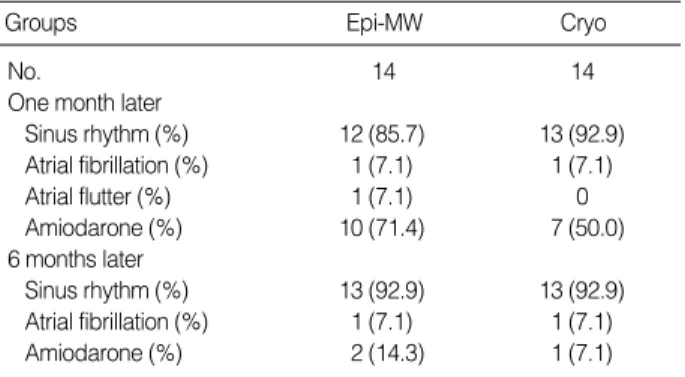
Sinus conversion occurred in 25 of 28 patients in the first month (12 Epi-MW, 13 Cryo), and in 26 of 28 patients (13 Epi-MW, 13 Cryo) by 6 months postoperatively. The con- duction block between the pulmonary veins and the non-iso- lated left atrium was verified by intraoperative pulmonary vein epicardial pacing (Table 4). Recurrent AF occurred in 2 patients (1 Epi-MW, 1 Cryo) and in 14 and 15% of the pati- ents after discharge (p=0.841, chi-square test) (Table 5). The
aortic clamp time was significantly shortened with Epi-MW maze procedure compared to the Cryo maze procedure (p=
0.011).
DISCUSSION
The conventional Maze procedure, though effective, is asso- ciated with certain limitations such as poor left atrial func- tional recovery and loss of effective atrial contraction. Several modifications were developed to overcome these shortcom- ings, and some of them showed good results for atrial func- tional recovery (4, 10-12, 31, 32). The evolution and appli- cation of more advanced concepts such as posterior atrial wall reduction combined with cryoablation were thought to be contributory (31, 32). Meanwhile, the introduction of new devices using alternative energy sources added benefits, which included simplification and reduction of the operative time without compromising the surgical outcome. Currently, radio- frequency and microwave devices have shown the most promise among the energy sources that have been looked into as poten- tially suitable alternatives to cryoablation as they are easy to use, less time consuming and conducive to good results (21- 30). However, some have pointed out that epicardial lesions created with either radiofrequency or cryoablation might be less penetrative than endocardial lesions due to the cooling effect of circulating blood and the epicardial fat tissue that can block energy transfer, necessitating a longer duration of ablation. Still, the time consumed is much less than it would take with the cut and sew technique (21, 28). Positive studies using microwave by a completely epicardial approach have shown success rates similar to those achieved with cryoabla- tion (21, 22, 32). Although the endocardial approach is the- oretically more effective, the disadvantages of this approach can include the necessitation of cross clamping and the inabil- ity to allow electrophysiological conduction block confirma- tion prior to aortic cross-clamp release and to CPB weaning.
Compared to some of the other energy sources, the advantages of microwave energy include the ability to create complete transmural lesions, highly localized tissue destruction, immu-
*, independent t-test.
Epi-MW, microwave epicardial ablation; Cryo, cryoablation; ICU, inten- sive care unit; LOS, length of stay; MI, myocardial infarction.
Epi-MW
Groups Cryo p value*
No. 14 14
ICU stay (days) 3.1±1.9 (1-7) 2.5±1.3 (1-6) 0.38 LOS (days) 15.1±12.3 (6-55) 12.1±6.0 (6-24) 0.28
Mortality 0 0
Stroke 0 0
MI 0 0
Re-exploration 0 0
for bleeding
Pacemaker implant 0 0
Table 3.Early hospital outcomes
Epi-MW
Groups Cryo
No. 14 14
One month later
Sinus rhythm (%) 12 (85.7) 13 (92.9)
Atrial fibrillation (%) 1 (7.1) 1 (7.1)
Atrial flutter (%) 1 (7.1) 0
Amiodarone (%) 10 (71.4) 7 (50.0)
6 months later
Sinus rhythm (%) 13 (92.9) 13 (92.9)
Atrial fibrillation (%) 1 (7.1) 1 (7.1)
Amiodarone (%) 2 (14.3) 1 (7.1)
Table 4.Postoperative rhythm during the follow-up
Epi-MW, microwave epicardial ablation; Cryo, cryoablation.
Epi-MW Cryo p value*
Treatment failure 1/14 (7.1%) 1/14 (7.1%) 1.0 Events/follow-up 7/50 (14%) 8/53 (15%) 0.84 Table 5.Recurrence of AF during the follow-up
*, Fisher’s exact test.
Epi-MW, microwave epicardial ablation; Cryo, cryoablation.
nity to the detrimental effects of fat tissue on energy transfer, ease of creating linear lesions facilitating isolation of the pul- monary veins, and the ability to achieve complete ablation epicardially (30). Of note, the energy release is unidirection- al, preventing collateral damage. This is particular impor- tance to epicardial beating-heart ablation as ablation could be carried out from the dorsal part of the heart without fur- ther protective measures. Review of our own series has also shown good results with AF ablation using the epicardial beating-heart approach. It was especially useful in situations where the ablation was incomplete, as further ablation was possible with a still-beating heart. The traditional Maze oper- ation, however, would require the re-institution of cardiopul- monary bypass and aortic cross-clamping. In view of the increas- ing population of elderly patients with AF and the ensuing complications, it appears that a large group of patients that otherwise would not have had the benefit of receiving AF surgery can receive this surgery, because AF surgery with this technology might now be viewed by surgeons as being less invasive and much simplified. Likewise, the epicardial Maze procedure can not only benefit patients undergoing beating-heart coronary artery bypass grafting but also patients undergoing valve surgery. However, it is important to con- sider that the Maze procedure can prolong cardiopulmonary bypass time, though the procedure with the epicardial approach is simplified. Consequently, in finally weighing the benefit in valve surgery patients, the disadvantages of the additional obligatory prolongation in the CPB time and the aortic cross- clamp time should be considered.
In this study, no microscopic or macroscopic examinations were performed on the thermal lesions. We cannot speculate on the effects of the ablation duration on either the lesion size or depth and the effects of the tissue thickness. Accurate deter- mination of the influence of these factors would require sup- plementary animal studies. A further limitation is the small size of the study population which may not be enough to obtain sufficient confidence.
In conclusion, the results of the current study showed epi- cardial microwave ablation with subsequent other cardiac procedure to be equally effective in inducing recovery of sinus rhythm in those who have undergone a conventional Maze procedure by open-heart surgery. Furthermore, it was possible to perform the ablation in a less traumatic manner and in a shorter time without adding to the ischemic time. In the long term, we expect that a significant proportion of patients under- going heart surgery with AF that would otherwise not have received AF surgery will receive ablative AF surgery with this new technology.
REFERENCES
1. Cox JL, Schuessler RB, D’Agostino HJ Jr, Stone CM, Chang BC, Cain ME, Corr PB, Boineau JP. The surgical treatment of atrial fib-
rillation. III. Development of a definitive surgical procedure. J Tho- rac Cardiovasc Surg 1991; 101: 569-83.
2. Cox JL, Boineau JP, Schuessler RB, Jaquiss RD, Lappas DG. Mod- ification of the maze procedure for atrial flutter and atrial fibrillation.
I. Rationale and surgical results. J Thorac Cardiovasc Surg 1995;
110: 473-84.
3. Cox JL, Jaquiss RD, Schuessler RB, Boineau JP. Modification of the maze procedure for atrial flutter and atrial fibrillation. II. Surgi- cal technique of the maze III procedure. J Thorac Cardiovasc Surg 1995; 110: 485-95.
4. Imai K, Sueda T, Orihashi K, Watari M, Matsuura Y. Clinical anal- ysis of results of a simple left atrial procedure for chronic atrial fib- rillation. Ann Thorac Surg 2001; 71: 577-81.
5. Raanani E, Albage A, David TE, Yau TM, Armstrong S. The efficacy of the Cox/maze procedure combined with mitral valve surgery: a matched control study. Eur J Cardiothorac Surg 2001; 19: 438-42.
6. Melo J, Adragao P, Neves J, Ferreira M, Timoteo A, Santiago T, Ri- beiras R, Canada M. Endocardial and epicardial radiofrequency ablation in the treatment of atrial fibrillation with a new intra-oper- ative device. Eur J Cardiothorac Surg 2000 ;18: 182-6.
7. Santiago T, Melo J, Gouveia RH, Neves J, Abecasis M, Adragao P, Martins AP. Epicardial radiofrequency applications: in vitro and in vivo studies on human atrial myocardium. Eur J Cardiothorac Surg 2003; 24: 481-6.
8. Benussi S, Pappone C, Nascimbene S, Oreto G, Caldarola A, Stefano PL, Casati V, Alfieri O. A simple way to treat chronic atrial fibrilla- tion during mitral valve surgery: the epicardial radiofrequency app- roach. Eur J Cardiothorac Surg 2000; 17: 524-9.
9. Sie HT, Beukema WP, Ramdat Misier AR, Elvan A, Ennema JJ, Wellens HJ. The radiofrequency modified maze procedure. A less invasive surgical approach to atrial fibrillation during open-heart surgery. Eur J Cardiothorac Surg 2001; 19: 443-7.
10. Nitta T, Lee R, Schuessler RB, Boineau JP, Cox JL. Radial approach:
a new concept in surgical treatment for atrial fibrillation I. Concept, anatomic and physiologic bases and development of a procedure.
Ann Thorac Surg 1999; 67: 27-35.
11. Nitta T, Lee R, Watanabe H, Harris KM, Erikson JM, Schuessler RB, Boineau JP, Cox JL. Radial approach: a new concept in surgical treatment for atrial fibrillation II. Electrophysiologic effects and atrial contribution to ventricular filling. Ann Thorac Surg 1999; 67: 36-50.
12. Lee R, Nitta T, Schuessler RB, Johnson DC, Boineau JP, Cox JL.
The closed heart MAZE: a nonbypass surgical technique. Ann Tho- rac Surg 1999; 67: 1696-702.
13. Kosakai Y, Kawaguchi AT, Isobe F, Sasako Y, Nakano K, Eishi K, Tanaka N, Kito Y, Kawashima Y. Cox maze procedure for chronic atrial fibrillation associated with mitral valve disease. J Thorac Car- diovasc Surg 1994; 108: 1049-55.
14. Kosakai Y, Kawaguchi AT, Isobe F, Sasako Y, Nakano K, Eishi K, Kito Y, Kawashima Y. Modified maze procedure for patients with atrial fibrillation undergoing simultaneous open heart surgery. Cir- culation 1995; 92 (Suppl 9): II359-64.
15. Izumoto H, Kawazoe K, Kitahara H, Nasu M, Sasaki T, Kamata J, Tsuji I, Yagi Y. Can the maze procedure be combined safely with mitral valve repair? J Heart Valve Dis 1997; 6: 166-70.
730 S.K. Lee, S.J. Choo, K.S. Kim, et al.
16. Sueda T, Nagata H, Orihashi K, Morita S, Suehiro M, Hirai S, Mat- suura Y. Efficacy of a simple left atrial procedure for chronic atrial fibrillation in mitral valve operation. Ann Thorac Surg 1997; 63:
1070-5.
17. Sueda T, Imai K, Ishii O, Orihashi K, Watari M, Okada K. Efficacy of pulmonary vein isolation for the elimination of chronic atrial fib- rillation in cardiac valvular surgery. Ann Thorac Surg 2001; 71:
1189-93.
18. Takami Y, Yasuura K, Takagi Y, Ohara Y, Watanabe T, Usui A, Masumoto H, Sakai Y, Teranishi K. Partial maze procedure is effec- tive treatment for chronic atrial fibrillation associated with valve dis- ease. J Card Surg 1999; 14: 103-8.
19. Tuinenburg AE, Van Gelder IC, Tieleman RG, Grandjean JG, Huet RC, van der Maaten JM, Pieper EG, De Kam PJ, Ebels T, Crijns HJ.
Mini-maze suffices as adjunct to mitral valve surgery in patients with preoperative atrial fibrillation. J Cardiovasc Electrophysiol 2000;
11: 960-7.
20. Szalay ZA, Skwara W, Pitschner HF, Faude I, Klovekorn WP, Bauer EP. Midterm results after the Mini-Maze procedure. Eur J Cardio- thorac Surg 1999; 16: 306-11.
21. Spitzer SG, Richter P, Knaut M, Schuler S. Treatment of atrial fibril- lation in open heart surgery-the potential role of microwave energy.
Thorac Cardiovasc Surg 1999; 47 (Suppl 3): 374-8.
22. Knaut M, Spitzer SG, Karolyi L, Ebert HH, Richter P, Tugtekin SM, Schuler S. Intraoperative microwave ablation for curative treatment of atrial fibrillation in open heart surgery--the MICRO-STAF and MICRO-PASS pilot trial. MICROwave Application in Surgical treat- ment of Atrial Fibrillation. MICROwave Application for the Treat- ment of Atrial Fibrillation in Bypass-Surgery. Thorac Cardiovasc Surg 1999; 47 (Suppl 3): 379-84.
23. Williams MR, Stewart JR, Bolling SF, Freeman S, Anderson JT, Argenziano M, Smith CR, Oz MC. Surgical treatment of atrial fib- rillation using radiofrequency energy. Ann Thorac Surg 2001; 71:
1939-44.
24. Sie HT, Beukema WP, Misier AR, Elvan A, Ennema JJ, Haalebos MM, Wellens HJ. Radiofrequency modified maze in patients with
atrial fibrillation undergoing concomitant cardiac surgery. J Thorac Cardiovasc Surg 2001; 122: 249-56.
25. Pasic M, Bergs P, Muller P, Hofmann M, Grauhan O, Kuppe H, Het- zer R. Intraoperative radiofrequency maze ablation for atrial fibril- lation: the Berlin modification. Ann Thorac Surg 2001; 72: 1484-91.
26. Manasse E, Colombo PG, Barbone A, Braidotti P, Bulfamante G, Roincalli M, Gallotti R. Clinical histopathology and ultrastructural analysis of myocardium following microwave energy ablation. Eur J Cardiothorac Surg 2003; 23: 573-7.
27. Mazzitelli D, Park CH, Park KY, Benetti FJ, Lange R. Epicardial ablation of atrial fibrillation on the beating heart without cardiopul- monary bypass. Ann Thorac Surg 2002; 73: 320-1.
28. Kubota H, Takamoto S, Morota T, Ohtsuka T, Motomura N, Kotsu- ka Y, Sudo K. Epicardial pulmonary vein isolation by cryoablation as concomitant cardiac operation to treat nonvalvular atrial fibril- lation. Ann Thorac Surg 2003; 75: 590-3.
29. Benussi S, Nascimbene S, Agricola E, Calori G, Calvi S, Caldarola A, Oppizzi M, Casati V, Pappone C, Alfieri O. Surgical ablation of atrial fibrillation using the epicardial radiofrequency approach: mid- term results and risk analysis. Ann Thorac Surg 2002; 74: 1050-7.
30. Maessen JG, Nijs JF, Smeets JL, Vainer J, Mochtar B. Beating-heart surgical treatment of atrial fibrillation with microwave ablation. Ann Thorac Surg 2002; 74: 1307-11.
31. Lee JW, Choo SJ, Kim KI, Song JK, Kang DH, Song JM, Song H, Lee SK, Song MG. Atrial fibrillation surgery simplified with cryoablation to improve left atrial function. Ann Thorac Surg 2001; 72: 1479-83.
32. Lee JW, Park NH, Choo SJ, Jo MS, Song H,Song MG. Surgical out- come of the maze procedure for atrial fibrillation in mitral valve dis- ease: rheumatic vs degenerative. Ann Thorac Surg 2003; 75: 57-61.
33. Veloso HH. Long-term efficacy of epicardial radiofrequency abla- tion of chronic atrial fibrillation during mitral valve surgery. Eur J Cardiothorac Surg 2001; 19: 231-2.
34. Thomas SP, Guy DJ, Boyd AC, Eipper VE, Ross DL, Chard RB.
Comparison of epicardial and endocardial linear ablation using hand- held probes. Ann Thorac Surg 2003; 75: 543-8.