INTRODUCTION
Recent treatment guidelines and algorithms for the man- agement of chronic hepatitis B (CHB) take into account the importance of prolonged viral suppression in terms of prevent- ing disease progression and hepatocellular carcinoma (HCC) development (1-3). Currently available oral nucleos(t)ide ana- logues (NUC) for the treatment of CHB include lamivudine, adefovir, entecavir, telbivudine, and recently tenofovir (3).
Although NUCs are more convenient than interferon-based therapies and have fewer side effects, sustained viral suppres- sion is usually not achieved after a 48-week course of NUC therapy, which necessitates long, and in many cases, indefi- nite treatment (1). Unfortunately, protracted NUC treatment is associated with an elevated risk of development drug resis- tance (4). Developments of new antiviral agents and regimens remain an important focus in terms of improving reductions in viral loads and resistance profiles.
Clevudine (1-[2-doxy-2fluoro-b-L-arabinofuranosyl]thy- mine, L-FMAU) is a novel pyrimidine nucleoside analogue with an unnatural b-L configuration and potent antiviral activ- ity in vitro and in a woodchuck model (5, 6). In a phase I/II
dose-escalating clinical study and in a randomized phase II clinical trial, 4-week and 12-week clevudine therapy induced potent viral suppression at an optimal dosage of 30 mg once daily (7-9). In randomized phase III clinical trials, 24-week clevudine therapy showed a potent antiviral effect and produc- ed significant biochemical improvements without evidence of viral resistance during the treatment period in HBeAg- positive and HBeAg-negative CHB (10, 11). The ability to maintain antiviral activity in a significant proportion of pati- ents following the discontinuation of therapy is a unique char- acteristic of clevudine. The above results show that clevudine is probably one of the most potent antivirals available for the treatment of hepatitis B virus (HBV). Clevudine is already licensed in Korea for anti-HBV therapy (Bukwang Pharma- ceuticals, Seoul), but previous clinical trials were placebo-con- trolled studies of relatively short treatment duration. Accord- ingly, we need to determine the longer-term treatment out- comes of clevudine therapy and to determine whether clevu- dine is superior to the preexisting oral NUC, lamivudine.
The aim of this study was to compare the antiviral effica- cies and resistances of clevudine and lamivudine after 48 weeks of administration in naı¨ve patients with hepatitis B e anti-
738
In Hee Kim1,2, Seok Lee1,2,
Seong Hun Kim1,2, Sang Wook Kim1,2, Seung Ok Lee1,2, Soo Teik Lee1,2, Dae Ghon Kim1,2, Chang Soo Choi3, and Haak Cheoul Kim3
Department of Internal Medicine1, The Research Institute for Medical Science2, Chonbuk National University Medical School and Hospital, Jeonju;
Department of Internal Medicine3, Wonkwang University College of Medicine and Hospital, Iksan, Korea
Address for Correspondence Dae Ghon Kim, M.D.
Department of Internal Medicine, The Research Institute of Clinical Medicine, Chonbuk National Medical School and Hospital, 20 Geongi-ro, Deokjin-gu, Jeonju 561-712, Korea
Tel : +82.63-251-1681, Fax : +82.63-254-1609 E-mail : [email protected]
This study was supported in part by the Chonbuk National University research fund in 2007.
Treatment Outcomes of Clevudine versus Lamivudine at Week 48 in Naive Patients with HBeAg Positive Chronic Hepatitis B
The authors assessed the efficacy and antiviral resistance of 48-week clevudine therapy versus lamivudine in treatment of na¨ıve patients with HBeAg positive chron- ic hepatitis B. In this retrospective study, a total of 116 HBeAg positive patients, who received 30 mg of clevudine once daily (n=53) or 100 mg of lamivudine once daily (n=63) for 48 weeks, were included. At week 48, clevudine therapy produced a sig- nificantly greater mean reductions in serum HBV DNA levels from baseline than lamivudine therapy (-5.2 vs. -4.2 log10IU/mL; P=0.005). Furthermore, a significantly higher proportion of patients on clevudine achieved negative serum HBV DNA by PCR (<13 IU/mL) at week 48 (60.4% vs. 38.1%; P=0.025). The incidence of viro- logic breakthrough in the clevudine group was significantly lower than in the lamivu- dine group (9.4% vs. 25.4%; P=0.031). However, rates of alanine aminotransferase normalization and HBeAg loss or seroconversion were similar in the two groups (83.0% vs. 81.0%, 11.3% vs. 11.1%; P=0.813, 1.000, respectively). In conclusion, clevudine is more potent for viral suppression and lower for antiviral resistance at week 48 than lamivudine in treatment of na¨ıve patients with HBeAg positive chron- ic hepatitis B.
Key Words : Hepatitis B, Chronic; 2’-fluoro-5-methylarabinosyluracil; Lamivudine; Virologic Breakthrough
Received : 4 July 2009 Accepted : 28 September 2009
ⓒ 2010 The Korean Academy of Medical Sciences.
This is an Open Access article distributed under the terms of the Creative Commons Attribution Non-Commercial License (http://creativecommons.org/licenses/by-nc/3.0) which permits unrestricted non-commercial use, distribution, and reproduction in any medium, provided the original work is properly cited.
.. ..
gen (HBeAg) positive CHB. In addition, we also analyzed associations between early viral suppression during therapy and 48 week treatment outcomes.
MATERIALS AND METHODS Patients
This was an open-labeled, retrospective, nonrandomized, comparative study. Data were collected from the medical records of all patients with CHB treated with clevudine or lamivudine at two tertiary referral hospitals, namely, Chon- buk National University Hospital and Wonkwang Univer- sity Hospital, between January 2007 and December 2008.
Patients with CHB who received either 30 mg of clevudine orally once daily or 100 mg of lamivudine orally once daily for at least 48 weeks were included in this analysis. Patients were eligible if they were 18-70 yr of age and had HBeAg positive CHB or compensated liver cirrhosis. CHB was defin- ed as a detectable serum hepatitis B surface antigen (HBsAg) level for more than 6 months, a serum HBV DNA level greater than 105copies/mL (or ≥20,000 IU/mL), and a serum ala- nine aminotransferase (ALT) level 1.5-10 times the upper limit of normal. Liver cirrhosis was demonstrated mainly by ultrasonography (i.e., a coarse liver architecture, a nodular liver surface, and blunt liver edges) and evidence of hyper- splenism (i.e., splenomegaly on ultrasonography and a platelet count of <100,000/mL). Patients with decompensated liver disease or biochemical signs of renal impairment (a serum creatinine of ≥1.5 mg/dL or a creatinine clearance of <50 mL/min, as determined by the Cockroft method) were exclud- ed. The other exclusion criteria applied were as follows: prior treatment with anti-HBV NUCs or interferon; coinfection with human immunodeficiency virus, hepatitis C virus, or hepatitis delta virus; a history of alcohol or drug abuse with- in the preceding 2 yr; documented or suspected HCC; prior organ transplantation; or pregnancy/lactation.
A total of 116 patients were included in this analysis. Fifty- three patients were treated with clevudine for 48-96 (medi- an 71.2) weeks and sixty-three with lamivudine for 48-108 (median 82.4) weeks. Routine blood tests and liver enzymes were performed every 3 months and adverse events were assess- ed at each visit. Liver panel, creatinine, HBeAg, anti-HBe, and quantitative HBV DNA were checked at commencement of therapy, and then every 3 months in all patients. All 116 patients were included in the analysis of treatment outcomes at 24 and 48 weeks. The myopathy associated with clevudine therapy has not been well defined by previous clinical trials, and therefore, serum creatine kinase (CK) was not checked regularly during this study. Only patients who presented with progressive proximal muscular weakness were tested for serum CK level. This study was conducted in compliance with the World Medical Association Declaration of Helsinki and was
approved by the Ethics Committee at our institution (CBIRB 1003-30).
Serum assays
HBsAg, anti-HBs, HBeAg, and anti-HBe were detected using commercial enzyme-linked immunosorbent assay (EL- ISA) kits (AXSYM, Abbott Laboratories, Chicago, IL, USA).
Serum HBV DNA levels were determined using polymerase chain reaction (PCR) assays (mainly real-time PCR assays) using the COBAS TaqMan HBV Test (Roche Diagnostics, Branchberg, NJ, USA; detection limit 13 IU/mL). In a small proportion of patients, the COBAS Amplicor HBV Monitor Test (Roche Diagnostics) with a detection limit of 300 copies/
mL was used to quantify serum HBV DNA level at baseline.
We rechecked serum HBV DNA levels by real-time PCR in patients with an undetectable HBV DNA level using the Amplicor PCR assay during treatment. The World Health Organization (WHO) has established an international refer- ence standard for HBV DNA testing based on IU/mL (12).
To compare serum HBV levels expressed in different units, we converted ‘copies/mL’ of serum HBV DNA levels to ‘IU/
mL’ using (1 IU/mL=5.6 copies/mL), which was provided by the manufacturer (13).
Genotypic analysis of HBV DNA polymerase was per- formed in patients showing virologic breakthrough during therapy using a matrix-assisted laser desorption/ionization time-of-flight mass spectrometry (MALDI-TOF MS) based genotyping assay, termed the Restriction Fragment Mass Polymorphism (RFMP) assay, as previously described (14).
Efficacy endpoints and definitions
The primary endpoints of this study were a reduction in serum HBV DNA at week 48 versus baseline, and the pro- portions of patients that achieved undetectable serum HBV DNA levels by PCR (<13 IU/L) and serum ALT normaliza- tion (≤40 IU/L). The secondary endpoints included the pro- portion of patients showing HBeAg loss or seroconversion, primary treatment failure, and virologic breakthrough. Pri- mary treatment failure was defined as the inability of antivi- ral treatment to reduce serum HBV DNA by ≥1 log10IU/
mL after the first 3 months of treatment (15). Virologic break- through, which is usually associated with drug resistance, was defined as a ≥1 log10IU/mL increase in serum HBV DNA level from its nadir in two consecutive samples 1 month apart while on treatment, after achieving an initial response, in med- ically compliant patients on antiviral medication(s) (15).
Data from all study subjects were pooled, regardless of treat- ment group, and subjects were categorized according to serum HBV DNA level at week 24; undetectable (<13 IU/mL), from 13 to <200 IU/mL, from 200 to <2,000 IU/mL, and ≥2,000 IU/mL. Treatment outcomes at week 48, including, HBV DNA non-detectability, HBeAg loss or seroconversion, ALT
normalization, and viral breakthrough were analyzed accord- ing to residual serum HBV DNA category at week 24.
Statistical analysis
Results are reported as means±standard deviations (SD).
HBV DNA levels were logarithmically transformed for anal- ysis. Continuous variables were compared using the 2-tailed Student’s t-test. Categorical data were analyzed using the chi- square test or Fisher’s exact test. Factors associated with viral breakthrough were analyzed by univariate analysis and mul- tivariate logistic regression analysis. P values of <0.05 were considered statistically significant. Data was collated in Mic- rosoft EXCEL (Microsoft Excel 2003; Microsoft Corporation, Seattle, WA, USA), and analyzed using SPSS for Windows (version 15.0; SPSS Inc., Chicago, IL, USA).
RESULTS Baseline characteristics of the patients
Of the 116 patients, 85 (73.3%) were male with a mean age of 40.2 yr and 12 (10.3%) patients had compensated cir- rhosis. The two treatment groups were comparable with res- pect to demographic and baseline laboratory features, includ- ing age, sex, presence of cirrhosis, serum ALT level, and serum HBV DNA level (Table 1).
Treatment responses
Serum HBV DNA levels declined markedly after treatment commencement in both treatment groups. Clevudine had a more potent antiviral effect at week 24, and subsequently the
mean reduction in serum HBV DNA level remained consis- tently greater in the clevudine group than in the lamivudine group (Fig. 1). At week 24, mean reductions of serum HBV DNA levels from baseline were -5.0 vs. -4.2 log10IU/mL in the clevudine and lamivudine groups, respectively (P=0.007).
Furthermore, mean reduction of serum HBV DNA level from baseline at week 48 was significantly greater in the clevudine group (-5.2 vs. -4.2 log10IU/mL; P=0.005) and a significantly higher proportion of patients on clevudine achieved negative serum HBV DNA by PCR (<13 IU/mL) at week 48 (60.4%
vs. 38.1%; P=0.025) (Table 2). Group distributions of pati- ents according to serum HBV DNA levels at weeks 24 and 48 are shown in Fig. 2. At week 24, more patients in the cle- vudine group than in the lamivudine group were non-detec- table for serum HBV DNA level by PCR (<13 IU/mL), where- as residual serum HBV DNA levels greater than 2,000 IU/
mL were more frequent in patients in the lamivudine group than in those in the clevudine group (P=0.041). The distri- bution of patients according to HBV DNA levels at week
Data are expressed as means±SDs or percentages.
*All patients had compensated cirrhosis.
GGT, gamma glutamyl transpeptidase; AST, aspartate aminotransferase;
ALT, alanine aminotransferase; HBV, hepatitis B virus.
Parameters Clevudine group (n=53)
Lamivudine
group (n=63) P value Mean age (yr) 40.4±10.9 39.9±11.2 0.814
Male sex, n (%) 38 (71.7) 47 (74.6) 0.725
Cirrhosis*, n (%) 5 (9.4) 7 (11.1) 0.768
Platelet (×103/mL) 178.8±51.2 176.8±62.1 0.856 GGT (IU/L) 110.0±134.8 94.9±86.3 0.479 AST (IU/L) 134.4±166.0 141.7±107.5 0.774 ALT (IU/L) 207.5±205.3 235.9±216.5 0.473 Total bilirubin (mg/dL) 1.1±0.9 1.1±0.7 0.893
Albumin (g/dL) 4.1±0.4 4.2±0.4 0.630
Creatinine (mg/dL) 1.0±1.3 0.8±0.2 0.273
Serum HBV DNA 7.2±0.8 7.2±0.9 0.964
(log10IU/mL)
Table 1. Baseline characteristics of patients
Fig. 1. Mean reductions of serum HBV DNA levels during the study period. At weeks 24, 36, and 48, clevudine therapy produced a significantly greater mean reduction in serum HBV DNA level from baseline than lamivudine therapy
*P=0.007; �P<0.001; and �P=0.005, respectively.
0 12 24 36 48
Time (weeks)
-4.0 -4.2
-5.0*
-5.3� -4.3
-5.2� -4.2 Clevudine Lamivudine
-4.4
Mean reduction of serum HBV DNA level (log10IU/mL) 0 -1 -2 -3 -4 -5 -6
Data are expressed as means±SDs or percentages.
HBV, hepatitis B virus; ALT, alanine aminotransferase; HBeAg, hepati- tis B e antigen.
Variables
Clevudine group (n=53)
Lamivudine group (n=63)
P value
Serum HBV DNA, mean reduction -5.2±1.7 -4.2±2.0 0.005 from baseline (log10IU/mL)
Serum HBV DNA, PCR negative, n (%) 32 (60.4) 24 (38.1) 0.025 Serum HBV DNA ≤2,000 IU/mL, n (%) 46 (86.8) 37 (58.7) 0.001 ALT normalization, n (%) 44 (83.0) 51 (81.0) 0.813 HBeAg loss or seroconversion 6 (11.3) 7 (11.1) 1.000 Primary treatment failure, n (%) 0 (0.0) 3 (4.8) 0.249 Virologic breakthrough, n (%) 5 (9.4) 16 (25.4) 0.031 Table 2. Efficacy of antiviral therapies in HBeAg positive patients at treatment week 48
48 was also consistent with the greater early viral suppres- sion observed with clevudine (P=0.002).
However, clevudine and lamivudine treated patients had similar biochemical and serological responses. At week 48, 83.0% in the clevudine group and 81.0% in the lamivudine group had achieved serum ALT level normalization (P=0.813), and the rate of HBeAg loss and/or HBeAg seroconversion was 11.3% in the clevudine group and 11.1% in the lamivu- dine group (P=1.000) (Table 2).
Virologic breakthrough and resistance
Five (9.4%) of the 53 clevudine treated patients and 16 (25.4%) of the 63 lamivudine treated patients showed viro- logic breakthrough during the 48-week treatment period.
The clevudine group had a significantly lower rate of viro- logic breakthrough than the lamivudine group (P=0.031) (Table 2). In addition, three (4.8%) patients in the lamivu- dine group but no patient in the clevudine group showed primary treatment failure (P=0.249).
Mutations associated with resistance to clevudine and lamivu- dine were analyzed using RFMP assays in all patients that
developed viral breakthrough during therapy. Of the 5 pati- ents in the clevudine group with viral breakthrough, 4 pati- ents had the rtM204I mutation alone and one patient har- bored rtM204I+rtL180M mutations. Of the 16 patients in the lamivudine group with viral breakthrough, 8 patients had rtM204V±rtL180M mutations, 7 patients had rtM204I mutation±tL180M mutations, and one patient had the rtM204I+rtM204V+rtL180M mutations.
Factors associated with virologic breakthrough
We assessed factors associated with virologic breakthrough over the 48-week treatment period by univariate analysis (Table 3). In the clevudine group, age, sex, presence of cir- rhosis, baseline serum ALT and baseline serum HBV DNA levels, and serum HBV DNA level (≥2,000 IU/mL at week 24) were not found to be associated with virologic break- through. However, in the lamivudine group, virologic break- through was found to be associated with a high baseline serum HBV DNA level (P=0.001), and a serum HBV DNA level of ≥2,000 IU/mL at week 24 (P=0.014).
We also analyzed factors associated with virologic break-
Fig. 2. Patient distributions with respect to serum HBV DNA levels. The distributions of patients according to HBV DNA levels at week 24 and 48 were consistent with the greater viral suppression observed with clevudine (*P=0.041 and �P=0.002, respectively).
Percent of patients (%)
100 90 80 70 60 50 40 30 20 10 0
26.4 34.9
13.2
18.9
41.5
27.0
19.0
19.0
≥2,000 IU/mL
13-200 IU/mL Undetectable
Clevudine Lamivudine At week 24*
200-2,000 IU/mL
Percent of patients (%)
100 90 80 70 60 50 40 30 20 10 0
18.9 42.9
60.4
7.9 11.1
38.1
≥2,000 IU/mL
13-200 IU/mL Undetectable
Clevudine Lamivudine At week 48�
200-2,000 IU/mL 13.2
7.5
Data are expressed as means±SDs or percentages.
V-BT, viral breakthrough; ALT, alanine aminotransferase; HBV, hepatitis B virus.
Clevudine group (n=53)
Variables With V-BT*
(n=5)
Without V-BT
(n=48) P
Lamivudine group (n=63) With V-BT*
(n=5)
Without V-BT
(n=48) P
Age (yr) 44.6±9.1 40.0±11.0 0.367 41.0±10.8 39.5±13.4 0.686
Male sex, n (%) 3 (60.0) 35 (72.9) 0.614 11 (68.8) 36 (76.6) 0.525
Cirrhosis, n (%) 0 (0.0) 5 (11.5) 0.590 1 (6.3) 6 (12.8) 0.667
Baseline serum ALT (IU/L) 174.4±156.9 211.0±215.0 0.708 172.9±131.7 257.4±235.9 0.180 Baseline serum HBV DNA (log10IU/mL) 7.5±0.4 7.2±0.9 0.475 7.7±0.5 7.0±1.0 0.001
Serum HBV DNA at week 24 3 (60.0) 11 (22.9) 0.108 10 (62.5) 12 (25.5) 0.014
≥2,000 IU/mL, n (%)
Table 3. Factors associated with virologic breakthrough during the 48-week treatment period
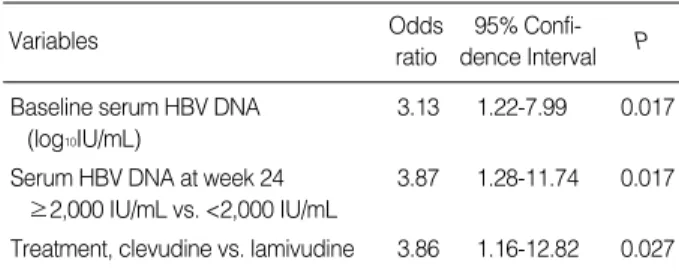
through by logistic regression analysis after pooling data from all study subjects (Table 4). It was found that baseline serum HBV DNA level (odds ratio 3.13, 95% confidence interval 1.22-7.99; P=0.017), serum HBV DNA level at week 24 (≥2,000 IU/mL vs. <2,000 IU/mL) (odds ratio 3.87, 95%
confidence interval 1.28-11.74; P=0.017), and treatment type (lamivudine vs clevudine) (odds ratio 3.86, 95% confi- dence interval 1.16-12.82; P=0.027) were significantly asso- ciated with virologic breakthrough.
Effect of early virologic response on treatment outcomes at week 48
Data from all study subjects were pooled, and categorized
according to serum HBV DNA level at week 24. Treatment outcomes at week 48 were found to be strongly associated with degree of viral suppression at week 24 (Fig. 3). As shown in Fig. 3, the likelihood of HBV DNA becoming undetec- table at week 48 was found to be inversely related to viral load at week 24. Furthermore, 32 (94.1%) of the 34 patients with an undetectable HBV DNA level by PCR (<13 IU/mL) at week 24 maintained an undetectable HBV DNA level at week 48, whereas only 3 (8.3%) of 36 patients with a serum HBV DNA level ≥2,000 IU/mL at week 24 achieved an undetectable HBV DNA level at week 48. Rates of HBeAg loss or seroconversion and ALT normalization at week 48 were also higher in patients with a non-detectable serum HBV DNA level at week 24 than in patients with a residual viral load of ≥2,000 IU/mL (23.5% vs. 0%, 88.2% vs. 66.7%, res- pectively). Moreover, at week 48, viral breakthrough occurred in only 1 (2.9%) of 34 patients with a non-detectable HBV DNA level at week 24, as compared with 13 (36.1%) of 36 patients with residual viremia of ≥2,000 IU/mL at week 24.
Safety and adverse events
During the treatment period, no specific serious adverse event was encountered in any patient. Adverse events occurred with similar frequencies in both groups. The most frequent adverse events in both groups were; fatigue, upper respira-
HBV, hepatitis B virus.
Variables Odds
ratio
95% Confi- dence Interval P Baseline serum HBV DNA 3.13 1.22-7.99 0.017
(log10IU/mL)
Serum HBV DNA at week 24 3.87 1.28-11.74 0.017
≥2,000 IU/mL vs. <2,000 IU/mL
Treatment, clevudine vs. lamivudine 3.86 1.16-12.82 0.027 Table 4. Multivariate analysis for factors associated with virolog- ic breakthrough
Fig. 3. Effect of early viral response on treatment outcomes at week 48. Treatment outcomes at week 48 were found to be strongly asso- ciated with degree of viral suppression at week 24.
94.1
Response at week 48 (%)
100 90 80 70 60 50 40 30 20 10 0
Undetectable 13-200 200-2,000 ≥2,000 Serum HBV DNA level at week 24 (IU/mL)
Undetectable levels of HBV DNA
54.5
37.5
8.3
23.5
Response at week 48 (%)
100 90 80 70 60 50 40 30 20 10 0
Undetectable 13-200 200-2,000 ≥2,000 Serum HBV DNA level at week 24 (IU/mL)
HBeAg loss/seroconversion
22.7
0.0 0.0
88.2
Response at week 48 (%)
120 100 80 60 40 20 0
Undetectable 13-200 200-2,000 ≥2,000 Serum HBV DNA level at week 24 (IU/mL)
ALT normalization
81.8
95.8
66.7
Response at week 48 (%) 2.9 100
90 80 70 60 50 40 30 20 10 0
Undetectable 13-200 200-2,000 ≥2,000 Serum HBV DNA level at week 24 (IU/mL)
Viral breakthrough
9.1
20.8
36.1
tory symptoms, headache, and dyspepsia. However, all symp- toms were mild and relatively well tolerated. No significant changes were observed over the treatment period in serum creatinine or in any other laboratory parameter, and no pati- ent with cirrhosis in either group experienced hepatic decom- pensation.
DISCUSSION
In this retrospective study, clevudine (30 mg daily for 48 weeks) showed potent antiviral activity in HBeAg positive CHB patients. In particular, it suppressed mean serum HBV DNA by -5.2 log10IU/mL during the 48-week treatment period, and 60.4% of clevudine treated patients had an unde- tectable serum HBV DNA level by PCR assay after treat- ment. Although this study was not randomized and the study groups were not matched on a patient-to-patient basis, the degree of HBV DNA reduction achieved by clevudine at 30 mg daily at week 48 was found to be significantly greater than that achieved by lamivudine at 100 mg daily (-5.2 log10IU/
mL vs. -4.2 log10IU/mL; P=0.005). Furthermore, the propor- tion of patients that achieved a non-detectable serum HBV DNA level by PCR (<13 IU/mL) at week 48 was also sig- nificantly greater in the clevudine group (60.4% vs. 38.1%;
P=0.025). Clevudine also showed potent early virologic res- ponse, and this was greater than that achieved by lamivudine.
At week 24, mean serum HBV DNA reductions from base- line and the proportion of patients with a serum HBV DNA level of <2,000 IU/mL at week 24 were also significantly greater in the clevudine group. In a previous 24-week clevu- dine treatment study (11), 68.2% of patients achieved serum ALT normalization, which concurs with the high normaliza- tion rate of 83.3% at week 48 found in the present study.
However, despite the more potent antiviral suppression of clevudine, clevudine and lamivudine induced similar bio- chemical and serological responses.
The presence of drug-resistant mutations is a primary con- cern when considering oral NUC therapy. In previous 24- week treatment trials, clevudine showed no virologic break- through (10, 11). In contrast, during the present 48-week study, virologic breakthrough occurred in 9.4% of clevudine treated patients. When we compared this with that of the lamivudine group, it was found that the incidence of viro- logic breakthrough was significantly lower in the clevudine group (9.4% vs. 25.4%; P=0.031). A recent study from Korea found that rates of viral breakthrough at 1 yr were 10.0%
in treatment naı¨ve patients and 44.4% in patients with a his- tory of previous lamivudine treatment (P<0.001) (16). These results indicate that viral breakthrough during clevudine ther- apy is not negligible in treatment naı¨ve CHB patients. Fur- thermore, previous lamivudine treatment was found to be associated with a substantially higher rate of viral breakthrough, which may have been due to an increased risk of cross resis-
tance between two drugs. Therefore, care is required when clevudine is administered to patients previously treated with lamivudine. In addition, the cumulative incidence of clevu- dine resistance is likely to increase with therapy duration. More long-term studies are needed to understand the cumulative incidences and clinical effects of resistance to clevudine.
Our resistance profiles confirm that the rtM204I mutation is the primary clevudine resistance mutation. Lee et al. also reported that rtM204I is most common mutation of HBV DNA polymerase in treatment naı¨ve patients; other sites of mutation were rtL80I, rtL180M, rtA181V/T, rtV207I (16).
Furthermore, the rtM204I mutation is cross resistant with other L-nucleosides, such as, lamivudine, emtricitabine, and telbivudine (15, 17). In vitro studies have demonstrated that adefovir, tenofovir, and entecavir have antiviral activity against L-nucleoside-resistant HBV mutants, but the activity of ente- cavir against these mutants is substantially lower than against wild type HBV (17). In previous studies in patients with lamivudine-resistant CHB, a combination of lamivudine and adefovir was found to be more effective at preventing subse- quent adefovir resistance (18, 19). Tenofovir has also been shown to be effective in patients with HBV resistance to both lamivudine and adefovir (20), on the other hand, entecavir monotherapy was found to have a high risk of entecavir resis- tance in lamivudine-resistant patients (21). Accordingly, the addition of adefovir or tenofovir may be preferable to switch- ing to adefovir or entecavir in patients with clevudine-resis- tant CHB.
We also assessed factors associated with virologic break- through. By univariate analysis, virologic breakthrough in the clevudine group was not found to be associated with base- line factors or early viral response. However, because the num- ber of patients with virologic breakthrough was small in the clevudine group, statistical power may have been underesti- mated. By multivariate analysis after pooling data from all study subjects, regardless of treatment group, baseline serum HBV DNA level (odds ratio 3.13, 95% confidence interval 1.22-7.99; P=0.017), serum HBV DNA level at week 24 (≥2,000 IU/mL vs. <2,000 IU/mL) (odds ratio 3.87, 95%
confidence interval 1.28-11.74; P=0.017), treatment type (lamivudine vs. clevudine) (odds ratio 3.86, 95% confidence interval 1.16-12.82; P=0.027) were found to be significant- ly associated with virologic breakthrough.
In the clinical trials of agents with lower genetic barriers to viral resistance, such as, lamivudine and telbivudine, early maximal reductions in HBV DNA levels at 24 weeks were found to predict improved clinical outcomes at 1 and 2 yr (22-24). Similar trends were observed in the present study.
When we pooled data from all of our study subjects and exam- ined relations between treatment outcomes at week 48 with respect to serum HBV DNA levels at week 24, it was found that treatment outcomes at week 48 were strongly associat- ed with degree of viral suppression at week 24. Patients with an undetectable HBV DNA level by PCR at week 24 showed
higher rates of HBV DNA non-detectability, HBeAg loss or seroconversion, ALT normalization, and a lower rate of viral breakthrough than those with residual viral viremia of
≥2,000 IU/mL at week 24. The results of the present study support the utility of the recently proposed ‘roadmap’ concept as a strategy to improve long-term treatment results (3).
Previous 24-week clinical trials have shown that the inci- dences of adverse events are similar for patients on clevudine or placebo (10, 11). We also encountered no meaningful seri- ous adverse events in either treatment group. However, a recent study reported that the long-term use of clevudine can induce mitochondrial DNA depletion and lead to mitochondrial myopathy associated with myonecrosis (25). Lee et al. also reported that 10 of 339 (2.9%) patients complained of promi- nent fatigue and had elevated serum levels of aspartate amino- transferase and CK after 1 yr of clevudine therapy. Further- more, two of these patients presented with severe myopathy, from which they recovered completely after quitting clevu- dine. We also reviewed the follow up medical records and labo- ratory data of both treatment groups after 48 weeks. Myopa- thy, characterized by muscle pain and weakness and moder- ately elevated CK levels during treatment, was observed in three (5.7%) of patients in the clevudine group and none of those in the lamivudine group. All three patients who devel- oped myopathy during clevudine therapy were treated with clevudine for more than 52 weeks (52-60 weeks). When cle- vudine was discontinued, CK levels returned to normal with- in 2 months and symptoms resolved over a period of 2 to 4 months in all patients. Therefore, we suggest that patients on long-term clevudine therapy should be monitored care- fully for skeletal muscle dysfunction.
In conclusion, we found that 48-week clevudine therapy induced more potent, earlier virologic response and produced better treatment outcomes at 48 weeks than lamivudine in patients with HBeAg positive CHB. Nevertheless, viral break- through was observed during the 48-week clevudine admin- istration period. Furthermore, treatment outcomes at week 48, in both treatment groups, were found to be strongly asso- ciated with degree of viral suppression at week 24. The pre- sent study is limited by its open-label, nonrandomized, retro- spective design. Accordingly, a longer-term, randomized, con- trolled clinical trial is needed to confirm our preliminary find- ings.
REFERENCES
1. Lok AS, McMahon BJ. Chronic hepatitis B. Hepatology 2007; 45:
507-39.
2. European Association for the Study of the Liver. EASL Clinical Prac- tice Guidelines: management of chronic hepatitis B. J Hepatol 2009;
50: 227-42.
3. Keeffe EB, Dieterich DT, Han SH, Jacobson IM, Martin P, Schiff ER, Tobias H. A treatment algorithm for the management of chron-
ic hepatitis B virus infection in the United States: 2008 update. Clin Gastroenterol Hepatol 2008; 6: 1315-41.
4. Fung SK, Lok AS. Management of hepatitis B patients with antivi- ral resistance. Antivir Ther 2004; 9: 1013-26.
5. Pai SB, Liu SH, Zhu YL, Chu CK, Cheng YC. Inhibition of hepatitis B virus by a novel L-nucleoside, 2’-fluoro-5-methyl-beta-L-arabino- furanosyl uracil. Antimicrob Agents Chemother 1996; 40: 380-6.
6. Chin R, Shaw T, Torresi J, Sozzi V, Trautwein C, Bock T, Manns M, Isom H, Furman P, Locarnini P. In vitro susceptibilities of wild- type or drug-resistant hepatitis B virus to (-)-beta-D-2,6-diaminop- urine dioxolane and 2′-fluoro-5-methyl-beta-L-arabinofuranosylu- racil. Antimicrob Agents Chemother 2001; 45: 2495-501.
7. Marcellin P, Mommeja-Marin H, Sacks SL, Lau GK, Sereni D, Bro- nowicki JP, Conway B, Trepo C, Blum MR, Yoo BC, Mondou E, Sorbel J, Snow A, Rousseau F, Lee HS. A phase II dose-escalating trial of clevudine in patients with chronic hepatitis B. Hepatology 2004; 40: 140-8.
8. Lee HS, Chung YH, Lee K, Byun KS, Paik SW, Han JY, Yoo K, Yoo HW, Lee JH, Yoo BC. A 12-week clevudine therapy showed potent and durable antiviral activity in HBeAg-positive chronic hep- atitis B. Hepatology 2006; 43: 982-8.
9. Lim SG, Leung N, Hann HW, Lau GK, Trepo C, Mommeja-Marin H, Moxham C, Sorbel J, Snow A, Blum MR, Rousseau F, Marcellin P. Clinical trial: a phase II, randomized study evaluating the safety, pharmacokinetics and anti-viral activity of clevudine for 12 weeks in patients with chronic hepatitis B. Aliment Pharmacol Ther 2008;
27: 1282-92.
10. Yoo BC, Kim JH, Kim TH, Koh KC, Um SH, Kim YS, Lee KS, Han BH, Chon CY, Han JY, Ryu SH, Kim HC, Byun KS, Hwang SG, Kim BI, Cho M, Yoo K, Lee HJ, Hwang JS, Kim YS, Lee YS, Choi SK, Lee YJ, Yang JM, Park JW, Lee MS, Kim DG, Chung YH, Cho SH, Choi JY, Kweon YO, Lee HY, Jeong SH, Yoo HW, Lee HS. Clevudine is highly efficacious in hepatitis B e antigen-negative chronic hepatitis B with durable off-therapy viral suppression. Hep- atology 2007; 46: 1041-8.
11. Yoo BC, Kim JH, Chung YH, Lee KS, Paik SW, Ryu SH, Han BH, Han JY, Byun KS, Cho M, Lee HJ, Kim TH, Cho SH, Park JW, Um SH, Hwang SG, Kim YS, Lee YJ, Chon CY, Kim BI, Lee YS, Yang JM, Kim HC, Hwang JS, Choi SK, Kweon YO, Jeong SH, Lee MS, Choi JY, Kim DG, Kim YS, Lee HY, Yoo K, Yoo HW, Lee HS.
Twenty-four-week clevudine therapy showed potent and sustained antiviral activity in HBeAg-positive chronic hepatitis B. Hepatology 2007; 45: 1172-78.
12. Saldanha J, Gerlich W, Lelie N, Dawson P, Heermann K, Heath A;
WHO Collaborative Study Group. An international collaborative study to establish a World Health Organization international stan- dard for hepatitis B virus DNA nucleic acid amplification techniques.
Vox Sang 2001; 80: 63-71.
13. Gish RG, Locarnini SA. Chronic hepatitis B: current testing strate- gies. Clin Gastroenterol Hepatol 2006; 4: 666-76.
14. Hong SP, Kim NK, Hwang SG, Chung HJ, Kim S, Han JH, Kim HT, Rim KS, Kang MS, Yoo W, Kim SO. Detection of hepatitis B virus YMDD variants using mass spectrometric analysis of oligonucleotide fragments. J Hepatol 2004; 40: 837-44.
15. Lok AS, Zoulim F, Locarnini S, Bartholomeusz A, Ghany MG, Paw- lotsky JM, Liaw YF, Mizokami M, Kuiken C; Hepatitis B Virus Drug Resistance Working Group. Antiviral drug-resistant HBV: Standard- ization of nomenclature and assays and recommendations for man- agement. Hepatology 2007; 46: 254-65.
16. Lee HJ, Eun JR, Lee CH, Hwang JS, Suh JI, Kim BS, Jang BK. Long- term clevudine therapy in nucleos(t)ide-na¨ıve and lamivudine-expe- rienced patients with hepatitis B virus-related chronic liver diseases.
Korean J Hepatol 2009; 15: 179-92.
17. Yang H, Qi X, Sabogal A, Miller M, Xiong S, Delaney WE 4th. Cross- resistance testing of next-generation nucleoside and nucleotide ana- logues against lamivudine-resistant HBV. Antivir Ther 2005; 10:
625-33.
18. Lampertico P, Viganò M, Manenti E, Iavarone M, Sablon E, Colom- bo M. Low resistance to adefovir combined with lamivudine: a 3- year study of 145 lamivudine-resistant hepatitis B patients. Gastroen- terology 2007; 133: 1445-51.
19. Manolakopoulos S, Bethanis S, Koutsounas S, Goulis J, Vlachogian- nakos J, Christias E, Saveriadis A, Pavlidis C, Triantos C, Christidou A, Papatheodoridis G, Karamanolis D, Tzourmakliotis D. Long-term therapy with adefovir dipivoxil in hepatitis B e antigen-negative pati- ents developing resistance to lamivudine. Aliment Pharmacol Ther 2008; 27: 266-73.
20. van Bömmel F, Zollner B, Sarrazin C, Spengler U, Hüppe D, Müller B, Feucht HH, Wiedenmann B, Berg T. Tenofovir for patients with
lamivudine-resistant hepatitis B virus (HBV) infection and high HBV DNA level during adefovir therapy. Hepatology 2006; 44: 318-25.
21. Sherman M, Yurdaydin C, Sollano J, Silva M, Liaw YF, Cianciara J, Boron-Kaczmarska A, Martin P, Goodman Z, Colonno R, Cross A, Denisky G, Kreter B, Hindes R; AI463026 BEHoLD Study Group.
Entecavir for treatment of lamivudine-refractory, HBeAg-positive chronic hepatitis B. Gastroenterology 2006; 130: 2039-49.
22. Lai CL, Leung N, Teo EK, Tong M, Wong F, Hann HW, Han S, Poynard T, Myers M, Chao G, Lloyd D, Brown NA; Telbivudine Phase II Investigator Group. A 1-year trial of telbivudine, lamivudine, and the combination in patients with hepatitis B e antigen-positive chronic hepatitis B. Gastroenterology 2005; 129: 528-36.
23. Liaw YF, Gane E, Leung N, Zeuzem S, Wang Y, Lai CL, Heathcote EJ, Manns M, Bzowej N, Niu J, Han SH, Hwang SG, Cakaloglu Y, Tong MJ, Papatheodoridis G, Chen Y, Brown NA, Albanis E, Galil K, Naoumov NV; GLOBE Study Group. 2-Year GLOBE trial results:
telbivudine is superior to lamivudine in patients with chronic hep- atitis B. Gastroenterology 2009; 136: 486-95.
24. Nguyen MH, Keeffe EB. Chronic hepatitis B: early viral suppres- sion and long-term outcomes of therapy with oral nucleos(t)ides. J Viral Hepat 2009; 16: 149-55.
25. Seok JI, Lee DK, Lee CH, Park MS, Kim SY, Kim HS, Jo HY, Lee CH, Kim DS. Long-term therapy with clevudine for chronic hepati- tis B can be associated with myopathy characterized by depletion of mitochondrial DNA. Hepatology 2009; 49: 2080-6.