양성 돌발성 두위현훈 유사 증상으로 발현한 전정발작
계명대학교 의과대학 이비인후과학교실
조혁기, 이예원, 박순형, 남성일
Vestibular Paroxysmia Mimicking Benign Parxysmal Positional Vertigo
Hyuk Ki Cho, Ye Won Lee, Soon Hyung Park, Sung Il Nam
Department of Otorhinolaryngology, Keimyung University School of Medicine, Daegu, Korea
⋅Received Aug 14, 2016 Revised Sep 24, 2016 Accepted Oct 12, 2016
⋅Corresponding Author:
Sung Il Nam
Department of Otorhinolaryngology, Keimyung University School of Medicine, 56 Dalseong-ro, Jung-gu, Daegu 41931, Korea Tel: +82-53-250-7715
Fax: +82-53-256-0325 E-mail: [email protected]
⋅Copyright ⓒ 2016 by The Korean Balance Society.
All rights reserved.
⋅This is an open access article distributed under the terms of the Creative Commons Attribution Non-Commercial License (http://creativecommons.org/licenses/by-nc/4.0) which permits unrestricted non-commercial use, dis- tribution, and reproduction in any medium, provided the original work is properly cited.
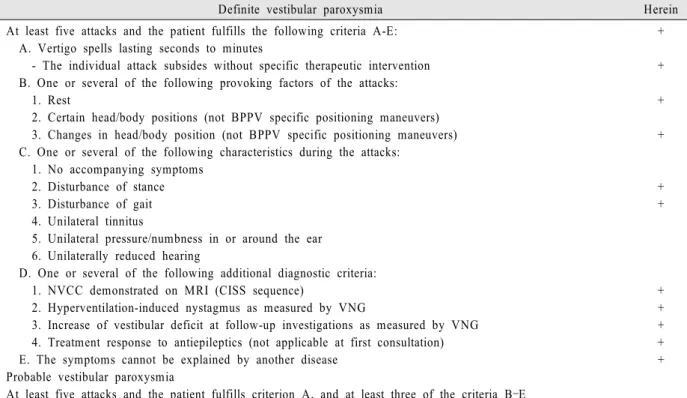
Vestibular paroxysmia is the name given to the syndrome caused by vascular compression of the vestibulocochlear nerve. The main symptoms of vestibular paroxysmia are recurrent, spontaneous, brief attacks of spinning, non-spinning vertigo or positional vertigo that generally last less than one minute, with or without ear symptoms (tinnitus and hypoacusis). Prior to attributing a patient’s symptoms to vestibular paroxysmia, however, clinicians must exclude common conditions like benign paroxysmal positional vertigo, Menière’s disease, vestibular neuritis and vestibular migraine. This is usually possible with a thorough history and bedside vestibular/ocular motor examination. Herein, we describe a patient with vestibular paroxysmia that mimicked resolved BPPV with a literature review.
Res Vestib Sci 2016;15(4):141-146 Keywords: Vestibular paroxysmia; Carbamazepine; Neurovascular compression;
Benign paroxysmal positional vertigo