Printed in the Republic of Korea
http://dx.doi.Org/10.5012/jkcs.2016.60.4.261
Preparation and Physical Properties of Silicone Hydrogel Ophthalmic Lens Containing Hydrophilic Monomer
Min-JaeLeeandA-YoungSung*
Department of Optometry & Vision Science, Catholic University of Daegu, Gyeongsan 38430, Korea.
^E-mail: [email protected]
(Received May 16, 2016; Accepted June 20, 2016)
ABSTRACT. The major physical characteristics of macromolecules used in silicone hydrogel ophthalmic lenses include optical transmittance, oxygen permeability, water content, and refractive index. For the preparation of highly functional silicone hydrogel lens materials, two silicone monomers were used in the presence of 2-hydroxyethyl methacrylate (HEMA) and hydroxypropyl methacrylate (HPMA). The samples containing HEMA and HPMA had oxygen transmissibility (Dk) values in the range of 73.38—50.98 x 10⁻¹¹ (cm2/s) (mLO/mLxmmHg) and 71.94—42.80 x 10⁻¹¹ (cm2/s) (mLO^mLxmmHg), respectively. Furthermore, the water contents of samples containing HEMA and HPMA were in the range of 32.73-34.67% and 31.94-33.74%, respec
tively, and the refractive indices were in the range of 1.4348-1.4364 and 1.4385-1.4407, respectively. Thus, silicone mono
mers containing HEMA and HPMA are expected to be useful for fabricating high-oxygen-permeability silicon hydrogel ophthalmic lenses.
Key words: Silicone monomer, Oxygen permeability, Silicone hydrogel ophthalmic lens
INTRODUCTION
Much attention has been paid to colored lenses in recent years, and thus the use of colored optical lenses has been increasing. Such lenses not only improve eyesight but also change the appearance of lens wearers by changing or emphasizing the color of the iris. At first, colored optical lenses were used as prosthetic contact lenses that corrected physical damage to the eye as a result of various ocular diseases or injuries to the eye. However, according to the report in recent years, more than 13% of all optical lens users as at 2012 used colored optical lenses for cosmetic purposes in East Asia, including China, Japan, and Korea.1-6Colored lenses are produced via printing with a pad printer using a pigment that forms a colored layer on the lens surface and poly(2-hydroxyethyl methacrylate) (PHEMA), which is used as resin, in order to make colors and patterns. In studies on coloring lenses in Korea, 2-hydroxyethyl methacrylate (HEMA) materials have been extensively used. A number of clinical test results have proven that a lens made from HEMA does not supply sufficient atmospheric oxygen to the cornea and, as a result, many side effects such as corneal edema and neovascularization can occur. Accordingly, a number of studies on optical lens materials with high oxygen per
meability have been actively conducted in recent years, together with studies on the compatibility of such materials with colored lenses.7-9
The most widely used material for high-oxygen-permeability lenses is silicone. A study on high-oxygen-permeability lens materials using silicone was pioneered by Gaylord in 1974.
Since then, a material called tris-(trimethylsiloxsil) (TRIS) was developed by Dow Corning, which led to the develop
ment of rigid gas permeable (RGP) contact lenses. However, although RGP contact lenses using silicone have high oxygen permeability, its wearing comfort is low owing to its low water content. To solve this problem, attempts have been made to increase the water content; however, doing so can result in degradation of the oxygen permeability, limiting the applicability of these lenses.9
It has been reported that polydimethylsiloxane (PDMS), which has been widely used as a high-oxygen-permeability material, has 20 times more oxygen permeability than general hydrogel lenses,10-12and its utilization as a material in silicone hydrogel lenses is high. Accordingly, this study aimed to measure the physical properties of silicone hydrogel lenses manufactured by adding HEMA and hydroxypropyl methac
rylate (HPMA), which are hydrophilic monomers used in contact lenses, after synthesizing silicone monomers that had acrylate and urethane groups and to determine the appli
cability of the resulting lenses as silicone hydrogel contact lenses that are highly compatible with resins of colored optical lenses in Korea.
EXPERIMENTAL
Polymerization
In this study, the monomers N,N-dimethylacry lamide (DMA), tris(3-[tris(trimethylsiloxy)silyl]propyl methac
rylate), HEMA, and HPMA were used to fabricate silicone hydrogel lenses after synthesizing silicone that included acrylate and urethane groups. Azobisisobutyronitrile (AIBN) was used as an initiator to perform copolymerization. For the HEMA used in the experiment, a product from JUNSEI was employed, and for 3-[tris(trimethylsiloxy)silyl]propyl methacrylate, DMA, and HPMA, products from Sigma- Aldrich were used to conduct the polymerization. A cast mold method was used to fabricate silicone hydrogen lenses, in which 2-h thermopolymerization was carried out at 120 °C.
The polymerized lens samples were hydrated in 0.9% phys
iological saline solution for 24 h and spectral transmittance,
refractive index, and moisture content, i.e., the optical and physical properties of the lenses, were measured. Table 1 summarizes the mix ratios of the fabricated silicone hydro
gel contact lenses.
ANALYSIS AND MEASUREMENTS
NMR analysis
The NMR data results of the synthesized silicone were obtained using a Bruker AC-300 MHz spectrometer (300.1 MHz for 1H NMR and 75.5 MHz for 13C NMR). The NMR solvent tetrahydrofuran (THF)-ds was cleansed by vacuum distillation over a NA/K alloy before using. Chloroform
di was stirred with CaH2 for 1 d and then filtered. Then, it was stirred again with P2O4 for 2 h and vacuum distilled one was used immediately. The NMR and constitutional for
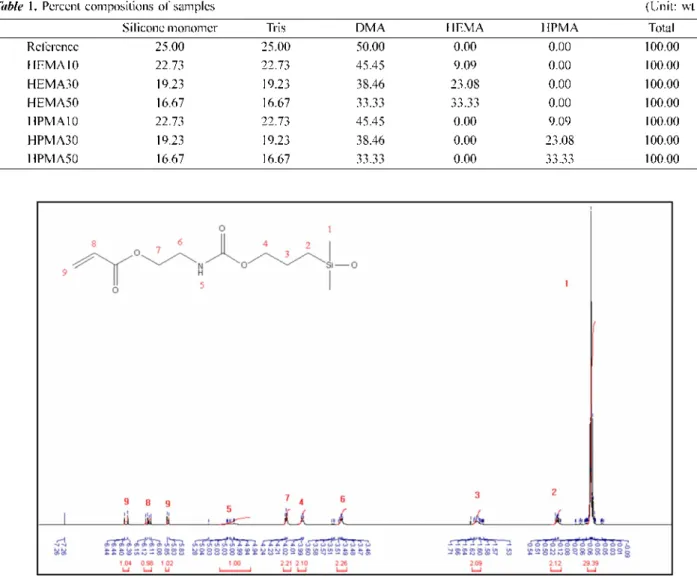
mula of the synthesized silicone are shown in Fig. 1.
Table1. Percent compositions of samples (Unit: wt %)
Silicone monomer Tris DMA HEMA HPMA Total
Reference 25.00 25.00 50.00 0.00 0.00 100.00
HEMA10 22.73 22.73 45.45 9.09 0.00 100.00
HEMA30 19.23 19.23 38.46 23.08 0.00 100.00
HEMA50 16.67 16.67 33.33 33.33 0.00 100.00
HPMA10 22.73 22.73 45.45 0.00 9.09 100.00
HPMA30 19.23 19.23 38.46 0.00 23.08 100.00
HPMA50 16.67 16.67 33.33 0.00 33.33 100.00
Figure1.NMR diagram of silicone monomer-modified acrylate.
The synthesis of silicone containing PDMS and the acry
late and urethane groups was carried out using the method reported in a study by Sung et al.13
Refractive index
For the refractive index measurement of the fabricated silicone hydrogel lenses, DR-A1(1310) from ATAGO was used and the refractive index was measured in accordance with ISO 18369-4:2006 (Ophthalmic optics - Contact lenses - Part 4: Physicochemical properties of contact lens mate
rials, 4.5. Refractive index). The mean of five samples was calculated.
Water content
The water contents of the fabricated silicone hydrogel lenses were measured using the gravimetric method. To dry the samples, a microwave oven was used and the weights of the dried samples and the water-containing samples were expressed as percentages after measuring the weight using a XS205 Dual-range scale from METTLER TOLEDO.
Spectral transmittance
In order to measure the spectral transmittance of the fab
ricated lens, TM-2 from Topcon was used. The spectral transmittance was measured by dividing the light into ultraviolet (UV) (280-315 nm of the UV-B region and 315-380 nm of the UV-A range) and visible light regions.
The mean value of five measurements on the transmit
tance rate at the UV and visible light regions was calculated to determine the spectral transmittance. Transmittances in all regions were represented as percentages.
Oxygen transmissibility (Dk)
In order to measure the oxygen transmissibility of the fabricated silicone hydrogen lens, the polarographic method of ISO 18369-4:2006, Ophthalmic optics - Contact lenses- Part 4 : Physicochemical properties of contact lens mate
rials was used. The equipment used was an O2 Permeometer Model 201T from Rehder Development Company, which was a Rehder single-chamber system.
The oxygen transmissibility measurements were carried out by maintaining a constant temperature by placing the entire sensor system in which the sample was fixed in a ther
mally controlled environment and the final measurement current was calculated at 35 ± 0.5°C. The oxygen trans
missibility (Dk/t) was calculated using the following equation by measuring the thickness of the center of the sample and measuring the current via an O2 permeometer.
Dk/ t(preliminary) = [Dk/1] uncorrected = 1 --- AxNxFxP%
1 吵x 22400揷而而
0.126 電 x 4mole electrons!mole 'amp s!mole electronx
155
mmHg= 2.97 x 10⁻³ X I
=2.97 x 10⁻⁹ x i cm mLO2/smLmmHg
RESULTS AND DISCUSSION
Refractive index
A refractive index of the reference hydrogel lens including silicone was 1.4301 and 1.4348-1.4364 according to the ratio of the HEMA addition. For HPMA, it was in the range of 1.4385-1.4407. Both combinations showed a tendency to increase as compared to the reference, but there was no significant difference for the added amounts of 10-50%
(Fig. 2). According to the present study results, when HEMA or HPMA was added to the silicone monomer, the binding capacity with the colored lens increased. The refractive index also increased, even by adding a small amount ofHEMA or HPMA. Thus, it can be concluded that it is applicable as a material for silicone hydrogel lenses.
Water content
Measurements of the water contents of the fabricated lenses showed that the reference lens had a water content of 31.13%. The water contents of the lenses in which HEMA was added proportionally were in a range of 32.73-34.67%, and the water contents of the lenses in which HPMA was added proportionally were in a range of 31.94-33.74%
(Fig. 3). According to the present study results, both the refractive index and the water content increased when a hydroxyl acrylate monomer was added to the silicone mono
mer. Thus, when a hydrophilic hydroxyl monomer was added
Figure 2. Effect of monomers on refractive index of samples with HEMA and HPMA.
(%) 一U 3 U O U
Figure3. Effect of monomers on water content of samples with HEMA and HPMA.
to hydrophobic silicone monomer, a different trend from the general inverse relationship between water content and refractive index was revealed. This was because the syn
thesized silicone affected the degree of polymerization of the lens polymer more than general hydrogel lens did, and so the synthesized silicone monomer acted as a cross-link
ing agent with a long chain structure, even with increas
ing water content, thereby increasing the optical density and refractive index.
Spectral transmittance
The mean value of the transmittance for the reference lens in the UV and visible light regions was 59.40% at UV-B, 76.60% at UV-A, and 93.20% at visible light region. The mean values of the spectral transmittance of the 10% and 30% HEMA samples were 58.20% and 58.20%, respec
tively, for UV-B, 74.80% and 73.60%, respectively, for UV- A, and 93.00% and 92.20%, respectively, for the visible light region. On the other hand, the addition of 50% HEMA resulted in a slightly opaque lens, with a spectral transmittance of 28.80% for UV-B, 43.00% for UV-A, and 71.40% for the visible light region. Furthermore, when 10-50% HPMA was added, the spectral transmittances were 55.80-69.90% for UV-B, 72.40-80.80% for UV-A, and 90.40-93.20% for the visible light region. Therefore, up to 30% of HEMA could be added to increase the binding capacity with colored lenses while maintaining the optical transmittance of the synthesized silicone monomer. Moreover, when HPMA was proportionally added, the optical transmittance increased, and so the UV and visible light transmission increased. That is, compatibility with the synthesized silicone monomer is better with HPMA than with HEMA. The measured optical transmittance graphs and values are presented in Fig. 4 and Table 2, respectively.
Oxygen transmissibility (Dk)
The oxygen transmissibility (Dk) of the fabricated silicone
(a) Reference Sample
Figure 4. Optical transmittance of (a) the reference lens and the lenses with (b) HEMA10, (c) HEMA50, and (d) HPMA50.
Table 2. Optical transmittance of samples (Unit: %)
Sample UV-B UV-A Vis.
Reference 59.40 76.60 93.20
HEMA10 58.20 74.80 93.00
HEMA30 58.20 73.60 92.20
HEMA50 28.80 43.00 71.40
HPMA10 55.80 72.40 90.40
HPMA30 65.20 78.40 92.40
HPMA50 69.00 80.80 93.20
hydrogel lens was determined by measuring and calculating the oxygen permeability (Dk/t) and the center thickness.
The center thickness of each of the samples was 0.434
0.467 pm. Because the thickness was measured before cut
ting in order to give refraction, the lens samples were slightly thicker than general contact lenses. In addition, the oxygen permeability (Dk/t) of the reference sample was 16.1123 x 10⁻⁹ (cm/s) (mLO2/mLxmmHg). The oxygen permeability values for the samples containing HEMA were 16.2162
11.4939 x 10⁻⁹ (cm/s) (mLOJmLxmmHg), whereas those
for the samples containing HPMA were 15.7410-9.7713 x 10⁻⁹(cm/s) (mLOJmL x mmHg), which was higher than that of general hydrogel contact lenses. The oxygen trans
missibility (Dk), which is a unique property of a material, was 75.2442 x 10⁻¹¹(cm2/s) (mLO2/mL x mmHg) for the ref
erence, which did not contain HEMA or HPMA. This was a much higher value than that of general hydrogel contact lenses, which indicated that the silicone monomer increased
(9으
、 .으
= 2
= 6 19.0 18.0 17.0 16.0 15.0 14.0 13.0 12.0 11.0 10.0 9.00 8.00 7.00 6.00 5.00 4.00 3.00 2.00
the oxygen transmissibility. Moreover, the oxygen trans- 1.00
missibilities of the lenses containing HEMA were 73.3783
50.9755 x 10⁻¹¹ (cm2/s) (mLOJmLxmmHg) and those con
taining HPMA were 71.9364-42.7983 x 10⁻¹¹ (cm2/s) (mL(O/
mL x mmHg). Overall, the larger the proportional addition of HEMA and HPMA, the lower the oxygen transmissi
bility (Dk) and oxygen permeability (Dk/t). However, the combination of approximately 10% HEMA and HPMA showed a slight reduction in oxygen transmissibility. Based on this result, when 10% ofHEMA or HPMA are added to fabricate colored lenses, a small amount of HEMA or HPMA minimizes the reduction in oxygen transmissibility and increases the binding capacity with PHEMA, which is used as a resin for colored lenses. Table 3 summarizes the center thickness, oxygen permeability, and oxygen trans
missibility of each sample. The Dk measurement graph for each sample is shown in Fig. 5, and a graph of the mea
sured current that was transferred to the polarographic cell of the oxygen permeability meter is shown in Fig. 6. Accord
ing to a study by Maldonado-Codina et al.,14 the oxygen
Elapsed Time (minutes)
Figure6.Probe current and temperature versus time in the peripheral zone for (a) HEMA10 and (b) HPMA10.
Table 3.Oxygen transmissibility of samples
Sample Central thickness Current Dk/t Dk
Reference 0.467 5.43 16.11 75.24
HEMA10 0.453 5.46 16.22 73.38
HEMA30 0.434 4.34 12.89 55.94
HEMA50 0.444 3.87 11.49 50.98
HPMA10 0.457 5.30 15.74 71.94
HPMA30 0.457 4.19 12.43 56.74
HPMA50 0.438 3.29 9.77 42.80
80 -i
o
o 7
5 x( eA M- qe Mo od uo 읏
X。
I 3HEMA E3HPMA I
Ref.(O%) 10% 30%
Amount of monomer (%)
Figure5. Oxygen permeability of the samples.
transmissibility is proportional to the water content for general hydrogel lenses. However, the Dk value decreases as the water content increases at low water contents for sil
icone hydrogel contact lenses. The results of the present study are consistent with those in the study done by Mal- donado-Codina et al.,14 in which the oxygen permeability decreased as the water content increased.
CONCLUSION
In this study, silicone monomers with excellent oxygen permeability and containing acrylate and urethane groups were synthesized and the physical properties of the copo
lymer created by the copolymerization of HEMA, which is a hydrophilic monomer used as a lens material, and HPMA, which is a similar hydrophilic monomer, were measured.
We thereby determined the usefulness ofthese copolymers as contact lens materials. As a result, the oxygen permeabilities (Dk) of the fabricated lenses were more than 75.2442 x 10⁻¹¹ (cm2/s) (mLO2/mLxmmHg), thus preventing the occurrence of corneal hypoxia and exceeding the reference value of oxy
gen permeability for continuous-wearing lenses. The water content was also more than 31.13%, which was higher than that of existing high-oxygen-permeability RGP lenses and silicone hydrogel lenses. Based on the present study results, compatibility with PHEMA, which is used currently as a resin for colored lenses, was increased by adding 10% of a hydroxyl acrylate-based material to the silicone mono-
mers used in this study. The measurement of optical trans
mittance was also more than 90% for visible light when HEMA10-HEMA30, as well as HPMA, were added. Both materials showed results similar to that of contact lenses in visible light. Therefore, contact lens materials with high oxygen permeability can be achieved through copolymer
ization of silicone monomers and hydrophilic monomers that include acrylate and urethane groups.
REFERENCES
1. Ji, Y. W.; Hong, S. H.; Chung, D. Y.; et al. J. Korean Ophthalmol. Soc. 2014, 55(5), 646.
2. Efron, N.; Morgan, P. B. Optom. Vs. Sci. 2012, 89, 122.
3. Morgan, P. B.; Efron, N.; Woods, C. A. Eye & Contact Lens 2013, 39, 200.
4. Efron, N.; Morgan, P. B.; Woods, C. A. Clin. Exp. Optom.
2013, 96, 58.
5. Kim, T. H.; Ye, K. H.; Sung, A. Y Korean J. Vis. Sci. 2010, 12(2), 119.
6. Ye, K. H.; Kim, T. H.; Sung, A. Y. J. Korean Oph. Opt Soc. 2008, 13(3), 29.
7. Steinemann, T. L.; Pinninti, U.; Szczotka, L. B.; Eiferman, R. A.; et al. Eye & Contact Lens 2003, 29(4), 196.
8. Gellatly, K. W.; Brennan, N. A.; Efron, N. Am. J. Optom
etry Physiol. Opt. 1988, 65, 934.
9. Kim, T. H.; Sung, A. Y. J. Korean Chem. Soc. 2009, 9, 459.
10. Allcock, H. R. Sci. Prog. Oxf. 1980, 66, 355.
11. Laurencin, C. T.; Norman, M. E.; Elgendy, H. M. J.
Biomed. Mat. Res. 1993, 27, 963.
12. Lskshmi, S.; Katti, D. S.; Laurencin, C. T. Adv. Drug Delivery Rev 2002, 55, 467.
13. Sung, A. Y.; Kim, T. H.; Kong, J. I. J. Korean Oph. Opt.
Soc. 2006, 11(1), 49.
14. Maldonado-Codina, C.; Efron, N. Optometry in Practice 2003, 4, 101.