• 검색 결과가 없습니다.

A Non-Pt Catalyst for Improved Oxygen Reduction Reaction in Microbial Fuel Cells

N/A
N/A
Protected

Academic year: 2021

Share "A Non-Pt Catalyst for Improved Oxygen Reduction Reaction in Microbial Fuel Cells"

Copied!
6
0
0

로드 중.... (전체 텍스트 보기)

전체 글

(1)

DOI:10.5229/JKES.2011.14.2.071

− 71

A Non-Pt Catalyst for Improved Oxygen Reduction Reaction in Microbial Fuel Cells

Jy-Yeon Kim, Sang-Beom Han, Sang-Eun Oh

†,

*, and Kyung-Won Park*

Department of Chemical and Environmental Engineering, Soongsil University, Seoul 156-743, Republic of Korea

Department of Biological Environment, Kangwon National University, Chuncheon, Kangwon-do, Republic of Korea (Received November 26, 2010 : Accepted January 26, 2011)

Abstract : Fe-tetramethoxyphenylporphyrin on carbon black (Fe-TMPP/C) is examined and compared with carbon (C) and Pt-coated carbon (Pt/C) for oxygen reduction reaction in a two chambered microbial fuel cell (MFC). The Fe-TMPP/C is prepared by heat treatment and char- acterized using SEM, TEM, and XPS. The electrochemical properties of catalysts are charac- terized by voltammerty and single cell measurements. It is found that the power generation in the MFC with Fe-TMPP/C as the cathode is higher than that with Pt/C. The maximum power of the Fe-TMPP/C is 0.12 mW compared with 0.10 mW (Pt/C) and 0.02 mW (C). This high output with the Fe-TMPP/C indicates that MFCs are promising in further practical appli- cations with low cost macrocycles catalysts.

Keywords : Oxygen reduction, Nutrient solution, Fe-TMPP, Non-Pt, Microbial fuel cells

1. Introduction

A microbial fuel cell (MFC) is an electrochemical sys- tem which employs exoelectrogenic biofilm as a biocatalyst for electricity generation (Fig. 1).

1-8)

Exoelectrogenic microorganisms in biofilms oxidize various biodegradable substrates generating electrons and protons. The electrons

are transferred to the cathode electrode through an external circuit while the protons diffuse through the solution to the cathode, where electrons combine with protons and oxygen to form water.

The exploration of non-noble metal catalysts, alternatives to Pt, has been of intensive interest in chemical fuel cells.

Jasinski et al . reported for the first time ORR catalysts with macrocyclic structure containing nitrogen-metal coord- ination. Several non-noble transition metals such as Co, Fe, and Mn have been studied in the form of iron(III) phthalocyanine (FePc) and Cobalt tetramethoxyphenylpor- phyrin (CoTMPP) for oxygen reduction reaction (ORR).

9-14)

The pyrolyzed transition metal-N

4

complexes such as Fe- or Co-based macrocycles in an inert atmosphere have been reported to demonstrate the catalytic activity and stability for the oxygen reduction reaction at 80

o

C.

15,16)

However, the subsequent works using several carbon- supported transition metal-N

4

macrocycles showed high activation losses in PEMFCs at low pHs.

17,18)

The chemical fuel cell systems operate under much different conditions of pH (highly acid conditions) and temperature (70-90

o

C) compared to neural pH and temperature (25-30

o

C) of MFCs. Carbon supported Fe-tetramethoxyphenylporphyrin

*E-mail: [email protected](Sang-Eun Oh)

[email protected](Kyung-Won Park)

Fig. 1. A schematic diagram of a microbial fuel cell.

(2)

(TMPP) [19] as the cathode have not been tested in a neutral cathode medium in a MFC.

Herein, we have studied an oxygen reduction reaction of carbon-supported Fe-tetramethoxyphenylporphyrin (Fe-TMPP/C) and compared with ORR of carbon and Pt-coated carbon. The Fe-TMPP/C catalyst was character- ized using X-ray photoelectron spectroscopy (XPS), X-ray diffraction (XRD), scanning electron microscopy (SEM) and transmission electron microscopy (TEM). The electro- chemical ORR characteristics of Fe-TMPP, Pt-coated carbon, and carbon were compared using voltammetry.

Finally, these cathode catalysts were implemented into a MFC reactor and were also compared for cell potential and power output.

2. Experimental

To prepare the carbon-supported Fe-TMPP (Fe- TMPP/C) catalyst, iron(III) acetatylacetonate (0.03 g, Aldrich) and 5,10,15,20-tetrakis(4-methoxyphenyl)- 21H,23H-porphyrin (H

2

TMPP, 0.1 g, Aldrich) were dissolved in acetic acid (99.7%, Aldrich) solution for 1 h. After completely dissolving, carbon powder (Vulcan XC-72R) was added slowly into the solution to form a homogeneous blended solution by adsorbing the Fe-TMPP on carbon. After an adequate stirring, the solution was completely evaporated and then dried at 60

o

C overnight.

The obtained powder was placed in a quartz boat and heat-treated at 700

o

C for 3h in a horizontal quartz furnace under N

2

atmosphere. For comparison with the Fe-TMPP/

C (0.5 mg/cm

2

; 20 wt% Fe-TMPP) the Pt-coated carbon (E-Tek, USA) coated with a Pt-catalyst (0.5mg/cm

2

; 10wt% Pt) on one side and carbon (E-Tek, USA) were used as the cathodes.

The catalysts were characterized by transmission electron microscopy (TEM) using a Philips CM20T/STEM Electron Microscope system at 200 kV. The TEM sample was prepared by placing a drop of the catalyst suspension with ethanol on a carbon-coated copper grid. Scanning electron microscopy (SEM, JSM-6700F) and energy dispersive X-ray (EDX, EX-23000BUB) analyzer were used to identify the Fe-TMPP in the catalyst. X-ray pho- toelectron spectrometry (XPS, Thermo Scientific) study was carried out with the Al K

α

X-ray source of 1486.6eV at the chamber pressure below 5 × 10

-9

Pa.

To characterize oxygen reduction reaction of the cata- lysts, cyclic voltammetry (CV) and linear sweep voltam-

metry (LSV) were obtained using a potentiostat (CH Instruments Inc. 700C Series) in a three-electrode electro- chemical cell with a RRDE-3A rotator (CH Instruments Inc.). The catalyst onto a glassy carbon disk (disk diameter of 0.4 mm)-platinum ring (ring width of 0.7-0.5 mm) electrode, Pt wire, and Ag/AgCl were used as a working, counter, and reference electrode, respectively. The catalyst ink was prepared by ultrasonically blending the mixture of catalyst powder (10mg), 57.2 µ L Nafion solution (0.5wt%

Ionomer, Aldrich), 57.2 µ L isopropanol, and 114.4 µ L deionized water for 10 min. The ink (1 µ L) was dropped onto the glassy carbon disk and dried at 50

o

C for 10 min.

The total catalyst loading is 347.8 µ g cm

−2

. The vol- tammetry of the catalysts was performed between 0 and 1.2 V in oxygen-saturated nutrient solution with a scan rate of 5 mV s

−1

. The nutrient solution (pH = 7.0) consists of 4.33 g L

−1

Na

2

HPO

4

, 2.69 g L

−1

NaH

2

PO

4

·H

2

O, 0.31 g L

−1

NH

4

Cl, 0.13 gL

−1

KCl, and 12.5 mL vitamin solution in de-ionized water.

8)

For the rotating ring disk electrode (RRDE) measurement, the ring potential was fixed at 1.2 V versus RHE with a scan rate of 5 mV s

−1

and a rotating speed of 1,600rpm. All of the experiments were performed at room temperature and ambient pressure.

Two-chamber MFCs with an aqueous-cathode were used in order to assess the performance of different cathode catalysts (Fe-TMPP/C, Pt/C, and C). The two bottles (250mL) were connected with a glass tube (inner diame- ter: 3.5 cm

2

) with a proton exchange membrane (NafionTM 117, Dupont Co., Delaware, USA) held by a clamp in the middle of the tube as previously described.

20)

The distance between the electrodes was approximately 16 cm. All the two-chambered MFCs were operated at 30

o

C. The anode and cathode compartments were filled with the nutrient solution (250-mL) and the anode chamber was inoculated with anaerobic sludge from the Wastewa- ter Treatment Plant in Chuncheon, Korea (10mL). Acetate (2mM) was used as the electron donor. The anode cham- ber was sparged with nitrogen gas for 3-5 minutes and sealed with a rubber stopper and cap. The anode (2.5 ×

4.0 cm) and Pt-coated cathode were connected with a

resistor (1 k Ω ) and the current produced was calculated

by measuring the voltage across a resistor every 30 min-

utes using a multimeter. Once the voltage increased and

stabilized at around 300mV, the Pt cathode was replaced

with the prepared different cathode materials. Current-

voltage response and power density curve were analyzed

by the IviumStat electrochemical analyzer (IVIUM

(3)

Technology, The Netherlands). The current was increased from 0 to 0.4 mA in series. At each level of current, the voltage response was recorded after stabilization in 600- 1200 sec. The reference electrode was placed to cathode as close as possible to reduce overpotential.

3. Results and discussion

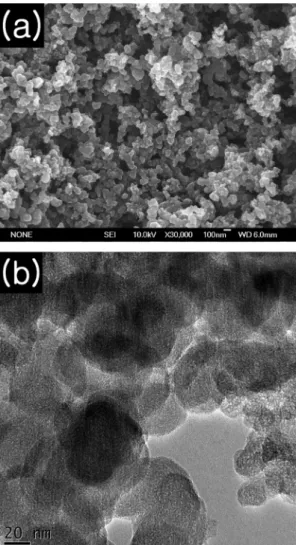
A SEM image of Fe-TMPP supported by carbon (Fe- TMPP/C) for oxygen reduction reaction was shown in Fig. 2(a). The Fe-TMPP/C seems to be homogeneously mesoporous structure for electrochemical reduction in nutrient solution facilitating oxygen diffusion. The Fe- TMPP/C seems to be the carbon particles mixed with TMPP exchanged by iron metal (Fig. 2(b)). In other

words, the Fe-TMPP is well dispersed on the carbon particles without any precipitates such as iron oxides or nitrides. As shown in Fig. 3(a), C 1s spectrum consists of five peaks at 283.83, 284.78, 285.88, 286.78, 288.18, and 291.18 eV corresponding to carbide, C-C, C-N, C-O (ethers), C-O(carboxyls), and C-O(carbonates), respec- tively. In N 1s spectrum of Fig. 3(b), the pyridinic-N is assigned to the component at 398.8 eV and quaternary- N is presented for the peak at 401.08 eV.

Fig. 4(a) shows the LSVs recorded on a glassy carbon disk electrode coated with the catalysts in an oxygen- saturated nutrient solution with a scan rate of 5 mV s

−1

at 25

o

C. The onset potentials for the C, Fe-TMPP/C, Pt/C are 0.52, 0.94, and 1.01V, respectively, where more posi- tive potential indicates higher catalytic activity. Thus, this means that the Fe-TMPP/C shows much improved ORR activity in comparison with the C and relatively compara- ble to the Pt/C. The reduction current densities at 0 V

Fig. 2. (a) SEM and (b) TEM images of Fe-TMPP/C. Fig. 3. XPS spectra of (a) C 1 s and (b) N 1 s of Fe-TMPP/C.

(4)

for the Fe-TMPP/C and Pt/C are 2.75 and 2.50 mA cm

−2

, respectively. Fig. 4(b) shows the plots of electron number ( n ) for ORR versus electrode potential of the C, Fe- TMPP/C and Pt/C at an elecrode rotation rate of 1,600rpm in oxygen saturated nutrient solution with a scan rate of 5 mV s

−1

. For a quantitative evaluation for ORR mecha- nism, the electron number ( n ) onto the glassy carbon disk- platinum ring electrode can be calculated by the fol- lowing equation:

n = 4 I

D

( I

D

+ ( I

R

N

−1

))

−1

where I

D

is the faradic current at the disk electrode, I

R

is the faradic current at the ring electrode, and N = 0.43 is the RRDE collection efficiency. As shown in the Fig. 4(b), it can be seen that the ORR catalyzed by the C proceeds mainly through a two-electron oxygen reduction pathway at the low polarization range, and then

the electron number increases when electrode potential is scanned to a more negative direction where the produ- ced hydrogen peroxide can be further reduced. In contrast, the ORR catalyzed by the Fe-TMPP/C has a more stable mechanism with a constant nearly four electron number for ORR between 0 and 0.7V. Similar to that of the Pt/C, the electron number for ORR of the Fe-TMPP/C is about four even at higher potential than +0.1 V.

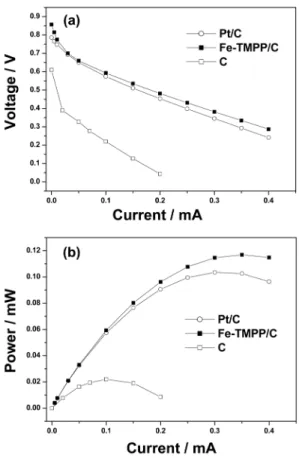
The current-potential curves of the different catalysts were shown in Fig. 5(a). The open circuit voltages (OCVs) for the C, Pt/C, and Fe-TMPP/C are 0.61, 0.80, and 0.86 V, reapectively. More positive OCV indicates much improved catalytic activity, meaning that the Fe-TMPP/C shows an excellent ORR activity in comparison with the C and Pt/C. At 0.6 V, where an activation polarization regime dominates, reduction current densities are 0.001mA (C), 0.081 mA (Pt/C) and 0.095 mA (Fe-TMPP/C).

Moreover, at 0.4 V, where an Ohmic polarization regime dominates, the reduction current density for the Pt/C Fig. 4. (a) Current density versus potential and (b) electron

number versus potential for oxygen reduction reaction of the catalysts in oxygen-saturated nutrient solution with a scan rate of 5 mV s

1

and an electrode rotation rate of 1,600 rpm.

Fig. 5. Cell performances of the two-chambered MFC using

different cathode catalysts with saturated dissolved oxygen.

(5)

(0.25 mA) is comparable to that of Fe-TMPP/C (0.29 mA).

The Fe-TMPP/C produced a higher maximum power density than Pt/C, which is 120 and 600% higher than that of the Pt/C and the C, respectively. The maximum power of the Fe-TMPP/C is 0.12mW as compared with 0.10mW of the Pt/C, and 0.02 mW of the C (Fig. 5(b)).

The excellent performance of the Fe-TMPP/C may be due to a superior electrocatalytic activity, low electrical resistance for current collection, and the unique pore characteristics of the electrode, which favors the diffusion of oxygen and the removal of the by-product H

2

O might result in the improved performance. In particular, the decreased cell performance using Pt/C cathode may be due to the crossover products such as formic acid, acetic acid from the anode. Detailed studies on the origins of the excellent performance of the Fe-TMPP/C will be reported in the future. From the results of the practical electrochemical cell, we conclude that the Fe-TMPP/C is an excellent candidate for the electrodes of microbial fuel cells.

4. Conclusions

The catalyst structure of heat-treated macrocyclic complex with nitrogen provided much improved oxygen reduction reaction for the MFC. The Fe-TMPP/C produced both higher reduction current density and maximum power density than those of the Pt/C and C. The excellent per- formance of the Fe-TMPP/C might be due to an improved ORR activity of the catalyst. Thus, the catalyst can reduce Pt loading and replace expensive noble catalysts in MFCs.

Acknowledgments

This work was supported by Korea Research Foundation Grant funded by the Korean Government (MOEHRD, Basic Research Promotion Fund) (KRF-2008-314-F00014) and Manpower Development Program for Energy &

Resources supported by the Ministry of Knowledge and Economy, Republic of Korea (20104010100610).

References

1. B. E. Logan and N.J. Hoboken, “ Microbial fuel cells ”, Wiley-Interscience. xii, New York (2008).

2. B. E. Logan, ‘Exoelectrogenic bacteria that power microbial fuel cells’ Nat. Rev. Micro., 7 , 375 (2009).

3. D. R. Lovely, J. D. Wall, C. S. Harwood, and A. L. Demain,

“ Electricity production with electricigens ”, ASM Press.

Washington D.C. (2008).

4. K. Rabaey, S. T. Read, P. Clauwaert, S. Freguia, P. L. Bond, L. L. Blackall, and J. Keller, ‘Cathodic oxygen reduction catalyzed by bacteria in microbial fuel cells’ ISME J., 2 , 519 ( 2008).

5. K. Rabaey and W. Verstraete, ‘Microbial fuel cells: novel biotechnology for energy generation’ Trends Biotechnol. ,

23 , 291(2005).

6. J. R. Kim, S. Cheng, S. E. Oh, and B. E. Logan, ‘Power generation using different cation, anion, and ultrafiltration membranes in microbial fuel cells’ Environ. Sci. Tech- nol., 41 , 1004 (2007).

7. S. E. Oh, J. R. Kim, J. H. Joo, and B. E. Logan, ‘Effects of applied voltages and dissolved oxygen on sustained power generation by microbial fuel cells’ Water Sci.

Technol., 60 , 1311 (2009).

8. S. E. Oh, B. Min, and B. E. Logan, Environ. ‘Cathode performance as a factor in electricity generation in microbial fuel cells’ Sci. Technol., 38 , 4900 (2004).

9. S. Cheng, H. Liu, and B. E. Logan, Environ. ‘Power densities using different cathode catalysts (Pt and CoTMPP) and polymer binders (Nafion and PTFE) in single microbial fuel cells’ Sci. Technol., 40 , 364 (2006).

10. S. You, Q. Zhao, J. Zhang, J. Jiang, and S. Zhao, ‘A microbial fuel cell using permanganate as the cathodic electron acceptor’ J. Power Sources , 162 , 1409 (2006).

11. F. Zhao, F. Harnisch, U. Schroder, F. Scholz, P. Bogdanoff, and I. Herrmann, ‘Application of pyrolysed iron(II) phthalocyanine and CoTMPP based oxygen reduction catalysts as cathode materials in microbial fuel cells’

Electrochem. Comm., 7 , 1405 (2005).

12. L. Zhang, J. J. Zhang, D. P. Wilkinson, and H. J. Wang,

‘Progress in preparation of non-noble electrocatalysts for PEM fuel cell reactions’ J. Power Sources, 156 , 171 (2006).

13. E. H.Yu, S. Cheng, K. Scott, and B. Logan ‘Microbial fuel cell performance with non-Pt cathode catalysts’ J. Power Sources , 171 , 275 (2007).

14. R. Jasinski, ‘A New Fuel Cell Cathode Catalyst’ Nature, 201 , 1212 (1964).

15. T. Schilling and M. Bron, ‘Oxygen reduction at Fe-N- modified carbon nanotubes in acidic electrolyte’ Electro- chim. Acta , 53 , 5379 (2008).

16. R. Bashyam and P. Zelenay, ‘A class of non-precious metal composite catalysts for fuel cells’ Nature , 443 , 63 (2006).

17. B. Wang, ‘Recent development of non-platinum catalysts for oxygen reduction reaction’ J. Power Sources , 152 , 1 (2005).

18. C. W. B. Bezerra, L. Zhang, K. Lee, H. Liu, A. L. B.

Marques, E. P. Marques, H. Wang, and J. Zhang, ‘A review of Fe-N/C and Co-N/C catalysts for the oxygen reduction reaction’ Electrochim. Acta , 53 , 4937 (2008).

19. K. Lee, L. Zhang, H. Lui, R. Hui, Z. Shi, and J. J. Zhang,

‘Oxygen reduction reaction (ORR) catalyzed by carbon-

(6)

supported cobalt polypyrrole (Co-PPy/C) electrocatalysts’

Electrochim. Acta , 54 , 4704 (2009).

20. S.-E. Oh and B.E. Logan, ‘Proton exchange membrane and electrode surface areas as factors that affect power generation in microbial fuel cells’ Appl Microbiol.

Biotechnol., 70 , 162 (2006).

21. F. Harnisch, S. Wirth and U. Schroder, ‘Effects of substrate

and metabolite crossover on the cathodic oxygen reduction

reaction in microbial fuel cells: Platinum vs. iron(II)

phthalocyanine based electrodes’ Electrochem. Comm.,

11 , 2253 (2009).

수치

Fig. 2. (a) SEM and (b) TEM images of Fe-TMPP/C. Fig. 3. XPS spectra of (a) C 1 s and (b) N 1 s of Fe-TMPP/C.
Fig. 5. Cell performances of the two-chambered MFC using different cathode catalysts with saturated dissolved oxygen.

참조

관련 문서

→ f depends on the number of nucleation sites and the growth rate.. (c) All of the parent phase is consumed by the

Mechanical properties of AISI 304 steel solution annealed at 1100°C (FC) and subseguently aged at 670°C for different aging time.. Schematic illustration of the

Plots of discharge capacity versus cycle number for LOBs with CNT-only and MOF-C/CNT electrodes.. Schematic diagram illustrating the synthesis process

At present, the caterpillar-type Fe electrode electrolysis system is known for its high phosphorous removal rate in sewage treatment, and in this study,

Frequency of conidial germination (A) and appressorium formation (B) of Colletotrichum orbiculare and callose formation of plant cells (C) at the

The matrix A show the cost per computer (in thousands of dollars) and B the production figures for the year 2005 (in multiples of 1000 units).. Find a matrix C that

• Lower w/c improve the rate of strength development at early age, can be used for precast concrete plant.

pollutants exposed to the gravel was increased to 10 times of the normal concentration, the oxygen uptake rate, indicating microbial activity of the gravel