Effect of Endophytic Bacterium Inoculation on Seed Germination and Sprout Growth of Tartary Buckwheat
Xoxiong Briatia
1, Chartchai Khanongnuch
2, Md Obyedul Kalam Azad
3and Cheol Ho Park
3*
1
Department of Food Science and Technology, Souphanouvong University, Luang Prabang 06300, Lao PDR
2
Division of Biotechnology, Chiang Mai University, Chiang Mai 50200, Thailand
3
Department of Bio-Health Technology, College of Biomedical Science, Kangwon National University, Chuncheon 24341, Korea
Abstract - This experiment was conducted to investigate the endophytic bacterium Herbaspirillum spp effect on seed germination and sprout growth of tartary buckwheat. Inoculant concentration (%v/v) and seed soaking time were applied 10, 20 and 40% and 0, 4, 8, 12 hour, respectively. The experiment was carried out in a growth chamber maintained temperature at 20, 25 and 30ºC without light for 7 days. Results showed that, 10 to 20% (v/v) inoculant concentration by 4 to 8 h seed soaking time at 20°C temperature increased seed vigor rate and total seed germination rate 80-95% and 90-100%, respectively. On the other and, seed inoculation with Herbaspirillum spp. increased hypocotyl length (13-15 ㎝), root length (8-11 ㎝), total fresh weight (135-296 g) and total dry weight (7-10 g), compared to control. It is indicated that sprouts growth and yield depends on inoculation concentrations, seed soaking time and temperature. Therefore, it would be suggested that seed inoculation with Herbaspirillum spp. at concentration of 10 to 20% (v/v), soaking time 4 to 8 h and temperature 20°C promote seed germinations and sprout growth rate of tartary buckwheat.
Key words - Endophytic bacterium, Seed germination, Sprout growth, Tartary buckwheat
*Corresponding author. E-mail : [email protected] Tel. +82-33-250-6473
Introduction
Buckwheat is well recognized as a healthy food. Moreover, tartary buckwheat grains possess important functional food materials such as proteins, amino acid compositions, bioactive phytochemicals and mineral elements (Vojtíšková et al., 2012; Hsu et al., 2008). The major functional components have been demonstrated to be flavonoids such as rutin and quercetin (Kim et al., 2001; Zhao et al., 2012). Recently, many researchers have focused on the development of buckwheat as a potential functional food material (Lin and Zhang, 2001; Chang et al., 2010). Popović et al. (2014) reported that during the period 2010-2011 about 2.113 million ha of buckwheat was cultivated annually worldwide and the average yield was 913 kg/ha. However, the yield is still low with compared to other grain crops. Researches on buckwheat production, breeding, and cultivation have been
conducted related to agricultural techniques (Akaya and Sun, 1992; Wang and Campbell, 2000).
However, seed is one of the most important inputs for higher grain production, therefore quality seed is required for rapid germination and synchronous seedling emergence, and development. Born and Corns (1958) found that a high degree of dormancy is normally exhibited by seeds of F.
esculentum and F. tartaricum species at harvest and after storage in a period of time. Seed dormancy is regarded as the failure of an intact viable seed to complete germination under favorable conditions and provides an escape from suboptimal germination conditions in seasonal or spatially heterogeneous environments (Born and Corns, 1958; Wang and Campbell, 2000). Low seed vigor and seed dormancy is undesirable characteristics of farmers and researchers that results in a low productivity. Several studies on seed germination and seed emergence revealed the beneficial effects of seed priming by several ways, such as light, heat, smoke, soaking, leaching, temperature, chilling, scarification, gamma rays and salinity, including cutting or removing the seed coat and pericarp were
Original Research Article
reported (Koger et al., 2004; Mathur, 1989; Tzortzakis, 2009;
Wang and Campbell, 2000). On the other hand, seed treatment with plant growth hormones such as gibberellic acid (GA
3), indole-3-acetic acid (IAA), indole-3-butyric acid (IBA), naphthalene acetic acid (NAA), and benzyladenine (BA) also reported (Dhoran and Gudadhe, 2012; Zare et al., 2011). However, poor seed germination is a great concern, thus, seed germination test is very important to determine the seed vigor, emergence and seedling establishment (ISTA, 1993). There are many factors influencing seed germination in general, plant growth promoting rhizobacteria, microbial inoculants have been used for treatment seed germination and seedling growth in various crops (Mia et al., 2012; Peng et al., 2009). Significant increases in seed germination and seedling vigor of agronomic important crops in response to inoculation with plant growth promoting rhizobacteria have been reported (Ertekin, 2011; Gholami et al., 2009; Oliveira et al., 2002).
With the increasing recognition of the nutritional value of buckwheat sprout, many researches on buckwheat sprout were carried out (Yoon et al., 2007; Zhao et al., 2012). The young plants (sprouts and microgreens) of buckwheat have been used as freshy health food because it takes only 6 to 8 days after sowing and could produce a greater quantity of fresh vegetables, with a soft and crispy texture and an attractive fragrance (Choi et al., 1996; Kim et al., 2004; Kim et al., 2008 ).
A high number of bacterial species have been isolated from plant tissues, such s seeds, roots, stems, and leaves (Surette et al., 2003). It has been demonstrated that plant stresss significantly affects endophyte communities because of plant physiological changes (Reiter et al., 2002). Various endophytic bacteria have been shown to have several beneficial effects on their host plant, and the mechanisms involved are probably similar to those described for rhizosphere bacteria.
Plant growth promotion may be achieved through the production of plant growth enhancing substances such as indole acetic acid (Beyeler et al., 1999). Beneficial effects on plant growth may also be achieved by improved nutrient acquisition, including nitrogen fixation (Reiter et al., 2003).
Endophytes may produce the enzyme 1-aminocclopropane 1-carboxylic acid (ACC) deaminase (Shah et al., 1998). This
enzymes has no function in bacteria but cleaves ACC, the precursor of ethylene in plants and thus modulates ethylene levels which contributes to plant growth promotion (Mayak et al., 2004).
Nowadays, functional vegetable consumption is increasing in Asian countries due to growing awareness of health. But the production of vegetables is not enough for the requirement.
Moreover, the method of production, mostly depends on chemical fertilizers and pesticides. Thus to increase the functional vegetable production without hazardous and toxic substances, the production method employed like bio-organics endophytic inoculant would be the way to ensure the quality, functional properties and safety of vegetables. Therefore, this study aims to investigate the effect of endophytic bacterium Herbaspirillum spp. on seed germination and sprout growth of Tartary buckwheat species.
Materials and Methods
The experiment was conducted at the Microbial Resources and Enzyme Technology Laboratory, Division of Biotechnology, Faculty of Agro-Industry, Chiang Mai University, Thailand.
The seeds of tartary buckwheat variety (KW45) were obtained from a farmer of Longlanh Village, Luang Prabang, Lao PDR. Endophytic bacterium Herbaspirillum spp. was used for the experiment. Endophytic bacterium isolate Herbaspirillum rubrisubalbicans was isolated from common buckwheat seedling stems at a Laboratory of Applied Microbiology, Department of Biology, Faculty of Science, Chiang Mai University, Thailand.
Inoculums preparation
Endophytic bacterium Herbaspirillum spp. was cultured in
a modified nutrient agar (NA) and nutrient broth (NB) (Atlas,
2010). A single colony was selected and inoculated into NB
medium, following incubation at 37°C for 8-10 h under
shaking conditions. Exponentially growth cells were harvested
by centrifugation at 6000 rpm for 20 min, and re-suspended in
either sterilized normal saline (0.85% NaCl) solutions to
obtain the final cell densities of 10
8cfu/㎖ and used as
inoculum stock solutions.
Seed preparation and seed inoculation
The inoculum were prepared with the proper diluents for the treatments by using sterile distilled water to obtain a final concentration of 10, 20 and 40% (v/v), respectively. Buckwheat seed was separately weighed 50 g seeds for each treatment and surface-sterilized with 2.5% (v/v) sodium hypochlorite solutions for 3 min, and rinsed thoroughly in sterile distilled water for 4 times. Seeds were soaked in liquid suspensions (10, 20 and 40%, v/v) for 0,4,8 and 12 hours at room temperature and sterile distilled water was used for the control.
Seed germination test
Tartary buckwheat seed germination tests were carried out by a top of paper (TP) method. Thirty seeds for each treatment with three replications in completely randomized design (CRD) were used. The seeds were placed directly onto a sterilized moist filter paper (No.1) in petri-dish and covered with a lid, thereafter transferred in a growth chamber under the dark condition, and temperatures maintained at 20, 25 and 30°C, for 7 days. Irrigated with sterile distilled water once in a day. Germination parameters: seed germination vigor rate (GV) in four days after seeding and total seed germination rates (GR) in seven days after seeding were investigated according to the International Rules for Seed Testing Association for the Fagopyrum species (ISTA, 1993), number of daily germinated seeds (GD), and seed germination index (GI) was calculated according to the formula described by Perry (1894): GI = n/d, where, n = number of seedlings emerging on day ‘d’ and d = day after planting.
Growing of tartary buckwheat sprouts
Tartary buckwheat sprouts were cultured in a growth chamber under dark condition. The treated and non-treated seeds were put on the sterilized plastic net trays (sizes 27.5 × 15.5 × 7 cm), which was modified for sprouting buckwheat seeds and kept in dark conditions for growing sprouts in a growth chamber adjusted with temperatures at 20, 25 and 30°C, for sprout growth at 7 days and water was supplied four times in a day with distilled watery sprayer (120 ㎖). Ten sprouts were randomly selected from each treatment and
determined the roots and hypocotyl length, sprout fresh weight and dry weight, including the moisture content was also calculated and expressed as percent fresh weight basis.
Statistical analysis
Statistical analysis of all tests was carried out using Statistix software version 8.0. FL. Data was analyzed with ANOVA and Least significant difference (LSD) test at P<
0.05 level was used to separate the means when the ANOVA F-test indicated a significant effect of the treatments.
Results and Discussion
Endophytic bacterium Herbaspirillum spp. inoculation effect on seed germination of tartary buckwheat
Endophytic bacterium Herbaspirillum spp. has positive effect on seed germination parameters such as seed germination vigor rate (GV) and total seed germination rate (GR), number of daily germinated seeds per day (GD), and seed germination index (GI), compared to control (Table 1).
In tartary buckwheat seeds, inoculation with 10 and 20%
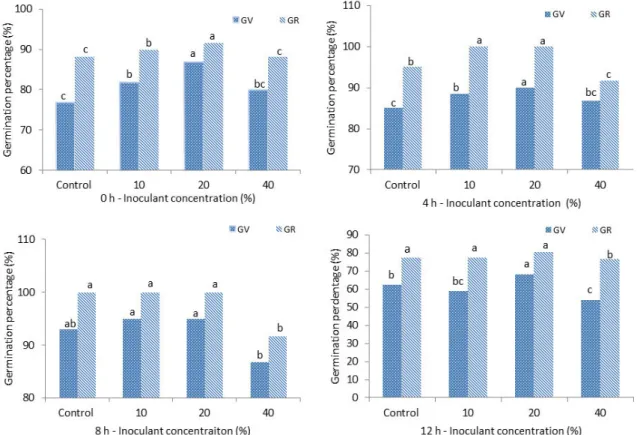
concentrations of bacterium Herbaspirillum with soaking for 4 and 8 hours showed higher GV (88-95%) and GR up to 100% at 20°C (Fig. 1) compared to the control. GD (6 seeds), and value of GI (14-18) were also relatively higher in 10 and 20% concentrations with soaking for 4 and 8 hours among the treatment (Table 1 & 2).
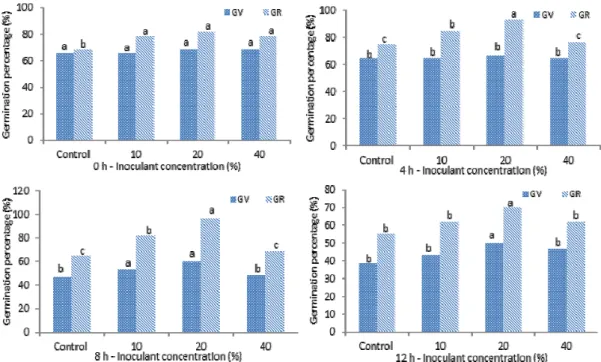
Seed germination test of tartary buckwheat at 25°C
showed positive effects of bacterium Herbaspirillum on seed
germination parameters such as GV, GR, GD, and seed GI by
showing increased values significantly compared to the
control (Fig. 2, Table 1 & 2). The enhancement varied depending
on the treatment concentration and soaking durations. The
highest germination parameters were found in the seed
treated with 10 and 20% (v/v) concentrations of 4 and 8 h,
which were shown GV (53-67%), GR (85-97%), GD (4 seeds),
and value of GI (7-10), respectively. Seed germination test of
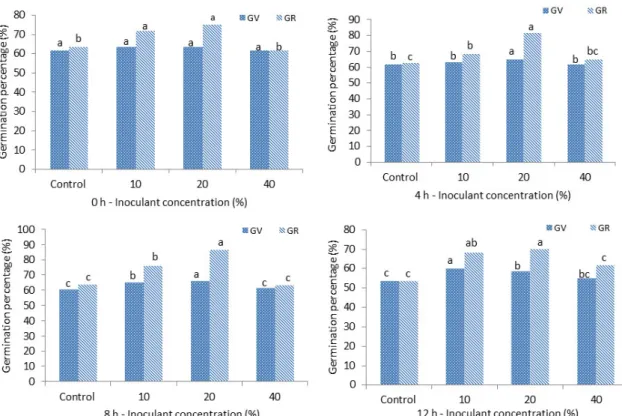
tartary buckwheat at 30°C enhanced significantly seed
germination parameters such as GV, GR, GD, and GI
compared to the control. Seed inoculation with 10, 20 and
40% (v/v) concentrations and soaking for 0, 4, 8 and 12 h
showed GV (55-66%), GR (62-87%), GD (3-4 seeds), and
Table 1. Effect of endophytic bacterium inoculation on number of daily germinated seeds (GD) in tartary buckwheat
Soaking time (h) Inoculants (% v/v)
No. of daily germinated seeds
20°C 25°C 30°C
0
Control 5.30 ± 0.14 b
z2.93 ± 0.10 b 2.72 ± 0.20 a
10 5.40 ± 0.28 a 3.36 ± 0.10 a 3.07 ± 0.10 a
20 5.50 ± 0.14 a 3.50 ± 0.10 a 3.22 ± 0.10 a
40 5.30 ± 0.14 b 3.36 ± 0.10 a 2.65 ± 0.30 b
4
Control 5.70 ± 0.14 a 3.22 ± 0.10 c 2.64 ± 0.10 c
10 6.00 ± 0.00 a 3.64 ± 0.10 b 2.93 ± 0.10 b
20 6.00 ± 0.00 a 4.00 ± 0.00 a 3.50 ± 0.10 a
40 5.50 ± 0.14 b 3.29 ± 0.00 c 2.79 ± 0.10 bc
8
Control 6.00 ± 0.14 a 2.79 ± 0.10 c 2.79 ± 0.10 c
10 6.00 ± 0.00 a 3.50 ± 0.10 b 3.36 ± 0.10 b
20 6.00 ± 0.00 a 4.14 ± 0.00 a 3.71 ± 0.00 a
40 5.50 ± 0.14 b 2.39 ± 0.10 c 2.72 ± 0.20 c
12
Control 3.30 ± 0.15 b 2.36 ± 0.10 b 2.29 ± 0.20 c
10 3.30 ± 0.15 b 2.64 ± 0.10 a 2.93 ± 0.10 ab
20 3.50 ± 0.05 a 3.00 ± 0.20 a 3.00 ± 0.00 a
40 3.30 ± 0.10 b 2.64 ± 0.10 a 2.64 ± 0.10 b
z
Means followed by a common letter between columns are non-significantly different ( p ≤ 0.05).
All the values are means (n=3) ± SD.
Fig. 1. Effect of endophytic bacterium inoculation on GV and GR (%) of tartary buckwheat in 0 h, 4 h, 8 h, and 12 h soaking time at
20°C. All the values are means (n=3) ± SD. Means followed by a common letter between columns are non-significantly different
( p ≤ 0.05).
Fig. 2. Effect of endophytic bacterium inoculation on GV and GR (%) of tartary buckwheat in 0 h, 4 h, 8 h, and 12 h soaking time at 25°C . All the values are means (n=3) ± SD. Means followed by a common letter between columns are non-significantly different ( p ≤ 0.05).
Table 2. Effect of endophytic bacterium inoculation on seed germination index (GI) of tartary buckwheat
Soaking time (h) Inoculants (% v/v)
Seed germination index
20°C 25°C 30°C
0
Control 16.70 ± 0.57 a
z11.17 ± 0.04 a 14.27 ± 0.61 a
10 16.50 ± 1.98 a 12.95 ± 1.39 a 16.39 ± 1.15 a
20 17.97 ± 1.08 a 12.88 ± 1.53 a 15.00 ± 0.97 a
40 15.67 ± 3.16 b 11.93 ± 0.12 a 13.86 ± 0.71 b
4
Control 13.98 ± 1.59 b 9.80 ± 0.65 b 14.42 ± 2.24 a
10 17.70 ± 0.05 a 10.26 ± 0.42 a 12.45 ± 0.07 a
20 17.35 ± 1.58 a 10.21 ± 1.78 a 11.83 ± 0.39 b
40 16.55 ± 0.02 a 9.44 ± 0.21 b 11.41 ± 0.41 b
8
Control 13.90 ± 0.65 a 6.04 ± 0.04 b 12.09 ± 0.12 a
10 14.38 ± 0.21 a 7.31 ± 0.36 b 12.67 ± 0.19 a
20 14.22 ± 0.45 a 9.00 ± 0.57 a 10.24 ± 0.34 b
40 13.13 ± 0.14 b 6.81 ± 0.67 b 9.94 ± 0.33 b
12 Control 7.03 ± 0.35 b 5.06 ± 0.09 b 8.04 ± 0.06 a
10 7.23 ± 0.32 ab 6.06 ± 1.23 a 8.89 ± 0.15 a
20 7.94 ± 0.05 a 5.95 ± 0.15 b 8.80 ± 1.19 a
40 6.60 ± 0.21 b 6.25 ± 0.78 a 7.89 ± 0.73 b
z
Means followed by a common letter between columns are non-significantly different ( p ≤ 0.05).
All the values are means (n=3) ± SD.
value of GI (8-16), respectively. These might be due to the increased synthesis of hormones like gibberellins by endophytic
bacterium Herbaspirilum spp. which would have triggered
the activity of specific enzymes that promote early germination
such as α-amylase, which have brought an increase in availability of starch assimilation (Gholami et al., 2009).
During the seed germination, α-amylase in the aleurone layer plays an important role in hydrolyzing the endosperm starch into metabolizeable sugars, which provide the energy of emergence rate and growth in cereal crops (Mia et al., 2012).
It is indicated that endophytic bacterium Herbaspirilum spp.
positively affect on seed germination of tartary buckwheat species. However, seed germination parameters showed slightly decreased when increased the inoculation concentrations and soaking time up to 40% and 12 h compared to other conditions. On the other hand, Mia et al. (2012) reported that rice seeds inoculated with rhizobium strains UMPR1006 and UMPR 1102, for 48 to 96 h improved percentage of seed emergence and lowland rice seeds inoculated with PGPR and Rhizobium spp. showed significantly increased seed germination rate and seedling vigor. In addition, Gholami et al. (2009) reported maize seeds inoculated with PGPR increased seed germination rate (90%) over non-treated seeds. Ertekin (2011) reported that Koelreuteria paniculata seeds treated with effective microorganism (EM1) at a concentration 100
㎖/L and stratification for 45 days at 4°C improved seed germination rate up to 94%. On the other hand, Bharagava and Chandra (2010) reported that Phaseolus mango L. seed treatment with bacteria (bacteria treated post-methanated distillery effluent) at 60% concentrations and germinated at 28°C for 6 days, increased seed germination rate up to 100%, but at 20% (v/v) was found most suitable concentrations for seed germination and better plant growth than other concent- rations. However, the present study found that increase inoculation concentration and soaking time up to 40% (v/v) and 12 h, decreased seed germination parameters of tartary buckwheat compared to other conditions (Table 2). Similarly, Lim et al. (2012) reported that decreased the seed germination rate of common buckwheat in response to increased concent- rations of NaCl up to 200 mM. Dhoran and Gudadhe (2012) found in Asparagus sprengeri Regelin seed germination rate and vigor indexes decreased rapidly when treated with growth regulator (GA) concentration above 60 ㎎/L.
Those results were generally discussed to be attributed to the production of some phytohormones, which were enhanced seed germination. However, one of the most direct
reason of the enhancements would be to seed germination and plant growth in some host plants related to the action with endophytes. This role of the endophytes in enhancing host plant performance was referred to be related to the growth hormones or secondary metabolite fungal alkaloids (Peng et al., 2013). Gholami et al. (2009) reported that maize seeds treated with PGPR strains improved seed germination rate and vigor rate over the control under in vitro conditions.
In contrast, increase inoculation concentrations and soaking time up to 40% and 12 h decreased seed germination parameters of tartary buckwheat compared to other conditions in this study. Bharagava and Chandra (2010) found that Phaseolus mungo L. seed treatment with bacteria (bacteria untreated post-methanated distillery effluent, PMDE) at high concentration (60-100%) decrease in percent seed germination to about 20-40%. On the other hand, Lim et al. (2012) observed a decline in the seed germination rate of common buckwheat in response to increased concentrations of NaCl up to 200 mM. Dhoran and Gudadhe (2012) found in Asparagus sprengeri Regelin seed germination rate and vigor indexes decreased rapidly when treated with growth regulator (GA) concentration above 60 ㎎/L. However, the present study suggested that the optimal inoculation concentration and soaking time would be in the 10 and 20% concentrations with seed soaking for 4 and 8 h. Enhancing seed germination and developing vigorous seedling are crucial for this study. In the present study, it was found that optimal temperature condition for tartary buckwheat seed germination were ranged from 20 to 30ºC, when seeds inoculated with 10 and 20% (v/v) concentrations of endophytitc bacterium Herbaspirilum spp. which were showed better seed germination rate. Born and Corns (1958) found that after-ripened seeds of tartary buckwheat germinated over a wide range of temperatures under laboratory conditions. Optimum seed germination and seedling emergence occurred at relatively high temperature between 20 to 30ºC for several cereal species have been reported (Koger, 2004; Gholami et al., 2009; Briatia et al., 2011, 2012; Mia et al., 2012).
Effect of endophytic bacterium Herbaspirillum spp.
inoculation on sprouts growth of tartary buckwheat species
Tartary buckwheat seed inoculation with endophytic
Fig. 3. Effect of endophytic bacterium inoculation on GV and GR (%) of tartary buckwheat in 0 h, 4 h, 8 h, and 12 h soaking time at 30°C . All the values are means (n=3) ± SD. Means followed by a common letter between columns are non-significantly different ( p≤0.05).
Table 3. Effect of endophytic bacterium inoculation on growth of tartary buckwheat sprouts
Growing temperature (°C)
Inoculant Concent.
(% v/v)
Hypocotyls Root Fresh Dry
length (㎝)
length (㎝)
weight (g/10 sprouts)
weight (g/10 sprouts)
20
Control 12.70 ± 0.08 b
z9.76 ± 0.06 b 1.60 ± 0.10 a 0.09 ± 0.00 b 10 13.83 ± 0.07 a 10.40 ± 0.18 ab 1.74 ± 0.08 a 0.11 ± 0.01 a 20 14.05 ± 0.19 a 11.18 ± 0.47 a 1.81 ± 0.09 a 0.12 ± 0.01 a 40 12.68 ± 0.42 b 9.36 ± 0.23 c 1.59 ± 0.16 a 0.09 ± 0.01 b
25
Control 14.32 ± 0.37 c 7.58 ± 0.48 b 2.10 ± 0.07 a 0.09 ± 0.00 b 10 14.80 ± 0.25 bc 7.80 ± 0.42 b 2.10 ± 0.06 a 0.09 ± 0.00 b 20 15.81 ± 0.10 a 8.12 ± 0.03 b 2.29 ± 0.15 a 0.12 ± 0.01 a 40 15.23 ± 0.10 b 11.26 ± 0.76 a 2.20 ± 0.02 a 0.12 ± 0.02 a
30
Control 12.26 ± 0.28 b 6.21 ± 0.13 b 1.53 ± 0.07 a 0.06 ± 0.00 a 10 13.09 ± 0.07 a 7.94 ± 0.11 a 1.63 ± 0.04 a 0.06 ± 0.00 a 20 13.17 ± 0.04 a 7.62 ± 0.40 a 1.59 ± 0.11 a 0.06 ± 0.00 a 40 12.58 ± 0.17 b 6.34 ± 0.20 b 1.57 ± 0.09 a 0.06 ± 0.00 a
z