• 검색 결과가 없습니다.

Phosphorus Removal in Wastewater Using Activated Ca-Loess Complex

N/A
N/A
Protected

Academic year: 2021

Share "Phosphorus Removal in Wastewater Using Activated Ca-Loess Complex"

Copied!
9
0
0

로드 중.... (전체 텍스트 보기)

전체 글

(1)

Abstract

Phosphorus Removal in Wastewater Using Activated Ca-Loess Complex

Seong Chul Kang·Byoung Ho Lee

*

Civil and Environmental Engineering, University of Ulsan, Ulsan City 680-749, Korea (2012년 8월16일 접수; 2012년 10월12일 수정; 2012년 10월15일 채택)

In many instances phosphorus is a limiting factor for eutrophication in streams, and lakes. Because wastewater treatment plant itself may be the main phosphorus source in a natural water body, removal of phosphorus in final effluent of wastewater treatment processes is required.

Amongst various technologies for phosphorus removal in wastewater, adsorption technology was investigated using activated Ca-loess complex. Ca was added in loess to enhance adsorption capacity and intensity of phosphorus. Ca added loess was activated at a high temperature of 400 ℃ which turned out to be the optimum temperature. Activated Ca-loess complex below 400 ℃ had not enough strength to be applied as an activated Ca-loess pallet column in wastewater treatment process. Ca-loess complex which activated above 400 ℃ lost its adsorption capacity as the loess surface was glassified when the activation tem- perature reached above 400 ℃. Even if adsorption capacity of activated Ca-loess was not very high due to the lack of abundant pores on its surface, adsorption intensity was still high because it was activated with added Ca in loess.

Activated loess was made by pallets. The activated loess pallets were filled in a column, and were applied in wastewater treatment process. Using an activated Ca-loess pallet column, total phosphorus (T-P) was reduced from about 0.5 mg/l to lower than 0.1 mg/l in wastewater treatment, and ionic phosphorus (phosphate) was completely removed for the four months of pilot plant operation.

Key words : phosphorus, loess, activation, Ca, phosphate

*Corresponding author : E-mail : [email protected](B. H. Lee) 강이나 호수로 유입되는 인(P)이 종종 부영양화의 가장 큰 제한요소로 작용한다. 그런데 하수처리장의 방류수가 자연수계에 인 의 중요한 공급처로 작용하는 경우가 많기 때문에 하수처리장의 최종 처리수에서 인의 제거가 요구된다.

하수에서 인을 제거할 수 있는 많은 기술 중에서, 활성 칼슘-황토의 복합체를 이용한 흡착기술을 연구하였다. 칼슘을 황토에 첨 가하여 인의 흡착 용량과 흡착강도를 증가시켰다. 칼슘을 첨가한 황토를 최적 온도로 밝혀진 400 ℃의 고온에서 활성화시켰다.

400 ℃ 미만에서 활성화시킨 칼슘-황토는 하수처리 공정의 활성칼슘-황토 복합체를 이용한 처리조에 적용하기엔 강도가 부족하였 다. 반면 400 ℃ 초과 온도에서 활성화시킨 칼슘-황토 복합체는 복합체 표면이 유리화되어 흡착용량이 감소하였다. 활성칼슘-황토 복합체는 표면에 충분한 기공이 발달하지 못하여 인의 흡착용량에 한계는 있으나 칼슘을 첨가하였기 때문에 흡착강도는 높았다.

활성칼슘-황토는 입자형 복합체로 만들어졌다. 제조된 복합체를 흡착칼럼에 채워 하수처리공정에 적용하였다. 활성칼슘-황토의 복합체를 충진한 칼럼을 파일롯트 플랜트에 적용한 결과 0.5 mg/l의 인의 농도를 0.1 mg/l로 낮출 수 있었고, 이온성 인을 4개 월의 운전기간 동안 완전하게 흡착시켜 제거할 수 있었다.

주제어 : 인, 활성, 황토, 칼슘, 이온성 인

요약문

(2)

1. Introduction

Importance of removing phosphorus in wastewater treatment is being acknowl- edged significantly because in many cases phosphorus may be the control factor in eutrophication of natural water body such as streams, and lakes. Phosphorus can be removed by a biological process such as A2O (Anaerobic-Anoxic-Oxic Process), and many other particular processes. To raise phosphorus removal in wastewater treatment, advanced technologies have been investigated (Hu et al., 2003; Wu et al., 2010). Wu et al. tried to find high- er phosphorus removal technology using granular sludge (Wu et al., 2010), while Hu et al. found that enriched nitrifying bacteria could remove phosphorus effec- tively (Hu et al., 2003). On the other hand wetland was suggested for removing phos- phorus from agricultural run-off which is a non-point source (Lu et al., 2009).

However, Chemical precipitation is usually used to remove phosphorus in wastewater treatment. Recently various technologies were suggested for remov- ing phosphorus in wastewater treatment (Guan et al., 2009; Xiong et al., 2010; Yin et al., 2011). Guan et al. assessed phos- phorus removal abilities for loess, cin- der, and limestone (Guan et al., 2009). It was reported that calcium plays an im- portant role in adsorption of phosphorus in wastewater (Xiong et al., 2010; Yin et al., 2011). It seems that ionic reaction be- tween calcium and phosphorus may be an important mechanism in removing phos-

phorus in wastewater for those materials containing calcium such as sepiolite, peat, and limestone (Guan et al., 2009; Xiong et al., 2010; Yin et al., 2011). Ion (Fe) is also known to be effective in remov- ing phosphorus in wastewater (Fu et al., 2009; Gutierrez et al., 2010; Moelants et al., 2011). Gutierrez et al. found that iron salts can remove phosphorus and sulfide at the same time if they were applied at influent step of wastewater (Gutierrez et al., 2010; Moelants et al., 2011). Govern- ing mechanisms of phosphorus removal by iron salts were complexation between iron and phosphorus, and then the adsorption of phosphorus on their complex (Fu et al., 2009; Gutierrez et al., 2010; Moelants et al., 2011). Other technologies such as ionic exchange, electrochemical coagulation, crystallization, and adsorption by a com- posite metal oxide have been investigated for removing phosphorus in wastewater as well (Awual et al., 2011; Bian et al., 2011;

Tran et al., 2012; Liu et al., 2012).

Adsorption technology using adsorbent

has also been reported (Khadhraoui et al.,

2002; Xiong et al., 2010). Khadhraoui et

al. found that Ca-based sorbent was ef-

fective in removing phosphorus, and the

adsorption capacity could be enhanced

by the generated pores on its surface

(Khadhraoui et al., 2002). Peat was also

used as an adsorbent for removing phos-

phorus in wastewater by using its porous

characteristics (Xiong et al., 2010). It was

known that adsorbed phosphorus on ad-

sorbent is hardly desorbed for regenera-

tion (Yin et al., 2011).

(3)

In this investigation, activated loess adsorbent was developed to remove phos- phorus in wastewater. Loess was mixed with Ca to enhance adsorption capacity and its intensity. Loess mixed with Ca was activated at an optimum temperature of 400 ℃. Activated Ca-loess complex was made as pallets to be applied in adsorption column of a wastewater treatment process.

Activated loess pallet column was applied in the pilot plant of domestic wastewater for about four months.

2. Material and Methods 2.1 Materials

For phosphate adsorbing metals (adsor- bents), activated calcium and loess com- plex was used as a supporting media. CaCl

2

(Yakuri Pure Chemicals, Japan) was used in preparing activated calcium and loess complex. Loess was grinded and sieved with STANDARD TESTING SIEVE 75 μm (No. 200). Sieved loess was mixed with 1M of CaCl

2

200 ml and 0.5 M of HCl 40 ml.

KH

2

PO

4

(Shinyo pure chemicals, Japan) was used for phosphate sample solution.

2.2 Adsorbent Preparation

Loess 1 kg was mixed with 1M CaCl

2

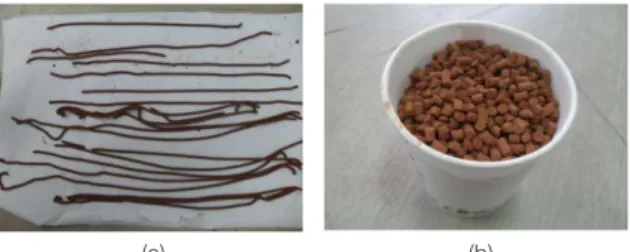
200 ml and 0.5 M HCl 40 ml (5 : 1). Calcium- loess complex (Loess mixed with calcium) was made in a form of stick with about 20

~ 40 cm length and 5 mm of diameter (a in Fig.1). The stick type loess was dried for 2 hours in electric oven at 105 ℃, and cut to around 4 ~ 5 mm as pallets (b in Fig.

1). Pallets of calcium-loess complex about

5mm in diameter (loess pallet hereafter) were made by being heated at various temperatures for 2 hours. Ca-loess pallets were activated by heating for 2 hours and cooling in desiccator for 24hours. Sticks of Ca-loess complex and its pallets were shown in Fig. 1.

2.3 Experimental Methods

Pallets (Fig. 1 (b)) were heated in vari- ous temperatures from 300 ℃ to 800 ℃ for 2 hours. Heated pallets were cooled in desiccator for 24 hours. As such the pallets were activated for adsorbing phosphate in water. In order to estimate adsorption capacities, activated Ca-loess pallets by various temperatures were introduced in different 300 ml of bottles filled with 1 mg/l of phosphate as T-P (Total Phosphorus).

The bottles which contains loess pallets activated in different temperatures, and which were filled with 1 mg/l of phosphate solution were shaken by shaking incuba- tor (Daeil Engineering DSK 522S, Korea) in 20 ℃ with 180rpm for 1 hour. Removal rates of phosphate by loess pallets, which were activated differently, were calculated to estimate the optimum activation tem- perature.

Fig. 1. Sticks of Ca-loess complex (a), and their pallets (b)

(a) (b)

(4)

2.3.1 Isotherm Test

Isotherm test has been performed to understand the characteristics of activat- ed loess pallets in adsorbing phosphorus in water. Pallet 5 gs were put in 300 ml of bottles filled with 0.1, 0.5, 1.0, 5.0, and 10 mg/l of phosphate solutions each. Phos- phate solution has been prepared using KH

2

PO

4

(Shinyo pure chemicals, Japan).

Bottles were shaken by shaking incubator (Daeil Engineering DSK 522S, Korea) at 20

℃ with 200 rpm for 2 hours. Water used in synthesizing samples of phosphorus so- lution for isotherm tests was prepared by that tap water was distilled, and followed by passing through activated carbon col- umn and ion exchange resin. pH of the prepared water was 5.15. Freundlich iso- therm model was applied in the experi- ment.

2.3.2 Field Application

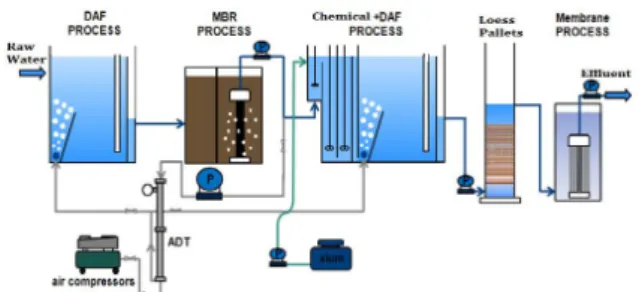
Activated loess pallets were applied in domestic wastewater treatment using a pilot plant. A schematic pilot plant dia- gram is presented in Fig. 2. Raw water was treated by DAF (Dissolved Air Flota- tion) without coagulant, and the effluent was introduced into MBR (Membrane Bio- reactor) system. Effluent of MBR system was again treated by DAF with coagulant to remove phosphorus. To remove phos- phorus in very low level, activated loess pallets adsorption was employed. Phos- phate was mainly removed by adsorption in loess column. Size of the column was D 15 cm × H 200 cm with flow rate of 100 ml/min. Ca-loess pallet (12 kg) was filled

in the column which having a volume of about 7,000 cm

3

with D 15 cm × H 125 cm.

Contact time (adsorption period) of the phosphorus with Ca-loess pallet was about 70 min. Phosphorus contained in floc was finally removed by microfiltration. Even though various processes have been used in the pilot plant for domestic wastewater treatment, phosphorus removal by Ca- loess pallet column was the main focus in this investigation. The pilot plant was set up in nearby domestic wastewater treat- ment plant.

3. Results and Discussion 3.1 Activation Temperature

Ca-loess complex were activated in various temperatures from 300 ℃ ~ 800 ℃ to find the optimum activation tempera- ture. Results of the activations are shown in Fig. 3. The highest removal rate of T-P (phosphate) occurred at 350 ℃ as shown in Fig. 3. However, loess pallets activated below 350 ℃ were crushed down or dis- organized during operation in the pilot plant. Even if phosphorus removal rate by loess pallets activated in 350 ℃ was high- est with 67 %, it was determined that the optimum activation temperature was 400

Fig. 2. Schematic diagram of the experimental process

(5)

℃ with removal rate of 51 % due to be lack of strength of loess pallets activated below 400 ℃. Loess pallets activated at 400 ℃ had enough strength to last the whole ap- plication process in the pilot plant. Loess pallets not only should have large surface area for phosphorus to be adsorbed, but they should also have enough strength to avoid being worn down by handling impact during application.

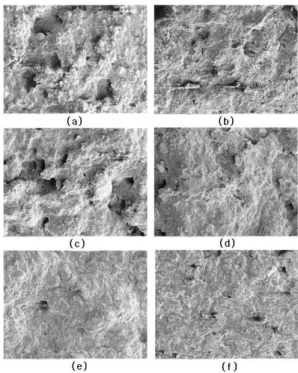
Reason for the decrease in phosphorus removal rate by the Ca-loess seems to be because pallets activated in high temper- ature seems to loose soil characteristics, and gain glass characteristics with activa- tion temperature. SEM (Scanning Electron Microscope JSM-820 Jeol, Japan) images of loess pallets activated in different tem- peratures (a, c, e), and those (b, d, f) af- ter phosphate adsorption are presented in Fig. 4. Pallet activated at low temperature (350 ℃) like (a) in Fig.4 has more rough surface, and looks more porous than the others such as (c) and (e) in Fig. 4. Surface of activated pallets was getting smoother with the increase in activating temperature as it may be observed in Fig. 4. It seems that loess is changing to glass matter at

higher temperature, and it loses surface area and active adsorption sites on surface of pallets. Phosphorus adsorbed surface of the used loess pallets are shown in b, d, f in Fig. 4. Adsorbed amount of phosphorus should depend on the surface area under the same condition. It was proved that removal rate of loess pallets activated at 350 ℃ was higher than those activated at higher temperature such as 400 and 800

℃. Surface of the activated Ca-loess pal- lets after phosphorus adsorption became smoother than the original ones before phosphorus adsorption as it may be ob- served in Fig. 4. Due to the loss of soil characteristics of Ca-loess pallet by acti- vation at high temperature, active func- tional groups such as –OH may be cov- ered by glassified material on the surface of Ca-loess pallet as it can be interpreted

Fig. 3. Removal rates of T-P (Phosphate) by loess pallets acti- vated in various temperatures

Fig. 4. SEM images (magnification: x 200) before and after phos-

phate adsorption of loess pallets activated in different

temperatures (a),(b) 350 ℃; (c),(d) 400 ℃; (e),(f) 800 ℃

(6)

in Fig. 4. Loosing functional group may be another reason why removal rate of phos- phorus by Ca-loess pallets is decreasing with active temperature.

3.2 Isotherm Test

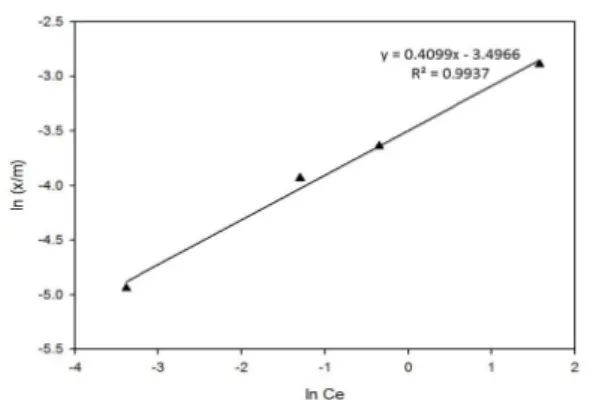
Isotherm test has been performed for the Ca-loess pallets activated at 400 ℃ which is believed to be the optimum ac- tivation temperature. Result of the iso- therm test is presented in Fig. 5. The re- sult shows very good co-relations between adsorption and equilibrium concentrations.

Freundlich Model, x/m = K

f

Ce

1/n

was ap- plied in the experiment. x is an amount of phosphate adsorbed in mg on the surface of loess pallets, m is weight of loess pal- lets in grams. K

f

and 1/n are experimental constants, and their values were obtained with 0.03, and 0.41 in the isotherm test.

Ce is equilibrium concentration. K

f

value represents adsorption capacity of the loess pallets. However, the value 0.03 of K

f

ob- tained was not so high due to the lack of number of pores on the surface of loess pallets. 1/n represents adsorption inten- sity. 1/n of 0.41 obtained was relatively high because loess pallets were activated with Ca and other minerals such as Al, and Fe which are contained in loess itself.

Activated loess pallets have low adsorption capacity, and high adsorption intensity.

Because phosphorus concentration is low in tertiary effluent, and loess is abundant and cheap, activated loess pallets may be used in removing phosphorus at very low level of concentration in final effluent of wastewater treatment.

3.3 Pilot Test

Pilot plant was set up in nearby domes- tic wastewater treatment plant. Raw water from influent of the wastewater treatment plant was pumped into a storage tank of the pilot plant. After about two months of adjustment period from Dec. 1, 2010 to Feb. 15, 2011, pilot plant has been operated for four months until June 21, 2011. During the operation T-P (Total Phosphorus) and phosphate concentrations were monitored along with other water quality parameters.

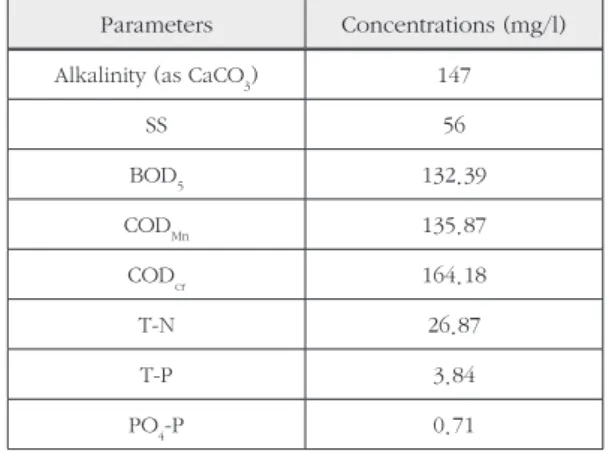
T-P and phosphate were the main focus in the investigation. Loess pallet column was set up on the wastewater treatment process as shown in Fig. 2. Domestic wastewater was treated by DAF (without chemical) – MBR – DAF (with coagulant) process. Ef- fluent of DAF was introduced into activated loess pallet column. To remove phosphorus in extremely low level, micro- membrane has been used to remove particulate phos- phorus even if activated loess column was the main focus in the investigation. Raw water quality is shown in Table 1.

Fig. 5. Applied Freundlich model in the isotherm test for acti-

vated loess pallets

(7)

Average T-P concentration in raw wa- ter was 3.84 mg/l, which was then re- moved down to about 0.5 mg/l by series of processes untill DAF process. The experi- ment attempted to lower the T-P concen- tration further using activated loess pallet column. Loess pallet was made through a series of processes. It was first mixed with MgCl

2

, and then it was reformed as pal- lets, which were followed by activation at 400 ℃. Loess pallet has pores and func- tional groups on its surface, which were generated by activation. Surface of loess pallets are charged by Ca

2+

and Al

3+

, and more of mineral cations. Phosphorus ion (phosphate) can be combined with these positively charged cations, and particu- late phosphorus may also be transported into pores on the surface. Removal mech- anisms of phosphorus in water by loess pallet may be these three principles which are ionic reaction between phosphate and functional groups on surface, transport of ionic and particulate phosphorus from bulk solution into pores of pallets, and adsorp- tion of particulate phosphorus on surface

of pallets. Fig. 6 shows T-P concentra- tions at effluent of each unit operation in the series of processes. T-P concentra- tions in raw water fluctuated all the way during the operation. T-P was removed up to about 0.5 mg/l until DAF with chemical (coagulant). It is being required to lower this T-P concentration down to lower than 0.1 mg/l to prevent receiving waters such as streams and lakes from eutrophication.

Activated loess pallet column could remove T-P from about 0.5 mg/l in effluent of DAF with coagulant down to 0.1 mg/l. Ionic and particulate T-P were removed together as it can be seen in Fig. 6. T-P in effluent of loess column has been treated very stably.

Even though T-P could be further removed by microfiltration, it was not feasible in the economic point of view.

Phosphate concentrations were also monitored along with T-P concentrations at each unit operation of the processes.

Ionic phosphorus (phosphate) could be virtually removed completely by acti- vated loess pallet column. Phosphate can

Table 1. Raw Water Quality Parameters of the Pilot Plant Parameters Concentrations (mg/l) Alkalinity (as CaCO

3

) 147

SS 56

BOD

5

132.39

COD

Mn

135.87

COD

cr

164.18

T-N 26.87

T-P 3.84

PO

4

-P 0.71

Fig. 6. T-P concentrations at each process of the pilot plant

(8)

be removed by ionic combination between phosphate and functional groups on sur- face of loess pallets. Because loess pallet was activated with Ca

2+

, and other cationic metal ions like Al

3+

and Fe

3+

contained in loess itself, ionic phosphorus (phosphate) may be adsorbed first, and then particu- late phosphorus can be adsorbed by mass transport on surface and into pores of loess pallets. Results of the pilot plant operation are shown in Fig. 7. Ionic phosphorus was virtually removed completely by loess pal- let column as it can be observed in Fig. 7.

Total phosphorus can be removed up to about 0.5 mg/l by DAF with coagu- lant, which is traditional technology. DAF with other technologies has been devised in wastewater treatment plants to re- move T-P. If T-P is to be removed fur-

ther, new technology should be employed like adsorption by activated loess pallet developed in the investigation. T-P was removed down to lower than 0.1 mg/l, and ionic phosphorus was removed completely by the developed loess pallet column in the pilot plant of domestic wastewater treat- ment as it can be seen in Table 2. Results of the pilot plant operation are shown in Table 2.

4. Conclusion

By traditional wastewater treatment technologies such as MBR (Membrane Bioreactor) – DAF with chemical process, total phosphorus (T-P) was removed down to about 0.5 mg/l in domestic wastewater treatment. If T-P is required to be re- moved further, new technology needs to be employed.

Loess mixed with Ca was activated at various temperatures. Even though the highest adsorption capacity of activated Ca-loess complex was obtained at 350

℃, hardness of the loess pallets was not strong enough, so that optimum activa- tion temperature was determined at about 400 ℃.

Activated Ca-loess pallets were devel- oped as a new technology to adsorb phos- phorus in tertiary effluent of wastewater

Fig. 7. PO

4

-P concentrations at each process of the pilot plant

Table 2. Concentrations and Removal Rates of T-P and PO

4

-P Treated by the Pilot Plant Operation

DAF MBR Coagulation+DAF Ca+Loess Menbrane

Unit mg/l Removal

rate(%) mg/l Removal

rate(%) mg/l Removal

rate(%) mg/l Removal

rate(%) mg/l Removal rate(%)

T-P 1.866 48 % 1.407 61 % 0.542 85 % 0.099 97 % 0.026 99%

PO

4

-P 0.526 72 % 0.753 60 % 0.08 96 % 0.001 100 % N.D. 100%

(9)

treatment plant in the investigation. Using activated loess pallet column total phos- phorus could be lowered below 0.1mg/l in final effluent of the pilot plant of domestic wastewater treatment. Ionic phosphorus (phosphate) could also be removed com- pletely within 4months of operation in the pilot plant.

References

J. Y. Hu , S.L. Ong, W.J. Ng, F. Lu, and X.J.

Fan. (2003). A new method for charac- terizing denitrifying phosphorus removal bacteria by using three different types of electron acceptors. Water Research 37, 3463-3471.

Chang- Yong Wu, Yong-Zhen Peng, Shu-Ying Wang, and Yong Ma. (2010). Enhanced biological phosphorus removal by granu- lar sludge: From macro- to micro-scale.

Water Research 44, 807-814.

S.Y. Lu , F.C. Wu, Y.F. Lu, C.S. Xiang, P.Y.

Zhang, and C.X. Jin. (2009). Phosphorus removal from agricultural runoff by con- structed wetland. Ecological Engineering 35, 402-409.

Baohua G uan, Xin Yao, Jinhui Jiang, Ziqiang Tian, and Shuqing An. (2009). Phos- phorus removal ability of three inex- pensive substrates: Physicochemical properties and application. Ecological Engineering 35, 567-581.

J.B. Xion g, and Q. Mahmood. (2010). Adsorptive removal of phosphate from aqueous me- dia by peat. Desalination 259, 59-64.

Hongbin Yin, Ye Yun, Yinlong Zhang, and Chengxin Fan. (2011). Phosphate re- moval from wastewaters by a naturally occurring calcium-rich sepiolite. Jour.

of Hazardous Materials 198, 362-369.

Fu Ying, and Yu Shui-li. (2009). Characteriza- tion and phosphorus removal of poly- silicic-ferric coagulant. Desalination 247, 442-455.

Oriol Gu t ierrez, Donglee Park, Keshab R. Shar- ma, and Zhiguo Yuan. (2010). Iron salts dosage for sulfide control in sewers in- duces chemical phosphorus removal during wastewater treatment. Water Research 44, 3467-3475.

N. Moela nts, I.Y. Smets, and J.F. Van Impe.

(2011). The potential of an iron rich sub- strate for phosphorus removal in decen- tralized wastewater treatment systems.

Separation and Purification Technology 77, 40-45.

Md. Rabi ul Awual, and Akinori Jyo. (2011). As- sessing of phosphorus removal by poly- meric anion exchangers. Desalination 281, 111-117.

Dejun Bi a n, Shengshu Ai, Jing Liu, Yan Zuo, and Xi Tian. (2011). Treatment of phospho- rus wastewater using crystallization method. Jour. of Environmental Sci- ences 23, s106-s109.

Nam Tra n , Patrick Drogui, Jean-Francois Blais, and Guy Mercier. (2012). Phosphorus removal from spiked municipal waste- water using either electrochemical co- agulation or chemical coagulation as tertiary treatment. Separation and Pu- rification Technology 95, 16-25.

Ting Liu, Kun Wu, and Lihua Zeng. (2012). Re- moval of phosphorus by a compos- ite metal oxide adsorbent derived from manganese ore tailings. Jour. of Haz- ardous Materials 217-218, 29-35.

M. Khad hraoui, T. Watanabe, and M. Kuroda.

(2002). The effect of the physical struc- ture of a porous Ca-based sorbent on its phosphorus removal capacity. Water re- search 36, 3711-3718.

J.B. Xio n g, and Q. Mahmood. (2010). Adsorptive removal of phosphate from aqueous me- dia by peat. Desalination 259, 59-64.

Hongbin Yin, Ye Yun, Yinlong Zhang, and Chengxin Fan. (2011). Phosphate re- moval from wastewaters by a naturally occurring, calcium-rich sepiolite. Jour.

of Hazardous Materials 198, 362-369.

수치

Fig. 1. Sticks of Ca-loess complex (a), and their pallets (b)
Fig. 2. Schematic diagram of the experimental process
Fig. 4.  SEM images (magnification: x 200) before and after phos- phos-phate  adsorption  of  loess  pallets  activated  in  different  temperatures (a),(b) 350 ℃; (c),(d) 400 ℃; (e),(f) 800 ℃
Fig. 5.  Applied  Freundlich  model  in  the  isotherm  test  for  acti- acti-vated loess pallets
+3

참조

관련 문서

Currently The solutions of blue-green algae control are spraying Loess, using of algal fence, dissolving the copper sulfate and spraying it onto the

A laboratory experiment was performed to investigate the removal of nitrogen and phosphorus from plating factory effluent using the soil column.. Soil,

캐나다정부간행물목록(Weekly checklist of Canadian government publications) 에 수록된 자료 중 Folder자료, 인구센서스, 전화번호 자료 등을 제외한

• Stormwater treatment.. 1) Domestic wastewater: Wastewater discharged from residences and from commercial, institutional, and similar facilities.. 2) Industrial

Protecting the aquatic ecosystem in the water body Recover water and resources from wastewater and. produce renewable energy using wastewater constituents.. • So, the goal

In order to remove phosphorus contained in domestic sewage, an experimental investigation is performed using intermittently aerated activated sludge process

• Oxygen dissolved in water (DO) is important for many forms of aquatic life. • From Henry’s Law, the DO concentration in air-saturated water is 8 to 15 mg/L depending

Change of the dissolution rate of the complex of loess according to the reaction time(400℃ firing temperature)