피음처리에 따른 고려엉겅퀴와 누룩치의 생리반응
이경철1·노희선2·김종환2·한상섭1*
1강원대학교 산림환경과학대학 산림자원조성학과, 2강원도 농업기술원 특화작물시험장
Physiological Responses of Cirsium setidens and Pleurospermum camtschaticum under Different Shading Treatments
Kyeong-Cheol Lee1, Hee-sun Noh2, Jongh-wan Kim2, and Sang-Sup Han1*
1Department of Forest Resources, College of Forest and Environmental Sciences, Kangwon National University, Chuncheon 200-701, Korea
2Specialty Crops Experiment Station, Gangwon-do Agricultural Research & Extension Services, Pyeongchang 232-923, Korea
Abstract. This study was conducted to investigate the chlorophyll contents, photosynthetic characteristics and chlorophyll fluorescence of Cirsium setidens and Pleurospermum camtschaticum by shading treatment.
Two species were grown under non-treated (full sunlight) and three different shading condition (88~93%, 65~75% and 45%~55% of full sunlight) for the experiment. Total chlorophyll content, photochemical effi- ciency (Fv/Fm), specific leaf area (SLA), and net apparent quantum yield were increased with elevating shading level but decreased dark respiration under the low light intensity. Therefore, light absorption and light utilization efficiency were improved under the low light intensity. 45~55% of full sunlight in C. set- idens and 65~75% of full sunlight in P. camtschaticum showed best maximum photosynthetic rate, net apparent quantum yield and photochemical efficiency. On the other hand, non-treated showed lower maxi- mum photosynthetic rate, photochemical efficiency, and chlorophyll content than treated ones. These results suggest that growth of P. camtschaticum adapted to 65~75% of full sunlight and C. setidens adapted to 45~55% of full sunlight.
Key words : chlorophyll content, photosynthetic rate, photochemical efficiency, shading treatment
서 론
우리나라 산림내에 자생하는 식물중 약 480여종이 식용으로 이용될 수 있다고 하며, 그 중 37종은 현재 전국에서 재배되고 있다(Kim 등, 2010). 특히 자연산 산채류는 일반 식생활에서 부족되기 쉬운 각종 비타민 과 무기질이 풍부하고, 섬유소가 많아 변비나 각종 성 인병 예방에 도움이 되며, 소비자들의 욕구를 충족시킬 수 있는 청정함과 기능성을 가지고 있어 농가의 고소 득 작물로 각광받고 있다(Nam과 Baik, 2005). 그러나 자연산 채취에 의존하던 기존의 공급형태가 자생지 훼
손 및 농촌 노동력의 양적, 질적 감소로 인한 채취인 력 부족으로 근래에 들어 재배위주로 전환되고 있는 추세이다.
산채의 일종인 누룩치(Pleurospermum camtschaticum) 와 고려엉겅퀴(Cirsium setidens)는 흔히 누리대와 곤 드레로 알려져 있으며, 누룩치는 α-amylase의 활성 증 가, 단백질 분해능 촉진, 항산화작용 및 항돌연변이원 효과가 확인되어 소화촉진 및 항암기능 향상에 도움이 되고(Chung와 Lee, 1998; Cho 등, 2004), 고려엉겅 퀴는 강원도 고산지역에서 자생하는 식물로 이화학적 성상과 항산화 활성, 간보호활성 등의 연구가 보고된 바 있어(Jung 등, 2008; Lee, 2006) 생리활성 효과가 뛰어난 유망 산채들이다.
산림내에서 자생하는 누룩치, 고려엉겅퀴는 임지내
*Corresponding author: [email protected]
*Received April 10, 2012; Revised May 8, 2012;
*Accepted June 1, 2012
환경에 따라 분포하는 곳이 다르며, 이에 따라 경작지 나 임내에서 직접 재배 할 경우 적합한 광과 수분조 건을 제공하는 것이 생장에 결정적인 요인으로 작용한 다(Han 등, 2010). 누룩치는 생육기에 매우 낮은 광 조건에서 생장하고, 이식재배시 성묘율이 낮아 재배면적 확대가 어려운 산채로 알려져 있으며(Hong, 1997), 고려엉겅퀴는 30% 차광시 생장에 유리한 것으로 보고 된 바 있다(Suh 등, 1996). 그러나 누룩치와 고려엉겅 퀴의 환경인자에 따른 생리반응에 관한 체계적인 연구 결과는 미흡한 실정으로 이 연구는 누룩치와 고려엉겅 퀴의 피음처리에 따른 광합성 특성과 엽록소 함량 등 을 조사하여 효율적이고 안정적인 재배가 가능하도록 기초자료를 제공하고자 하였다.
재료 및 방법
1. 공시식물 및 피음처리
실험에 사용된 재료는 강원도 홍천군 내촌면의 재배 농가에서 분양받은 3년생 고려엉겅퀴와 누룩치를 2010 년 3월초 마사토와 펄라이트(1 : 1)를 이용한 직경
25cm 포트에 파종하여 강원대학교 구내 온실에서 1년
간 생육시킨 것을 사용하였다.
피음처리 조사는 강원대학교 구내 묘포장에 노천광 을 모두 수광하는 처리구(이하 전광처리구)와 시중에서 생산하는 35%, 55% 검정색 차광막을 이용하여 45~
55%(약피음), 65~75%(중간피음), 88~92%(강피음) 처 리구를 각각 설치하고 2011년 4월 9일부터 2011년 7 월 23일까지 처리별로 10개체씩 피음처리를 실시하여 광환경 변화에 따른 생리반응을 알아보고자 하였다. 처 리구의 주요 환경인자를 알아보기 위하여 2011년 4월 1일부터 7월 31일까지 온습도 측정기(HOBO H08-
004-02, ONSET, USA)를 지상으로부터 2m 높이에 각각 설치하였으며, 휴대용 광량측정기(HD 2102.1, Delta OHM, Italy)를 사용하여 7월 22일 피음처리 차광막 하부에서 지면과 수평으로 10반복씩 광량을 측 정하였다(Fig. 1).
2. 엽록소 함량 및 엽면적비 분석
피음처리에 따른 엽록소 함량의 변화를 조사하기 위 하여 각 처리구 마다 3장의 엽을 채취한 후 엽편 0.1g을 10ml의 DMSO(dimethyl sulfoxide) 용액이 들어있는 20ml 유리병에 넣어 60oC로 설정된 항온기 에서 6시간 색소를 추출하였다(Hiscox and Israelstam,
1979). 추출한 용액은 자외선/가시광선 분광광도계(UV/
VIS Spectrophotometer, HP 8453, Hewlett-Packard, U.S.A)를 이용하여 663nm와 645nm의 파장에서 흡광 도를 측정하고, Arnon(1949)의 방법에 따라서 엽면적 당 엽록소 a, b 함량을 구하였고 엽록소 a + b 함량을 산출하였다. 또한 광환경 변화에 따른 잎의 형태적 특 성 변화를 알아보기 위해 각 처리구 마다 3장의 엽을 채취하여 엽면적과 건중량을 측정하고 엽면적비(SLA;
specific leaf area = leaf area/leaf dry weight)를 산 출하였다. 엽면적은 LIA 3.2progrom(version 0.377e, copy. Kazukiyo Yamato)을 이용하여 측정하였으며, 건중량은 건조기(Dry-oven)에 48시간 동안 80oC로 건 조하여 측정하였다.
3. 엽록소 형광반응 분석
엽록소 형광반응은 엽록소 형광반응 측정기 (chlorophyll fluorometer, OSI 30P, ADC, UK)를 이 용하여 조사하였으며, 광합성 측정과 동일한 잎을 대상 으로 측정하였다. 측정 전 sample clip으로 약 20분간 Fig. 1. Diurnal changes of temperature, relative humidity (RH) and light intensity (Photosynthetic photon flux density;
PPFD) following shading treatments on 22 July.
광을 차단하였다. 측정할 때는 2,000µmol · m−2· s−1의 광선을 조사하였으며(Choi와 Kim, 1995; Demmig and Björkman, 1987; Cho 등, 2008), 초기형광반응
(Fo), 최대형광반응(Fm), 형광반응 최대변화치(Fv =
Fm-Fo) 및 광화학반응 효율(Fv/Fm)의 변수를 측정하 여 분석하였다.
4. 광합성 반응
피음처리에 따른 광합성 반응을 조사하기 위하여 건 전엽을 대상으로 휴대용 광합성 측정장치(Ultra Compact Programmable Photosynthesis System, LCpro+, ADC, UK)를 이용하여 7월 18~25일 사이의 맑은 날 측정을 실시하였다.
측정시 휴대용 광합성 측정장치에 부착된 LED light source를 이용하여 PPFD(Photosynthetic Photon Flux Density)를 0, 50, 100, 200, 400, 600, 800, 1,000, 1,200µmol · m−2· s−1의 9단계로 조절하였으며, 온도는 25 ± 2oC를 유지하여 오전 10시부터 오후 2시 까지 처리구당 3반복으로 광합성을 측정하였다.
단위 잎표면적당 순광합성속도(net photosynthetic rate; Pn), 기공증산속도(stomatal transpiration rate; E), 기공전도도(stomatal conductance; gH2O)는 Caemmerer and Farquhar(1981)의 식으로 자동 계산하였으며, 수 분이용효율(water use efficiency; WUE)은 순광합성속 도를 기공증산속도로 나눈 값, 즉 µmol CO2· mmol H2O−1로 나타내고, 대기 속의 CO2 농도(air CO2
concentration; Ca)에 대한 엽육세포간극의 CO2농도 (intercellular CO2 concentration; Ci)의 비율은 Ci Ca−1로 나타냈다(Sim과 Han, 2003). 측정된 자료를 이용하여 Kume and Ino(1993)식에 의해 광-광합성곡 선을 나타냈고 광보상점, 광포화점, 암호흡, 최대광합성 량을 구하였다. 광-광합성곡선 중 Kok 효과(Kok, 1948; Sharp et al., 1984)가 비교적 작게 나타나는 PPFD 0~100µmol · m−2· s−1 영역에서는 광과 광합성 의 관계가 직선적이고, 그 직선 회귀식은 y = a + bx가 되는데, 여기서 y절편인 a는 호흡속도이고, x절편인 a/
b는 광보상점, 기울기 b는 순양자수율을 나타낸다. 또 한 광합성 속도가 증가하다 일정한 값(Asat)을 유지하 기 시작할 때 x의 값인 (Asat− a)/b가 광포화점이다 (Kim과 Lee, 2001a; Kwon 등, 2009). 피음처리에 따른 측정결과를 분석하기 위해서 SPSS Statistics
Program(Version 19.0)을 이용하여 ANOVA(analysis of variance) 분석을 실시하였으며, 각 처리간의 유의 성은 DMRT(duncan’s multiple range test) 5% 수준 에서 실시하였다.
결과 및 고찰
1. 엽록소 함량 및 엽록소형광반응
피음처리에 따른 온도와 습도는 오전 12시경 가장 큰 차이를 보였으며, 전광처리구에 비해 강피음처리구 의 온도는 3.23oC 낮았고, 습도는 12.9% 높게 나타났 다. 시중에서 판매하는 35%, 55% 차광막을 이용하여 처리구를 설치한 결과 실제 피음수준은 이보다 높게 나타났으며, 35% 차광막은 전광의 45~55%(약피음), 55% 차광막은 전광의 65~75%(중간피음) 피음이 되는 것으로 나타났다. 35% 차광막 2겹을 겹쳐 설치한 처 리구는 전광의 88~92%(강피음) 피음되는 광환경이 조 성되었다(Fig. 1).
광합성 능력과 비례하는 엽록소 a + b 함량 즉 총 엽록소 함량(Kim 등, 2008)은 누룩치와 고려엉겅퀴 모두 전광처리구에서 가장 낮았고, 피음처리에 따라 증 가하는 경향을 보였다. 엽록소 a와 b의 함량 또한 엽 록소 a + b 함량과 같은 경향을 보였으며, 약피음처리 구와 중간피음처리구는 유의적인 차이를 보이지 않았 다(Table 1). 일반적으로 낮은 광도조건에서 순화된 식 물이나, 내음성이 강한 식물은 높은 광도의 광환경 조 건이 주어지게 되면 낮은 총 엽록소 함량을 나타내고 (Hansen et al., 2002; Valladares et al., 2002), 피 음처리 수준이 높아질수록 총 엽록소 함량이 높아지는 데(Kim과 Lee, 2001b; Jeong과 Kim, 1999) 이와 같은 결과를 보였으며, 특히 전광조건에서 엽록소 함량 이 감소한 것은 과도한 빛의 흡수를 줄이기 위한 광 보호작용(Kyparissis et al., 2000; Je 등, 2006)으로 생각된다.
일반적으로 빛에너지를 잎에 흡수하는 단계에서 엽 록소 a가 주로 결합된 반응중심(core complex)에는 엽록소 b가 거의 없고, 광수확 단백질복합체(light harvesting chl-protein complex; LHC)에는 상대적으 로 엽록소 b의 함량이 많기 때문에(Kwon 등, 2003) 약광조건에서 보다 많은 광을 수집하기 위해 LHC 특 히 광계 2(photosystem II)의 LHC II가 많이 생성되
고 피음처리시 엽록소 a의 증가보다 엽록소 b의 증가 가 더 크게 나타나 엽록소a/b의 값은 감소하게 된다고 한다(Kim과 Lee, 2001b). 그러나 고려엉겅퀴의 경우 약피음처리구에서 강피음처리구까지 엽록소 a/b의 함량 이 점진적으로 감소하여 엽록소 a의 증가보다 엽록소 b의 함량증가가 더 큰 것을 확인할 수 있었으나, 누룩 치의 경우는 다소 불규칙적이며, 유의적인 차이를 나타 내지 않았다(Table 1).
엽건중량에 대한 엽면적비율을 나타내는 엽면적비 SLA는 고려엉겅퀴와 누룩치 모두 피음처리 수준에 따 라 증가하여 광이 부족한 환경에서 수광량을 높이기 위해 엽면적의 증가가 일어났으며, 엽의 두께는 얇아지 는 것을 알 수 있었다(Table 1).
광화학반응 효율(Fv/Fm)은 엽록체 틸라코이드막에서
방출되는 엽록소 형광값으로 광 스트레스에 대한 중요 한 지표로서(Rascher et al., 2000) 식물의 광이용 효 율과 직결되는 대사능력 정도를 간접적으로 보여주며, 광계 2(photosystem II)의 광합성 반응을 본질적이면 서도 민감하게 나타낸다(Lavorel and Etienne, 1977).
전광조건에서 내음성을 지닌 음지성 식물은 양지성 식 물에 비해 광화학반응 효율이 낮다고 하며(Kitao et al., 2003), 엽록소 형광반응을 통해 알아본 광화학반응 효율의 변화는 고려엉겅퀴와 누룩치 모두 전광처리구 에서 가장 낮은 값을 보였고, 약피음처리구에서 강피음 처리구까지 유의적인 차이가 없었다(Fig. 2).
2. 광합성 반응
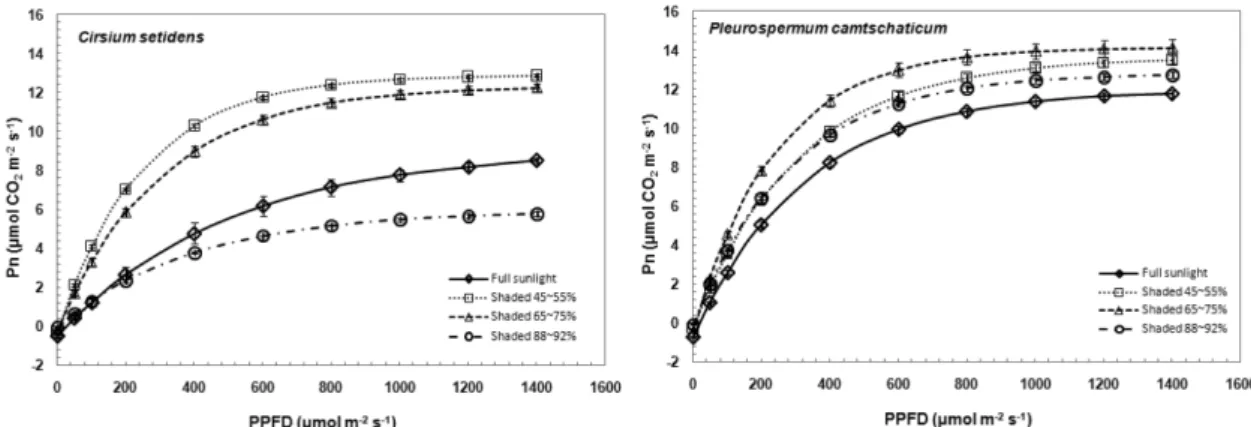
광-광합성곡선(Fig. 3)을 통해 광보상점, 광포화점, 최대광합성 속도, 그리고 순양자수율을 산출하였다
(Table 2). 약광조건에서 생장한 식물은 전광조건에 생
장한 식물보다 광-광합성곡선의 초기기울기 즉 순양자 수율이 높고, 광포화점이 낮으며, 높은 광도영역에서의 광합성속도가 낮다. 특히 순양자수율은 약광조건에서 광합성 능력을 나타내며, 광화학계의 활성을 반영하는 값(Evans, 1987)으로 순양자수율이 높은 것은 엽내 질소를 엽록소 생성에 적극 투자하여 낮은 광도에서 효율적으로 광합성을 하기 위한 것을 의미한다(Kim과
Lee, 2001b). 고려엉겅퀴와 누룩치 역시 전광처리구에
서 광포화점이 가장 높았으며, 암호흡의 감소에 따라 광보상점 역시 감소됨을 알 수 있었다.
고려엉겅퀴는 강피음처리구에서 최대광합성 속도와 순양자수율 모두 가장 낮았으며, 전광처리구<중간피음 Table 1. Change of chlorophyll content in C. setidens and P. camtschaticum grown under four different shading treatments.
Species Treatment Chlorophyll content (mg · g−1) Chlorophyll
a/b
SLA (cm2· g−1)
a b a + b
C. setidens
Full sunlight 0.99 ± 0.05*a** 0.44 ± 0.01a 1.48 ± 0.05a 2.23 ± 0.14b 200.6 ± 14.3a Shaded 45~55% 1.48 ± 0.09b 0.45 ± 0.05a 1.93 ± 0.14b 3.32 ± 0.20d 201.9 ± 9.5a0 Shaded 65~75% 1.51 ± 0.19b 0.50 ± 0.1a0 2.01 ± 0.30b 3.04 ± 0.27c 267.9 ± 15.0b Shaded 88~92% 2.30 ± 0.20c 1.17 ± 0.13b 3.47 ± 0.33c 1.98 ± 0.44a 286.3 ± 12.6b
P. camtschaticum
Full sunlight 0.60 ± 0.06a 0.27 ± 0.08a 0.89 ± 0.13a 2.32 ± 0.47a 224.6 ± 9.4a0 Shaded 45~55% 1.25 ± 0.05b 00.36 ± 0.03ab 1.62 ± 0.05b 3.48 ± 0.37b 224.3 ± 13.7a Shaded 65~75% 1.29 ± 0.03b 0.39 ± 0.07b 1.67 ± 0.09b 3.40 ± 0.60b 224.3 ± 13.7a Shaded 88~92% 2.17 ± 0.10c 0.63 ± 0.14c 2.80 ± 0.23c 3.59 ± 0.73b 268.3 ± 8.1b0
*Values are mean ± S.D.
**Means with different letters are significantly different at P < 0.05, which are testified with one ANOVA test and Duncan’s multiple range test.
Fig. 2. Change of chlorophyll fluorescence in C. setidens and P. camtschaticum grown under four different shading treatments. A different letter indicates significant differ- ence at P≤ 0.05, which are testified with one ANOVA test and Duncan’s multiple range test.
처리구<약피음처리구 순으로 높게 나타났다. 누룩치는 전광처리구에서 가장 낮은 최대광합성 속도와 순양자 수율을 나타냈고, 중간피음처리구에서 가장 높은 최대 광합성속도와 순양자수율을 나타냈으나 고려엉겅퀴에 비해 처리구간의 차이가 크지 않았다.
고려엉겅퀴가 강피음처리구에서 엽록소함량과 광화 학반응효율이 비교적 높게 유지되는데 비해(Table 1,
Fig. 2) 가장 낮은 최대광합성속도와 순양자수율을 보
이는 것은 강피음으로 인한 낮은 광환경에서 계속 생 장하여 광합성 능력을 점차 상실한 것으로 생각되며, 함박꽃나무와 같은 음수도 광량이 지나치게 부족한 환 경에서는 광합성 기능이 저하된다고 보고한 Kim 등 (2010)의 연구와 유사한 결과를 보였다.
누룩치와 고려엉겅퀴에서 전광처리구가 피음처리구
에 비해 비교적 낮은 최대광합성 속도를 보이는 것은 강광으로 인해 과다한 들뜬 에너지가 광계 2의 불활성 화를 초래하여 광합성 활성을 억제하는 광저해현상 (photoinhibitation)으로 생각할 수 있다(Choi 등, 1995;
Kim과 Lee, 2001b, Kwon 등, 2003; Je 등, 2006).
식물의 CO2와 수분의 교환은 90% 이상 기공에서 일어나며, 대기로의 수분확산 속도크기를 의미하는 기 공전도도(stomatal conductance; gH2O)를 측정하여 기 공개폐의 정도를 알 수 있다. 기공전도도는 광도, 수증 기압포차, 이산화탄소 농도, 기온 그리고 상대습도 등 과 같은 여러 가지 환경인자들의 영향을 받으며(Sim과
Han, 2003), 기공전도도의 감소에 따라 기공증산속도
(Stomatal transpiration rate; E)가 감소되고 광합성능 력에 영향을 미치게 된다.
Fig. 3. Light response curves of C. setidens and P. camtschaticum grown under four different shading treatments.
Table 2. Light compensation point (Lcomp), light saturation point (Lsatp), dark respiration (Dresp), maximum photosynthesis rate (Pn max), net apparent quantum yield (Φ) of C. setidens and P. camtschaticum grown under four different shading treat- ments.
Species Treatment
Lcomp
(µmol · m−2· s−1)
Lsatp
(µmol · m−2· s−1)
Dresp
(µmol CO2· m−2· s−1)
Pn max
(µmol CO2· m−2· s−1)
Φ (mmol CO2·
mol−1)
C. setidens
Full sunlight 30.1 ± 3.0*b** 611.9 ± 118.2c 0.51 ± 0.06c 09.7 ± 0.2b 17.0 ± 3.1b Shaded 45~55% 05.5 ± 1.8a 308.4 ± 3.0a 0.24 ± 0.08b 13.2 ± 0.1d 43.7 ± 0.6d Shaded 65~75% 05.0 ± 2.4a 365.2 ± 11.1ab 0.17 ± 0.08b 12.6 ± 0.1c 35.0 ± 1.0c Shaded 88~92% 03.1 ± 2.5a 454.8 ± 36.8b 0.04 ± 0.04a 06.0 ± 0.2a 13.3 ± 0.6a
P. camtschaticum
Full sunlight 20.8 ± 1.2d 405.7 ± 5.4d 0.69 ± 0.06d 12.7 ± 0.2a 33.0 ± 1.0a Shaded 45~55% 06.1 ± 0.1b 376.9 ± 18.9c 0.23 ± 0.01b 13.9 ± 0.2b 37.7 ± 2.1b Shaded 65~75% 07.4 ± 0.5c 302.0 ± 4.2a 0.37 ± 0.03c 14.6 ± 0.4c 49.7 ± 1.5c Shaded 88~92% 00.5 ± 0.4a 343.2 ± 2.6b 0.02 ± 0.01a 12.9 ± 0.2a 37.7 ± 0.6b
*Values are mean ± S.D.
**Means with different letters are significantly different at P < 0.05, which are testified with one ANOVA test and Duncan’s multiple range test.
고려엉겅퀴와 누룩치 모두 최대광합성 속도의 크기와 유사한 경향을 나타냈으며, 전광처리구에서 가장 낮은 기공증산속도와 기공전도도를 보였다. 또한 고려엉겅퀴 의 약피음처리구와 누룩치의 중간피음처리구는 가장 높 은 기공증산속도 및 기공전도도를 나타냈다(Fig. 4).
고려엉겅퀴와 누룩치 모두 최대광합성 속도와 기공 전도도 및 기공증산속도가 비슷한 경향을 나타내어 기 공개폐 반응과 광합성속도 간에 밀접한 관계가 있음을 알 수 있었으며(Andrew and Wiliam, 1998), 전광처 리구에서는 강한 광으로 기공닫힘을 야기하였고, 광합 성에 제한인자로 작용함을 알 수 있었다.
같은 대기의 CO2농도에서 Ci Ca−1농도가 높다는 의미는 엽육세포간극의 CO2 농도가 높다는 의미로 즉 엽육세포간극의 CO2 이용효율이 낮다는 의미이다(Sim 과 Han, 2003). 고려엉겅퀴와 누룩치 모두 초기에 광 합성속도가 증가함에 따라 Ci Ca−1 농도가 급격히 감 소되었다가 이후 비슷한 농도를 계속 유지하였다(Fig.
5). 그러나 고려엉겅퀴는 강피음처리구에서 비교적 높 은 Ci Ca−1농도를 유지하였고, 전광처리구에서 가장 낮은 Ci Ca−1농도를 보였는데, 이는 고려엉겅퀴가 강 피음처리구에서 충분한 광을 공급받지 못한 상태가 지 속되어 광합성 능력이 저하되었고 엽육내 CO2를 효율 적으로 소비하지 못하고 있는 것을 의미한다. 또한 전 광처리구의 경우 엽육내 Ci Ca−1농도는 낮게 유지되 고 있으나 기공전도도와 기공증산속도 역시 가장 낮은 것으로 보아(Fig. 4) 강한 광조건에서 기공닫힘으로 인 해 엽육내 CO2농도가 낮아져 광합성 속도의 감소를 가져온 것으로 생각된다(Hernandez et al., 1995;
Takemura et al., 2000; Sung 등, 2009).
누룩치의 경우 약피음처리구가 초기 낮은 광도조건 에서 다른 처리구들과 비교해 낮은 Ci Ca−1 농도를 나타냈지만 광합성속도가 증가할수록 처리구간의 Ci Ca−1농도에 유의적인 차이를 보이지 않았다(Fig. 5).
수분이용효율은 광합성 동화산물에 대한 수분손실률 Fig. 4. Stomatal transpiration rate (E) and Stomatal conductance (gH2O) of C. setidens and P. camtschaticum grown under
four different shading treatments.
로서 기공전도도 감소에 따라 증산량이 감소되고 일시 적으로 수분이용효율이 증가될 수 있으며, 따라서 낮은 기공전도도는 높은 수분이용효율과 연결된다고 알려져 있다(Lim et al., 2006). Je 등(2006)이 보고한 바에 따르면 내음성이 강한 죽절초의 경우 차광수준에 따라 수분이용효율이 감소한다고 하였으며, 고려엉겅퀴 역시 전광처리구에서 가장 높은 수분이용효율을 보였고, 강 피음처리구에서 가장 낮은 수분이용효율을 나타냈다.
그러나 누룩치의 경우 강피음처리구에서 수분이용효율 이 다소 낮을 뿐 다른처리구에서는 유의적인 차이를 보이지 않았다(Fig. 6).
적 요
피음처리에 의한 고려엉겅퀴와 누룩치의 광합성 및 생장특성을 조사하기 위하여, 차광막을 이용하여 전광 처리구(0%), 약피음처리구(45~55%), 중간피음처리구 (65~75%), 강피음처리구(88~92%) 설치하고 엽록소함 량, 엽록소 형광반응, 광합성 반응 등을 조사하였다.
고려엉겅퀴와 누룩치 모두 피음처리 수준에 따라 엽 록소 함량과 엽록소형광반응, 순양자효율 등이 증가하 여 빛의 흡수와 광합성 반응에 대한 효율을 높이는 내음성 적응 반응을 나타냈으며, 엽면적 SLA 역시 증 가하여 부족한 광환경에서 수광량을 늘리기 위해 엽면 적은 늘어나고, 엽두께는 얇아지는 형태적인 변화가 나 타났다. 특히 전광처리구에서 총 엽록소 함량, 엽록소 형광반응, 순양자효율, 기공전도도 및 기공증산속도가 비교적 낮았으며, 이는 강한 광으로 광저해 현상이 일
어나 광합성 능력이 저하되는 것으로 볼 수 있다.
고려엉겅퀴의 강피음 처리구는 엽록소 함량도 높으 며, 엽면적이 늘어나고 엽두께는 얇아져 광을 수집하기 위한 형태적인 변화도 나타나고 있으나 광선요구도보다 적은 광 환경에서 계속 생장함으로서 엽육내 CO2를 효 율적으로 소비하지 못하고, 수분이용효율 역시 감소되 어 광합성 능력을 점점 상실해 가는 것으로 생각된다.
또한 고려엉겅퀴는 약광처리구(전광의 45~55%)에서 최 대광합성속도와 순양자효율이 가장 높고, 기공개폐 반 응과 광화학반응 효율이 비교적 높았으며, 누룩치는 처 리구간의 차이는 크지 않지만, 중간피음처리구에서 최 대광합성속도, 순양자수율, 기공개폐반응 및 광화학효율 이 가장 높은 것으로 나타났다. 따라서 적절한 피음처 리를 통해 건전한 생육을 유도하기 위해서는 고려엉겅 퀴의 경우 전광을 약 45~55% 차단하고, 누룩치는 약 65~75% 차단시킨 광환경이 효과적이라 생각된다.
주제어 : 광합성속도, 광화학효율, 엽록소함량, 피음처리
사 사
본 연구는 농촌진흥청 특화작목연구개발과제(과제번 호: C1008514-01-01)의 지원에 의해 이루어진 것으로 이에 감사합니다.
인 용 문 헌
1. Andrew, J.J. and J.D. William. 1998. The coupled Fig. 5. Intercellular (Ci)/atmospheric CO2 concentration (Ca) of Cirsium setidens and Pleurospermum camtschaticum grown
under four different shading treatments.
response of stomatal conductance to photosynthesis and transpiration. J. Exp. Bot. 49:399-406.
2. Arnon, D.I. 1949. Copper enzymes in isolated chloro- plasts, polyphenoloxidase in Beta vulgaris. J. Plant Physiol. 24:1-15.
3. Caemmerer, S. and G.D. Farquhar. 1981. Some rela- tionships between the biochemistry of photosynthesis and the gas exchange of leaves. Planta. 153:376-387.
4. Cho, M.S., K.W. Kwon, G.N. Kim, and S.Y. Woo.
2008. Chlorophyll contents and growth performances of the five deciduous hardwood species growing under different shade treatments. Kor. J. Agr. For. Meteorol.
10:149-157 (in Korean).
5. Cho, S.D., D.H. Choi, and K.H. Kim. 2004. A study on quality characteristics of Pleurospermum kamtschati- cum as a functional food resource. J. Kor. Soc. Food Sci. Nut. 33:1212-1217 (in Korean).
6. Choi, Y.B. and J.H. Kim. 1995. Change in needle chlo- rophyll fluorescence of Pinus densiflora and Pinus thunbergii treated with artificial acid rain. J. Kor. For.
Soc. 84:97-102 (in Korean).
7. Chung, M.S. and M.S. Lee. 1998. Analysis of volatile flavor component of Pleurospermum kamtschaticum.
Kor. J. Food Cook. Sci. 14:541-547 (in Korean).
8. Demmig, B. and O. Björkman. 1987. Comparison of the effect of excessive light on chlorophyll fluorescence (77 K) and photon yield of O2 evolution in leaves of higher plants. Planta. 171:171-184.
9. Evans, J.R. 1987. The dependence of quantum yield on wavelength and growth irradiance. Aust. J. Plant Physiol. 14:69-79.
10. Han, S.S., K.C. Lee, and S.R. Jeon. 2010. Studies on the agroforestry methods of wild edible greens(IV) water relations parameters of three Ligularia species leaves obtained from P-V curves. J. Kor. For. Soc.
99:131-135 (in Korean).
11. Hansen, U., B. Fiedler, and B. Rank. 2002. Variation of pigment composition and antioxidative systems along the canopy light gradient in a mixed beech/oak forest: a comparative study on deciduous tree species differing in shade tolerance. Trees. 16:354-364.
12. Hernandez, J.A., E. Olmos, F.J. Corpas, F. Sevilla, and L.A. del Rio. 1995. Salt-induced oxidative stress in chloroplasts of pea plant. Plant Sci. 105:151-167.
13. Hiscox, J.D. and G.F. Israelstam, 1979. A method for the extraction of chlorophyll from leaf tissue without maceration. Can. J. Bot. 57:1332-1334.
14. Hong, D.K. 1997. Studies on the cultivation of Pleuro- spermum kamtschaticum Hoff. to high land area. M.
Sc. thesis. Univ. Kangwon. Chun-Cheon. Korea. p. 51 (in Korean).
15. Je, S.M., S.G. Son, S.Y. Woo, K.O. Byun, and C.S.
Kim. 2006. Photosynthesis and chlorophyll contents of Chloranthus glaber under different shading treatments.
Kor. J. Agr. For. Meteorol. 8:54-60 (in Korean).
16. Jeong, H.H. and K.S. Kim. 1999. Effects of shading on the growth of Hedera rhombea bean and Pachysandra terminalis Sieb. et Zucc. Kor. J. Hort. Sci. Technol.
17:29-32 (in Korean).
17. Jung, M.J., S.I. Heo, and M.H. Wang. 2008. Rat lens aldose reductase inhibitory of Taraxacum mongolicum and two Crisium species. J. Kor. Soc. App. Bio. Chem.
51:302-306 (in Korean).
18. Kim, G.N., M.S. Cho, and S.W. Lee. 2010. Physiolog- ical responses of the three deciduous hardwood seed- lings growing under different shade treatment regimes.
J. Bio-Env. Con. 19:36-48 (in Korean).
19. Kim, K.D., E.H. Lee, W.B. Kim, J.G. Lee, D.L. Yoo, Y.S. Kwon, J.N. Lee, S.W. Jang, and S.C. Hong. 2010.
Year-round production of fresh leaves of narrowhead goldenray ‘Ligularia stenocephala’ by using stored rootstocks in sequential highland-lowland cultivation.
J. Bio-Env. Con. 19:324-332 (in Korean).
20. Kim, S.H., J.H. Saung, Y.K. Kim, and P.G. Kim. 2008.
Photosynthetic responses of four oak species to changes in light environment. Kor. J. Agr. For. Meteorol. 10:
141-148 (in Korean).
21. Kim, P.G. and E.J. Lee. 2001a. Ecophysiology of pho- tosynthesis 1: effects of light intensity and intercellu- lar CO2 pressure on photosynthesis. Kor. J. Agr. For.
Meteorol. 3:126-133 (in Korean).
22. Kim, P.G. and E.J. Lee. 2001b. Ecophysiology of pho- tosynthesis 2: adaptation of the photosynthetic apparatus to changing environment. Kor. J. Agr. For. Meteorol.
3:171-176 (in Korean).
23. Kitao, M., H. Utsugi, S. Kuramoto, R. Tabuchi, K.
Fujimoto, and S. Lihpai. 2003. Light-dependent photo- synthetic characteristics indicated by chlorophyll fluo- rescence in five mangrove species native to Pohnpei Island, Micronesia. Physiologia Plantarum 117:376-382.
24. Kok, B. 1948. A critical consideration of the quantum yield of chlorella photosynthesis. Enzymologia Hague.
13:1-56.
25. Kume, A. and Y. Ino. 1993. Comparison of ecolphysi- ological response to heavy snow in two varieties of Acuba japonica with different areas of distribution.
Ecol. Res. 8:111-121.
26. Kyparissis, A., P. Drilias, and Y. Manetas. 2000. Sea- sonal fluctuations in photoprotective (xanthophylls cycle) and photoselective (chlorophylls) capacity in eight Mediterranean plant species belonging to two differ- ent growth forms. Aust. J. Plant Physiol. 27:265-272.
27. Kwon, K.W., G.N. Kim, and M.S. Cho, 2009. Physiol- ogy responses of the three wild vegetable under differ- ent shading treatment. J. Kor. For. Soc. 98:106-114 (in Korean).
28. Kwon, Y.M., S.C. Ko, J.C. Kim, B.Y. Moon, M.C.
Park, H.B. Park, I.H. Park, Y.S. Lee, I.H. Lee, J.S.
Lee, J.B. Lee, C.H. Lee, B.U. Jeon, S.H. Jo, and J.B.
Hong. 2003. Plant Physiology. Academybook. Seoul.
Korea. p. 429. (in Korean).
29. Lavorel, J. and A.L. Etienne, 1977. In vivo chloro- phyll fluorescence, pp. 203-268. In: J. Barber (ed.).
Primary processes of photosynthesis. Elsevier Scien- tific. New York. USA.
30. Lee, S.H., Y.S. Jin, S.I. Heo, T.H. Shin, J.H. Sa, D.S.
Choi, and M.H. Wang. 2006. Composition analysis and antioxdative activity from different organs of Cir- sium setidens Nakai. Kor. J. Food Sci. Tech. 38:571- 576 (in Korean).
31. Lim, J.H., S.Y. Woo, M.J. Kwon, J.H. Chun, and J.H.
Shin. 2006. Photosynthetic capacity and water use effi- ciency under different temperature regimes on healty and declining korean Fir in Mt. Halla. J. Kor. For. Soc.
95:705-710 (in Korean).
32. Nam, Y.K. and J.A. Baik. 2005. Status of research and possibility of development about endemic wild vegeta- bles in korea. Korean Society for People, Plant, and Environment. 8:1-10 (in Korean).
33. Rascher, U., M. Liebig, and U. Lttge. 2000. Evalua- tion of instant light-response curves of chlorophyll fluorescence parameters obtained with a portable chlo- rophyll fluorometer on site in the field. Plant Cell and Environment. 23:1397-1405.
34. Sharp, R.E., M.A. Matthews, and J.S. Boyer. 1984.
Kok effect and the quantum yield of photosynthesis. J.
Plant Physiol. 75:95-101.
35. Sim, J.S. and S.S. Han. 2003. Ecophysiological char- acteristics of deciduous oak species(III) photosyn- thetic responses of leaves to change of light intensity.
J. Kor. For. Soc. 92:208-214 (in Korean).
36. Suh, J.T., S.Y. Ryu, W.B. Kim, K.S. Choi, and B.H.
Kim. 1996. Improvement of germination rate by low temperature and development of effective shading cul- tivation of Cirsium setidens under rain shelter in high- land. Kor. J. Plant Res. 9:151-156 (in Korean).
37. Sung, J.H., M.J. Sun, S.H. Kim, and Y.K. Kim. 2009.
Effect of calcium chloride (CaCl2) on the characteris- tics of photosynthetic apparatus, stomatal conductance, and fluorescence image of the leaves of Cornus kousa.
Kor. J. Agr. For. Meteorol. 11:143-150 (in Korean).
38. Takemura, T., N. Hangata, K. Sugihara, S. Baba, I.
Karube, and Z. Dubinsky. 2000. Physiological and bio- chemical responses to salt stress in the mangrove, Bru- guiera gymnorrhiza. Aquatic Botany. 68:15-28.
39. Valladares, F., J.M. Chico, I. Aranda, L. Balaguer, P.
Dizengremel, E. Manrique, and E. Dreyer. 2002. The greater seedling high-light tolerance of Quercus robur over Fagus sylvatica is linkes to a greater physiologi- cal plasticity. Trees. 16:395-403.