altering their photosynthetic nature as well as their growth and development periods, making it a problem across the globe due to its association with food production(Qaderi and Reid 2009). These climate changes also influence the occurrence pattern of exotic weeds and many studies have reported that exotic weeds adapt to climate changes faster and become dominant species over the native plants (Brad-ley et al. 2010). Harmful exotic weeds not only deteriorate
the production and quality of crops but also destroy the
https://doi.org/10.11626/KJEB.2020.38.3.450
INTRODUCTION
According to a report by the Intergovernmental Panel on Climate Change, the average temperature of the earth is predicted to rise by 0.3°C every 10 years due to global warming(IPCC 2007), and the United Nations(UN) estimated that the average temperature will rise by 1.4-5.78% over the century(Tkemaladze and Makhashvili 2016). Global warming has a direct impact on plants by
Original article
Characterization and evaluation of response to heat and chilling
stress in exotic weeds using chlorophyll a fluorescence OJIP transient
Soo In Sohn, Yong Ho Lee1, Sun Hee Hong1, Chang Seok Kim2, Myung Hyun Kim,Chae Sun Na3 and Young Ju Oh4,*
National Institute of Agricultural Sciences, RDA, Jeonju 54874, Republic of Korea
1Plant Life & Environmental Science, Hankyong National University, Anseong 17579, Republic of Korea 2National Institute of Crop Science, RDA, Pyeongchang 5481, Republic of Korea
3Seed Conservation Research Division, Baekdudaegan National Arboretum, Bonghwa 36209, Republic of Korea 4Institute for Future Environmental Ecology Co., Ltd., Jeonju 54883, Republic of Korea
Korean J. Environ. Biol.
38(3) : 450-460(2020) ISSN 1226-9999(print) ISSN 2287-7851(online)
Korean Journal of Environmental Biology
* Corresponding author Young Ju Oh Tel. 063-211-7122 E-mail. [email protected] Received: 2 June 2020 Revised: 4 September 2020
Revision accepted: 21 September 2020
Abstract: The occurrence of exotic weeds and their influx into farmlands due to climate change poses many problems. Therefore, it is necessary to generate a prediction model for the occurrence pattern of these exotic weeds based on scientific evidence and devise prevention measures. The photosynthetic apparatus is known as the most temperature-sensitive component of a plant cell and its initial response to temperature stress is to inhibit the activation of photosystem II. This study investigated the potential of OJIP transients in assessing temperature stress in exotic weeds. The four exotic weeds cur-rently flowing into Korean farmlands include Amaranthus spinosus, Conyza bonariensis,
Crassocephalum crepidioides, and Amaranthus viridis. These weeds were treated at 5°C,
10°C, 15°C, 20°C, 25°C, 30°C, 35°C, and 40°C and the OJIP curves and JIP parameters were measured and analyzed. The results showed that heat and chilling stress affected the photosystem II(PSII) electron transport of A. spinosus, whereas C. crepidioides and A.
viridis were more affected by high-temperature stress than by low-temperature stress.
Lastly, C. bonariensis showed resistance to both high and low-temperature stress. The results of this study suggest that OJIP transients and JIP parameters can be used to analyze damage to the photosynthetic apparatus by temperature stress and that they can serve as sensitive indicators for the occurrence pattern of exotic weeds.
plant ecosystem and even pose threat to humans by aller-gic reactions to exotic weed pollen(Cariñanos and Casa-res-Porcel 2011). Therefore, it is necessary to predict the occurrence pattern of exotic weeds according to climate changes and devise prevention and/or control methods.
The photosynthetic apparatus is the most tempera-tusensitive component of a plant cell and the initial re-sponse to temperature stress is the inhibition of the activa-tion of photosystem II(PSII)(Salvucci and Crafts-Brand-ner 2004). Many studies have been conducted and the analysis of chlorophyll fluorescence has been commonly used in studying plant responses to temperature stress con-ditions(Ibaraki and Marakami 2006; Haque et al. 2014).
The fluorescence emission upon light illumination is not continuous, but a rapid increase is followed by a decrease to a steady level(Kautsky and Hirsch 1931). When the flu-orescence value during the rapid rise is plotted on a loga-rithmic scale across time, different phases become evident (Strasser and Govindjee 1992). Based on the incidence of these different phases, Strasser et al.(2000) described and developed concepts for the changes in the rise kinetics and amplitudes of these phases under stress conditions. A formula to calculate a series of parameters based on these concepts was devised, which is now known as the JIP test.
The typical fast chlorophyll fluorescence increase kinet-ics display a series of phases, spanning an increase from the initial(FO) fluorescence value to the maximal(FM)
fluorescence value. The series are step O(20µs, all reaction centers(RCs) open), J(~2ms), I(~30ms), and P(equal to FM when all RCs are closed)(Strasser 1995). Other
steps occur under specific conditions other than these O-J-I-P steps, which are the L-step(reflecting the energetic connectivity of the PSII units), the K-step(reflecting the inactivation of the oxygen-evolving complex; OEC), and the H-step and G-step, which occur in coral or foramini-fers(Tsimilli-Michael et al. 1999; Strasser et al. 2004). For
example, the K-step is a rapid additional step that occurs between 200-300µs when the sample is under heat or drought stress. Nitrogen deficiency has also been shown to induce the K-step, H-step, and G-step(Strasser et al.
2004). In contrast, one or two steps of the O-J-I-P steps disappear under some stress conditions. In PSII-herbicide treated samples, the J-step quickly increased to the P level and the I and P phases disappeared. This resulted from the action of the herbicide to block the delivery of electrons from the primary quinone electron acceptor of PSII(QA-)
to the secondary quinone electron acceptor of PSII(QB-),
causing it to accumulate in the QA of the PSII RCs(Strasser
et al. 2004; Tóth et al. 2005a; Chen et al. 2007). Thus, the
OJIP curve can be analyzed to obtain various quantitative data such as the change in energy flow and reduction in the electron acceptance by PSII under environmental stress (Strasser et al. 2000). However, it is yet unclear whether
OJIP transients can be used as indicators of temperature stress for exotic weeds and how the photosynthetic physio-logical responses change for these exotic weeds under tem-perature stress conditions.
Thus, this study aimed to investigate how different tem-peratures affected the electron transport system of the pho-tosystem using OJIP transients in an attempt to predict the occurrence pattern of exotic weeds Amaranthus spinosus, Conyza bonariensis, Crassocephalum crepidioides, and Ama-ranthus viridis currently flowing into the farmlands due to
climate changes.
MATERIALS AND METHODS
1. Plant materials and temperature treatment Amaranthus spinosus, Conyza bonariensis, Crassocephalum crepidioides, and Amaranthus viridis seeds were sown on
vermiculite and germinated in a 25°C incubator for four weeks. These plants were used for chlorophyll a fluores-cence OJIP transient analysis. The exotic weed seeds were provided by the Korea University Wild Resource Plant Seed Bank.
The effect of temperature change on the OJIP transients of each exotic weed was analyzed. Each exotic weed plant was treated in a dark incubator for 30 minutes at 5°C, 10°C, 15°C, 20°C, 25°C, 30°C, 35°C, and 40°C and chlorophyll fluorescence measurements were performed. Each treat-ment was carried out in three replicates. The control group was treated at 25°C.
2. Chlorophyll a fluorescence measurements Chlorophyll a fluorescence was measured on a leaf using a hand fluorometer(FluorPEN FP 100; Photon System Instrument, Czech Republic). The leaves were exposed to a pulse of saturating light at a wavelength of 650nm and 2700µmol m-2 s-1 intensity for five seconds after becom-ing dark-adapted. The fluorescence transients were record-ed at a 12-bit resolution between 10µs and 5s(Strasser et al. 2000). FluorPen software(PSI, CZ) was used to load the full fluorescence transients and calculate the O-J-I-P parameters from the variable fluorescence values at F50
µs, F100µs, F300µs, F2ms, and F30ms according to the OJIP test formula(Strasser and Govindjee 1992; Strasser and Tsimili-Michael 2001). The expressed specific
flux-es(ABS/RC; TR0/RC; DI0/RC; ET0/RC) per reaction
center and phenomenological flux(ABS/CS; TR0/CS;
DI0/CS; ET0/CS) per cross-section were derived from
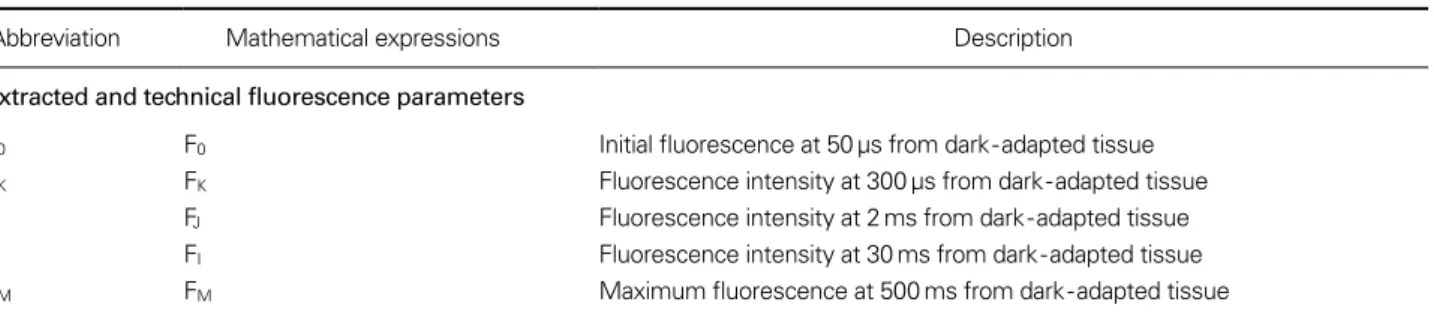
Table 1. Short description of the chlorophyll fluorescence parameters used in the study according to the OJIP test Abbreviation Mathematical expressions Description Extracted and technical fluorescence parameters
F0 F0 Initial fluorescence at 50μs from dark-adapted tissue
FK FK Fluorescence intensity at 300μs from dark-adapted tissue
FJ FJ Fluorescence intensity at 2ms from dark-adapted tissue
FI FI Fluorescence intensity at 30ms from dark-adapted tissue
FM FM Maximum fluorescence at 500ms from dark-adapted tissue
Fluorescence parameters derived from the extracted data
Fv/Fm (FM-F0)/ FM Maximum yield of primary photochemistry
VJ (FJ-F0)/ (FM-F0) Relative variable fluorescence at the J-step
VI (FI-F0)/ (FM-F0) Relative variable fluorescence at the I-step
M0 4·(FK-F0)/ (FM-F0) Slope at the beginning of the transient Fo → Fm, maximal fractional rate of
photochemistry Quantum efficiency or flux ratios
ψ0(ET0 / TR0) 1-VJ Probability of a trapped exciton moving an electron beyond φP0 -
maximum quantum yield of primary photochemistry (QA-)
φE0(ER0 / ABS) (1-F0 / FM)·ψ0 Probability of an absorbed exciton moving an electron beyond QA
-φP0(TR0 / ABS) 1-F0 / FM=FV/FM Maximum yield of primary photochemistry, equal to Fv/Fm
δR0(RE0 / ET0) (1-VI)(1-VJ) Efficiency with which an electron can move from the reduced intersystem
electron acceptors to the photosystem I(PSI) end electron acceptors
φR0(RE0 / ABS) φP0·ψ0·δR0 Quantum yield of electron transport from QA- to the PSI end electron acceptors
ρR0(RE0 / TR0) ψ0·δR0 Efficiency with which a trapped exciton can move an electron into the electron
transport chain from QA- to the PSI end electron acceptors
Density of reaction centers
RC/CS φP0·(VJ / M0)·ABS/CS Density of active reaction centers per cross section
Vitality indexes
PIabs (RC/ABS)·[φP0 / (1-φP0)]·[ψ0 / (1-ψ0)] Performance index(PI) on an absorption basis
Specific fluxes or specific activities per reaction center(RC)
ABS/ RC M0·(1/VJ) · (1/ φP0) Absorption flux per RC
TR0 / RC M0·(1/VJ) Trapped energy flux per RC(at t=0)
ET0 / RC M0·(1/VJ)·ψ0 Electron transport flux per RC(at t=0)
DI0 / RC (ABS/RC)-(TR0 / RC) Dissipated energy flux per RC(at t=0)
RE0 / RC (RE0 / ET0)·(ET0 / RC) Reduction of end acceptors at PSI electron acceptor side per RC(at t=0)
Phenomenological fluxes or phenomenological activities per excited cross section(CS)
ABS/CS FM Absorption flux of photons per cross section
TR0 / CS φP0·(ABS/CS) Trapping of electrons per cross section
ET0 / CS φP0·ψ0·(ABS/CS) Electron flux per cross section
the theory of the biomembrane energy flux and was cal-culated from the O-J-I-P test(Sironval et al. 1981; Strasser
and Tsimili-Michael 2001). Absorbance(ABS) refers to the absorption of the photons by the chlorophyll molecule within the antenna complex. Part of the absorbed energy is trapped(TR0) by the reaction center of PSII(P680) while
the rest is lost in the form of heat or fluorescence(DI0).
Part of the trapped energy is changed to redox energy by electron transport(ET0) through QA and QB(Strasser et al.
2000). The JIP parameters were determined according to the formula shown in Table 1.
3. Statistical analysis
The parameters of the JIP test were log-transformed (different temperature treatment/control(25°C)) for eval-uation of the relative changes. The performance index PIabs
were subjected to an analysis of variance(ANOVA). When the F-test was significant, a comparison of the means was performed with Dunnett’s test. Statistical analyses were performed using SAS 9.4(SAS Institute Inc., Cary, NC, USA).
RESULTS
1. OJIP curve
A. spinosus had a relatively higher FO at 5°C and 40°C
temperature conditions compared to other temperatures and showed low fluorescence density FI and FP at the I
and P stages(Fig. 1a). The results showed that the OJIP curves at temperatures of 15°C, 20°C, 30°C, and 35°C were not significantly different from those at 25°C. For
Conyza bonariensis, the FP values showed a tendency to
slightly decrease with higher temperature treatments, but fluorescence density was not significantly different at each stage under all temperature treatment conditions(Fig. 1b).
C. crepidioides also showed a higher FO at 40°C heat stress
conditions like that of A. spinosus and the FI and FP
fluo-rescence density at the I and P stages showed a relatively rapid decrease compared to other temperature treatments. In contrast, the fluorescence density at the J, I, and P stages was higher at 5°C cold stress conditions compared to that at 25°C(Fig. 1c). The results for A. viridis showed a higher
FO at 40°C compared to the other temperatures, and the FI
Fig. 1. Chlorophyll a fluorescence OJIP transient curves from 4-week leaves of Amaranthus spinosus(A), Conyza bonariensis(B),
Crasso-cephalum crepidioides(C), and Amaranthus viridis(D) under different temperatures. O, K, J, I, and P in the transient curves indicate minimal
fluorescence intensity when all PSII reaction centers are open, the intensity at 300-400μs, the intensity at 2ms, the intensity at 30ms, and the maximal intensity when all PSII RCs are closed, respectively.
(A) (B)
and FP fluorescence density rapidly decreased at the I and
P stages. The fluorescence density for each stage of the 5°C and 10°C cold stress conditions was similar to the fluores-cence density at each stage at 25°C. Treatment at 30°C and 35°C showed lower fluorescence densities at the I and P stages compared to the 25°C treatment(Fig. 1c).
2. Change in chlorophyll fluorescence parameter
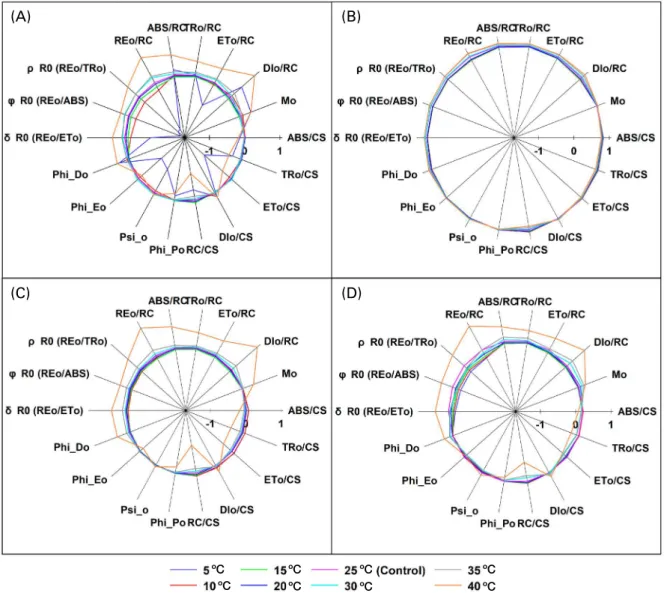
The fluorescence parameters were calculated from the OJIP analysis of exotic weeds(Fig. 2). Most of the param-eters for A. spinosus at treatments of 5°C and 40°C were
different from those at 25°C. Under 5°C temperature conditions, the PSII parameters φEO, ψO, and φPO and all
phenomenological fluxes per CS including ETO/CS, TRO/
CS, and ABS/CS, except for DIO/CS, were found to be
lower compared to those at 25°C. The photosystem I(PSI) parameters including REO/RC, ρRO, φRO, and δRO, and the
specific fluxes ETO/RC were lower than those at 25°C. In
contrast, MO, the specific fluxes, PSI parameters, and ψO
of PSII were higher at 40°C compared to those at 25°C. However, φEO and φPO of the PSII parameters and all
phe-nomenological fluxes per CS including ETo/CS, TRo/CS, and ABS/CS, except for DIO/CS, were lower compared to
those at 25°C. For C. bonariensis, the PSI parameter values ºC ºC ºC ºC ºC ºC ºC ºC
Fig. 2. Spider plots of JIP parameters deduced from chlorophyll a fluorescence OJIP transient curves of 4-week leaves of exotic weeds under different temperatures. Extracted and technical fluorescence parameters from Amaranthus spinosus(A), Conyza bonariensis(B),
Crassocephalum crepidioides(C), and Amaranthus viridis(D). For each parameter, the value at 25°C was set as 1.0 and log-transformed.
(A) (B)
of REO/RC, ρRO, φRO, and δRO were relatively lower at 5°C,
10°C, 15°C and 20°C compared to those at 25°C, whereas these values were 1.3-, 1.1-, 1.1- and 1.1-fold higher, respec-tively, at 40°C compared to 25°C. C. crepidioides showed
no significant difference in the parameters between treat-ments at 5°C and 25°C, whereas MO, the specific fluxes,
and PSI parameters were higher at 40°C treatment com-pared to those at 25°C. However, the PSII parameters φEO
and φPO, as well as phenomenological fluxes were lower
compared to those at 25°C. For A. viridis, the PSI
parame-ters at 5°C, 10°C, 15°C, and 20°C were lower compared to those at 25°C. MO, the specific fluxes, and PSI parameters
were higher at 40°C compared to those at 25°C, yet φEO
and φPO of the PSII parameters and all phenomenological
fluxes including ETO/CS, TRO/CS, and ABS/CS, except
for DIO/CS, were higher.
3. Comparative analysis of plant vitality The PIabs, indicating the vitality of the plant, was
low-er in A. spinosus at 5°C and 40°C temperature treatments
compared to the other temperatures(Fig. 3). The PIabs for
C. bonariensi decreased as the temperature increased. In C. crepidioides, the PIabs was significantly lower at 40°C
treat-ment conditions compared to 25°C. The PIabs for A. viridis
decreased as the temperature increased, similar to C. bonar-iensis.
DISCUSSION
1. OJIP curve
A. spinosus at 5°C and 10°C temperature conditions
showed a greatly increased fluorescence intensity at 2ms compared to that at 25°C. This was likely the result of the accumulation of a reduced QA- pool, which led to a
decrease in the delivery of electrons across QA-(Strasses
et al. 1995; Lazár and Ilík 1997; Haldimann and Strasser
1999). The same observation was made in two genotypes of soybean, PAN809 and Sonop, where the dark chilled samples had greatly increased fluorescence intensity com-Fig. 3. Performance index(PIAbs) in the exotic weeds exposed to 5°C, 10°C, 15°C, 20°C, 25°C, 30°C, 35°C, and 40°C for 30 min.
Amaran-thus spinosus(A), Conyza bonariensis(B), Crassocephalum crepidioides(C), and Amaranthus viridis(D). Asterisks indicate significant
differ-ences from the controls(25°C) at p<0.05 by Dunnett’s multiple comparison test.
ºC (A) (B)
pared to the non-treated controls at 2ms(J-peak)(Strauss
et al. 2006). In this study, A. spinosus treated at 40°C heat
stress conditions had a higher FO value compared to that
at other temperatures, and the K peak was found at 300 µs in the OJIP curve. Also, fluorescence densities FJ, FI,
and FP decreased at the J, I, and P stages. FO refers to the
fluorescence emission when all primary quinone-type ac-ceptors(QA) of the reaction center are in the oxidized state
(Rodríguez et al. 2015). A significant increase in FO under
high-temperature conditions was the result of a partial dis-sociation of the outer antenna from the rest of the PSII or a shift in the equilibrium between the electron acceptors QA and QB and thus, an increase in the reverse transfer of
electrons from QB to QA. In this state, QA was partially
re-duced in the dark state and the O-step no longer indicated the FO(Srivastava et al. 1997). At the high-temperature
(40°C) treatment of A. sponisus, FK was increased and the
I-step disappeared, which seemed to be the result of an in-hibition of electron transfer within PSII to the secondary electron donor due to the inactivation of the oxygen-evolv-ing complex(OEC)(Guisse et al. 1995; Strasser 1997;
Chen et al. 2016). The K-peak is known to arise from the
accumulation of QA- from the stable charge separation and
the absence of an electron donor is known to result in the accumulation of P680+(Toth et al. 2007). Commonly, the presence of the K-peak is known as an important change in the OJIP rise kinetics under heat treatment but is also used as a heat indicator in predicting the plant response to high temperature(Srivastava and Strasse 1995; Lu and Chang 1999; Oukarroum et al. 2013). In wheat(Triticum aestivum
L.), FK was absent in leaves grown at 25°C but leaves
ex-posed to a high temperature of 45°C showed decreases in the FJ, FI, and FP values with a distinct presence of FK. It
was also reported that FK steadily increased as the
tempera-ture increased above 37.5°C(Lu and Zhang 2000; Mathur
et al. 2011). Based on these previous results, it seems A. spinosus was affected by both chilling and heat stress. C. bonariensis showed no significant difference in
fluores-cence intensity under both chilling stress(5-10°C) or heat stress(35-40°C) conditions compared to 25°C, indicating it was more resistant to temperature stress conditions than the other exotic weeds. C. crepidioides seems to be more
affected by heat stress compared to cold stress where the presence of the K-step, the missing I-step, and decreases in fluorescence intensity in the J and P steps indicated the in-hibition of electron transfer as a result of damage to the do-nor side of PS II. Like C. crepidioides, A. viridis was found to
have a K-step, a missing I-step, and the fluorescence
inten-sity decreased at the J and P steps, which indicated it was also more affected by heat stress than chilling stress.
FM represents the maximal fluorescence intensity, and
a decrease in FM and an increase in FO indicate the
inhibi-tion of the delivery of electrons from OEC to the PQ pool (Havaux 1993; Yamane et al. 2000). When the FM values at
different temperature treatments were comparatively ana-lyzed across the exotic weeds, the results showed that they were more sensitive to heat stress compared to chilling stress and the photochemical efficiency of PS II was found to be lowest at the 40°C treatments of A. spinosus and C. crepidioides.
2. Change in chlorophyll fluorescence parameter
MO represents the initial fluorescence slope(Oh et al.
2014). Increases in MO indicate a greater reduction of QA
to QA- and a net rate increase in RC closure(Zushi et al.
2012). A. spinosus showed a 2-fold higher MO value at 5°C
and 40°C compared to 25°C. C. bonariensis showed no
sig-nificant differences at 5°C and 40°C compared to 25°C. C. crepidioides was 2.2-fold higher at 40°C, and 1.1-, 1.3-, 1.4-,
and 1.6-fold higher at 5°C, 30°C, 35°C, and 40°C, respec-tively, compared to 25°C. Previous reports on heat stress treatments of pea(Pisum sativum L.) leaves, apple(Malus domestica Borkh.) and tomato(Solanum lycopersicon cv.
Muni Carol) leaves, and fruit peel at temperatures higher than 40°C also showed an increase in MO(Strasser et al.
2000; Chen and Cheng 2009; Zushi et al. 2012).
The JIP parameters and energy pipeline model of to-mato leaves and fruit juice suggest several sensitive sites of PSII that respond to heat stress(Zushi et al. 2012). For
example, decreases in ABS/CSM of the phenomenological
flux per CSM indicate an increased density of the inactive
reaction centers. Also, decreases in TR/CSM and ETO/
CSM indicate the transition of active RCs to inactive RCs,
which represents a decrease in trapping efficiency and PSII activity. In other words, decreases in ABS/CS, TRO/CS,
ETO/CS due to chilling and heat stress are indications that
the light energy absorbed per leaf area, energy captured in PSII, and the energy transferred by electron transfer are all decreased. On the contrary, increases in DIO/CS as
tem-perature increases indicate an increase in energy not being used for electron transfer. In the case of A. spinosus, ABS/
CS, TRO/CS, and ETO/CS at 5°C temperature conditions
decreased 73%, 55%, and 10%, respectively, compared to the results at 25°C. At 40°C temperature conditions, the
values decreased 66%, 44%, and 50%, respectively, com-pared to those at 25°C. In contrast, DIO/CS was found to
increase by 133% and 143% at 5°C and 40°C temperature conditions, respectively, compared to that at 25°C. For
C. bonariensis, the results showed relatively small changes
in these parameters under both heat and chilling stress.
C. crepidioides showed a decrease in the ABS/CS, TRO/
CS, and ETO/CS values and an increase in DIO/CS under
40°C heat stress, suggesting that it was more sensitive to heat stress compared to chilling stress. A. viridis showed a
result similar to that of C. crepidioides.
ΦPo, ψo, and φEo, which represent the quantum efficiency
of PSII, decreased under heat stress conditions in Chinese cabbage, which indirectly indicated an increase in inactive reaction centers and that most of the captured energy was not being used to transfer electrons when the plant was under high-temperature stress(Oh et al. 2014). The Fv/
Fm value of dark-adapted leaves, ΦPo, represents the
max-imum potential photosynthetic value of the leaf, and the healthy leaves of most plants commonly have a value of around 0.83(Bjorkman and Demmig 1987; Johnson et al.
1993). The value will be lower when the plant has been exposed to stress. A. spinosus had a ΦPo value of 0.58 at 5°C,
0.78 at 25°C, and 0.51 at 40°C treatment conditions. This suggests that A. spinosus was affected by both chilling and
heat stress. C. bonariensis had a value of 0.84 at 5°C, 0.82
at 25°C, and 0.80 at 40°C treatment conditions. C. crepid-ioides had a value of 0.82 at 5°C, 0.81 at 25°C, and 0.56 at
40°C treatment conditions. Lastly, A. viridis had a value of
0.77 at 5°C, 0.78 at 25°C, and 0.61 at 40°C treatment con-ditions. Thus, these results suggest that C. bonariensis was
resistant to both chilling and heat stress, C. crepidioides was
resistant to chilling stress but sensitive to heat stress, and A. viridis was affected by both chilling and heat stress.
Specific fluxes per RC were found to increase with tem-perature across all exotic weeds. An increase in the average ABS/RC, TRo/RC, and DIo/RC per active RC was seen due to the inactivation of several RCs, which also suggests an increase in the total dissipation ratio to the active RCs as a result of the high dissipation of inactive RCs(Zushi et al. 2012).
The PSI and PSII responses to chilling stress and heat stress were different according to each exotic weed. It is widely accepted that PSII is the most thermally labile com-ponent of the photosynthetic apparatus, whereas PSI is relatively resistant to heat stress(Havaux et al. 1991;
Apos-tolova and Dibrikova 2011). In accordance with this, most PSII parameters were lower under 40°C temperature
treat-ment compared to those at 25°C, while most PSI param-eters were relatively higher compared to 25°C for all the exotic weeds used in this study. PSI is known to be more sensitive to chilling stress compared to PSII(Zushi et al.
2012). The results of this study showed that for C. bonar-iensis and A. viridis, but not for A. spinosus and C. crepidi-oides, the PSII parameters under chilling stress treatment
conditions were not different than those at 25°C, while the PSI parameters under chilling stress treatment conditions were lower compared to those at 25°C.
3. Performance index
Of the fluorescence parameters, the PIabs indicates the
vitality of the plant. A. spinosus had significantly lower
PIabs values at 5°C and 40°C temperature treatments
com-pared to those at other temperatures. At a 5°C treatment temperature, the PIabs decreased by 3% compared to that
at 25°C, whereas at 40°C, the PIabs decreased by 12%
com-pared to the 25°C treatment. This suggests that A. spinosus
was sensitive to damage by chilling stress and heat stress. The results for C. bonariensis showed no significant
differ-ence between the 5°C and 25°C treatments, but at 40°C treatment conditions, the PIabs decreased by 81%
com-pared to that at 25°C. This suggests that C. bonariensis was
more sensitive to heat stress compared to chilling stress, but was the least sensitive to heat stress of all the exotic weeds studied. C. crepidioides showed significant
differenc-es between the 5°C and 25°C treatments, whereas, at 40°C treatment conditions, the PIabs decreased by 11%
com-pared to that at 25°C, suggesting that it was more sensitive to damage by heat stress. The results for A. viridis showed
that at a treatment temperature of 5°C, the PIabs decreased
by 78%. At a 40°C treatment temperature, the PIabs
de-creased by 26%, which suggests that A. viridis was more
sensitive to heat stress than to chilling stress.
This study used chlorophyll a fluorescence OJIP tran-sients to investigate the effect of temperature stress on the photosynthetic apparatus of exotic weeds to predict the occurrence pattern of exotic weeds that are currently flow-ing into Korean farmlands based on climate changes. It also aimed to assess the potential of OJIP transients and the calculated JIP parameters for use as sensitive methods to detect damage to the photosynthetic apparatus caused by temperature stress. Differing results were found regarding how temperature stress conditions affected the photosyn-thetic apparatus in exotic weeds. The results of this study indicate that from the range of temperatures studied,
chill-ing stress conditions(5°C and 10°C) and heat stress condi-tions(40°C) had the greatest impact on the photosynthetic apparatus of the exotic weeds. All of the exotic weeds used in the study had lower PSII parameters at 40°C tempera-ture treatment compared to those at 25°C, whereas PSI parameters were all relatively higher compared to those at 25°C. The results suggested that PSI was more sensitive to chilling stress than PSII.
OJIP transients were found to be an efficient and non-destructive tool to easily and quickly assess the occurrence pattern of exotic weeds by providing a description of the changes in the photosynthetic apparatus of exotic weeds upon temperature stress. This study was the first study to assess the potential of OJIP transients for use as a system to predict the occurrence pattern of exotic weeds that re-sult from climate changes. This study looked at four exotic weed species and further studies conducted on other weed species using the same methods may be effective in pre-dicting the occurrence pattern of exotic weeds due to cli-mate change and devising prevention methods.
ACKNOWLEDGEMENTS
This study was carried out with the support of the Re-search Program for Agricultural Science & Technology Development(Project No. PJ01385503), and the National Academy of Agricultural Science, Rural Development Ad-ministration, Republic of Korea.
REFERENCES
Apostolova EL and AG Dobrikova. 2011. Effect of high tempera-ture and UV-A radiation on the photosystem II. pp. 577-591. In: Handbook of Plant and Crop Stress(Pessarakli M, ed.). CRC press. Boca Raton, London, New York.
Björkman O and B Demmig. 1987. Photon yield of O2 evolution
and chlorophyll fluorescence at 77 K among vascular plants of diverse origins. Planta 170:489-504.
Bradley BA, DS Wilcove and M Oppenheimer. 2010. Climate change increases risk of plant invasion in the Eastern United States. Biol. Invasions 12:1855-1872.
Cariñanos P and M Casares-Porcel. 2011. Urban green zones and related pollen allergy: A review. Some guidelines for de-signing spaces with low allergy impact. Landsc. Urban Plan. 101:205-214.
Chen LS and L Cheng. 2009. Photosystem 2 is more tolerant to
high temperature in apple(Malus domestica Borkh.) leaves than in fruit peel. Photosynthetica 47:112-120.
Chen S, X Xu, X Dai, C Yang and S Qiang. 2007. Identification of tenuazonic acid as a novel type of natural photosystem II inhibitor binding in QB-site of Chlamydomonas reinhardtii. Biochim. Biophys. Acta 1767:306-318.
Chen S, J Yang, M Zhang, RJ Strasser and S Qiang. 2016. Clas-sification and characteristics of heat tolerance in Ageratina
adenophora populations using fast chlorophyll a fluorescence
rise O-J-I-P. Environ. Exp. Bot. 122:126-140.
Guisse B, A Srivastava and RJ Strasser. 1995. The polyphasic rise of the chlorophyll a fluorescence(O-K-J-I-P) in heat stressed leaves. Arch. Sci. 48:147-160.
Haque MS, KH Kjaer, E Rosenqvist, DK Sharma and CO Ottosen. 2014. Heat stress and recovery of photosystem II efficiency in wheat(Triticum aestivum L.) cultivars acclimated to differ-ent growth temperatures. Environ. Exp. Bot. 99:1-8. Havaux M, H Greppin and RJ Strasser. 1991. Functioning of
pho-tosystems I and II in pea leaves exposed to heat stress in the presence or absence of light. Planta 186:88-98.
Haldimann P and RJ Strasser. 1999. Effects of anaerobiosis as probed by the polyphasic chlorophyll a fluorescence rise ki-netic in pea(Pisum sativum L.). Photosynth. Res. 62:67-83. Ibaraki Y and J Murakami. 2007. Distribution of chlorophyll
flu-orescence parameter Fv/Fm within individual plants under various stress conditions. pp. 255-260. In: XXVII Internation-al HorticulturInternation-al Congress-IHC2006: InternationInternation-al Symposium on Advances in Environmental Control, Automation 761. Seoul, Korea.
Intergovernmental Panel on Climate Change(IPCC). 2007. Climate Change 2007: Mitigation of Climate Change, Con-tribution of Working Group III ConCon-tribution to the Fourth As-sessment Report of the Intergovernmental Panel on Climate Change. Cambridge University Press. Cambridge, New York, USA.
Johnson GN, AJ Young, JD Scholes and P Horton. 1993. The dis-sipation of excess excitation energy in British plant species. Plant Cell Environ. 16:673-679.
Kautsky H and A Hirsch. 1931. Neue versuche zur kohlensäure-assimilation. Naturwissenschaften 19:964.
Kriedemann PE, RD Graham and JT Wiskich. 1985. Photosyn-thetic dysfunction and in vivo changes in chlorophyll a fluo-rescence from manganese-deficient wheat leaves. Aust. J. Agric. Res. 36:157-169.
Lazár D and P Ilík. 1997. High-temperature induced chlorophyll fluorescence changes in barley leaves: comparison of the critical temperatures determined from fluorescence induc-tion and from fluorescence temperature curve. Plant Sci. 124:159-164.
Lu C and J Zhang. 1999. Effects of water stress on photosystem II photochemistry and its thermostability in wheat plants. J. Exp. Bot. 50:1199-1206.
Lu CM and JH Zhang. 2000. Heat-induced multiple effects on PS II in wheat plants. J. Plant Physiol. 156:259-265.
Mathur S, A Jajoo, P Mehta and S Bharti. 2011. Analysis of elevat-ed temperature-inducelevat-ed inhibition of photosystem II using chlorophyll a fluorescence induction kinetics in wheat leaves (Triticum aestivum). Plant Biol. 13:1-6.
Oh S and SC Koh. 2013. Chlorophyll a fluorescence response to mercury stress in the freshwater microalga Chlorella
vulgar-is. J. Environ. Sci. Int. 22:705-715.
Oh S, KH Moon, IC Son, EY Song, YE Moon and SC Koh. 2014. Growth, photosynthesis and chlorophyll fluorescence of Chinese cabbage in response to high temperature. Korean J. Hortic. Sci. 32:318-329.
Qaderi MM and DM Reid. 2009. Crop responses to elevated car-bon dioxide and temperature(chp1). In: Climate Change and Crops, Environmental Science and Engineering(Singh SN, ed.). Springer-Verlag Berlin Heidelberg.
Rhee KH, EP Morris, J Barber and W Kühlbrandt. 1998. Three-di-mensional structure of the plant photosystem II reaction centre at 8 Å resolution. Nature 396:283-286.
Rodríguez VM, P Soengas, V Alonso-Villaverde, T Sotelo, ME Cartea and P Velasco. 2015. Effect of temperature stress on the early vegetative development of Brassica oleracea L. BMC Plant Biol. 15:145.
Salvucci ME and SJ Crafts-Brandner. 2004. Mechanism for de-activation of Rubisco under moderate heat stress. Physiol. Plant. 122:513-519.
Sironval C, RJ Strasser and M Brouers. 1981. Equivalence entre la theorie des flux et la theorie des relations entre propor-tions de pigments pour la description de la repartition de l’energie lumineuse absorbée par les membranes photoac-tives. Bulletin de l’Académia royale de Belgique 67:248-259. Srivastava A, B Guissé, H Greppin and RJ Strasser. 1997.
Regula-tion of antenna structure and transport in photosystem II of
Pisum sativum under elevated temperature probed by fast
polyphasic chlorophyll a fluorescence transient: OKJIP. Bio-chim. Biophys. Acta-Bioenerg. 1320:95-106.
Strasser BJ. 1995. Measuring fast fluorescence transients to address environmental questions: The JIP test. pp. 977-980. In: Photosynthesis: From Light to Biosphere(Mathis P, ed.). Kluwer Academic. Dordrecht, Netherlands.
Strasser BJ. 1997. Donor side capacity of photosystem II probed by chlorophyll a fluorescence transients. Photosynth. Res. 52:147-155.
Strasser R and Govindjee. 1992. On the O-J-I-P fluorescence transients in leaves and D1 mutants of Chlamydomonas
rein-hardtii. pp. 29-32. In: Research in Photosynthesis(Murata N,
ed.). Kluwer Academic Publishers. Dordrecht, Netherlands. Strasser RJ, A Srivastava and Govindjee. 1995. Polyphasic
chlo-rophyll a fluorescence transient in plants and cyanobacteria. Photochem. Photobiol. 61:32-42.
Strasser RJ, A Srivastava and M Tsimilli -Michael. 2000. The fluorescence transient as a tool to characterize and screen photosynthetic samples. pp. 443-480. In: Probing Photosyn-thesis: Mechanisms, Regulation and Adaptation(Yunus M, U Pathre and P Mohanty, eds.). Taylor & Francis. London, UK. Strasser RJ and M Tsimilli-Michael. 2001. Structure function
re-lationship in the photosynthetic apparatus: a biophysical ap-proach(chapter 16). pp. 271-303. In: Biophysical Processes in Living Systems(Saradhi PP, ed.). Science Publishers, Inc. Enfield(NH). New Hampshire, USA.
Strasser RJ, M Tsimilli-michael and A Srivastava. 2004. Analysis of the chlorophyll fluorescence transient. pp. 321-362. In: Chlorophyll a Fluorescence: a Signature of Photosynthesis. Advances in Photosynthesis and Respiration(Papageorgiou GC and Govindjee, eds.). Springer. Dordrecht, Netherlands. Strauss AJ, GHJ Kruger, RJ Strasser and PDR van Heerden.
2006. Ranking of dark chilling tolerance in soybean geno-types probed by the chlorophyll a fluorescence transient O-J-I-P. Environ. Exp. Bot. 56:147-157.
Takahashi S and N Murata. 2008. How do environmental stress-es accelerate photoinhibition? Trends Plant Sci. 13:178-182. Tkemaladze GS and KA Makhhashvili. 2016. Climate changes
and photosynthesis. Ann. Agrar. Sci. 14:119-126.
Tóth SZ, G Schansker, G Garab and RJ Strasser. 2007. Photo-synthetic electron transport activity in heat-treated barley leaves: the role of internal alternative electron donors to pho-tosystem II. Biochim. Biophys. Acta-Bioenerg. 1767:295-305.
Tóth SZ, G Schansker and RJ Strasser. 2005a. In intact leaves, the maximum fluorescence level(FM) is independent of the redox state of the plastoquinone pool: a DCMU-inhibition study. Biochim. Biophys. Acta-Bioenerg. 1708:275-282. Tsimilli-Michael M, M Pêcheux and RJ Strasser. 1999. Light
and heat stress adaptation of the symbionts of temperate and coral reef foraminifers probed in hospite by the chloro-phyll a fluorescence kinetics. Zeitschrift für Naturforschung 54C:671-680.
Yan K, P Chen, H Shao, S Zhao, L Zhang, L Zhang, G Xu and J Sun. 2012. Responses of photosynthesis and photosystem II to higher temperature and salt stress in Sorghum. J. Agron. Crop Sci. 198:218-225.
Yoshioka M, S Uchida, H Mori, K Komayama, S Ohira, N Morita, T Nakanishi and Y Yamamoto. 2006. Quality control of photo-system II: Cleavage of reaction center D1 protein in spinach
thylakoids by FtsH protease under moderate heat stress. J. Biol. Chem. 281:21660-21669.
Zouni A, HT Witt, J Kern, P Fromme, N Krauss, W Saenger and P Orth. 2001. Crystal structure of photosystem II from
Syn-echococcus elongatus at 3.8 Å resolution. Nature
409:739-743.
Zushi K, S Kajiwara and N Matsuzoe. 2012. Chlorophyll a fluores-cence OJIP transient as a tool to characterize and evaluate response to heat and chilling stress in tomato leaf and fruit. Sci. Hortic. 148:39-46.