시비처리에 따른 산마늘, 곰취, 곤달비의 생리적 반응
조민석1·김길남2*·박관수2·이수원1
1국립산림과학원산림생산기술연구소
,
2충남대학교산림환경자원학과Physiological Responses of Allium victorialis var. platyphyllum , Ligularia fischeri and Ligularia stenocephala Growing
at Different Fertilizing Schemes
Min Seok Cho
1, Gil Nam Kim
2*, Gwan Soo Park
2, and Soo Won Lee
11Forest Practice Research Center, Korea Forest Research Institute, Pocheon 487-821, Korea
2Department of Environment and Forest Resources, Chungnam National University, Daejeon 305-764, Korea
Abstract.
The present study was conducted to investigate photosynthetic responses (Pn), chlorophyll flu- orescence (Pe), chlorophyll contents of
Allium victorialisvar.
platyphyllum,
Ligularia fischeri, and
Ligu- laria stenocephalagrowing at four different fertilizing schemes (non-fertilizing and 2.5 g ·
ℓ−1, 5 g ·
ℓ−1, 10 g ·
ℓ−1fertilizing). Three wild vegetables showed outstanding Pn and Pe at 5 g ·
ℓ−1fertilizing treatment.
10 g ·
ℓ−1of fertilizer, however, proved to be too much eventually leading to declined growth.
A. victorialisvar.
platyphyllumshowed good Pn and Pe under shade treatment whereas Pn and Pe of
L. fischeri, and
L.stenocephala
showed the opposite tendency. The chlorophyll contents of the three wild vegetables showed the highest measurement ranging between 11.70~24.36 mg · g
−1when treated with 5 g ·
ℓ−1of fertilizer. Also it was showed that there were more chlorophyll contents under shade treatment as opposed to full sun. These results showed that 5 g ·
ℓ−1fertilizing treatment is optimal fertilizing of three wild vegetables and fertiliz- ing and light intensity controlling is very important for productivity of vegetables.
Key words :
chlorophyll contents, chlorophyll fluorescence, fertilizing, light intensity, photosynthetic responses
서 론
산림에서목재수확뿐만아니라산림부산물수확을 함께 고려한산림의 효율적관리에 대한 전략계획이 수립되어야한다
.
지역에따라서는산림부산물생산이 목재생산보다수익성이높아산촌주민들의소득에기 여하는바도매우높다.
최근국민들의생활수준향상 과건강에대한지대한관심으로건강식품에 대한수 요가증가하고있는데,
산림부산물중에하나인식용식 물은독특한맛과향을즐기는건강기호식품으로각 광받고있는추세이다.
식용식물들은대부분오랜옛날부터 국민들에게부식이나구황작물로서긴요하게이
용되어왔으며특유의맛과향
,
약효,
식생활습관,
계 절감 등 다양한 이유로지금까지도 꾸준히이용되고 있다(Cho, 2000).
임분하층의생산성은산림내광
,
수분,
온도등의무기환경과이곳에분포하는식생의상호작용뿐만 아니라시비처리
,
수확방법등의재배기술에따라많은 변화를가져온다.
이 때문에산림 내생산 가능한식 용식물들의번식,
재배등의생산기술개발이요구되며,
이를위한임분의입지조건과식물의증식및재배에 관련되는생리·생태학적연구가지속적으로필요하다
.
산채는환경적응력이비교적낮아식물별적정생육 환경조건이아니면생육이불량하거나전혀되지않 는특성을 갖고있어 광
,
온도,
수분 등의무기 환경 과함께토양특성,
시비처리등에따라생육이달라진 다(Hong
등, 1997).
*Corresponding author: [email protected]
*Received May 17, 2010; Revised June 10, 2010;
*Accepted June 21, 2010
산채류자생지의환경과생태적특성
(Lee
등, 1993;
Oh
등, 1994; Lim, 1993; Lim
과Sang, 1990; Cho, 1984; Kim
과Um, 1997)
및산채의 성분분석(Kim
과Yang, 1986; Jeong
등, 2005; Ham
등, 1997; Choi
와
Cho, 1994; Lim
등, 1996; Choi
등, 1993;
Jeong
등, 1998)
에관한연구는현재까지국내에서활발하게진행되었으며
,
많은연구결과가발표되었다.
그 러나 임분의입지조건과 재배환경에 관련되는생리·생태학적연구는입지별광합성율
,
엽록소함량및생장특성
(Kim, 2003)
과 차광처리에 의한 광합성및 물질생산
(Won
과Lee, 2002)
등을 보고하는수준에머 물러있다.
현재우리나라에서는식용식물의 임간재배시적절 한시비량을구명한연구는많이부족한실정이다
.
따 라서 본 연구에서는 최근 그 수요가 증가하고 있는 산마늘,
곰취,
곤달비를대상으로전광및피음조건에 서시비처리에따른광합성특성,
엽록소형광반응,
엽록소함량변화등을조사·분석하여광도조건에따른 공시식물의적정시비기술을구명하고자연구를실시 하였으며
,
본연구결과는고품질의산채류를지속적으 로 생산할수 있는 임간 재배기술개발에필요한 정 보를제공해줄것으로기대된다.
재료 및 방법
1. 공시식물
본연구를실시하기위해사용된식물은충남금산 군에서 재배중인 울릉도산 산마늘
(
Allium victorialisvar.
platyphyllum)
과 강원도산곰취(
Ligularia fischeri),
곤달비
(
Ligularia stenocephala)
식물을분양받아이용 하였다.
2. 시험구 설치 및 시비처리 방법
시험지는대전광역시유성구궁동에위치한충남대 학교농업생명과학대학묘포장으로
2008
년4
월에마사토와펄라이트
(1 : 1)
를고르게섞이도록조제한토양을이용하여
2
ℓ의포트중심에1
개체씩이식하여식물별,
처리별
12
개체씩3
반복으로총36
개체씩식재하였다.
시험구는전광처리구
(full sun)
와검정색차광망을이용한 피음 처리구
(35~42% of full sun)
로 하는 두개의시험구로나누어설치하였다
.
각시험구별로지효성 비료인
Osmocote(N : P : K = 14 : 14 : 14, USA, Scotts)
를이용하여시비량을무시비, 2.5g
·ℓ−1, 5g
·ℓ−1, 10g
·ℓ−1으로달리하여시비하였다.
3. 광합성 특성
시비처리에따른광합성차이를조사하기위하여식 물별처리별생장속도가비슷하고
,
평균적인생육상태를유지하고있는개체의건전엽을대상으로
2008
년5~8
월까지 월별로 휴대용 광합성 측정장치
(Portable
photosynthesis system, Li-6400, LI-COR Inc., USA)
를이용하여측정하였다
.
광도를임의로조절할수있 는LED light source(LI-6400-02, LI-COR Inc., USA)
를 이용하여PPFD(Photosynthetic Photon Flux Density)
를0, 25, 50, 100, 200, 500, 800, 1000, 1500, 2000
µmol
·m
−2·s
−1의10
수준으로차이를두어 오전10
시부터오후2
시까지광합성반응을측정하였 다.
광합성측정기의leaf chamber
에유입되는공기의유량은
400
µmol
·s
−1,
온도는25
oC
로설정하여외기의 환경변화로인한영향이없도록하였다.
또한광합성측 정기에CO
2injector system(LI-6400-01, LI-COR Inc., USA)
을 부착하여CO
2 농도를400 ± 2
µmol
·mol
−1범위내에서안정된상태를유지하도록 하였다(Kim
등, 2001; Lim
등, 2006; Choi, 2001).
광도별 광합성 속도를 측정하여 광-
광합성곡선을 작성(Sigmaplot, 2000)
하고,
이 곡선에서 순양자수율(apparent quantum yield),
광보상점,
광포화점 및 이 때의 광합성능력(photosynthetic capacity)
등을 산출 하였다(Kim
과Lee, 2001; Barker
등, 1997).
4. 엽록소 형광반응 특성
식물별시비변화에 따른엽록소형광반응을 조사하 기위하여
5~8
월까지월별로엽록소형광반응측정기(Continuous source chlorophyll fluorometer, OSI
30P, ADC, UK)
를이용하여측정하였다.
형광반응측정은 광합성 측정과 동일한 잎을 대상으로
sample
clip
으로광을차단하여측정전약20
분간측정대상잎을암조건에적응시킨후측정하였다
.
측정할때는2000
µmol
·m
−2s
−1의광선을조사하였다(Choi
와Kim, 1995; Demmig
와Björkman, 1987).
초기 형광반응(F
o),
최대 형광반응(F
m),
형광반응 최대 변화치(F
v=
F
m-F
o)
및광화학반응 효율(F
v/F
m)
의변수를측정하여비교·분석하였다
.
5. 엽록소 함량 분석
시비처리에따른엽록소함량의변화를조사하기위 하여월별에따른엽록소함량을분석하였다
.
엽록소의추출은
Hiscox
와Israelstam(1978)
의 방법에 따라DMSO(dimethylsulfoxide)
를추출용매로이용하여엽 록소를 추출하였다.
추출액을UV-Visible spectro- photometer(Nicolet Evolution 100, Thermo Electron Co., USA)
를이용하여663nm(A
663)
와645nm(A
645)
의파장에서흡광도를측정하여아래와같은식으로엽록 소
a
와b
의함량을 구하였다(Arnon, 1949; Mackinney, 1941).
Chlorophyll a(mg
·g
−1·fresh wt.)
= (12.7 × A
663−2.69 × A
645) Chlorophyll b(mg
·g
−1·fresh wt.)
= (22.9 × A
645−4.68 × A
663) Total Chlorophyll(mg
·g
−1·fresh wt.)
= (8.02 × A
663+ 20.20 × A
645)
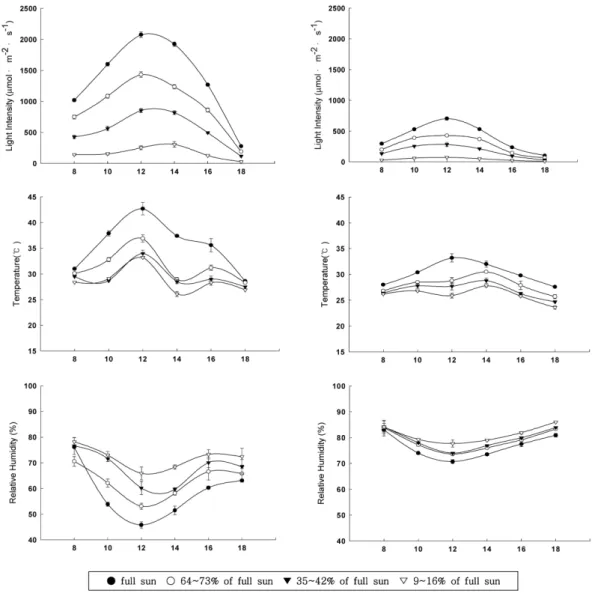
Fig. 1. Diurnal changes of light intensity, air temperature, relative humidity following shading treatments in July (left; sunny days. right; cloudy days).
결과 및 고찰
1. 시험지 생육환경 특성
시험지의주요환경인자를 알아보기위하여휴대용 광량측정기
(Li-250, LI-COR Inc., USA)
와 온습도계(HM34C, Vaisala, Finland)
를 이용하여7
월의 맑은날과흐린날에차광망하부에서
2
시간간격으로매회20
번이상반복측정하였다.
차광망하부의광량은지 면과수평으로측정하였다(Fig. 1).
맑은날피음처리별광량을살펴보면
12
시기준으로전광처리구는
2,100
µmol
·m
−2·s
−1,
피음처리구 는850
µmol
·m
−2·s
−1을보였으며,
일중시간대별변 화는12
시까지광량이증가하다가점차감소하는경향을 나타냈다
.
피음 수준에따른 광환경 변화는전광처리구를 상대투광율
100%
로보았을때,
피음처리구는상대투광율
35~42%
를보였다.
온도변화도광량과같은경향으로
12
시까지증가하다가점차감소하였으며
,
상대습도는12
시까지광량이 증가함에따라낮아지다다시증가하는상반되는결과를보였다
.
흐린날 역시맑은날과 같이광량,
온도,
습도의일 변화 및피음 처리에 따른변화는 같았지 만 그 값은 낮았으며
,
습도는 맑은 날에 비해 흐린 날이약15~25%
더높았다.
2. 광합성 특성
1) 시기별·식물별 광합성 특성
시비처리에 따른세식물의시기별광보상점
,
광포 화점,
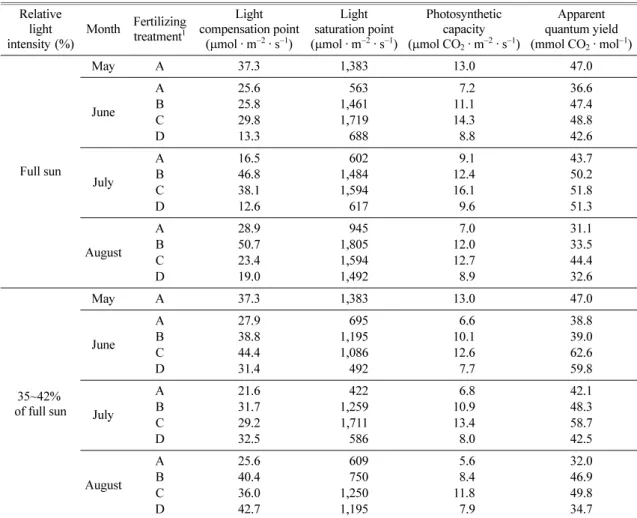
광합성 능력 및 순양자수율은Table 1, 2, 3
과 같다.
세 식물의광합성 능력은대부분 모든 처리구에서 산마늘은
6
월,
곰취와곤달비는7
월에 가장우수하였 으며,
산마늘은6
월,
곰취와곤달비는7
월까지꾸준히증가하다가다시감소하는경향을보였다
.
전광조건에서생육한실험대상식물들간의광합성 능력비교에서는곰취
,
곤달비,
산마늘순으로곰취가 가장우수한능력을보였다.
특히곰취는산마늘에비해약
3
배이상의차이를보이며높은광합성능력을 나타냈다.
식물별순양자수율은산마늘이가장낮은값 Table 1. Estimated values of photosynthetic parameters in the Allium victorialis var. platyphyllumt under different fertilizingtreatment.
Relative light
intensity(%) Month Fertilizingtreatment1
Light compensation point
(µmol · m−2 · s−1)
Light saturation point (µmol · m−2 · s−1)
Photosynthetic capacity (µmol CO2 · m−2 · s−1)
Apparent quantum yield (mmol CO2 · mol−1)
Full sun
May A 34.1 0,352 02.5 24.2
June
A 75.1 0,391 01.6 21.2
B 47.8 0,523 03.7 32.4
C 53.3 1,039 06.6 33.3
D 53.4 0,344 02.4 28.9
July
A 17.1 0,227 02.3 22.6
B 42.7 0,445 04.1 38.3
C 37.1 0,523 05.4 40.4
D 30.5 0,398 02.8 24.0
35~42%
of full sun
May A 34.1 0,352 02.5 24.2
June
A 43.3 0,422 04.6 36.0
B 44.7 0,797 07.9 45.0
C 40.1 0,953 10.9 54.8
D 45.7 0,742 06.0 40.1
July
A 29.0 0,305 03.9 28.8
B 42.1 0,492 04.6 38.0
C 43.2 1,188 06.1 41.7
D 30.5 0,422 04.0 35.4
1Osmocote Fertilizing treatment; A: non-fertilizing treatment, B: 2.5 g ·ℓ−1 treatment, C: 5 g ·ℓ−1 treatment, D: 10 g ·ℓ−1
treatment.
을보였는데이는식물별광합성능력의결과와같은 경향으로광화학계활성에의해서광합성능력이달라 지는 것을알 수있다
.
또한 피음조건에서도 광합성능력및순양자수율이대부분전광처리구와같은경 향이나타났다
.
2) 시비처리에 따른 수종별 광합성 특성
산마늘의광합성능력은
5g
·ℓ−1시비에서전광,
피 음 처리구각각6.6, 10.9
µmolCO
2·m
−2·s
−1로가장 높았으며,
광보상점은시비처리에대한일정한경향이없었다
.
또한전광처리구보다피음처리구에서더높은광합성능력을보였는데산마늘은음지성식물로써 적정차광조건에서시비에대한영향을더많이받는 것으로판단된다
.
순양자수율도전광,
피음처리구각각
33.3, 54.8mmolCO
2·mol
−1로5g
·ℓ−1 시비에서가장 높았다
(Fig. 2).
전광,
피음 처리구 모두 시비량이증가할수록광합성능력이증가하다가
10g
·ℓ−1시비에서감소하였는데이는 산마늘의적정양분요구량 을 넘는 과량시비로 인한 스트레스로 광합성 능력이 떨어지는것으로판단된다
.
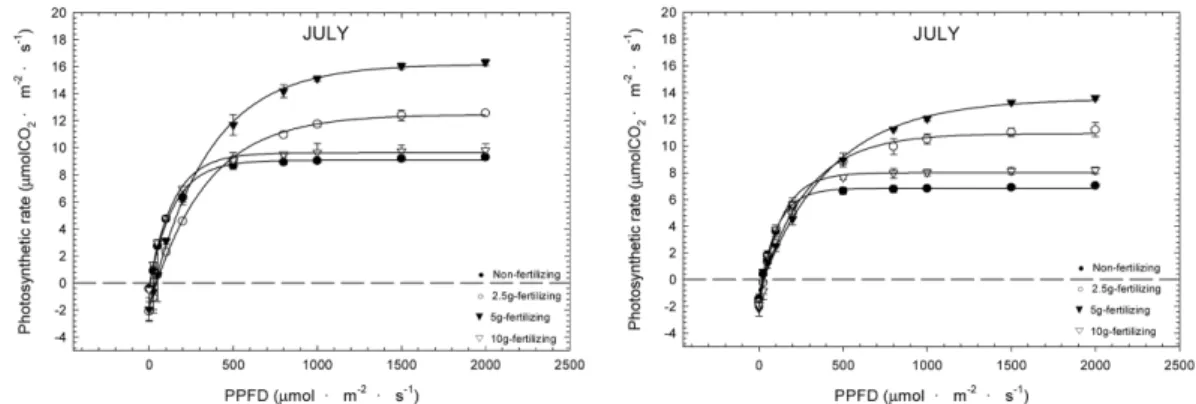
곰취는전광
,
피음처리구각각16.1, 13.4
µmolCO
2·m
−2·s
−1로모두5g
·ℓ−1시비에서가장우수한광합성 능력을보였으며,
산마늘과같이10g
·ℓ−1시비에서는 오히려감소하였다.
순양자수율도광합성능력과같은경향을나타냈지만
,
산마늘과달리전광처리구가피음처리구보다우수한광합성능력을보였다
(Fig. 3).
곤달비도
5g
·ℓ−1시비에서전광,
피음처리구각각12.7, 13.1
µmolCO
2·m
−2·s
−1로위의두식물과같이Table 2. Estimated values of photosynthetic parameters in the Ligularia fischeri under different fertilizing treatment.
Relative light
intensity(%) Month Fertilizingtreatment1 Light compensation point
(µmol · m−2 · s−1)
Light saturation point (µmol · m−2 · s−1)
Photosynthetic capacity (µmol CO2 · m−2 · s−1)
Apparent quantum yield (mmol CO2 · mol−1)
Full sun
May A 37.3 1,383 13.0 47.0
June
A 25.6 0,563 07.2 36.6
B 25.8 1,461 11.1 47.4
C 29.8 1,719 14.3 48.8
D 13.3 0,688 08.8 42.6
July
A 16.5 0,602 09.1 43.7
B 46.8 1,484 12.4 50.2
C 38.1 1,594 16.1 51.8
D 12.6 0,617 09.6 51.3
August
A 28.9 0,945 07.0 31.1
B 50.7 1,805 12.0 33.5
C 23.4 1,594 12.7 44.4
D 19.0 1,492 08.9 32.6
35~42%
of full sun
May A 37.3 1,383 13.0 47.0
June
A 27.9 0,695 06.6 38.8
B 38.8 1,195 10.1 39.0
C 44.4 1,086 12.6 62.6
D 31.4 0,492 07.7 59.8
July
A 21.6 0,422 06.8 42.1
B 31.7 1,259 10.9 48.3
C 29.2 1,711 13.4 58.7
D 32.5 0,586 08.0 42.5
August
A 25.6 0,609 05.6 32.0
B 40.4 0,750 08.4 46.9
C 36.0 1,250 11.8 49.8
D 42.7 1,195 07.9 34.7
1Osmocote Fertilizing treatment; A: non-fertilizing treatment, B: 2.5 g ·ℓ−1 treatment, C: 5 g ·ℓ−1 treatment, D: 10 g ·ℓ−1 treatment.
전광
,
피음 처리구모두 가장 우수한 광합성 능력을 보였으며,
순양자수율도 같은 경향을 나타냈다.
또한곤달비역시
10g
·ℓ−1시비에서는감소하였다(Fig. 4).
세식물모두시비수준이증가할수록광합성률이증 Table 3. Estimated values of photosynthetic parameters in the Ligularia stenocephala under different fertilizing treatment.
Relative light
intensity(%) Month Fertilizingtreatment1 Light compensation point
(µmol · m−2· s−1)
Light saturation point (µmol · m−2 · s−1)
Photosynthetic capacity (µmol CO2 · m−2 · s−1)
Apparent quantum yield (mmol CO2 · mol−1)
Full sun
May A 31.0 0,680 06.0 37.1
June
A 39.6 0,523 05.2 40.5
B 46.0 0,906 07.5 39.4
C 30.6 0,563 07.4 56.8
D 18.4 0,641 06.5 36.7
July
A 42.9 1,523 08.9 32.1
B 12.5 0,992 11.1 50.3
C 22.9 1,344 12.7 43.1
D 35.1 0,984 11.1 59.2
August
A 33.2 0,695 06.7 45.8
B 38.4 0,828 08.6 50.2
C 37.1 1,047 10.4 52.8
D 22.3 0,859 07.2 38.0
35~42%
of full sun
May A 31.0 0,680 06.0 37.1
June
A 96.8 0,689 03.2 26.7
B 47.9 1,094 07.0 30.5
C 48.9 1,188 08.0 35.0
D 34.9 0,969 05.5 26.6
July
A 33.2 1,086 07.5 32.5
B 31.3 1,094 10.4 50.0
C 25.1 1,625 13.1 39.8
D 47.7 1,195 09.6 42.1
August
A 72.1 1,617 06.6 23.6
B 58.1 1,289 07.7 33.4
C 43.9 1,305 10.9 49.2
D 33.0 0,742 06.8 40.1
1Osmocote Fertilizing treatment; A: non-fertilizing treatment, B: 2.5 g ·ℓ−1 treatment, C: 5 g ·ℓ−1 treatment, D: 10 g ·ℓ−1 treatment.
Fig. 2. Effect of fertilizing treatment on the photosynthetic rate of Allium victorialis var. platyphyllum (left; full sun, right;
35~42 of full sun).
가하다가
10g
·ℓ−1에서감소하는과량시비피해가일어났는데
,
이는 배추의엽면 시비량이증가함에따라 광합성률이높아지다가,
엽면시비량이지나치게많으 면 오히려 광합성률이 감소한다는 연구(Jeong
등,
2006)
와 유사한경향을보인 것이다.
또한 곰취와곤달비는산마늘과달리같은시비처리구내에서대부분 전광처리구가피음처리구보다더높은광합성률을보 였다
.
이는,
곰취와곤달비는산마늘보다 양지성식물 에가깝기때문에차광조건보다전광조건에서시비 에 대한 영향을 더 많이 받는 것으로,
식물별 적정 광도 조건에서 최대의시비 효과를얻을 수 있을 것 으로판단된다.
3. 엽록소 형광반응 특성
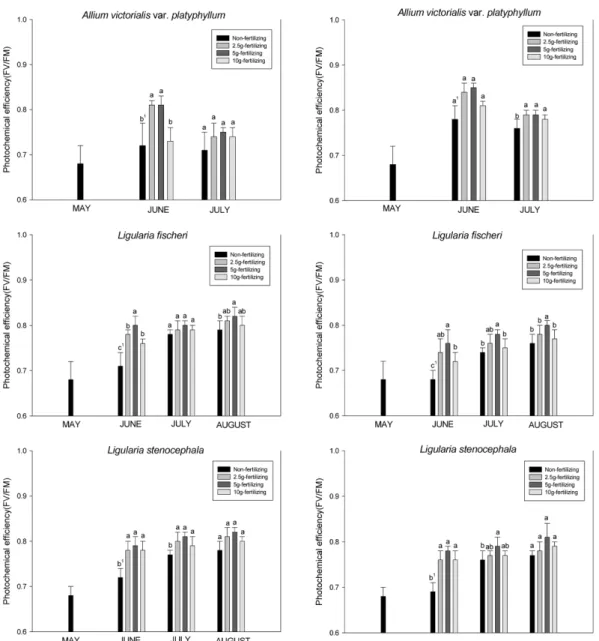
시비처리에 따른 시기별세 식물의광화학 반응에 대한 순양자수율의 최대치
(F
V/F
M)
인 광화학 효율은Fig. 5
와같다.
세식물의월별광화학효율에서산마늘은
5
월< 7
월
< 6
월순으로높았으며,
곰취와곤달비는5
월< 6
월< 7
월< 8
월순으로높았지만,
월별에따른큰차이는 없었다.
이는 세식물이적정광환경이아닌 조건에서도시비처리에의해 어느정도생육활동을유지시 키는결과라생각된다
.
산마늘의광화학효율은
5g
·ℓ−1시비에서전광,
피음처리구 각각
0.81, 0.85
로가장 높았으며 전광처리구보다피음처리구에서더높은광화학효율을보 였다
.
시비수준이증가할수록광화학효율은높은값을 나타냈지만, 10g
·ℓ−1시비에서는광화학효율이오히려감소하였다
.
이는광합성특성결과에서나타났듯이과량시비에의해식물의스트레스지수가높아진것 이라판단된다
.
즉,
광화학효율은광스트레스에대한 중요한지표로서,
광합성능력과밀접한관계가있으며,
Fig. 4. Effect of fertilizing treatment on the photosynthetic rate of Ligularia stenocephala (left; full sun, right; 35~42 of full sun).
Fig. 3. Effect of fertilizing treatment on the photosynthetic rate of Ligularia fischeri (left; full sun, right; 35~42 of full sun).
서로비례관계경향을나타낸다
(Cho, 2008).
5g
·ℓ−1시비에서곰취는전광,
피음처리구에서각 각0.80, 0.78
곤달비는 각각0.81, 0.79
로 두 식물 모두 가장 우수한 광화학 효율을 보였다.
특히 곤달비는 전광 처리구에서 유의적인 차이를 보이며무시 비가 가장 낮은 광화학 효율을 보였다
.
그러나 산마 늘과는 다르게곰취와 곤달비는 전광 처리구에서 피음 처리구보다 높은 광화학 효율을 보였다
.
이는 산마늘은 전광 대비
35~42%
조건에서,
곰취와곤달비는전광조건에서우수한광합성및엽록소형광반응
특성을 보인 결과
(Kwon
등, 2009)
와 유사한경향을보인것이다
.
세수종모두 내음성수준에따라 적정 광도 조건에서 우수한 광화학효율을 나타내는 것으 로판단된다.
Fig. 5. Changes of Chlorophyll fluorescence in the three wild vegetables under different fertilizing treatment (left; full sun, right; 35~42% of full sun). 1Different letters within the columns indicate statistical differences at the 5% levels by Dun- can’s multiple range test.
4. 엽록소 함량 분석
세식물의총엽록소함량은모든시비처리구에서 산마늘은
6
월,
곰취와 곤달비는7
월에 가장 많았다.
이는세식물의생육최성기에는광합성뿐만아니라엽 록소함량도우수하다는것을알수있는결과이다
.
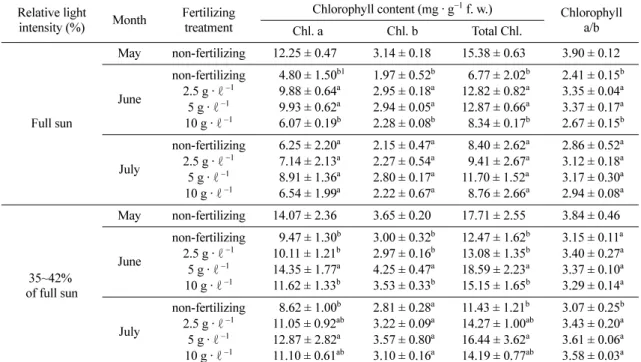
산마늘의총엽록소함량은전광처리구에서
6.77~
12.87,
피음 처리구에서11.43~16.44mg
·g
−1범위 내 에서 피음 처리구가 전광 처리구보다 더 많은 값을 보였다.
또한전광,
피음처리구모두5g
·ℓ−1시비에서유의적인차이를보이며가장많은함량을보였다
(Table 4).
이러한결과는배추의엽면시비시무시비보다엽록 소함량이많았다
(Jeong
등, 2006)
는결과와유사하였으며
,
시비처리에의해산마늘의생리적인활성도가왕 성해지는것을보여주는것이다.
그러나10g
·ℓ−1시 비에서다시엽록소함량이감소하는경향을나타냈는 데 이는광합성능력과같은경향으로5g
·ℓ−1시비 이상에서는 오히려산마늘의생리적인활성이저하되는현상을가져오는것으로생각된다
.
엽록소a, b
각각의 함량과엽록소
a/b
율도 총 엽록소 함량과같은경향을보였다
.
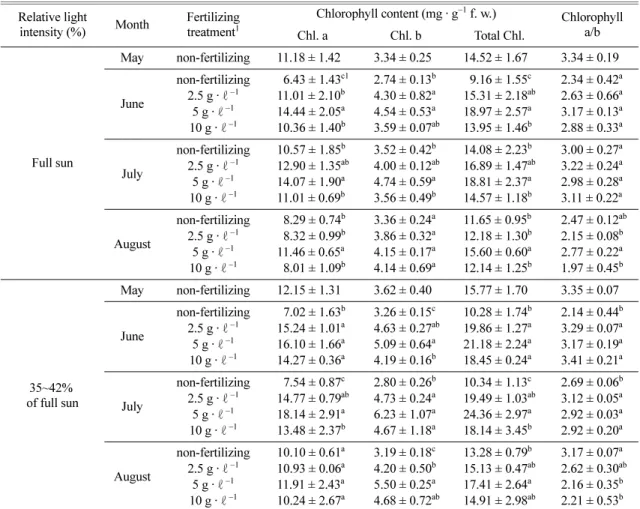
시비처리에따른곰취와곤달비의총엽록소함량분 석에서곰취는전광처리구에서
15.63~17.83mg
·g
−1,
피음처리구에서
12.84~23.48mg
·g
−1,
곤달비는전광 처리구에서14.08~18.81mg
·g
−1,
피음 처리구에서10.34~24.36mg
·g
−1의 범위 내에서 산마늘과 같이5g
·ℓ−1시비구에서유의적인차이를보이며가장많 은함량을나타냈으며,
시비량이증가할수록엽록소함량이증가하다가
10g
·ℓ−1시비에서다시감소하였다(Table 5, 6).
곰취와곤달비의엽록소함량은전광처리구보다피 음처리구에서무시비와시비처리간의차이가크게나
타났으며
, 10g
·ℓ−1시비에서다시감소하는폭이작음을 알 수 있다
.
이는 양수성인 두 수종 모두 광도 조건이 불량한피음 처리구에서 시비에대한 효과가 더크게나타나는것으로,
시비처리에의해불량한생육환경에 대한 보상 효과가 있음을 판단할 수 있다
.
즉
,
수종별 적정 생육환경이 아닌 지역에서 재배 시 적정생육환경을 크게벗어나지않는다면시비처리에 의해불량한생육환경조건을만회할수있을것이며,
Table 4. Monthly changes of chlorophyll contents in the Allium victorialis var. platyphyllumt under different fertilizing treat- ment.
Relative light
intensity (%) Month Fertilizing
treatment Chlorophyll content (mg · g−1 f. w.) Chlorophyll Chl. a Chl. b Total Chl. a/b
Full sun
May non-fertilizing 12.25 ± 0.47 3.14 ± 0.18 15.38 ± 0.63 3.90 ± 0.12
June
non-fertilizing 04.80 ± 1.50b1 1.97 ± 0.52b 06.77 ± 2.02b 2.41 ± 0.15b 2.5 g ·ℓ−1 09.88 ± 0.64a 2.95 ± 0.18a 12.82 ± 0.82a 3.35 ± 0.04a 5 g ·ℓ−1 09.93 ± 0.62a 2.94 ± 0.05a 12.87 ± 0.66a 3.37 ± 0.17a 10 g ·ℓ−1 06.07 ± 0.19b 2.28 ± 0.08b 08.34 ± 0.17b 2.67 ± 0.15b
July
non-fertilizing 06.25 ± 2.20a 2.15 ± 0.47a 08.40 ± 2.62a 2.86 ± 0.52a 2.5 g ·ℓ−1 07.14 ± 2.13a 2.27 ± 0.54a 09.41 ± 2.67a 3.12 ± 0.18a 5 g ·ℓ−1 08.91 ± 1.36a 2.80 ± 0.17a 11.70 ± 1.52a 3.17 ± 0.30a 10 g ·ℓ−1 06.54 ± 1.99a 2.22 ± 0.67a 08.76 ± 2.66a 2.94 ± 0.08a
35~42%
of full sun
May non-fertilizing 14.07 ± 2.36 3.65 ± 0.20 17.71 ± 2.55 3.84 ± 0.46
June
non-fertilizing 09.47 ± 1.30b 3.00 ± 0.32b 12.47 ± 1.62b 3.15 ± 0.11a 2.5 g ·ℓ−1 10.11 ± 1.21b 2.97 ± 0.16b 13.08 ± 1.35b 3.40 ± 0.27a 5 g ·ℓ−1 14.35 ± 1.77a 4.25 ± 0.47a 18.59 ± 2.23a 3.37 ± 0.10a 10 g ·ℓ−1 11.62 ± 1.33b 3.53 ± 0.33b 15.15 ± 1.65b 3.29 ± 0.14a
July
non-fertilizing 08.62 ± 1.00b 2.81 ± 0.28a 11.43 ± 1.21b 3.07 ± 0.25b 2.5 g ·ℓ−1 11.05 ± 0.92ab 3.22 ± 0.09a 14.27 ± 1.00ab 3.43 ± 0.20a 5 g ·ℓ−1 12.87 ± 2.82a 3.57 ± 0.80a 16.44 ± 3.62a 3.61 ± 0.06a 10 g ·ℓ−1 11.10 ± 0.61ab 3.10 ± 0.16a 14.19 ± 0.77ab 3.58 ± 0.03a
1Different letters within the columns indicate statistical differences at the 5% levels by Duncan,s multiple range test.
특히 광도
,
수분,
양분 등이 알맞지않는 지역에서는 시비처리가반드시필요할것으로판단된다.
적 요
본연구에서는 산마늘
(
Allium victorialisvar.
platy- phyllum)
과 곰취(
Ligularia fischeri),
곤달비(
Ligulariastenocephala
)
를대상으로시비처리에 따른광합성특성
,
엽록소형광반응,
엽록소함량변화등을조사·분 석하여시비처리에따른공시식물의영향을분석한결 과다음과같은결론을얻을수있었다.
시비처리에따른광합성능력및광화학효율은공 시식물 모두
5g
·ℓ−1 시비에서 가장 우수하였으며, 10g
·ℓ−1시비에서는과량시비로인한생육저하현상으로오히려감소하는경향을나타냈다
.
또한산마늘은 피음 처리구에서,
곰취와곤달비는무 처리구에서더 우수한광합성특성및광화학효율을보였는데이는 각 식물이적정 광환경에서 시비에대한 영향을더 많이받는것으로,
식물별적정광도조건에서최대의 시비효과를얻을수있을것으로판단된다.
공시식물의 총 엽록소 함량은
5g
·ℓ−1 시비에서11.70~24.36mg
·g
−1의 범위 내로 가장 많았으며,
무 처리구보다 피음 처리구에서더 많은함량을보였다.
이와같은현상이일어나는이유는광이 부족한환경 에 적응하면서 정상적인 광합성을 지속하기 위해 광 에너지를 가능한 한 많이 확보하는 방법으로 엽록소 함량을높게유지할필요가있기때문이다
.
이상의결과를 종합해보면 공시식물 모두 지효성 Table 5. Monthly changes of chlorophyll contents in the Ligularia fischeri under different fertilizing treatment.
Relative light
intensity (%) Month Fertilizing
treatment1 Chlorophyll content (mg · g−1 f. w.) Chlorophyll Chl. a Chl. b Total Chl. a/b
Full sun
May non-fertilizing 08.21 ± 2.46 2.77 ± 0.66 10.98 ± 3.12 2.93 ± 0.23
June
non-fertilizing 06.62 ± 1.89c1 3.41 ± 0.64c 10.03 ± 2.23c 1.95 ± 0.53a 2.5 g ·ℓ−1 08.92 ± 0.83b 6.66 ± 0.68b 15.57 ± 1.23b 1.35 ± 0.15a 5 g ·ℓ−1 12.25 ± 0.35a 10.19 ± 0.80a 22.44 ± 1.15a 1.20 ± 0.06a 10 g ·ℓ−1 07.47 ± 0.87bc 4.74 ± 1.76bc 12.20 ± 1.64c 1.76 ± 0.74a
July
non-fertilizing 11.58 ± 1.21a 6.15 ± 0.48a 17.72 ± 1.68a 1.88 ± 0.06a 2.5 g ·ℓ−1 11.17 ± 0.93a 6.60 ± 2.42a 17.76 ± 2.59a 1.88 ± 0.82a 5 g ·ℓ−1 12.58 ± 1.84a 5.25 ± 0.74a 17.83 ± 2.48a 2.40 ± 0.20a 10 g ·ℓ−1 11.14 ± 0.15a 4.50 ± 0.11a 15.63 ± 0.24a 2.48 ± 0.05a
Aug.
non-fertilizing 08.36 ± 0.18c 3.11 ± 0.08b 11.47 ± 0.18b 2.69 ± 0.09b 2.5 g ·ℓ−1 11.33 ± 0.96a 4.80 ± 0.65a 16.12 ± 1.48a 2.38 ± 0.26b 5 g ·ℓ−1 12.32 ± 0.91a 4.81 ± 0.38a 17.13 ± 1.29a 2.56 ± 0.03b 10 g ·ℓ−1 09.93 ± 0.17b 3.03 ± 0.26b 12.96 ± 0.19b 3.30 ± 0.31a
35~42%
of full sun
May non-fertilizing 10.75 ± 0.94 3.53 ± 0.47 14.28 ± 1.38 3.06 ± 0.21
June
non-fertilizing 06.53 ± 0.81c 5.33 ± 1.43a 11.85 ± 1.80b 1.29 ± 0.40b 2.5 g ·ℓ−1 12.44 ± 3.23ab 6.14 ± 3.04a 18.58 ± 1.36a 2.27 ± 0.80ab
5 g ·ℓ−1 14.59 ± 1.85a 6.05 ± 1.91a 20.64 ± 1.94a 2.58 ± 0.84a 10 g ·ℓ−1 10.40 ± 0.78b 6.43 ± 1.38a 16.82 ± 2.00ab 1.65 ± 0.28ab
July
non-fertilizing 9.18 ± 1.75c 3.66 ± 0.24c 12.84 ± 1.73c 2.52 ± 0.55a 2.5 g ·ℓ−1 013.14 ± 0.93b 8.46 ± 0.69a 21.60 ± 0.25a 1.57 ± 0.25b 5 g ·ℓ−1 15.78 ± 1.74a 7.71 ± 0.72a 23.48 ± 2.46a 2.04 ± 0.04ab 10 g ·ℓ−1 12.77 ± 0.76b 5.29 ± 0.88b 18.05 ± 0.77b 2.47 ± 0.46a
Aug.
non-fertilizing 07.11 ± 1.73c 2.82 ± 0.35ab 09.93 ± 2.07c 2.50 ± 0.35a 2.5 g ·ℓ−1 11.22 ± 0.52b 4.19 ± 0.81a 15.41 ± 0.48b 2.76 ± 0.60a 5 g ·ℓ−1 16.74 ± 2.11a 2.83 ± 0.97ab 19.57 ± 1.38a 6.55 ± 2.86a 10 g ·ℓ−1 13.00 ± 0.76b 2.24 ± 1.35b 15.24 ± 0.71b 7.44 ± 2.26a
1Different letters within the columns indicate statistical differences at the 5% levels by Duncan’s multiple range test.
비료인
Osmocote
이용시5g
·ℓ−1시비가본시험지 와같은환경조건에서가장유용한시비처리로생각된 다.
그러나 시비뿐만 아니라 각 산채류의 적정 광도조건에의해 생육이달라지는 결과를보였는데
,
이는 산채류재배 시시비처리,
수확방법 등의재배기술과 함께 각식물별적정생육환경을구명하는연구가보 다많이이루어져야할것으로판단된다.
주제어 : 광도변화
,
광합성특성,
광화학효율,
시비처 리,
엽록소함량인 용 문 헌
1. Arnon, D.I. 1949. Copper enzymes in isolated chloro-
Table 6. Monthly changes of chlorophyll contents in the Ligularia stenocephala under different fertilizing treatment.
Relative light
intensity (%) Month Fertilizing
treatment1 Chlorophyll content (mg · g−1 f. w.) Chlorophyll Chl. a Chl. b Total Chl. a/b
Full sun
May non-fertilizing 11.18 ± 1.42 3.34 ± 0.25 14.52 ± 1.67 3.34 ± 0.19
June
non-fertilizing 06.43 ± 1.43c1 2.74 ± 0.13b 09.16 ± 1.55c 2.34 ± 0.42a 2.5 g ·ℓ−1 11.01 ± 2.10b 4.30 ± 0.82a 15.31 ± 2.18ab 2.63 ± 0.66a 5 g ·ℓ−1 14.44 ± 2.05a 4.54 ± 0.53a 18.97 ± 2.57a 3.17 ± 0.13a 10 g ·ℓ−1 10.36 ± 1.40b 3.59 ± 0.07ab 13.95 ± 1.46b 2.88 ± 0.33a
July
non-fertilizing 10.57 ± 1.85b 3.52 ± 0.42b 14.08 ± 2.23b 3.00 ± 0.27a 2.5 g ·ℓ−1 12.90 ± 1.35ab 4.00 ± 0.12ab 16.89 ± 1.47ab 3.22 ± 0.24a 5 g ·ℓ−1 14.07 ± 1.90a 4.74 ± 0.59a 18.81 ± 2.37a 2.98 ± 0.28a 10 g ·ℓ−1 11.01 ± 0.69b 3.56 ± 0.49b 14.57 ± 1.18b 3.11 ± 0.22a
August
non-fertilizing 08.29 ± 0.74b 3.36 ± 0.24a 11.65 ± 0.95b 2.47 ± 0.12ab 2.5 g ·ℓ−1 08.32 ± 0.99b 3.86 ± 0.32a 12.18 ± 1.30b 2.15 ± 0.08b
5 g ·ℓ−1 11.46 ± 0.65a 4.15 ± 0.17a 15.60 ± 0.60a 2.77 ± 0.22a 10 g ·ℓ−1 08.01 ± 1.09b 4.14 ± 0.69a 12.14 ± 1.25b 1.97 ± 0.45b
35~42%
of full sun
May non-fertilizing 12.15 ± 1.31 3.62 ± 0.40 15.77 ± 1.70 3.35 ± 0.07
June
non-fertilizing 07.02 ± 1.63b 3.26 ± 0.15c 10.28 ± 1.74b 2.14 ± 0.44b 2.5 g ·ℓ−1 15.24 ± 1.01a 4.63 ± 0.27ab 19.86 ± 1.27a 3.29 ± 0.07a 5 g ·ℓ−1 16.10 ± 1.66a 5.09 ± 0.64a 21.18 ± 2.24a 3.17 ± 0.19a 10 g ·ℓ−1 14.27 ± 0.36a 4.19 ± 0.16b 18.45 ± 0.24a 3.41 ± 0.21a
July
non-fertilizing 07.54 ± 0.87c 2.80 ± 0.26b 10.34 ± 1.13c 2.69 ± 0.06b 2.5 g ·ℓ−1 14.77 ± 0.79ab 4.73 ± 0.24a 19.49 ± 1.03ab 3.12 ± 0.05a 5 g ·ℓ−1 18.14 ± 2.91a 6.23 ± 1.07a 24.36 ± 2.97a 2.92 ± 0.03a 10 g ·ℓ−1 13.48 ± 2.37b 4.67 ± 1.18a 18.14 ± 3.45b 2.92 ± 0.20a
August
non-fertilizing 10.10 ± 0.61a 3.19 ± 0.18c 13.28 ± 0.79b 3.17 ± 0.07a 2.5 g ·ℓ−1 10.93 ± 0.06a 4.20 ± 0.50b 15.13 ± 0.47ab 2.62 ± 0.30ab
5 g ·ℓ−1 11.91 ± 2.43a 5.50 ± 0.25a 17.41 ± 2.64a 2.16 ± 0.35b 10 g ·ℓ−1 10.24 ± 2.67a 4.68 ± 0.72ab 14.91 ± 2.98ab 2.21 ± 0.53b
1Different letters within the columns indicate statistical differences at the 5% levels by Duncan’s multiple range test.
plasts polyphenol-oxidase in Beat vulgaris. Plant Phys- iol. 24(1):1-15.
2. Barker, M.G., M.C. Press, and N.D. Brown. 1997.
Photosynthetic characteristics of dipterocarp seedlings in three tropical rain forest light environments: a basis for niche partitioning. Oecologia 112:453-463.
3. Cho, E.J. 2000. A Survey on the Usage of Wild Grasses. Korean J. Dietary Culture 15(1):59-68.
4. Cho, J.T. 1984. Physiological and ecological studies on the chinese bellflower, Platycodon grandiflorum DC.
I. Studies on seed germination, growth and flowering of chinese bellflower. J. Kor. Soc. Hort. Sci.
25(3):187-193.
5. Cho, M.S. 2008. Effects of light intensity on physio- logical characteristics and growth performances of deciduous hardwood species distributed in the central temperate zone of korean forest. Chungnam national university Master’s dissertation p. 81.
6. Choi, J.H. 2001. Effects of artificial shade treatment on the growth performances, water relations, and pho- tosynthesis of several tree species. Chungnam national university Doctor’s dissertation p. 152.
7. Choi, S.T., J.T. Lee, and W.C. Park. 1993. Growth environment and nutritional evaluation of native Allium victorialis var. platyphyllum in Ulrung island. J.
Korean Agric. Chem. Soc. 36(6):502-509.
8. Choi, Y.B. and J.H. Kim. 1995. Change in needle chlo- rophyll fluorescence of Pinus densiflora and Pinus thunbergii treated with artificial acid rain. Jour. Korean For. Soc. 84(1):97-102.
9. Choi, Y.H. and C.H. Cho. 1994. Compositions of fatty acids, inorganic components and volatile organic acids in Korean valerian roots. Korean J. Medicinal Crop Sci. 2(2):162-167.
10. Demmig, B. and O. Björkman. 1987. Comparison of the effect of excessive light on chlorophyll fluores- cence (77 K) and photon yield of O2 evolution in leaves of higher plants. Planta 171:171-184.
11. Ham, S.S., S.Y. Lee, D.H. Oh, S.H. Kim, and J.K.
Hong. 1997. Development of beverages drinks using mountain edible herbs. J. Korean Soc. Food Sci. Nutr.
26(1):92-97.
12. Hixcox, J.D. and G.F. Israelstam. 1978. A method for the extraction of chlorophyll from leaf tissue without maceration. Can. J. of Bot. 57(12):1332-1334.
13. Hong, C.K., S.B. Bang, S.B. Kwon, S.C. Kim, and Y.M. Mo. 1997. Studies on the nutri-culture of major wild vegetable Ligularia fischeri Turcz. I. Growth and yield of Ligularia fischeri Turcz. by media, amount of media and planting density in nutri-culture. Korean J.
Plant. Res. 10(4):401-410.
14. Jeong, C.S., J.N. Park, J.H. Kyoung, J.P. Kang, and K.W. Kwak. 2006. Effects of foliar application of liq- uid hydration calcium in chinese cabbage during culti- vated. Inst. Agr. Sci., Kangwon Nat’l Univ. 17:175- 15. Jeong, J.C., H.C. Ok, O.S. Hur, C.G. Kim, S.Y. Kim,182.
and W.B. Kim. 2005. Food value and postharvest physiological characteristics of wild garlic (Allium vic- torialis var. platyphyllum) in Korea. Kor. J. Hort. Sci.
Technol. 23(2):164- 169.
16. Jeong, S.W., E.J. Kim, H.J. Hwang Bo, and S.S. Ham.
1998. Effects of Ligularia fischeri on oxidation of low density lipoprotein. Korean J. Food Sci. Technol.
30(5):1214-1221.
17. Kim, G.T. 2003. A study on the growth, photosyn- thetic rate and chlorophyll contents of Ligularia fis- cheri by the growing site. Jour. Korean For. Soc.
92(4):374-379.
18. Kim, G.T. and T.W. Um. 1997. Astudy on the distribu- tion of wild edible herb species in mt. kariwang. Jour.
Korean For. Soc. 86(4):422-429.
19. Kim, P.G. and E.J. Lee. 2001. Ecophysiology of photo- synthesis 1: Effect of light intensity and intercellular CO2 pressure on photosynthesis. Korean Journal of Agricultural and Forest Meteorology 3(2):126-133.
20. Kim, P.G., Y.S. Yi, D.J. Chung, S.Y. Woo, J.H. Sung, and E.J. Lee. 2001. Effect of light intensity on photo- synthetic activity of shade tolerant and intolerant tree species. Jour. Korean For. Soc. 90(4):476-487.
21. Kim, Y.D. and W.M. Yang. 1986. Studies on the com- ponents of wild vegetables in Korea. J. Korean Soc.
Food Nutr. 15(4):10-16.
22. Kwon, KW., G.N. Kim, and M.S. Cho. 2009. Physio- logical responses of the three wild vegetables under different shading treatment. Jour. Korean For. Soc.
98(1):106-114.
23. Lee, D.G., G.T. Kim, and T.W. Um. 1993. The produc- tion of edible wild herbaceous plants growing at natu- ral forests. Korea Forest Service p. 759.
24. Lim, J.H. and K.C. Sang. 1990. Growth conditions Hepatica asiatica Nakai in the habitats for the cultiva- tion as a floricultural crop. J. Kor. Soc. Hort. Sci.
31(1):81-89.
25. Lim, J.H., S.Y. Woo, M.J. Kwon, J.H. Chun, and J.H.
Shin. 2006. Photosynthetic capacity and water use effi- ciency under different temperature regimes on healty and declining korean Fir in Mt. Halla Jour. Korean For. Soc. 95(6):705-710.
26. Lim, S.C. 1993. The study of propagating method on Erythronium Japonicum decaisne. Korean J. Intl. Agri.
5(2):175-178.
27. Lim, S.C., H.J. Park, S.Y. Yun, M.S. Lee, and W.T.
Kim. 1996. Structures of flavonoids and furostanol glycosides isolated from the bulbs of Allium victoria- lis L. J. Kor. Soc. Hort. Sci. 37(5):675-679.
28. Mackinney, G. 1941. Absorption of light by chloro- phyll solution. J. Biol. Chem. 140:315-322.
29. Oh, I.S., S.O. Yoo, and J.H. Bae. 1994. Morphological characteristics of Chrysanthemum zawadskii Herb.
native to Korea. J. Kor. Soc. Hort. Sci. 35(1):78-87.
30. SAS Institute Inc., 2000: SAS/STAT TM Guide for Personal Computer. Version 8 Edition. SAS Institute Inc., N. C. p. 1026.
31. Sigmaplot. 2000. philscience p. 136.
32. Won, J.Y. and C.Y. Lee. 2002. Characteristics of pho- tosynthesis and dry matter production of Liriope platy- phylla WANG et TANG. Korean J. Medicinal Crop Sci.
10(2):82-87.