건조 스트레스가 난대 상록활엽수의 광합성 반응 및 엽록소 형광반응에 미치는 영향
진언주1⋅윤준혁1⋅배은지1⋅최명석2*1)
1국립산림과학원 산림바이오소재 연구소, 2국립경상대학교 환경산림과학부 (2018년 11월 15일 접수; 2019년 5월 20일 수정; 2019년 9월 19일 수락)
Photosynthesis and Chlorophyll Fluorescence of Evergreen Hardwoods by Drying Stress
Eon-Ju Jin
1, Jun-Hyuk Yoon
1, Eun-Ji Bae
1and Myung-Seok Choi
2*1
Forest Biomaterials Research Center, National Institute of Forest Science, Jinju, 52817, Korea
2
Division of Environmental Forest Science, Gyeongsang National University, Jinju, 52828, Korea
(Received November 15, 2019; Revised May 20, 2019; Accepted September 19, 2019)ABSTRACT
This study was carried out to investigate the effects of C. japonica, D. morbifera, D.
macropodum, I. anisatum, Q. glauca and R. indica To investigate the photosynthetic ability, chlorophyll content, chlorophyll fluorescence analysis, and physiological environmental. The photosynthetic rate, cancer respiration rate, stomatal conductance, and rate of evaporation tended to decrease as a result of drying stress in the no-water condition for 28 days. I.
anisatum, Q. glauca and R. indica showed a low rate of less than 40% until 28 days of no-treatment. The total chlorophyll contents were decreased in the order of D. macropodum>
D. morbifera> C. japonica> Q. glauca> M. thunbergii> R. indica> I. anisatum. Chlorophyll fluorescence analysis showed that there was no change in the qP, but after 28 days no Fv / F
m, F
o, R
fd, NPQ
_LSScan be a useful indicator for quantitative estimation within a short period of time with a marked reduction rate of PSII quantum yield ΦPSII in the rectified state by continuous light during the nominal adaptation period. In the case of I. anisatum, Q.
glauca and R. indica If water management can be carried out at intervals, it may be possible to plant trees in trees and landscape trees.
Key words: Drought-Tolerant Plants, Photosynthetic capacity, Chlorophyll fluorescence
I. 서 론
20세기 산업화 및 도시화로 지난 100년간 전 지구 평균온도는 0.78℃ 상승하였으며, 향후 100년간 1.0∼
3.7℃로 증가할 것으로 예측된다(Stocker et al., 2013).
난대 상록활엽수종은 이러한 변화에 가장 빠르게 적응
할 수 있는 수종이라 할 수 있는데, 앞으로의 기후변화 로 현재 난대로 분류되는 지역들이 확장될 것으로 예 상되기 때문이다. 이러한 기후변화로 난대 상록활엽수 종에 대한 관심이 집중되고 있으며, 지구온난화 발생 으로 식물이 받는 비생물적 스트레스(건조, 내염, 고온, 저온 및 중금속)에 대한 관심 또한 높아지고 있다(Yu
* Corresponding Author : Myung-Seok Choi ([email protected])
ⓒ Author(s) 2019. CC Attribution 3.0 License.
et al., 2004). 우리나라의 최근 30년간 연평균 강수량
(Korea Meteorological administration, 1981∼2010) 은 1,308 mm, 세계 연평균 강수량 평균인 973 mm보 다 약 1.3배 가량 많으나 대부분이 여름철에 집중되어 있어 효율적인 물 관리가 어려운 실정이다. 특히 2017 년 1월 1일부터 6월 30일까지 전국 누적 강수량은 224.4 mm로 평년대비 약 48.5% 수준이며, 이는 지난 1973년 이후 가장 최악의 가뭄으로 평가 받고 있다 (Korea Meteorological administration, 2017). 이처럼 기상조건에 따른 수분부족은 식물의 형태적, 생리적, 생화학적 그리고 분자생물학적으로 생육을 저해한다 (Wang et al., 2012).수분부족으로 인한 식물의 초기반응은 엽의 확장, 줄 기 신장과 같은 팽압에 영향을 받는 요소들이 감소되면 서 광합성 속도의 감소, 삼투조절기능(osmoregulation) 상실, 세포 내 주요 대사에 심각한 장애 등을 유발하여 영구적인 손상을 끼치게 된다(Taiz and Zeiger, 2006).
또한 식물은 수분스트레스에 대응하기 위해 다양한 생 존전략을 가지고 있으며, 이러한 능력은 식물의 양적 형질로써 엽의 탈리, 기공 닫힘 등 체내 수분보존과 수분이용효율을 높이는 기작의 상호작용에 의하여 수 분부족에 대한 내건성을 나타낸다(Oh et al., 2005).
내건성에 따른 식물의 생리적 피해 및 적응 기작을 이해하기 위해 광합성 활성과 관련하여 기공닫힘, 수 분이용효율의 변화, 광계Ⅱ에서 일어나는 광화학반응 및 전자 흐름의 불균형 등을 지표로 활용하여 연구가 진행되고 있다(Lee et al., 2017; Yoo et al., 2012).
특히 엽록소 형광반응 측정은 광합성 기구 변화를 모 니터링하여 정량화할 수 있는 민감하고 신뢰성 있는 방법으로 식물체의 건전한 생장에 관한 연구가 대표적 이며, 광계Ⅱ의 구조와 기능변화를 빠르고 간편하게 측정할 수 있어 최근 해외에서 많은 연구가 이루어지 고 있다(Strasser et al., 2000; Naumann et al., 2007;
Falqueto et al., 2010; Wang et al., 2012). 우리나라에 서도 일반 밭작물(Yoo et al., 2012)을 비롯하여 관목 및 교목(Lee et al., 2014; Park et al., 2017)을 대상으 로 엽록소 형광반응 측정을 통해 비생물적 영향에 따 른 환경지표로 활용가능성을 제시한 바 있다. 최근까 지 기후변화에 따른 난대상록활엽수의 적지예측 평가 모델에 관한 연구는 많이 진행되었으나(Kang et al., 2009; Choi et al., 2013; Shin et al., 2014), 환경요인 에 따른 생리적 반응 등 적지생육 조건에 대한 연구는 미비한 실정이다. 따라서 본 연구는 난대 상록활엽수 종을 대상으로 수분 스트레스에 따른 광합성 반응 및
엽록소 형광반응을 측정하여 단기간의 수분부족 시 나 타나는 피해와 조기 진단을 위한 생리적 지표를 찾아 보고 건전한 생육을 위한 적절한 수분공급에 대한 기 초자료를 제공하고자 수행하였다.
II. 재료 및 방법
2.1. 공시재료
본 실험에 사용된 난대 상록활엽수는 동백나무 (Camellia japonica L.: C. japonica), 황칠나무 (Dendropanax trifidus (Thunb.) Makino: D. trifidus), 굴거리나무(Daphniphyllum macropodum Miq.: D.
macropodum), 붓순나무(Illicium anisatum L.: I.
anisatum),
후박나무(Machilus thunbergii:M.
thunbergii), 종가시나무(Quercus glauca: Q. glauca),
다정큼나무(Raphiolepis indica var. umbellata: R.indica)등 7수종의 3년생 묘목 15 본씩을 공시재료로
이용하였다. 선정된 묘목은 피트모스:펄라이트:질석 (1:1:1, v/v)을 혼합한 배양토를 담은 플라스틱 화분(상 부 118.97×하부 72.98× 높이 201.66 mm)에 이식하여 국립산림과학원 산림바이오소재 연구소 유리온실 (35°09’48.5"N 128°06’02.8"E)에서 3개월간 순화과 정을 거쳐 활착되도록 하였다. 2017년 8월 5일 비가림 시설이 되어 있는 비닐온실로 옮겨 2017년 9월 5일까 지 인위적인 단수처리를 통한 건조 스트레스를 유발하 였다. 건조 스트레스 전 수종별 평균 수고와 근원경은 각각C. japonica(42.6±1.2 cm, 5.3±0.7 mm), D.
morbifera (50.4±2.5 cm, 7.8±0.8 mm), D. macropodum
(61.5±3.7 cm, 6.6±0.6 mm), I. anisatum(62.1±2.9 cm, 6.3±0.4 mm), M. thunbergii(63.6±4.1 cm, 5.0±0.7 mm), Q. glauca (68.6±2.7 cm, 5.9±0.4 mm), R.indica(62.9±1.7 cm, 5.5±2.8 mm)였으며, 엽은 개체당
10∼15개였다.2.2. 기상자료 및 시료수집
실험이 진행되는 기간의 주요 환경인자를 알아보기 위해 온⋅습도 측정기(HOBO H08-004-02, ONSET, Massachusetts, Boston, USA)를 지상에서 1 m 높이에 설치하여 10분마다 기상자료를 수집하였다. 실험기간 동안 비닐온실 내 온도는 최고 49.8±1.2℃, 최저 19.8±0.8℃, 평균 28.9℃ 였으며, 습도는 최고 95.4±2.6%, 최저 24.5±0.9℃, 평균 54.8%, 일사량은 최고 624.1 W⋅m-2, 최저 107.8 W⋅m-2, 평균 281.4 W⋅m-2
였다. 또한 건조 스트레스에 따른 생리적 반응을 분석 하기 위하여 단수처리 후 1일(DS 1)과 28일(DS 28)에 잎을 채취하여 엽록소 함량을 분석하였다. 또한 동일한 잎을 대상으로 광합성 반응, 엽록소 형광반응 및 토양 수분함량을 측정하였다. 분석 및 측정을 위하여 선택한 잎은 오전 9∼10시 사이로 하였으며, 여러 개의 잎 중 에서 가장 건전한 잎을 대상으로 시료를 수집하였다.
2.3. 용적수분함량
단기적인 건조 스트레스에 따른 고사일을 측정하기 위해 공시재료들을 매일 육안으로 관찰하였다. 시간경 과에 따른 수종별 용적수분함량 변화는 포트 가장자리 에서 20 mm 떨어진 지점을 Multi Function Soil Moisture Meter(HMM-200, hy-sys, Seoul, Republic of Korea)을 이용하여 용적수분함량이 0%에 도달하 는 시점까지 매일 오전 10시에 5반복으로 측정하였다.
2.4. 광색소 함량
광색소 함량 측정은 DMSO(dimethyl sulfoxide)을 이용하여 추출하는 Hiscox and Isrealstam(1979)의 방 법을 사용하였다. 각 수종별 5개체에서 잎 시료 채취 기(0.785 cm)를 이용하여 채취하였으며, 채취한 잎은 Hiscox and Isrealstam(1979)의 방법에 따라 DMSO를 추출용매로 이용하여 엽록소를 추출하였다. 추출액을 UV-Visible spectrophotometer(Nicolet Evolution 100, Thermo Electron Co., USA)를 이용하여 663 nm (A663)와 645 nm(A645)의 파장에서 흡광도를 측정하여
아래와 같은 식으로 각각의 엽록소 함량을 구하였다 (Arnon, 1945; Mackinney, 1941).
Chlorophyll a(mg⋅g-1 fresh w.t.) = (12.7 × A663 - 2.69 × A645) Chlorophyll b(mg⋅g-1 fresh w.t.) =
(22.9 × A663 - 4.68 × A645) Total Chlorophyll(mg⋅g-1 fresh w.t.) =
(8.02 × A663 + 20.20 × A645) (Eq. 1)
2.5. 광합성 반응
수종별 생장 속도가 비슷한 개체의 건전한 잎을 대 상으로 휴대용 광합성 측정기(Li-6400, LI-COR Inc., Lincoln, NE, USA)를 이용하여 광합성 속도, 암호흡 속도, 기공전도도, 증산속도 등을 측정하였다. 광합성 속도 시 광도는 임의로 조절할 수 있는 LED 광원 (Li-6400, LI-COR Inc., Lincoln, NE, USA)를 이용하 여 PPFD (Photosynthetic Photon Flux Density) 0, 50, 100, 250, 500, 800, 1000, 1,500, 2,000 μmol⋅m−2⋅s−1 의 9수준으로 차이를 두어 광합성 반응을 측정하였다.
아홉 수준의 광도 중에 엽챔버 내 광도와 같은 수준인 600 μmol⋅m−2⋅s−1의 광도에서의 값을 이용하여 광 합성 관련 인자들을 계산하였다. 광합성 측정기의 엽 챔버에 유입되는 공기의 유량은 500 μmol⋅s−1, 온도 는 25℃, 상대습도 60%로 설정하고 외기의 환경변화 로 인한 영향이 없도록 하였다. 또한 CO2 농도가 급변 하지 않도록 광합성 측정기에 CO2 injector system을
Fluorescence parameters Definition
Fo Minimal chlorophyII fluorescence intensity measured in the dark-adapted state, when all PSII reaction centres are open
Fm Maximal chlorophyII fluorescence intensity measured in the dark-adapted state during the application of a saturating pulse of light
F´m(Fm_Lss) Maximal chlorophyII fluorescence intensity measured in the light-adapted state during the application of a saturating pulse of light
Fs(Ft_Lss) ChlorophyII fluorescence intensity measured at the steady-state after subjecting the sample to non-saturating actinic illumination
Fv/ Fm Maximum quantum yield of PSII photochemistry measured in the dark-adapted state RFd=Fd/ Fs=(Fm- Fs)/ Fs ChlorophyII fluorescence decrease ratio. In this case, Fs is obtained after illumination
with continuous saturating irradiance. RFd is an indicator of the photosynthetic quantum conversion and is correlated with CO2 fixation rates
ΦPSII Effective quantum yield of photochemical energy conversion in PSII NPQ=(Fm- F´m) / Fm Stern-Volmer non-photochemical quenching coefficient
Table 1. Summary of the major Chlorophyll fluorescence parameters(modified from Gorbe et al.’s data, 2012)
부착하여 CO2 농도를 400±2 μmol⋅mol−1 범위 내에 서 안정된 상태를 유지하도록 하였다. 광합성 반응 측 정은 식물의 생육이 가장 활발한 오전 9시부터 오후 2시까지 수종별 5반복으로 측정하였다.
2.6. 엽록소 형광 반응
엽록소 형광 분석은 Handy FluorCam(Photon Systems Instruments, spol. Sr.o., Drásov, Czech Republic)을 이용하여 암적응(20분간 암처리)상태에 서 Quenching kinetics analysis 방법으로 측정하였다 (Barbagallo et al., 2003; Genty et al., 1989,1990). 측 정 시 엽록소 형광 유도를 위해 화학광선과 연속광원을 사용하였다. 이때 Handy FluorCam의 분석조건은 화 학광선 (actinic light, red LED): 200 μmol m-2⋅s-1, 연속광원(saturating light, moderate light): 1,250 μ mol m-2⋅s-1)이었다. 측정된 데이터는 Gorbe et
al.(2012)이 제시한 방법에 의해 분석하였다(Table 1).
2.7. 통계 분석
통계분석용 프로그램인 IBM SPSS Statistics (SPSS Statistics Program, version 14.0, SPSS Inc,
USA)을 이용하여 일원분산분석(one-way analysis of variance)을 이용하였고, 각 처리간의 유의성은 DMRT (duncan’s multiple range test) 5% 수준에서 실시하였다.
III. 결과 및 고찰
3.1. 용적수분함량
무관수 처리 전 33.1∼39.4% 수준의 유사한 범위 내 공시수종을 선택하여 용적수분함량을 측정하였다.
용적수분함량은 모든 공시수종에서 무관수 이후 지속 적으로 감소하였으며, 10% 이하에 도달하는 시간은
D. macropodum 가 18일로 가장 빨랐으며, 그 다음으
로M. thunbergii 22일, C. japonica, Q. glauca, D.
macropodum, D. trifidus, R. indica, I. anisatum 등은
25일 이후로 나타났다(Fig. 1). D. macropodum 와 M.thunbergii 는 다른 공시식물과 비교하여 상대적으로
높은 증산속도를 보여(Table 2), 용적수분함량이 1%이하에 도달하는 시간이 빠른 것으로 판단된다. 토양 수분의 감소는 식물과 토양에 의한 증발산으로 인한 감소이며(Million et al., 2007), 무관수 처리 후 용적수 분함량의 감소는 실험조건, 방법에 따라 달라지며 이
Species Treatment Chlorophy II a (mg⋅g-1)
Chlorophy II b (mg⋅g-1)
Chlorophy II a/b ratio
Total Chlorophy II (mg⋅g-1)
C. japonica
DS 1 3.96±0.23c 2.68±0.10a 1.48±0.08def 6.64±0.30bDS 28 2.45±0.24d 2.08±0.36b 1.23±0.38f 4.54±0.31def
D. trifidus
DS 1 4.76±1.46b 2.01±0.24ab 2.33±0.39a 6.77±1.71bDS 28 2.45±0.04d 1.63±0.05def 1.51±0.06de 4.08±0.21ef
D. macropodum
DS 1 5.43±0.26a 2.82±0.15a 1.92±0.07bc 8.25±0.41aDS 28 2.20±0.16d 1.81±0.03bcde 1.21±0.08f 4.01±0.18ef
I. anisatum
DS 1 2.80±0.08d 1.84±0.02bcd 1.52±0.04de 4.64±0.10cdeDS 28 2.56±0.33d 1.66±0.06def 1.54±0.15de 4.21±0.28ef
M. thunbergii
DS 1 2.20±0.17d 1.74±0.10cdef 1.27±0.11ef 3.93±0.21ef DS 28 1.34±0.09e 1.51±0.03f 0.89±0.05g 2.85±0.11gQ. glauca
DS 1 3.45±0.21c 1.82±0.04bcde 1.90±0.15bc 5.28±0.23c DS 28 2.26±0.07d 1.54±0.55ef 1.47±0.33def 3.80±0.54fR. indica
DS 1 3.46±0.20c 1.67±0.03def 2.07±0.12b 5.12±0.23cdDS 28
2.65±0.48d 1.55±0.02ef 1.71±0.15cd 4.21±0.28efSpecies(S) *** *** *** ***
Treatment(T) *** *** *** ***
SⅹT *** *** *** ***
Table 2. Variation of the photosynthetic characteristics in the condition of no irrigation
는 식물 종, 생장단계, 토심, 일사, 용기 크기, 토양성분 등에 의해서 발생한다(Bousselt et al., 2011;
VanWoert et al., 2005). Egert and Tevini(2002)는 9 일 이상 토양에 수분공급이 이루어지지 않으면, 90%
이상의 수분이 증발되고 엽수분은 3.6% 이상 감소하 며, 무강우기간 적절한 관수는 식물의 스트레스와 고 사율을 줄일 수 있다고 보고하였다.
3.2. 엽록소 함량
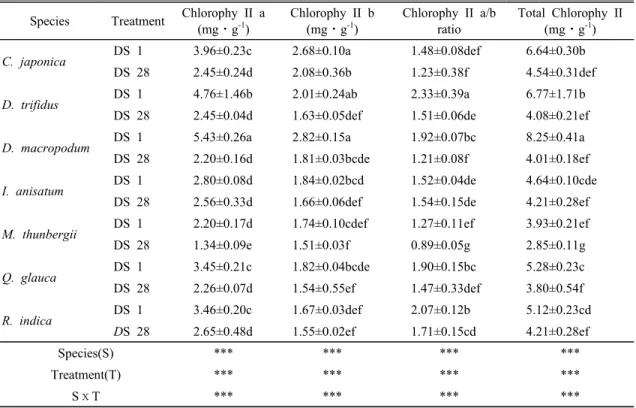
일반적으로 엽록소는 환원력을 지닌 광 수용체로써 식물체에서 중요한 구성 물질이다. 일반적으로 광색소 함량은 스트레스를 받으면 감소하는 특징을 가지고 있 어(Iglesias et al., 2006), 스트레스 평가 지표로 널리 이용되고 있는데, 수종 간 반응차이도 매우 크게 나타 나는 인자이다(Han et al., 2009). 본 연구에서도 무관 수 처리기간이 길어질수록 광색소 함량이 뚜렷하게 감 소하는 경향을 보였으며, 수종 및 건조처리간 유의성 도 존재하였다(Table 2). Chlorophyll a의 초기함량은
D. macropodum가 5.43±0.27 mg⋅g
-1로 가장 높았으 며, 그 다음으로 D. trifidus 4.76±1.46, C. japonica 3.96±0.24, R. indica 3.47±0.22, Q. glauca 3.45±0.20,I. anisatum 2.81±0.08, M. thunbergii 2.20±0.17 mg⋅g
-1 순으로 조사되었다. 무관수 28일 째 모든 공시수종에 서 감소하는 경향으로 나타났으나, D. macropodum (17.5%)와 D. trifidus(10.9%)는 상대적으로 높은 감 소율을 보였다. Chlorophyll b의 초기함량은 D.macropodum가 2.83±0.16 mg⋅g
-1로 가장 높았으며, 이후 변화는 Chlorophyll a와 유사한 경향을 보였다.Chlorophyll a와 b함량의 비는 무관수 기간이 길어질 수록 감소하였으며, 이러한 결과는 Chlorophyll a 함량 의 감소가 Chlorophyll b함량 감소보다 컸기 때문이다.
총 총 엽록소 함량은 수종에 상관없이 모든 건조 처리 구에서 감소하였으며, 수종별 변화를 조사한 결과 D.
macropodum와 D. trifidus의 감소폭이 비교적 높아 수
분변화에 매우 민감한 것으로 조사되었다. 지속적인 건조가 엽록소 함량을 감소시켰다는 결과는 많은 연구 에서 찾아 볼 수 있다(Kim and You, 2010; An et al., 2008). 본 연구에서처럼 건조로 인한 잎의 엽록소 함 량 감소는 잎의 질소 함량 감소와 관계가 깊다. 즉 건 조로 뿌리의 생산량이 감소하면서 질소 흡수가 감소하 였고 이로 인해 잎의 엽록소 함량이 감소한 것으로 판단된다(Kim et al., 2014).Species Treatment Photosynthetic rate (μmol CO2⋅m-2⋅s-1)
Stomatal conductance (μmol H2O⋅m-2⋅s-1)
Transpiration rate (μmol H2O⋅m-2⋅s-1)
C. japonica
DS 1 4.51±0.39def 0.017±0.004c 0.420±0.153efDS 28 2.89±1.14f 0.240±0.075c 0.188±0.087e
D. trifidus
DS 1 8.03±1.98ab 0.164±0.083a 1.958±0.735bcdDS 28 3.42±0.42ef 0.029±0.007c 0.362±0.085ef
D. macropodum
DS 1 7.95±0.53ab 0.165±0.033a 2.599±0.086aDS 28 4.33±0.93def 0.046±0.011c 0.548±0.105ef
I. anisatum
DS 1 5.82±1.07cd 0.072±0.019c 0.873±0.130eDS 28 3.79±1.70ef 0.029±0.006c 0.739±0.160ef
M. thunbergii
DS 1 7.95±0.52ab 0.183±0.005a 2.330±0.296abDS 28 4.78±0.36def 0.044±0.016bc 0.461±0.144ef
Q. glauca
DS 1 5.36±1.02cde 0.104±0.054b 1.441±0.628dDS 28 4.46±1.11def 0.052±0.021bc 0.404±0.107ef
R. indica
DS 1 9.30±1.12a 0.176±0.035a 2.284±0.304abcDS 28
7.06±1.01bc 0.066±0.004bc 1.761±0.188cdSpecies(S) *** *** ***
Treatment(T) *** *** ***
SⅹT
NS
** ***Table 3. Variation of the photosynthetic pigmen in the condition of no irrigation
3.3. 광합성 반응
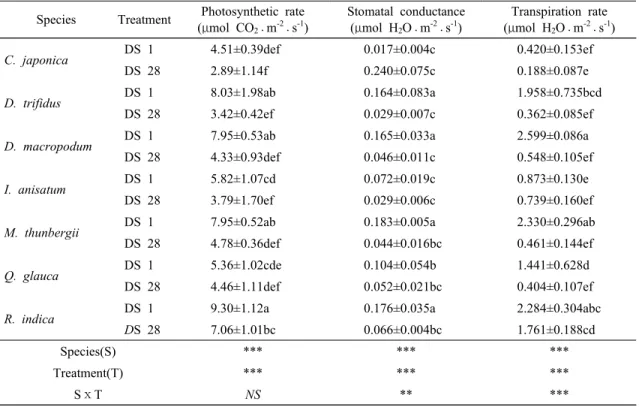
식물이 건조 스트레스를 받게 되면 여러 부위 또는 기관에서 생리적인 장애가 나타나며 특히 광합성 기작 에 많은 피해를 주어 식물 생장을 저하시키는 원인이 된다(Chaves and Oliveira, 2004). 공시수종들의 잎에 서 측정한 광합성 속도와 기공전도도, 기공증산속도는 수종간, 건조 처리간 뚜렷한 차이를 보였으며, 기공전 도도와 증산속도는 수종 및 건조처리간 상호작용도 존 재하였다. 또한 광합성 속도는 수종 및 건조 처리간 뚜렷한 차이를 보였다(Table 2). 광합성 속도는 DS 1 일 후 R. indica 9.30±1.13 μmol CO2⋅m-2s-1로 가장 높았으며, 그 다음으로 D. trifidus 8.03±1.99, M.
thunbergii 7.95±1.37, D. macropodum 7.84±0.53, I.
anisatum 5.82±1.10, Q. glauca 5.36±1.02, C.
japonica 4.51±0.39 μmol CO
2⋅m-2s-1 순으로 나타났 다. DS 28일 후 Q. glauca(16.8%)와 R. indica(24.1%) 를 제외한 모든 수종에서 30% 이상 광합성 속도가 감소하는 경향을 보였으며, 그 중에서 D. trifidus가 57.3%로 가장 크게 감소하였다. 일반적으로 건조 스 트레스는 식물이 기공을 닫도록 유도하고 엽육 내 CO2농도를 감소시켜 광합성을 저해하거나, 또는 직접적으 로 탄소 대사를 저해하여 광합성 감소를 유발시킨다 (Gimenez et al., 1992; Cornic, 2000).
기공전도도 측정 결과, DS 1일째의 잎을 기준으로 DS 28후 감소율은 D. trifidus 81.9, M. thunbergii 76.2, D. macropodum 72.2, R. indica 62.8, I.
anisatum 58.5, Q. glauca 50.0, C. japonica 43.8%
순으로 광합성 속도와 유사한 경향으로 나타났다. 기 공전도도는 광합성 속도와 관련성이 매우 높기 때문에 기공전도도와 광합성 속도는 정(+)의 상관관계를 가진 다(Lim et al., 2006)는 연구결과 일치하였다.
식물은 수분이 부족한 환경에서 수분이용효율을 높 이기 위해 기공을 닫아 광합성 속도보다 증산속도를 더 많이 감소시킨다(Richards and Condon, 1993). 본 연구결과에서도 DS 1일째를 기준으로 DS 28일 후 증 산속도를 조사한 결과 광합성 속도보다 높은 감소율을 보였으며, D. trifidus가 81.5%로 가장 높게 나타났다.
그 다음으로 M. thunbergii 80.2, Q. glauca 80.0, D.
macropodum 78.9, C. japonica 55.1, R. indica 22.9, I. anisatum 15.4% 순으로 나타났다. 또한 증산속도의
감소는 수분손실에 따른 엽 수분량 부족이나 엽의 노 화로 설명될 수 있으며(An et al., 2008), 기공전도도와 증산속도의 감소는 토양 및 엽의 수분부족으로 인한스트레스가 지속되면 세포 내 함수량이 줄어들기 때문 이다(Price et al., 2002).
DS 28일 동안의 수종별 광합성 반응을 조사한 결과
I. anisatum, R. indica, C. japonica는 다른 수종들에
비해 건조 스트레스에 따른 내성이 높은 것으로 조사 되었다. 반면 D. trifidus, M. thunbergii, D.macropodum는 비가오지 않는 28일 기간 동안 평균
온도 28.9℃, 평균 일사량 281.4 W⋅m-2 환경에서는 건조 스트레스에 따른 수분손실이 큰 것으로 조사되었 다. 이처럼 식물별 기공전도도 및 증산속도 차이는 생 육, 엽 부위, 생리학적 차이 등에 의해서 기공수가 다 르고 외부환경에 의한 차이 때문에 나타난다(Cooper and Qualls, 1976; Shearman and Beard, 1972).3.4. 엽록소 형광 반응
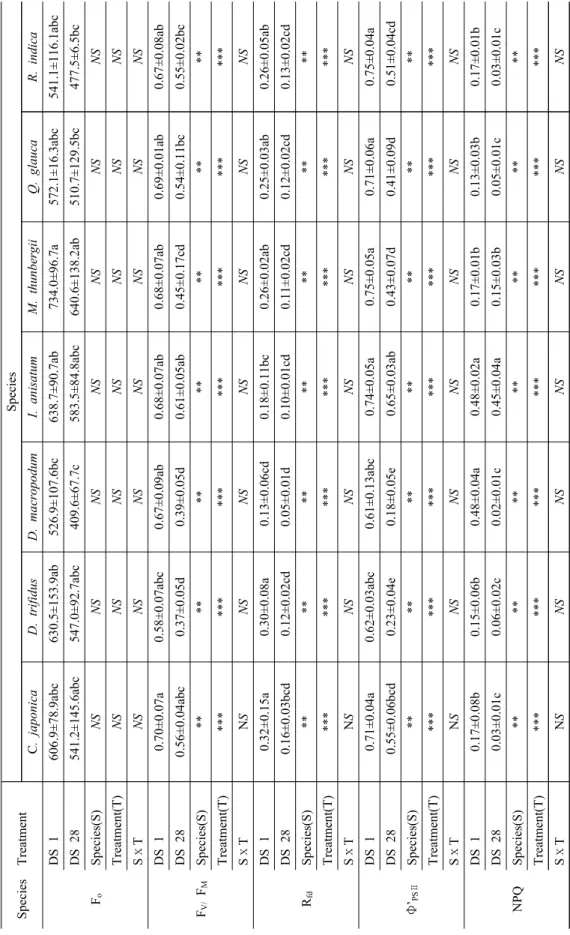
수분부족은 잎에서 광합성 감소를 직접 유도하고 연속적으로 RuBisCO와 같은 광합성 조절 효소의 불 활성화 및 광억제 충격(Photoinhibition damage)을 초 래하기 때문에 궁극적으로 식물의 생육에 치명적인 작 용을 나타내는 생리적 작용을 하는 것으로 알려져 있 다(Medrano et al., 1997). 본 연구에서는 DS 1일째를 기준으로 DS 28일 후 수종별 엽록소 형광반응의 차이 를 분석하기 위해 초기형광수율(Fo), Fv/FM, 광계Ⅱ의 광화학적 양자수율(Φ’PSⅡ), 형광감소량(RFd), 비광화 학적 소멸(NPQ) 등을 형광변수들을 산출하였다 (Table 4). 광계Ⅱ에있는 기저 상태의 엽록소 분자들이 들뜬 후 에너지가 반응중심으로 이동하기 이전에 나오 는 형광을 의미하는(Bolhár-Nordenkampf and Öquist., 1993) Fo 값은 DS 28일 후 8.6∼22.3% 감소 하는 경향을 보여 건조에 의한 스트레스를 받는 것으 로 나타났다. 그 중에서 D. macropodum가 22.3%로 가장 높은 감소율을 보인 반면, I. anisatum 8.6%로 비교적 적은 감소율로 나타났다. 이러한 결과는 엽록 소 함량과 동일한 경향으로 나타났으며, Fo값은 총 엽 록소 함량에 비례(Rysgaard et al., 2001)한다는 연구 결과와 일치하였다.
빛이 없는 상태(암적은)에서의 매개변수인 최대형 광값(Fm)과 변동형광값(Fv)에서 기인하는 PSII 최대 양자 수득율을 나타내는 중요한 변수인 Fv/Fm값은 수 종간, 건조처리 기간간 뚜렷한 차이로 나타났다. DS 1일째는 건조 스트레스를 받지 않았으나, DS 28일 후
D. macropodum(41.1%)> D. trifidus (36.4%)> M.
thunbergii(33.5%)> Q. glauca(21.7%)>C.
Sp ecies T reatmen t Species C . ja po nica D. trifid us D. ma cr op od um I. an isa tum M. th un be rgii Q. g la uc a R . in dica F
oD S 1 60 6. 9±78 .9a bc 6 30. 5± 153. 9a b 526. 9± 107. 6bc 63 8. 7± 90. 7a b 734 .0± 96. 7a 57 2. 1± 16 .3a bc 54 1. 1±11 6. 1a bc D S 28 5 41. 2± 145. 6a bc 54 7. 0± 92 .7a bc 409 .6± 67. 7c 58 3. 5± 84 .8a bc 640. 6± 138. 2a b 510. 7± 129. 5bc 477. 5± 6. 5bc Sp ecies(S) NS NS NS NS NS NS N S T reatmen t(T ) NS NS NS NS NS NS N S S ⅹ T NS NS NS NS NS NS N S F
V/F
MD S 1 0. 70 ±0. 07a 0. 58 ±0 .07a bc 0. 67 ±0. 09a b 0. 68 ±0. 07a b 0. 68 ±0. 07a b 0. 69 ±0. 01a b 0. 67± 0. 08a b D S 28 0. 56 ±0 .04a bc 0. 37 ±0. 05d 0. 39 ±0. 05d 0. 61 ±0. 05a b 0. 45 ±0. 17c d 0. 54 ±0 .11b c 0. 55 ±0. 02bc Sp ec ie s( S ) ** *** ** ** ** * ** Tr ea tm ent (T) *** *** *** *** *** *** *** S ⅹ TN S N SN SN SN SN S N S R
fdD S 1 0. 32 ±0. 15a 0. 30 ±0. 08a 0. 13 ±0. 06c d 0. 18 ±0 .11b c 0. 26 ±0. 02a b 0. 25 ±0. 03a b 0. 26± 0. 05a b D S 28 0. 16± 0. 03 bc d 0. 12 ±0. 02c d 0. 05 ±0. 01d 0. 10 ±0. 01c d 0. 11 ±0. 02c d 0. 12 ±0. 02c d 0. 13± 0. 02c d Sp ec ie s( S ) ** *** ** ** ** * ** Tr ea tm ent (T) *** *** *** *** *** *** *** S ⅹ TN S N SN SN SN SN S N S Φ ’
PSⅡD S 1 0. 71 ±0. 04a 0. 62 ±0 .03a bc 0. 61 ±0 .13a bc 0. 74 ±0. 05a 0. 75 ±0. 05a 0. 71 ±0. 06a 0. 75± 0. 04 a D S 28 0. 55± 0. 06 bc d 0. 23 ±0. 04e 0. 18 ±0. 05e 0. 65 ±0. 03a b 0. 43 ±0. 07d 0. 41 ±0. 09d 0. 51± 0. 04c d Sp ec ie s( S ) ** *** ** ** ** * ** Tr ea tm ent (T) *** *** *** *** *** *** *** S ⅹ TN S N SN SN SN SN S N S NPQ D S 1 0. 17 ±0. 08b 0. 15 ±0. 06b 0. 48 ±0. 04a 0. 48 ±0. 02a 0. 17 ±0. 01b 0. 13 ±0. 03b 0. 17± 0. 01b D S 28 0. 03 ±0. 01c 0. 06 ±0. 02c 0. 02 ±0. 01c 0. 45 ±0. 04a 0. 15 ±0. 03b 0. 05 ±0. 01c 0. 03± 0. 01 c Sp ec ie s( S ) ** *** ** ** ** * ** Tr ea tm ent (T) *** *** *** *** *** *** *** S ⅹ T N S NS NS NS NS NS NS
Ta bl e 4 . Va ri ati on of the Fluoresc ence par am eter s in the cond ition o f no ir rigation .
japonica(20.4%)> R. indica(18.3%)> I. anisatum
(10.8%) 순으로 유의적인(p≤0.001) 감소율을 보여 광 합성 효율 면에서 손실이 발생했을 것으로 판단된다 (Kim and Park, 2013). 이는 지금까지 여러 연구를 통해 증명되어진 결과(Kim et al., 2013; Park et al., 2017)와 일치하였다. Fv/Fm 값은 광화학반응의 각 단 계에 대한 에너지전이 비율 및 형광수율을 의미하는 것으로(Strasser et al., 2000) 건조 스트레스에 따른 호흡량 감소는 세포의 탈수가 심하게 발생할 때이며, 이는 엽록소 형광 수치의 감소를 초래한다(Park, 2013). 따라서 D. macropodum, M. thunbergii, D.trifidus 등 3 수종은 건조스트레스에 민감한 수종으로
판단된다.Φ’PSⅡ은 빛이 노출된 상태에서 열린 광계Ⅱ 반응중 심이 포획한 여기에너지(excitation energy)의 효율성 을 의미하며, 이 값의 감소는 광계Ⅱ에서의 전자 흐름 이 감소하고 있음을 나타낸다(Schreiber et al., 1986;
Genty et al., 1989). DS 28일 후 모든 수종에서 감소하 였으며, 그 중에서 D. macropodum (69.3%), D.
trifidus (62.7%)는 다른 수종들에 비해 높은 감소율을
보였다. Calatayud et al.(2006)은 점진적으로 한발스 트레스를 받게 한 장미에서 Φ’PSⅡ의 광합성 능력(공 간적, 시간적 변화)연구를 수행한 결과 비광화학 과정 은 한발스트레스 조건에서 초기에는 증가하고 상대수분함량은 처리기간이 길어질수록 감소하였으며, 이때 Φ’PSⅡ값은 감소한다고 하였다. 이는 본 연구결과와 일 치하였으며, 유의성 분석을 한 결과 수종간, 건조처리 간 0.1%의 유의성이 인정되었다.
Rfd값을 DS 1일째를 기준으로 DS 28일 후 감소율 을 분석한 결과 46.7∼60.4% 범위를 보였으며, 광합성 속도 반응에서 감소폭이 가장 크게 나타났던
D.
trifidus에서 60.4%로 높은 감소율을 보였다. R
fd는 광 합성능, CO2 광합성능 또는 CO2 고정률과 유의성있는 상관관계를 보이는 것으로 보고된바 있으며 (Lichtenthaler et al., 2005), 수종 및 처리기간간 0.1%의 유의성이 인정되었다. qP값을 분석한 결과 동일하 게 DS 28일 후 감소하는 경향으로 보였으나, 그 감소 폭(0.9∼46.8%)이 다른 매개변수에 비해 미미하였다.
그 중에서 D. macropodum에서 46.8%로 가장 높은 감소율을 보였으며, 앞서 분석한 초기형광수율(Fo), Fv/FM, 광계Ⅱ의 광화학적 양자수율(Φ’PSⅡ), 형광감소 량(RFd) 등의 결과들과 유사한 경향으로 나타나 건조 스트레스에 따른 반응이 뚜렷한 것으로 조사되었다.
과도한 빛에너지에 의해 들뜬 상태의 엽록소가 많 아지면 광계Ⅱ의 상태 변화를 초래하여 빛에너지가 열 에너지로 방출됨으로써 형광이 감소하는데 이를 비광 화학적 형광소멸(non-photochemical fluorescence quenching, NPQ)이라고 한다(Lee et al., 2007). 틸라
Fig. 1. Changes of volumetric water content according to unirrigated period. Vertical bar means standard error(n= 5).
코이드 막을 가로질러 형성되는 ΔpH와 밀접한 관련 이 있는 비광화학적 소멸(NPQ)은 DS 28일 후 감소되 는 경향을 보였다. 특히 DS 28일 후 D. macropodum,
D. trifidus는 DS 1일째에 비해 60% 이상 감소되었으
며, 엽록소 함량 및 광합성 반응과 동일한 경향으로 나타났다. NPQ는 광합성 색소의 손상과 관련되어 있 으며, NPQ감소는 광합성 색소의 손상에 의한 결과로 해석할 수 있다(Ricart et al., 2010; Bilger and Björkman, 1990).전반적으로 DS 28일 이후 광화학적 과정에 이용 하기 위해 포획되는 에너지가 줄어들고 전자전달에 이용되지 못하는 에너지는 증가하여 광계Ⅱ의 활성 이 감소하는 것으로 나타났다. 또한 수종 및 건조처리 간 0.01% 유의성을 보였던 Fv/FM, Φ’PSⅡ, RFd, NPQ 등의 형광변수는 광합성 속도의 현저한 감소와 동일 하게 민감한 반응을 보여 단기간의 건조 스트레스에 따른 조기 진단의 지표로 이용될 수 있을 것으로 판 단된다.
IV. 결 론
수분은 수목의 생장과 생리적 특성에 영향을 미치 는 중요한 인자이다(Wu et al., 2011; Rustad et al., 2001). 또한 토양 내 수분함량은 수목의 직경생장과 수고생장을 결정짓는 중요한 요인중의 하나이다 (Koch et al., 2004). 본 연구에서는 DS 28일 이후 토 양수분함량이 10%이하로 감소되면서 난대 상록활엽 7수종 모두 엽록소 함량 및 광합성 반응, 엽록소 형광 반응이 점진적으로 감소하였다. 특히 D. macropodum 와 D. trifidus는 엽록소 함량 및 광합성 반응, 엽록소 형광을 측정한 결과 DS 1일째를 기준으로 DS 28일 이후 다른 수종에 비해 감소폭이 높아 건조에 따른 민감성이 높은 수종으로 나타났다. 또한 DS 28일 이후 광계Ⅱ의 전자전달이 원활히 수행되지 못하여 흡수한 에너지가 광화학반응에 이용되지 못하여 감소하였다. 전반적으로 난대 상록활엽 7수종은 조경수 및 가로수 식재 시 28일간 평균 온도 28.9℃에서 토양수분함량이 10%미만으로 감소하면 생리적 활성이 저하되는 것으 로 조사되었다. 그 중에서 D. macropodum와 D.
trifidus는 건조한 환경에서는 비교적 취약한 종임을
알 수 있었고, Fo, Fv/FM, Φ’PSⅡ, RFd, qP, NPQ 등의 엽록소 형광 매개를 이용하면 건조 스트레스에 따른 피해를 진단할 수 있을 것으로 판단된다.적 요
본 연구는 현재 국내에서 조경소재로 이용하고 있 는 목본식물 중 동백나무(C. japonica), 황칠나무 (D.
morbifera), 굴거리나무(D. macropodum), 붓순나무(I.
anisatum), 후박나무(M. thunbergii), 종가시나무(Q.
glauca), 다정큼나무(R. indica) 등 7수종에 대해서 건
조 스트레스에 따른 광합성 능력, 엽록소 함량, 엽록소 형광분석에 미치는 영향 및 생리적 환경지표를 알아보 고자 수행하였다. 28일 동안 무관수 상태에서 건조 스 트레스를 유발한 결과 광합성 속도, 암호흡 속도, 기공 전도도, 증산속도는 전반적으로 감소하는 경향을 보였 으나 I. anisatum, Q. glauca 및 R. indica의 경우 무관 수 처리 28일까지 40% 이하의 낮은 감소율을 보였다 (p<0.05). 총 엽록소 함량의 경우 D. macropodum> D.morbifera> C. japonica> Q. glauca> M. thunbergii>
R. indica> I. anisatum 순으로 무관수 기간이 길어질
수록 유의적으로 감소하는 경향으로 나타났다. 엽록소 형광을 분석한 결과 광화학적 소멸(qP)는 변동이 없는 반면, 무관수 28일 이후 광계Ⅱ 활성(Fv/Fm), 암적응 형광값(Fo), 형광감소량(Rfd), 정류상태 광화학적 소광 (NPQ_LSS), 명적응 기간 동안 연속광에 의한 정류상태 PSII양자 수득율 ΦPSII에서 뚜렷한 감소율로 짧은 시 간 내에 정략적으로 파악하는데 있어 유용한 지표가 될 수 있을 것으로 판단된다. 따라서 내건성이 높게 나타난 I. anisatum, Q. glauca, R. indica의 경우 최대 20일 간격으로 물관리를 할 수 있다면 가로수 및 조경 수에 식재하여도 무방할 것으로 판단된다.REFERENCES
An, D. H., Y. T. Kim, D. J. Kim, and J. S. Lee, 2008: The effects of water stress on C3 plant and CAM plant. Korean Society of Environmental
Biology 26, 271-278.
Arnon, D. I., 1945: Copper enzymes in isolated chloroplasts polyphenoloxidase in Beta Vulgaris.
Plant Physiology 24(1), 1-15.
Barbagallo, R. P., K. Oxborough, K. E. Pallett, and N. R. Baker. 2003: Rapid, non-invasive screening for pertubations of metabolism and plant growth using chlorophyll fluorescence imaging. Plant
Physiol 132, 485-493.
Bilger, W., and O. Björkman, 1990: Role of the xanthophyll cycle in photoprotection elucidated by
measurements of light-induced absorbance changes, fluorescence and photosynthesis in leaves of Hedera canariensis. Photosynthesis Research 25, 173-185.
Bolhàr-Nordenkampf, H. R., and Öquist, G., 1993:
Chlorophyll fluorescence as a tool in photosynthesis research. In Photosynthesis and Production in a Changing Envi -ronment, in: Hall, D. O., Scurlock, J. M. O., Bolhàr -Nordenkampf, H. R., Leegood, R. C., Long, S. P.,(eds.), A Field and Laboratory Manual, Chapman and Hall, London, 193-206.
Bousselot, J. M., J. E. Klett, and R. D. Koski, 2011: Moisture content of extensive green root substrate and growth response of 15 temperate plant species during dry down. HortScience 46, 518-522.
Calatayud, A., D. Roca, and P.F. Martinez. 2006:
Spatialtemporal variations in rose leaves under water stress conditions studied by chlorophyll fluorescence imaging. Plant Physiology and
Biochemistry 44(10), 564-573.
Cooper, C. S., and M. Qualls, 1967: Morphology and chlorophyll content of shade and sun leaves of two legumes. Crop Science 7, 672-673.
Cornic, G., 2000: Drought stress inhibits photosynthesis by decreasing stomatal aperture-not by affecting ATP synthesis. Trends in Plant
Science 5, 1360-1385.
Egert, M., and M. Tevini, 2002: Influence of drought on some physiological parameters symptomatic for oxidative stress in leaves of chives(Allium schoenoprasum). Environmental and
Experimental Botany 48(1), 43-49.
Falqueto, A. R., F. S. Silva, D. Cassol, A. M.
Magalhães Júnior, A. C. Oliveir, and M. A.
Bacarin, 2010: Chlorophyll fluorescence in rice:
probing of senescence driven changes of PSII activity on rice varieties differing in grain yield capacity. Brazilian Journal of Plant Physiology
22, 35-41.
Genty, B., J. Harbinson, and N. R. Baker, 1990:
Relative quantum efficiencies of the two photosystems of leaves in photorespiratory and non-photorespiratory conditions. Plant Physiology
and Biochemistry (Paris) 28(1), 1-10.
Genty, B., J. M. Briantais, and N. R. Baker, 1989:
The relationship between the quantum yield of photosynthetic electron transport and quenching of chlorophyll fluorescence. Biochimica et Biophysica
Acta 990, 87-92.
Gimenez, C., V. J. Mitchell, and D. W. Lawlor, 1992: Regulation of photosynthetic rate of two sunflower hybrids under water stress. Plant
Physiology 98, 516-524.
Grobe, E., and A. Calatayud, 2012: Applications of chlorophy Ⅱ fluorescence imaging techniqure in horticultural research: A review. Scientia
Horticulturea 138, 24-35.
Han, S. H., D. H. Kim, K. Y. Lee, J. J. Ku, and P.
G. Kim, 2007: Physiological damages and biochemical alleviation to ozone toxicity in five species of genus Acer. Journal of Korean Forest
Society 96, 551-560.
Hiscox, J. D., and G. F. Israelstam, 1979: A method for the extraction of chlorophyll from leaf tissue without maceration. Canadian Journal of Botany
57, 1322-1334.
Horton, P., A. V. Ruban, A. J. Young, 1999:
Regulation of the structure and function of the light harvesting complexes of photosytem II by the xanthophyll cycle. In the photochemistry of carotenoids, in: Frank, H. A., Young, A. J., Cogdell, R. J., (eds.), Kluwer, Dordrecht, 271-291.
Iglesias, J. D., A. Calatayud, E. Barreno, E.
Primo-Millo, and M. Talon, 2006: Responses of citurs plants to ozone: Leaf biochemistry, antioxidant mechanisms and lipid peroxidation.
Plant Physiology and Biochemistry 44, 125-131.
Kim, H. R., and Y. H. You, 2010: Effects of elevated CO2 concentration and increased temperature on leaf relatedphysiological responses of Phytolacca insularis (native species) and Phytolacca Americana (invasive species). Journal
of Ecology and Field Biology 33, 195-204.
Kim, S. C., and B. J. Park, 2013: Assessment of temperature reduction and heat budget of extensive modular green root system. Korean Journal
Horticultural Science Technology 31(4), 503-511.
Kim, G. N., S. H. Han, and G. S. Park, 2014:
Differences on Growth, Photosynthesis and Pigment Contents of Open-pollinated Pinus
densiflora Families Under Elevated Temperature
and Drought. Korea Journal of Agricultural andForest Meteorology 16, 285-296.
Koch, G. W., S. C. Sillet, G. M. Jennings, and S.
D. Davis, 2004: The limits to tree height. Nature
428, 851-854.
KMA (Korea Meteorological Administration), 2017:
Integrated Drought Information System.
https://drought.kma.go.kr/(2017.07.11).
Lichtenthaler, H. K., G. Langsdorf, S. Lenk, and C.
Busch-mann, 2005: Chlorophyll fluorescence imaging of photosynthetic activity with the flash-lamp fluore -scence imaging system.
Photosynthetica 43, 355-369.
Lee, S. W., D. Y. Park, T. S. Kim, B. T. Yeon, C.
G. Kim, and S. W. Cha, 2007: Effect of soil moisture content on photosynthesis and root yield of Panax ginseng C. A. Meyer seedling. Korean
Journal of Medicinal Crop Science 15, 367-370.
Lee, K. C., S. H. Kim, W. G. Park, and Y. S. Kim, 2014: Effect of Drought Stress on Photosynthetic Capacity and Photosystem Ⅱ Activity in
Oplopanax elatus. Korean Journal of Medicinal Crop Science 22(1), 38-45.
Lee, K. C., and H. B. Lee, 2017: Drought stress influences photosynthesis and water relations parameters of Synurus deltoids. Journal of Korean
Forest Society 3, 228-299.
Lim, J. H., S. Y. Woo, M. J. Kwon, J. H. Chun, and J. H. Shin, 2006: Photosynthetic capacity and water use efficiency under different temperature regimes on healthy and declining Korean fir in Mt. Halla. Journal or Korean Forestry Society 95, 705-710.
Mackinney, G., 1941: Absorption of light by chlorophyll solution. Journal of Biological Chemistry
140(2), 315-322.
Medrano, H., M. A. J. Parry., X. Socias, and D. W.
Lawlor, 1997: Long term water stress inactivates Rubisco in subterranean clover. Annals of Applied
Biology 131(3), 491-501.
Million, J., T. Yeager., and C. Larsen, 2007: Water use and fertilizer response of azalea using several no-leach irrigation methods. HortTechnology 17, 21-25.
Naumann, J. C., D. R. Young, and J. E. Anderson, 2007: Linking leaf chlorophyll fluorescence properties to physiological responses for detection of salt and drought stress in coastal plant species.
Physiologia Plantarum 131, 422-433.
Oh, C. Y., S. H. Han, Y. Y. Kim, and J. C. Lee, 2005: Changes of drought tolerance and photosynthetic characteristics of Populus davidiana dode according to PEG concentration. Korean
Journal of Agricultural and Forest Meteorology 7,
296-302.Park, Y. M., 2013: Characteristic of matter allocation of Calystegia soldanella under water stress.
Journal of Environmental Science International 22(2), 187-193.
Park, S. S., J. H. Choi, and B. J. Park, 2017:
Physiological responses of green roof plants to drought stress. Journal of Korean institute of
landscape architecture 45(2), 51∼59.
Price, A. H., J. E. Cairns, P. Horton, H. G. Jones, and H. Griffiths, 2002: Linking drought-resistance mechanisms to drought avoidance in upland rice using a QTL approach: Progress and new opportunities to integrate stomatal and mesophyll responses. Journal of Experimental Botany 53, 989-1004.
Ricart, M., H. Guasch, D. Barceló, R. Brix, M. H.
Conceicão, A. Geiszinger, M. J. López, J. C.
López-Doval, I. Muñoz, C. Postigo, A. M.
Romaní, Villa de Alda grasa, M., S. Sabater, 2010: Primary and complex stressors in polluted Mediterranean rivers: pesticide effects on biological communities. Journal of Hydrology 383, 52-61.
Richards, R. A., and A. G. Condon, 1993: Challenges
ahead in using carbon isotope discrimination in plant-breeding programs. Academic Press, 451-462.
Rustad, L. E., J. L. Campbell, G. M. Marion, R. J.
Norby, M. J. Mitchell, A. E. Hartley, J. H. C.
Cornelissen, and J. Gurevitch, 2001: A meta-analysis of the response of soil respiration, net nitrogen mineralization, and aboveground plant growth to experimental ecosystem warming.
Oecologia 126, 543-562.
Rysgaard, S., M. Kühl, R. N. Glud, and J. W.
Hansen, 2001: Biomass, production and horizontal patchiness of sea ice algae in a high-Arctic fjord (Young Sound, NE Greenland). Marine Ecology
Progress Series 223, 15-26.
Schreiber, U., U. Schliwa, and W. Bilger, 1986:
Continuous recording of photochemical and nonphotochemical chlorophyll fluorescence quenching with a new type of modulation fluorometer. Photosynthesis Research 10, 51-62.
Shearman, R. C., and J. B. Beard, 1972: Stomatal density and distribution in Agrostis as influenced by species, cultivar, and leaf blade surface and position. Crop Science 12(6), 822-823.
Stocker, T. F., D. Qin, G.-K. Plattner, L. V.
Alexander, S. K. Allen, N. L. Bindoff, F.-M.
Bréon, J. A. Church, U. Cubasch, S. Emori, P.
Forster, P. Friedlingstein, N. Gillett, J. M.
Gregory, D. L. Hartmann, E. Jansen, B. Kirtman, R. Knutti, K. Krishna Kumar, P. Lemke, J.
Marotzke, V. Masson-Delmotte, G. A. Meehl, I. I.
Mokhov, S. Piao, V. Ramaswamy, D. Randall, M.
Rhein, M. Rojas, C. Sabine, D. Shindell, L. D.
Talley, D. G. Vaughan, and S.-P. Xie, 2013: The
Physical Science Basis. Contribution of Working Group I to the Fifth Assessment Report of the Intergovernmental Panel on Climate Change(Eds.).
Cambridge University Press, 33-115.
Strasser, R. J., A. Srivastava, and M.
Tsimilli-Michael, 2000: The fluorescence transient as a tool to characterize and screen photosynthetic samples.
Probing Photosynthesis: Mechanism, Regulation and Adaptation, In M. Yunus, U.
Pathre, P. Mohanty (Eds.), Taylor and Francis, London, UK. 443-480.
Taiz, L., and E. Zeiger, 2006: Plant Physiology(4th ed.). Sinauer Associates. Sunderland. Massachusetts, U.S.A., 672-705.
VanWoert, N. D., D. B. Rowe, J. A. Andresen, C.
l. Rugh, and L. Xiao, 2005: Watering regime and green roof substrate design affect Sedum plant growth. HortScience 40, 659-664.
Wang, Z. X., L. Chen, J. A. i, H. Y. Qin, Y. X.
Liu, P. L. Xu, Z. Q. Jiao, Y. Zhao, and Q. T.
Zhang, 2012: Photosynthesis and Activity of Photosystem II in Response to Drought Stress in Amur Grape (Vitis Amurensis Rupr.). Photosynthetica
50, 189-196.
Wn, Z., P. Dijkstra, G. W. Koch, J. Penuelas, and B. A. Hungate, 2011: Responses of terrestrial ecosystems to tempetature and precipitation change: a meta-analysis of treeline birch(Betula
utilis) saplings, Eastern Tibetan Plateau, China.
European Journal of Forest Research 13, 811-819.
Yoo, S. Y., K. C. Eom, S. H. Park, and T. W.
Kim, 2012: Possibility of Drought stress Indexing by Chlorophyll Fluorescence Imaging Technique in Red Pepper (Capsicum annuum L.). Korean
Journal of Soil Science and Fertilizer 45(5),
676-682.Yu, S. O., and J. H. Bae, 2004: The effect of fertigation setting point on the growth and fruit quality of sweet pepper(Capsicum annuum L.).