보 문
독도 번행초에서 분리된 내생균류의 배양적 특성과 Aspergillus tubingensis YH103 의 gibberellin A7의 생산
유영현1* ・ 박종명2 ・ 임성환3 ・ 강상모4 ・ 박종한5 ・ 이인중4 ・ 김종국2*
1국립해양생물자원관 해양미생물팀, 2경북대학교 생명과학부, 3국립낙동강생물자원관 담수생물다양성연구실,
4경북대학교 응용생명과학부, 5농촌진흥청 국립원예특작과학원 원예특작환경과
Gibberellin A7 production by Aspergillus tubingensis YH103 and cultural characteristics of endophytic fungi isolated from
Tetragonia tetragonoides in Dokdo islands
Young-Hyun You1*, Jong Myong Park2, Sung Hwan Lim3, Sang-Mo Kang4, Jong-Han Park5, In-Jung Lee4, and Jong-Guk Kim2*
1Marine Microorganism Team, National Marine Biodiversity Institute of Korea, Seocheon 33662, Republic of Korea
2School of Life Science, Kyungpook National University, Daegu 41566, Republic of Korea
3Freshwater Biodiversity Research Division, Nakdonggang National Institute of Biological Resources, Sangju 37242, Republic of Korea
4School of Applied Biosciences, Kyungpook National University, Daegu 41566, Republic of Korea
5Horticultural & Herbal Crop Environment Division, National Institute of Horticultural & Herbal Science, Rural Development Administration, Wanju 55365, Republic of Korea
(Received December 28, 2015; Revised February 3, 2016; Accepted February 3, 2016)
ABSTRACT: Coastal plant species Tetragonia tetragonoides (Pall.) Kuntze native to the Dokdo islands was sampled and then 17 endophytic fungi were purely isolated based on morphological differences. The fungal isolates were characterized by their growth properties under NaCl concentration or pH gradient. Culture filtrates of the 17 fungal isolates were treated to Waito-c rice (WR) seedlings for verifying plant growth-promoting activity. As the results, YH103 strain showed the highest plant growth-promoting activity among them. Phylogenetic analysis of the isolates was done by the maximum likelihood method based on partial internal transcribed spacer region (ITS region: contaning ITS1, 5.8S, and ITS2), beta-tubulin (BenA), and calmodulin (CaM) gene sequences. Chromatographic analysis of the strain YH103 culture filtrate showed the existence of gibberellins (GA4, GA7, GA8, and GA19). Finally, the strain YH103 was identified as Aspergillus tubingensis by microscopic observation and molecular analysis and, to our knowledge, this is the first report of GAs producing A. tubingensis.
Key words: Aspergillus tubingensis, endophytic fungi, gibberellin A7, plant growth-promoting activity
*For correspondence. (Y.H. You) E-mail: [email protected] / (J.G. Kim) E-mail: [email protected]
Tel.: +82-41-950-0713; Fax: +82-41-950-0747
독도는 우리나라 동해의 울릉군 죽변면에서 217 km 떨어진 해양성 화산도로 크고 작은 약 89개의 바위섬을 포함한 동도 와 서도로 크게 구분된다(Sung and Ghim, 2010). 또한 대부분
의 지형이 40° 이상의 급경사를 보이며(Ham et al., 2009; Jeon et al., 2009), 도서주변의 해류는 한류와 난류가 접하는 완대류 해역에 속하고 기후적 특징으로 연평균 12°C에 강우량이 많 은 온난·다습한 기후를 가지고 있다. 특히, 내륙과는 멀리 떨어 진 해양성 조건으로 극심한 건조, 강한 바람, 강한 자외선, 염 류, 강우로 인한 유기영양분의 유실로 인해 육상과는 차별화
된 식생을 형성하고 특징적이고 다양한 식물종이 자생한다 (Shin et al., 2004; You et al., 2011, 2015b). 기본적으로 해안식 물(Coastal plants) 자생 종들이 우점하고 있지만 최근에는 외 부인의 출입으로 인해 외래종이 유입되고 있으며, 이러한 문 제에 대응하기 위해 독도 자생식물 종 및 식생에 대한 연구는 지속적으로 이루어지고 있었지만 미생물에 대한 연구는 최근 에 들어서야 점차적으로 연구되고 있는 상황이다.
독도 자생미생물에 대한 연구로는 독도의 특수한 환경조건 으로 인한 다양한 신종세균의 보고가 주를 이루고 있으며 (Yoon et al., 2005), 이외 근권세균의 군집분석(Jeon et al., 2009; Sung and Ghim, 2010), 호염성 세균 (You et al., 2015b, 2015c), 균류(You et al., 2011, 2013b)에 대한 연구가 점진적 으로 이루어지고 있다. 최근에는 독도에서 분리되는 균류 중 에서 식물에 생장활성을 가지는 균류에 대한 연구가 보고되었 는데(You et al., 2011, 2013b), 특히 이들 중 내생균류는 고염 분의 환경에 자생하는 해안식물에 대해 건조, 고온, 염에 대한 내성을 부여하고(Redman et al., 2002; Rodriguez et al., 2004, 2008), 식물체의 생장을 촉진하며 기본적으로 식물역병에 대 한 자체적인 항균활성을 가진다고 보고되고 있다(Redman et al., 2002; Waller et al., 2005; You et al., 2012, 2013a).
특히, 내생균류가 식물체에 대한 생장을 촉진하는 메커니 즘으로 식물생장호르몬인 indole acetic acid (IAA)와 gibberellic acid (GA)를 생산한다고 보고되고 있으며(Khan et al., 2008, 2011; Hamayun et al., 2009) 해안지역에 자생하는 내생균류 가 생산하는 GA는 현재까지 Arthrinium 속(Khan et al., 2009b), Cadophora 속(You et al., 2013a), Gliomastix 속(Khan et al., 2009a), Fusarium 속(Seo et al., 2012) 및 Penicillium 속(Khan et al., 2008; You et al., 2012) 등의 균류에서 생산된다고 보고 되고 있다. 독도는 높은 파도, 주기적으로 발생하는 해무, 괭이 갈매기의 서식활동으로 인한 특수한 환경조건으로 인해 토양 및 근권의 무기물, 염분 함량이 높으며 이러한 환경으로 인해 형성된 독자적인 생태계 내에서 자생하는 식물-미생물의 상 호관계 연구는 척박한 환경에 자생하는 식물과 균류간에 중요 한 기초연구가 될 것이다. 따라서 본 연구는 독도에 자생하는 해안식물로부터 내생균류를 분리하여 배양적 특성을 파악하 고 균류에 의해 만들어지는 유용물질을 탐색하고자 하였다.
재료 및 방법
식물시료의 채집 및 균류의 분리
독도에 자생하고 있는 해안식물인 번행초(Tetragonia tetra-
gonoides (Pall.) Kuntze)를 채집하여 냉장보관 상태로 실험실 로 이동한 후 재료로 사용하였다. 식물시료의 전 처리를 위하 여 계면활성제(Tween 80)와 표백제(Perchloric acid 1.0%) 및 차아염소산나트륨(Sodium hypochlorite 1.0%)을 사용하여 식물체의 표면을 살균하였다(Khan et al., 2008; You et al., 2015a). 표면 살균된 번행초의 뿌리 시료를 2–3 cm 길이로 절단 한 후 뿌리 조각 3–4개씩을 50개의 고체배지 상에 각각 접종하 여 배양하였다. 배양조건은 세균의 증식을 배제하기 위해 스트 렙토마이신(Streptomycin) 80 mg/L이 포함된 hagem minimal (HM) 배지를 사용하여 25°C에서 3–7일간 배양하였다(Rim et al., 2005; You et al., 2012). 뿌리시료의 말단 단면에서 생장해 나온 균사의 순수분리를 위해 새로운 HM 배지에 획선도말하 여 동일한 조건하에서 배양하였으며, 이후에는 형태학적으로 상이한 균류의 선별을 위해 potato dextrose agar (PDA) 배지에 서 계대배양을 반복하였다(You et al., 2015a).
균류의 배양적 특성 분석
번행초의 뿌리로부터 분리된 내생균류는 NaCl의 염농도 (Salinity %)와 pH에 따라 생장을 확인하기 위해 다양한 농도 구배를 적용하여 실험하였다. 염농도는 3.5, 5, 7, 9%의 4종류 의 구배와 pH는 4, 5.5, 9를 적용하였다. 생장유무는 7일을 기 준으로 배양하여 각 조건에 따라 생장의 정도를 판단하였다.
식물생장활성 시험
독도에 자생하는 식물인 번행초의 내생균류로부터 식물생 장촉진 원인물질을 얻기 위한 기본배지로는 Czapek broth medium (CBM)를 사용하였고, 균주당 각각 50 ml의 배지에서 25°C에서 180 rpm 조건으로 진탕배양 하였다(You et al., 2012). 배양액은 여과지(Whatman)를 사용하여 여과한 후 여 과액 30 ml을 동결건조하여 1 ml의 처리용액을 준비하였다 (Khan et al., 2008; You et al., 2012, 2013a, 2015a).
식물생장활성시험은 비교적 다루기가 쉬운 난장이벼(Waito-c rice)의 종자를 1일 동안 스포탁과 유니코나졸(200 mg/L)을 처 리하고 세척한 후 4–5일 동안 증류수에 침지시켜 발아한 종자 를 선별하여 water agar (0.5%)에 파종해서 재배하였다. 6–8일 후에 생장한 유묘를 일정크기에 따라 선별하여 실험에 사용하 였다. 대조구는 sterile distilled water (SDW)과 농축된 CBM 배지를 같은 조건으로 만들어 사용했고 처리구는 난장이벼의 이엽기 엽액부분에 준비한 농축배양 여과액 10 μl를 처리하여 7일 뒤 생장유무를 측정하였다. 지상부 길이(Shoot length)와 식물체 길이(Plant length)를 3회 반복측정하였다. 측정한 난
장이벼의 통계처리는 SPSS 프로그램(Version 18.0)을 이용 하여 일원배치분산분석(ANOVA)으로 기술통계값을 분석 하였고 Duncan's multiple range test (DMRT)를 통하여 사후 검정을 분석해서 유의확률 P < 0.05 수준에서 결과값을 도출 하였다.
균류의 대사산물 분석
식물생장활성이 우수한 균주의 배양여과액을 membrane filter로 여과한 후 pH를 조정하였으며, 내부표준물질로는 20 ng의 [17, 17-2H2] 추정물질(Gibberellin: GA)을 추출하기 전에 균주의 배양여과액에 첨가하였다. 배양여과액에 ethyl acetate (EtOAc)를 첨가하여 휘발처리하였고, methanol을 처리하여 pH 8.3으로 맞추었다. 시료는 C18 column (90–130 μm, 60Å pore size, Altech)과 Celite/SiO2 column (용매 formic acid로 포화된 ethyl acetate : hexane = 95 : 5)을 이용하여 농축하였 다. 또한, 인산완충용액과 EtOAc 및 polyvinylpolypyrrolidone (PVPP)를 이용하여 진탕처리하였다. 그리고 pH를 다시 조정 하고 EtOAc를 처리하여 농축하였으며, 농축된 잔사를 methanol 에 용해시켜 membrane filter로 여과한 후에 분석시료로 사용 하였다(Khan et al., 2009a, 2011; You et al., 2012, 2015a). 내생 균류가 생산하는 이차대사산물의 분석을 위하여 HPLC column 은 μ BondaPak C18 column (3.9 × 300 mm)을 사용하였으며, 후보물질(GA)은 acetic acid (1%)를 포함한 methanol의 농도 구배에 따라 분리하였다. 또한, 건조한 각 후보물질의 분획을 reaction vial에 분주하여 질소가스로 고정화하였고, 후보물질 의 표준시료는 ethereal diazomethane으로 methyl ester로 유도하 여 질소가스로 고정화하였다. 그리고 시료는 dichloromethane 에 용해시켜서 GC/MS [30 m × 0.25 mm (i.d.), 0.25 μm film thickness HP-1 capillary column]에 주입하였고(Khan et al., 2008, 2009a; You et al., 2012, 2015a), hydrocarbon standard 의 정량분석 및 KRI 값을 측정했다. [2H2] 후보물질의 내부표 준물질(Obtained from Prof. Lewis N. Mander, Australian National University, Canberra, Australia)의 3개의 이온질량을 비교하여 정량 분석하였다(Khan et al., 2008; You et al., 2013a, 2015a).
균류의 계통학적 분석 및 동정
Genomic DNA의 분리를 위하여 내생균류를 PDB 배지에 접종한 후 25°C에서 120 rpm으로 5–7일 동안 진탕배양하였으 며, 수확한 균체를 동결건조하여 분석시료로 사용하였다. 시 료는 DNeasy plant mini kit (QIAGEN)를 이용하여 genomic
DNA를 추출하였고, ITS영역 프라이머로는 ITS1 (5′-TCC GTA GGT GAA CCT GCG G-3′)과 ITS4 (5′-TCC TCC GCT TAT TGA TAT GC-3′)를 사용하였으며(White et al., 1990), beta-tubulin 유전자의 프라이머로는 bt2a (5′-GGT AAC CAA ATC GGT GCT GCT TTC-3′)와 bt2b (5′-ACC CTC AGT GTA GTG ACC CTT GGC-3′)를 사용하였다(Glass and Donaldson, 1995). Calmodulin 유전자의 프라이머로는 cmd5 (5′-CCG AGT ACA AGG AGG CCT TC-3′)와 cmd6 (5′-CCG ATA GAG GTC ATA ACG TGG-3′)를(Hong et al., 2006) 사 용하였다. 또한, PCR 산물은 purification kit (AccuPrepPCR
& Gel Extraction Kit, Bioneer)를 사용하여 정제한 후에 염기 서열을 해독하였다. 그리고 염기서열을 NCBI의 GenBank blast 검색을 통하여 상동성이 높은 종과 문헌조사를 통하여 비교분석하였다. 근연종들과 유연관계도 작성은 MEGA 프 로그램(Version 6.0)을 이용하여 ClustalW 방법으로 multiple alignment를 하였으며 phylogenetic tree는 maximum likelihood (ML) 방법을 이용하여 Tamura-nei 상수모델 알고리즘으로 분 류학적 위치를 확인하여 동정을 수행하였다(Tamura et al., 2013; You et al., 2015a).
유용균류의 형태적인 관찰
우수한 식물생장 활성을 보인 균주의 형태학적 관찰을 위 해 malt extract agar (MEA), czapek yeast extract agar (CYA) 및 creatine sucrose agar (CREA) 배지를 사용하였으며, 균주 는 25°C에서 1주일간 해당 배지에서 배양한 후 관찰하였다.
또한, MEA 배지에서 생장한 내생균류를 광학현미경(Carl Zeiss)으로 관찰하여 분생포자경(Conidiophore)과 분생포자 (Conidium) 등을 관찰하였다.
결 과
균류의 배양적인 특성 분석
번행초 뿌리에서 분리된 17균주의 내생균류를 염농도와 pH에 따라 생장을 확인했으며, 7일 배양하여 생장이 우수한 것에 비교하여 판단하였다. 염농도 3.5%, 5%에서는 거의 대 부분 분리 균주들이 무리없이 생장하였으며, pH의 변화에서 는 4, 5.5에서 생장능이 우수하였으나 pH 9에서는 생장이 이 루어 지지 않은 경우가 다수 확인되었다. 대부분의 균류들이 다양한 염농도에서 비교적 생장이 좋은 편이었으며, 특정의
Table 1. The cultural characteristics by salinity and pH value of endophytic fungi isolated from Tetragonia tetragonoides
Fungal isolates
Salinity (%) pH value
3.5% 5% 7% 9% pH 4 pH 5.5 pH 9
YH101 +++ +++ + - +++ +++ -
YH102 +++ +++ ++ + +++ +++ +
YH103 +++ +++ +++ ++ +++ +++ ++
YH104 +++ +++ ++ + +++ +++ ++
YH105 +++ +++ ++ + +++ +++ +
YH106 +++ +++ +++ +++ +++ +++ +
YH107 +++ +++ +++ +++ +++ +++ ++
YH108 +++ +++ +++ + +++ +++ +
YH109 +++ +++ +++ +++ +++ +++ ++
YH110 +++ +++ ++ + +++ +++ -
YH111 +++ +++ +++ ++ +++ +++ ++
YH112 +++ +++ +++ ++ +++ +++ ++
YH113 +++ +++ ++ ++ +++ +++ ++
YH114 +++ +++ +++ + +++ +++ +
YH115 +++ +++ +++ ++ +++ +++ +
YH116 +++ +++ +++ ++ +++ +++ ++
YH117 +++ +++ +++ ++ +++ +++ ++
-, no growth (1–2 cm); +, weak growth (2–3 cm); ++, good growth (3–4 cm); +++, very good growth (4–8 cm).
Table 2. Screening for plant growth-promoting activity of Waito-c rice seedling with fungal culture filtrates of endophytic fungal strains isolated from root
of Tetragonia tetragonoides (cm)
Fungal isolates SL PL Fungal isolates SL PL
SDW 5.00 ± 0.25ijkl 8.76 ± 0.31ij YH109 4.78 ± 0.37jkl 9.16 ± 0.52i
CBM 5.55 ± 0.24efgh 10.24 ± 0.37fgh YH110 5.88 ± 0.24cde 12.34 ± 0.59b
YH101 5.74 ± 0.36def 10.76 ± 0.40efg YH111 4.58 ± 0.38l 11.10 ± 0.34de
YH102 5.12 ± 0.29hij 9.42 ± 0.48fgh YH112 6.88 ± 0.34b 12.44 ± 0.34b
YH103 9.11 ± 0.40a 10.64 ± 0.65a YH113 5.04 ± 0.40ijk 10.88 ± 0.36ef
YH104 5.38 ± 0.26efgh 10.14 ± 0.43gh YH114 6.22 ± 0.19c 12.14 ± 0.62bc
YH105 5.60 ± 0.45defg 11.94 ± 0.52bc YH115 5.24 ± 0.11ghi 8.28 ± 0.44j
YH106 5.10 ± 0.22hij 9.82 ± 0.43h YH116 6.20 ± 0.37c 11.92 ± 0.33bc
YH107 5.96 ± 0.29cd 11.66 ± 0.48cd YH117 4.62 ± 0.26kl 10.50 ± 0.56efg
YH108 5.04 ± 0.34ijk 11.96 ± 0.52bc
The ten microliters of concentrated fungal culture filtrates (FCFs) were treated to Waito-c rice (WR) seedlings. The shoot length and plant length of WR seedlings were measured after a week of treatment (You et al., 2015a). According to Duncan's multiple range test (DMRT) (P < 0.05), the different letters in a row indicate significant differences. The letters indicate that values are not significantly different. Data are showed as mean value ± standard deviation. SL, Shoot length; PL, Plant length; SDW, sterile distilled water; CBM, lyophilized liquid of Czapek broth medium.
pH 조건에서는 염농도 보다는 균사가 약하게 자라는 것으로 확인되었다(Table 1).
균류의 식물생장활성 시험
번행초의 뿌리로부터 순수 분리하여 형태적으로 다른 17개 의 내생균류 균주를 선발하였으며 이들을 CBM 배지에 배양
하여 농축배양 여과액을 발아한 난장이유묘에 처리하여 7일 간 배양하였다. 대조구로서 SDW를 처리한 경우에는 지상부 의 길이가 5.00 cm이었고 식물체의 길이는 8.76 cm로 측정되 었다. 또한, 대조구로서 CBM 배지를 농축하여 처리한 경우에 는 지상부의 길이가 5.55 cm이었고 식물체의 길이는 10.24 cm 로 측정되었다. YH109 균주군에서 지상부 생장이 가장 낮은 4.78 cm이었고, 식물체길이는 SDW와 CBM 배지를 처리한 중간정도인 9.16 cm으로 측정되었다. 또한, YH103 균주군이 다른 처리구와 대조구보다 생장활성이 가장 우수하였고 지상 부 및 식물체길이가 각각 9.22 cm와 18.12 cm로 측정되었다.
그리고 전체시료의 통계분석에서 지상부길이는 12 그룹(a–l) 으로 구분되었고 식물체 길이는 10 그룹(a–j)으로 분류되었다 (Table 2).
균류의 대사산물 정량분석
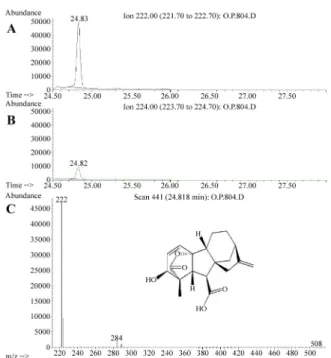
식물생장활성 시험을 통해 YH103 균주의 배양액에는 식 물생장활성을 유도하거나 활성하는 물질이 함유되어 있다고 판단되었다. 이에 따라 본 연구에서는 IAA와 GA에 대한 분석 을 실시하기로 하였다. YH103 균주의 농축배양 여과액을 추 출하여 HPLC의 retention time을 확인해서 후보물질을 최종 선정하였다. GC-MS를 통해 배양여과액을 표준물질과 비교 분석한 결과 IAA는 검출되지 않았으며 GA는 4종류가 확인되 었다. 분석된 GA들은 GA4 (0.01 ng/ml), GA7 (1.63 ng/ml)과 GA8 (0.02 ng/ml), GA19 (0.05 ng/ml)이고 표준물질과 비교해 서 정량분석 할 수 있었으며, 식물활성 GA로 알려진 GA4과 GA7이 확인되었다(Fig. 1).
Fig. 2. Combined phylogenic tree for ITS, BenA and CaM of Aspergillus section Nigri. A. porphyreostipitatus sp. nov. CBS 138203T was used as outgroup in these analyses (KJ775564, KJ775080, and KJ775338). Numbers above branches are bootstrap values. Only values above 70% are indicated. The ‘T’ after the collection number indicates the type strain of the species (T=Type, NT=Neotype). Bar, 0.02 substitutions per nucleotide position; combined alignment 1,240 bp. CBS culture collection of the CBS-KNAW Fungal Biodiversity Centre, Utrecht, Netherlands.
Fig. 1. The GC-MS SIM spectra for GA
7in fungal culture filtrate of the Aspergillus tubingensis YH103. GC-MS peak of A. tubingensis YH103;
(A) GC-MS peak of fungal culture filtrate, and (B) GC-MS peak of standard GA
7, (C) Ion value of standard GA
7.
유용균류의 동정 및 계통학적 분석
GA를 생산하는 YH103 균주의 동정을 위해 ITS 영역 [KU356312], beta-tubulin (BenA) 유전자[KU356313] 및 calmodulin (CaM) 유전자[KU356314]의 염기서열을 NCBI GenBank에 등록하고 고유번호를 부여받았다. 분류학적인 위 치를 확인하였을 때 YH103균주는 Aspergillus section Nigri 에 속하는 것이 확인되었고, A. tubingensis CBS 134.48T 균주 와 같은 종으로 추정되었다. 계통학적 분석은 Aspergillus section Nigri에 속하는 표준균주와 참고균주를 이용했고, out- group으로는 Aspergillus porphyreostipitatus sp. nov. CBS 138203T (KJ775564, KJ775080, KJ775338)를 사용하여 유연 관계를 확인하였다(Varga et al., 2011) (Fig. 2). 또한, 근연종 으로는 A. neoniger CBS 115657, A. brasiliensis CBS 101740T 및 A. awamori CBS 557.65T이 비교적 가까운 것으로 확인되 었다.
유용균류의 형태적인 관찰
MEA, CYA, CREA 배지에서 배양한 YH103 균주의 형태
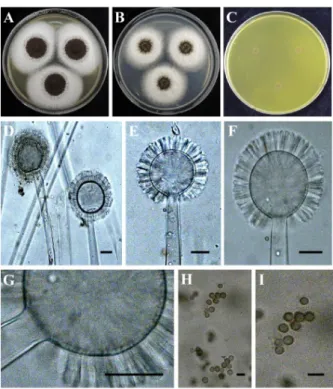
Fig. 3. Morphological description of Aspergillus tubingensis YH103 isolated from root of T. tetragonoides. The A. tubingensis YH103 (A) Colonies on MEA, (B) Colonies on CYA, (C) Colonies on CREA, (D –G) Conidiophores, (H –I) Conidia.
학적인 특징을 참고하고, 이에 더하여 광학현미경을 이용한 분생포자경과 분생포자의 미세구조 관찰을 통해 형태학적 분 석을 실시하였다. YH103 균주는 7일 동안 25°C에서 배양했 을 때, MEA (5.0–5.1 mm), CYA (3.8–3.9 mm), CREA (2.1–2.2 mm)의 생장을 나타내었다.
미세구조는 소낭(Vesicle)이 21–23 μm의 크기에 약간 부드 러운 편이었고, 자루(Stipe)는 8.0–6.5 μm의 넓이에 표면이 거 칠게 보였다.
분생포자(Conidia)는 2.0–3.0 × 2.0–3.0 μm 크기인 것을 관 찰할 수 있었고 경자(Conidiophore)의 형태와 분생포자의 형 태를 비교하였을 때에 A. tubingensis와 흡사한 형태를 나타내 었다(Fig. 3). 분자적인 특징과 형태적인 특징을 토대로 YH103 균주는 A. tubingensis Mosseray으로 최종 동정되었다.
고 찰
독도에 자생하는 식생에 대한 생태학적인 연구를 비롯해 다양한 연구들이 지속적으로 진행되고는 있지만 미생물에 대 한 연구는 신종 및 미기록 종에 대한 보고가 주를 이루고 있는 추세이다. 이에 반하여 유용미생물 등에 대한 연구는 거의 이
루어지지 않았을 뿐만 아니라 특히 유용한 활성을 가진 균류 에 대한 연구는 거의 없다고 할 수 있다. 본 연구에서 내생균류 의 분리에 사용된 번행초는 제주도와 독도에 주로 자생하고 있고, 울릉도와 동해안에서는 비교적 찾아보기가 힘들다. 번 행초는 속씨식물문, 쌍떡잎식물강, 중심자목, 번행초과에 속 하고, 자생지는 한국을 포함한 동남아시아, 오스트레일리아, 남아메리카 등에서 자생하며 이명으로는 번향 또는 갯상추라 고도 불리고 있다. 주로 해수와 육지의 경계지점에 자생하며 염농도가 높음에도 불구하고 자생하고 있어 염에 상당한 내성 을 가지고 있거나, 염분을 생장에 활용한다고 볼 수 있다. 본 연 구는 해양성 균류의 다양성 및 척박한 환경에 자생하는 식물- 균류 상호작용 연구를 위하여 독도 자생식물의 뿌리 내생균류 에서 형태학적으로 상이한 다른 17균주를 분리하여 염농도와 pH 농도구배에 따라 생장능과 생장유무를 확인하였다. 독도 는 해무, 파고 등으로 인한 해수의 극심한 침투, 조류의 활동으 로 인해 토양은 유기물 함량이 매우 낮고 약산성을 나타내며 내륙 토양보다 염농도가 상대적으로 높다. 따라서 번행초가 이러한 독특한 환경에 자생할 수 있다는 점은 내생균류의 영 향을 받을 가능성이 크다고 할 수 있다. 일반적으로 미생물이 생장 가능한 염 농도에 따라 9.0% (w/v) 이상의 NaCl 농도에 서 자라는 경우 극호염(extreme halophilic), 7.0% (w/v) 혹은 3.5% (w/v) 이상에서 자라는 경우 호염성균(slight or moderate halophilic)으로 구분하며, 3.5% (w/v) 농도 근방에서 생장하는 경우 호염성이 아닌 단순한 halo-tolerant로 구분된다(Kushner, 1985). 본 연구에서 대부분의 분리 균류가 기본적으로 3.5%
및 5.0%의 농도범위에서 무리없이 생장하며, 7–9% 농도에서 생장이 감소하기는 하지만 대부분이 생장이 가능한 것으로 미 루어 볼 때 염생식물이 그들의 생장을 위해 염분을 필요로 하 며, 이로 인해 번행초와 상호작용 하는 내생균류 또한 상당한 호염성 혹은 염 내성을 확보하였을 것으로 판단되는 결과이 다. 또한 분리균주들이 pH 4.0–5.5의 산성조건에서도 원활한 생장을 보였으나, pH 9와 같은 알칼리 조건에서 생장이 크게 둔화되는 것은 이들 내생균류가 독도 토양 특유의 약산성 조 건에서 어느 정도 적응한 결과로 생각된다. 이처럼 특정한 특 성을 보이는 환경과 식물 식생들은 그들 나름대로의 특이적인 상호작용을 하고 있으며, 또한 이러한 환경 및 숙주식물과 상 호작용하는 내생균류들 또한 그들의 생리에 있어 적응된 패턴 을 보인다고 할 수 있다. 일반적으로 내생균류가 식물의 생장 을 촉진하는 활성을 가지므로 해안사구 복원 혹은 염해에 대 응하는 수단으로 활용될 수 있다고 보고되고 있는데, 본 연구 를 참조하면 특정 환경에 적응된 내생균류의 활용이 매우 중 요할 것으로 생각된다.
분리된 내생균류가 가지는 특성을 확인하기 위하여 식물생 장활성 시험을 수행하였는데 YH109 균주의 경우에 지상부의 길이가 가장 낮은 것으로 확인되었고, 뿌리생장에서는 다른 대조구들과 차이가 크지 않았지만 지상부의 경우에 적은 양이 지만 식물생장을 저해하는 물질이 미량 함유되어 있을 가능성 이 있을 것으로 생각된다. 특히, 식물생장활성이 우수한 조건 의 결과는 YH103 균주가 가장 높은 활성을 나타내었고, 물질 분석을 통해 생산량이 많은 GA7이 분석되었으며 활성호르몬 인 GA4는 소량이지만 GA8, GA19는 불활성물질인 것을 감안 해서 본 연구에서는 배제하여 해석하였다. GA는 식물호르몬 (Phytohormone)으로서 현재까지 약 136종류가 알려져 있지 만 활성을 나타내는 GA1,GA3, GA4 및 GA7으로써 4종류 밖 에 되지 않으며 식물과 박테리아, 균류에서 생성한다고 알려 져 있다. 활성 GA의 4종류가 식물에 따라 미치는 영향은 각 각 다르고, 4종류가 가지는 고유활성 또한 다르며 미생물마다 생합성 기작과 활성이 다르다고 할 수 있다. GA는 식물에 생 리활성을 나타내며 특히, 내생균류와 유용미생물에 대한 연구 소재로서 환경분야와 농업분야에서 보고되고 있다(Rim et al., 2005; You et al., 2012). 그러나 이러한 균류들이 일반환경에 서는 발굴이 잘 되지 않는데 반해 척박한 생태계나 염 환경생 태계에서 비교적 발굴이 높은 편이라고 할 수 있다. 해안생태 계에 자생하는 내생균류에 의해 식물호르몬을 생산한다는 몇 몇의 균류들이 보고되고 있다(Khan et al., 2008; You et al., 2013a). 특히, 본 연구에서 분리된 내생균류인 A. tubingensis 에 의해 생리활성물질이나 항진균성 물질연구 등에 대한 연구 도 보고되고 있으며(Kriaa et al., 2015; Ma et al., 2015), 이처럼 다양한 응용연구에도 활용되는 이런 내생균류가 가지는 잠재 능력은 상당히 크다고 할 수 있다. 또한, A. tubingensis에서 GA 를 생산하는 것은 처음 보고되는 것이고, 앞으로 많은 종들에 서 알려질 것으로 생각된다. 본 연구는 해양성 생태계에 자생 하는 식물-내생균류의 상호작용에 관한 연구이며, 상대적으 로 연구가 진행되지 않은 척박한 환경이나 해안지역에서 자생 하는 다양한 미생물들이 고염분, 산성 등의 특수한 토양환경 에 적응하면서 식물의 생장을 촉진하는 능력을 가진다는 것을 보여주고 있다. 그래서 내생균류는 앞으로 균류분야의 생물소 재로서 기초연구와 활용연구에 중요하다고 생각된다.
적 요
독도에 자생하는 번행초의 뿌리로부터 순수 분리하여 형태 적으로 상이한 17개의 내생균류를 선별하였다. 또한 분리된
균류들에 대하여 각각의 염농도와 pH 농도 구배에 따라 생장 시험을 확인하였다. 내생균류에 대해 각각 난장이벼의 유묘에 식물생장활성시험을 진행하였고, 그 결과 YH103 균주가 가 장 높은 활성을 나타내었다. 계통분석은 Maximum likelihood 방법을 활용하여 결합된 ITS영역, beta-tubulin 및 calmodulin 유전자 염기서열을 분석하여 분리된 균주의 유연관계를 분석 하였다. YH103 균주의 배양여과액을 HPLC와 GC/MS SIM 을 이용하여 분석한 결과 식물호르몬인 지베렐린 GA4, GA7, GA8 및 GA19가 확인되었다. 최종적으로 YH103 균주의 형태 학적 관찰 및 결합된 유전자 염기서열의 분자적 분석을 통해 GA를 생산하는 새로운 Aspergillus tubingensis로 동정되었다.
감사의 말
이 논문은 2016년 국립해양생물자원관 재원으로 지원을 받 아 수행된 연구임(2016M00400).
References