The Korean Journal of Mycology 한국균학회지
© The Korean Society of Mycology Kor. J. Mycol. 39(3) : 223-226 (2011)
DOI:10.4489/KJM.2010.39.3.223
223
송이버섯과 공생하는 소나무 세근으로부터 분리된 내생균의 다양성
유영현1†·윤혁준1†·우주리1·임순옥1·이진형1·공원식2·김종국1*
1경북대학교 생명과학부, 2농촌진흥청 국립원예특작과학원 버섯과
Diversity of Endophytic Fungi Isolated from the Rootlet of Pinus densiflora Colonized by Tricholoma matsutake
Young-Hyun You1†, Hyeokjun Yoon1†, Ju-Ri Woo1, Soon-Ok Rim1, Jin-Hyung Lee1, Won-Sik Kong2 and Jong-Guk Kim1*
1Department of Life Sciences and Biotechnology, Kyungpook National University, Daegu 702-701, Korea
2National Institute of Horticultural & Herbal Science, RDA, Korea
(Received 9, August 2011., 1st Revised 8, September 2011., Accepted 6, November 2011)
ABSTRACT : Endophytic fungi were isolated from the Pinus densiflora rootlet colonized by ectomycorrhizal fungus Tricholoma matsutake. Eighteen species of endophytic fungi were identified by analyzing rDNA-ITS sequence. As the result of the rDNA-ITS analysis, ascomycota of 15 species and Mucoromycotina of 3 species were isolated. Of all the endophytic fungi isolated, Penicillium sp. was confirmed as the highest frequency.
KEYWORDS : Diversity, Endophytic fungi, Pinus densiflora rootlet, Ribosomal DNA-ITS, Tricholoma matsutake
송이버섯(Tricholoma matsutake)은 소나무(Pinus densiflora) 뿌리 끝부분인 세근에 붙어사는 외생균근으로, 소나무로 부터 탄수화물을 공급받으며 무기양분의 일부를 소나무에 공급하는 활물공생균으로 알려져 있다(Koo, 2005; Yamada et al., 1999). 소나무는 가장 넓게 서식하고 있는 우리나 라의 대표 수종으로서 온대림 대부분에 분포하고 있으며, 그 영역은 우리나라와 일본 및 만주영역까지 분포하고 있다 (양, 2002; Farjon, 2005). 그러나 모든 소나무림에서 송이 가 발생하는 것이 아니며, 송이가 발생할 수 있는 특정 환경 을 가지는 소나무림에서만 발생하는 특수미생물로 알려져 있 다(송과 민, 1991; 이 등, 1986; Gong et al., 2002).
메틸 트랜스 신나메이트(Methyl trans-cinnamate), 마츠 다케올(1-octen-3-ol)과 같은 독특한 향기성분을 가지고 있는 송이는 씹는 맛이 일품이며, 한국, 일본, 중국 등 아 시아 전역에서 선호하는 버섯식품이다(안과 이, 1986). 그러나 현재까지 송이버섯의 인공재배법은 개발 중에 있으며, 생 산량은 그 해의 온도, 강수량, 소나무림 환경, 소나무 재 선충병, 산불 등에 많은 영향을 받기 때문에 해마다 발생 하는 송이 생산량에는 큰 차이가 있다.
송이 인공재배와 관련하여 송이가 발생하는 기후특성 분석, 송이균사 재배용 배지조성 및 발효기, 어린 소나무 묘에 송이균 감염 연구 등이 활발하게 진행되고 있으나(김과
조, 2006; 심 등, 2007; Park et al., 2004), 현재까지 송이 생육의 결정적 메카니즘은 명확하게 해결되지 않은 난제 이다. 또한 송이 발생에 영향을 주는 기후, 기주특이성 외의 다른 외부요인으로 토양(가 등, 2010; 허와 박, 2001) 또는 소나무 뿌리에 서식하는 미생물들의 다양성과 이들과의 상호작용에 관한 연구는 상당히 미비한 실정이다.
본 연구에서는 경상북도 가창의 산림에서 자생하는 송 이버섯과 공생관계인 소나무 세근(Pinus densiflora rootlet) 을 채집하였으며, Clay and Holah (1999) 그리고 Fisher 등 (1984)의 연구방법에 따라 소나무 세근의 내생균을 분 리하여 rDNA-ITS 영역을 이용하여 동정 및 내생균의 다 양성에 대하여 조사 하였다.
소나무 세근을 계면활성제인 Tween 80을 첨가하고 10분 동안 교반 후, 증류수로 세척하였다. 그리고 과염소산 (Perchloric acid) 1%에 10분 동안 2회 교반 후, 증류수로 세척하였으며 수분을 제거하였다. 그리고 내생균을 분리하기 위하여 배지는 Hagem 배지(Glucose 0.5%, KH2PO4 0.05%, MgSO4 7H2O 0.05%, NH4Cl 0.05%, FeCl3 0.05%, Streptomycin 0.1%, pH 5.6)를 사용하여 25oC 조건하에 배 양하였다(Khan et al., 2008; Rim et al., 2007). 그리고 PDA (Potato Dextrose Agar)배지로 옮겨 25oC 조건하에 계대배 양하여 124점의 내생균을 순수 분리하였다. 그리고 형태 학(morphology)적으로 다른 내생균을 선별하여 18종을 선별 하였다.
*Corresponding author <E-mail : [email protected]>
†Both authors contributed equally to this work.
224 유영현 등
소나무 세근에서 분리한 내생균은(Kil et al., 2009) Potato Dextrose Broth (PDB)배지에 접종하여 25oC에서 100 rpm의 조건으로 7일간 진탕 배양하였으며, filter paper를 사용하여 배양액을 여과하였다. 그리고 균체는 동결건조 수행 후에 DNeasy Plant Mini Kit (Qiagen, Valencia, CA)를 이용하 여 genomic DNA를 추출하였다(Khan et al., 2008). 추출 된 genomic DNA는 universal primer ITS1 (5´-TCC GTA GGT GAA CCT GCG G-3´)과 ITS4 (5´-GGA AGT AAA AGT CGT AAC AAG G-3´)를 사용하여 rDNA-ITS영역을 증폭하였다(Khan et al., 2008; Rim et al., 2007). 그리고 PCR (Polymerase Chain Reaction) 조건은 최종농도 10 mM Tris-HCl (pH 8.5), 40 mM KCl, 1.5 mM MgCl2, 200 nM dNTPs이고, 10 pmol의 primer와 0.1 unit의 Ex-Taq DNA polymerase (Takara)를 사용하였으며, 50 ul로 반응용량을 맞추어 사용하였다. 반응조건은 predenaturation (95oC, 2 min), denaturation (95oC, 30 Sec), annealing (54.5oC, 1 min), extension (72oC, 1 min), total cycles (35 cycles), final extension (72oC, 7 min) 수행하였으며, 증폭된 PCR 산물은 1.5% agarose gel에서 전기영동 후, EtBr (Ethidium bromide)로 15분 염색하여 UV transilluminator에서 밴드를 확인 하였 다. 그리고 증폭된 단편들은 QIAquick PCR purification kit (Qiagen)를 사용하여 정제하였고, ABI PRISM BigDye Terminator Cycle Sequencing Kit (PE Biosystems, Foster,
CA, USA)와 ABI 310 DNA sequencer (Perkin Elmer, Foster, CA, USA)를 이용하여 염기서열을 결정하였다(Seo et al., 2009). 그리고 ClustalX로 다중정렬을 수행한 후, Lasergene 7 과 BioEdit 프로그램을 이용하여 염기서열을 정리하였다.
그리고 내생균주 종들 간에 계통분석은 MEGA 4.1프로 그램 Neighbor-Joining (NJ) 방법으로 분석하였다(Khan et al., 2008).
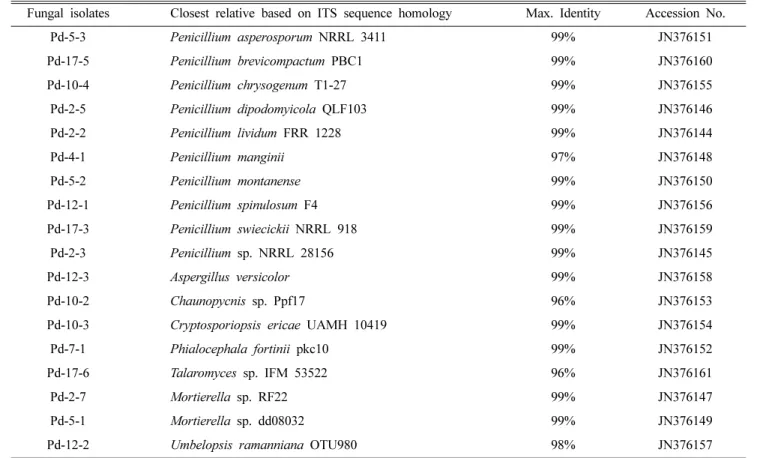
소나무 세근에서 분리한 내생균의 분자적인 동정을 위 하여 rDNA-ITS 영역의 염기서열을 blastn 프로그램을 이 용하여 분석하였으며, 분리된 균류들과 서열 상동성이 가 장 높은 균류들을 분석하였다.
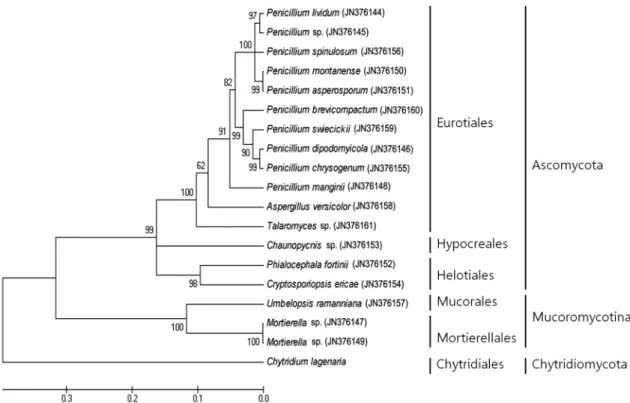
소나무 세근에서 분리된 내생균들은 계통분류에 따라 크게 2가지의 그룹으로 분류 되었다(Fig. 1). 첫 번째 그 룹은 자낭균문(Ascomycota)에 속하였으며, Trichocomaceae과 에 속하는 Penicillium속과 Aspergillus속 그리고 Talaromyces속 을 확인 하였고, 분류체계가 명확하지 않은 Helotiales목에 속 하는 Phialocephala속을 동정하였다. 그리고 Clavicipitaceae과 에 속하는 Chaunopycnis속과 Dermateaceae과에 속하는 Cryptosporiopsis속이 동정 되었다. 두 번째 그룹은 털곰 팡이 아문(Mucoromycotina)으로서 Mortierellaceae과에 속하는 Mortierella속과 Umbelopsis속을 동정 하였다. 소 나무 세근에서 분리된 내생균의 빈도는 자낭균문에 속하는 Penicillium속 10 종, Aspergillus속 1종, Talaromyces속 1종,
Fig. 1. Phylogenetic analysis of endophytic fungi using rDNA-ITS sequences Phylogenetic tree (Neighbour-joining: 1000 bootstrap replications) was constructed using 19 taxa (18 reference sequences and 1 clone). Phylogenetic tree showed that all isolated endophytic fungi belong to the order and phylum (Ascomycota and subphylum Mucoromycotina). Chytridium lagenaria was used as outgroup.
송이버섯과 공생하는 소나무 세근으로부터 분리된 내생균의 다양성 225
Phialocephala속 1종, Chaunopycnis속 1종, Cryptosporiopsis속 1종이 동정되었고, 털곰팡이 아문에 속하는 Mortierella속 2종과 Umbelopsis속 1종이 분리 및 동정되었다. 그리고 분리 된 내생균은 자낭균문에 속하는 내생균 15종과 털곰팡이 아
문 3종이 분리 동정되었고, 자낭균문에 속하는 Penicillium속 내생균이 10종으로 가장 높은 빈도를 나타내었다(Table 2).
그리고 Chaunopycnis속의 Pd-10-2 (JN376153)와 Pd-17-6 (JN376161)는 ITS영역을 blastn으로 분석하였을 때, 두 균주 는 모두 96% (Pd-10-2, Pd-17-6)의 상동성을 확인 할 수 있었다.
본 연구는 송이버섯과 공생관계에 있는 소나무 세근의 내생균을 분리하여 동정을 수행하였으며, 공생관계 연구 가 부족한 내생균의 다양성을 확인하고자 하였다.
적요
송이버섯 생육지의 소나무세근으로부터 내생균이 분리 되었다. 분리된 내생균을 rDNA-ITS 영역으로 동정한 결과 18종이 확인 되었으며, 이중에는 자낭균류 15종, 털곰팡이 아문 3종이 포함되어 있음이 확인 되었다. 본 연구의 내 생균 중에는 Penicillium속 균주가 가장 높은 빈도로 생육 하고 있음이 확인되었다.
감사의 글
본 논문은 농촌진흥청 차세대 바이오그린21사업(과제번 Table 1. Molecular identification of endophytic fungi isolated in this study
Fungal isolates Closest relative based on ITS sequence homology Max. Identity Accession No.
Pd-5-3 Penicillium asperosporum NRRL 3411 99% JN376151
Pd-17-5 Penicillium brevicompactum PBC1 99% JN376160
Pd-10-4 Penicillium chrysogenum T1-27 99% JN376155
Pd-2-5 Penicillium dipodomyicola QLF103 99% JN376146
Pd-2-2 Penicillium lividum FRR 1228 99% JN376144
Pd-4-1 Penicillium manginii 97% JN376148
Pd-5-2 Penicillium montanense 99% JN376150
Pd-12-1 Penicillium spinulosum F4 99% JN376156
Pd-17-3 Penicillium swiecickii NRRL 918 99% JN376159
Pd-2-3 Penicillium sp. NRRL 28156 99% JN376145
Pd-12-3 Aspergillus versicolor 99% JN376158
Pd-10-2 Chaunopycnis sp. Ppf17 96% JN376153
Pd-10-3 Cryptosporiopsis ericae UAMH 10419 99% JN376154
Pd-7-1 Phialocephala fortinii pkc10 99% JN376152
Pd-17-6 Talaromyces sp. IFM 53522 96% JN376161
Pd-2-7 Mortierella sp. RF22 99% JN376147
Pd-5-1 Mortierella sp. dd08032 99% JN376149
Pd-12-2 Umbelopsis ramanniana OTU980 98% JN376157
The endophytic fungi were cultured at 180 rpm, and 25oC in dark condition. Universal primer ITS1 and ITS4 were used for identification of endophytic fungi in PCR reaction. Amplified fragments were analyzed to compare the ITS regions with BLAST progrom of NCBI. The nucle- otide sequences of endophytic fungi were deposited in database of NCBI.
Table 2. Occurrence of endophytic fungi isolated from P. densiflora rootlet
Phylogenetic
classificationa Endophytic fungib The number of isolated fungal strainsc (species)
Ascomycota
Penicillium sp. 10 Aspergillus sp. 1 Phialocephala sp. 1
Chaunopycnis sp. 1
Cryptosporiopsis sp. 1
Talaromyces sp. 1
Mucoromycotina Mortierella sp. 2
Umbelopsis sp. 1
aPhylogenetic classification (phylum Ascomycota and subphylum Mucoromycotina) of endophytic fungi isolated from the rootlet of Pinus densiflora colonized by Tricholoma matsutake.
bPhylogenetic classification (Genus) of isolated endophytic fungi.
cThe number of isolated endophytic fungal strain.
226 유영현 등 호: PJ008216)의 지원에 의해 이루어진 것이며 연구비 지 원에 감사드립니다.
참고문헌
가강현, 허태철, 박현, 김희수, 박원철. 2010. 송이 감염묘로부터 송이균의 생장과 균환 형성. 한국균학회지. 38:16-20.
김명욱, 조영제. 2006. 송이버섯 biomass를 위한 균사체 배양 조건.
한국응용생명화학회지. 49:266-269.
송현순, 민강희. 1991. 적송(Pinus densiflora)림내 송이(Tricholoma matsutake) 발생지와 미발생지의 토양 균류의 수직 분포. 한국 균학회지. 19:109-119.
심교문, 고철순, 이양수, 김건엽, 이정택, 김순정. 2007. 양양지역 송 이 발생과 기상요소의 상관관계. 한국농림기상학회지. 9:188-194.
안장수, 이규한. 1986. 한국산 식용버섯의 향기성분에 관한 연구(I)- 송이버섯의 향기성분. 한국식품영양과학회지. 15:253-257.
양효식. 2002. 한국 서남해 도서의 소나무(Pinus densiflora S. et Z.) 림에 대한 식물사회학적 연구. 한국생태학회지 25:127-134.
이경준, 김양섭, 이태수, 김교수. 1986. 송이발생림과(松發生林) 미발생림의 버섯분포에 관한 비교연구. 한국임학회지. 72:27-31.
허태철, 박현. 2001. 송이 균환 주변의 토양미생물과 토양효소의 동태. 한국임학 회지. 90:767-773.
Clay, K. and J. Holah. 1999. Fungal endophyte symbiosis and plant diversity in successional fields. Science. 285:1742-1744.
Farjon, A. 2005. Pines drawings and description of the genus Pinus. Brill Academic Publishers Leiden, Netherlands.
Fisher, P. J., Anson, A. E. and Petrini, O. 1984. Novel antibiotic
activity of an endophytic Cryptosporiopsis sp. isolated from Vaccinium myrtillus. Trans. Br. Mycol. Soc. 83:145-148.
Gong, M. Q., Su, L., Chen, Y., Wang, F. G. and Cao, J. X. 2002.
A study on development of shiro and productive potentialities of Tricholoma matsutake. Forest Research. 15:374-379.
Koo, C. D. 2005. Morphological characteristics of Tricholoma matsutake ectomycorrhiza. J. Kor. For. Soc. 94:16-20.
Khan, S. A., Hamayun, M., Yoon, H. J., Kim, H. Y., Suh, S. J., Hwang, S. K., Kim, J. M., Lee, I. J., Choo, Y. S., Yoon, U. H., Kong, W. S., Lee, B. M. and Kim, J. G. 2008. Plant growth promotion and Penicillium citrinum. BMC Microbiol. 8:231.
Kil, Y. J., Eo, J. K. and Eom, A. H. 2009. Molecular identification and diversity of endophytic fungi isolated from Pinus densiflora in Boeun, Korea. Kor. J. Mycol. 37:130-133.
Park, H., Ka, K. H., Hur, T. C., Hong, Y. P., Bak, W. C. and Yeo, U. H. 2004. Occurrence of fruiting body of Tricholoma matsutake at a Pinus rigida stand in Korea. Kor. J. Mycol.
93:401-408.
Rim, S. O., Lee, J. H., Khan, S. A., Lee, I. J., Rhee, I. K., Lee, K. S.
and Kim, J. G. 2007. Isolation and identification of fungal strains producing gibberellins from the root of plants. Kor. J.
Microbiol. Biotechnol. 35:357-363.
Seo, S. T., Kim, K. H., Kim, M. J., Hong, J. S., Park, J. H. and Shin, S. C. 2009. Diversity of Fungal Endophytes from Pinus koraiensis Leaves in Korea. Kor. J. Mycol. 37:108-110.
Yamada, A., Maeda, K. and Ohmasa, M. 1999. Ectomycorrhiza formation of Tricholoma matsutake isolates on seedlings of Pinus densiflora in vitro. Mycoscience. 40:455-463.