Diversity and Characteristics of Rhizosphere Microorganisms Isolated from the Soil around the Roots of Three Plants Native to the Dokdo Islands
Ye-Eun Kim, Hyeokjun Yoon, Young-Hyun You, Hyun Kim, Yeonggyo Seo, Miae Kim, Ju-Ri Woo, Yoon-Jong Nam, Khalmuratova Irina, Gyeong-Min Lee, Jin-Ha Song, Young-Ju Jin, Jong-Guk Kim* and Young-Bae Seu*
Department of Life Sciences and Biotechnology, Kyungpook National University, Daegu 702-701, Korea
Received February 19, 2014 /Revised April 16, 2014 /Accepted April 16, 2014Three plant species, Aster sphathulifolius, Sedum oryzifolium, and Lysimachia mauritiana, native to the Dokdo Islands in South Korea, were examined for rhizosphere microorganisms by using 16S rDNA sequences. Nine species of rhizosphere microorganisms were isolated from the three native plant spe- cies, respectively. Phylogenetic analysis showed that the microorganisms could be classified into 19 species belonging to four phyla (Actinobacteria, Bacteroidetes, Firmicutes and Proteobacteria), and the characteristics of the microbes were confirmed. Rhizosphere microorganisms from the six orders (Bacillales, Corynebacteriales, Flavobacteriales, Micrococcales, Oceanospirillales, and Rhodobacterales) were isolated from S. oryzifolium. From L. mauritiana, microbes belonging to the seven orders (Bacillales, Flavobacteriales, Micrococcales, Oceanospirillales, Rhizobiales, and Rhodobacterales) were isolated.
From A. sphathulifolius, the six orders of rhizosphere microorganisms (Alteromonadales, Bacillales, Corynebacteriales, Flavobacteriales, Micrococcales, and Rhizobiales) were isolated. These data showed that Actinobacteria and Proteobacteria were the dominant phyla for the rhizosphere of all three plants.
To confirm the bacterial diversity in rhizospheres, Shannon’s diversity index (H’) was used at the ge- nus level. In these data, the rhizosphere from S. oryzifolium and L. mauritiana had more diverse bac- teria compared to that from A. sphathulifolius.
Key words : 16S rDNA, diversity, plants native to the Dokdo Islands, rhizosphere microorganisms, taxonomic analysis
*Corresponding author
*Tel : +82-53-950-5379, Fax : +82-53-955-5379
*E-mail : [email protected] (Jong-Guk Kim) [email protected] (Young-Bae Seu)
This is an Open-Access article distributed under the terms of the Creative Commons Attribution Non-Commercial License (http://creativecommons.org/licenses/by-nc/3.0) which permits unrestricted non-commercial use, distribution, and reproduction in any medium, provided the original work is properly cited.
Journal of Life Science 2014 Vol. 24. No. 4. 461~466 DOI : http://dx.doi.org/10.5352/JLS.2014.24.4.461
서 론
동해 중남부의 울릉군 죽변면으로부터 217 km 떨어진 지점 에 위치하고 있는 화산섬인 독도 (Dokdo Island)는, 독특한 생 태환경을 유지하기 때문에 2000년 9월 5일자로 천연기념물로 지정되어 보존되고 있으며 [19], 난류의 영향을 많이 받는 전형 적인 해양성 기후 지역이며 [5, 7, 23], 연평균 기온 12℃를 나타 내고 , 연중 계속적으로 내리는 비나 눈 때문에 연평균 85%의 습도가 유지되고 있다 [1, 11]. 한 덩어리의 화산섬인 독도는 파랑에 의한 해식작용으로 인해 해저산의 해면 위의 부위가 동도와 서도를 포함한 여러 작은 섬들로 구성 되어 있고 , 화산 암 , 안산암 그리고 현무암으로 이루어져 있다. 대부분이 40℃
이상의 급사면을 갖기 때문에 토양층이 넓게 발달되지 못하고 30 cm 이하의 얕은 토양층을 이루고 있고, 토양의 특성이 건조
하고 염분함량이 높은 특징 때문에 [5, 7] 육지에서와 같이 많은 종류의 식물군락이 형성되지는 못하였으나 48종의 식물이 자 생하는 것으로 보고되고 있다 [9, 10, 15, 17, 23].
독도의 동물상과 식물상에 대한 연구는 많이 보고되었지만 미생물상에 대한 연구는 비교적 최근에 이루어지고 있다 . 알 려진 바로는 독도에서 4개 속, 36종의 미생물이 보고되었다.
근권 세균은 생육중인 식물의 뿌리 주변 토양에 서식하면서 식물과 상호작용을 하는 미생물로서 , 독도에 주를 이루고 있 는 식물과 근권미생물 간의 상호관계에 대한 연구는 일부 수 행되고 있는 실정이다 [3, 6, 16].
토양발달이 거의 이루어져 있지 않은 암벽에서 주로 해국 (Aster sphathulifolius), 갯까치수영(Lysimachia mauritiana), 땅 채송화 (Sedum oryzifolium) 등이 우점종으로 출현하고 있다. 이 들 종은 토양발달이 없거나 미약한 독도의 전역에 나타나는 전형적인 군락으로 바위가 노출되어 있는 지역에 발달한다 [9].
이러한 환경에서 자생하는 특정식물의 근권 미생물의 다양성 을 확인하는 것은 독도의 미생물자원에 대한 주권을 선취하는 데 그 의의를 갖는다 . 따라서 본 연구에서는 독도에 자생하는 해안식물 A. sphathulifolius, L. mauritiana, S. oryzifolium의 근권 세균을 분리하고 , 동정하였고 이들 세균의 다양성을 조사하고 근권 토양의 세균 집단 조성을 분석하였다 .
- Note -
Table 1. Geographic coordinates of the sampling locations of the three plant species on the Dokdo Islands
Plant names Plant code Geographic coordinates
Sedum oryzifolium Lysimachia mauritiana Aster sphathulifolius
LmSo As
37° 14' 22.02" N, 131° 52' 6.11" E 37° 14' 22.69" N, 131° 52' 10.09" E 37° 14' 22.78" N, 131° 52' 10.17" E
Soil samples were collected from around roots of three plants species (
Sedum oryzifolium
, So;Lysimachia mauritiana
, Lm; andAster sphathulifolius
, As) native to Dokdo.재료 및 방법
시료 채취
본 연구에서 사용된 식물시료는 독도에서 자생하는 땅채송 화 (Sedum oryzifolium, So; 37° 14' 22.02" N, 131° 52' 6.11" E), 갯까치수영 (Lysimachia mauritiana, Lm; 37° 14' 22.69" N, 131°
52' 10.09" E), 해국(Aster sphathulifolius, As; 37° 14' 22.78" N, 131° 52' 10.17" E)을 사용하였다(Table 1).
세균의 분리 및 배양
근권 토양 샘플로부터 다양한 균주의 분리를 위하여 선택 배지 (Marine broth & agar medium, MA)를 사용하였다. 시료 1 g을 멸균식염수(0.85% NaCl) 9 ml에 현탁한 후, 상등액을 희석 (10
-4∼10
-6배 )하여 균원 시료로 사용하였다. 원핵미생물을 분리하기 위하여 tryptic soy agar 배지, marine agar 배지를 사용하였다 . 그리고 pH (pH: 5.5, 7, 9)와 염농도(salinity: %, 농도구배조건 (%): 3.5, 5, 7, 9, 12, 15, 20)에 따라 스크리닝 기법 을 적용하여 고체배지에 균원 시료 희석용액을 100 ul씩 도말 하고 세균은 30℃에서 1일간, 배양하여 형성된 각각의 독립 colony를 형태 및 색깔 등을 기준으로 분리하였다. 분리한 독 립 colony들은 동일한 평판배지에서 백금이로 접종하여 세균 은 30℃에서 1일 배양하여 순수 분리하였다
16S rRNA 유전자 염기서열에 기초한 세균의 동정 PCR로 증폭한 단편들은 QIAquick PCR purification kit (Qiagen, Hilden, Germany)를 사용하여 정제한 후, 염기 서열 결정을 위해 ABI PRISM BigDye Terminator cycle Sequencing Kit (PE Biosystems, Foster City, CA, USA)를 사용하여 se- quencing 반응을 수행하여, 생산된 DNA단편들은 ABI 310 DNA sequencer (Perkin Elmer, Foster City, CA, USA)를 사용 하여 분석하였다 [24]. 배양된 균체로부터 DNA를 분리하여 16S rDNA영역의 서열을27 forward, 1492 reverse primer을 사용하여 확인하여 동정한 후 , 분석하여 다양한 서식지 식물 들과 원핵미생물의 유전적 특징에 기초하여 균주의 다양성을 확인하였다 [25]. 모든 균주의 염기 서열들은 NCBI GenBank database의BLASTN으로 동정 되었고 Ez-Taxon database와 비교하여 계통을 확인하였다 .
근권세균의 계통관계 분석과 다양성 분석
근권세균의 계통관계를 분석하기 위하여 세균의 염기서열 을 MEGA 5.2프로그램 Neighbor-Joining (1000 bootstrap rep- licates) 방법을 수행하여 분석하였다[12]. 근권 세균의 다양성 분석을 위하여 Shannon’s diversity index (H’)를 적용하여 분 석 확인하였다 [2, 4, 25].
결과 및 고찰
독도 자생식물의 근권으로부터 배양 가능한 세균의 분리와 계통학적 분석
독도에 자생하고 있는 식물인 S. oryzifolium, L. mauritiana 및 A. sphathulifolius에서 각 9균주 합계 27균주의 근권 세균을 분리하였다 . 세가지 식물 뿌리 주변의 토양으로부터 분리된 세균의 염기서열을 분석하여 동정을 수행하였으며 , NCBI의 GenBank로부터 accession No. [KF740538-KF740564]를 제공 받았다 (Table 1, 2). 본 연구 결과로 얻어진 3종의 식물에서 원핵미생물의 분포는 계통학적 분석을 수행하였을 때 크게 4문 19종에 속함을 알 수 있었다(Table 3).
독도의 자생식물 S. oryzifolium에서는 Rhodobacterales목 (Order)에 Paracoccus (P.)속, Loktanella (Lok.)속에 속하는 세균 이 확인되었고 , Micrococcales목에 속하는 Isoptericola (I.)속, Kytococcus (K.)속이 확인되었으며, Corynebacteriales목에 속 하는 Gordonia (Gor.)속과 Flavobacteriales목에 속하는 Gillisia (Gill.)속, Oceanospirillales목에 속하는 Salinicola (S.)속이 확인 되었다 . 또한 Bacillales목에 속하는 Halobacillus (H.)속, Staphylococcus (Staphyl.)속이 확인되었다. 자생식물 L. maur- itiana에서는 Micrococcales목에 속하는 Curtobacterium (C.)속, I.속, Micrococcus (M.)속이 확인되었고, Flavobacteriales목에 속하는 Joostella (J.)속, Leeuwenhoekiella (L.)속이 확인되었으며, Rhizobiales목에 속하는 Aurantimonas (A.)속과 Oceanospirill- ales목에 속하는 S.속, Rhodobacterales목에 속하는 P.속, Bacillales목에 속하는 H.속이 분리, 확인되었다. 자생식물 A.
sphathulifolius에서는 Flavobacteriales목에 속하는 L.속, J.속이
확인되었으며 , Rhizobiales목에 속하는 Mesorhizobium
(Mesorhiz.)속, Corynebacteriales목에 속하는 Dietzia (D.)속이
확인되었고 , Micrococcales목에 속하는 Arthrobacter (Arthr.)
속 , Alteromonadales목에 속하는 Idiomarina (Id.)속, 그리고
Table 2. Identification and characteristics of rhizosphere microorganisms isolated from the soil around roots of plants native to the Dokdo Islands
Plant code Strains No. Closely related bacterial sequences Accession No. Similarity (%) pH/Salinity
So
D2-1So-4B-6-2 D2-1So-4C-8-2 D2-1So-4D-1-2 D2-1So-4D-7-1 D2-1So-4E-2-2 D2-1So-4E-9-1 D2-1So-4F-2-1 D2-1So-5G-15-1 D2-1So-6G-1-3
Paracoccus denitrificans
DSM 413Isoptericola halotolerans
YIM 70177Gordonia terrae
DSM 43249Gillisia myxillae
UST050418-085Salinicola salarius
M27Loktanella salsilacus
LMG 21507Halobacillus alkaliphilus
FP5Kytococcus sedentarius
DSM 20547Staphylococcus haemolyticus
ATCC 29970KF740559 KF740549 KF740544 KF740543 KF740561 KF740556 KF740545 KF740553 KF740564
97.52 98.22 97.83 98.63 99.285
98.20 98.67 99.86 99.65
pH 5.5 S 3.5%pH 9 S 3.5%
S 5%S 5%
S 7%S 9%
S 9%
Lm
D2-7Lm-6B-6-1 D2-7Lm-6C-2-1 D2-7Lm-6C-8-1 D2-7Lm-4E-2-1 D2-7Lm-5E-7-1 D2-7Lm-4G-5-3 D2-7Lm-4G-7-2 D2-7Lm-4G-8-2 D2-7Lm-4G-11-1
Flavobacterium oceanosedimentum
ATCC 31317Isoptericola halotolerans
YIM 70177Micrococcus endophyticus
YIM 56238Joostella marina
En5Aurantimonas coralicida
WP1Leeuwenhoekiella marinoflava
LMG 1345Salinicola socius
SMB35Paracoccus saliphilus
YIM 90738Halobacillus alkaliphilus
FP5KF740542 KF740550 KF740558 KF740552 KF740539 KF740554 KF740562 KF740560 KF740546
99.57 98.22 99.86 99.64 99.93 98.99 99.07 97.89 98.60
pH 5.5 pH 9pH 9 S 5%S 5%
S 9%S 9%
S 9%S 9%
As
D2-8As-4B-2-2 D2-8As-4C-3-1 D2-8As-4C-3-2 D2-8As-4D-3-1 D2-8As-4G-6-3 D2-8As-4G-7-1 D2-8As-4G-8-1 D2-8As-4G-10-1 D2-8As-5G-6-3
Leeuwenhoekiella marinoflava
LMG 1345Mesorhizobium thiogangeticum
SJTDietzia maris
DSM 43672Arthrobacter pascens
DSM 20545Idiomarina baltica
OS145Joostella marina
En5Idiomarina loihiensis
L2TRBacillus decolorationis
LMG 19507Staphylococcus caprae
ATCC 35538KF740555 KF740557 KF740541 KF740538 KF740547 KF740551 KF740548 KF740540 KF740563
98.72 97.61 99.93 99.07 96.07 99.93 99.72 97.55 99.65
pH 5.5 pH 9pH 9 S 3.5%
S 9%S 9%
S 9%S 9%
S 9%
Twenty-seven strains of rhizosphere microorganisms were isolated from the three native plants species. Maximum salinity and pH ranges of strains are shown in the table.
Sedum oryzifolium
, So;Lysimachia mauritiana
, Lm; andAster sphathulifolius
, As.Table 3. Taxonomic composition of rhizosphere microorganisms isolated from the three plant species native to the Dokdo Islands
Phylum Order Genus Distribution ratio (%)
Actinobacteria
Corynebacteriales
Dietzia
Gordonia
3.73.7Micrococcales
Arthrobacter
Curtobacterium Isoptericola Kytococcus Micrococcus
3.73.7 7.43.7 3.7
Bacteroidetes Flavobacteriales
Gillisia
Joostella Leeuwenhoekiella
3.77.4 7.4
Firmicutes Bacillales
Bacillus_g27
Halobacillus Staphylococcus
3.77.4 7.4
Proteobacteria
Alteromonadales Oceanospirillales Rhizobiales
Idiomarina Salinicola Aurantimonas
7.47.4 3.7
Rhodobacterales
Mesorhizobium
Loktanella Paracoccus
3.73.7 7.4
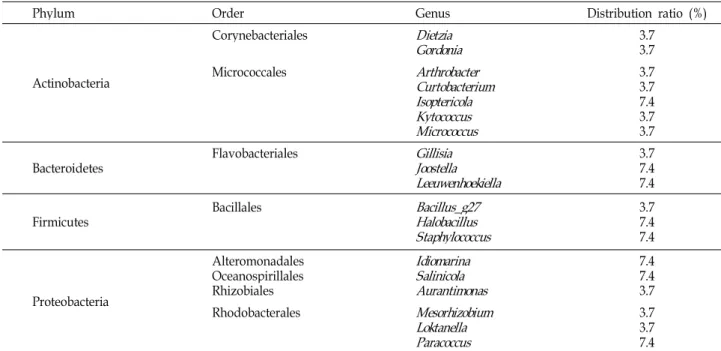
The isolated microorganisms were classified into nineteen species belonging to the four phyla (Actinobacteria, Bacteroidetes, Firmicutes, and Proteobacteria). The table shows the distribution ratio of all isolated bacterial strains, identified to the phylum, order and genus (%).
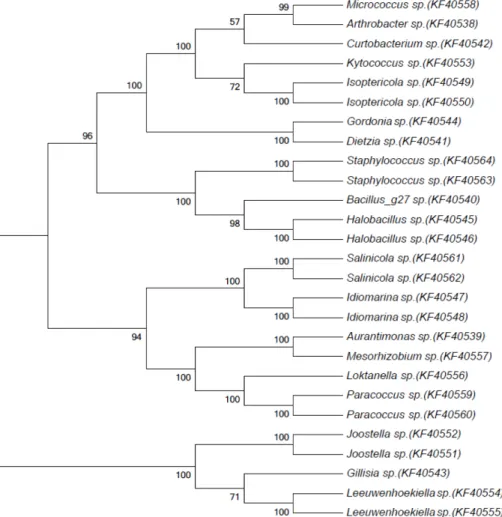
Fig. 1. Phylogenetic analysis of rhizosphere microorganisms isolated from three plant species native to the Dokdo Island. A phyloge- netic tree was constructed by using the neighbor-joining method (1,000 bootstrap replications). The twenty seven taxa belong to the four phyla (Actinobacteria, Bacteroidetes, Firmicutes, and Proteobacteria).
Bacillales목에 속하는 Bacillus (B.)속과 Staphyl.속이 분리, 동 정 , 확인되었다(Table 2).
분리된 근권 세균의 다양성 분석
본 연구를 바탕으로 3종의 자생식물에서 방선균문(Actino- bacteria)과 프로테오박테리아문(Proteobacteria)에 속하는 근 권세균이 많이 존재함을 확인 할 수 있었다 . 방선균문은 그람 양성균으로 , G+C 함량이 높은 계통으로 Corynebacteriales목 과 Micrococcales목이 주로 확인되었다(Table 3). 그람음성균 이면서 프로테오박테리아문에 속하는 4가지 강 중에 주로 Alphaproteobacteria강과 Gammaproteobacteria강이 확인되 었고 , 여기에 속하는 Alteromonadales목, Oceanospirillales목, Rhizobiales목, Rhodobacterales목의 근권세균이 확인되었다 (Table 3). 기존 연구결과를 보았을 때, 토양에 존재하는 세균 중 방선균문과 프로테오박테리아문 , 그리고 아키도박테리움 균 (Acidobacteria)문이 우점하는 것을 알 수 있다[13, 14, 18, 20, 21]. 아키도박테리움균문은 난배양성 토양세균으로, 토양 에는 많이 존재하나 배양상의 어려움을 가지고 있다 . 따라서
본 실험의 결과 자생식물의 근권에서 분리된 세균이 방선균문 과 프로테오박테리아문에 우점하는 것은 기존의 데이터와 많 은 부분 일치함을 알 수 있었다 .
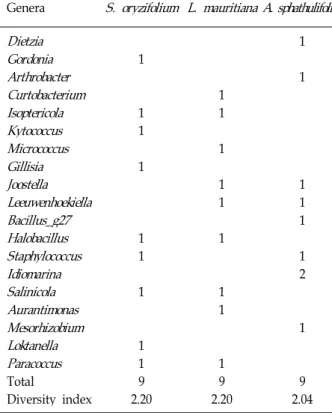
독도에 자생하는 해양 식물로부터 분리된 근권세균의 유전 학적 다양성을 확인하기 위하여 Shannon’s diversity index를 이용하여 확인하였다 . 독도 자생 식물로부터 분리된 내생진균 류의 다양성 지수는 S. oryzifolium (2.20), L. mauritiana (2.20), A. sphathulifolius (2.04)으로 확인되었다(Table 4). 세가지 식물 중에 S. oryzifolium와 L. mauritiana이 근권세균의 다양성 지수 가 비슷한 수치로 나왔으며 , A. sphathulifolius의 경우 다소 낮 은 수치의 다양성을 갖는 것을 확인할 수 있었다 .
본 연구에 분리 동정된 근권세균들 간의 유연관계를 확인하 기 위하여 계통수를 작성하였다 (Fig. 1).
분리된 근권세균의 생육조건 분석
미생물의 생육에 영향을 미치는 요인으로는 탄소원 , 질소
원 , 온도, 산소, pH 및 염농도 등이 있다. 그 중에서 본 분리
균주의 생육에 미치는 pH 또는 염류(NaCl)의 영향을 조사하
Table 4. Diversity index and distribution of rhizosphere micro- organisms isolated from the three plant species native to the Dokdo Island
Genera
S. oryzifolium L. mauritiana A. sphathulifolius Dietzia
Gordonia Arthrobacter Curtobacterium Isoptericola Kytococcus Micrococcus Gillisia Joostella Leeuwenhoekiella Bacillus_g27 Halobacillus Staphylococcus Idiomarina Salinicola Aurantimonas Mesorhizobium Loktanella Paracoccus
TotalDiversity index
1
1 1 1
1 1 1
1 1 9 2.20
1 1 1 1 1 1
1 1
1 9 2.20
1 1
1 1 1 1 2 1
9 2.04 Rhizosphere microorganisms were isolated from three native plant species, and were analyzed using Shannon’s diversity in- dex (
H
’) at the genus level.였다 . 자생식물 S. oryzifolium에서 P.속에 속하는 균주는 pH 5.5의 약산성에서도 잘 생존 하였으며 I.속에 속하는 균주는 pH9에서 생존이 가능함을 알 수 있었다. 내염성의 정도를 실 험해 본 결과 , K.속과 Staphyl.속이 9% 높은 염류에도 생존함이 확인되었다 . 자생식물 L. mauritiana에서는 C.속이 pH 5.5의 낮은 pH에서 생존 가능하였고, I.속, M.속은 pH 9의 높은 pH 에서 생존 가능함이 확인되었다 . 내염성 정도를 실험한 결과 로는 L.속, S.속, P.속, H.속이 9%의 높은 내염성을 갖는 것으로 조사되었다 . 자생식물 A. sphathulifolius에서는 L.속이 약산성 의 조건인 pH 5.5에서 생존 가능함을 확인할 수 있었고, Mesorhiz.속과 D.속은 pH 9에서 생존 가능함이 확인되었다.
내염성 정도를 측정한 결과 , J.속, Id.속, B.속, Staphyl.속은 9%
의 높은 내염도에서도 잘 생존함이 확인되었다 .
본 연구에서는 천연기념물 336호로 지정된 독도에서 자생 하고 있는 A. sphathulifolius, S. oryzifolium, L. mauritiana의 근 권에서 원핵미생물을 분리 , 동정을 수행하여 근권세균의 분포 및 다양성을 확인하였으며 , 이 연구 결과는 독특한 독도 환경 에서 자생하는 식물인 A. sphathulifolius, S. oryzifolium, L.
mauritiana과 근권 미생물 간의 상호 작용을 이해하는데 중요 한 기초 자료로 활용될 것이 기대된다 .
감사의 글
본 연구는 환경부 ‘차세대 에코이노베이션 기술개발사업’
으로 지원받은 과제이며 , 연구비 지원에 감사 드립니다.
References
1. Chang, K. I., Kim, Y. B., Suk, M. S. and Byun, S. K. 2002.
Hydrography around Dokdo.
Ocean Polar Res
24, 369-389.2. Fierer, N. and Jackson, R. B. 2006. The diversity and bio- geography of soil bacterial communities
. Proc Natl Acad Sci USA
103, 626-631.3. Ham, M. S., Park, Y. M., Sung, H. R., Sumayo, M., Ryul, C. M., Park, S. H. and Ghim, S. Y. 2009. Characterization of rhizobacteria isolated from family solanaceae plants in Dokdo Island.
Korean J Microbiol Biotechnol
37, 110-117.4. Hill, T. C., Walsh, K. A., Harris, J. A. and Moffett, B. F.
2003. Using ecological diversity measures with bacterial communities.
FEMS Microbiol Ecol
43, 1-11.5. Hwang, S. K. and Jeon, Y. G. 2003. Eruption cycles and vol- canic form of the Dokdo volcano, Korea.
Econ Environ Geol
36, 527-536.6. Jeon, S. A., Sung, H. R., Park, Y. M., Park, J. H. and Ghim, S. Y. 2009. Analysis of endospore-forming bacteria or nitro- gen-fixing bacteria community isolated from plants rhizo- sphere in Dokdo Island.
Korean J Microbiol Biotechnol
37, 189-196.7. Jeon, Y. G. 2005. The regional geomorphology of Dokdo (Volcanic Island).
Korean J Reg Geol
11, 12-28.8. Kim, C. H., Park, J. W., Lee, M. H. and Park, C. H. 2013.
Detailed bathymetry and submarine terraces in the coastal area of the Dokdo volcano in the Ulleung Basin, the East Sea (Sea of Japan).
J Coastl Res
65, 523-528.9. Kim, M. H., Oh, Y. J., Kim, C. S., Han, M. S., Lee, H. T.
and Na, Y. E. 2007. The flora and vegetation distribution in Dokdo.
Korean J Environ Agric
26, 85-93.10. Lee, D. H., Cho, S. H. and Park, J. H. 2007. The analysis of vascular plant species composition in Dokdo Island.
Korean J Plant Taxon
37, 545-563.11. Lee, D. I. 1995. Atomshperic background values at Dokdo Island, Korea.
Korean J Fish Aquat Sci
28.12. Mani, A., Arga, C. A., Jane, D., Nithyalakshmy, R., Kaveh, E. and Ehsan, M. 2012. Carbohydrate degrading bacteria closely associated with
Tetraselmis indica:
influence on algal growth.Aquat Biol
15, 61-71.13. Miyashita, N. T., Iwanaga, H., Charles, S., Diway, B., Sabang, J., and Chong, L. 2013. Soil bacterial community structure in five tropical forests in Malaysia and one temper- ate forest in Japan revealed by pyrosequencing analyses of 16S rRNA gene sequence variation.
Genes Genet Syst
88, 93-103.14. Nacke, H., Thürmer, A., Wollherr, A., Will, C., Hodac, L., Herold, N., Schöning, I., Schrumpf, M., and Daniel, R. 2011.
Pyrosequencing-based assessment of bacterial community structure along different management types in German for-
초록:독도의 자생식물의 근권에서 분리한 원핵 미생물의 다양성 분석
김예은․윤혁준․유영현․김 현․서영교․김미애․우주리․남윤종․이리나․이경민․송진하․진영주․김종국*․서영배*
(경북대학교 생명과학부)
본 연구에서는 독도에 자생하는 3종의 해안식물 해국(Aster sphathulifolius), 땅채송화(Sedum oryzifolium), 갯까치 수영 (Lysimachia mauritiana)을 연구 재료로 사용하였다. 각 식물에서 근권세균을 각 9주씩 분리하고, 동정하여 이 들 세균의 다양성을 조사하고 근권 토양의 세균 집단 조성을 분석하였다 . 16S rDNA의 염기서열 분석 결과, 계통 학적으로 총 4문 19종의 근권세균이 분리, 동정, 확인되었다. 또한 본 실험을 통하여 독도 자생식물 근권 균주의 최적 생육 환경이 확인되었다 . S. oryzifolium는 Rhodobacterales목, Micrococcales목, Corynebacteriales목, Flavobacteriales목, Oceanospirillales목, Bacillales목의 세균 균주가 확인되었으며, 자생식물 L. mauritiana에서는 Micrococcales목, Flavobacteriales목, Rhizobiales목, Oceanospirillales목, Rhodobacterales목, Bacillales목의 세균 균주가 확인되었다 . 자생식물 A. sphathulifolius에서는 Flavobacteriales목, Rhizobiales목, Corynebacteriales목, Micrococcales목, Alteromonadales목 및 Bacillales목의 균주가 분리, 동정, 확인되었다. 본 연구를 바탕으로 3종의 자생식물에서 방선균문 (Actinobacteria)과 프로테오박테리아문(Proteobacteria)에 속하는 근권세균이 많이 존재함 을 확인할 수 있었다 .
est and grassland soils.
PLoS One
6, e17000.15. Park, S. J., Song, I. G., Park, S. J. and Lim, D. O. 2010. The flora and vegetation of Dokdo Island in Ulleung-gun, Gyeongsanbuk-do.
Korean J Env Eco
24, 264-278.16. Persello-Cartieaux, F., Nussaume, L. and Robaglia, C. 2003.
Tales from the underground: Molecular plant-rhizobacteria interactions.
Plant Cell Environ
26, 189-199.17. Research Institute for Ullengdo & Dokdo Islands. 2008. pp.
166-221, The plant of Dokdo Island. Nature of Dokdo island.
Kyungpook National University Press. Daegu, Korea.
18. Roesch, L. F., Fulthorpe, R. R., Riva, A., Casella, G., Hadwin, A. K., Kent, A. D., Daroub, S. H., Camargo, F. A., Farmerie, W. G., and Triplett, E. W. 2007. Pyrosequencing enumerates and contrasts soil microbial diversity.
ISME J
1, 283-290.19. Shin, H. T., Park, S. J., Kang, K. H. and Yoo, J. H. 2004.
The establishment of conservation area and conservation strategy in Ulnung island (II)-flora and management in Dokdo island, South Korea.
Korean J Env Eco
18, 221-230.20. Singh, D., Shi, L. and Adams, J. M. 2013. Bacterial diversity in the mountains of South-West China: Climate dominates over soil parameters.
J Microbiol
51, 439-447.21. Singh, D., Takahashi, K., Kim, M., Chun, J., and Adams, J. M. 2012. A hump-backed trend in bacterial diversity with elevation of Mount Fuji, Japan.
Microb Ecol
63, 429-437.22. Sohn, Y. K. 1995. Geology of Tok Island, Korea: eruptive and depositional processes of a shoaling to emergent island volcano.
Bull Volcanol
56, 660-674.23. Sun, B. Y., Sul, M. R., Im, J. A., Kim, C. H. and Kim, T.
J. 2002. Evolution of endemic vascular plants of Ulleungdo and Dokdo in Korea- floristic and cytotaxonomic character- istic of vascular flora of Dokdo.
Korean J Plant Taxon
32, 143-158.24. Tang, Y. W., Von, G. A., Waddington, M. G., Hopkins, M.
K., Smith, D. H., Li, H., Kolbert, C. P., Montgomery, S. O.
and Persing, D. H. 2000. Identification of coryneform bacte- rial isolates by ribosomal DNA sequence analysis.
J Clin Microbiol
38, 1676-1678.25. Woo, P. C., Lau, S. K., Teng, H. and Yuen, K. Y. 2008. Then and now: use of 16S rDNA gene sequencing for bacterial identification and discovery of novel bacteria in clinical mi- crobiology laboratories