Genetic Diversity of Endophytic Fungal Strains Isolated from the Roots of Coastal Plants in Ulleung Island for Restoration of Coastal Ecosystem
Miae Kim
1†, Young-Hyun You
1†, Hyeokjun Yoon
1, Hyun Kim
1, Yeonggyo Seo
1, Irina Khalmuratova
1, Jae-Ho Shin
3, In-Jung Lee
3, Yeon-Sik Choo
2and Jong-Guk Kim
1*
1
School of Life Sciences and Biotechnology, Kyungpook National University, Daegu 702-701, Korea
2
Department of Biology, College of National Sciences, Kyungpook National University, Daegu 702-701, Korea
3
School of Applied Biosciences, Kyungpook National University, Daegu 702-701, Korea
Received August 21, 2012 /Revised October 29, 2012 /Accepted October 29, 2012Five coastal plant species, Artemisia fukudo, Aster sphathulifolius, Plantago camtschatica, Sedum oryzifolium, and Setaria viridis, were collected from the coastal region of Ulleung Island (Ulleung-Do, South Korea).
Thirty-six endophytic fungi were isolated from the roots of these plants, and all were identified by using PCR with the following specifications: internal transcribed spacer 1 (ITS1), 5.8S rRNA, and ITS2 regions. Phylogenetic analysis indicated that all fungal strains belong to the phylum Ascomycota and comprise four orders (Capnodiales, Eurotiales, Hypocreales, and Pleosporales). Among all the identi- fied species, the Eurotiales species were more abundant than species in the other orders. Nine differ- ent genera (Alternaria, Aspergillus, Cladosporium, Exserohilum, Fusarium, Neosartorya, Penicillium, Phoma, and Pyrenochaeta) in the four orders were confirmed. Penicillium and Aspergillus species were the most dominant species among the endophytic fungi isolated from the coastal plants. Shannon’s diversity index (H’) ranged from 0.684 to 1.609, and the endophytic fungi in S. oryzifolium was more diverse compared to the endophytic fungi in the other plants.
Key words : Endophytic fungi, genetic diversity, coastal plant, Ulleung island
†Both authors contributed equally to this work.
*Corresponding author
*Tel:+82-53-950-5379, Fax:+82-53-955-5379
*E-mail : [email protected]
서 론
울릉도는 우리나라의 한반도에서 137 km떨어진 동해에 자 리잡고 있고, 제4기에 화산활동에 의하여 형성되었으며, 면적 은 7,268 ha로 오각형의 해양성 화산섬이다. 그리고 지형이 사화산으로 형성되어서 경사가 심하고, 해발 984 m의 성인봉 아래에 위치한 나리분지를 제외하고는 평지가 거의 없으며, 기후는 전형적인 해양성 기후를 보이고 있다. 울릉도의 식생 에 관한 식물 분류학적 연구는 1980년대부터 이루어 지고 있 으며, 현재에는 성인봉지역, 나리분지 등의 산림식생유형과 생장특성 연구 등이 점차적으로 이루어지고 있다[22]. 그러나 울릉도의 해안에 대한 연구 및 해안에 자생하는 식물관련 연 구는 거의 이루어져 있지 않으며, 식물에 관련된 미생물상 연 구 또한 이루어져 있지 않다.
우리나라의 해안식물은 자갈이나 바위에 자생하는 일반적 인 해안식물과, 해안사구지역에 자생하는 해안사구식물 (Coastal sand-dune plant) [16,18] 및 해안 염습지(Coastal salt marsh) [41,42]에 자생하는 염생식물(Halophyte) [3]로 분류되 고 있다. 최근에는 해안식물의 보호와 환경 보존을 위하여 식
물의 발아, 개화, 성장에 대한 연구와 식물과 공생 및 공존하는 미생물에 대한 연구가 이루어지고 있다[13,14,17,18]. 그리고 내생진균류의 이차대사산물 규명 및 균주의 기술개발 연구 등으로 해안식물의 증식과 생장을 촉진하는 것이 해안환경보 호를 위해서 중요하다는 것이 알려졌다[13,16]. 그러나 해안미 생물에 관한 연구로서 토양으로부터 분리된 해안미생물 군집 분석 등이 다소 이루어져 있지만[6], 해안환경에 자생하는 해 안식물과 상호관계에 있는 내생진균류(endophytic fungi)에 대한 연구[16,18,20] 및 해양성 곰팡이(Marine fungi)는 최근에 연구되기 시작하여 주목을 받고 있다[4,43].
내생진균은 식물과 공생하며 식물생장에 중요한 역할을 한 다고 알려져 있고, 내생진균류 유래 이차대사산물(GA, IAA, ABA)을 생산하는 균주[9,16,19] 및 이를 이용한 연구도 증가 하고 있다[15,19]. 그리고 내생진균류는 고온과 건조 및 염분과 같은 식물의 생장을 방해하는 환경인자에 대한 저항성에 기여 하고, 항균효과로 인한 면역 활성을 가지는 것으로 알려져 있 다[1,25,27,28,35].
본 연구에서는 우리나라의 해양성 화산섬인 울릉도 해안에
자생하는 해안식물과 공생 및 공존하는 내생진균류를 형태적
으로 순수 분리하여 동정하였으며, 다양한 해안식물에 따른
내생진균류의 분포 및 다양성을 확인하여 유연관계를 확인하
였다.
Table 1. Details of coastal plants collected in the study Scientific name of plant samples Plant code Habitat
Artemisia fukudo
Makino Af CoastAster sphathulifolius
Maxim. As CoastPlantago camtschatica
Cham. Pc CoastSedum oryzifolium
Makino So CoastSetaria viridis
Makino Sv Coast재료 및 방법
식물시료는 경상북도 울릉군 서면 남서리 해안에 자생하고 있는 해안식물을 채집하였다. 식물들은 큰비쑥(Artemisia fuku- do Makino), 해국(Aster sphathulifolius Maxim.), 갯질경이 (Plantago camtschatica Cham.), 땅채송화(Sedum oryzifolium Makino), 갯강아지풀(Setaria viridis Makino)등 5종을 채집하 여 식물시료로 사용하였다(Table 1).
채집한 해안식물 뿌리의 토양을 제거하였고, 표백제인 과염 소산(Perchloric acid, 1%)을 사용하여 10분간 처리하여 살균 한 후에 멸균증류수로 세척하였다[39]. 그리고 계면활성제 (Tween 80)를 10분간 처리하여 멸균증류수로 세척하였다[41].
해안식물의 뿌리를 전처리 하였고, 멸균된 수술용 가위를 사 용하여 3~4 cm 길이로 뿌리를 절단한 후 수분을 제거하였다.
그리고 내생진균류의 분리 및 배양을 위하여 스트렙토마이신 (Streptomycin, 80 ppm)이 함유된 Hagem minimal (HM) 최 소배지[33,36]를 사용하여 전처리 된 염생식물의 뿌리를 25°C 조건에서 배양하였다[16,17]. 그리고 배양된 뿌리의 끝 단면에 서 뻗어 나온 내생진균류의 균사를 HM 배지에 획선도말법을 이용하여 다시 28°C 조건에서 배양하였다. 그리고 HM 배지에 배양된 내생진균류를 수술용 칼을 사용하여 PDA 배지에 계대 배양하여 순수분리 하였다. 순수 분리된 내생진균류들을 po- tato dextrose broth (PDB) 배지에 14일 동안, 100 rpm으로 28°C조건으로 진탕배양하였고, 내생진균의 균체를 여과하여 5일 동안 동결건조 하였으며, 동정을 위한 실험재료로 사용하 였다[42].
DNeasy Plant mini kit (QIAgen)를 이용하여 동결건조 된 균체로부터 Genomic DNA를 추출하였다. 중합 효소 연쇄 반 응(Polymerase Chain Reaction, PCR)을 이용하여 rDNA- in- ternal transcribed spacer (ITS) 영역을 증폭하였으며, Ex-Taq DNA polymerase (Takara, Japan)를 사용하였다[41,42]. PCR 증폭 반응 조건은 predenaturation (1 min: 95°C), 35 사이클의 denaturation (30 sec: 95°C), annealing (1 min: 51-54.5°C), ex- tension (1 min: 72°C), 그리고 final extension (7 min: 72°C)으 로 수행하였다[42]. PCR프라이머는ITS1 (5'-TCC GTA GGT GAA CCT GCG G-3')과 ITS4 (5'-GGA AGT AAA AGT CGT AAC AAG G-3')를 이용하였다[16, 42]. PCR 산물은 전기영동 (agarose gel: 1.5%) 후, ethidium bromide (EtBr)을 사용하여
15분간 염색 후, UV transilluminator로 전기영동밴드를 확인 하였다. 내생진균류의 rDNA-ITS 영역의 전기영동 단편들은 QIAquick PCR purification kit (Qiagen Inc., Germany)를 사 용하여 정제하였다. 염기서열 결정을 위하여 ABI PRISM BigDye Terminator Cycle Sequencing Kit (PE Biosystems, Foster City, CA, USA)를 사용하였다. 그리고 DNA 단편들은 ABI 310 DNA sequencer (Perkin Elmer, Foster City, CA, USA)를 사용하여 내생진균의 염기서열을 결정하였다[16,42].
해안식물의 뿌리로부터 분리된 분리주의 동정을 위하여 rDNA-ITS 영역의 염기서열을 NCBI의 blastn으로 확인하였 다. 그리고 내생진균류의 유연관계 확인을 위하여 ITS영역 염 기서열을 ClustalX program으로 다중정렬을 하였고, Lasergene 7 program과 BioEdit program을 사용하여 염기서 열을 정리하였다. 내생진균류의 계통 및 유연관계 분석은 MEGA 4.1 program, neighbor-joining (NJ) 방법의 Kimura 2-parameter model에 따라 분석하여 계통수를 작성하였다 [31,42]. 그리고 내생균류의 다양성 분석을 위하여 각 내생진균 류들의 목(Order), 과(Family), 속(Genus)을 확인하였으며, 다 양성지수를 확인하기 위하여 Shannon's diversity index (H’) 를 적용하여[24,41] 각 식물군에 대한 내생균류의 다양성지수 를 분석하였다.
결과 및 고찰
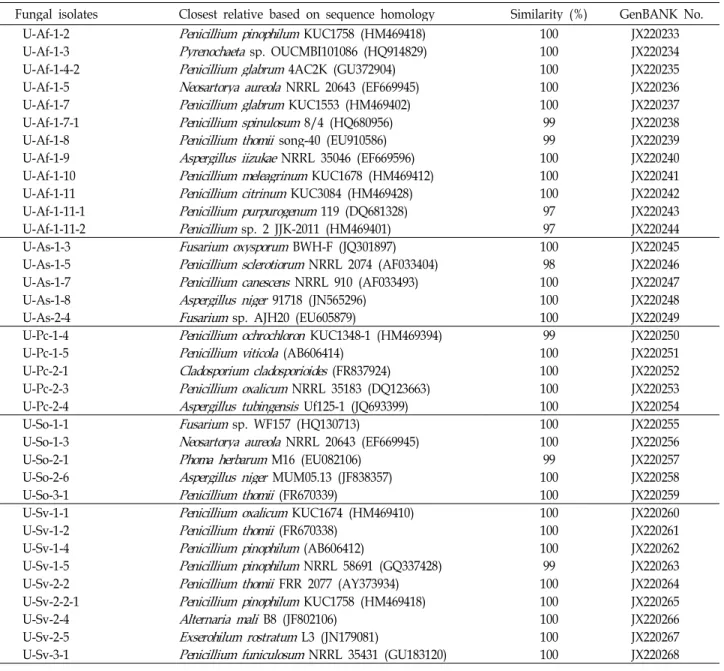
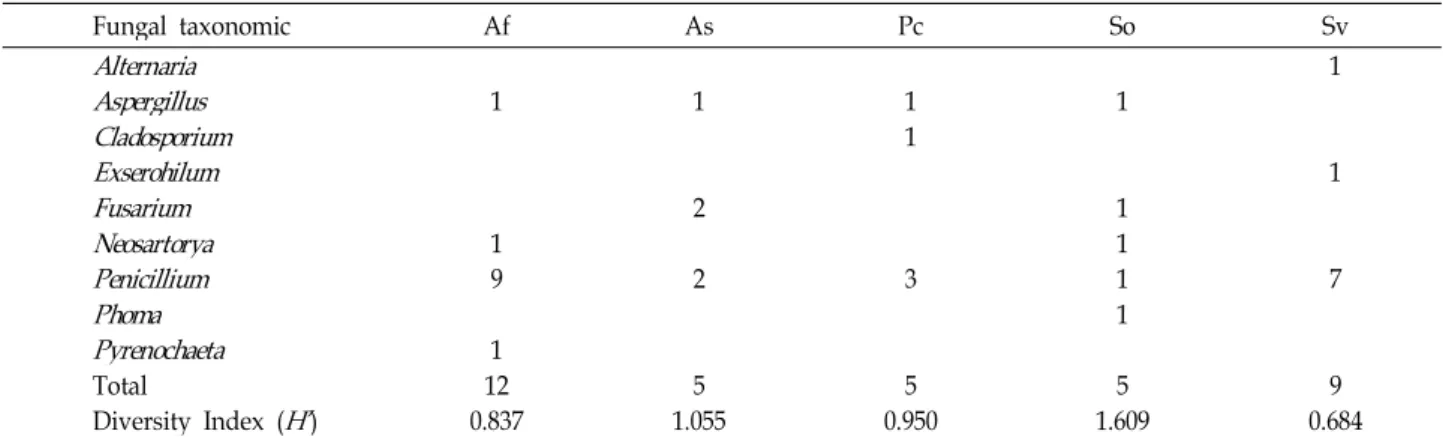
울릉도에 자생하는 5종류의 해안식물로부터 형태학적으로 다른 내생진균류 36주를 분리 및 선별하였다. 분리선별 균주 들에서 큰비쑥(Af)으로부터 12주, 해국(As)으로부터 5주, 갯질 경이(Pc)로부터 5주, 땅채송화(So)로부터 5주 및 갯강아지풀 (Sv)로부터 9주가 분리 및 동정되었다. 내생진균류의 염기서 열은 NCBI의 GenBANK에 등록하여 모든 내생진균류에 대한 accession number [JX220233 - JX220268]를 부여받았다(Table 2). 그리고 내생진균류는 식물코드(plant code) Af에서 4속 10 종, As에서 3속 5종, Pc에서 3속 5종, So에서 5속 5종, Sv에서 3속 6종에 해당하는 내생진균류를 확인하였다(Table 3).
내생진균류의 계통분석결과 Af에서 자낭균문
(Ascomycota), Eurotiales목, Trichocomaceae과에 속하는 Penicillium속, Neosartorya속, Aspergillus속과 Pleosporales 목, Pleosporaceae과에 속하는 Pyrenochaeta속이 확인되었다.
As에서는 Ascomycota문, Eurotiales목, Trichocomaceae과에
속하는 Penicillium속, Aspergillus속과 Hypocreales목,
Nectriaceae과에 속하는 Fusarium속이 확인되었다. Pc에서는
Ascomycota문, Eurotiales목, Trichocomaceae과에 속하는
Penicillium속, Aspergillus속과 Capnodiales목, Davidiellaceae
과에 속하는 Cladosporium속이 확인 되었다. So에서는
Ascomycota문, Eurotiales목, Trichocomaceae과에 속하는
Penicillium속, Aspergillus속, Neosartorya속과 Hypocreales목,
Table 2. The identification of endophytic fungi isolated in this study
Fungal isolates Closest relative based on sequence homology Similarity (%) GenBANK No.
U-Af-1-2
Penicillium pinophilum
KUC1758 (HM469418) 100 JX220233U-Af-1-3
Pyrenochaeta
sp. OUCMBI101086 (HQ914829) 100 JX220234U-Af-1-4-2
Penicillium glabrum
4AC2K (GU372904) 100 JX220235U-Af-1-5
Neosartorya aureola
NRRL 20643 (EF669945) 100 JX220236U-Af-1-7
Penicillium glabrum
KUC1553 (HM469402) 100 JX220237U-Af-1-7-1
Penicillium spinulosum
8/4 (HQ680956) 99 JX220238U-Af-1-8
Penicillium thomii
song-40 (EU910586) 99 JX220239U-Af-1-9
Aspergillus iizukae
NRRL 35046 (EF669596) 100 JX220240U-Af-1-10
Penicillium meleagrinum
KUC1678 (HM469412) 100 JX220241U-Af-1-11
Penicillium citrinum
KUC3084 (HM469428) 100 JX220242U-Af-1-11-1
Penicillium purpurogenum
119 (DQ681328) 97 JX220243U-Af-1-11-2
Penicillium
sp. 2 JJK-2011 (HM469401) 97 JX220244U-As-1-3
Fusarium oxysporum
BWH-F (JQ301897) 100 JX220245U-As-1-5
Penicillium sclerotiorum
NRRL 2074 (AF033404) 98 JX220246U-As-1-7
Penicillium canescens
NRRL 910 (AF033493) 100 JX220247U-As-1-8
Aspergillus niger
91718 (JN565296) 100 JX220248U-As-2-4
Fusarium
sp. AJH20 (EU605879) 100 JX220249U-Pc-1-4
Penicillium ochrochloron
KUC1348-1 (HM469394) 99 JX220250U-Pc-1-5
Penicillium viticola
(AB606414) 100 JX220251U-Pc-2-1
Cladosporium cladosporioides
(FR837924) 100 JX220252U-Pc-2-3
Penicillium oxalicum
NRRL 35183 (DQ123663) 100 JX220253U-Pc-2-4
Aspergillus tubingensis
Uf125-1 (JQ693399) 100 JX220254U-So-1-1
Fusarium
sp. WF157 (HQ130713) 100 JX220255U-So-1-3
Neosartorya aureola
NRRL 20643 (EF669945) 100 JX220256U-So-2-1
Phoma herbarum
M16 (EU082106) 99 JX220257U-So-2-6
Aspergillus niger
MUM05.13 (JF838357) 100 JX220258U-So-3-1
Penicillium thomii
(FR670339) 100 JX220259U-Sv-1-1
Penicillium oxalicum
KUC1674 (HM469410) 100 JX220260U-Sv-1-2
Penicillium thomii
(FR670338) 100 JX220261U-Sv-1-4
Penicillium pinophilum
(AB606412) 100 JX220262U-Sv-1-5
Penicillium pinophilum
NRRL 58691 (GQ337428) 99 JX220263U-Sv-2-2
Penicillium thomii
FRR 2077 (AY373934) 100 JX220264U-Sv-2-2-1
Penicillium pinophilum
KUC1758 (HM469418) 100 JX220265U-Sv-2-4
Alternaria mali
B8 (JF802106) 100 JX220266U-Sv-2-5
Exserohilum rostratum
L3 (JN179081) 100 JX220267U-Sv-3-1
Penicillium funiculosum
NRRL 35431 (GU183120) 100 JX220268Table 3. Endophytic fungi isolated from the five coastal plants were 36 fungal strains. Coastal plants data present scientific name, plant code, taxon of fungal strain, and fungal isolates, respectively.
Scientific name of plant samples Plant code Taxon of fungal strains Fungal isolates
Artemisia fukudo
Makino Af 4 genera 10 species 12Aster sphathulifolius
Maxim. As 3 genera 5 species 5Plantago camtschatica
Cham. Pc 3 genera 5 species 5Sedum oryzifolium
Makino So 5 genera 5 species 5Setaria viridis
Makino Sv 3 genera 6 species 9Nectriaceae과, Fusarium속이 확인되었고, Pleosporales목, Didymellaceae과에 속하는 Phoma속이 확인되었다. Sv에서는 Ascomycota문, Eurotiales목, Trichocomaceae과에 속하는 Penicillium속과 Pleosporales목, Pleosporaceae과에 속하는
Alternaria속, Exserohilum속이 확인되었다. 그리고 내생진균류
36균주를 목으로 분류하였을 때, 분포 비율은 각각 Eurotiales
78%, Pleosporales 11%, Hypocreales 8%, Capnodiales 3%인
것으로 확인되었고, 속으로 분류하였을 때, Penicillium속 61%,
(A) (B)
Fig. 1. The graph showed that all isolated endophytic fungi belong to the order and genus level (%). Classification of endophytic fungi isolated from the root of coastal plants naturally growing in Ulleung island. 36 fungal strains belonging to 9 genera were identified from coastal plants in Ulleung island. (A) Fungal taxonomic (Order), (B) Fungal taxonomic (Genus)
Aspergillus속11%, Fusarium속 8%, Alternaria속 3%,
Cladosporium속 3%, Exserohilum속 3%, Neosartorya속 3%, Pyrenochaeta속 3% 그리고Phoma속 3%에 해당하는 비율을 나 타내었다(Fig. 1).
본 연구는 울릉도 해안에 우점종으로 자생하고 있는 5종의 해안식물로부터 총 9속에 해당하는 내생진균류를 분리 및 동 정하였다. Alternaria 속의 경우 Sv에서 1 주의 균주만이 분리 되었으며, 분리된 Alternaria mali 균주는 일반적으로 사과나무 의 잎이나 과실의 내생진균으로 사과반점낙엽병을 유발하고 [26] alternariol, altenuene등 5가지 Alternaria 진균독소를 생 성하는 것으로 알려져 있다[21]. Aspergillus 속은 Sv를 제외한 모든 식물로부터 1 균주씩 분리되었으며, 이 중 Aspergillus tu- bingensis의 경우 식물생장촉진 호르몬을 생산하는 내생진균 으로 알려지고 있다[40]. 그리고 Cladosporium 속은 Pc에서만 1 균주가 분리되었고, 분리된 Cladosporium cladosporioides 균주 의 경우 본 연구에서는 적은 비율로 나타났지만 이집트 홍해 의 해안가의 염생식물에서는 우점하는 내생진균으로 분리가 되기도 하였다[5]. Exserohilum 속은 Sv에서만 1 균주가 분리되 었으며, Exserohilum rostratum는 항진균활성을 가지는 mono- cerin의 유도체인 11-Hydroxymonocerin을 생산 하는 것으로 보고되었다[30]. Fusarium 속은 As와 So에서 2 균주와 1균주로 각각 분리되었고, 분리된 균주 중 Fusarium oxysporum는 일반 적으로 식물 병원성 및 내생진균으로 잘 알려져 있다[7].
Neosartorya 속은 Af와 So에서 각 한 균주 씩 분리되었으며, Aspergillus 속의 완전세대를 지칭하며[10,29], 국내에서 Neosartorya 속에 속하는 균주의 분리 및 신종 발견이 홍 등 [11,12]에 의해 이루어져있고, 현재까지 밝혀진 Neosartorya 속
중 일부는 탄화수소 및 디젤 등을 분해하는 활성을 가지는 것으로 알려져 있다[2,23,38]. Penicillium 속은 모든 식물에 걸 쳐 가장 많이 분리되었고, 일반적으로 식물의 뿌리에 우점하 는 내생진균으로 알려져 있으며[39,41,42], Phoma 속은 So에서 한 개의 균주가 분리되었고, Phoma herbarum은 높은 염농도와 저온의 환경에도 강한 적응력을 가지고 있으며[34,37], 식물생 장촉진 호르몬을 생산 하는 것으로 보고되었다[8]. 그리고 Pyrenochaeta 속은 Af에서 1 균주만이 분리되었고, 난초의 뿌 리에서 분리한 내생진균의 다양성 연구에서 유서조설란 (Holcoglossum weixiense) 의 뿌리로부터 1 균주만이 분리된 것 과 마찬가지로 Pyrenochaeta 속은 내생진균 중 적은 비율을 차 지함을 알 수 있었다[32].
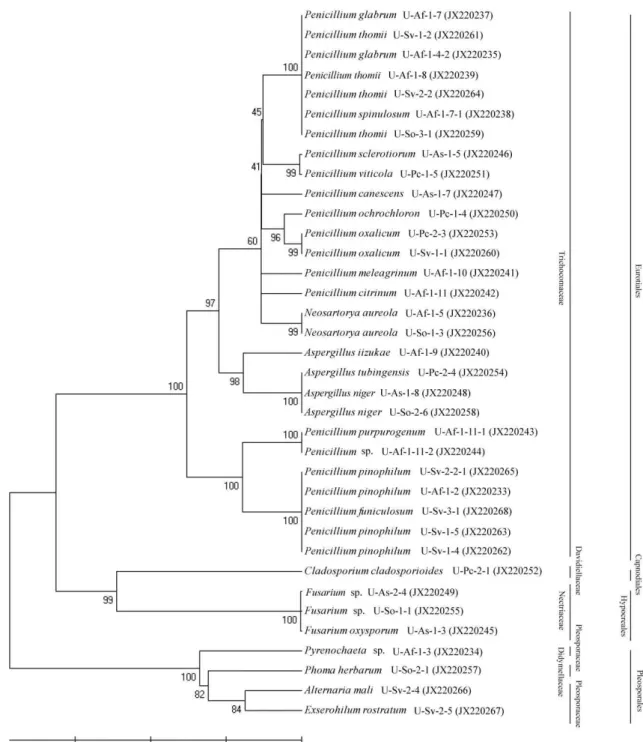
울릉도 해안에 자생하는 식물의 뿌리로부터 분리 및 동정된 내생진균류의 계통학적 유연관계를 확인하기 위하여 균류들 간의 계통수를 작성하였고, 전체 내생진균류에 대한 목과 과 를 나타내어 분류 및 표기하였다(Fig. 2). 내생진균류의 모든 균주는 자낭균문에 속하며 4목, 5과, 9속에 해당하는 것을 확 인 할 수 있었고, Eurotiales 목Trichocomaceae과에 속하는 Penicillium 속, Aspergillus속이 우점종으로 분포하고 있음을 확인하였다.
해안식물의 뿌리로부터 분리된 내생진균류의 다양성을 확
인하기 위하여 Shannon’s diversity index를 적용하였다. 그리
고 해안식물에 따른 각 내생진균류의 다양성 지수는 Af
(0.837), As (1.055), Pc (0.950), So (1.609), Sv (0.684)로 확인되
었다(Table 4). Shannon’s diversity index (H’)는 So에서 분리
된 내생진균류의 다양성이 1.609로 가장 높은 지수를 나타내
었고, Sv에서 분리된 내생진균류의 다양성지수가 0.684로 가
Fig. 2. Phylogenetic analysis of endophytic fungi isolated from Ulleung island. The neighbour joining tree was constructed using 36 taxa. Phylogenetic analysis showed that all fungal strains belong to orders and family.
장 낮은 지수로 확인됨에 따라 So에서 분리된 내생진균류의 다양성이 다른 식물에 비해 풍부한 것으로 생각된다.
본 연구에서 분리된 울릉도 자생식물 유래 내생진균류의 경우, 해안 염습지인 갯벌에 자생하는 염생식물로부터 분리된 내생진균류와 비교하였을 때[41,42], 두 지역 모두 자낭균류인 Penicillium속 및 Aspergillus속이 대부분을 차지하고 있었다.
울릉도 자생 해안식물 유래 내생진균류는 Alternaria속,
Exserohilum속, Neosartorya속, Phoma속, Pyrenochaeta속의 균류가
독특하게 낮은 분포비율을 차지하며 나타났지만, 갯벌 유래 내생
진균류는 Cephalosporium속, Chaetomium속, Colletotrichum속,
Cryptococcus속, Didymella속, Eupenicillium속, Paraconiothyrium속,
Nigrospora속 등의 균류들이 분리 되는 것을 확인 할 수 있었으
Table 4. Diversity index of endophytic fungal strains isolated from the roots of coastal plants collected in Ulleung island.
Fungal taxonomic Af As Pc So Sv
Alternaria
1Aspergillus
1 1 1 1Cladosporium
1Exserohilum
1Fusarium
2 1Neosartorya
1 1Penicillium
9 2 3 1 7Phoma
1Pyrenochaeta
1Total 12 5 5 5 9
Diversity Index (
H’
) 0.837 1.055 0.950 1.609 0.684The Shannon's diversity index (
H'
) on genus level of endophytic fungal strains isolated from the roots of coastal plants collected in Ulleung island were analyzed.며, 그리고 갯벌유래 자생 균류의 경우에 분류체계가 명확하 지 않은 Epicoccum속, Macrophoma속, Microsphaeropsis속, Phaeomyces속이 나타나는 것을 비교할 수 있었다. 울릉도 해안 지역에 자생하는 식물과 갯벌에 자생하는 염생식물에 따른 내생진균의 다양성은 숙주와 그 자생환경에 따라 조금씩 다르 게 나타났으나, 자낭균문인 Penicillium속에 포함되는 균류들 이 공통적으로 많은 것을 확인하였으며, Penicillium속의 분포 비율이 다른 속에 비해 높은 것을 확인 할 수 있었다.
본 연구는 울릉도 해안에 자생하는 해안식물의 뿌리로부터 내생진균류의 분포 및 다양성을 확인 하였고, 염농도가 높은 해안환경에서의 균류자원 및 미생물 다양성연구에 기초자료 가 될 것이라 생각된다.
감사의 글
본 연구는 환경부 ‘차세대 에코이노베이션 기술개발사업’
및 2012학년도 경북대학교 학술연구비 지원으로 수행된 연구 이며, 연구비 지원에 감사를 드립니다.
References
1. Arnold, E. A., Mejia, L. C., Kyllo, D., Rojas, E., Maynard, Z., Robbins, N. and Herre, E. A. 2003. Fungal endophytes limit pathogen damage in a tropical tree.
Proc. Natl.
Acad. Sci. USA
100, 15649-15654.2. Chaillan, F., Fleche, A. L., Bury, E., Phantavong, Y., Grimont, P., `Saliot, A. and Oudot, J. 2004. Identification and biodegradation potential of tropical aerobic hydrocarbon- degrading microorganisms.
Res. Microbiol.
155, 587-595.3. Chapman, V. J. 1974. Salt Marshes and Salt Deserts of the World.
Ecology of Halophytes
. pp. 3-22, Academic Press, New York.4. Ding, B., Yin, Y., Zhang, F. and Li, Z. 2011. Recovery and
phylogenetic diversity of culturable fungi associated with marine sponges
Clathrina luteoculcitella
andHoloxea
sp. in the South China Sea.Mar. Biotechnol.
13, 713-721.5. El-Morsy, E. M. 2000. Fungi isolated from the endorhizo- sphere of halophytic plants from the Red Sea Coast of Egypt.
Fungal Diversity
5, 43-54.6. Gomes, N. C. M., Cleary, D. F. R., Pinto, F. N., Egas, C., Almeida, A., Cunha, A., Mendonça-Hagler, L. C. S. and Smalla, K. 2010. Taking root: enduring effect of rhizosphere bacterial colonization in mangroves.
PLoS ONE
5, e14065.7. Gordon, W. L. 1965. Pathogenic strains of
Fusarium oxysporum
.Can. J. Bot.
43, 1309-1318.8. Hamayun, M., Khan, S. A., Khan, A. L., Rehman, G., Sohn, E. Y., Shah, A. A., Kim, S. K., Joo, G. J. and Lee, I. J. 2009.
Phoma herbarum
as a new gibberellin-producing and plant growth-promoting fungus.J. Microbiol. Biotechnol
. 19, 1244-1249.9. Hamayun, M., Khan, S. A., Khan, M. A., Khan, A. L., Kang, S. M., Kim, S. K., Joo, G. J. and Lee, I. J. 2009. Gibberellin production by pure cultures of a new strain of
Aspergillus fumigates
.World J
.Microbiol
.Biotechnol
. 25, 1785-1792.10. Hong, S. B., Go, S. J., Shin, H. D., Frisvad, J. C. and Samson, R. A. 2005. Polyphasic taxonomy of
Aspergillus fumigatus
and related species.Mycologia
97, 1316-132911. Hong, S. B., Cho, H. S., Shin, H. D., Frisvad, J. C. and Samson, R. A. 2006. Novel
Neosartorya
species isolated from soil in Korea.Int J Systemat Evol Microbiol
. 56, 477-486.12. Hong, S. B., Kim, D. H., Park, I. C., Samson, R. A. and Shin, H. D. 2010. Isolation and Identification of
Aspergillus
SectionFumigati
Strains from Arable Soil in Korea.Mycobiology
38, 1-6.13. Hwang, J. S., You, Y. H., Bae, J. J., Khan, S. A., Kim, J. G.
and Choo, Y. S. 2011. Effects of endophytic fungal secondary metabolites on the growth and physiological response of
Carex kobomugi
Ohwi.J. Coastal Res.
27, 544-548.14. Kawaide, H. and Sassa, T. 1993. Accumulation of gibberellin A1and the metabolism of gibberellin A9 to gibberellin A1
in a
Phaeosphaeria
sp. L 487 culture.Biosci. Biotech. Biochem.
57, 1403-1405.
15. Kawanabe, Y., Yamane, H., Murayama, T., Takahashi, N., and Nakamura, T. 1983. Identification of gibberellin A3 in mycelia
Neurospora Crassa
.Agric. Biol. Chem
. 47, 1693-1694.16. Khan, S. A., Hamayun, M., Yoon, H. J., Kim, H. Y., Suh, S. J., Hwang, S. K., Kim, J. M., Lee, I. J., Choo, Y. S., Yoon, U. H., Kong, W. S., Lee, B. M. and Kim, J. G. 2008. Plant growth promotion and
Penicillium citrinum
.BMC Microbiol
. 8, 231.17. Khan, S. A., Hamayun, M., Kim, H. Y., Yoon, H. J., Lee, I. J. and Kim, J. G. 2009a. Gibberellin production and plant growth promotion by a newly isolated strain of
Gliomastix murorum
.World J. Microbiol. Biotechnol.
25, 829-833.18. Khan, S. A., Hamayun, M., Kim, H. Y., Yoon, H. J., Seo, J. C., Choo, Y. S., Lee, I. J., Kim, S. D., Rhee, I. K. and Kim, J. G. 2009b. A new strain of
Arthrinium phaeospermum
iso- lated fromCarex kobomugi
Ohwi is capable of gibberellin production.Biotechnol. Lett
. 31, 283-287.19. Khan, A. L., Hamayun, M., Kang, S. M., Kim, Y. H., Jung, H. Y., Lee, J. H. and Lee, I. J. 2012. Endophytic fungal associ- ation via gibberellins and indole acetic acid can improve plant growth under abiotic stress: an example of
Paecilomyces formosus
LHL10.BMC Microbiol.
12, 3.20. Kil, Y. J., Eo, J. K. and Eom, A. H. 2009. Molecular identi- fication and diveristy of endophytic fungi isolated from
Pinus densiflora
in Boeun, Korea.Korean J. Mycol.
37, 130-133.21. Lee, H. B. and Yu, D. H. 1995. Distribution of mycotoxin-pro- ducing isolates in the Genus
Alternaria
.Korean J. Plant Pathol
. 11, 151-157.22. Lee, J. H., Cho, H. J., Lee, B. C., Oh, S. H. and Bae, K. H.
2007. Forest vegetation types and growth characteristics of Seongin-bong in Ulleung Island, Korea.
Korean J. Agric. For.
Meteorol
. 9, 37-48.23. Naranjo, L., Urbina, H., Sisto, A. D. and Leon, V. 2007.
Isolation of autochthonous non-white rot fungi with poten- tial for enzymatic upgrading of Venezuelan extra-heavy crude oil.
Biocatal. Biotransformation
25, 341-349.24. Pielou, E. C. 1975
. Ecological diversity
. pp. 165, John Wiley, New York.25. Redman, R. S., Sheehan, K. B., Stout, R. G., Rodriguez, R.
J. and Henson, J. M. 2002. Thermotolerance conferred to plant host and fungal endophyte during mutualistic symbiosis.
Science
298, 1581.26. Roberts, J. W. 1914. Experiments with apple leaf-spot fungi.
J. Agr. Res.
2, 57-66.27. Rodriguez, R. J., Redman, R. S. and Henson, J. M. 2004. The role of fungal symbioses in the adaptation of plants to high stress environments.
Mitigation and Adaptation Strategies for Global Change
9, 261-272.28. Rodriguez, R. J., Henson, J., Van, V. E., Hoy, M., Wright, L., Beckwith, F., Kim, Y. and Redman, R. S. 2008. Stress tol- erance in plants via habitat-adapted symbiosis.
ISME J
. 2, 404-416.29. Samson, R. A., Hong, S., Peterson, S. W., Frisvadand, J. C.
and Varga, J. 2007. Polyphasic taxonomy of
Aspergillus
sec- tionFumigati
and its teleomorphNeosartorya
.Stud. Mycol.
59, 147-203.
30. Sappapan, R., Sommit, D., Ngamrojanavanich, N., Pengpreecha, S., Wiyakrutta, S., Sriubolmas, N. and Pudhom, K. 2008. 11-Hydroxymonocerin from the plant en- dophytic fungus
Exserohilum rostratum
.J. Nat. Prod.
71, 1657-1659.31. Tamura, K., Dudley, J., Nei, M. and Kumar, S. 2007.
Molecular evolutionary genetics analysis (MEGA) software version 4.0.
Mol
.Biol
.Evol
. 24, 1596-1599.32. Tan, X. M., Chen, X. M., Wang, C. L., Jin, X. H., Cui, J.
L., Chen, J., Guo, S. X. and Zhao, L. F. 2012. Isolation and identification of endophytic fungi in roots of nine
Holcoglossum
plants (Orchidaceae) collected from Yunnan, Guangxi, and Hainan provinces of China.Curr. Microbiol.
64, 140-147.
33. Vazquez, M. M., Cesar, S., Azcon, R. and Barea, J. M. 2000.
Interaction between arbuscular mycorrhizal fungi and other microbial inoculants (
Azospirillum
,Pseudomonas
,Trichoderma
) and their effects on microbial population and enzyme activities in the rhizosphere of maize plants.Appl.
Soil Ecol
. 15, 261-272.34. Vishniac, H. S. 1996. Biodiversity of yeasts and filamentous microfungi in terrestrial Antarctic ecosystems.
Biodivers.
Conserv.
5, 1365-1378.35. Waller, F., Achatz, B., Baltruscha, T. H., Fodor, J., Becker, K., Fischer, M., Heier, T., Hckelhoven, R., Neumann, C., Wettstein, D. V., Franken, P. and Kogel, K. H. 2005. The endophytic fungus
Piriformospora indica
reprograms barley to saltstress tolerance, disease resistance, and higher yield.Proc. Natl. Acad. Sci. USA
102, 13386-13391.36. Yamada, A., Takeo, O., Yosuke, D. and Masatake, O. 2001.
Isolation of
Tricholoma matsutake
andT. bakamatsutake
cul- tures from field-collected ectomycorrhizas.Mycoscience
42, 43-50.37. Yang, X. B., Gao, X. D., Han, F. B. and Tan, R. X. 2005.
Sulfation of a polysaccharide produced by a marine fila- mentous fungus
Phoma herbarum
YS4108 alters its anti- oxidant propertiesin vitro
.Biochim. Biophys. Acta. Gen. Subj
. 1725, 120-127.38. Yi, T. W., Lee, E. H., Park, H. R. and Cho, K. S. 2011.
Biodegradation of petroleum hydrocarbons by
Neosartorya
sp. BL4.J. Environ. Sci. Health A Tox. Hazard. Subst. Environ.
Eng.
46, 1763-176839. You, Y. H., Yoon, H., Lee, G. S., Woo, J. R., Shin, J. H., Lee, I. J., Rim, S. O., Choo, Y. S. and Kim, J. G. 2011.
Diversity and plant growth-promotion of endophytic fungi isolated from the roots of plants in Dokdo islands.
J. Life Sci.
21, 992-996.40. You, Y. H., Yoon, H. J., Woo, J. R., Seo, Y. G., Shin, J. H., Choo, Y. S., Lee, I. J. and Kim, J. G. 2011. Plant growth promotion activity of endophytic fungi isolated from the roots of
Calystegia soldanella
.Korean J. Microbiol. Biotechnol
. 39, 324-329.41. You, Y. H., Yoon, Seo, H. Y., Kim, M., Kang, M. S., Kim, C. Ha, S. C., Cho, G. Y. and Kim, J. G. 2012. Genetic Diversity of Culturable Endophytic fungi Isolated from
초록:해안 생태계 복원을 위한 울릉도에 자생하는 해안식물의 뿌리로부터 분리된 내생진균류의 유전적 다양성 분석
김미애
1†․유영현
1†․윤혁준
1․김 현
1․서영교
1․할무라토바 이리나
1․신재호
3․이인중
3․추연식
2․김종국
1* (
1경북대학교 생명공학부,
2경북대학교 생물학과,
3경북대학교 응용생명과학부)
본 연구에 사용된 해안식물은 울릉도의 해안지역으로부터 채집하였다. 그리고 식물은 큰비쑥, 해국, 갯질경이, 땅채송화, 갯강아지풀 등 5종류의 식물이 채집되었다. 울릉도에서 채집된 해안식물의 뿌리로부터 36주의 내생진 균이 분리되었다. 모든 내생진균류는 ITS영역에 의해 분석 및 동정되었다. 그리고 계통분석 결과, 분리된 내생진 균류는 모두 자낭균문에 속하고 4종류의 목(Capnodiales, Eurotiales, Hypocreales and Pleosporales)으로 분류되 었으며, 이 중 Eurotiales 목이 가장 분포 비율이 높은 것으로 확인되었다. 그리고 내생진균류를 속으로 분류하였 을 때, 9종류의 속(Alternaria, Aspergillus, Cladosporium, Exserohilum, Fusarium, Neosartorya, Penicillium, Phoma and Pyrenochaeta)으로 분류되었으며, Penicillium 속과 Aspergillus 속이 가장 우점종으로 확인되었다. 그리고 Shannon’s diversity index (H’)는 0.684에서 1.609의 분포로 나타났으며, 땅채송화에서 분리된 내생진균류의 다양 성이 다른 식물에 비하여 높은 것으로 확인되었다.
Halophytes Naturally Growing in Muan Salt Marsh.
J. Life Sci
. 22, 970-980.42. You, Y. H., Yoon, H., Woo, J. R., Seo, Y., Kim, M., Lee, G.
and Kim, J. G. 2012. Diversity of Endophytic Fungi from the Roots of Halophytes Growing in Go-chang Salt Marsh.
Korean J. Mycol
. 40, 86-92.43. Zhang, X. Y., Bao, J. G., Wang, H., He, F., Xu, X. Y. and Qi, S. H. 2012. Diversity and Antimicrobial activity of cultur- able fungi isolated from six species of the South China sea gorgonians.