단 보
독도 해안식물로부터 분리된 호염성 세균들의 특성 및 계통학적 분석
유영현1,3† ・ 박종명2† ・ 이명철3 ・ 김종국1*
1경북대학교 생명과학부, 2롯데중앙연구소, 3농촌진흥청 국립농업과학원 농업유전자원센터
Characterization and phylogenetic analysis of halophilic bacteria isolated from rhizosphere soils of coastal plants in Dokdo islands
Young-Hyun You1,3†, Jong Myong Park2†, Myung-Chul Lee3, and Jong-Guk Kim1*
1School of Life Science, Kyungpook National University, Daegu 702-701, Republic of Korea
2LOTTE R&D Center, Seoul 150-096, Republic of Korea
3National Agrobiodiversity Center, NAAS, RDA, Jeonju 560-500, Republic of Korea
(Received February 23, 2015; Accepted March 16, 2015)
ABSTRACT: To study the halobacterial diversity at the rhizospheric soil of coastal plant native to Dokdo islands, several host plant were selected and its rhizospheric soil was sampled. Soil sample was diluted serially and pure isolation was done by sub-culture using marine agar media. 26 halophilic strains cultivable at the marine medium containig concentration of 9.0% sodium chloride were selected among total 161 isolates. Their partial 16S rRNA gene sequences extracted from genomic DNA were analyzed and partially identified.
Furthermore, to identify their genetic relationship, phylogenetic tree was deduced. Total 26 strains were belongs to Firmicutes (30.8%), Gamma proteobacteria (53.8%), Bacteroidetes (7.7%), Alpha proteobacteria (7.7%), and Actinobacteria (7.7%). These results showed the specific difference from previous researches which has been reported the microbial flora of soil or sea water around the Dokdo islands.
Furthermore, 4 among 26 halophilic strains grew at above 12.0% NaCl concentrated marine broth, and 2 strains Idiomarina abyssalis LM4H23 and Halomonas huangheensis AS4H13 grew at 15.0% concentration. These halophilic strains thought to overcoming the severe stress like high salt concentration or variation derived from Dokdo-specific climate and might have unknown, specific relationship with their host coastal plant native to Dokdo islands.
Key words: coastal plant, Dokdo islands, halophilic bacteria, phylogenetic analysis
†
These authors contributed equally to this work.
*For correspondence. E-mail: [email protected];
Tel.: +82-53-950-5379; Fax: +82-53-955-5379
독도(Dokdo isolands)는 해양성 화산도로서 북서태평양 연 해인 동해 중남부, 울릉군 죽변면에서 217 km 떨어진 곳에 위 치하고 있다. 동도와 서도로 구분되며 그 외 크고 작은 89개의 바위섬으로 이루어지며(Sung and Ghim, 2010), 대부분 40°
이상의 급경사로 이루어져 있다(Ham et al., 2009; Jeon et al., 2009). 한류와 난류가 접하는 완대류 해역에 속해 연평균 12℃
의 기온분포를 보이며, 강우량이 많아 온난·다습한 기후를 보 인다. 대한민국 해안선에서 멀리 위치한 관계로 강한 자외선 조사, 극심한 건조, 강한 바람, 강우로 인한 유기영양분의 유실 및 부족과 같은 토양 특성을 보여 육상생태계와 차별화된 식
물상을 형성한다(Shin et al., 2004; Seo et al., 2009). 이러한 환 경적 영향에 따라 특징화된 48분류군의 식물이 서식한다고 보 고되었으며(You et al., 2011a), 특히 해안식물(coastal plants) 이 우점하고 있다. 독도 자생식물에 대한 연구는 지속적으로 수행되었지만, 독도서식 미생물에 관한 연구는 많이 이루어져 있지 않으며, 신종세균 분리(Yoon et al., 2005), 근권세균(Jeon et al., 2009; Sung and Ghim, 2010), 자생식물 내생균류(You et al., 2011a, 2011b, 2013) 연구는 점차적으로 이루어 지고 있다.
식물학계에서는 독도 특유의 환경, 즉 태풍에 의한 높은 파 고 및 상시로 발생하는 해무, 괭이갈매기 등의 서식활동으로 인해 토양 무기물 및 염분함량이 매우 높은 것으로 알려져 있 다(Jeon et al., 2009). 또한 염분을 체내에 축적하는 해안식물 이 생장과 사멸을 반복하는 동시에, 최근까지 실시된 참억새
와 같은 독도 외래 염생식물 제거사업을 통해 독도 토양의 염 분은 지속적으로 축적되었을 것이라 생각된다.
독도 토양에서 생존하며 식물 생장을 촉진하는 일반적인 토양세균에 대한 연구는 진행되고 있으나, 위와 같은 극한의 고염분 환경에서 호염성을 나타낼 수 있는 세균자원에 대한 연구는 독도 뿐만 아니라 국내에서도 전무한 실정이다. 따라 서 본 연구에서는 첫째, 독도에 자생하는 해안식물의 근권에 서 다양한 세균을 순수 분리한 후 이들 중 호염성 세균만을 선 발하여 부분동정 및 계통분석을 수행하였다. 둘째, 이들 호염 성 세균 특히 극호염성 균주에 대해 염 농도 변화에 따른 생장 곡선을 도출하였다. 최근 해안식생 복원, 염해 농경지 복원에 대한 연구분야에서 해안·염생식물과 상호작용하며 식물생장 촉진 및 식물면역성을 유도하는 해양 미생물자원과 관련된 연 구가 증가하고 있는 바(Ham et al., 2009; You et al., 2011a, 2011b, 2013), 본 연구에서는 독도 해안에서 자생식물과 상호 작용할 것으로 추측되는 다양한 근권의 호염성 세균을 분리하 고 계통수를 확인하여 유용 미생물 자원을 확보하고자 하였 다. 우선 샘플링 및 배양 가능한 세균의 분리를 위해 다음과 같 은 과정을 거쳤다. 독도의 동도에 자생하는 해안식물인 땅채 송화(Sedum oryzifolium Makino; plant code: SO), 갯까치수영 (Lysimachia mauritiana Lamarck; plant code: LM), 해국 (Aster spathulifolius Maximowicz (Maxim.); plant code: AS) 군락 하부의 근권토양을 채취하였다. 채취한 토양시료는 10 개체의 식물을 채집하여 뿌리에 붙은 토양을 멸균된 tube (SPL life science, Korea)에 각각 100 ml씩을 채취하였으며, 약 4℃
의 아이스박스에 보관해서 연구실로 운반하여 실험재료로 사 용하였다.
채취한 토양시료를 sterilized 0.85% NaCl 용액과 토양시료 를 9:1로 섞어 1분간 vortex 하였다. 이로서 균질화된 시료를 10-1~10-7으로serial dilution을 실시하였다(Jeon et al., 2009).
자생식물들이 독도의 해수가 드나드는 해안에서 자생함을 감 안하여, 근권 세균의 순수분리를 위해 marine broth (Difco) 한 천배지를 사용하였다. 희석액을 도말한 후 25℃ 항온환경에 서 3–5일 간 배양을 실시하였으며, 형태학적으로 상이한 콜로 니를 최대한 선발한 후 동일 배지 및 생장조건에서 계대배양 을 반복하여 순수분리 하였다(Sung and Ghim, 2010). 일반적 으로 해안 염생식물 군락 구조상 군락을 구성하는 개체와 개 체 간의 뿌리가 얽혀있거나 접한 경우가 대부분이므로 같은 host plant내에서 각각의 개체별로 독립된 형태학적 순수분리 결과를 도출하지는 않았다. 그러나 순수분리를 위해 샘플 희 석 후 최초 도말 단계에서는 최대한 다양한 균주를 정확히 분 리하기 위해 개체별로 각각 따로 도말을 실시하였으며, 10개
개체에서 순수분리된 균주를 획선도말하여 형태학적으로 유 사한 경우는 제외하고 상이한 콜로니를 보일 경우만을 선발하 여 모두 합쳐 동일한 host plant에서의 순수분리 결과로 도출하 였다.
순수분리된 이들161개 균주들 중에서 호염균의 선발을 위 해 다음과 같은 과정을 거쳤다. 일반적으로 세균이 생장가능 한 염농도에 따라 비호염균(non halophile: 0.2 M 이하), 내호 염균(halo-tolerant: 0–2.5 M), 저호염균(slight halophile: 0.2–
0.5 M), 중호염균(moderate halophile: 0.5–2.5 M), 그리고 고 호염균(2.5–5.2 M, 포화농도)으로 분류되고 있다(Kushner, 1985). 따라서 호염성균의 분리를 위해 1차적으로 염농도 9.0%
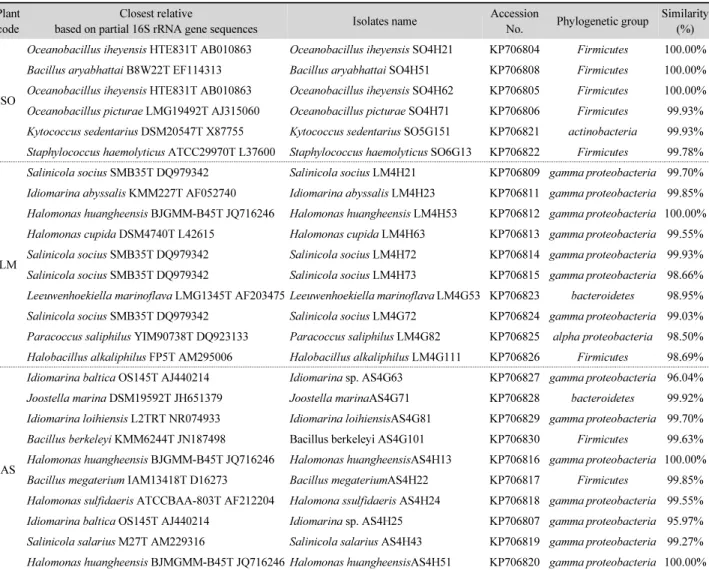
(1.54 M)로 조정된 marine agar (MB; Difco)에 도말하여(Na et al., 2011) 25℃ 항온조건에서 48시간 배양한 후, 생장가능한 균주 26개를 선발할 수 있었다(Table 1). 분리된 161 균주 중에 서 50균주(31.1%)가 내호염균에 포함되었고, 63균주(39.1%) 가 저호염균에 속하는 균주로 확인 되었으며, 22균주는 중호 염균에 속하였지만 염농도 1.2 M (7%) 이상에서는 생장을 못 하였다. 그리고 선발된 26균주는 염농도 9.0% (1.54 M)의 배 지상에서 생장하였으며, 이들 26개 호염성 균주들을 제외한 나머지 분리균주들 중 50균주들은 독도 해안이라는 특수한 환 경에서 높은 염분농도에서 내염성(halotolerance)을 확보하여 생존하는 종들로 판단된다. 이들의 partial 16S rRNA gene sequence 분석을 통한 호염세균의 부분동정을 위해(Baati et al., 2010; Vijayanand et al., 2010) 분리한 세균을 marine broth 를 사용하여 25℃에서 48시간동안 진탕배양한 후 원심분리하 여 일정량 이상의 균체를 취하였다(10,000 × g, 5 min). 이후 QIAamp DNA mini kit (QIAGEN)을 사용하여 total genomic DNA를 추출하였으며, 이들 중 16S rRNA gene sequence 증폭 을 위해 27F (5′-AGAGTTTGATCCTGGCTCAG-3′)를 for- ward primer로, 1492R (5′-GGTTACCTTGTTACGACTT-3′) 을 reverse primer로 사용하여 PCR을 수행하였다. PCR 조건 및 수행방법으로, initial denaturation (95℃, 15 min), denaturation (95℃, 20 sec), annealing (50℃, 40 sec), elongation (72℃, 90 sec)를 35회 반복한 후 마지막으로 elongation (72℃, 5 min) 과 정을 거쳤다(Yoon et al., 1998, 2005). 이후 PCR products는 product purification kit (SGP27-S150 Gel & PCR Extraction system-UB)을 이용하여 정제하였으며, 염기서열 분석은 ABI 3730XL DNA analyzer (Applied Biosystems)를 이용하여 실 시하였다. 결정된 서열은 Ez-Taxon server (http://eztaxon.org) 의 database 및 NCBI (National Center for Biotechnology Information)의 blast (Basic Local Alignment Search Tool) search를 이용하여 GenBank로부터 상동성이 높은 염기서열
Table 1. Partial identification of marine halophilic bacteria isolated from the rhizosphere soils of three coastal plants native to Dokdo islands Plant
code
Closest relative
based on partial 16S rRNA gene sequences Isolates name Accession
No. Phylogenetic group Similarity (%)
SO
Oceanobacillus iheyensis HTE831T AB010863 Oceanobacillus iheyensis SO4H21 KP706804 Firmicutes 100.00%
Bacillus aryabhattai B8W22T EF114313 Bacillus aryabhattai SO4H51 KP706808 Firmicutes 100.00%
Oceanobacillus iheyensis HTE831T AB010863 Oceanobacillus iheyensis SO4H62 KP706805 Firmicutes 100.00%
Oceanobacillus picturae LMG19492T AJ315060 Oceanobacillus picturae SO4H71 KP706806 Firmicutes 99.93%
Kytococcus sedentarius DSM20547T X87755 Kytococcus sedentarius SO5G151 KP706821 actinobacteria 99.93%
Staphylococcus haemolyticus ATCC29970T L37600 Staphylococcus haemolyticus SO6G13 KP706822 Firmicutes 99.78%
LM
Salinicola socius SMB35T DQ979342 Salinicola socius LM4H21 KP706809 gamma proteobacteria 99.70%
Idiomarina abyssalis KMM227T AF052740 Idiomarina abyssalis LM4H23 KP706811 gamma proteobacteria 99.85%
Halomonas huangheensis BJGMM-B45T JQ716246 Halomonas huangheensis LM4H53 KP706812 gamma proteobacteria 100.00%
Halomonas cupida DSM4740T L42615 Halomonas cupida LM4H63 KP706813 gamma proteobacteria 99.55%
Salinicola socius SMB35T DQ979342 Salinicola socius LM4H72 KP706814 gamma proteobacteria 99.93%
Salinicola socius SMB35T DQ979342 Salinicola socius LM4H73 KP706815 gamma proteobacteria 98.66%
Leeuwenhoekiella marinoflava LMG1345T AF203475 Leeuwenhoekiella marinoflava LM4G53 KP706823 bacteroidetes 98.95%
Salinicola socius SMB35T DQ979342 Salinicola socius LM4G72 KP706824 gamma proteobacteria 99.03%
Paracoccus saliphilus YIM90738T DQ923133 Paracoccus saliphilus LM4G82 KP706825 alpha proteobacteria 98.50%
Halobacillus alkaliphilus FP5T AM295006 Halobacillus alkaliphilus LM4G111 KP706826 Firmicutes 98.69%
AS
Idiomarina baltica OS145T AJ440214 Idiomarina sp. AS4G63 KP706827 gamma proteobacteria 96.04%
Joostella marina DSM19592T JH651379 Joostella marinaAS4G71 KP706828 bacteroidetes 99.92%
Idiomarina loihiensis L2TRT NR074933 Idiomarina loihiensisAS4G81 KP706829 gamma proteobacteria 99.70%
Bacillus berkeleyi KMM6244T JN187498 Bacillus berkeleyi AS4G101 KP706830 Firmicutes 99.63%
Halomonas huangheensis BJGMM-B45T JQ716246 Halomonas huangheensisAS4H13 KP706816 gamma proteobacteria 100.00%
Bacillus megaterium IAM13418T D16273 Bacillus megateriumAS4H22 KP706817 Firmicutes 99.85%
Halomonas sulfidaeris ATCCBAA-803T AF212204 Halomona ssulfidaeris AS4H24 KP706818 gamma proteobacteria 99.55%
Idiomarina baltica OS145T AJ440214 Idiomarina sp. AS4H25 KP706807 gamma proteobacteria 95.97%
Salinicola salarius M27T AM229316 Salinicola salarius AS4H43 KP706819 gamma proteobacteria 99.27%
Halomonas huangheensis BJMGMM-B45T JQ716246 Halomonas huangheensisAS4H51 KP706820 gamma proteobacteria 100.00%
을 비교 및 분석하였다(Maidak et al., 2000). 그 결과, 26개의 호염균들은 분리된 host plant에 관계없이 크게 4개 문 (phylum), 11개 속(genus)에 속함을 알 수 있었다(Table 2). 이 들은 각각 Firmicutes 문에 속하는 Oceanobacillus 속, Bacillus 속, Staphylococcus 속, Halobacillus 속에 속하는 다양한 종 의 세균들과 Gamma proteobacteria에 속하는 Halomonas 속, Idiomarina 속, Salinicola 속의 세균, bacteroidetes 문에 속 하는 Leeuwenhoekiella 속, Joostella 속의 세균들, Alpha proteobacteria에 속하는 Paracoccus 속 및 actinobacteria 문 에 속하는 Kytococcus 속의 세균들과 높은 유사도를 나타내었 다. 호염성 균주에 속하는 이들 26균주에 대해 NCBI의 Gen- Bank에 등록하였다(Table 1).
특히, 본 연구에서 분리된 호염성 세균인 Oceanobacillus 속, Kytococcus 속, Salinicola 속, Idiomarina 속, Leeuwenhoekiella
속, Joostella 속의 세균들은 지금까지 보고된 독도 토양 및 해 수 미생물상 관련 선행연구에서는 분리된 적이 없다(Jeon et al., 2009; Sung and Ghim, 2010).
이는 호염성 세균이라고 할 지라도 본 연구 및 선행연구에 서 일반적인 세균분리용 배지에서 분리되었음을 감안할 때, 단순히 독도의 해안지대에서 토양과 해수 분포 세균들이 함께 분리될 수 있다는 것이 아니라, 독도 해안식물 근권이라는 특 수한 환경에서 특이적인 미생물 상이 형성되어 있는 것으로 해석될 수 있다. 이와 별개로 98.5% 미만의 낮은 상동성을 보 인 Idiomarina 속 1개의 분리균은 신종세균으로의 가능성을 보였으며, 추가적인 연구가 필요하다(Table 1) (Woo et al., 2008). 실제로 독도의 특수한 기후환경으로 인해 2015년 2월 현재까지 총 40건의 이상의 신종세균 보고가 이루어 졌고, 독 도가 생태학적으로 다양한 신종세균의 보고임이 밝혀져 왔음
Table 2. Taxonomic composition of marine halophilic bacteria isolated from the rhizosphere soils of three coastal plants native to Dokdo islands
Phylum Genus Species Number Ratio
(%)
Firmicutes
Oceanobacillus iheyensis 2 7.7
picturae 1 3.8
Bacillus
aryabhattai 1 3.8 berkeleyi 1 3.8 megaterium 1 3.8 Staphylococcus haemolyticus 1 3.8 Halobacillus alkaliphilus 1 3.8
gamma proteobacteria
Salinicola socius 4 15.4
salarius 1 3.8
Idiomarina
abyssalis 1 3.8
baltica 2 7.7
loihiensis 1 3.8
Halomonas
huangheensis 3 11.5
cupida 1 3.8
sulfidaeris 1 3.8 bacteroidetes Leeuwenhoekiella marinoflava 1 3.8
Joostella marina 1 3.8
alpha
proteobacteria Paracoccus saliphilus 1 3.8 actinobacteria Kytococcus sedentarius 1 3.8
을 볼 때, 다양한 호염성 신종 미생물 또한 존재할 것이라 생각 된다(Sung and Ghim, 2010).
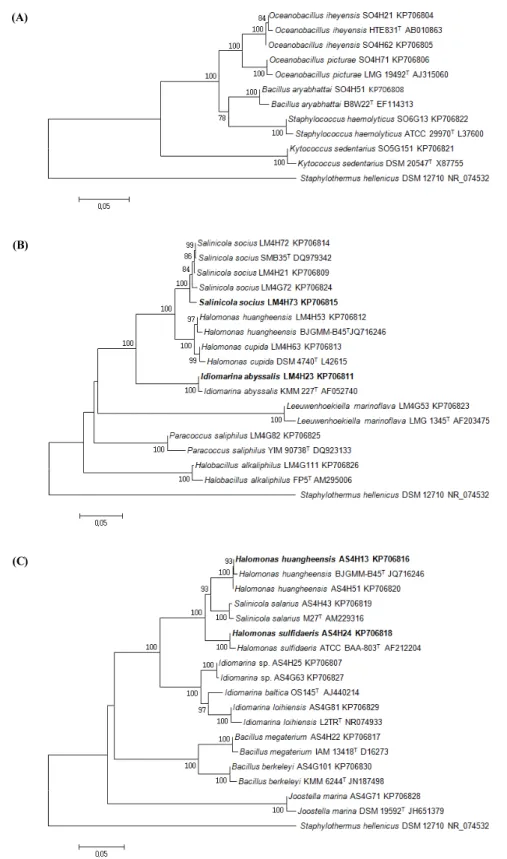
분리된 DNA로부터 결정된 염기서열과 데이터베이스에서 얻어진 염기서열은 유연관계 확인을 위해 partial 16S rRNA gene sequence 영역을 Clustal X program으로 다중정렬 후, BioEdit Sequence Alignment Editor를 사용해서 염기서열을 재차 정렬하고 Mega 6.0 Neighbor-Joining 방법과 Kimura 2-parameter 모델을 이용하여 계통수를 작성하였다(Felsenstein, 1985; Saitou and Nei, 1987). 그 결과 Site 1의 땅채송화 근권 및 주변토양에서는 Firmicutes 목이 대부분을 차지하였으나, 오 히려 Site 2, 3의 해국 및 갯까치수영 근권, 주변토양에서는 Gamma proteobacteria가 집중 분포하는 것으로 나타났다. 이 는 같은 해안식물이라고 하더라도 host plant에 따라 특이적인 문, 특이적인 종들이 분포하고 있음을 보여준다. 분리된 지점과 는 관계없이, 총 14개의 호염성균주가 Gamma proteobacteria 에 속하는 것으로(53.8%), 8개의 균주가 Gram-positive, low G+C contents의 특징을 가진 Firmicutes 문에 속하는 것으로 (30.8%), 2개 분리균이 Bacteroidetes 문에(7.7%), Alpha proteobacteria 와 Actinobacteria 문에 각각 1개 균주(3.8%)가
속하는 것으로 나타났다. 일반적으로 각 환경적 특징에 의해 분 리되는 phylum은 특징적인 패턴을 보이는데 해수에서는 Alpha, Gamma proteobacteria 순으로 발견되는 것으로(Felsenstein, 1985; Cho and Azam, 1988; Gonzalez and Moran, 1997;
Cottrell and Kirchman, 2000a, 2000b), 강이나 호수 등 담수환 경에서는 Beta proteobacteia가, 해양 침적지에서는 Delta proteobacteria가 주로 분리되는 것으로 보고되고 있다(Amann et al., 1995; Cho and Azam, 1988; MEthé et al., 1998; Cottrell and Kirchman, 2000b; Lee et al., 2008; Kim et al., 2014). 또한 냉용수나 심해 열수구나 같은 극한 해양환경에서는 주로 Epsilon proteobacteria 가 분리된다(Campbell et al., 2006). 또 한 특히 기존의 독도 환경 미생물상 연구에서 독도주변 해수 에서는 호염균을 분리하기 위한 배양조건이 아닌 일반적인 순 수분리 배지로서 marine broth 혹은 tryptic broth 한천배지를 활용하였으며, 그로서 순수분리를 실시한 결과로 주로 Gamma, Alpha proteobacteria 순으로 분리되었으나(Jeon et al., 2009;
Sung and Ghim, 2010), 본 연구에서 독도 해안식물 근권에서 생 존하는 호염성 세균은 오히려 Gamma proteobacteria, Firmicutes 문의 순으로 분리되었다. 또한 선행연구에서 일반배지인 tryptic broth 한천배지를 사용하여 순수분리를 실시한 결과 기 존 독도 토양에서는 Firmicutes 문의 세균들이 집중 분리되는 점은 일치하나, 위에서 언급한 대로 종 단위로 비교해 볼 때 대 부분 Bacillus, Paenibacillus 균주가 대부분을 차지하였던 결 과(Jeon et al., 2009)와는 명확히 다른 분리 종 조성을 보여주 고 있다. 이는 독도 해안식물 근권에서 고염분의 분리배지를 이용한 호염균 분리를 위한 본 연구가 유의적이었음을 의미한 다. 특히 Fig. 2의 phylogenetic tree에 표시된, 본 연구에서 분 리된 균주들과 상동성이 높은 표준균주(type strain) Bacillus aryabhattai, Bacillus megaterium 등은 식물생장 및 면역성 유 도와 관련되어 있는 균주이며, Oceanobacillus iheyensis, Oceanobacillus picturae 등은 독도해안과 유사한 환경을 보이 는, 해안과 삼림이 접하는 해안토양에서 분리 보고된 종들이 다(Lee et al., 2006, 2012; Lu et al., 2001; Siddikee et al., 2010;
Kang et al., 2014; Porcel et al., 2014). 우리나라 일반적인 해안 유형으로 경사가 완만한 갯벌, 강의 하구 등지에 서식하는 식 물근권 미생물상은 연구된 사례가 다수 있었으나(Kim et al., 2005; Lim et al., 2006; Seo et al., 2012; You et al., 2012), 해안 토양이 급격한 경사를 이루며 험한 파도 등으로 해수와 바로 접하는 지형에서의 해안식물 미생물상에 관한 연구는 이루어 진 사례가 없었다. 이러한 점들을 종합해 볼 때, 이들 호염성 균 은 독도 해안가 해안식물 근권에서 독도 특유의 극심한 염분 변화 및 높은 염농도에 적응하며 해안식물과 어떠한 특이적
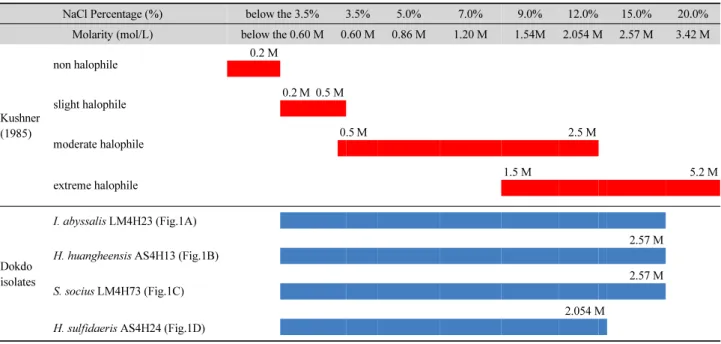
Table 3. Growth section of halophilic Dokdo bacteria in MB medium containig serial concentration of NaCl from 3.5% to 20.0%. Red line shows the criteria for classification of non halophile, slight, moderate and extreme halophile (Kusher, 1985).
NaCl Percentage (%) below the 3.5% 3.5% 5.0% 7.0% 9.0% 12.0% 15.0% 20.0%
Molarity (mol/L) below the 0.60 M 0.60 M 0.86 M 1.20 M 1.54M 2.054 M 2.57 M 3.42 M
Kushner (1985)
non halophile
0.2 M
slight halophile
0.2 M 0.5 M
moderate halophile
0.5 M 2.5 M
extreme halophile
1.5 M 5.2 M
Dokdo isolates
I. abyssalis LM4H23 (Fig.1A)
H. huangheensis AS4H13 (Fig.1B)
2.57 M
S. socius LM4H73 (Fig.1C)
2.57 M
H. sulfidaeris AS4H24 (Fig.1D)
2.054 M
상호작용을 하고 있는 것으로 판단되어, 후행연구가 필요하 다.
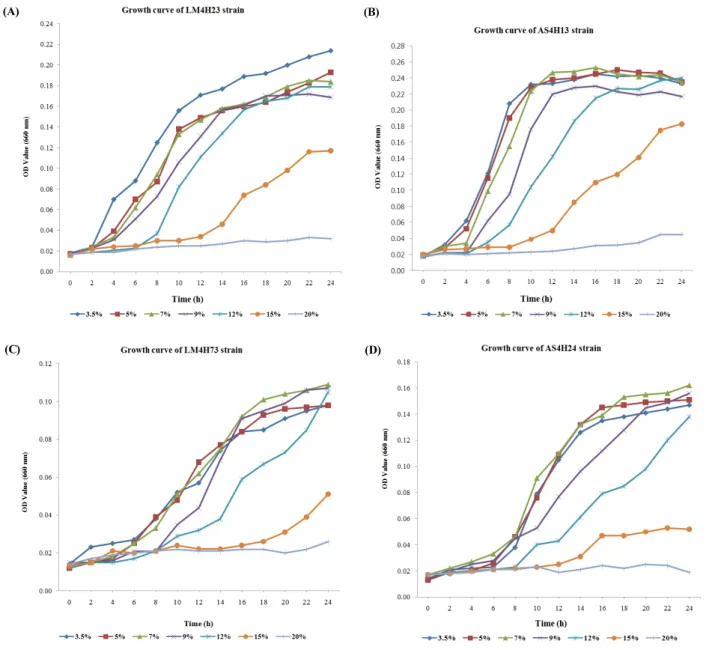
분리된 호염성 균주 26개에 대해 염 농도에 따른 생장특성 확인 및 극호염성 세균의 유무 판별을 위해 각각의 균주별로 NaCl (sodium chloride)의 농도를 각 비율에 따라 조정하여 진 탕배양을 실시하였다(Kushner, 1985). 이들 위해 기본배지로 서 250 ml의 marine broth 액체배지를 사용하였으며, 각각 염 분농도를 Table 3에 표시된 바에 따라 조정하여 121℃ 15 lb로 고온가압멸균 후 냉각하여 본배양액으로 사용하였다. 선발된 26개 균주를 각각 10 ml의 marine broth에 접종한 후 25℃에서 16시간 동안 180 rpm으로 전배양한 후, 다양한 염분 농도로 조 정된 본배양액에 1 ml씩을 접종하여 25℃에서 180 rpm으로 24시간 동안 진탕배양을 실시하였다. 최초 접종 후, 120분 간 격으로 배양액 각200 µl씩을 취하여 660 nm 파장에서 흡광도 를 측정하였으며, 이를 바탕으로 염분농도 구배별로 growth curve을 작성하였다(microtiter plate reader at 580 nm, Merck Co.) (Park and Jeong, 1996). 그 결과, 26균주 중에서 22균주 는 NaCl 농도 9.0% (1.54 M) 까지만 생장 및 증식이 가능하였 으며, 나머지 4개 균주인 Halomonas sulfidaeris AS4H24, Salinicola socius LM4H73, Idiomarina abyssalis LM4H23과 Halomonas huangheensis AS4H13 균주는 12.0% 염농도에서 까지 생장이 가능하였다. 그들 중 H. sulfidaeris AS4H24을 제 외한 나머지 3개 균주는 15.0% 농도에서 증식하였으며, 20.0%
에서는 4개 균주 모두 증식이 이루어 지지 않는 것으로 관찰되
었다. Fig. 1에서 이들 4개 균주의 growth curve를 보면, S.
socius LM4H23 균주의 경우 3.5%에서 15.0%까지 광범위한 농도에서 생장이 가능하였다(Fig. 1A). 또한, 염농도 9.0%에 서도 낮은 염농도에서와 유사한 시간대의 lag phase를 보였으 나, 12.0%–15.0%에서 부터는 lag phase가 2–3배 길어졌으며, 서서히 stationary phase 로 접어드는 것으로 나타났다. 염농도 20.0%까지 증가하였을 때에는 생장하지 못하는 것으로 나타 났다(Fig. 1A). H. huangheensis AS4H13 균주의 경우 S. socius LM4H23 균주와 기본적인 lag phase는 유사하고, 역시 3.5–
15.0%까지 광범위한 염농도에서 증식이 가능하였다. 저농도 의 염(3.5%)에서보다는 7.0% 내외 염농도에서 stationary phase (12 h)에 일찍 도달하는 것으로 관찰되었다(Fig. 1B). 그러나 12.0% 이상의 염농도에서는 lag phase가 서서히 길어졌으며 특히 15.0% 농도에서는 서서히 stationary phase로 접어드는 것으로 나타났다. 20.0% 염농도에서는 더 이상 증식하지 못하 였다. S. socius LM4H73 균주의 경우 기본적인 lag phase (6 h) 에서 낮은 염농도에서보다 7.0%, 9.0% 염농도에서 오히려 stataionary phase에 빨리 도달하였다. 그러나 12%에서는 낮 은 염농도보다 lag phase가 길어지는 경향을 보였으나, 3.5%
에서보다 stataionary phase에 일찍 도달하는 것으로 나타났다.
15.0% 염농도에서는 낮은 농도에서보다 exponential phase에 서 curve가 천천히 증가하였으나, 생장이 가능한 것으로 판단 된다(Fig. 1C and D). 이들 2 균주도 20.0% 에서는 생장을 하지 못하는 것으로 나타났다. H. sulfidaeris AS4H24 균주의 경우
(A) (B)
(C) (D)
Fig. 1. Growth profile of halophilic bacteria in MB medium containig serial concentration of NaCl from 3.5% to 20%. Biomass was spectrophotometrically measured during 24hr incubation. A) I. abyssalis LM4H23; B) H. huangheensis AS4H13; C) S. socius LM4H73; D) H. sulfidaeris AS4H24.
역시 기본적인 lag phase (6 h)에서 낮은 염농도에서보다 7.0%, 9.0% 염농도에서 오히려 stataionary phase에 빨리 도달하였 다. 그러나 12%에서는 낮은 염농도보다 lag phase가 길어지는 경향을 보였으며, 저농도에서보다 느리게 stationary phase에 도달하였다. 15.0% 염농도 이상에서는 증식하지 못하는 경향 을 보였다. 결론적으로 S. socius LM4H73 (Fig. 1C) 및 H.
huangheensis AS4H13 (Fig. 1B) 균주의 경우 12.0% 미만에 서, H. sulfidaeris AS4H24 (Fig. 1D) 균주의 경우 9.0% 이하의 염농도에서는 각각 염농도가 증가할수록 급격한 저농도의 염 에서보다 빠른 속도로 stationary phase 에 도달하는 것으로 보
아, 최적 생장을 위해 환경상에서 일정 농도 이상의 NaCl이 요 구되는 호염성의 특성을 보여주고 있다(Simbert and Kreig, 1981; Javor, 1984; Grand and Larsen, 1989). 또한 S. socius LM4H23 (Fig. 1A), S. socius LM4H73 (Fig. 1C) 및 H.
huangheensis AS4H13 (Fig. 1B) 균주의 경우 15.0% 염농도에 서 생장이 가능하므로, 이들은 고호염성 세균에 속하는 것으 로 판단된다(Table 3) (Kushner, 1985). 그러나 H. sulfidaeris AS4H24 균주의 경우 15.0% 염농도에서는 거의 증식이 이루 어 지지 않음을 볼 때 극호염성에는 해당하지 않는 것으로 판 단된다. 그러나 이러한 극호염성에의 해당 유무와 관계없이,
(A)
(B)
(C)
Fig. 2. Neighbour-joining phylogenetic tree based on partial 16S rRNA gene sequences showing the positions of marine bacteria and representatives of other
species related taxa. Only bootstrap values (expressed as percentages of 1000 replications) greater than 70% are shown at branching points. Staphylothermus
hellenicus DSM 12710 (GenBank accession number, NR_074532) was used as an outgroup. Bar, 0.05 substitutions per nucleotide position. The marine
halophilic bacteria isolated from rhizosphere soils of coastal plants (A) S. oryzifolium; (B) L. mauritiana; (C) A. spathulifolius.
염 농도가 3.0%인 순수 분리배지 marine broth에서 생장이 가 능한 점, 이에 더하여 Table 3를 참고하면 위의 4균주 모두 광 범위한 NaCl 농도에서 생장이 가능한 것을 보여준다. 이는 급 격한 각도를 보이는 독도 경사면과 해수가 접하는 지점에서 강우, 태풍, 상시 발생하는 해무, 해양 반사광으로 인한 건조, 토양 염분조절을 담당하는 염생식물의 생장과 사멸로 인해 해 안식물 근권 염분농도의 변화가 극심한 환경(Choo et al., 2009)에 적합하도록 호염성 세균들이 적응해 온 결과로 생각 된다. Fig. 2의 phylogenetic tree에 표시된 이들 4균주와 상동 성이 가장 높은 표준균주(type strain)는 모두 암염, 소금사막, 바다에서 분리된 호염성 신종세균으로 보고 되었다(Ivanova et al., 2000; Kaye et al., 2004; Anan'ina et al., 2007; Miao et al., 2013). 그러나 신종보고 혹은 분류학적 계통관계에 관한 기초 적 연구 이후 이들 호염성 세균에 대해 거의 연구된 바가 없다.
독도 특유의 가파른 지형에 의해 독도의 식생은 해수와 바로 접해 있으며, 종종 발생하는 높은 풍속으로 인한 풍랑으로 경 사가 완만한 일반적 해안가보다 염분의 유입이 극심하다. 분 리된 균주들이 해양환경에서 분리된 균이기는 하나, 본 연구 의 샘플링 시점이 여름철 태풍이 지나간 이후 1주일이 지난 시 점에서 실시되었으며, 태풍 이후 풍랑이 발생할만한 날씨변화 가 없었던 점을 감안할 때 분리된 4종의 고호염균은 단순히 해 수에만 존재하는 것이 아니라 토양에서 정주가능한 것으로도 볼 수 있으며, 이들이 독도의 해안식물 근권에서 정주하면서 식물과 긍정적 상호작용을 할 가능성이 높은 것으로 예측된 다. 따라서 이들이 식물과 관련하여 구체적으로 어떠한 긍정 적 역할을 수행하는지에 대한 후행 연구가 필요하다.
적 요
독도의 해안에 군락을 이룬 해안식물 근권에서 호염성 및 염 내성을 가지는 세균의 분리를 위해 3종의 해안식물의 군락을 선정한 후 각 식물의 군집 하부에서 토양시료를 채취하였다.
시료는 marine broth 한천배지를 이용하여 형태학적인 구분을 통해 순수분리 되었다. 분리된 161개 세균들을 NaCl 9.0% 농 도로 조정된 배지에서 생존하는 26개 균주를 선발하여 genomic DNA를 얻은 후, 16S rRNA gene sequence를 증폭하여 부분동 정 하였다. 이들의 유연관계 확인을 위해 계통수를 작성한 결 과, 이들은 각각 Firmicutes (30.8%), Gamma proteobacteria (53.8%), Bacteroidetes (7.7%), Alpha proteobacteria (7.7%), Actinobacteria (7.7%)에 속하였으며, 이는 기존의 독도 토양 및 해수 미생물상 연구와 특징적 차이를 보인다. 또한, 분리된
세균의 종 조성도 기존 독도 토양 및 해양연구와 유의적으로 상이함을 보였다. 이에 더하여 선발된 26개 균주들 중에서 4균 주가 12.0% 이상의 염농도에서 생장하였으며, 이들 중에서 3 개 균주가 15.0% 이상의 염농도에서 생장하여 극호염성의 특 성을 나타내었으며, 광범위한 염분농도에서도 생장하는 특성 을 보였다. 이들은 해안식물 근권에서 독도 특유의 고염분 및 염분변화라는 환경적 스트레스를 극복하며 해안식물과 어떠 한 상호작용을 하는 것으로 생각된다.
감사의 말
본 연구는 환경부 “차세대 에코이노베이션기술개발사업”
으로 지원 받은 연구이며, 연구비 지원에 감사를 드립니다.
References