—29—
INTRODUCTION
It is well known all the life on the earth depends on freshwater which has unique property as a solvent cover- ing a wide range. The freshwater system covers approxi- mately 0.8% of the world’s surface and makes up only 0.01% of the world’s water (Dudgeon et al., 2005). But this tiny fraction has a critical position in providing a home for 7% of the estimated 1.8 million described spec- ies (Ballie et al., 2008), including a quarter of the esti- mated 60,000 vertebrates (Darwall, 2008). The biodiver- sity of particular area or ecosystem indicates the richness of species in it and increases with the complexity of an ecosystem and vice versa. Biodiversity with complex of
species provides services to human society including clean water, fresh air and good food. Reducing or loosing biodiversity affects on these ecosystem services and life support systems we desperately depend upon. The con- servation of freshwater ecosystem containing large part of biodiversity is so fundamental to achieving human survival.
Recently this critically important and vulnerable fresh- water ecosystems are under most pressure of all the world’s global ecosystems by which humans have caus- ed rapid and significant declines in freshwater species and habitats. Extinction is a natural process, but the rate in water ecosystem is known to be 4 to 5 times higher than in terrestrial ecosystems. According to IUCN Red List of 2004, 81 fish species are extinct and another 12 species can not be found in nature (Baillie et al., 2004) that is only alive in captivity. About 58 animal species
Strategies for Conservation and Restoration of Freshwater Fish Species in Korea
By Eon-Jong Kang*, In-Chul Bang
1and Hyun Yang
2Inland Aquaculture Research Center, National Fisheries Research and Development Institute, Busan 619-902, Korea
1Department of Marine Biotechnology, Soonchunhyang University, Asan 336-745, Korea
2Institute of Biodiversity Research, Jeonju 561-211, Korea
ABSTRACT The tiny fragment of freshwater body is providing home for huge biodiversity and resour- ces for the existence of human. The competing demand for freshwater have been increased rapidly and it caused the declination of biodiversity in recent decades. Unlike the natural process of extinction in gradual progress, the current species extinction is accelerated by human activity. As a result many fish species are already extinct or alive only in captivity in the world and about fifty eight animal species are in endangered in Korea including eighteen freshwater species. Conservation of biodiversity is the pro- cess by which the prevention of loss or damage is attained, and is often associated with management of the natural environment. The practical action is classified into in-situ, or ex-situ depending on the location of the conservation effort. Recovery means the process by which the status of endangerment is improved to persist in the wild by re-introduction of species from ex-situ conservation population into nature or translocation of some population. However there are a lot of restrictions to complete it and successful results are known very rare in case. In this article the authors explore some strategies for conservation and restoration of freshwater fish species conducted in Korea for few years. The major causes are discussed in relation with the decline of freshwater fish diversity during few decades and some strategies are evaluated to advance the process of conservation. A study on the Korean bullhead, Pseudobagrus brevicorpus, is introduced as a case for ex-situ conservation and restoration in fresh- water ecosystem.
Key words : Conservation, restoration, endangered species
*Corresponding author: Eon-Jong Kang Tel: 82-55-540-2720, Fax: 82-55-546-6292, E-mail: [email protected]
Accepted : June 20, 2009
http://www.fishkorea.or.kr
are listed as endangered in Korea and among it 18 spec- ies are freshwater fish species.
In the context of species at risk conservation and re- covery is so necessary before extinct or extinct in wild.
Conservation of biodiversity is the process by which the prevention of loss, waste, damage and destruction is at- tained and is often associated with care and management of the natural environment. This act is an integral com- ponent of biodiversity management, and is often describ- ed as being in-situ or ex-situ depending on the location of the conservation effort. In-situ means literally the con- servation of species where they are naturally found. Ex- situ conservation means the components of biological diversity outside their natural habitat in temporary and complementary to in-situ (Austin, 2004).
Recovery is the process by which the decline of an endangered species is arrested or reversed, and threats are removed or reduced to improve the likelihood of the species’ persistence in the wild. A species will be consi- dered recovered when its long-term persistence in the wild has been secured. The ex-situ conservation under recent imperilled condition of biodiversity is known as useful in restoration or re-introduction. But it will not be a complete way and have done very rare in case, even though so many countries or scientific groups have stud- ied or tried especially for the group of salmon (Pima County, 2001; Dennis, 2002; Secwepemc Fisheries Com- mission, 2003; U.S. Fish and Wildlife Service, 2003;
Desert Fish Team, 2006; Soorae, 2008).
There are needs to assess the status of conservation and restoration efforts or acts in Korea that is required to con- serve biodiversity. The authors explored and reviewed some strategies for conservation and restoration of fresh- water fish species with respect to act of ex-situ conserva- tion and the case study of restoration in Korea. The high- ligt will be on the causes of reducing biodiversity, status of ex-situ conservation of endangered freshwater fish species including authors results on it as a case study, and relevant conventions and legislation for biodiversity conservation.
MAJOR CAUSES AFFECTING ON THE DECLINE OF FRESHWATER FISH DIVERSITY
Five interacting categories are thought to be the leading causes of these threats to global freshwater biodiversity, that is overexploitation, water pollution, flow modificat- ion, destruction or degradation of habitat and invasion of exotic species. Moreover the climate change occuring at the global scale are superimposed upon all of these threat categories (Dudgeon et al., 2005).
Korean peninsular location in a temperate monsoon climate zone is heavily dependent on its surface water resources to use. The average annual precipitation is
1,245 mm, which is 1.4 times of world’s average. How- ever, the problem is its characteristics of the season that two thirds of the rainfall is concentrated during the sum- mer. Some other factors are added to this situation mak- ing water supply worse. The rivers are short in length and drainage areas are small, and the channel slopes are relatively steep because of topographically steep condit- ion in the uplands. This makes very sharp and peak flood discharges in the rain season and the extreme variation of river flow that the rate of maxinum/minimum dischar- ge is between 100~700. There are frequent early or pre- summer droughts when water demand for agriculture peaks (CSD, 2004).
Total supply of annual water resources is estimated to be 127.6 billion tons, but about 54.5 billion tons are lost and about 49.3 billion tons are discharged to the sea dire- ctly. Only about 33.1 billion tons is available for use and the amount for agriculture is responsible for about 50%
of it. It makes needs to have various legislation to mana- ge the water resource. Among them Dam Construction and Support Act (1999) comprise the general legal and regulatory framework for water resource management and development in Korea. As a result 14 lage scale dams, 3 estuary banks and more than 18,000 banks were constructed along the river blocking the flow and reser- ving the water as much as about 13.3 billion tons (Mini- stry of Communication and Transport, 2007).
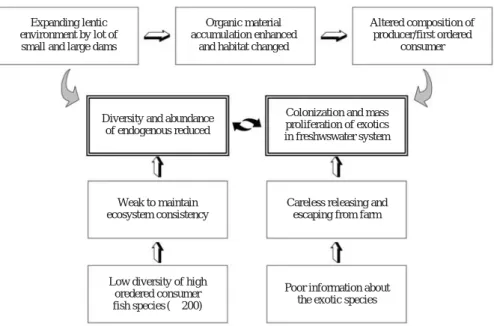
This act of reform of rivers or reallocation of surface water for water management have resulted in the modifi- cation of physical and geo-morphological characteristics of rivers, and it influenced on the structure of flow and channel (Fig. 1). The modification of stream altered the flow patterns by storing water into stagnant status which followed by the change of aquatic habitats and the redu- ction of biodiversity in response to the alteration of the flow regime. Also the physical fragmentation resulted in cutting off the migration routes of aquatics and in the tra- pping of various suspends which can lead to abnormal web of food chain. These changes in ecosystem has to be received attention in relation to the modification of species composition and abnormal breakout of some water-borne disease or exotic species. Suggesting any colonial population of alien species introduced without competent native species, they can be settled down easily utilizing enough food organism in accordance with chan- ged habitat into stagnant (Fig. 2). Usually they are the apex predator and altered food web can be restored in response to removal of introduced one (Lepak et al., 2005).
Blocking movement of migratory by dams or river- banks can divide the species gene pool up and down rivers which may reduce the chance of encounter of species members carrying diverse genes in reproduction and be a cause of diversity reduction within species. It just seems like a inbreeding effect occured within a
small population. On the other hand blocking migration itself will have impact on some migratory species that complete its life history from river to sea or vice versa (Lariniar, 2000; McAllister et al., 2001).
Another important factor affecting on diversity is des- truction or degradation of habitat. It was occured widely in Korea to supply the water and to control the flood. In 1996, an integrated water management policy launched
in 1993 were succeeded by the Comprehensive Measures for Water Management, which constituted a long-term plan for water management with a 10-year program for water quality and a 15-year program for water resources.
Though the assessment of ecosystem is defined to be in- cluded before development or reform of river, the im- pacts on ecosystem is still not be or may not be evaluated by such a simple and short period of investigation.
Fig. 1. Diagram showing the causes of water shortage and results of policy of water management affecting on the freshwater ecosystem (data from Ministry of Communication and Transport, 2005, 2007).
Annual precipitation averaging 1,245 mm Min. 754 mm Max. 1,782
Short length ⁄510 km, Steep gradient of river
�High density of population
�High demand for irrigation of 48%
�Insufficient of water supply (12% of world)
�Frequent natural disaster
Act for Water Management
Results High fluctuation of
water level Index 300-390
�Lentic environment
�Blocking fish pathway
�Flow modification
�Destruction of habitat
Results
�14 multi-purpose large dams
�3 estuary banks constructed reserving 128 billion ton of total river capacity 506 billian ton
�18,000 banks for drink and irrigation
Fig. 2. Diagram explaining the possible process of colonization of introduced species and decline of biodiversity in freshwater ecosystem altered.
Expanding lentic environment by lot of small and large dams
Diversity and abundance of endogenous reduced
Weak to maintain ecosystem consistency
Low diversity of high oredered consumer fish species (⁄200)
Poor information about the exotic species Careless releasing and
escaping from farm Colonization and mass proliferation of exotics in freshwswater system Organic material
accumulation enhanced and habitat changed
Altered composition of producer/first ordered
consumer
SPECIATION EVENT UNIQUE TO KOREA AND STATUS OF ENDANGERED FISHES
Since Steindachner reported 12 species in 1892 for the first time, many foreign and Korean scientists found and described new species, and revised them (Mori, 1936;
Uchida, 1939; Chyung, 1977; Kim and Kang, 1993; Kim, 1997). Still some new freshwater fish species are found (Kim and Kim, 1991a; Chae and Yang, 1999; Arai et al., 2001) and listed newly in Korea (Kim and Kim, 1991b).
Recently Kim et al. (2005) revised Korean freshwater fishes including brackish and exotics, and described 212 species.
Among indigenous Korean freshwater species 30.5%
of the species are endemic to Korea. Most of the ende- mic species are found in the bottom dwellers and the fact give some cues to understand the process of speciation event. The concept of geographic isolation (Wiley, 1981) is considered as major factor of the speciation and the cause of high endemism for Korean freshwater fishes.
The Paleo-Hwangho river was connecting Chinese main- land and Korean Peninsular about 15,000 years ago (Fig.
3). The connection was broken completely about 10,000 years ago by the rapid raising of the sea level. As a result of separation, Korean river system composed of 5 major rivers can retain its independent status from near freshwater system, Chinese and Japanese (Lee, 1988).
Phylogenetical analysis on the subfamily Gobioninae showed such a close relationship between speciation and geographical isolation (Kang, 1991). All those endemic species are very important in understanding Korean history of freshwater fishes and in having unique gene material.
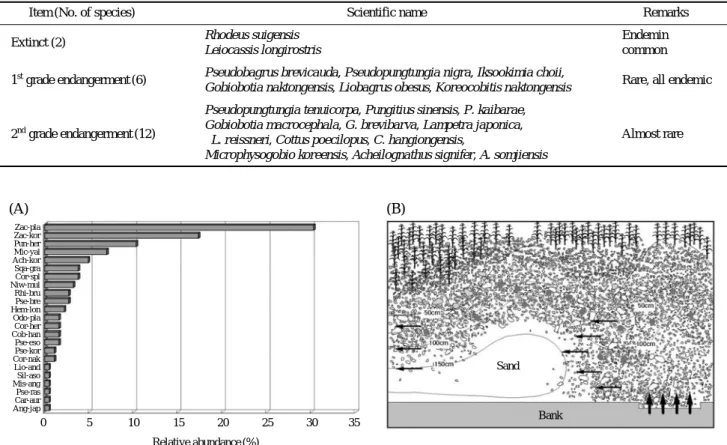
Unfortunately two species, long sonuted bullhead, Leiocassis longirostris, and soho bitterling, Rhodeus hon- dae, are extinct in Korea. The former is common with China and a case of local or population extinction. But the later had been reported only once in Seo-ho reservoir in the world. Besides these two extinct species, 18 spec- ies are listed as endangered and designated under 1stand 2ndgrade by Ministry of Environment (Table 1). Almost all of the listed species are included in bottom dwellers, such as Gobioninae of Cyprinidae, Bagridae and Ambly- cipitidae. Among those protected species only four, Pseudopungtungia nigra, Acheilognathus signifer, Pseu- dobagrus brevicorpus, and Pungitius kaibarae ssp., are under the ex-situ conservation by Inland Aquaculture Research Center (former Southern Regional Inland Fish- eries Research Institute) of National Fisheries Research and Development Institute. The consideration is focused on Korean stumpy bullhead, Pseudobagrus brevicorpus, because its distributional area is so restricted within about 5 kms. in diameter of Nakdong River and remarked as most vulerable species therefore.
CASE STUDY OF CONSERVATION AND RESTORATION FOR FRESHWATER FISHES
Before begining the conservation act, the authors con- structed a team to conduct the project which each of the partner takes part in the field of study; artificial prolifer- ation and management, investigation on ecology of endangered fishes, and analysis on genetic diversity within population in captivity and natural respectively.
To keep longevity and effectiveness of the project govern- mental institute, SRIFRI has a role for conservation cen- ter designated by the Law. According to the agenda of related law, conservation center can do another act of utilization procedure helping conservation. That is to use resources and satisfying the demand of people on target species, just same as CITES. The goal of this act is
“Never use the biological resources from nature, but use artificially proliferated only”. Now the conservation cen- ter keeps four species and two of them, Aheilognathus signifer and Pungitius kaibarae, are ready to distribute to produce as commercial purpose. P. brevicorpus is the main species to conserve in captivity and to develop the way on how we must strictly follow this procedure of conservation and re-storation of species.
Investigation on biology requires conservation Detailed biological informations are needed to conduct the project, relating to ecology at least for habitat require- ment. Four items are included in this field; sympatric species living together as competitors for habitat utiliza- tion, microhabitat structure of the species, food organisms in nature, and population structure including reproductive potentials. Only the information was its nocturnal behav- ior and macrohabitat under the gravel in upper current stream of Nakdong river (Uchida, 1939; Kim et al., 2005) when we started the study.
According to the result of our ecological investigation
Fig. 3. Diagram showing the hypothetical Paleo-Hwangho River sys- tem (Lee, 1988) and accorded speciation event by vicariance.
Vicariance event 2 Vicariance event 1 Paleo-Hwangho R. formation,
15,000 yr before
Separation of river, 10,000 yr before
61 among 200 species (30.5%) mostly appeared in bottom dweller
Distribution of common spec.
Speciation of endemic spec.
Endemism
Paleocoastline East sea
Paleocoastline Paleo Hwang-ho
team in 2007 the sympatric species composed of 23 species of 9 families in 3 orders. Dominat species was Zacco platypus and sub-dominance was Z. koreanus with relative abundance of 30.3% and 17.3% respectively (Fig. 4A). This result means that the stream has charac- ters between upper and middle part of the river. The den- sity of P. brevidorpus was 1.3 inds/m2followed by square method in most crowded and restricted area under small riverbank (Fig. 4B). The microhabitat was constructed with large gravel near sand bottom just below the current flowing from the bank. All the specimens were found separately under each gravel and at the place with water depth of 30~150 cm. Total population size was suppos- ed to be 528~870 individuals followed by capture-re- capture method (Fig. 4B).
Their nocturnal behavior was evidenced by diurnal pat- tern of feeding. Most active feeding habit was appeared in the time of dawn and the intestine was empty in after- noon (Fig. 5A). Food contents observed was attained to 13 species of insects including Tricoptera, Ephemerop- tera and Diptera among 16 species found in same habitat (Fig. 5B). This condition of habitat was referred when select a site for re-storation to expand the population of species within the natural distribution.
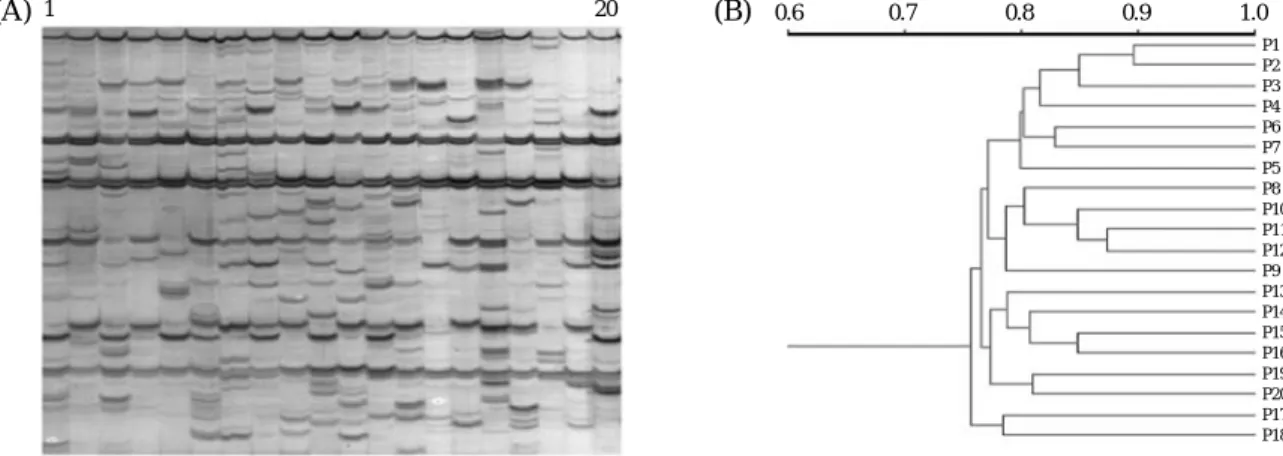
Analysis on genetic diversity within population It is important to analyze their endangerment and to strengthen the diversity within the population through management in captivity. In this study AFLP analysis was conducted and 315 bands were analysed using 3 primers (E/ACT-M/CAG, E/ACG-M/CCT, E/AGA-M/
CTC). The genetic similarity within population was rela- tively high as 0.811 comparing other endangered species, Iksookimia choii (Lee et al., 2008a) and Hemibarbus mylodon (Lee et al., 2008b). This population is forming a clade at the similarity of 0.756 in UPGMA dendrogram analysis showing relatively high polymorphism (Fig. 6).
This result means more efforts are needed to expand mother population from various localities to enhance genetic diversity in ex-situ conservation.
Artificial proliferatioin in captivity and domestication to adult
When artificial breeding is adopted to reproduce in captivity for this species, the procedure of getting artifi- cial milt may cause of loss of male fishes because dissec- ting and extracting testis is needed to prepare milt. To reduce unnecessary loss of fishes artificial mating was
Table 1. List of extincted and protected species under the law in Korea
Item (No. of species) Scientific name Remarks
Extinct (2) Rhodeus suigensis Endemin
Leiocassis longirostris common
1stgrade endangerment (6) Pseudobagrus brevicauda, Pseudopungtungia nigra, Iksookimia choii,
Rare, all endemic Gobiobotia naktongensis, Liobagrus obesus, Koreocobitis naktongensis
Pseudopungtungia tenuicorpa, Pungitius sinensis, P. kaibarae, 2ndgrade endangerment (12) Gobiobotia macrocephala, G. brevibarva, Lampetra japonica,
Almost rare L. reissneri, Cottus poecilopus, C. hangiongensis,
Microphysogobio koreensis, Acheilognathus signifer, A. somjiensis
Fig. 4. Relative abundance of species in % collected at the site (A) and diagram of habitat (B). ■in A shows Pseudobagrus brevicorpus and ● in B indicates the specimen collected.
Zac-pla Zac-kor Pun-her Mic-yal Ach-kor Sqa-gra Cor-spl Niw-mul Rhi-bru Pse-bre Hem-lon Odo-pla Cor-her Cob-han Pse-eso Pse-kor Cor-nak Lio-and Sil-aso Mis-ang Pse-ras Car-aur Ang-jap
0 5 10 15 20 25 30 35
Relative abundance (%)
Sand
Bank
(A) (B)
induced after hormone injection in the aquarium. The female fishes were injected intramuscularly near the base of dorsal fin with LHRH-a at 0.002μg/g and pimozide at 5μg/g. The male fishes were injected with half of the dosage for female. The dose was similar with the result of Lin et al. (1988) conducted on Chinese loach. Three kind of nest were prepared and installed together in one aquarium to find prefered one for this species to spawn.
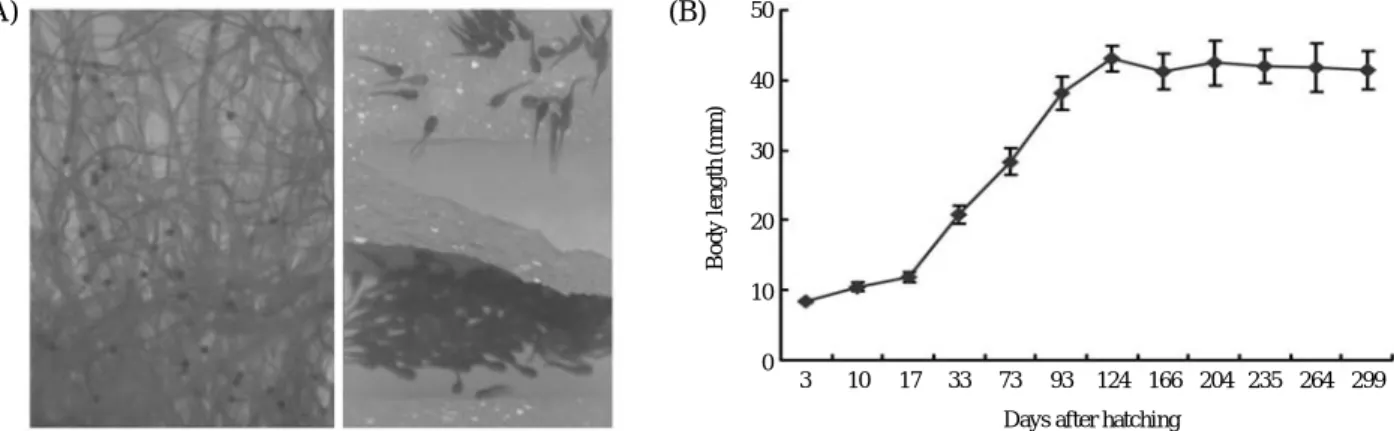
Spawning eggs occured 7 days after injection at 24�C and all the fertilized eggs were found only on prefered weed type of artificial nest. No eggs were found on the under- or upper-surface of rigid block or pipe type of material (Fig. 7A). The number of eggs were 230~260 per indi- viduals which was similar to those of amount investi- gated from parental fishes directly by dissection. The growth rate was fast during 17 and 124 days after hatch- ing then became slow (Fig. 7B) and represented by the formula y==7E-5X2.6656(R2==0.9916) for the standard length.
Releasing fries to re-establishment
The first step considered to restore fishes was finding out any restricting conditions for living of this species at present. An investigation on the introduced population was conducted to define the conditions from the course of settlement of pupulation at new site. Another impor- tant factor of genetic diversity affecting on the endanger- ment is not considered here because the result of analysis showed relatively high than other rare species (See above). Before releasing the fries the habitat requirement was analysed at selected site for this species and com- pared with its original one. The fish fauna was similar to the site for parental fishes collected in which Z. platypus was dorminant species, but the density of target species was extremely low. Other conditions such as composition of possible food organism and bottom structure are also very similar to it.
2,000 fries were discharged to selected site of almost same in area with derived place. 15 days after releasing
Fig. 5. Diagram shows the diurnal behavior of feeding (A) and the composition of food contents found in stomach (a) and in habitat (b).
Fig. 6. Result of fingerprint pattern after AFLP analysis generated with some primer combination (A) and UPGMA dendrogram showing the sim- ilarity within population (B).
0.25
0.2
0.15
0.1
0.05
0
Stomach contents(g)
6 8 10 12 14 16 18 20 22 14 2 4
Time
Ephemeroptera
(a)
(b)
Tricoptera Diptera
(A) (B)
1 20 0.6 0.7 0.8 0.9 1.0
P1 P2 P3 P4 P6 P7 P5 P8 P10 P11 P12 P9 P13 P14 P15 P16 P19 P20 P17 P18
(A) (B)
the density at new site was average 2.8 inds/m2 with maximun 8 inds/m2 that is very high than parental one.
Midges and tricopteran were found to be utilized as the major food items by the species at new site. This result indicates the population is settling down at new site and needed for further study.
FURTHER STUDY OR TASK AND PROBLEMS FOR CONSERVATION ACT IN KOREA
Problems in conservation policy
The use of ex-situ conservation play a significant role in species recovery and continue to play by federal de- partment and agencies in Canada (Austin, 2004), and the task needs organized team (Desert Fish Team, 2006). The act of conservation in Korea is based mainly on the Law for Conservation of Natural Wild Plants and Animals enacted in 2005, Ministry of Environment (ME). The task of conservation is very complicated including a lot of taxa, therefore ME can not establish all the institutes to cover various taxa. The freshwater resources itself and the habitat of freshwater fishes are managed by different law, the Law for River Act, Ministry of Land, Transport and Maritime Affairs (MLTM). An act to collect samples for fisheries or study are managed by the Law for Inland Fisheries, Ministry of Agriculture, Food, Forestry and Fisheries (MOFAFF). On the other hand national level of institutes should be engaged to manage or develop whole the procedures of conservation or restoration because condensed efforts and great sum of expenditures are needed for long time. Among the Ministries mention- ed above at present is only the MOFAFF that has the institute to treat the expert field of study for freshwater fishes. Completing the act needs mutual agreement bet- ween the Ministries, change of political strategies, and supports in large scale of expenditures by them. After reaching this condition further study or task can be adv- anced furthermore. The government have to be placed in
rigid and integrated standpoint of strategies to support this inevitable tasks. Leaving the duties under different law of priority is just making a mistake that we ourselves forgive our rights for the future.
Practical problems in conserving and recovering the species
Most of all the problems now may be arising from less manpower of experts and insufficient facilities or fund (Pardy et al., 1999). Because the center for conservation is responsible for another public duties by the law, restri- cted number of scientists can only be allocated for the tasks or subtasks of conservation. Only one or two scien- tists take part both in scientific and public duties for endangered species. It should be the first thing that the agreement between Ministries might be drawn to make integrated organization including universities or indivi- dual level of institutes. So the policies of different Mini- stries can be on the same way, same goes with the pur- pose relating conservation of species and also habitat, and on the management of species in captivity and res- toration of nature.
Given these well formed structural condition for study- ing the next step of the process will be of gathering all the information about the species itself. It should be done in consecutive order before the beginning of the conser- vation action. Assessment and designation for endanger- ment can be possible according to the results without any debates. It helps to enhance the understanding the importance during the course of education for peoples and to identify or recognize the species exactly for the officials responsible to the duty. There are no start point to study and conserve for the species not included in the list. Though the list of endangered species suggested by ME can help it as a start point, disagreements are still remains between different scientists about criteria for species selection. Investigation projects are inevitable needs to make decision about which species be conserved and whether in-situ or ex-situ is through concentration
Fig. 7. Prefered spawning nest for the species and aggressive behavior of fries (A) and the result of growth for 124 days in laboratory (B).
Body length(mm)
50
40
30
20
10
0 3 10 17 33 73 93 124 166 204 235 264 299
Days after hatching
(A) (B)
and long-term project of investigation.
Genetic diversity within and among populations of endangered species produced in captivity should be ana- lysed prior to use in restoration of program to avoid in- breeding depression and artificial selection (Vrijenhoek, 1998; Parkinson et al., 2000) and potential harmful gene- tic and ecological effects on natural population (Danne- witz, 2003). This will affect on the design of captive breeding programmes for species to maximize genetic diversity. The genetic analysis have been done in part for parental fishes only and remained for the fries produced under different way of breeding. The range of distribu- tion of endangered species is likely being isolated by separation of inadequate habitats between them. More efforts need to find another distinct population and to construct programmes for breeding between populations for ex-situ conservation.
Ex-situ conservation is not the only or the best means of conservation and treated as temporary before recover the species. It needs high monetary and logistic cost associated with management of facilities, but still has not yet been a successful for re-establishment of species from stocks. Also it is restrictive in which the capacity never meet all the species endangered and should have priority for selected species. Given this situation there should be considered another way of in-situ strategy together (Filipe et al., 2004). It is neccessary to protect or restore the habitat itself after releasing fries into nature.
Institutes of central government can manage the plan as a whole but insufficient in capacity to monitor all the local habitat or specific conditions. Participating the lo- cal government can only ensure the management or res- toration/rehabitation plan for species conservation.
ACKNOWLEDGEMENTS
The authors are greatful to Mr. S.J. Lee, H.S. Shin, and H.G. Chang for the help with collection of specimens and managing the fishes in captivity. This work was sup- ported by a grant from the National Fisheries Research and Development Institute, RP-2009-FR-010 and partly by Ministry of Environment.
REFERENCES
Arai, R., S.R. Jeon and T. Ueda. 2001. Rodeus pseudoseri- ceus sp. nov., a new bitterling from Korea (Cyprinidae:
Acheilognathinae). Ichthyol. Research, 48: 275-282.
Austin, J. 2004. Ex situ conservations and translocations in species recovery. Toward a national policy and guide- lines for Canada. NSERC Postdoctoral Fellow, Ecolo- gy and evolutionary biology, Cornell University, Itha-
ca NY. 72pp.
Baillie, J.E.M., H.-T. Craig and N.S. Simon (eds.). 2004. A global species assessment. The IUCN Species Survi- val Commission.
Chae, B.S. and H.J. Yang. 1999. Microphysogobio rapidus, a new species of gudgeon (Cyprinidae, Pisces) from Korea, with revised key to species of the genus Mi- crophysogobio of Korea. Korean J. Biol. Sci., 3: 17- 21.
Chyung, M.K. 1977. The fishes of Korea. Ijji-sa, Korea.
727pp. (in Korean)
CSD (Commission on Sustainable Development, UN). 2004.
Freshwater country profile. Republic of Korea. Pre- sented in CSD-12/13(2004-2005) of UN.
Dannewitz, J. 2003. Genetic and ecological consequences of fish release. With focus on supportive breeding of brown trout Salmo trutta and translocation of Euro- pean eel Anguilla anguilla. ACTA Universitatis Up- saliensis. Comprehensive summaries of Upsala Dis- sertations from the Faculty of Science and Technolo- gy 906. 36pp, Uppsala.
Darwall, W., K. Smith, D. Allen, M. Seddon, G. Mc Gregor Reid, V. Clausnitzer and V. Kalkman. 2008. Fresh- water biodiversity-a hidden resource under threat. In:
Vi ˙e, J.-C., C. Hilton-Taylor and S.N. Stuart (eds.) The 2008 Review of The IUCN Red List of Threatened Species. IUCN, Gland, Switzerland.
Dennis, E.R. 2002. Strategic plan for the restoration of ana- dromous fishes to Rhode Island cost streams. Com- pletion Report in Fullfilment of Federal Aid in Sport- fish Restoration Project F-55-R.
Desert Fishes Team. 2006. Analysis of recovery plan imple- mentation for threatened and endangered warm water fishes of the Gila River basin. Desert Fishes Team Report 3. Desert Fishes Team, Phoenix, Arizona.
Dudgeon, D., A.H. Arthington, M.O. Gessner, Z.-I. Kawa- bata, D.J. Knowler, Ch. Lévêque, R.J. Naiman, A.- H. Prieur-Richard, D. Soto, M.L.J. Stiassny and C.A.
Sullivan. 2005. Freshwater biodiversity: importance, threats, status and conservation challenges. Biol. Rev., 81: 163-182.
Fillipe, A.F., T.A. Marques, S. Seabra, P. Tiago, F. Ribeiro, L. Moreira Da Costa, I.G. Cowx and M.J. Collares- Pereira. 2004. Selection of priority areas for fish con- servation in Guadiana River Basin, Iberian Penninsu- la. Conservation Biology, 18: 189-200.
Kang, E.J. 1991. Phylogenetic study on the subfamily Gobi- oninae (Pisces: Cyprinidae) from Korea as evidenced by their comparative osteology and myology. Thesis of Ph. D., Chounbuk National University. 108pp. (in Korean)
Kim, I.S. 1997. Illustrated encyclopedia of fauna and flora
of Korea. vol. 37. Freshwater fishes. Ministry of Education. 629pp. (in Korean)
Kim, I.S. and E.J. Kang. 1993. Coloured fishes of Korea.
Academy Pub. co., Seoul, 477pp. (in Korean) Kim, I.S. and C.H. Kim. 1991a. A new acheilognathine fish
Acheilognathus somjinensis (Pisces, Cyprinidae) from Korea. Korean J. Syst. Zool., 7: 189-194.
Kim, I.S. and C.H. Kim. 1991b. A new acheilognathine fish Acheilognathus koreensis (Pisces, Cyprinidae) from Korea. Korean J. Ichthyol., 2: 47-52.
Kim, I.S., Y. Choi, C.L. Lee, Y.J. Lee, B.J. Kim and J.H.
Kim. 2005. Illustrated book of Korean fishes. Kyo- Hak Pub. co., Seoul, 615pp. (in Korean)
Lariniar, M. 2000. World Commission on Dams. Environ- mental Issues, Dams and Fish Migration, Final Draft, June 30-2000.
Lee, D.S. (ed.), 1988. Geology of Korea. Geological Society of Korea, Kyohak-sa, Seoul, 389-426pp.
Lee, I.R., Y.A. Lee, H.C. Shin, Y.K. Nam, W.J. Kim and I.C.
Bang. 2008a. Genetic diversity of an endangered fish, Iksookimia choii (Cypriniformes), from Korea as assessed by amplified fragment length polymorphism.
Kor. J. Limnol., 41: 97-102. (in Korean)
Lee, Y.A., Y.E. Yun, Y.K. Nam and I.C. Bang. 2008b. Gene- tic diversity of endangered fish Hemibarbus mylodon (Cyprinidae) assessed by AFLP. Kor. J. Aquaculture, 21: 196-200. (in Korean)
Lepak, J.M., C.E. Kraft and B.C. Weidel. 2005. Rapid food web recovery in response to removal of an introduced apex predator. Can. J. Fish. Aquat. Sci., 63: 569-575.
Lin, H.-R., G. van D. Kraak, X-J. Zhou, J.-Y. Liang, R.E.
Peter, J.E. Rivier and W.W. Vale. 1988. Effects of [D-Arg6, Trp7, Leu8, Pro9NEt]-luteinizing hormone- releasing hormone (sGnRH-A) and [D-Ala6, Pro9NEt]- luteinizing hormone-releasing hormone (LHRH-A), in combination with pimozide or dompheridone, on gonadotropin release and ovulation in the Chinese loach and common carp. General and Comparative Endocrinology, 69: 31-40.
McAllister, D.E., J.F. Craig, N. Davidson, S. Delany and M.
Seddon. 2001. Biodiversity Impacts of Large Dams.
Background Paper Nr. 1, Prepared for IUCN/UNEP/
WCD.
Ministry of Communication and Transport. 2005. Synopsis of Korean Rivers. Department of River Environment.
Seoul, 757pp. (in Korean)
Ministry of Communication and Transport. 2007. Long-term plan for water management 2006-2020. 231pp. (in Korean)
Mori, T. 1936. Descriptions of two new genera and seven new species of Cyprinidae from Chosen. Annot. Zool.
Japan., 15: 161-181.
Pardi, P.G., B. Koo, B.D. Wright, M.E. van Dusen, B. Skov- mand and S. Taba. 1999. Costing the ex situ conser- vation of genetic resources: Maize and wheat at CYMMIT. EPTD Discussion Paper No. 52. 108pp.
Parkinson, E., E. Taylor and E. Keeley. 2000. Conserving genetic diversity in rainbow trout. In: Darling, L.M.
(ed.), Proceedings of a Conference on the Biology and Management of Species and Habitats at Risk, Kam- loops, B.C., 15-19 Feb., 1999. Volume Two. B.C.
Ministry of Environment, Lands and Parks, Victoria, B.C. and University College of the Cariboo, Kam- loops, B.C., 520pp.
Pima County. 2001. Species Re-establishments within Pima County. Sonoran Desert Conservation and Compre- hensive Land Use Plan, Arizona.
Secwepemc Fisheries Commission. 2003. Report on Fish Habitat and Species Recovery Workshop, 14pp.
Soorae, P.S. (ed.) 2008. Global re-introduction perspectives:
re-introduction case-studies from around the globe.
IUCN/SSC Re-introduction Specialist Group, Abu Dhabi, UAE. viii ++284pp.
Uchida, K. 1939. The fishes of Tyosen (Korea). Part I. Nem- atognathi, Eventognathi. Fish. Tyosen, 458pp. (in Japanese)
U.S. Fish and Wildlife Service. 2003. Anadromous Fish Res- toration Program, Mohler Tract Riparian Restoration, Stanislaus River, San Joaquin County, California.
Vrijenhoek, R.C. 1998. Conservation genetics of freshwater fish. Journ. of Fish Biol., 53(Suppl. A): 394-412.
Wiley, E.O. 1981. Phylogenetics: The theory and practice of phylogenetic systematics. John Wiley and Sons, New York, 439pp.