—54—
INTRODUCTION
Recently, the coastal water pollution in the North Yel- low Sea has threatened the survival of many marine organisms, especially has more damage to the intertidal fishes. Although intertidal fishes play important roles in the food-chain of the coastal ecosystem, the studies about them have often been overlooked because of their small size, secretive nature and little commercial or edi- ble value. For the fishes in the East China and Yellow Sea, Yamada et al. (2007) reviewed 480 species, Lee (1994) confirmed 389 species based on the published materials from Korea and China, nevertheless there have been still no studies on intertidal fishes in China, it is urgent to fill up the blank of studies on this field.
Geographically, the Shandong Peninsula is situated in the same latitude as the middle Korean Peninsula. Due to the common influences from the Yellow Sea, the coast of the Shandong Peninsula and west coast of Korea show the similar environmental conditions which are essential factors to form the resemblant ichthyofauna (Tian et al., 1993). In Korea, several new species of intertidal fishes have been recorded for the past few years, but it still lacked enough evidences from the opposite side of the Yellow Sea to support their results. This study may pro- vide the proper evidences to them and verify whether that could be convinced or not.
MATERIALS AND METHODS
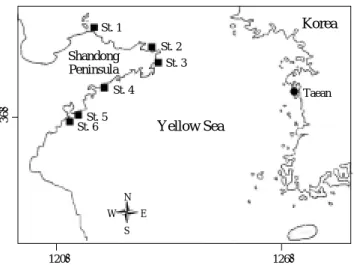
Six sites of the intertidal areas in the Shandong Penin- sula were chosen for sampling, including Penglai, Wei- hai, Rongcheng, Haiyang, Qingdao and Huangdao (Fig.
1). Samplings were carried out by four times separately in August 2006, February, April and September 2007.
The collecting tools included a stake net (5×5 mm) and scoop net (1×1 mm). Collected fishes were put into 1
Intertidal Fishes from the Shandong Peninsula, China
By Youn Choi* and Zhen-Feng Yang
Faculty of Marine Life Science, Kunsan National University, Gunsan 573-701, Korea
ABSTRACT This study was conducted to investigate the species composition and distribution pat- terns of intertidal fishes from the Shandong Peninsula, China from August 2006 to September 2007.
The collected fishes were composed of 28 species, belonging to 21 genera, 14 families and 6 orders.
Among them, the family Gobiidae was most abundant in both the number of species and individuals, while two species including Hexagrammos agrammus and Sebastes schlegelii were caught in large quantities of young fishes. In this study, Sebastes koreanus and Porocottus leptosomus known as Korean endemic species so far were collected in the Shandong Peninsula, therefore it should be revis- ed that these two species were distributed on the North Yellow Sea and owned by both China and Korea.
Key words : Intertidal fishes, distribution, Shandong Peninsula
*Corresponding author: Youn Choi Tel: 82-63-469-4596, E-mail: [email protected]
http://www.fishkorea.or.kr
36�
120� 126�
Yellow Sea Shandong
Peninsula St. 1
St. 2 St. 3
Taean St. 4
N
S W E St. 5 St. 6
Korea
Fig. 1. Map showing the sampling sites in the Shandong Peninsula.
St. 1: Penglai, St. 2: Weihai, St. 3: Rongcheng, St. 4: Haiyang, St. 5:
Qingdao, St. 6: Huangdao.
liter bottles, fixed with 10% formalin, and taken back to the laboratory of Faculty of Marine Life Science in
Kunsan National University (KNUM) for identification.
The identifications of samples followed Nakabo (2002) and Kim et al. (2005).
RESULTS
1. Species composition of intertidal fishes from the Shandong Peninsula
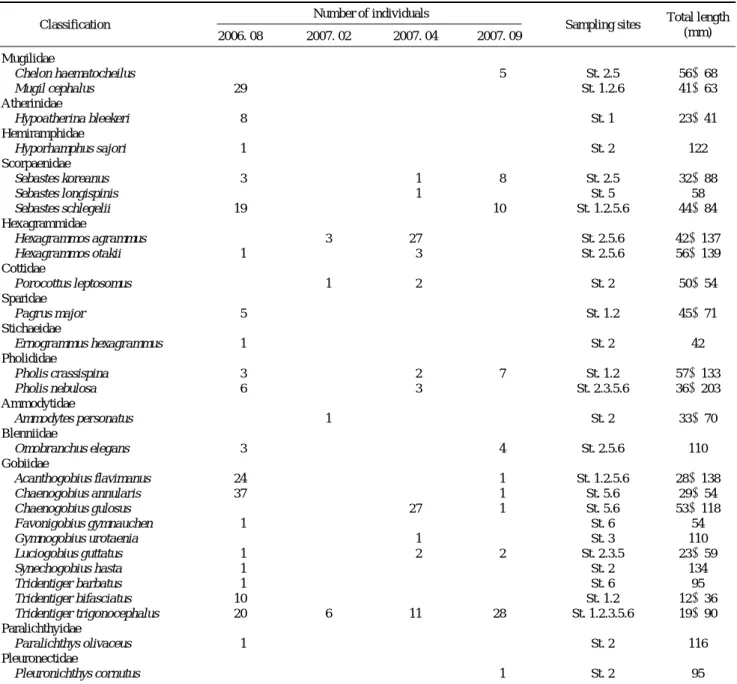
The fishes collected from the Shandong Peninsula were identified into 28 species, 21 genera, 14 families and 6 orders (Table 1). Among them, the order Perci- formes had the largest amount of 16 species, 12 genera and 6 families, the family Gobiidae was most abundant
Table 1. Number of intertidal fishes collected from the Shandong Peninsula, China
Orders Families Genera Species
Mugiliformes 1 2 2
Atheriniformes 1 1 1
Beloniformes 1 1 1
Scorpaeniformes 3 3 6
Perciformes 6 12 16
Pleuronectiformes 2 2 2
6 14 21 28
Table 2. Species composition based on seasons from the Shandong Peninsula, China
Classification Number of individuals
Sampling sites Total length
2006. 08 2007. 02 2007. 04 2007. 09 (mm)
Mugilidae
Chelon haematocheilus 5 St. 2.5 56~68
Mugil cephalus 29 St. 1.2.6 41~63
Atherinidae
Hypoatherina bleekeri 8 St. 1 23~41
Hemiramphidae
Hyporhamphus sajori 1 St. 2 122
Scorpaenidae
Sebastes koreanus 3 1 8 St. 2.5 32~88
Sebastes longispinis 1 St. 5 58
Sebastes schlegelii 19 10 St. 1.2.5.6 44~84
Hexagrammidae
Hexagrammos agrammus 3 27 St. 2.5.6 42~137
Hexagrammos otakii 1 3 St. 2.5.6 56~139
Cottidae
Porocottus leptosomus 1 2 St. 2 50~54
Sparidae
Pagrus major 5 St. 1.2 45~71
Stichaeidae
Ernogrammus hexagrammus 1 St. 2 42
Pholididae
Pholis crassispina 3 2 7 St. 1.2 57~133
Pholis nebulosa 6 3 St. 2.3.5.6 36~203
Ammodytidae
Ammodytes personatus 1 St. 2 33~70
Blenniidae
Omobranchus elegans 3 4 St. 2.5.6 110
Gobiidae
Acanthogobius flavimanus 24 1 St. 1.2.5.6 28~138
Chaenogobius annularis 37 1 St. 5.6 29~54
Chaenogobius gulosus 27 1 St. 5.6 53~118
Favonigobius gymnauchen 1 St. 6 54
Gymnogobius urotaenia 1 St. 3 110
Luciogobius guttatus 1 2 2 St. 2.3.5 23~59
Synechogobius hasta 1 St. 2 134
Tridentiger barbatus 1 St. 6 95
Tridentiger bifasciatus 10 St. 1.2 12~36
Tridentiger trigonocephalus 20 6 11 28 St. 1.2.3.5.6 19~90
Paralichthyidae
Paralichthys olivaceus 1 St. 2 116
Pleuronectidae
Pleuronichthys cornutus 1 St. 2 95
in both species and individuals. Most specimens were young fishes, the sizes were ranging from 5 cm to 10 cm in total length, some specimens of Hexagrammos agram- mus, H. otakii, Hyporhamphus sajori and Ammodytes personatus were more than 10 cm, whereas the gobiid fishes were mostly less than 4 cm.
2. Distribution patterns of intertidal fishes in Shandong Peninsula
Species composition on different seasons indicated that 11 species were collected in April, 20 species in August, 11 species in September and 4 species in Feb- ruary (Table 2). The specimens collected in spring pre- sented the similar diversity with the ones in early au- tumn, although the abundance of them were both lower than those collected in summer. For some visitors that spent part time of their lives in the intertidal in spring and summer, intertidal zone seemed to be a nursery gro- und, such as Mugil cephalus, Pagrus major, Hexagram- mos agrammus and Pleuronichthys cornutus which usu- ally disappeared in winter. Only few resident species could be observed through the entire year, including Tri- dentiger trigonocephalus, Luciogobius guttatus, Sebastes koreanus and Pholis crassispina.
21 species were totally collected at Weihai, more than 16 species at Qingdao, far more than that at other sites.
Some cold-temperature species occurred at Weihai while more gobiid fishes were caught at Qingdao, because of influence from the coast current of north Yellow Sea, which caused the surface water temperature at Weihai is averagely 4�C lower than that at Qingdao. The types of intertidal zones at Weihai are the combinations of sandy beaches, gravel and rocky shores, so habitat partitioning could form high diversity and abundance of intertidal fishes here. In contrast, Qingdao is mainly characterized by tidal pools with sea grass mass, Sebastes koreanus, S. schlegelii, S. longispinis, Pholis crassispina, P. nebu- losa and gobiid fishes were respectively abundant in these areas.
The dominant species collected from the Shandong Peninsula included Mugil cephalus, Sebastes schlegelii, Hexagrammos agrammus, Pholis crassispina, P. nebu- losa, Ammodytes personatus, Acanthogobius flavimanus, Chaenogobius annularis, C. gulosus and Tridentiger trigonocephalus. The dominant family is Gobiidae with A. flavimanus and T. trigonocephalus abundant in the sandy areas, Luciogobius guttatus in the gravels, C. gu- losus in the rocky shores. Although the sculpins were generally known as a representative species in the inter- tidal zones, only one species Porocottus leptosomus was collected in the studying areas.
3. Redescriptions of unrecorded species in China Three species of family Scorpaenidae including Se-
bastes koreanus, S. longispinis, and S. schlegelii were collected in this study. The genus Sebastes was consi- dered to be distributed in the northwestern Pacific and contain 10 species in China (Yamada et al., 1995; Jin, 2006), thus the present study will add two species of S.
koreanus and S. longispinis to this genus as first records in China. S. longispinis is obviously different from other rock fishes by owning broad white vertical band on cau- dal fin base, the Chinese name is proposed here as bai- banweipingyou ( ) accordingly. Redescrip- tions of Sebastes koreanus and the other Korean endem- ic species Porocottus leptosomus are shown as below.
Sebastes koreanus Kim and Lee, 1994
Material examined. KNUM 1781~1783, 27.0~29.1 mm SL, Yuanyaozui, Weihai, 10th Aug. 2006; KNUM 1784, 57.5 mm, Badaguan, Qingdao, 16th Apr. 2007;
KNUM 1785~1788, 36.7~49.8 mm, Jinhaiwan, Wei- hai, 16th Sept. 2007; KNUM 1789~1792, 31.4~71.8 mm, Badaguan, Qingdao, 15th Sept. 2007.
Description. Dorsal fin XIV, 12~13; anal fin III, 6;
pectoral fin 16; caudal fin rays I, 12, I. All soft rays bran- ched. Lateral line pores 30~31. Body depth more than 35% of its length. Head length 41% in standard length, 1.1 in predorsal length. Mouth terminal, jaw equal, eye large, orbit diameter same as snout length, and 1.6 in interorbital width. Caudal peduncle very short, its length 1.3 in depth. First and second dorsal fins jointed, last spine longer than the one in front of it, length of the third spine of anal fin 92% in the second one (Table 3).
Pelvic fin originating posterior to anterior base of first dorsal fin.
Remarks. Kim and Lee (1994) compared 10 speci- mens of Sebastes koreanus with S. hubbsi and S. longi- spinis, and described that it was an endemic species of genus Sebastes in Korea. Some results on proportional measurement in this study differs from the original des-
Fig. 2. Sebastes koreanus from Weihai, Shandong Peninsula, China, 29.1 mm SL, KNUM 1781.
criptions, mostly due to a wide range of body sizes: the specimens in this study were all young fishes, standard length was much shorter than the specimens from the previous description, in addition S. koreanus is deep- bodied fish, so that the ratio of body depth in standard length of young fishes was smaller than that of adults.
Porocottus leptosomus Muto, Choi and Yabe, 2002
Material examined. KNUM 1779, 39.8 mm SL, Xi- aoshidao, Weihai, 1st Feb. 2007; KNUM 1777~1778, 39.7~41.7 mm, Yuanyaozui, Weihai, 17th Apr. 2007.
Description. Dorsal fin VI-18~19; Anal fin 13; Pec- toral fin 15; Pelvic fin I, 3. Soft rays of all fins except
for middle rays of caudal fin unbranched. Body com- pressed, body width 76% in body depth. Caudal pedun- cle short, compressed, its length 2 in depth. Head small, head length 35.5% in standard length. Snout short, blunt- ly pointed, its length 93% in orbital diameter. Interorbi- tal space narrow, concave, its width 53% in orbital dia- meter (Table 4).
Two pairs of cirri on dorsal surface of head. A single filamentous cirrus on distal tip of each dorsal fin spine.
First dorsal fin originating slightly anterior to anterior tip of opercular flap. First and second dorsal fins jointed by a low membrane. Last ray of second dorsal fin broad- ly connected with caudal peduncle by a terminal mem- brane. Pelvic fin originating slightly anterior to anterior base of first dorsal fin. Proximal part of terminal ray of anal fin connected with caudal peduncle by a narrow membrane. Body brightly green, because of adaptation to habitat background of eelgrass. Body with five dark bands: one below first dorsal fin, three below second dorsal fin, and one on caudal peduncle.
Remark. According to Muto et al. (2002), Porocottus leptosomus is distinguished from all other species of genus Porocottus except P. minutus in having a single filamentous cirrus on the distal tip of each dorsal fin spine. Most of results in this study agreed well with pre- vious descriptions of P. leptosomus, except for preanal length and anal fin base length in standard length. But the sum of them in this study is 87.2, similar to that of 86.8, probably because the anterior origin of anal fin chosen in this study is lightly different from the original description. Additionally, Length of second dorsal fin base is obviously shorter than that from the previous description, 88% in the latter, the likely explanation is that there are only 16 dorsal fin rays for the specimens in this study, whereas there were 18~19 rays in the specimens of holotype and paratypes.
DISCUSSION
The sampling areas in the Shandong Peninsula com- prise different intertidal types, including rocky shores, sandy beaches, gravel shores and mud flats. Rocky shores sustain more residents like the pricklebacks and gunnels, with the rock fishes occasionally abundant.
Sheltered sandy beaches mainly distributing at Weihai and Haiyang are relatively homogeneous in terms of substratum, and fish species such as Mugil cephalus that swims fast and Paralichthys olivaceus which has flattened bodies are active in these zones. The gobies Luciogobius guttatus, Chaenogobius gulosus and Tri- dentiger trigonocephalus live in some gravel shores with sandy-mud substrate, while some mud hoppers could be observed at a mud flat which is located at Qingdao.
Among six sampling sites, Weihai has the largest num-
Table 3. Proportional measurements of Sebastes koreanus Holotype
Paratypes Present study
Munyae Range Mean
Standard length (mm) 130.4 118.2~139.5 27.0~71.8 -
No. of specimens 1 4 12 -
Proportional measurements (% SL)
Head length 42.4 39.6~40.7 39.3~43.0 40.9
Snout length 11.9 9.7~11.7 10.0~13.4 11.2
Orbital diameter 11.7 10.5~10.8 10.7~12.5 11.4
Interorbital width 6.2 4.2~5.2 7.4~8.0 7.4
Length of upper jaw 18.8 16.8~18.9 16.2~19.4 17.8 Predorsal length 36.2 33.9~35.1 31.7~40.0 36.6
Body depth 41.2 38.4~40.9 33.6~37.3 35.5
Pectoral fin length 26.1 28.0~31.7 27.0~33.3 30.3 Pelvic fin length 24.2 21.6~24.0 22.0~24.8 23.2
1st dorsal spine 7.0 5.9~7.3 5.2~6.7 6.0
3rd dorsal spine 13.1 9.6~12.4 12.9~14.1 13.3 2nd dorsal soft-ray 14.9 15.8~16.3 16.3~17.5 16.7
1st anal spine 9.6 7.9~8.5 6.3~9.1 7.5
2nd anal spine 18.3 14.5~17.5 14.7~19.8 16.0 3rd anal spine 15.3 12.5~15.0 13.5~16.0 14.7 Length of caudal peduncle 16.2 16.8~18.2 11.6~15.1 13.8 Depth of caudal peduncle 10.7 9.9~11.1 9.1~12.0 10.7
Fig. 3. Porocottus leptosomus from Weihai, Shandong Peninsula, China, 39.4 mm SL, KNUM 1778.
ber of fish species, most probably due to its various habitat partitioning.
Total number of species collected in this study is close to that at Taean, west coast of Korea (Lim and Choi, 2000), which contained 27 species, 25 genera, 15 fami- lies and 6 orders. Comparing with species composition of tidepool fishes at Kunsan, west coast of Korea (Ryu and Choi, 1993; Choi et al., 2005), Mugil cephalus, Tri- dentiger trigonocephalus, Synechogobius hasta, Favo- nigobius gymnauchen and Gymnogobius urotaenia oc- curred in common. On the other hand, some species that had not been reported in China were collected in this study, especially for the genus Sebastes (Scorpaenidae), it was considered that there was a total of 10 species distributing in China (Zhu and Jin, 1965; Jin, 2006), less than 19 species of genus Sebastes from Korea (Kim et al., 2005).
The species of family Gobiidae were most abundant in this study, but still less than that of 19 species in the Bohai Bay (Liu et al., 1997), 15 species at Taean of Korea (Lim and Choi, 2000). Luciogobius guttatus, Syne- chogobius hasta, Tridentiger barbatus and T. trigonoce- phalus were commonly collected in the intertidal zones of three regions. Although the fishes in the Bohai Bay are usually considered as an extended part of ichthyo- fauna in the Yellow Sea (Tian et al., 1993), the assem- blage of gobiid fishes between the Shandong Peninsula and Taean are much higher, the common species being 39.8% than that of 20.8% between the Shandong Penin- sula and Bohai Bay. Especially, the dominant species in both the Shandong Peninsula and Taean, such as Favo-
nigobius gymnauchen, Chaenogobius annularis and C.
gulosus were not found in the Bohai Bay, showing the closer geological relationships between the former two.
Typically true resident intertidal fishes, such as the species of family Gobiidae, Pholidae and Blenniidae, are active emergers in a restrict area of intertidal zones permanently. Some deep-bodied fishes in families of Scorpaenidae, Hexagrammidae and Mugilidae usually occur in the intertidal as young fishes and migrate to the coast when growing up (Horn et al., 1999; Suda et al., 2002), thus they distribute more extensively in the Shan- dong Peninsula. The sculpin is also typical of intertidal fishes like Hexagrammos agrammus, H. otakii and Pho- lis nebulosa in which its color patterns match the back- ground, for example, Porocottus leptosomus collected on green eelgrass at Weihai were in brightly green color, whereas those collected at Taean were maroon (Lim and Choi, 2000).
Additionally, Sebastes koreanus and Porocottus lepto- somus should be revised as endemic species of the Yel- low Sea but not of Korea, distributing on the intertidal zones in the Shandong Peninsula and west coast of Kor- ea. The Chinese names, Huanghaipingyou ( ) is proposed here for S. koreanus according to its Korean name Hwanghaebolnak, while zhaitijidufuyu ( 棘
) is for P. leptosomus with Jidufuyushu (棘 ) for the genus Porocottus according to its fea- ture of multifid cirrus on tip of each dorsal spine.
The limitation of this study lies in using the present sampling methods, for the fishes were collected in a relatively small number of both species and individuals,
Table 4. Proportional measurements of Porocottus leptosomus
Holotype HUMZ Paratypes (specimens) Present study
172394 Range Mean Range Mean
Standard length (mm) 43.4 30.7~45.6 - 39.1~41.8 -
Proportional measurements (% SL)
Body depth 27.4 24.6~28.7 27.3 26.1~29.4 28.2
Body width 20.3 18.2~23.4 20.4 18.2~24.3 21.4
Head length 37.0 34.7~37.8 36.2 35.0~35.9 35.5
Snout length 9.4 9.2~10.8 9.7 9.5~10.3 9.8
Orbital diameter 11.6 10.4~12.0 11.0 10.3~10.7 10.5
Interorbital width 5.4 4.1~6.4 5.3 5.0~6.0 5.6
Length of upper jaw 15.3 14.1~15.9 15.0 14.2~15.7 14.9
Predorsal length 34.7 31.3~34.9 32.9 31.5~34.0 33.2
Prepelvic length 31.8 30.0~34.9 32.4 32.0~33.3 32.5
Preanal length 54.5 52.8~58.7 56.2 58.9~59.1 59.0
Length of caudal peduncle 14.4 14.9~17.4 15.8 14.6~15.3 15.0
Depth of caudal peduncle 7.1 6.4~7.9 6.9 7.0~7.9 7.4
Length of 1st dorsal fin base 19.6 16.7~22.2 19.3 17.9~22.1 19.7
Length of 2nd dorsal fin base 45.0 38.9~49.5 42.5 36.5~39.0 37.6
Length of anal fin base 31.4 27.5~34.5 30.6 27.4~31.3 28.7
Length of pectoral fin base 14.9 14.7~16.7 15.5 14.6~16.1 15.3
Pectoral fin length 34.1 30.5~34.3 32.8 31.0~34.7 32.4
Pelvic fin length 24.5 21.1~26.1 23.1 20.1~25.8 22.5
Caudal fin length 27.4 25.6~31.3 28.1 27.4~28.6 28.1
at the same time, some problems like whether species abundance in the intertidal is higher at low tide or high tide (Suda et al., 2002) were not well studied by this study.
ACKNOWLEDGMENTS
The field work for study was supported by the Fisher- ies Science Institute of Kunsan National Universty.
REFERENCES
Choi, Y., H.C. Lim, H.K. Ra, J.S. Yang and K.W. Choi.
2005. Tide-pool fishes from Saemanggeum waters.
Korean J. Ichthyol., 17: 142-147 (in Korean).
Horn, M.H., K.L.M. Martin and M.A. Chotkowski. 1999.
Intertidal Fishes, Life in two Worlds. Academic Press, 399pp.
Jin, X.B. 2006. Fauna Sinica Ostichthyes: Scorpaeniformes.
Science Press, China, 799pp., (in Chinese).
Kim, I.S. and W.O. Lee. 1994. A new species of the genus Sebastes (Pisces; Scorpaenidae) from the Yellow Sea, Korea. Korean J. Zool., 37: 409-415.
Kim, I.S., Y. Choi, C.R. Lee, Y.J. Lee, P.J. Kim and J.H.
Kim. 2005. Illustrated book of Korean fishes. Kyo- hak Co., Ltd., Seoul, 615pp., (in Korean).
Lee, C.L. 1994. A review on the fish fauna of the Yellow Sea. Korean J. Ichthyol., 6: 172-192 (in Korean).
Lim, H.C. and Y. Choi. 2000. Fish fauna of the coastal waters off Taean in the West Sea of Korea. Korean J. Ichthyol., 12: 215-222 (in Korean).
Liu, Q., Z.M. Su, X.Q. Zeng, Z.J. Ye and K. You. 1997.
Studies on ichthyofauna and ecology of goby fishes in the Bohai Sea. Journal of Ocean University of Qingdao, 27: 157-165 (in Chinese).
Muto, F., Y. Choi and M. Yabe. 2002. Porocottus leptoso- mus sp. nov., from the west coast of Korea, Yellow Sea (Scorpaeniformes: Cottidae). Ichthyol. Res., 49:
229-233.
Nakabo, T. 2002. Fishes of Japan with pictorial keys to the species, English edition. Tokai Univ. Press, 1749pp.
Ryu, B.S. and Y. Choi. 1993. The fluctuation of fish com- munities from the coast of Kunsan, Korea. Korean J.
Ichthyol., 5: 194-207 (in Korean).
Suda, Y., T. Inoue and H. Uchida. 2002. Fish communities in the surf zone of a protected sandy beach at Doi- gahama, Yamaguchi prefecture, Japan. Estuarine, Coastal and Shelf Science, 55: 81-96.
Tian, M.C, B.L. Sun and J.M. Yang. 1993. Analysis of the fish fauna of the Bohai Sea. Studia Marine Sinica, 34: 157-167 (in Chinese).
Yamada, U., M. Tokimura, H. horikawa and T. Nakabo.
2007. Fishes and fisheries of the East China and Yellow Sea. Tokai Univ. Press, 1262pp.
Yamada, U., S. Deng and Y.U. Kim. 1995. Names and illu- strations of fishes from the East China Sea and the Yellow Sea. Overseas Fishery Cooperation Founda- tion, 288pp.
Zhu, Y.D. and X.B. Jin. 1965. The geographical distribution and faunal characteristics of cottoid fishes of China.
Oceanologia et Limnologia Sinica, 7: 235-252 (in Chinese).
중국 산둥반도의 조수웅덩이 어류상
최 윤∙Zhen-Feng Yang
군산대학교 해양생명과학부
요 약 : 2006년 8월부터 2007년 9월까지 4회에 걸쳐 중국 산둥반도의 조수웅덩이로부터 어류를 채집하여 서
식어종과 분포유형을 조사하였다. 조사기간 동안 채집된 어류는 모두 6목 14과 21속 28종이었고, 이 가운데 망 둑어과 어류가 종수와 개체수에서 우점하였다. 모래지역에서 숭어와 가숭어, 문치가자미의 유어들이 주로 채집 되었고, 자갈과 바위지역에서는 조피볼낙과 노래미의 유어 그리고 점베도라치가 우점하였다. 한편 지금까지 한 국 고유종으로 알려진 고려실횟대와 황해볼낙이 본 조사 해역에서 채집되었다. 따라서 이 2종의 어류는 한국 서 해안의 태안뿐만 아니라, 중국의 산둥반도에 서식하는 것이 확인됨으로써 황해 고유종으로 수정됨이 타당하다.
찾아보기 낱말 :산둥반도, 조수웅덩이, 어류상