139 This is an Open-Access article distributed under the terms of the Creative Commons Attribution Non-Commercial License (http://
creativecommons.org/licenses/by-nc/3.0) which permits unrestricted non-commercial use, distribution, and reproduction in any medium, provided the original work is properly cited.
J. Mushrooms 2017 September, 15(3): 139-144 http://dx.doi.org/10.14480/JM.2017.15.3. 139 Print ISSN 1738-0294, Online ISSN 2288-8853
© The Korean Society of Mushroom Science
*Corresponding author E-mail : [email protected] Tel : +82-43-871-5707, Fax : + Received June 23, 2017 Revised August 8, 2017 Accepted September 22, 2017
양송이 품종과 수집 균주간의 Inter-simple sequence repeat (ISSR) 마커 분석
남윤걸
1,2
· 공원식1
· 장갑열1
· 신평균1
· 오민지1
· 임지훈1
· 구창덕2
· 오연이1
*1 농촌진흥청 국립원예특작과학원 버섯과
2 충북대학교 산림학과
Analysis of Inter-simple sequence repeat (ISSR) markers in cultivars and collected strains of button mushroom
(Agaricus bisporus)
Youn-keol Nam
1,2
, Won-Sik Kong1
, Kab-Yeul Jang1
, Pyung-Gyun Shin1
, MinJi Oh1
, Ji-Hoon Im1,
Chang-Duck Koo2
, and Youn-Lee Oh1
*1 Mushroom Science Division, National Institute of Horticultural and Herbal Science, RDA, Eumseong 369-873, Korea
2 Department of Forestry, Chungbuk National University, Cheongju, 361-763
ABSTRACT:
A. bisporus is the fifth most cultivated mushroom in Korea, and approximately 10,757 tons were cultivated in 2015. The genetic diversity of collected strains in Korea and commercial cultivars was analyzed using inter-simple sequence repeat (ISSR) markers. ISSR markers known to be comparable among A. bisporus spp. were selected from various markers.
Totally, 16 markers, namely the ISSR markers 807, 808, 810, 811, 834, 835, 836, 841, 842, P3, P8, P17, P22, P30, P38, and P39, were evaluated to discriminate between ASI 1110, 1114, 1115, 1238, 1246, 1365, 1366, and 1369 for selecting suitable markers in 16 markers. The ISSR markers P31, P38 and P39 exhibited various fingerprints that could help classify the strains in species. Using the three markers, genetic relationships among 39 strains, including commercial cultivars, such as SaeA and SaeYeon, were analyzed using the UPGMA method. The results of the analysis of the genetic relationships between commercial cultivars and collected strains in Korea confirmed that the commercial cultivars were different from the collected strains in Korea. These results suggested that the ISSR markers P31, P38, and P30 could be used for selecting the commercial cultivars of A. bisporus.
KEYWORDS: Agaricus bisporus, Genetic relationship, ISSR marker, UPGMA method
양송이는 전 세계적으로 가장 널리 재배되는 식용 버 섯으로 우리나라에서는 10,757톤으로 5번째로 많이 생 산된다 (특용작물생산실적, 2015). 당질, 단백질, 비타민, 무기질 등과 같은 영양소가 골고루 함유되어 있으며 독 특한 맛과 향기를 지니고 있다 (Fei, 2006). 1990년대 이 후 많은 전 세계의 과학자들에 의해 양송이에 대한 연구 가 시작되어 비교 유전학, 유전자지도, 유전적 다양성 분 석, 극세포질동정, 유전적 계통분류 또는 분석에 대한 광 범위한 연구가 되어왔었다 (Wang et al., 2011). 최초의 양송이 교잡품종 Horst U1이 1981년 개발된 이후 동 품 종에서의 조직분리나 단포자 분리에 의한 품종 육성으로 재배 품종 간 유전적 다양성이 느타리버섯 등에 비하여 월등히 떨어진다는 보고가 있다 (Sonnenberg et al.,
2011). 우리나라는 아직까지 미국, 유럽, 호주에 있는 거 대 종균회사(Amycel, Silvan등)으로부터 종균을 수입하 여 국내 농가에서 재배하고 있는 실정이다. 최근 농촌진 흥청에서는 2010년 이후부터 국내 자생 양송이 계통과 외국 품종 간 동형핵균주를 교잡하여 중고온성(18~20
o
C) 에서 재배가 가능한 ‘새아’를 시작으로 선발된 우수계통 과 단포자를 교배한 ‘새정’(2011년), ‘새연’, ‘새도’(2012)를 차례로 육성하여 보급하기 시작하고 있으며 국 내 품종 점유율이 4%에서 27%까지 높아져서 점차 국내 양송이 품종으로 대체되어 재배되고 있다 (Oh et al., 2013). DNA마커로 버섯품종이나 계통간의 유전적 유연 관계를 빠르게 검정할 수 있어서 육종의 소재인 모본 선 발을 효율적으로 증진 할 수 있다(Sonnenberg et al., 2011).
본 연구에서는 국내 수집된 균주와 상업적으로 이용되 는 양송이 품종간의 DNA 다형성 확인에 유용한 ISSR 마커를 탐색하고 양송이 계통간의 분자생물학적 유연관 계를 구명함으로써 국내 양송이 품종을 육성하는데 기여 하고자 1966년부터 국내외에서 수집되어 농촌진흥청 국 립원예특작과학원 버섯과에 보존 중인 양송이류 46균주 를 사용하였다(Table 1). 균주 배양에 사용된 배지는 볏 짚발효퇴비 추출배지(Compost Dextrose Agar, CDA)로 볏짚발효퇴비 추출물(볏짚발효퇴비 40 g/L)에 0.7%
malt extract, 1% sucrose, 2% agar을 첨가하여 사용하 여 24
o
C에서 20일간 배양하였다. DNA추출을 위해 Petri-dish 내 볏짚발효퇴비 추출물 배지에 멸균한 셀로 판 필름을 깔고 직경 5 mm 균사 절편을 중간에 접종하 였다. 배양 25일 후에 셀로판 필름에 형성된 균사체를 수집하여 동결 건조한 균사체를 Tissue Lyser ll(Qiagen) 로 30 rpm/s, 10분 설정하여 분쇄하였다. 25 mg의 균사 체를 Toyobo kit(Toyobo Mag Extracter, MTNPK-501) 를 이용하여, 제공된 매뉴얼에 따라 DNA를 추출하였다.균사분말을 약 40 mg씩 덜어 Lysis Buffer 300 µl를 넣 어주고 vortexing 해준 후, 65
o
C water bath에 10분 동 안 중탕을 하였다. 이 후 Hood시설에서 PCI (GENEray BioTECH, GR2516-100ml) 300 µl를 넣은 후 살짝 vortexing 을 해준다. 그리고 4o
C centrifuge에 13000 rpm으로 10분 간 돌려준다. centrifuge 에서 꺼낸 후 상층액(약 200 µl)를 침전물이 첨가되지 않도록 주의 하여 새 tube에 옮긴다. 옮긴 상층액에 binding 600 µl를 넣고 invert 해준다. 그리고 magnetic bead를 넣고, rotamix F6에 5분간 돌려주고 spin down시킨다. 산물을 trapper에 넣고 20초 후 나머지 용액을 버린다. 그리고 다시 washing buffer 600 µl를 넣는 과정으로 돌아가 이 와 같은 과정을 1~2번 반복한다. 불순물이 제거된 DNA 에 70% EtOH 900 µl를 넣고, vortexing한 후 spin down 시킨다. 그리고 trapper에 넣고 20초 후 나머지 용 액을 버린다. 다시 70% EtOH 900 µl를 넣는 과정으로돌아가 이와 같은 과정을 1~2번 반복한다. 남은 EtOH이 없도록 뚜껑을 열어서 Hood에서 1시간 정도 말려서 제 거한다. 정제된 DNA에 멸균수 60 µl를 넣고 rotamix F6(MYLA3
TM
, SLRM-2M Intelli Mixer)에 5분간 돌려 준 후 spin down시킨다. 마지막으로 trapper에 넣고 20 초 후 정제된 DNA를 새 tube에 옮긴다. 사용된 DNA들 은 –20o
C에 보관하였다. PCR 반응은 Prime Taq Premix(Genetbio, G-3000)을 사용하여 GeneAmp ® PCR System 9700(Applied Biosystems) 기계로 증폭 조건은 94o
C(5 min), 94o
C(30 sec), 52o
C는 primer의 Tm값에 따라(45 sec), 72o
C (90 sec), 72o
C(7 min)에서 40cycle, 4o
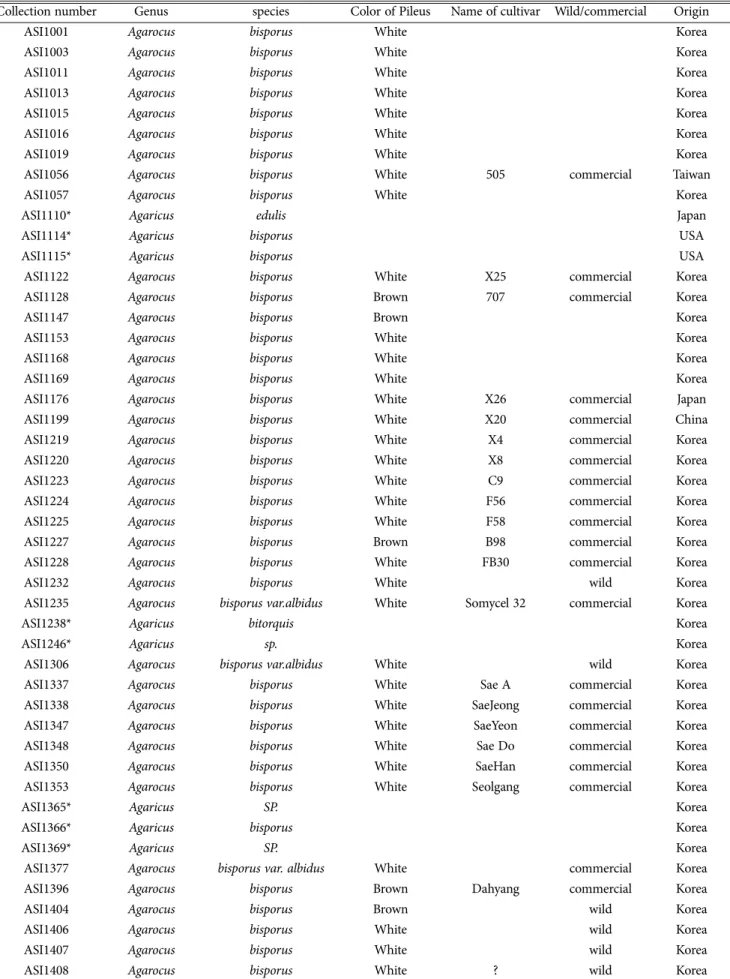
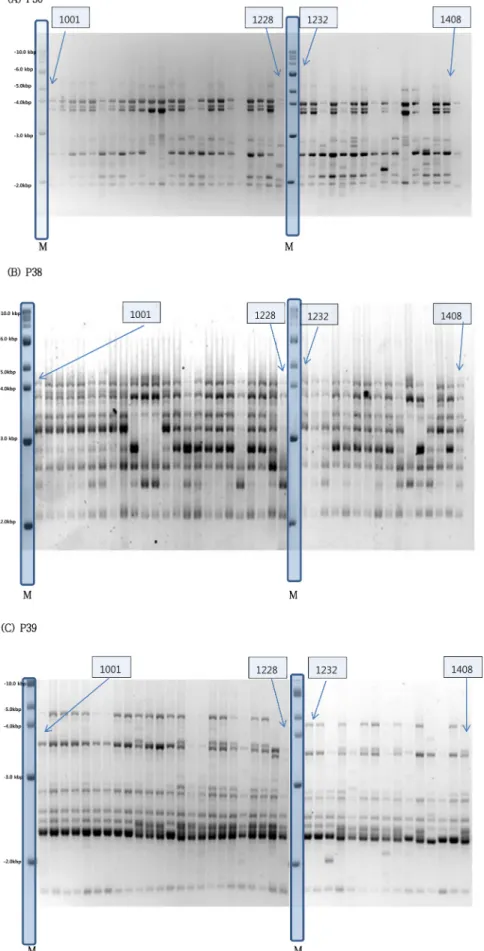
C 휴지조건의 프로그램으로 실시하였다. 전기 영동은 2% agarose gel에 100V로 40분간 수행하였고, 전기영동은 ImageQuant 400(GE healthcare Bio- sciences)기계의 IQuant Capture 400프로그램을 이용하 여 확인하였다. 또한, 10Kbp 마커로 밴드사이즈를 확인 하였다. ISSR PCR 분석을 위해 임의로 선발된 8개의 양 송이 균주에 16개의 ISSR primer(Table 2)를 이용하여 사전실험을 수행하였고, 해당 산물을 전기영동한 후 밴 드의 다양성을 비교해 보았다. 그 후 뚜렷하게 구분되는 밴드를 가진 ISSR P30, P38, P39 primer 3종을 선발하 였다. 선발된 3종의 Primer는 39점의 양송이 DNA의 PCR에 이용되었다(Fig. 1). PCR 증폭 산물은 전기영동 후 화상분석시스템(GE healthcare Bio-sciences, SE/ImageScanner lll)을 이용하여 ISSR 실험결과를 특정위 치에 밴드가 있으면 1, 없으면 0으로 구분하여 SIMQULA의 계수를 계산 하였고, 이 계수를 이용하여 mega6 프로그램의 UPGMA 법을 이용하여 군(cluster)분 석을 하여 dendrogram을 작성하고 유연관계를 분석하였 다 (Sneath와 Sokal, 1973). 그 결과, 국내수집균주과 상 업균주들의 유연관계 중에서 상업균주의 그룹들이 같은 그룹내에 속해 있어 국내수집 균주들과는 비교되는 유사 한 유연관계들을 보였다(Fig. 2). 특히 A1 그룹은 상업균 주 B그룹과 유연관계가 구분은 되었으나, 0.049로 가까 운 유연관계를 보였고, A2그룹은 0.128로 A1보다 먼 유 연관계를 보였다. 이는 상업적으로 사용되는 품종들이 교잡 시 공통적으로 추구하는 형질이 유사하여, 이를 바 탕으로 교잡을 한 결과 그에 따른 분자생물학적 유연관 계 또한 비슷한 경향을 나타내지 않는가 사료된다. 하지 만, 상업균주 ASI1056(505호), 1223(C9), 1228(FB30), 1350(Sae Han) 균주는 수집균주내에 포함되어 있었고, 상업균주내에는 포함되지 않았다. 따라서, ISSR마커로는 이 균주들이 분리가 되지 않은 것을 볼 수 있었다. 품종 육성에서 다양한 변이를 지닌 균주를 요구하기에 보유하 고 있는 유전자원에서 상업적으로 사용되는 품종의 분류 가 더욱 더 중요하다. 위 실험 내용을 근거로 국내 양송 이 품종개발에서 국내 수집균주 중 모본선발시 활용되는 우수한 자료로 사용될 것이라 기대된다.
Table 1. The strain list of A. bisporus studied in this study.
Collection number Genus species Color of Pileus Name of cultivar Wild/commercial Origin
ASI1001 Agarocus bisporus White Korea
ASI1003 Agarocus bisporus White Korea
ASI1011 Agarocus bisporus White Korea
ASI1013 Agarocus bisporus White Korea
ASI1015 Agarocus bisporus White Korea
ASI1016 Agarocus bisporus White Korea
ASI1019 Agarocus bisporus White Korea
ASI1056 Agarocus bisporus White 505 commercial Taiwan
ASI1057 Agarocus bisporus White Korea
ASI1110* Agaricus edulis Japan
ASI1114* Agaricus bisporus USA
ASI1115* Agaricus bisporus USA
ASI1122 Agarocus bisporus White X25 commercial Korea
ASI1128 Agarocus bisporus Brown 707 commercial Korea
ASI1147 Agarocus bisporus Brown Korea
ASI1153 Agarocus bisporus White Korea
ASI1168 Agarocus bisporus White Korea
ASI1169 Agarocus bisporus White Korea
ASI1176 Agarocus bisporus White X26 commercial Japan
ASI1199 Agarocus bisporus White X20 commercial China
ASI1219 Agarocus bisporus White X4 commercial Korea
ASI1220 Agarocus bisporus White X8 commercial Korea
ASI1223 Agarocus bisporus White C9 commercial Korea
ASI1224 Agarocus bisporus White F56 commercial Korea
ASI1225 Agarocus bisporus White F58 commercial Korea
ASI1227 Agarocus bisporus Brown B98 commercial Korea
ASI1228 Agarocus bisporus White FB30 commercial Korea
ASI1232 Agarocus bisporus White wild Korea
ASI1235 Agarocus bisporus var.albidus White Somycel 32 commercial Korea
ASI1238* Agaricus bitorquis Korea
ASI1246* Agaricus sp. Korea
ASI1306 Agarocus bisporus var.albidus White wild Korea
ASI1337 Agarocus bisporus White Sae A commercial Korea
ASI1338 Agarocus bisporus White SaeJeong commercial Korea
ASI1347 Agarocus bisporus White SaeYeon commercial Korea
ASI1348 Agarocus bisporus White Sae Do commercial Korea
ASI1350 Agarocus bisporus White SaeHan commercial Korea
ASI1353 Agarocus bisporus White Seolgang commercial Korea
ASI1365* Agaricus SP. Korea
ASI1366* Agaricus bisporus Korea
ASI1369* Agaricus SP. Korea
ASI1377 Agarocus bisporus var. albidus White commercial Korea
ASI1396 Agarocus bisporus Brown Dahyang commercial Korea
ASI1404 Agarocus bisporus Brown wild Korea
ASI1406 Agarocus bisporus White wild Korea
ASI1407 Agarocus bisporus White wild Korea
ASI1408 Agarocus bisporus White ? wild Korea
* The eight strains were only analyzed with 16 ISSR markers.
Fig 1. The DNA polymorphism produced by using ISSR markers P30 (A), P38 (B) and P39 (C) on strains (Table 1) of A.
bisporus. Lane M represents the 10-kb ladder.
적 요
양송이(Agaricus bisporus)는 국내에서 2015년 약 10,757톤이 생산되어 5번째로 많이 생산되는 버섯이다.
본 연구에서는 ISSR 마커를 사용하여 국내 수집균주와 상업품종간의 유전적 다양성을 분석하였다. 이를 위해 우 선, 다양한 마커 중 양송이 속 내 비교 분석이 가능다고 알려진 ISSR마커를 선발하였다. 분석한 마커는 ISSR 807, 808, 809, 810, 811, 834, 835, 836, 841, 842, P3, P8, P17, P22, P30, P38 and P39 총 16종이였고 이들 중 육종에서 모본선발을 위한 효율적인 마커를 선발하기 위 하여 양송이 수집균주 ASI 1110, 1114, 1115, 1238, 1246, 1365, 1366, 1369 등 8종을 선발하여 수행하였다.
그 결과 ISSR P31, P38, P39 마커에서 종내 구분이 가능 한 다양한 밴드가 나타났다. 이를 바탕으로 선발된 3종의 마커를 이용하여 국내 수집균주와 새아, 새연 등의 상업 품종이 포함된 39균주를 UPGMA 프로그램을 통하여 유 연관계를 분석하였다. 국내 수집균주와 상업품종간의 계 통도를 분석한 결과, 국내 수집균주와 상업품종들이 다른 그룹을 형성하는 것을 확인하였다. 이 결과를 근거로
Table 2. List of ISSR markers in this study.
Primer
name ISSR sequence(5’–3’) Tm ( o C)
Polymorphism at Interspecies level 808 AGAGA GAGAG AGAGA GC 49 NO 810 GAGAG AGAGA GAGAG AT 47 NO 811 GAGAG AGAGA GAGAG AC 48 NO 834 AGAGA GAGAG AGAGA GYT 49 NO 835 AGAGA GAGAG AGAGA GYC 51 NO 842 GAGAG AGAGA GAGAG AYC 51 NO 807 AGAGA GAGAG AGAGA GT 46 NO 809 AGAGA GAGAG AGAGA GG 49 NO 836 AGAGA GAGAG AGAGA GYA 49 NO 841 GAGAG AGAGA GAGAG AYC 50 NO
p3 GAGAG AGAGA GAGAG AT 52 NO
P8 CTCTC TCTCT CTCTC TAGA 55 NO p22 AGAGA GAGAG AGAGA GYC 53 NO P30 GAGAG AGAGA GAGAG AC 55 YES p38 CTCCT CCTCC TCCTC CTC 62 YES
P39 CAAGG CAAGG CAAGG 54 YES
Fig 2. The dendrogram based on genetic distance for 39 A. bisporus strains based on UPGMA analysis resulting from ISSR
fingerprints.ISSR P31, P38, P39가 상업품종을 구분할 수 있는 마커 로 활용될 것이라 기대된다.
감사의 말씀
본 결과물은 농림축산식품부의 재원으로 농림수산식품 기술기획평가원의 Golden Seed 프로젝트 사업의 지원을 받아 연구되었음(213007-05-1-SBJ10)
References
농림축산식품부, 특용작물생산실적, 2015
Fei T, Zhang M, Hangqing Y, Jincai S. 2006. Effect of different storage conditions on chemical and physical propertise of white mushrooms after vacuum cooling. J Food Engin 77:545-549
Malekzadeh K, Jalalzadeh B, Shahri M, Mohsenifard E.
2011. Use if ISSR markers for strain identification in the button mushroom, Agaricus bisporus. Proceedings of the 7th International Conference on Mushroom Biology and
Mushroom Products (ICMBMP7)
Mahmudul IN ●Bian YB. 2010. ISSR as New Markers for Identification of Homokaryotic Protoclones of Agaricus bisporus. Curr Microbiol 60:92-98
May B, Royse DJ. 1982. Confirmation of crosses between lines of Agaricuse brunnescenes by isozyme analysis.
Experim Mycol 6:283-292
Oh YL, Jang KY, Jhune CS, Kong WS, Yoo YB, Shin PG, Seo JS. 2013. Quality changes in Agaricus bisporus varieties due to period and temperature during their storage. J Mushroom Sci Prod 11:137-144.
Senrath RR, Sokal RR. 1973. Numerical Taxonomy Freeman san Francisco. pp573.
Sonnenberg AS, Johan JPB, Hendricx PM, Lavrijssen B, Gao W, Weijin A, Mes JJ. 2011. Breeding and strain protection in the button mushroom Agaricus bisporus.
Proceedings of the 7th International Conference on Mushroom Biology and Mushroom Products, 1, pp. 7-15 Wang ZS, Chen MY, Cai ZX, Liao JH, Li HR, Guo ZJ, Lu
ZH. 2011. Dan Fingerprinting of Genetic Diversity if Agaricus bisporus Mushroom Biology and Mushroom Products, 7, pp. 2-8