Study on the Influence of Contemporary Art on Furniture Design -Based on the Analysis on <Stool with Partitions 1,2,3> with
Key Features of Contemporary Art and Furniture Design-
Kim, Jinwoo
1ABSTRACT
The history repeatedly shows that designers have sought their creative inspiration from fine arts. <Stool with Partitions 1,2,3> was also influenced by contemporary art such as surrealism or installment works. This thesis aims to examine the inter-relationship between contemporary art and contemporary furniture design with examples of organic modernism and minimalism furniture design. Also, <Stool with Partitions 1,2,3> will be analyzed in light of such interdisciplinary relationship, explaining the significances of <Stool with Partitions 1,2,3> in scholastic perspective.
The previous research analysis of finding out examples of how fine art and design sought mutual exchanges to develop will help to examine the significance of <Stool with Partitions 1,2,3> in the context of art history. This analysis could be used as an important academic material to understand the origin and characteristics of modern design furniture.
The features of surrealism and minimalism will be discussed in light of their influences on and interactive relationship with organic modernism furniture design. This provides important basic material to further analyze <Stool with Partitions 1,2,3>.
Furthermore, the artistic language and plastic features of contemporary sculptors and installment artists such as Jean Arp, Richard Serra and Anish Kapoor will be examined to show how
<Stool with Partitions 1,2,3> integrated and combined main features of those artists.
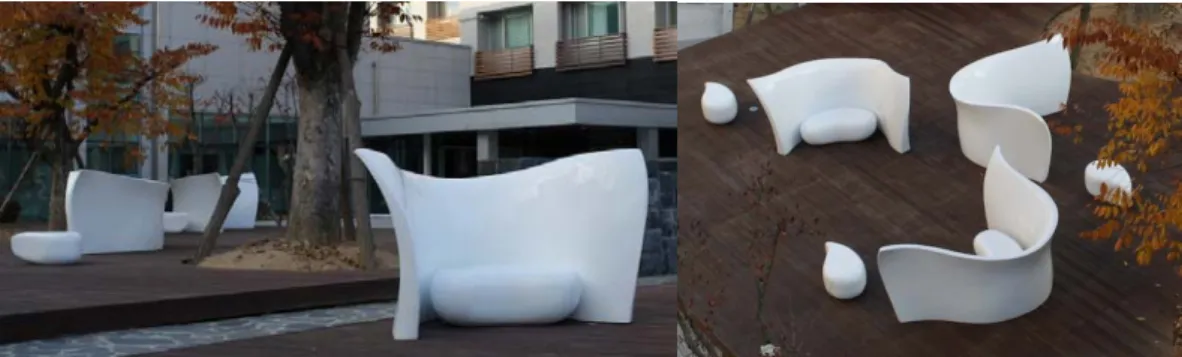
<Stool with Partitions 1,2,3> extracted cognitive and phenomenological aspects from Serra’s works that overwhelm viewers with their massive scales. Somewhat abstract yet somewhat primitive and dynamic features of Arp’s works was also referred to <Stool with Partitions 1,2,3>. <Stool with Partitions 1,2,3> are made of FRP, composed of three partitions and six stools. This work was analyzed in aspect of form, composition and function. They have organic and flexible formations with free composition availability which endow free disassemble and arrangement. Also, they have cognitive features as of small elements are freely dispersed upon spaces to bestow certain presences.
Based on this, this thesis could develop scholastic researches that examine the mutual and interactive relationship between contemporary art and furniture design with much more detailed discussions and examples.
Key words: Contemporary Art, Furniture Design, Stool with Partitions 1,2,3.
1. INTRODUCTION
1-1 Background and Aim
Designers have sought inspirations from fine arts, as repeatedly shown in the history of art.
Received for publication: May 02, 2009 ; Reviewed: Jun 01, 2009 ; Accepted: Nov 19, 2009.
1) Department of Interior Design, Konkuk University, Chungbook. Korea. Email: [email protected].
Especially, the abstract features of surrealistic works heavily influenced all areas of arts and designers over many centuries. The organic modernism furniture design could be cited as a good example of this as shown by artists from Northern Europe and USA in 60’s.
Northern European Designers such as of Alvar Aalto(1898-1976) combined the artistic language of contemporary art with his ethnical and regional features, forming the basis of the organic modernism furniture design. Later on, Aalto’s organic modernism was spread to USA through reciprocal influences with the works of Charles Eames(1907-1978) and Eero Saarinen(1910–1961).
Also, American artists in 60’s have created minimalism art which interpreted the wholeness of trendy paintings in light of geometric forms while eliminating any references of emotions or feelings.
This study is based on my works, <Stool with Partitions 1,2,3>, and they were created as the doctorate degree application works. They were exhibited in the Modern Art Museum of Hongik University from September 1
stto 5
thof 2008. The works were inspired by the contemporary surrealistic works and installations works. This research reflected and materialized furniture designs under the influence of a minimalist Richard Serra(1939- ), a surrealist Jean Arp(1886–1966), a sculptor Henry Moore(1898–1986), and an installation artist Anish Kapoor(1954- ).
This thesis aims to study the reciprocal relevance of organic modernism and minimalism furniture design works, citing the most known cases of furniture design under the influence of contemporary art. Also, <Stool with Partitions 1,2,3> will be analyzed in view of such aspect, to find out their unique features and significances. This study enumerates and analyzes the mutual development of contemporary art and design with references to actual examples. Such attempt can be used as an important academic resource in grasping the fundamental concepts and features of contemporary furniture design.
1-2 Research Methodology and Scope
The research will first go through surrealism and minimalism that influenced organic furniture design and minimalistic furniture design, respectively. At this stage, their individual unique features and inter-relevance between art and design will be discussed. These will be the fundamentals in analyzing <Stool with Partitions 1,2,3>. As for organic modernism and surrealism, the evidence of direct and/or indirect interchanges or reciprocal influences between contemporary artists such as Jean Arp, Henry Moore, and Isamu Noguchi(1904-1988) with furniture designers will be highlighted. For this, the features of these contemporary artists will be overviewed in view of the organic furniture design works of Scandinavian designers such as Alvar Aalto, Hans Wegner(1914-2007), Finn Juhl(1912-1989) and Arne Jacobsen(1902-1971), along with American designers such as Charles & Ray Eames(1907-1978 and 1912-1988) and Eero Saarinen(1910-1961).
As for the minimalistic furniture design and minimalism art, four designers who are one of the first generation artists of American minimalism artists will be cited. They were also designers who created works with furniture which has functions. They are Donald Judd(1928-1994), Sol LeWitt(1928-2007), Scott Burton(1939-1989), and Richard Artschwager(1923- ). Also, the concept of modernism in the early 20
thcentury will be discussed with the works of Constantin Brancusi(1876-1957) who also greatly influenced minimalists. Along with this, the avant-garde concepts, works and artistic background of the Marcel Duchamp(1887-1968) will be examined.
Especially, the works of Richard Serra, Jean Arp and Anish Kapoor will be scrutinized since they
were the key artists who directly influenced <Stool with Partitions 1,2,3>. This study will discuss
how the conceptual language and formality of these contemporary artists were transferred to and
was reflected in <Stool with Partitions 1,2,3>. The reciprocal influences will be discussed, analyzed
to provide conclusion in the end.
2. THEORICAL BACKGROUND
2-1 Surrealism and Organic Modernism Furniture
The unique features of surrealism works greatly influenced furniture designers who sought to overcome the formalistic limitations on modernism, and this brought in the creation of organic modernism. The sculpting works of Jean Arp, who opposed mechanical and dominance of reason, emphasized the importance of subconscious with irregular and abstract features, which were born on to randomness and chances. Henry Moore portrayed the human figures in primitive or unrealistic way, based on his own reflection on the relationship between nature and human, and nature and universe. Noguchi was influenced by African sculpture and sought simple primitive forms and plasticity that transcend any religious ideologies. Noguchi had interchanged his ideas with Brancusi, and this inspired him to realize his love toward the nature and the universe, building his own idea that the natural environment and art works should be in harmony and synthesized.
(Diane & Bruce 1994)His later works reflect such notion. (Choi 2004)
The works of those contemporary artists could be summarized as organic, symbolic, primitive, visionary (fanciful), unrealistic, relying upon chances and irregularity. Finish architect Alvar Aalto from was the actual pioneer in the organic modernism furniture design, and he started to make chairs as early as 30’s by organically shaping white birch trees. This was a great contrast and departure from the modernism furniture with the dominance of Bauhaus in Germany. Alvar Alto admired Arp’s works and was deeply immersed in the organic forms shown in early relief works of Arp. This provided the basis for Alto’s organic modernism furniture design. His one of the most known work is <Paimio Chair>, designed for the patients’ lounge in the Paimio Senior
House, which is often cited as Alto’s most ergonomic architectural work<Fig.1>. This work provided the starting of organic modernism aesthetics in furniture design. Paimio chair enabled wood furniture with soft angle design. In this work, the contact surface of the patient, sitter, and the chair was treated in soft lines; an organic furniture design.
Fig. 2. Furniture by Finn Juhl and relief of Jean Arp, Cabinetmakers' Guild Exhibition (1941) .
Fig. 1. Paimio chair by Alvar Aalto,
Denmark, in fact, was a bit late comer in the international furniture design, but it brought huge public success, and Hans Wegner(1914-2007), Finn Juhl(1912-1989), and Arne Jacobsen(1902-1971) were great contributors for this. Hans Wegner preferred hand-craft features so used natural wood, making hand-finished furniture. His furniture has delicate details that cannot be made with machines. Finn Juhl showed his new furniture works along with Arp’s relief works in the exhibition, Cabinetmakers' Guild exhibition(Copenhagen, 1941). This was Finn Juhl’s explicit declaration of Arp’s influence<Fig 2>. (Hiort 1990) A Scandinavian designer, Arne Jacobsen presented organic modernism furniture such as <7 chair>, <Egg Chair> and <Swan chair> under the influence of American designers such as Charles Eames and Eero Saarinen.
Charles Eames and Eero Saarinen attracted huge public attention by receiving the first prize in
the Organic Design in Home Furnishings Competition, held in MoMA, New York, 1940, paving the
way toward the bloom of organic modernism furniture in America. Charles Eames could create
organic modernism furniture under the influence of surrealism; because of his wife Ray Eames and
his friend, a Finnish designer, Eero Saarinen. Ray Eames herself was a creative artist as a pupil of
Hans Hoffman, and Picasso and Miro was frequented Hoffman’s studio. She studied fine art
(painting) and textile design and often created highly experimental works. Her inclination toward
organic forms greatly influenced Charles Eames’ furniture design. Eero Saarinen introduced organic
formality in architecutre with his TWA Terminal of New York JFK Airport, and he continued this inclination to furniture design by creting shell-furniture forms than straight lined storing furniture.
The romanticism and humanism as a finnish designer combined with the rationalism of America, expressed as organic modernism furniture design.
Fig. 3. Painting by Ray Eames (From left 1,2), Molded-plywood sculpture by Ray Eames, and TWA air terminal by Eero Saarinen (Far right).
The Scandinavian furniture designers, Alvar Aalto as a pioneer, adopted the surrealism, and they sought further development in this with seeking exchanges with American designers such as Charles Eames and Eero Saarinen.
They further created furniture design with three-dimensional, organic formalistic and symbolic features. The organic modernism furniture also influenced contemporary furniture designers who seek free and advanced concepts, paving the basis for the furniture to develop into a medium of expression.
Now, furniture design has departed from the previous notion of the architectural element and is now viewed as art objects, and organic modernism furniture design greatly contributed to this.
Fig. 4. Surrealism artists’ works (From left, 1,2,3) and furniture design works under surrealism influence (Right, 1,2,3).
2-2 Minimalism Art and Minimalism furniture
The regularity and symmetric concept of the early 20
thcentury art notions shown in Russia’s constructivism, De Stijl and Bauhaus influenced the minimalism furniture design. Also, we cannot omit the wide and huge influence of Duchamp who questioned and denied the intrinsic value, meaning and notion of fine arts to all levels of society.
Like many minimalism artists, minimalism furniture designers were actively involved in deterritorialization works, constantly aiming to find a balance in/between the border of design and art. There are contrasting and many differentiated opinions among not only art critics, designers and artists as to whether minimalism furniture design could be called either as art or as design.
Donald Judd insisted that we should accept the genuine difference lying between art and design; on the while, Button insisted that all art objects will have to have functional features as everyday object in the future. Judd insisted the notion of specific object which is neither a sculpture nor a painting. (Bloemink 2004) His art works convey ascetic, geometric and abstract concepts, departing from convention art works, but rather providing new and dynamic functions.
On the other hand, Button stated that furniture and sculpture are all very equally important as
art and design, and individual work obtains its’ value by coexisting of function and artistic value.
He emphasized the objective necessity and adequacy of art by saying ‘art is a personal language, learned from people who love art. What is important is making art understandable by those who don’t know art.’ (Bloemink 2004) Sol LeWitt designed furniture upon very practical reasons, yet, he wasn’t a utilitarianism who only sought practicality. His works emphasized geometric pattern, and he added circles and triangles in 80’s, complementing previously sharp angled designs. His application of check patterns and colors are still widely used until now.
Artschwager was interested in ‘how to make art that has no boundaries’. (Bloemink 2004) Ultimately, he distinguished practical from non-practical objects, based on how we use the object.
He believed that the realm of art was decided by how the viewer interprets the relationship between him/herself with the world.
The minimalism furniture created by minimalism artists in America are still regarded as one of the most creative and difficult works to understand. Brancusi, Duchamp and other minimalism furniture designers who integrated and combined the artistic lexicons of Minimalism aimed to convey difficult and complex concepts with simplified yet controlled aesthetics. Unpolished raw materials, found objects, were preferred by Richard Turtle, Carl Andre, Robert Morris, and they emphasized that there exists only least of difference between art object and non-art objects exists.
(Baker 1993)