Vol.21 No.2 p133-142, Dec. 2004
1)
책임저자:이관호, 대구시 남구 대명동 317-1, 영남대학교 의과대학 내과학교실 호흡기-알레르기내과, Tel: (053) 620-3838, Fax: (053) 654-8386, E-mail: [email protected]
만성폐쇄성폐질환 환자의 영양관리
이 관 호
영남대학교 의과대학 내과학교실
Nutritional Management in Patients with Chronic Obstructive Pulmonary Disease Kwan Ho Lee
Department of Internal Medicine,
College of Medicine, Yeungnam University, Daegu, Korea
-Abstract-
Chronic obstructive pulmonary disease(COPD) is characterized by a not entirely reversible limitation in the airflow. An airflow limitation is progressive and associated with an abnormal inflammatory response of the lung to gases and harmful particles.
In COPD, the weight loss is commonly observed and there is a negative impact on the respiratory as well as skeletal muscle function.
The pathophysiological mechanisms that result in weight loss in COPD are not fully understood. However, the mechanisms of weight loss in COPD may be the result of an increased energy expenditure unbalanced by an adequate dietary intake.
The commonly occurring weight loss and muscle wasting in COPD patients adversely affect the respiratory and peripheral muscle function, the exercise capacity, the health status, and even the survival rates.
Therefore, it is very valuable to include management strategies that the increase energy balance in order to increase the weight and fat free mass.
A Better understanding of the molecular and cellular pathological mechanisms of COPD can improve the many new directions for both the basic and clinical investigations.
The Nutritional supply is an important components of a multidisciplinary pulmonary
rehabilitation program.
서 론
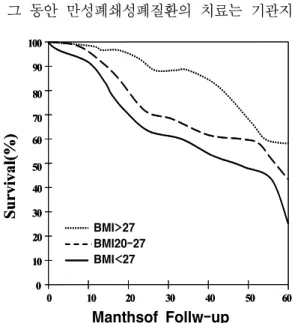
만성기도질환과 체중감소와의 관계는 19세 기 이후 밝혀졌으며, 1960년대에 이르러 만성 폐쇄성폐질환에서 체중감소가 수명감소와 관계 있다는 것이 밝혀졌다. 1) 만성폐쇄성폐질환에서 체중감소는 폐기능을 감소시키고 폐동맥고혈압 과 폐성심을 유발할 수 있으며, 신체활동을 제약하고, 삶의 질을 감소시키며, 수명을 단축 시킨다(Fig. 1). 2) 체중감소와 수명단축과의 관 계는 폐기능과는 독립적으로 상관관계가 있다 (Fig. 2). 2, 3)
그 동안 만성폐쇄성폐질환의 치료는 기관지
확장제, 스테로이드, 항생제와 같은 약물치료가 중심이었으며 체중감소에 대한 영양 치료에 대 해서는 관심이 거의 없었다. 최근 만성폐쇄성 폐질환에서 폐재활 치료와 함께 체중감소에 대 한 치료의 필요성과 중요성에 대하여 관심을 가지게 되었다. 그러나 많은 호흡기질환 전문 가들조차도 만성폐쇄성폐질환에서 영양치료는 체중을 증가시킬 뿐만 아니라 감염을 감소시키 고, 삶의 질을 향상시키며, 사망률을 감소시키 Future studies combining an exercise program, the role of anabolic steroids, nutritional individualization, a more targeted nutritional therapy, and the development of new drugs including anti-cytokines is needed for the effective management of COPD.
Key Words: Chronic obstructive pulmonary disease, Pulmonary rehabilitation, Nutrition, Assessment
Fig. 1. Survival curves for patients with chronic obstructive pulmonary disease by body mass index (BMI)(kg/m
2).
0 10 20 30 40 50 60
0 10 20 30 40 50 60 70 80 90 100
Months of Follow-Up
Survi val( % )
BMI>27 BMI 20-27 BMI<27
0 10 20 30 40 50 60
0 10 20 30 40 50 60 70 80 90 100
Months of Follow-Up
Survi val( % )
BMI>27 BMI 20-27 BMI<27
Fig. 2. Chronic obstructive pulmonary disease (COPD) -related mortality by body mass index in subjects with mild, moderate, and severe COPD. Normal- weight subjects (BMI 20 to 24.9kg/m
2) with mild COPD were used for reference.
BMI, Body mass index; FEV1, Forced expiratory volume in 1 second.
B M I(k g /m
2)
Relat ive Risk
< 2 0 2 0 -2 4 .9 2 5 -2 9 .9 ≥ 3 0 0
2 4 6 8 1 0 1 2 1 4 1 6 1 8 2 0 2 2
2 4 M ild C O P D
F E V 1 % p r e d o c e d ≥ 7 0 M o d e r a te C O P D F E V 1 % p r e d ic te d 5 0 -7 0 S e v e r e C O P D
F E V 1 % p r e d ic te d < 5 0
B M I(k g /m
2)
Relat ive Risk
< 2 0 2 0 -2 4 .9 2 5 -2 9 .9 ≥ 3 0 0
2 4 6 8 1 0 1 2 1 4 1 6 1 8 2 0 2 2
2 4 M ild C O P D
F E V 1 % p r e d o c e d ≥ 7 0 M o d e r a te C O P D F E V 1 % p r e d ic te d 5 0 -7 0 S e v e r e C O P D
F E V 1 % p r e d ic te d < 5 0
Manthsof Follw-up
BMI>27 BMI20-27 BMI<27
BMI(kg/m2)
Mild COPD
FEV 1% predoced≥70 Moderate COPD FEV 1% predoced 50-70 Severe COPD
FEV 1% predoced<70
고, 3) 호흡부전으로 인한 기계 환기의 필요성을 감소시킬 수 있다 4) 는 것을 잘 인식하지 못하 고 있는 듯하다.
이에 만성폐쇄성폐질환에서 체중감소의 원 인, 영양평가방법, 영양치료의 효과 등에 관하 여 알아보고자 한다.
빈도
만성폐쇄성폐질환에서 체중감소 빈도는 외 래환자의 20%, 5) 폐재활 치료를 받는 환자의 35%, 6) 입원환자의 62∼71%이다. 7) 일반적으로 기도폐쇄 8) 와 저산소혈증이 심할수록 체중감소 도 심하다. 저자의 연구에서는 만성폐쇄성폐질 환이 있는 외래 환자의 51%에서 체중감소가 있었다. 8)
체중감소의 원인
에너지대사의 증가
건강한 사람은 호흡 시에 총에너지요구량의 1∼2%가 소모된다. 만성폐쇄성폐질환에서는 기 도저항이 증가되어 호흡 시 일을 많이 하게 되 면서 산소요구량이 증가되어 에너지요구량이
증가되어 있다. 9,10) 만성기도질환에서 에너지요 구량의 증가는 호흡일의 증가, 사강환기의 증 가, 산소소모량의 증가, 불충분한 가스교환 등 이 원인이다. 11) 만성폐쇄성폐질환 환자들은 건 강한 사람보다도 호흡할 때 훨씬 더 많은 에너 지가 요구되어 정상 호흡 시의 에너지요구량의 10배 혹은 30∼50%까지 더 많은 에너지가 요 구된다는 보고도 있다. 12)
만성폐쇄성폐질환에서 체중이 감소되는 다 른 원인은 전신성 염증이 증가되어 대사가 과 도하게 일어나는것이다. 최근 만성폐쇄성폐질 환은 폐에 국한된 국소적 질환이 아니고 전신 성 염증성 질환으로 인식되고 있으며, 염증반 응에 의해 에너지대사를 증가시키는 여러 가지 Table 1. Factors that may contribute to suboptimal dietary intake
요 소 이론적 근거
호흡곤란/공기연하증 만성 구강 호흡 진하고 악취나는 객담 약제
구강과 치아의 궤양 피로
운동능력저하 사회적 고립 걱정,우울 재정적 부족
위확장은 기능적 잔존능을 감소시키고 횡경막의 압박으로 인한 조기팽만 음식의 맛을 변화시키고 호감을 줄임
미각을 변화시킴
항생제나 티오필린, 프레드니손은 위장장애 구강통증을 일으킬 수 있음
피곤하거나 먹을 기운이 없으면 먹는데 사용되는 시간을 줄이게 됨 상점에 갈수 없거나 먹을 능력이 없음l
음식을 구입하거나 식사를 준비하거나 이동하는데 어려움이 있음 식욕을 억제시키고 개인을 돌보는 능력을 감소시킴
음식물을 구입, 선택하는 것을 어렵게 함
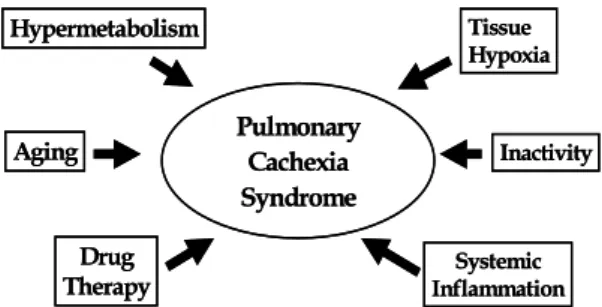
Fig. 3. The causes of weight loss in chronic obstructive pulmonary diseases.
Hypermetabolism Tissue
Hypoxia
Aging Inactivity
Drug
Therapy Inflammation Systemic Pulmonary
Cachexia Syndrome
Hypermetabolism Tissue
Hypoxia
Aging Inactivity
Drug
Therapy Inflammation Systemic Pulmonary
Cachexia
Syndrome
사이토카인의 분비가 증명되었다. 13, 14) 만성폐 쇄성폐질환에서 특히 종양괴사인자-알파가 체 중감소와 관계있다는 것이 밝혀져 있다. 15)
만성폐쇄성폐질환이 급성으로 악화되는 경 우에도 체중이 감소되며 이 때의 체중감소는 악화된 호흡곤란, 16) 전신염증의 증가, 17) 전신성 스테로이드의 사용 18) 때문이다(Fig. 3).
영양섭취의 감소
만성폐쇄성폐질환에서 체중감소의 원인은 에 너지대사의 증가뿐만 아니라 음식섭취의 감소 에 의해서도 일어난다. 만성폐쇄성폐질환에서 일어나는 음식섭취 감소의 원인은 Table 1과 같다. 4, 10, 11)
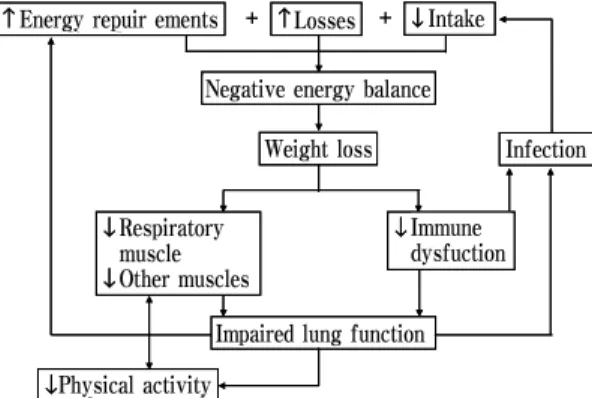
체중감소가 호흡기질환에 미치는 영향 체중이 감소되면 폐기능의 감소로 분당환기 량이 감소한다(Fig. 4). 저산소혈증에 대한 중 추신경의 민감도가 감소되어 호흡곤란에 대한 인지력이 저하된다. 그리고 폐포사이의 주된 간질성 물질인 콜라겐의 합성이 감소되어 폐기 종을 초래한다. 장기간 체중감소가 지속되면 폐감염에 대한 저항력이 감소되어 폐렴과 같은
감염성 질환의 이환률이 증가한다.
영양평가법
영양상태를 평가하는 방법은 여러 가지가 개발되어 있으나, 어느 한 가지가 다른 방법에 비해서 우월한 검사법은 없다. 만성기도질환에 서 영양평가도 어느 한 가지 방법에 의존하기 보다는 몇 가지 가능한 방법으로 평가를 하여 야 정확한 평가를 할 수 있다.
영양평가법은 일반적인 스크리닝 검사방법 과 같이 검사법이 단순하여야 하고, 통증이 없 어야 하며, 값이 싸야하고, 정확하여야 하며, 자주 쉽게 반복적으로 측정할 수 있어야 한다.
일반적으로 영양상태는 크게 신체계측(A:
Anthropometric assessment), 생화학적 검사 (B: Biochemical assessment), 임상조사(C: Clinical assessment), 식사 섭취조사(D: Dietary assess- ment)과 같은 네 가지 방법(A,B,C,D)으로 알 수 있다.
만성기도질환에서 영양상태를 평가할 때는 이와 같은 네 가지 방법을 포괄적이고도 개인 에 맞게 평가하여야 한다.
(1) 체질량 지수
세계보건기구에 의한 체중감소의 기준은 체 중이 이상적인 체중의 90%이거나 체질량지수 가 20kg/m 2 이하일 때이다. 체중을 체질량 지수 에 따라서 저체중, 정상체중, 과체중으로 평가 할 수 있다. 저체중은 미국이나 유럽인에서는 체질량 지수가 20kg/m 2 이하일 때이지만 이 수 치는 임의적인 것이며, 실제로 만성폐쇄성폐질 환에서 체질량 지수가 24kg/m 2 이하인 경우에 도 사망률이 증가한다. 19)
Fig. 4. Negative feedback cycle between nutrition and lung function.
↑ Energy requirements + ↑ Losses + ↓ Intake Negative energy balance
Weight loss Infection
↓ Respiratory muscle
↓ Other muscles
↓ Immune dysfuction
Impaired lung function
↓ Physical activity
↑ Energy requirements + ↑ Losses + ↓ Intake Negative energy balance
Weight loss Infection
↓ Respiratory muscle
↓ Other muscles
↓ Immune dysfuction
Impaired lung function
↓ Physical activity
Energy repuir ements Losses Intake
Negative energy balance
Weight loss Infection
Immune dysfuction Respiratory
muscle Other muscles
Impaired lung function Physical activity
(2) 체성분 측정
임상적으로 중요한 체성분은 근육, 지방, 수 분이다. 체성분은 Fig. 5와 같이 체지방과 체지 방을 제외한 제지방(fat free mass)의 두 부분 으로 나눌 수 있다. 체지방은 지방 조직으로 이루어지지만 제지방은 약 50%가 근육이며, 이외에 뼈, 장기가 포함된다. 수분은 체지방에 는 없으며 제지방의 여러 부위에 골고루 분포 하며 체중의 약 73%를 차지한다.
만성폐쇄성폐질환에서 제지방 감소는 제지 방량이 남자에서는 16kg/m 2 이하이고, 여자에서 는 15kg/m 2 이하일 때이다. 체중에 따른 만성폐 쇄성폐질환 환자를 체중과 제지방량을 기준으 로 구분할 때, 저체중-제지방 감소 그룹, 저체 중-정상 제지방 그룹, 정상체중-제지방 감소 그룹, 정상체중-정상 제지방 그룹의 4가지 그 룹으로 구분할 수 있다.
정상인에서도 나이가 들면서 매년 200g의 제지방 감소가 일어난다. 중등도의 만성폐쇄성 폐질환에서는 제지방이 20%까지 감소하며, 5) 폐재활 치료를 받는 환자의 35%까지, 6) 급성으 로 악화 시에는 70%까지 감소된다. 19) 제지방 량과 안정상태의 폐기능과는 상관관계가 있으 며, 20) 최대운동능력과도 상관관계가 있다. 21)
이와 같은 체성분을 직접 측정할 수 있다면
영양상태를 정확하게 평가할 수 있지만 체성분 을 정확하게 측정하는 것은 복잡하고 거의 불 가능하다. 따라서 다음과 같은 간접적인 방법 으로 체성분을 측정한다.
1) 생체전기저항법(bioelectrical impedance) 신체의 수분과 전해질은 주로 제지방에 있 으며 지방 조직에는 없기 때문에 신체에 약한 전류를 흐르게 하여 체지방과 제지방 조직의 전기전도성이 다른 것을 이용하여 각 부위의 성분을 측정하는 방법이다. 이 방법은 간단하 고 값도 싸며, 쉽게 재현할 수 있어서 최근에 많이 사용되고 있다. 22, 23)
2) Dual-Energy X-Ray Absorptiometry (DEXA)
신체의 말초부위의 체성분까지 측정할 수 있는 방법으로 허벅지와 복부의 체지방은 컴퓨 터단층촬영으로 측정한 결과와 매우 상관관계 가 있을 정도로 정확하나, 제지방과의 상관관 계는 낮은 단점이 있다.
(3) 신체계측 피부두께 측정법
피하 지방량을 추정하기 위하여 간단한 캘 리버로 신체의 여러 부위의 피부두께를 측정하 여 간접적으로 체지방률을 측정하는 방법이다.
측정 부위는 삼두근, 가슴, 견갑골 부분, 장골 윗부분, 복부, 허벅지 등이다.
(4) 생화학적 검사법
혈청의 단백질, 알부민, 림프구, 트렌스페린 등과 같은 지표가 영양상태를 평가하는 데 사 용될 수 있다. 이 방법은 장기의 상태를 측정 하는 방법으로 신체의 전반적인 영양상태를 측 Fig. 5. The two-compartment model of body
composition.
Fat mass
Fat-free mass (≡Lean body
mass)
Fat mass
Visceral organs Bone
Water-distributed Throughout the fat-free mass and Accounting for 73%
of it by weight Skeletal
muscle Fat mass
Fat-free mass (≡Lean body
mass)
Fat mass
Visceral organs Bone
Water-distributed Throughout the fat-free mass and Accounting for 73%
of it by weight Skeletal
muscle
Fat mass Fat mass
Fat-free mass (=Lean body
mass)
Viscer al organs Bone
Skeletal muscle
Water-distributed Throughout the fat-free mass and Accounting for 73%
of it by weight
정하기는 불가능하다.
영양치료
영양치료의 목표
만성기도질환에서 영양치료의 주된 목적은 제지방량을 증가시키는 것이다. 영양치료의 목 표는 건강 상태를 최대한 증가시키고, 호흡근 육의 기능을 증가시키며, 환자가 건강하다는 느낌을 갖게하고, 삶의 질과 수명을 향상시키 는 것이다.
영양치료 방법
폐재활에서 영양치료를 할 때는 총 칼로리 양과 3대 영양소를 처방하여야 한다. 총칼로리 측정은 주로 간접칼로리 방법으로 측정한다.
처방은 체중이 정상인 환자에서는 측정된 총칼 로리양의 1.2∼1.4배를 처방한다. 체중이 감소 되어 체중증가를 요하는 환자에서는 측정된 총 칼로리양의 1.4∼1.7배를 처방한다.
3대 영양소의 경우은 탄수화물은 이산화탄 소생성이 증가될 수 있으므로 총칼로리의 50%
를 넘기지 않도록 하며, 지방은 30∼40%정도 를 처방하고, 단백질 부족은 많지 않으므로 체 중이 감소된 환자에서는 체중당 1.5∼2.0g을 처방한다.
2주이내의 치료로는 기대하는 효과를 얻기 가 어려우므로, 적어도 2주 이상의 영양치료기 간이 필요하다.
영양치료 효과
만성폐쇄성폐질환에서 짧은 기간동안의 영 양치료로도 체중과 폐기능을 향상시키고, 25,26) 혈중 림프구를 증가시키며, 면역력으로는 알레
르겐 피부반응검사 반응을 증가 시킨다고 27) 하 였으나 최근 이를 증명하기 위한 몇몇 무작위 대조 연구에서 2주 동안 영양치료를 한 결과 신체계측, 폐기능, 호흡근육의 강도, 운동능력 을 향상시킨다는 결론을 얻지는 못하였다. 28)
이 질환에서 영양치료 단독으로는 뚜렷한 결과를 얻지 못하였으나, 영양치료를 운동요법 과 동시에 시도할 경우 체중을 증가시키고, 제 지방량과 호흡근육의 강도를 향상시킬 수 있 다. 29) 만성폐쇄성폐질환에서 체중감소의 부작 용은 여러 가지 나쁜 결과를 초래하므로 체중 감소를 예방하고 치료하는 것은 매우 중요하 다. 현재까지는 대부분이 안정상태의 만성폐쇄 성폐질환 환자의 영양치료에 대하여 주로 연구 하여 왔으나, 급성으로 악화된 환자에서의 영 양치료의 효과에 대한 연구도 필요하다.
영양치료가 어려운 이유
환자들은 복용약물이나 위장관운동장애로 인한 소화기 증상 때문에 식사하기를 싫어하며 식사 중에 호흡곤란이 악화되는 것이 두려워서 식사를 잘 하려하지 않는다. 영양치료를 하는 경우에도 체중증가가 어려우며 체중이 증가하 더라도 영양치료의 주된 목적인 제지방량이 잘 증가되지 않는다. 따라서 영양치료를 하면서 동시에 제지방량을 증가시키기 위한 방법으로 운동을 동시에 하여야 한다. 이외에도 단백동 화(anabolic) 스테로이드 29) 혹은 성장호르몬 30) 을 투여하는 방법이 시도되고 있다.
영양치료의 실제
만성폐쇄성폐질환에서 영양치료의 목적은 질
환을 악화시키지 않으면서, 영양결핍을 예방하
고 회복하는 것과 호흡기능을 향상시킴으로써
합병증과 사망률을 감소시키는 것이다.
환자의 건강한 식사습관을 가지게 하는 것 이 중요하다. 운동프로그램과 동시에 실시하면, 제지방량을 증가시킬 수 있을 뿐만 아니라 영 양치료의 효과를 증가시킬 수 있고, 식욕도 향 상시킬 수 있다.
이 환자들은 적당한 음식을 선택하는 것 외 에도 그 음식을 쉽게 구할 수 있는지, 조리방
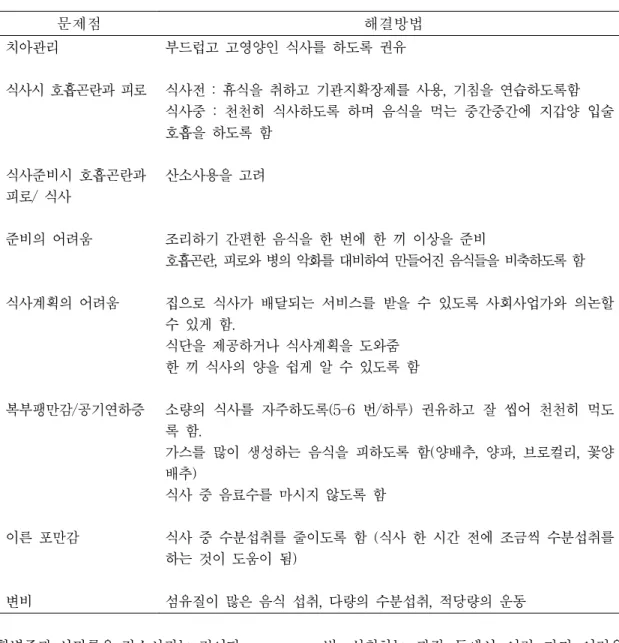
법, 섭취하는 과정 등에서 여러 가지 어려운 점이 많다. 만성폐쇄성폐질환 환자에서 영양치 료 시 여러 가지 문제점과 해결 방법은 Table 2 와 같다.
특히 다른 질환(신장질환, 심장질환, 당뇨병 등)이 동반된 경우나 스테로이드를 장기간 사 용하는 환자들은 영양사에 의뢰하여 영양처방 을 받도록 하여야 한다.
Table 2. Problems that the health professional may identify and proposed solutions
문제점 해결방법
치아관리
식사시 호흡곤란과 피로
식사준비시 호흡곤란과 피로/ 식사
준비의 어려움
식사계획의 어려움
복부팽만감/공기연하증
이른 포만감
변비
부드럽고 고영양인 식사를 하도록 권유
식사전 : 휴식을 취하고 기관지확장제를 사용, 기침을 연습하도록함 식사중 : 천천히 식사하도록 하며 음식을 먹는 중간중간에 지갑양 입술 호흡을 하도록 함
산소사용을 고려
조리하기 간편한 음식을 한 번에 한 끼 이상을 준비
호흡곤란, 피로와 병의 악화를 대비하여 만들어진 음식들을 비축하도록 함 집으로 식사가 배달되는 서비스를 받을 수 있도록 사회사업가와 의논할 수 있게 함.
식단을 제공하거나 식사계획을 도와줌 한 끼 식사의 양을 쉽게 알 수 있도록 함
소량의 식사를 자주하도록(5-6 번/하루) 권유하고 잘 씹어 천천히 먹도 록 함.
가스를 많이 생성하는 음식을 피하도록 함(양배추, 양파, 브로컬리, 꽃양 배추)
식사 중 음료수를 마시지 않도록 함
식사 중 수분섭취를 줄이도록 함 (식사 한 시간 전에 조금씩 수분섭취를 하는 것이 도움이 됨)
섬유질이 많은 음식 섭취, 다량의 수분섭취, 적당량의 운동
영양치료의 평가와 치료의 전반적인 순서는 Fig. 6과 같다.
앞으로의 과제
폐재활 치료에서 영양치료 시에 제지방량을 증가시키기 위한 운동프로그램의 개발이 필요 하며, 제지방량을 증가시키기 위한 방법으로 성장호르몬이나 단백동화 스테로이드의 역할에 대해서는 더 많은 연구와 경험이 필요하다. 만 성기도질환은 국소적 장기의 장애가 아니라 전 신 대사성 질환으로 생각하여 염증, 저산소혈 증, 에너지 손실 등과의 관계에 대한 관계의 정립이 필요할 것으로 생각된다.
영양치료는 개개인에 따른 맞춤치료와 원인 인자에 대한 표적치료가 요구된다. 새로운 치 료제의 개발로는 항 종양괴사인자항체, 항 사 이토카인제제 등의 개발이 필요하며, 특수 영 양제의 개발도 필요하다.
참 고 문 헌
1. Vandenbergh E, Van de Woestijne KP, Gyselen
A. Weight changes in the terminal stages of chronic obstructive pulmonary disease. Am Rev Respir Dis 1967 Apr;95(4):556-66.
2. Shoup R, Dalsky G, Warner S, Davies M, Connors M, Khan M, et al. Body composition and health-related quality of life in patients with chronic obstructive pulmonary disease.
Eur Respir J 1997 Jul;10(7):1576-80.
3. Schols AM, Slangen J, Volovics L, Wouters EF. Weight loss is a reversible factor in the prognosis of chronic obstructive pulmonary disease. Am J Respir Crit Care Med 1998 Jun;157(6 Pt 1):1791-7.
4. Keim NL, Luby MH, Braun SR, Martin AM, Dixon RM. Dietary evaluation of outpatients with chronic obstructive pulmonary disease.
J Am Diet Assoc 1986 Jul;86(7):902-6.
5. Engelen MP, Schols AM, Baken WC, Wesseling GJ, Wouters EF. Nutritional depletion in relation to respiratory and peripheral skeletal muscle function in out-patients with COPD. Eur Respir J 1994 Oct;7(10):1793-7.
6. Schols AM, Soeters PB, Dingemans AM, Mostert R, Frantzen PJ, Wouters EF.
Prevalence and characteristics of nutritional depletion in patients with stable COPD eligible for pulmonary rehabilitation. Am Rev Respir Dis 1993 May;147(5):1151-6
7. Laaban JP, Kouchakji B, Dore MF, Orvoen- Frija E, David P, Rochemaure J. Nutritional status of patients with chronic obstructive pulmonary disease and acute respiratory failure.
Chest 1993 May;103(5):1362-8.
8. Mun YC, Yu SK, Park HJ, Park JW, Shin KC, Chung JH, et al. The differences in resting pulmonary function in relation to the nutritional status of patients with chronic obstructive pulmonary disease. Tuberculosis and Respiratory Diseases 2001 Dec;51(6):570-8.
9. Goldstein SA, Thomashow BM, Kvetan V,
Fig. 6. Flowchart of nutritional screening and
therapy. BMI, body mass index; FFMI, fat-free mass index.
underweight normal weight overweight SCREENING
weight loss stable weight loss stable weight loss stable
low FFM normal low FFM normal control
nutritional intervention TREATMENT
CONTROL responder
maintenance therapy oral supplements anabolic stimulation
nonresponder compliance improvement oral/enteral supplements anabolic stimulation underweight normal weight overweight SCREENING
weight loss stable weight loss stable weight loss stable
low FFM normal low FFM normal control
nutritional intervention TREATMENT
CONTROL responder
maintenance therapy oral supplements anabolic stimulation
nonresponder compliance improvement oral/enteral supplements anabolic stimulation
Askanazi J, Kinney JM, Elwyn DH. Nitrogen and energy relationships in malnourished patients with emphysema. Am Rev Respir Dis 1988 Sep;138(3):636-44.
10. Wilson DO, Donahoe M, Rogers RM, Pennock BE. Metabolic rate and weight loss in chronic obstructive pulmonary disease. JPEN J Parenter Enteral Nutr 1990 Jan-Feb;14(1):7-11.
11. Braun SR, Dixon RM, Keim NL, Luby M, Anderegg A, Shrago ES. Predictive clinical value of nutritional assessment factors in COPD. Chest 1984 Mar;85(3):353-7.
12. Laaban JP. Nutritional and chronic obstructive pulmonary disease. Rev Pneumol Clin 1991; 47 (6):235-50.
13. de Godoy I, Donahoe M, Calhoun WJ, Mancino J, Rogers RM. Elevated TNF-alpha production by peripheral blood monocytes of weight- losong COPD patients. Am J Respir Crit Care Med 1996 Feb;153(2):633-7.
14. Di Francia M, Barbier D, Mege JL, Orehek J.
Tumor necrosis factor-alpha levels and weight loss in chronic obstructive pulmonary disease.
Am J Respir Crit Care Med 1994 Nov;150(5 Pt 1):1453-5.
15. Schols AM, Buurman WA, Staal van den Brekel AJ, Dentener MA, Wouters EF. Evidence for a relation between metabolic derangements and increased levels of inflammatory mediators in a subgroup of patients with chronic obstructive pulmonary disease. Thorax 1996 Aug;51(8):819-24.
16. Vermeeren MA, Schols AM, Wouters EF.
Effects of an acute exacerbation on nutritional and metabolic profile of patients with COPD.
Eur Respir J 1997 Oct;10(10):2264-9.
17. Pack JH, Park JY, Park HJ, Baek SH, Shin KC, Chung JH, et al. The study for the relationship of weight loss with plasma leptin and TNF-α level in patients with chronic
bronchitis and emphysema. Tuberculosis and Respiratory Diseases 2003 Feb;54(2):199-209.
18. Saudny-Unterberger H, Martin JG, Gray- Donald K. Impact of nutritional support on functional status during an acute exacerbation of chronic obstructive pulmonary disease. Am J Respir Crit Care Med 1997 Sep;156(3 Pt 1):
794-9.
19. Fiaccadori E, Del Canale S, Coffrini E, Vitali P, Antonucci C, Cacciani G, et al. Hypercapnic- hypoxemic chronic obstructive pulmonary disease (COPD): influence of severity of COPD on nutritional status. Am J Clin Nutr 1988 Sep;48(3):680-5.
20. Park JY, Pack JH, Park HJ, Bae SW, Shin KC, Chung JH, et al. The effect of body mass index, fat percentage, and fat-free mass index on pulmonary function test. Tuberculosis and Respiratory Diseases 2003 Feb;54(2):
210-8.
21. Mun YC, Park HJ, Shin KC, Chung JH, Lee KH. The influence of fat-free mass to maximum exercise performance in patients with chronic obstructive pulmonary disease.
Tuberculosis and Respiratory Diseases 2002 Apr;52(4):346-54.
22. Wilson DO, Rogers RM, Wright EC, Anthonisen NR. Body weight in chronic obstructive pulmonary disease :the National Institutes of Health Intermittent Positive Pressure Breathing Trial. Am Rev Respir Dis 1989 Jun;139(6):
1435-8.
23. Schols AM, Wouters EF, Soeters PB, Westerterp KR. Body composition by bioelectrical- impedance analysis compared with deuterium dilution and skinfold anthropometry in patients with chronic obstructive pulmonary disease.
Am J Clin Nutr 1991 Feb;53(2):421-4.
24. Baarends EM, Schols AM, van Marken Lichtenbelt WD, Wouters EF. Analysis of
body water compartments in relation to tissue depletion in clinically stable patients with chronic obstructive pulmonary disease. Am J Clin Nutr 1997 Jan;65(1):88-94.
25. Whittaker JS, Ryan CF, Buckley PA, Road JD. The effects of refeeding on peripheral and respiratory muscle function in malnourished chronic obstructive pulmonary disease patients.
Am Rev Respir Dis 1990 Aug;142(2):283-8.
26. Wilson DO, Rogers RM, Openbrier D. Nutritional aspects of chronic obstructive pulmonary disease. Clin Chest Med 1986 Dec;7(4):643-56.
27. Fuenzalida CE, Petty TL, Jones ML, Jarrett S, Harbeck RJ, Terry RW, et al. The immune response to short-term nutritional intervention in advanced chronic obstruction pulmonary disease. Am Rev Respir Dis 1990 Jul;142(1):
49-56.
28. Ferreira IM, Brooks D, Lacasse Y, Goldstein RS. Nutritional support for individuals with COPD: a meta-analysis. Chest 2000 Mar;117 (3):672-8.
29. Schols AM, Soeters PB, Mostert R, Pluymers RJ, Wouters EF. Physiologic effects of nutritional support and anabolic steroids in patients with chronic obstructive pulmonary disease. A placebo-controlled randomized trial.
Am J Respir Crit Care Med 1995 Oct;152(4 Pt 1):1268-74.
30. Burdet L, de Muralt B, Schutz Y, Pichard C, Fitting JW. Administration of growth hormone to underweight patients with chronic obstructive pulmonary disease. A prospective, randomized, controlled study. Am J Respir Crit Care Med 1997 Dec;156(6):1800-6.