Vol. 38, No. 3, 329–334 (2010)
근권세균과 옥수수를 이용한 유류 및 중금속 복합 오염토양의 Rhizoremediation
홍선화·구소연·김성현1·류희욱2·이인숙1·조경숙*
이화여자대학교 환경공학과, 1이화여자대학교 에코과학부
2숭실대학교 환경화학공학과
Rhizoremediation of Petroleum and Heavy Metal-Contaminated Soil using Rhizobacteria and Zea mays. Hong, Sunhwa Hong, So Yeon Koo, Sung Hyun Kim1, Hee Wook Ryu2, In Sook Lee1,and Kyung- Suk Cho*. Department of Environmental Science and Engineering, Ewha Womans University, Seoul 120-750, Korea, 1Devision of Ecoscience, Ewha Womans University, Seoul 120-750, Korea, 2Department of Chemical and Environmental Engineering, Soongsil University, Seoul 156-743, Korea − In this study, the rhizoremediation of petroleum and heavy metal-contaminated soil was characterized employing Zea mays and two plant-growth promoting rhizobacteria, Gordonia sp. S2RP-17 and Serratia sp. SY5 which have petroleum-degrading activ- ity and heavy metal-resistance, respectively. After 51 days, the average dry weights of Zea mays’ root without and with the inoculation of rhizobacteria were 1.9±0.2 and 5.6±0.7 g, respectively. Compared with initial TPH concentration in soil (21,576±3,426 mg-TPH·kg-dry soil-1), the residual TPH concentrations were 220±98 mg-TPH·kg-dry soil-1 in soil planted with Zea mays, and 20±41 mg-TPH·kg-dry soil-1 in soil planted with Zea mays and inoculated with rhizobacteria. These results indicated that the inoculation of S2RP-17 and SY5 could promote TPH removability in soil as well as the growth of Zea mays’ root. There was little positive effect of the rhizobacteria inoculation on the removability of heavy metal such as Cu, Cd and Pb in soil planted with Zea mays.
Key words: Rhizoremediation, petroleum, heavy metal, Zea mays, plant-growth promoting rhizobacteria
광석의 제련 및 정련 과정 등 각종 산업활동과정에서 배 출된 유류와 중금속에 의한 토양오염은 주요 환경문제로 대 두되고 있다[27, 38, 45]. 중금속과 유류로 오염된 토양을 정 화하기 위해 미생물과 식물을 이용하는 생물정화방법은 경 제적이고 환경친화적인 방법으로 최근 들어 상용화되고 있 다[12, 19, 20]. 유류 오염 토양 정화를 위해 이용될 수 있 는 유류 분해 미생물로 Pseudomonas[10, 30], Arthrobacter [35], Alcaligenes[30, 32], Rhodococcus[2, 22, 23, 24, 35], Bacillus[1, 11]등이 있다. 또한, 유류 오염 토양 정화에 이용될 수 있는 식물로는 쥐보리[6, 18, 29], 콩과식물[18, 29], 포플러[5, 29, 43], 소나무[29], 톨 페스큐[14], 옥수수 [24, 28, 39, 44] 등이 보고 되고 있다.
일반적으로 중금속은 식물에 의해 분해되는 것이 아니라, 토양으로부터 식물체내로 축적되어 제거되기 때문에, 식물 근권의 발달은 중금속 제거에 매우 중요하다[20]. 중금속 과 축적 식물과 식물이 중금속을 잘 축적할 수 있게 돕는 미생 물에 관한 연구가 많이 진행되고 있다[16, 36, 46, 47]. 지금 까지 연구된 중금속과축적식물(Metal-hyperaccumulator)은
국화과(Asteraceae), 십자화과(Brassicaceae), 석죽과(Caryo- phyllaceae), 사초과(Cyperaceae), 콩과(Fabaceae), 이나무과 (lacourtiaceae), 꿀풀과(Lamiaceae), 벼과(Poaceae), 그리고 제비꽃과(Violaceae)등이 있고[20, 34], 중금속에 내성이 강 한 미생물로는 Bacillus sp., Pityrogramma calomelanos, 그 리고 Serratia sp. 등이 알려져 있다[16, 21, 36, 47].
지금까지 진행된 대부분의 연구는 유류 혹은 중금속을 미 생물이나 식물을 이용하여 제거하는 것에 초점이 맞추어져 있다. 유류와 중금속으로 복합 오염된 토양은 한 종류의 오 염물질로 오염된 토양보다 오염물질을 제거하는 것이 휠씬 어려워지는 경우가 많다[7, 38, 42, 48]. 따라서, 2종 이상의 오염물질로 오염된 토양정화에 대한 연구를 통해 관련 정보 를 구축하는 것이 필요하다.
본 연구에서는 미생물과 식물을 동시에 이용한 mesocosm 실험을 통해 복합오염 토양의 정화 특성을 조사하였다. 즉, 유류 분해능이 있고 식물 성장 촉진능력을 가진 Gordonia sp. S2RP-17[13], 중금속에 내성을 가지며 식물성장촉진 능 력이 있는 Serratia sp. SY5[21] 및 옥수수를 이용하여 유류 및 중금속 오염 토양의 정화 특성을 조사하였다.
토양 시료 준비 및 미생물 배양은 다음과 같이 하였다. 이 화여자대학교에서 채취한 토양을 2 mm 체로 친 후, 마사와 2 : 1(w/w) 비율로 섞었다. 이 혼합토양에 비료를 50 : 3(w/
*Corresponding author
Tel: 82-2-3277-2393, Fax: 82-2-3277-3275 E-mail: [email protected]
w) 비율로 섞었는데, 비료는 돈분 25%, 계분 35%, 우분 5%, 톱밥 25%로 섞어 C/N비가 50 이하가 되도록 숙성시킨 것이다. 이렇게 준비한 토양시료를 인위적으로 오염시키기 위해 디젤을 20,000 mg·kg-wet soil-1이 되도록 첨가하였고, Pb, Cu 및 Cd는 각각 500, 50 및 30 mg·kg-wet soil-1이 되도록 첨가한 후 잘 혼합하였다. 중금속은 CuCl2·2H2O (Duksan pure chemical Co., LTD, Korea, 97%), Pb(NO3)2 (Duksan pure chemical Co., LTD, Korea, 99%), 그리고 CdCl2(Farco chemical Co., LTD, China, 99%) 시약으로 stock 용액을 만들어서 토양에 첨가하였다. 중금속 첨가량 (30-500 mg·kg-wet soil-1)이 미량이므로, 중금속 용액에 함 유된 염소와 질산염은 토양미생물과 식물에 영향을 미치는 않는다. 오염시킨 토양을 4일간 서늘한 곳에 두고, 하루에 한번씩 토양을 완전히 섞어 주었다. 이렇게 준비한 오염토양 시료의 pH, 수분함량, 유기물함량 및 탈수소효소 활성은 각 각 5.7±0.01, 8.2±0.6%, 3.5±0.02% 및 124±21 µg-TPF·g- dry soil-1·d-1이었다.
오염 토양에 접종한 세균으로 디젤을 분해하는 동시에 식 물의 성장을 촉진할 수 있는 Gordonia sp. S2RP-17[13]과, Pb에 강한 내성을 가지고 있으며 식물 성장 촉진능이 있는 Serratia sp. SY5[21]을 이용하였다. 이들 세균은 1 L의 LB 배지(Difco, USA)에서 30oC에서 3일 동안 진탕배양(180 rpm)하였다. 배양액을 10,000 rpm에서 10분 동안 원심분리 하여 회수한 균체에 멸균수를 첨가하여 현탁 한 후 다시 동 일 조건으로 원심분리 하였다. 이 과정을 2차례 반복하여 균 체를 세정해 주었다. 세정한 균체를 멸균수 700 mL에 현탁 한 후, 균주 현탁액을 디젤과 중금속으로 오염시킨 토양 5 kg에 주입한 후 충분히 혼합하였다. 최종 접종 농도는 S2RP- 17균주는 2.6×10⁷ CFU·g-dry soil-1, SY5 균주는 1.2×10⁸ CFU·g-dry soil-1이었다.
Mesocosm은 직경 150 mm인 원통형 PVC관을 이용하여, 3개의 층(각 층의 높이 300, 250, 250 mm로, 총 800 mm) 으로 만들었다(Fig. 1). 중간과 하부 두 단(총 500 mm)은 비 오염토양을 10 kg 넣었고, 유류와 중금속으로 인공 오염시 킨 토양 혹은 오염 토양에 근권세균을 접종한 토양 5 kg을 상부 첫째 단(300 mm)에 넣었다. 오염 토양을 넣은 첫째 단 에 윗부분 가운데에 4 cm 정도의 빈 공간으로 만들어 비오 염 토양을 넣은 후 옥수수 씨앗을 3알씩 심었다. 오염 토양 에 식물만 식재한 조건(DHM+P) 및 오염 토양에 식물과 근 권세균을 함께 접종한 조건(DHM+P+B)으로 mesocosm 실 험을 4반복으로 하였다. 실험은 기온이 약 20-35oC인 온실 에서 51일간 수행하였으며, 재배 초기 20일 동안은 하루에 한번씩, 그 이후에는 이틀에 한번씩 물을 주었다.
근권세균을 미접종 혹은 접종한 오염토양에서 옥수수를 51일 동안 재배한 후, 토양의 특성 변화 및 잔류 오염물질 농도를 분석하여 비교하였다. 각 mesocosm 상단층에서 옥 수수의 뿌리가 손상되지 않도록 조심스럽게 옥수수를 채취
한 후, 상단층 토양을 전부 꺼내 손으로 잘 혼합하였다. 토 양의 pH는 토양 5 g에 증류수 25 mL을 넣고 교반기 안에 서 한 시간 동안 혼합한 뒤, 30분간 정치한 후 상등액의 pH 를 pH meter(420A, Orion Research Inc., USA)를 이용하 여 측정하였다. 일정량의 토양을 110oC에서 24시간 건조시 킨 후, 전후의 무게 차를 이용하여 수분함량을 구하였다. 이 렇게 건조한 토양을 다시 650oC에서 30분간 강열감량 하였 으며, 전후의 무게 차를 이용하여 유기물함량을 구하였다.
토양 미생물 활성을 비교하기 위해 탈수소 효소 활성을 측 정하였다[31]. 토양의 잔류 TPH 농도를 분석하기 위해, 토 양 5 g(습중량)을 test tube에 넣고, hexane-acetone solution (1:1, v/v)을 5 mL 넣어 준 후 30oC, 200 rpm의 교반기에 서 30분간 교반하였다. 그 후 test tubes를 실온에서 30분간 정치한 후 상등액을 채취하여 용매 속에 녹아있는 잔류 TPH 의 농도를 gas chromatography(GC, 5890 series II, Hewlett Packard, USA)를 이용하여 분석하였다. GC 분석 조건은 오 븐 온도가 초기 40oC 에서 3분간 유지한 후, 4oC·min-1으로 70oC까지 승온, 10oC·min-1으로 200oC까지 승온, 그리고 8oC·min-1으로 300oC까지 승온 한 후 15분간 유지하였다. 시 료 주입부와 검출기 온도는 각각 300, 320oC이고, column은 HP-5 capillary column(0.25 mm×30 m, 0.25 µm)을 사용 하였으며, carrier gas는 N2를 사용하였다. 디젤의 농도가 0, 312.5, 625, 1,250, 10,000, 20,000, 그리고 40,000 mg·L-1 로 하여 검량선을 작성한 후, 검량식으로부터 TPH농도를 환 산하였다. 또한, 토양의 중금속 농도를 분석하기 위해, 풍건 토양 0.5 g에 왕수(65% HCl 1.8 mL + 37% HNO3 0.6 Fig. 1. Schematic diagram of a soil mesocosm.
mL) 2.4 mL를 가한 후 가열하여 시료를 산 분해하여, 증류 수 10 mL로 희석하고 여과지(Whatman, No.44, USA)로 여 과하였다. 이 시료를 Atomic Absorption Spectrophotometer (AAS analysis 100, Perkin Elmer, USA)로 측정하였다. 토 양 중금속 분석법의 신뢰도는 캐나다의 CNRC(National Research Council of Canada)에서 공인된 표준물질인 MESS-2(Marine Sediment)의 분석을 통해 확인하였다. 위의 모든 실험의 결과는 SPSS(12.0K)을 이용하여 통계분석 (Anova, two sample t-test)을 하였다.
유류 및 중금속 복합오염 토양에 옥수수만 식재(DHM+P) 하거나 옥수수 식재와 더불어 근권세균을 동시에 접종한 조 건(DHM+P+B)에서 51일 동안 처리한 토양의 pH, 수분 함 량, 유기물 함량 및 탈수소효소 활성을 측정한 결과를 Table 1에 나타내었다. 토양의 pH는 DHM+P 및 DHM+P+B 조건 에서 거의 비슷하였으나, 근권세균을 접종한 DHM+P+B 토 양의 수분함량과 유기물 함량이 옥수수만을 식재한 DHM+P 토양보다 높았다(p<0.05). 또한, 근권세균을 접종한 조건인 DHM+P+B 토양의 탈수소 효소 활성(840.6±127.9 µg-TPF·
g-dry soil-1·d-1)은 옥수수만 식재한 DHM+P의 활성(418.8±
117.6 µg-TPF·g-dry soil-1·d-1)보다 2배 이상 높았다. 또한, 본 연구에 사용한 토양의 초기 탈수소 효소 활성(124±21 µg-TPF·g-dry soil-1·d-1)과 비교해 보면, 옥수수 식재 및 근 권세균 접종에 의해 토양의 탈수소 효소 활성이 약 3~7배 이상 증가되었다. 일반적으로 식물의 뿌리에서 영양물질이 분비되며 이로 인해 토양 미생물의 활성과 신진대사가 활발 해지는 것으로 알려져 있다[26, 41]. 그러므로 본 연구에서 옥수수 식재로 인하여 토양의 미생물 활성이 증가함을 알 수 있었다. 또한, DHM+P+B 토양의 탈수소 효소 활성이 DHM+P의 활성 보다 2배 이상 높은 결과는 토양에 접종한 Gordonia sp. S2RP-17과 Serratia sp. SY5의 두 균주가 유 류 및 중금속 오염 토양에서 어느 정도 생존하고 있다는 것 을 간접적으로 시사하는 결과로 생각된다.
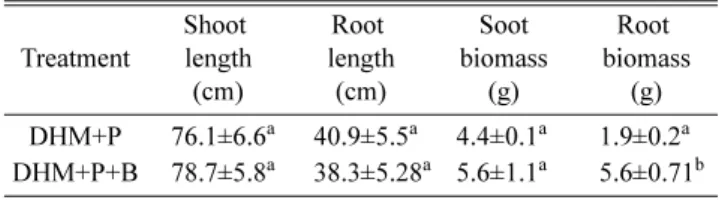
유류와 중금속으로 복합 오염된 토양에 식재한 옥수수의 생장에 미치는 근권세균 접종효과를 분석하기 위해, 51일 동 안 재배 후 수거한 옥수수의 지상부 길이와 중량 그리고 지 하수(뿌리) 길이와 중량을 측정하였다(Table 2). 옥수수만을 식재한 DHM+P 조건에서 재배한 옥수수 지상부 길이와 중 량은 각각 76.1±6.6 cm 및 4.4±0.1 g이었다. 근권세균을 접 종한 DHM+P+B 조건에서 재배한 옥수수의 지상부 길이와
중량은 각각 78.7±5.8 cm 및 5.6±1.1 g로, 근권미생물 접종 에 의해 옥수수의 지상부 생장이 약간 촉진된 것으로 보였 으나, 유의적인 차이는 없었다(p > 0.05). 그런데, DHM+P 조건에서 재배한 옥수수의 뿌리 길이와 중량은 각각 40.9±5.5 cm 및 1.9±0.2 g이었으나, DHM+P+B 조건에서 재배한 옥 수수의 뿌리 길이와 중량은 38.3±5.2 cm 및 5.6±0.7 g이었 다. 근권세균 접종 유무에 따라 뿌리 길이는 유의차가 없었 으나(p>0.05), 근권세균 접종에 의해 옥수수의 뿌리의 중량 이 유의적으로 증가함을 알 수 있었다(p<0.05). 식물상 복원 에 있어 식물의 생장을 촉진하고 또한 식물과 함께 오염물 질을 제거할 수 있는 근권미생물의 역할이 매우 중요하다[9, 17]. 미생물은 토양에 있는 유기 오염물질을 탄소원으로 이 용하며[3], 식물성 병원균으로부터 식물을 보호하거나 그러 한 병원균으로부터의 해로운 영향을 줄이는 항생물질 (antibiotic)을 합성하게 된다[20]. 본 연구에서 접종한 Gordonia sp. S2RP-17과 Serratia sp. SY5는 옥수수의 지 상부(줄기, 잎) 생장에는 큰 영향을 미치지 않았지만, 뿌리의 biomass 생장을 향상시켰다. Gordonia sp. S2RP-17는 1- aminocyclopropane-1-carboxylic acid(ACC) deamiase 활성 을 가지고 있는데[13], 이에 의해 옥수수 뿌리 생장이 촉진 된 것으로 사료된다. 즉, 식물이 오염물질에 노출 될 경우 ethylene을 생산하게 되는데, ethylene이 고농도로 축적되면 식물의 뿌리 성장이 저해를 받게 된다[4, 37, 40]. 그런데 ACC는 ethylene의 전구체로, ACC deamiase은 ACC를 분 해함으로써 ethylene을 생산을 억제하는 효과로 인해 식물 성장을 촉진할 수 있게 된다[4, 37, 40]. 또한, Serratia sp.
SY5 균주는 indole-3-acetic acid(IAA) 생산능이 우수한 근 권세균인데[21], IAA는 식물 성장 호르몬인 오옥신 중의 하 나로 식물 생장을 촉진하는 것으로 알려져 있다[8, 25].
Table 1. Comparison of physicochemical properties and dehydrogenase activity in soil after 51 days.
Treatment pH Moisture content
(%)
Organic matter content (%)
Dehydrogenase (µg-TPF·g-dry soil-1·d-1)
DHM+P 5.2±0.1a 16.5±0.9a 5.5±0.5a 418.8±117.6a
DHM+B+P 5.1±0.1a 18.9±1.2b 6.6±0.72b 840.6±127.972b
DHM+P, contaminated soil + plant; DHM+P+B, contaminated soil + plant + rhizobacteria.
a, bDifferent letters indicate statistical significance (p<0.05).
Table 2. Comparison of the growth of Zea mays after 51 days (n=12)
Treatment
Shoot length (cm)
Root length (cm)
Soot biomass
(g)
Root biomass
(g) DHM+P 76.1±6.6a 40.9±5.5a 4.4±0.1a 1.9±0.2a DHM+P+B 78.7±5.8a 38.3±5.28a 5.6±1.1a 5.6±0.71b DHM+P, contaminated soil + plant; DHM+P+B, contaminated soil + plant + rhizobacteria.
a,bDifferent letters indicate statistical significance (p<0.05).
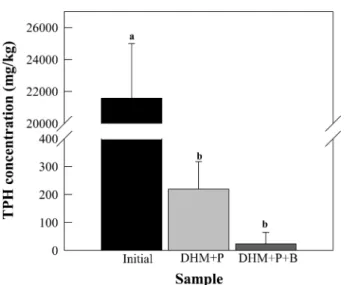
유류 및 중금속 복합오염 토양을 mesocosm에서 51일 동 안 처리한 후, 토양의 잔류 TPH와 중금속 농도를 Fig. 2와 Table 3에 각각 나타내었다. 초기에는 토양의 TPH 농도는 21,576±3,426 mg-TPH·kg-dry soil-1이었는데, 51일 후 DHM+P와 DHM+P+B 토양의 TPH 농도는 각각 220±98 및 20±41 mg-TPH·kg-dry soil-1 이었다(Fig. 2). 이러한 결 과로부터 옥수수 식재에 의해 대부분의 TPH를 제거할 수 있으며, 옥수수와 함께 근권세균을 접종하면 TPH 효율이 약 간 향상됨을 알 수 있었다. 근권미생물은 식물의 성장을 저 해하는 독성물질을 분해함으로써 식물의 성장을 돕거나, 식 물이 독성물질을 분해할 수 있도록 도와주는 역할을 한다 [19]. 원유로 오염된 토양의 경우, Azospirillum lipoferum strain 15와 밀(Triticum aestivum)을 함께 배양하였을 때, 14 일 동안 원유가 56.5%가 제거되었으며, 밀 뿌리의 성장이 촉진하였다[28]. TPH와 PAH로 오염된 토양의 경우, 톨 페 스큐(Festuca arundinacea)를 이용하여 오염토양을 복원할 때, Enterobactor cloacae CAL-2, Azospirillum brasilense Cd, Pseudomonas putida UW3의 접종에 의해 오염물질에 대한 톨페스큐의 내성이 강해지고 오염물질에 의한 스트레 스 하에서도 톨 페스큐의 성장이 촉진 되었다[14, 15]. 이는 근권미생물이 존재할 때 오염물질의 제거와 식물의 성장이 우수했던 본 연구와 일치하는 결과이다.
중금속 제거효율을 비교해 보면(Table 3), 복합오염토양의 초기 Cu 농도는 104±4.1 mg·kg-dry soil-1이었고, DHM+P 및 DHM+P+B 토양의 Cu 농도는 각각 66.3±1.5 및 67.6±
7.3 mg·kg-dry soil-1로, 초기값에 비해 Cu 농도가 감소하였 으나 근권세균 접종 효과는 관찰되지 않았다. 즉, 옥수수만 식재한 조건과 비교하여, 근권세균을 접종한 경우의 Cd 잔
류 농도가 약간 낮았으나, Pb 잔류농도는 오히려 조금 높았 다(p<0.05).
근권미생물은 토양에 존재하는 무기오염물질을 제거해주 고 무기오염물에 대한 식물의 내성을 완화 시켜 식물이 잘 성장하게 도와준다[12]. 중금속의 경우는 식물체에 중금속을 축적하여 오염물을 제거하기 때문에 식물의 생장은 식물상 복원이 성공적으로 상용화되기 위해 매우 중요한 요소이다 [20]. 본 연구에서 사용한 Gordonia sp. S2RP-17과 Serratia sp. SY5는 S2RP-17는 식물 생장 촉진 능력을 가지고 있어 이들 근권세균 접종에 의해 옥수수에 의한 중금속 제거 효 율이 향상될 것으로 기대하였으나, 실험결과 중금속 제거에 는 근권세균 접종 효과가 거의 없었다. 본 연구에서 접종한 2종의 근권세균은 중금속과 유류로 오염된 토양에서 서식하 는 식물의 근권에서 분리한 근권세균이다: Gordonia sp.
S2RP-17은 쇠뜨기(Equisetum arvense L.)의 근권에서, Serratia sp. SY5은 돌피(Echinochloa crus-galli)의 근권에 서 분리되었다[13, 21]. 이들 근권세균의 접종에 의해 복합 오염토양에서 유류 제거효율은 증가하였으나, 중금속 제거 효율에 영향을 미치지 않은 이유는 Gordonia sp. S2RP-17 은 옥수수와 양(positive)의 상호작용을 가지고 있으나, Serratia sp. SY5는 옥수수와 상호작용을 거의 하지 않았기 때문으로 사료되나, 향후 추가 연구가 필요하다. 본 연구 결 과와는 달리, 유채(Brassica campestris subsp. napus var.
nippo-oleifera)를 이용한 식물상 복원에 있어 근권 미생물을 함께 접종하여 중금속 제거 효율을 증가시킨 연구 사례가 있 다[33]. 또한, 납과 아연 제거에 Azotobacter chroococcum HKN-5가 활용되었는데, 이 미생물은 식물의 성장을 촉진함 과 동시에 중금속 독성으로부터 식물을 보호하였다[46].
Bacillus megaterium HKP-1, Bacillus mucilaginosus HKK- 1, 그리고 Bacillus subtilis SJ-101은 니켈로 오염된 토양에 서 갓의 뿌리길이는 28%, 줄기는 51%가 미생물을 접종하 지 않은 조건보다 더 성장하였고[47], Bacillus sp. SM3는 해바라기(Helianthus annuus)의 성장을 향상 시켰고, 동시에 중금속을 축적 능력을 향상시켰다[36].
Fig. 2. Comparison of residual TPH concentration in soil after 51 days. DHM+P, contaminated soil + plant; DHM+P+B, contam- inated soil + plant + rhizobacteria. a,bDifferent letters indicate sta- tistical significance (p<0.05).
Table 3. Comparison of residual heavy metal concentration in soil after 51 days.
Treatment
Heavy metal concentration (mg-heavy metal·kg-dry soil-1)
Cu Cd Pb
Initial 104±4.1a 40.3±0.7a 663.3±13.6a DHM +P 66.3±1.5b 27.7±3.45b 412.8±7.645b DHM +P+B 67.6±7.3b 20.1±4.845c 547.6±42.345c DHM+P, contaminated soil + plant; DHM+P+B, contaminated soil + plant + rhizobacteria.
a-cDifferent letters indicate statistical significance (p<0.05).
요 약
본 연구에서는 유류 분해능이 있고 식물 성장 촉진능력을 가진 Gordonia sp. S2RP-17, 중금속에 내성을 가지며 식물 성장촉진 능력이 있는 Serratia sp. SY5 및 옥수수를 이용 하여 유류 및 중금속 오염 토양의 정화 특성을 조사하였다.
유류 및 중금속 오염 토양에서 51일간 재배한 옥수수의 평 균 뿌리 건중량은 1.9±0.2 g이었으나, 근권세균을 접종한 오 염 토양에서 재배한 옥수수의 뿌리 건중량은 5.6±0.7 g로, 근권세균 접종에 의해 옥수수의 뿌리의 중량이 유의적으로 증가함을 알 수 있었다(p<0.01). 초기에는 토양의 TPH 농도 는 21,576±3,426 mg-TPH·kg-dry soil-1이었는데, 51일 후 옥수수만을 식재한 토양의 잔류 TPH 농도는 220±98 mg- TPH·kg-dry soil-1이었고, 옥수수와 함께 근권세균을 접종한 토양의 잔류 TPH 농도는 20±41 mg-TPH·kg-dry soil-1이었 다. 이러한 결과로부터 옥수수 식재에 의해 대부분의 TPH 를 제거할 수 있으며, 옥수수와 함께 근권세균을 접종하면 TPH 효율이 조금 더 향상됨을 알 수 있었다. 그러나, 중금 속 제거효율에 미치는 근권세균 접종 효과는 거의 없었다.
감사의 글
본 연구는 2008년도 정부(교육과학기술부)의 재원으로 한 국과학재단 지정 차세대바이오환경기술연구센터(AEBRC, R11-2003-006-06001-0)와 국가지정연구실사업의 지원을 받 아 수행된 연구이며(No. R0A-2008-000-20044-0), 이에 감 사드립니다.
R
EFERENCES1. Al-Sharidah, A., A. Richardt, J. R. Golecki, R. Dierstein, and M. H. Tadros. 2000. Isolation and characterization of two hydrocarbon-degrading Bacillus subtilis strains from oil contaminated soil of Kuwait. Microbiol. Res. 155: 157-164.
2. Andreoni, V., L. Cavalca, M. A. Rao, G. Nocerino, S.
Bernasconi, E. Dell'Amico, M. Colombo, and L. Gianfreda.
2004. Bacterial communities and enzyme activities of PAHs polluted soils. Chemosphere 57: 401-412.
3. Boopathy, R. 2004. Factors limiting bioremediation tech- nologies(review paper). Bioresour. Technol. 74: 63-67.
4. Deikman, J. 1997. Molecular mechanism of ethylene regulation of gene transcription. Physiol. Plant 100: 561- 566.
5. El-Gendy, A. S., S. Svingos, D. Brice, J. H. Garretson, and J.
Schnoor. 2009. Assessments of the efficacy of a long-term application of a phytoremediation system using hybrid poplar trees at former oil tank farm sites. Water Environ.
Res. 81: 486-498.
6. Etsuko, K., M., M. T. Shyoji, and T. Masahiko. 2006. Rye- grass enhancement of biodegradation in diesel-contaminated
soil. Environ. Exp. Bot. 55: 110-119.
7. Fijalkowska, S., K. Lisowska, and J. Dlugonski. 1998.
Bacterial elimination of polycyclic hydrocarbons and heavy metals. J. Basic Microbiol. 38: 361-369.
8. Frankenberger, W. T. and W. J. Brunner. 1983. Method of detection of auxin-indole-3-acetic acid in soil by high performance liquid chromatography. Soil Sci. Soc. Am. J. 47:
237-241.
9. Glick, B. R., D. M. Karaturovic, and P. C. Newell. 1995. A novel procedure for rapid isolation of plant growth promoting pseudomonads. Can. J. Miccrobiol. 41: 533-536.
10. Hamnann, C., J. Hegemann, and A. Hildebrandt. 1999.
Detection of polycyclic aromatic hydrocarbon degradation genes in different soil bacteria by polymerase chain reaction and DNA hybridization. FEMS Microbiol. Lett. 173: 255- 263.
11. Haritash A. K. and C. P. Kaushik. 2009. Biodegradation aspects of Polycyclic Aromatic Hydrocarbons (PAHs): A review. J. Hazard. Mater. 169: 1-15.
12. Hong, S. H. and K. S. Cho. 2007. Effects of plants rhizobac- teria and physicochemical factors on the phytoremediation of contaminated Soil. Kor. J. Microbiol. Biotechnol. 35: 261- 271.
13. Hong, S. H. 2010. Rhizoremediation of diesel and heavy metal contaminated soil, Doctor’s thesis, Ewha Womans University, South Korea.
14. Huang, X. D., Y. El-Alawi, J. Gurska, B. R. Glick, and B.
M. Greenberg. 2005. A multi-process phytoremediation system for decontamination of persistent total petroleum hydrocarbons (TPHs) from soils. Microchem. J. 91: 139- 147.
15. Huang, X. D., Y. El-Alawi, J. Gurska, B. R. Glick, and B.
M. Greenberg. 2004. A multiprocess phytoremediation system for removal of polycyclic aromatic hydrocarbons from contaminated soils. Environ. Pollut. 130: 465-76.
16. Jankong, P., P. Visoottiviseth, and S. Khokiattiwong. 2007.
Enhanced phytoremediation of arsenic contaminated land.
Chemosphere 68: 1906-1912.
17. Johnson, D. L., D. R. Anderson, and S. P. McGrath. 2005.
Soil microbial response during the phytoremediation of a PAH contaminated soil. Soil Biol. Biochem. 37: 2334-2336.
18. Johnson, D. L., K. L. Maguire, D. R. Anderson, and S. P.
McGrath. 2004. Enhanced dissipation of chrysene in planted soil:the inpact of a rhizobial inoculume. Soil Boil. Biochem.
36: 33-38.
19. Kim, J. Y. and K. S. Cho. 2006. Bioremediation of oil- contaminated soil using rhizobacteria and plant. Kor. J.
Microbiol. Biotechnol. 34: 185-195.
20. Koo, S. Y. and K. S. Cho. 2006. Interaction between plants and rhizobacteria in phytoremediation of heavy metal- contaminated soil. Kor. J. Microbiol. Biotechnol. 2: 83-93.
21. Koo, S. Y., and K. S. Cho. 2009. Isolation and characteri- zation of a plant growth promoting rhizobacterium, Serratia sp. SY5. J. Microbiol. Biotechnol. 19: 1431-1438.
22. Lee, E. H. and K. S. Cho. 2009. Effect of substrate interac-
tion on the degradation of methyl tert-butyl ether, benzene, toluene, ethylbenzene, and xylene by Rhodococcus sp. J.
Hazard. Mater. 167: 669-674.
23. Lee, E. H., J. Kim, K. S. Cho, Y. G. Ahn, and G. S. Hwang.
2009. Degradation of hexane and other recalcitrant hydro- carbons by a novel isolate, Rhodococcus sp. EH831. Environ.
Sci. Pollut. Res. 17: 64-77.
24. Liste, H. and D. Felgentreu. 2006. Crop growth, culturable bacteria, and degradation of petrol hydrocarbons (PHCs) in a long-term contaminated field soil. Appl. Soil Ecol. 31: 43-52.
25. Ma, Y., M. Rajkuma, and H. Freitas. 2009. Improvement of plant growth and nickel uptake by nickel resistant-plant- growth promoting bacteria. J. Hazard. Mater. 166: 1154- 1161.
26. Macek, T. M. and J. Kas. 2000. Exploitation of plants for the removal of organics in environmental remediation (research review paper). Biotechnol. Adv. 18: 23-34.
27. Margesin, R., D. Labbe, F. Schinner, C. W. Greer, and L. G.
Whyte. 2003. Characterization of hydrocarbon-degrading microbial populations in contaminated and pristine Alpine soils. Appl. Environ. Microbiol. 69: 3085-3092.
28. Muratova, A. Y., T. V. Dmitrieva, L. V. Panchenko, and O.
V. Turkovskaya. 2008. Phytoremediation of oil-sludge- contaminated soil. Int. J. Phytoremediat. 10: 486-502.
29. Palmroth, M. R. T., J. Pichtel, and J. Puhkka. 2002. Phy- toremediation of subarctic soil contaminated with diesel fuel.
Bioresour. Technol. 84: 221-228.
30. Pepi, M., A. Minacci, F. Di cello, F. Baldi, and R. Fani.
2003. Logn-term analysis of diesel fuel consumption in a co- culture of Acinetobacter venetianus, Pseudomonas putida and Alcaligenes faecalis. Antonie Van Leeuwenhoek. 83: 3- 9.
31. Pepper, I. L., C. P. Gerba, and J. W. Brendecke. 1995. Envir- onmental Microbiology: A Laboratory Manual, Academic Press Inc., New York, USA.
32. Plaza, G. A., K. Ulfig, and R. L. Brigmon. 2005. Surface active properties of bacterial strains isolated from petroleum hydrocarbon-bioremediated soil. Pol. J. Microbiol. 54: 161- 167.
33. Poonguzhali, S., M. Madhaiyan, and T. Sa. 2006. Cultiva- tion-dependent characterization of rhizobacterial communi- ties from field grown Chiness cabbage Brassica campestris ssp pekinensis and screening of traits for potential plant growth promotion. Plant Soil 286: 167-180.
34. Prasad, M. N. V., and H. M. O. Freitas. 2003. Metal hyper- accumulation in plants - Biodiversity prospecting for phy- toremediation technology. Electron. J. Biotechnol. 6: 285- 321.
35. Radwan, S. S., H. Al-Awadhi, N. A. Sorkhoh, and I. M. El- Nemr. 1998. Rhizospheric hydrocarbon-utilizing micro- organisms as potential contributors to phytoremediation for the oily Kuwaiti desert. Microbiol. Res. 153: 247-251.
36. Rajkumar, M., Y. Ma, and H. Freitas. 2008. Characterization
of metal-resistant plant-growth promoting Bacillus weihen- stephanensis isolated from serpentine soil in Portugal. J.
Basic Microb. 48: 500-508.
37. Reed, M. L. E. and B. R.Glick. 2005. Plant growth- promoting bacteria facilitate the growth of the common reed Phragmites australis in the presence of copper or polycyclic aromatic hydrocarbons. Curr. Microbiol. 51: 425-429.
38. Riis, V., W. Babel, and O. H. Pucci. 2002. Influence of heavy metals on the microbial degradation of diesel fuel.
Chemosphere 49: 559-568.
39. Ronchel, M. C. and J. L. Ramos. 2001. Dual system to rein- force biological containment of recombinant bacteria design- ed for rhizoremediation. Appl. Environ. Microbiol. 67: 2649- 2656.
40. Safronova, V. I., V. V. Stepanok, G. L. Engqvist, Y. V.
Alekseyev, and A. A. Belimov. 2006. Rootassociated bacteria containing 1-aminocyclopropane-1-carboxylate deaminase improve growth and nutrient uptake by pea genotypes cultivated in cadmium supplemented soil. Biol. Fertil. Soils 42: 267-72.
41. Shimp, J. F., J. C. Tracy, L. C. Davis, E. Lee, W. Huang, L.
E. Erickson, and J. L. Schnoor. 1993. Beneficial effects of plants in the remediation of soil and groundwater con- taminated with organic meterials. Envoron. Sci. Technol. 23:
41-77.
42. Sokhn, J., F. A. A. M. De Leij, T. D. Hart, and J. M. Lynch.
2001. Effect of copper on the degradation of phenanthrene by soil micro-organisms. Lett. Appl. Microbiol. 33: 164-168.
43. Tesar, M., T. G. Reichenauer, and A. Sessitsch. 2002. Bac- terial rhizosphere populations of black poplar and herbal plants to be used for phytoremediation of diesel fuel. Soil Biol. Biochem. 34: 1883-1892.
44. Toshitomi, K. J. and J. R. Shann. 2001. Corn(Zea mays) root exudates and their impact on 14C-pyrene mineralization. Soil Biol. Biochem. 33: 1769-1776.
45. Wei, Q. F., R. R. Mather, and A. F. Fotheringham. 2005. Oil removal from used sorbents using a biosurfactant. Bioresour.
Technol. 96: 331-334.
46. Wu, S.C., K. C. Cheung, Y. M. Luo, and M. H. Wong. 2006.
Effects of inoculation of plant growth-promoting rhizobac- teria on metal uptake by Brassica juncea. Environ. Pollut.
140: 124-35.
47. Zaidi, S., S. Usmani, B. R. Singh, and J. Musarrat. 2006.
Significance of Bacillus subtilis strain SJ-101 as a bioinoculant for concurrent plant growth promotion and nickel accumulation in Brassica juncea. Chemosphere 64:
991-997.
48. Zukauskaite, A., V. Jakubauskaite, O. Belous, D. Ambrazai- tiene, and Z. Stasiskiene. 2008. Impact of heavy metals on the oil products biodegradation process. Waste Manag. Res.
26: 500-507.
(Received May 28, 2010/Accepted August 24, 2010)