주요어: 혈액투석, 간호업무, 표준
Corresponding author: Kim, Jung A
College of Nursing, Hanyang University, 222 Wangsimni-ro, Seongdong-gu, Seoul 04763, Korea.
Tel: 82-2-2220-0799, Fax: 82-2-2297-8613, E-mail: [email protected]
*본 연구는 2014년 병원간호사회에서 연구비를 지원받아 진행한 연구임.
투고일: 2015년 9월 30일 / 심사의뢰일: 2015년 10월 2일 / 게재확정일: 2015년 10월 21일
내원유형별 혈액투석 간호업무 표준개발
김민선
1)
⋅김문실2)
⋅김정아3)
⋅정은주4)
⋅허은화5)
⋅홍화정6)
⋅신혜선7)
⋅정여원8)
1)동국대학교일산병원 인공신장실 파트장, 2)이화여자대학교 간호학부 명예교수,
3)한양대학교 간호학부 교수, 4)강남세브란스병원 인공신장실 파트장, 5)분당차병원 수간호사,
6)손승환내과 수간호사, 7)경동대학교 간호학과 부교수, 8)한양대학교 간호학과 박사과정생
Development of Nursing Practice Standards of Hemodialysis Care According to Admission Types
Kim, Min Sun
1)Kim, Moon Sil
2)Kim, Jung A
3)Jeong, Eun Ju
4)Heo, Eun Hwa
5)Hong, Hwa Jeong
6)Shin, Hye Sun
7)Jeong, Yeo Won
8)1)Part Manager, Hemodialysis Room, Dongguk University Ilsan Hospital
2)Emeritus Professor, Division of Nursing Science, Ewha Womans University
3)Professor, College of Nursing, Hanyang University
4)Part Manager, Hemodialysis Room, Gangnam Severance Hospital
5)Head Nurse, CHA Bundang Medical Center
6)Head Nurse, Son’s Internal Medicine Clinic
7)Associate Professor, Department of Nursing, Kyungdong University
8)Doctoral Student, Department of Nursing, Hanyang University
Purpose: This study aimed to develop nursing practice standards of hemodialysis care according to admission
types. Methods: The standards were developed in four phases. Phase 1: The preliminary standards of hemodialysis care were developed based on literature review and evaluation of professional experts. Phase 2:Content validity was evaluated by 34 professional experts and the standards were modified and revised.
Phase 3: Clinical validity was evaluated by 212 hemodialysis nurses. Expert group validated and verified the final outcome. Phase 4: Final standards of hemodialysis care according to admission types were developed.
Results: The standard of hemodialysis care for out-patients included 5 standards, 9 contents, 43 nursing
activities. The standard for in-patients included 6 standards, 10 contents, 50 nursing activities. The standards for critical patients included 4 standards, 10 contents, 43 nursing activities. There were differences in nursing activities according to admission type. Time required to meet the standards were different according to admission types. Conclusion: The findings of this research demonstrated that the time required for hemodialysis care and appropriate number of nurse would be different according to admission types.Different nursing workload according to admission type of hemodialysis patients need to be considered in allocating nursing manpower.
Key words: Hemodialysis, Nursing Practice, Standard
I.
서 론1. 연구의 필요성
신질환의 원인이 되는 당뇨, 고혈압 등에 이환된 노인인 구의 증가와 국민건강보험의 의료비 본인 부담비율 저하 에 따른 의료서비스 이용률 증가 등으로 인해 우리나라 신 대체 요법 환자의 수는 빠르게 증가하고 있다[1]. 대한신장 학회[2]에 따르면, 말기 신질환자의 신대체요법 중 국내에 서 가장 선호되고 있는 것은 혈액투석으로, 혈액투석환자 수는 2001년 17,568명, 2007년 30,907명, 2011년 42,593명 으로 빠른 속도로 증가하고 있다. 뿐만 아니라 혈액투석으 로 지출되는 진료비는 2002년 5,860억, 2007년 9,973억, 2011년 1조 3,960억으로 크게 증가하고 있다[3]. 또한 말기 신질환자의 지속적인 증가는 보험재정의 부담으로 이어 지게 되고 혈액투석환자관리에 대한 질 평가가 필요하다 는 문제의식이 제기됨에 따라 2009년부터 건강보험심사 평가원에는 혈액투석적정성 평가를 실시하고 있다[3].
혈액투석적정성 평가는 급증하는 투석기관 및 환자에 대한 양질의 서비스를 적정하게 제공하기 위해 구조적, 과 정적, 결과에 대한 질 지표 및 기준을 제시하고 있다. 특히 종합적이고 체계적인 환자관리를 위해서 전문 인력 및 전 문 인력 1인당 1일 투석환자수의 적정 수준 유지가 중요함 을 강조하면서, ‘2년 이상 혈액투석 경력을 가진 간호사 비 율’과 함께 ‘간호사 1인당 1일 평균 투석 횟수’라는 2가지 지표를 구조적 지표에 포함하고, 그 중에도 ‘간호사 1인당 1 일 평균 투석 횟수’는 1.5배의 가중치를 부여하는 중요한 지 표로서 활용하고 있다[3]. 그러나 위 2개 지표의 충족여부 결정은 혈액투석 간호업무분석이 아니라, 조사에 참여한 병원들의 간호사 1인당 1일 투석횟수의 평균을 기준으로 하여, 질향상을 위한 합리적 기준제시에 부족한 실정이다.
2009년 혈액투석 적정성 평가결과보고서[4]에 따르면, 간 호사 1인당 1일 평균 투석횟수는 평균 4.4회(총 621기관)이 었으며, 전체 의료기관 중 의원급기관은 평균 4.1회로 74.4%
(229기관/총308기관)가 본 지표를 충족하였으며, 상급종합 기관의 경우 평균 4.8회로 전체 44기관 중 절반에 미치지 못하 는 45.5%(20개 기관)만이 본 지표를 충족한 것으로 나타났다.
Kim 등[5]은 2차 의료기관에서의 중증도 혈액투석환자 의 간호업무량이 경증도 환자에 비해 2배 정도 많은 것을 확인하였고, 이에 혈액투석환자 중증도에 따른 분류체계 적용 및 간호업무량 산정이 필요함을 주장하였다. 또한
Im[6]은 3차 의료기관을 대상으로 혈액투석 간호업무량을 조사한 결과, 조사대상 혈액투석환자의 대부분이 중등도 혹은 중증도 환자로 나타났으며, 1회 혈액투석 시 제공되 는 직접 간호시간은 경증도의 경우 44.0분, 중등도 60.8분, 중증도 환자는 90.4분으로, 경증도 환자에 비해 중증도 환 자의 간호업무량이 약 2배 이상 높은 것을 확인하였다. 외 국의 경우를 살펴보면, 미국 혈액투석기관 중 병원의 혈액 투석센터에 내원하는 환자의 중증도가 독립 혈액투석기 관보다 더 높으며, 그에 따른 높은 비용이 발생될 뿐 아니 라, 혈액투석 과정 중에 진행되는 비일상적 처치를 더 많 이 수행하는 것으로 나타났다[7].
이상 문헌에서 살펴본 바와 같이, 혈액투석 간호에 있어 환자의 중증도에 따라 수행되는 간호업무와 간호업무량 에 차이가 있음을 알 수 있으며, 이는 자연스럽게 혈액투 석 적정성 평가에 반영되어야 할 필요가 있다고 여겨진다.
간호의 질을 높이기 위해서는 간호업무량과 간호인력 간 의 적절한 균형이 필요하며[6], 이때 간호업무량은 혈액투 석환자의 중증도에 따라 간호사의 간호기술, 육체적 노 력, 정신적 노력 및 판단력, 스트레스에 차이가 있음[5]을 인식해야 한다. 또한 이를 반영한 혈액투석 간호업무에 대한 현실적인 수가 마련 및 합리적인 혈액투석 적정성 평가를 위해서는 혈액투석 간호업무의 표준 제시가 우선 되어야 한다. 그러나 국내에서 환자 중증도에 따른 혈액 투석간호업무 분석 혹은 실무 표준에 대한 연구는 미흡한 실정이다. 이와 함께 적정 간호인력을 산정하기 위해서는 간호업무 표준에 따른 간호업무량과 중증도 분류에 따른 가중치 부여가 필요한 상황이며, 이를 혈액투석 적정성 평가에 반영하기 위해서는 혈액투석 1건에 필요한 간호 업무량의 분석과 혈액투석 적정성 평가 혈액투석 건수 조 사표에 기입되는 사항인 외래환자, 입원환자, 중환자실 환자의 투석에 소요되는 간호업무를 세분화하여 업무를 분석할 필요가 있다[3]. 이에 본 연구는 외래환자, 입원환 자, 중환자실환자 등 혈액투석환자의 세 가지 내원 유형 별 혈액투석 1건을 진행하는데 필수적으로 요구되는 혈 액투석 간호업무의 표준을 개발하여, 혈액투석 적정성 평 가기준의 현실화 및 적정한 혈액투석간호인력 산정의 기 초자료를 마련하고자 한다.
2. 연구목적
본 연구의 목적은 혈액투석환자의 전반적인 간호업무
Phase Contents Method Panel Results
1
Identification of hemodialysis nursing practice &
development of preliminary standard of hemodialysis
nursing practices
Literature review
Preliminary standards of hemodialysis nursing practices Validation and verification by
professional group
2 Nursing professors
& boards of directors of the Korean hemodialysis nurses
▼ ▼ ▼ ▼
2
Evaluation of the content validity, and revision & modifi- cation the preliminary standard
Initial survey for content validity (selection criteria: CVI≥ .80)
34 Professional hemodialysis nurses
Revised standards based on the evaluation of CVI
▼ ▼ ▼ ▼
3
Evaluation of the clinical validity of the revised preliminary standard by
admission type
Time & frequency measurement of each nursing actions including revised
preliminary standard
212 Hemodialysis
nurses Final standards of hemodialysis nursing practices by admission type (out-patient, in-patient,
critical-patient) Validation and verification by
professional group 2 Nursing professors ▼
4 Final standards of hemodialysis nursing practice by admission type (out-patient, in-patient, critical-patient)
Figure 1. Procedure of standard development.를 확인하고, 이를 토대로 혈액투석 내원 유형별(외래환 자, 입원환자, 중환자) 혈액투석 1건 수행에 필요한 혈액 투석 간호업무의 표준을 개발하는 것이다.
3. 용어정의
1) 혈액투석 간호행위
투석 간호행위란 급, 만성 신부전 환자와 그 가족이 요 구하는 건강문제를 사정, 분석, 진단하여 환자에게 기대되 는 결과에 도달하기 위해 간호계획을 세우고 간호중재를 하는 간호사의 모든 간호행위를 의미한다[8]. 본 연구에서 의 혈액투석 간호행위란 급, 만성 신부전으로 혈액투석을 받는 환자와 그 가족이 요구하는 건강문제를 사정, 분석, 진단하여 혈액투석환자에게 기대되는 결과에 도달하기 위해 혈액투석과 관련된 간호계획을 세우고 간호중재를 하는 혈액투석간호사의 모든 간호행위를 의미한다.
2) 간호업무 표준
간호업무 표준이란 그 역할이나, 인구집단, 전공영역 등 에 상관없이 모든 면허간호사가 수행할 것으로 기대되는 업무들을 기술한 권위있는 진술문을 의미한다[9]. 본 연구 에서 간호업무 표준이란 혈액투석 1건당 필수로 수행되는 간호업무의 집합을 의미한다.
Ⅱ
.
연 구 방 법1. 연구설계
본 연구는 혈액투석환자의 내원 유형(외래환자, 입원환 자, 중환자)에 따른 간호업무 표준을 개발하기 위한 방법 론적 연구이다.
2. 연구절차
본 연구는 1단계 혈액투석 간호업무 확인 및 혈액투석 간호업무 예비표준(안) 개발, 2단계 개발된 혈액투석 간호 업무 예비 표준(안)의 내용타당도 검정 및 예비표준 수정 (안) 도출, 3단계 혈액투석 간호업무 예비표준 수정(안)의 내원 유형별 분류, 임상타당도 검정 및 수정·보완, 4단계 내원유형별 혈액투석 간호업무 표준 최종(안) 도출 등 4단 계로 진행되었다(Figure 1).
1) 1단계: 간호업무 확인 및 간호업무 예비표준(안) 개발 대한간호협회의 간호표준[10], 미국간호협회의 임상간 호업무표준[9], 미국신장간호협회의 임상간호업무표준[11], 병원간호사회의 병원간호표준[12] 및 간호중재분류(Nursing Interventions Classification, NIC) [13], 국제간호협회의 국 제간호업무분류체계(International classification for nursing
practice, ICNP)[14], 임상간호분류체계(Clinical care clas- sification system)[15] 등을 검토하여 이들이 제시한 간호 업무표준 개발의 기본원리와 개발된 표준 혹은 분류체계 의 기본틀을 고찰하였다. 또한 혈액투석 간호행위 항목의 개발을 위해 관련 선행연구[6,7,13,16-20]의 내용을 고찰 하고, 신장간호 및 간호관리학 전공교수 2인을 포함한 연 구진들의 3차에 걸친 회의 및 병원투석간호사회 임원진의 자문을 시행하였으며, 이를 통해 혈액투석 간호업무를 확 인하고 혈액투석 간호업무 예비표준(안)을 도출하였다.
연구의 1단계는 2014년 4월 7일~6월 1일까지 진행되었다.
2) 2단계: 개발된 간호업무 예비표준(안)의 내용타당도 검정 및 예비표준 수정(안) 도출
2단계에서는 개발된 내원유형별 혈액투석 간호업무 예 비표준(안)에 대한 내용 타당도 검정 및 유의항목 선정 내 용 등을 바탕으로 내원유형별 혈액투석 간호업무 예비표준 수정(안)을 완성하였다. 연구의 2단계는 2014년 6월 15일~
9월 10일까지 진행되었으며, 내용타당도 검정 절차 및 예 비표준(안) 수정 및 보완을 통해 예비표준 수정(안)을 도 출한 절차는 다음과 같다.
(1) 내용타당도 검정 및 유의항목 선정
내용타당도 검정을 위한 전문가 집단은 병원투석간호 사회의 임원 중 간호사로서의 총 임상경력 10년 이상 그리 고 혈액투석실에서의 임상경력이 3년 이상인 간호사 34명 으로 구성하였다. 1단계에서 도출된 혈액투석 간호업무 예비표준(안)에 포함된 간호행위 항목 각각과 해당 간호 행위가 분류된 업무, 표준, 기준, 지표가 적절한지에 대한 내용 타당도 검정이 시행되었다. 이는 자가보고식 설문지 를 통해 조사하였다. 각 항목은 ‘매우 타당함’ 4점, ‘타당 함’ 3점, ‘타당하지 않음’ 2점, ‘전혀 타당하지 않음’을 1점 으로 표기하게 하였으며, ‘타당하지 않음과’, ‘전혀 타당하 지 않음’에 응답한 경우 그 대안을 기입하도록 하고, 추가 혹은 삭제되어야 할 업무, 표준, 기준, 지표, 간호행위 등 이 있다고 여겨지는 경우에도 해당내용을 자유로이 기 입하도록 하였다. 유의항목 선정은 각 문항에 대한 내용 타당도 지수(Content Validity Index, CVI)를 산출하여 CVI .80 이상인 항목[21]으로 선정하였다. 내용타당도 검 정을 위해 수집된 자료는 SPSS 21.0을 이용해 분석되었 으며, 평균, 표준편차, 빈도, 백분율 등의 서술통계를 이 용하였다.
(2) 간호업무 예비표준 수정(안) 도출
내용타당도 검정 및 유의항목 선정 결과를 바탕으로 연 구자들은 혈액투석 간호업무 5개의 구성항목과 각 하위영 역 항목들의 수정, 삭제 및 추가 여부 등의 논의를 진행하 였다. 즉, 내용타당도 검정결과 CVI가 .80이상이었던 항목 과 내용타당도 검정 결과 CVI .80 이상인 항목이라 하더라 도 전문가 집단의 ‘기타 의견’이 부정적이거나 검토가 필 요한 내용(예: ‘구체적으로 설명이 필요하다’, ‘내용이 포 괄적이다’, ‘간호행위 내용이 애매모호하다’, ‘현재 임상에 서 적용되지 않는 내용이 있다’. ‘1차, 2차, 3차 병원의 업 무차이가 많이 난다’)으로 여겨지는 항목에 대해서는 연 구진 회의를 통해 검토 및 수정 등의 과정이 이루어졌다.
3) 3단계: 간호업무 예비표준 수정(안)의 내원 유형별 분류, 임상타당도 검정 및 수정·보완
혈액투석간호 전문가 집단의 내용타당도 검정과 연구 자 회의 및 간호학 교수의 자문 등을 통하여 수정·보완된 혈액투석 간호업무 예비표준 수정(안)이 실제 혈액투석 임상현장에 적합한지 확인하기 위해 임상타당도를 검정 하였다. 3단계는 2014년 9월 15일~10월 30일까지 진행되 었으며, 세부 절차는 다음과 같다.
(1) 임상타당도 검정을 위한 대상자 선정 및 교육 의료기관유형별(상급종합병원, 종합병원, 전문병원, 병 원 등) 18개 의료기관 혈액투석실의 간호관리자 및 일반간 호사 중 혈액투석실 근무 경력 2년 이상의 간호사 212명을 임상타당도 검정을 위한 대상자로 편의표집하였다. 표집 된 대상자들에게 면대면 설명회를 개최하여 연구의 목적 과 범위, 내용에 대해 설명하고, 임상타당도 검정을 위해 사용될 설문지 작성법과 1회 수행 시 소요시간 측정법등 에 대해 교육하였다.
(2) 내원 유형별 분류 및 임상타당도 검정
임상타당도 검정방법은 혈액투석 간호업무 예비표준 수정(안)에 포함된 각 간호행위 별 필수 수행여부, 수행 빈 도(횟수/일) 및 1회 수행 시간을 직접 측정 및 기록할 수 있 도록 설문지를 자체 제작·이용하였으며, 연구자들이 직 접 혹은 이 메일이나 우편을 통하여 설문지를 배부한 후 회수하였다. 예비표준 수정(안)에 포함된 각 간호행위 중 혈액투석환자 내원유형별로 매 혈액투석 1건당 필수로 수 행한다는 응답이 전체의 80% 이상인 간호행위를 혈액투석
간호업무 표준 최종(안) 의 내용으로 1차 선정하고, 70% 이 상 80%미만의 수행률을 보인 간호행위 중에서 내원 유형에 따른 수행의 차이, 임상적 중요성 등을 고려해 볼 때 혈액투 석 간호업무 표준으로 포함시킬 필요가 있는 간호행위에 대해서는 별도의 연구진들의 검토·논의 및 간호학 교수 2 인의 자문과정을 거쳐 2차 최종 포함여부를 결정하였다.
4) 4단계: 내원유형별 혈액투석 간호업무 표준 최종(안) 도출 1~3단계 연구절차의 결과로 내원유형별 혈액투석 간호 업무 표준 최종(안)을 도출하였다.
3. 연구의 윤리적 고려
본 연구는 H대학 임상연구 심의위원회(Institutional Review Board [IRB])의 심의를 거친 후(승인번호: HYI-14-066-3) 진행하였다. 각 연구단계별로 연구대상자에게는 면대면 혹은 서면으로 연구 및 설문조사의 목적, 설문 기재 방법, 연구 자료의 비밀보장, 설문 작성 중 연구 참여 포기 가능 등에 대한 설명을 하였으며, 자발적으로 참여할 것을 동의 한 대상자에게 서면화된 동의서에 서명을 받은 후 설문조 사를 진행하였다. 설문지는 연구대상자가 직접 작성하도 록 하였으며, 응답한 내용의 비밀 보장을 위해 설문지는 무기명으로 작성해 동의서와 별도의 봉투에 수거하였다.
Ⅲ
.
연 구 결 과1. 간호업무 예비표준(안)
내원유형별 혈액투석 간호업무 예비표준(안)의 개발을 위해 대한간호협회의 간호표준[10], 미국간호협회의 임상 간호업무표준[9], 미국신장간호협회의 임상간호업무표준 [11], 병원간호사회의 병원간호표준[12] 등을 검토하여 업 무(work), 표준(standard), 기준(critria), 지표(indicator), 간 호행위(nursing activity) 등 5단계의 구조틀을 설정하였다.
업무(work)는 일반적 간호업무 표준(general standards of nursing practice)과 전문적 간호업무 표준(professional standards of nursing practice)으로 분류하였고, 각각 일 반적 간호업무 표준은 사정(자료수집), 간호진단, 결과확 인, 계획, 수행 및 평가 등 6개 표준(standards)으로, 전문 가적 업무수행표준은 윤리, 교육, 근거기반 실무와 연구수 행, 간호실무의 질, 의사소통, 리더십, 협력, 전문적 간호
수행, 자원활용 및 환경적 의료 등 10개 표준(standards) 으로 정리해 총 16개 표준을 도출하였다. 기본틀 내 각 기 준과 간호행위의 개발을 위해 기존에 시행한 혈액투석 간 호업무 분석 연구결과[16]와 NIC(Nursing Intervention Classification)[13]의 내용 검토, 이외 혈액투석 간호업무 관련 선행연구[6,9-12,14,15,17-20]에서 개발된 혈액투석 간호업무를 바탕으로 간호관리학 전공교수 2인을 포함한 연구진의 3차에 걸친 회의를 통해 98개 기준, 기준에 따른 지표 174개, 지표에 따른 간호행위는 553개로 정리하여 혈액투석 간호업무 예비표준(안)을 완성하였다.
2. 개발된 간호업무 예비표준(안)의 내용타당도 검정 결과 및 예비표준 수정(안)
전단계에서 도출된 혈액투석 간호업무 예비표준(안)의 업무, 표준, 기준, 지표, 간호행위의 체계와 구성이 타당한 지, 그리고 간호행위 각각이 타당한지 타당도 검정을 수행 한 결과, 혈액투석 간호업무는 최초 업무, 표준, 기준, 지표, 간호행위 등 5개 구성항목으로 이루어졌던 것이 최종 4개 의 구성항목 즉, 업무, 표준, 영역, 간호행위로 통합, 수정되 었으며, 2개 업무 중 ‘일반적 간호업무 표준’은 4개의 표준, 28개 영역, 179개 간호행위로, 2개 업무 중 ‘전문적 간호업 무 표준’은 8개의 표준, 76개의 간호행위로 재정비 되었다.
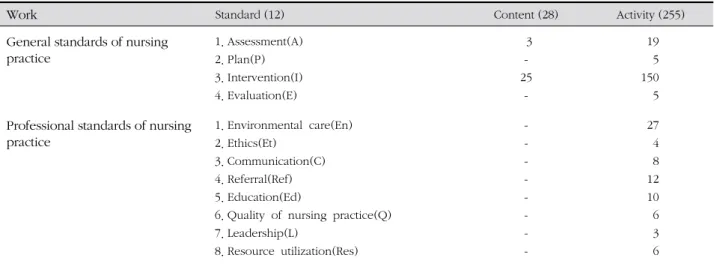
그 과정에서 간호행위 중 ‘환자의 진료비 수납과 관련된 업 무를 돕는다’(CVI=.70), ‘관장을 실시한다’(CVI=.70), ‘환자 권리장전에 대한 정보를 제공한다’(CVI=.60) 등 3개 항목 의 경우 타당도 검정결과가 .80미만인 것으로 나타났지만 다수의 병원에서 실시하고 있는 간호행위 내용으로 판단하 여 최종 간호행위에 포함시키기로 하였다. 이를 바탕으로 최종 간호학 교수 2인의 자문을 얻어 최종 내원유형별 혈액 투석 간호업무 예비표준 수정(안)을 완성하였다(Table 1).
3. 간호업무 예비표준 수정(안)의 내원유형별 분류와 임상 타당도 검정
1) 외래
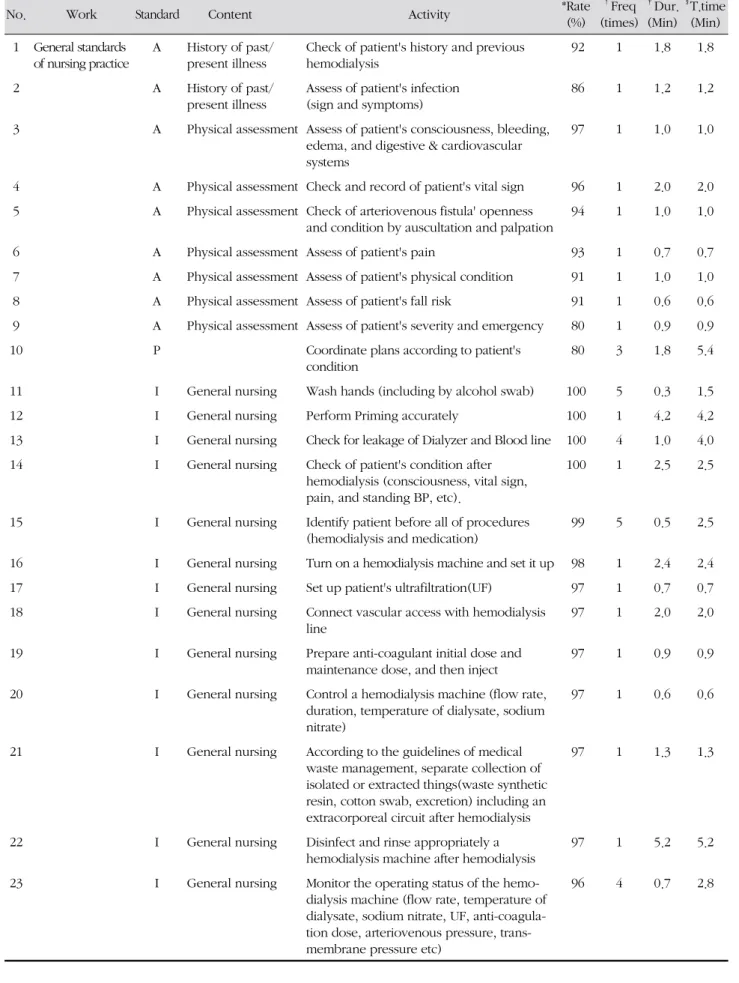
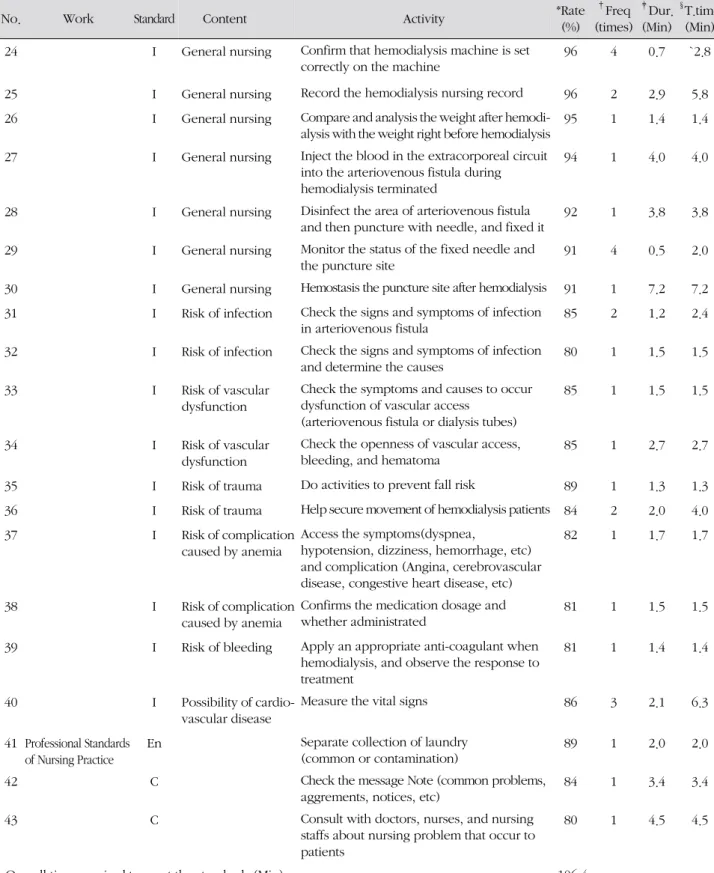
임상타당도 검정 결과, 내원유형이 외래인 경우 5개 표 준, 9개 영역이며, 혈액투석 간호업무 예비표준 수정(안)으 로 제시된 총 255개 간호행위 목록 중 외래환자 혈액투석 1건당 필수로 수행하는 간호행위는 총 43개(16.9%)였다.
이를 바탕으로 최종 개발된 외래환자 혈액투석 간호업무
Table 1. Composition of Standards of Hemodialysis Nursing Practice
Work
Standard (12) Content (28) Activity (255)
General standards of nursing practice
1.
2.
3.
4.
Assessment(A) Plan(P) Intervention(I) Evaluation(E)
3 - 25
-
19 5 150 5
Professional standards of nursingpractice
1.
2.
3.
4.
5.
6.
7.
8.
Environmental care(En) Ethics(Et)
Communication(C) Referral(Ref) Education(Ed)
Quality of nursing practice(Q) Leadership(L)
Resource utilization(Res)
- - - - - - - -
27 4 8 12 10 6 3 6
표준은 Table 2와 같다. 43개 간호행위 중 ‘수행’에 해당하 는 간호행위가 30개로 가장 많았고, ‘사정’에 해당하는 간 호행위가 9개로 그 다음을 차지했다.
연구대상자의 100%가 매 혈액투석 1건당 필수로 수행한 다고 응답한 간호행위는 ‘손을 씻는다(알콜젤을 이용한 손 씻기도 포함)’, ‘Priming을 정확히 수행한다’, ‘Dialyzer와 Blood line의 누출여부를 확인한다’, ‘투석 후 환자 상태를 확인한다(의식상태, 활력징후, Standing BP, 통증 등)’ 총 4 개였으며, 43개 간호행위의 매 혈액투석 1건당 수행빈도와 1회 수행 시 소요시간을 곱하여 총합한 결과, 외래 환자의 매 혈액투석 1건당 간호표준에 해당된 간호행위를 수행하 는 데 총 106.4분 즉 1.77시간이 소요되는 것으로 나타났다.
2) 입원
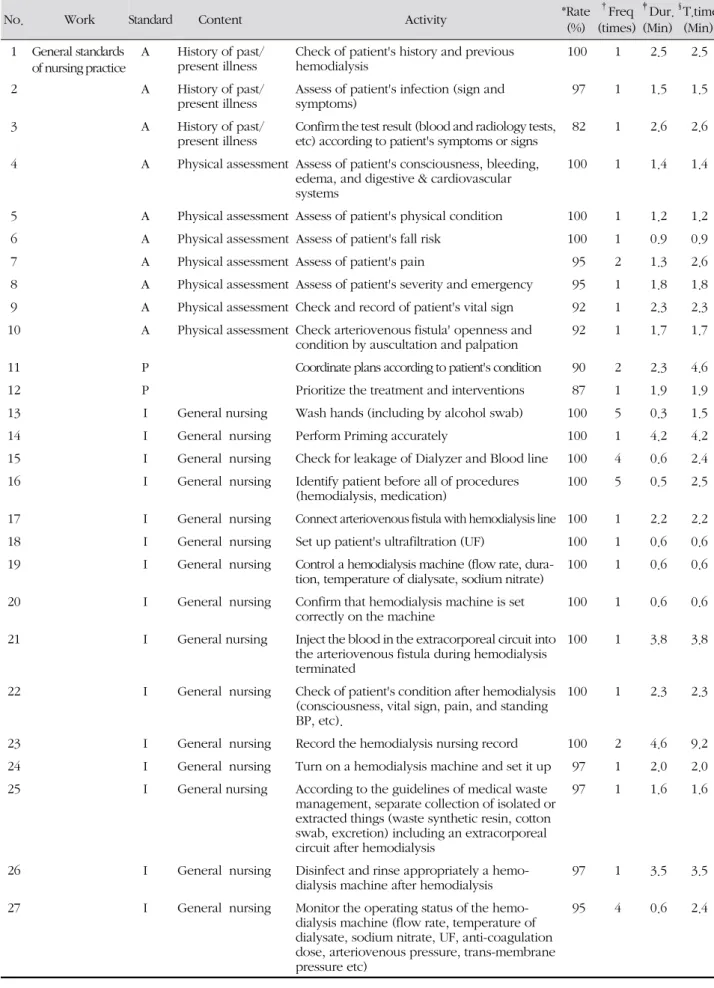
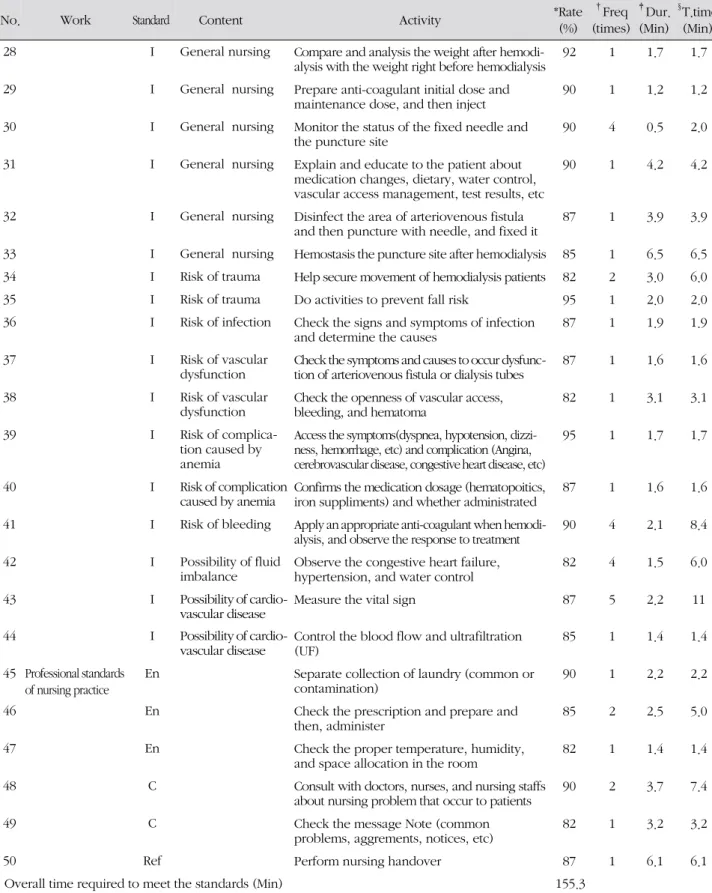
임상타당도 검정결과, 내원 유형이 입원인 경우 6개 표 준, 10개 영역이며, 혈액투석 간호업무 예비표준 수정(안) 으로 제시된 총 255개 간호행위 목록 중 임상에서 입원환 자 혈액투석 1건당 필수로 수행하는 간호행위는 총 50개 (19.6%)였으며, 이를 바탕으로 최종 개발된 입원환자 혈 액투석 간호업무 표준은 Table 3과 같다. 50개 간호행위 중 ‘수행’에 해당하는 간호행위가 32개로 가장 많았고, ‘사 정’에 해당하는 간호행위가 10개로 그 다음을 차지했다.
연구대상자의 100%가 입원환자 매 혈액투석 1건당 필 수로 수행한다고 응답한 간호행위는 ‘투석환자의 병력, 이 전 투석상태를 확인한다’, ‘투석시작 전 환자의 의식상태, 출혈경향, 부종, 소화기계, 순환기계 등을 사정한다’, ‘투 석환자의 현재 상태를 신체검진 한다’, ‘투석환자의 낙상위 험을 사정한다’, ‘손을 씻는다(알콜젤을 이용한 손씻기도
포함)’, ‘Priminig을 정확히 수행한다’, ‘Dialyzer와 Blood line의 누출여부를 확인한다’, ‘모든 시술(투석, 투약) 전 환 자를 확인한다’, ‘혈관통로를 투석회로에 연결한다’, ‘환자 의 초여과량을 설정한다’, ‘투석기계의 작동상태(혈류속도, 투석시간, 투석액온도, 나트륨 등)를 조절한다’, ‘투석처치 가 정확히 기계에 설정되어 있는지 확인한다’, ‘투석 종료 시 체외순환회로내의 혈액을 몸속으로 주입한다’, ‘투석 후 환 자 상태를 확인한다(의식상태, 활력징후, Standing BP, 통증 등)’, ‘혈액투석 임상관찰지(간호기록)를 기록한다’로 총 15 개였다. 50개 간호행위의 매 혈액투석 1건당 수행빈도와 1 회 수행 시 소요시간을 곱하여 총합한 결과, 입원 환자의 매 혈액투석 1건당 간호표준에 해당된 간호행위를 수행하는 데 총 155.3분 즉 2.59시간이 소요되는 것으로 나타났다.
3) 중환자
임상타당도 검정결과, 내원유형이 중환자인 경우 4개 표준, 10개 영역이며, 혈액투석 간호업무 예비표준 수정 (안)으로 제시된 총 255개 간호행위 목록 중 중환자 혈액 투석 1건당 필수로 수행하는 간호행위는 총 39개(15.3%) 였으며, 그 외 연구진의 검토·논의 및 간호학 교수의 자문 을 거쳐 ‘투석환자의 증상에 따라 검사결과(혈액검사와 영 상의학검사 등)를 확인한다’, ‘청진 및 촉진을 통해 환자의 동정맥루의 개방성을 확인하고 혈관상태를 확인한다’, ‘투 석환자의 통증을 사정한다’, ‘천자부위의 상태 및 바늘의 고정상태를 모니터링한다’ 등 4개 항목이 중환자 대상의 혈액투석 간호업무 표준에 추가로 포함되었다. 최종 개발 된 중환자 혈액투석 간호업무 표준은 Table 4와 같다. 43개 간호행위 중 ‘수행’에 해당하는 간호행위가 29개로 가장
Table 2. Final Standards of Hemodialysis Nursing Practice - Out Patient
No. Work Standard Content Activity *Rate
(%)
†Freq (times)
‡Dur.
(Min)
§T.time (Min) 1 General standards
of nursing practice
A History of past/
present illness
Check of patient's history and previous hemodialysis
92 1 1.8 1.8
2 A History of past/
present illness
Assess of patient's infection (sign and symptoms)
86 1 1.2 1.2
3 A Physical assessment Assess of patient's consciousness, bleeding, edema, and digestive & cardiovascular systems
97 1 1.0 1.0
4 A Physical assessment Check and record of patient's vital sign 96 1 2.0 2.0
5 A Physical assessment Check of arteriovenous fistula' openness and condition by auscultation and palpation
94 1 1.0 1.0
6 A Physical assessment Assess of patient's pain 93 1 0.7 0.7
7 A Physical assessment Assess of patient's physical condition 91 1 1.0 1.0
8 A Physical assessment Assess of patient's fall risk 91 1 0.6 0.6
9 A Physical assessment Assess of patient's severity and emergency 80 1 0.9 0.9
10 P Coordinate plans according to patient's
condition
80 3 1.8 5.4
11 I General nursing Wash hands (including by alcohol swab) 100 5 0.3 1.5
12 I General nursing Perform Priming accurately 100 1 4.2 4.2
13 I General nursing Check for leakage of Dialyzer and Blood line 100 4 1.0 4.0
14 I General nursing Check of patient's condition after hemodialysis (consciousness, vital sign, pain, and standing BP, etc).
100 1 2.5 2.5
15 I General nursing Identify patient before all of procedures (hemodialysis and medication)
99 5 0.5 2.5
16 I General nursing Turn on a hemodialysis machine and set it up 98 1 2.4 2.4
17 I General nursing Set up patient's ultrafiltration(UF) 97 1 0.7 0.7
18 I General nursing Connect vascular access with hemodialysis line
97 1 2.0 2.0
19 I General nursing Prepare anti-coagulant initial dose and maintenance dose, and then inject
97 1 0.9 0.9
20 I General nursing Control a hemodialysis machine (flow rate, duration, temperature of dialysate, sodium nitrate)
97 1 0.6 0.6
21 I General nursing According to the guidelines of medical waste management, separate collection of isolated or extracted things(waste synthetic resin, cotton swab, excretion) including an extracorporeal circuit after hemodialysis
97 1 1.3 1.3
22 I General nursing Disinfect and rinse appropriately a hemodialysis machine after hemodialysis
97 1 5.2 5.2
23 I General nursing Monitor the operating status of the hemo- dialysis machine (flow rate, temperature of dialysate, sodium nitrate, UF, anti-coagula- tion dose, arteriovenous pressure, trans- membrane pressure etc)
96 4 0.7 2.8
Table 2. Final Standards of Hemodialysis Nursing Practice - Out Patient (continued)
No. Work Standard Content Activity *Rate
(%)
†Freq (times)
‡Dur.
(Min)
§T.time (Min) 24 I General nursing Confirm that hemodialysis machine is set
correctly on the machine
96 4 0.7 `2.8
25 I General nursing Record the hemodialysis nursing record 96 2 2.9 5.8
26 I General nursing Compare and analysis the weight after hemodi- alysis with the weight right before hemodialysis
95 1 1.4 1.4
27 I General nursing Inject the blood in the extracorporeal circuit into the arteriovenous fistula during hemodialysis terminated
94 1 4.0 4.0
28 I General nursing Disinfect the area of arteriovenous fistula and then puncture with needle, and fixed it
92 1 3.8 3.8
29 I General nursing Monitor the status of the fixed needle and the puncture site
91 4 0.5 2.0
30 I General nursing Hemostasis the puncture site after hemodialysis 91 1 7.2 7.2
31 I Risk of infection Check the signs and symptoms of infection in arteriovenous fistula
85 2 1.2 2.4
32 I Risk of infection Check the signs and symptoms of infection and determine the causes
80 1 1.5 1.5
33 I Risk of vascular
dysfunction
Check the symptoms and causes to occur dysfunction of vascular access
(arteriovenous fistula or dialysis tubes)
85 1 1.5 1.5
34 I Risk of vascular
dysfunction
Check the openness of vascular access, bleeding, and hematoma
85 1 2.7 2.7
35 I Risk of trauma Do activities to prevent fall risk 89 1 1.3 1.3
36 I Risk of trauma Help secure movement of hemodialysis patients 84 2 2.0 4.0
37 I Risk of complication
caused by anemia
Access the symptoms(dyspnea,
hypotension, dizziness, hemorrhage, etc) and complication (Angina, cerebrovascular disease, congestive heart disease, etc)
82 1 1.7 1.7
38 I Risk of complication
caused by anemia
Confirms the medication dosage and whether administrated
81 1 1.5 1.5
39 I Risk of bleeding Apply an appropriate anti-coagulant when hemodialysis, and observe the response to treatment
81 1 1.4 1.4
40 I Possibility of cardio-
vascular disease
Measure the vital signs 86 3 2.1 6.3
41 Professional Standards of Nursing Practice
En Separate collection of laundry
(common or contamination)
89 1 2.0 2.0
42 C Check the message Note (common problems,
aggrements, notices, etc)
84 1 3.4 3.4
43 C Consult with doctors, nurses, and nursing
staffs about nursing problem that occur to patients
80 1 4.5 4.5
Overall time required to meet the standards (Min) 106.4
A=Assessment; P=Plan; I=Intervention; En=Environmental care; C=Communication.
*Rate(%)=Mandatory performing rate of each hemodialysis nursing practice.
†
Freq(Time)=Frequency of performing each hemodialysis nursing practice.
‡
Dur.(Minute)=Duration required to perform one time.
§
T. time(Minute)=Freq×Dur. (Total time performed during hemodialysis).
Table 3. Final Standards of Hemodialysis Nursing Practice - In Patient
No. Work Standard Content Activity *Rate
(%)
†Freq (times)
‡Dur.
(Min)
§T.time (Min) 1 General standards
of nursing practice
A History of past/
present illness Check of patient's history and previous
hemodialysis 100 1 2.5 2.5
2 A History of past/
present illness
Assess of patient's infection (sign and symptoms)
97 1 1.5 1.5
3 A History of past/
present illness Confirm the test result (blood and radiology tests,
etc) according to patient's symptoms or signs 82 1 2.6 2.6 4 A Physical assessment Assess of patient's consciousness, bleeding,
edema, and digestive & cardiovascular systems
100 1 1.4 1.4
5 A Physical assessment Assess of patient's physical condition 100 1 1.2 1.2
6 A Physical assessment Assess of patient's fall risk 100 1 0.9 0.9
7 A Physical assessment Assess of patient's pain 95 2 1.3 2.6
8 A Physical assessment Assess of patient's severity and emergency 95 1 1.8 1.8
9 A Physical assessment Check and record of patient's vital sign 92 1 2.3 2.3
10 A Physical assessment Check arteriovenous fistula' openness and
condition by auscultation and palpation 92 1 1.7 1.7
11 P Coordinate plans according to patient's condition 90 2 2.3 4.6
12 P Prioritize the treatment and interventions 87 1 1.9 1.9
13 I General nursing Wash hands (including by alcohol swab) 100 5 0.3 1.5
14 I General nursing Perform Priming accurately 100 1 4.2 4.2
15 I General nursing Check for leakage of Dialyzer and Blood line 100 4 0.6 2.4
16 I General nursing Identify patient before all of procedures (hemodialysis, medication)
100 5 0.5 2.5
17 I General nursing Connect arteriovenous fistula with hemodialysis line 100 1 2.2 2.2
18 I General nursing Set up patient's ultrafiltration (UF) 100 1 0.6 0.6
19 I General nursing Control a hemodialysis machine (flow rate, dura- tion, temperature of dialysate, sodium nitrate)
100 1 0.6 0.6
20 I General nursing Confirm that hemodialysis machine is set correctly on the machine
100 1 0.6 0.6
21 I General nursing Inject the blood in the extracorporeal circuit into the arteriovenous fistula during hemodialysis terminated
100 1 3.8 3.8
22 I General nursing Check of patient's condition after hemodialysis (consciousness, vital sign, pain, and standing BP, etc).
100 1 2.3 2.3
23 I General nursing Record the hemodialysis nursing record 100 2 4.6 9.2
24 I General nursing Turn on a hemodialysis machine and set it up 97 1 2.0 2.0
25 I General nursing According to the guidelines of medical waste management, separate collection of isolated or extracted things (waste synthetic resin, cotton swab, excretion) including an extracorporeal circuit after hemodialysis
97 1 1.6 1.6
26 I General nursing Disinfect and rinse appropriately a hemo- dialysis machine after hemodialysis
97 1 3.5 3.5
27 I General nursing Monitor the operating status of the hemo- dialysis machine (flow rate, temperature of dialysate, sodium nitrate, UF, anti-coagulation dose, arteriovenous pressure, trans-membrane pressure etc)
95 4 0.6 2.4
Table 3. Final Standards of Hemodialysis Nursing Practice - In Patient (continue)
No. Work Standard Content Activity *Rate
(%)
†Freq (times)
‡Dur.
(Min)
§T.time (Min) 28 I General nursing Compare and analysis the weight after hemodi-
alysis with the weight right before hemodialysis
92 1 1.7 1.7
29 I General nursing Prepare anti-coagulant initial dose and maintenance dose, and then inject
90 1 1.2 1.2
30 I General nursing Monitor the status of the fixed needle and the puncture site
90 4 0.5 2.0
31 I General nursing Explain and educate to the patient about medication changes, dietary, water control, vascular access management, test results, etc
90 1 4.2 4.2
32 I General nursing Disinfect the area of arteriovenous fistula
and then puncture with needle, and fixed it 87 1 3.9 3.9 33 I General nursing Hemostasis the puncture site after hemodialysis 85 1 6.5 6.5
34 I Risk of trauma Help secure movement of hemodialysis patients 82 2 3.0 6.0
35 I Risk of trauma Do activities to prevent fall risk 95 1 2.0 2.0
36 I Risk of infection Check the signs and symptoms of infection
and determine the causes 87 1 1.9 1.9
37 I Risk of vascular
dysfunction
Check the symptoms and causes to occur dysfunc- tion of arteriovenous fistula or dialysis tubes
87 1 1.6 1.6
38 I Risk of vascular
dysfunction Check the openness of vascular access,
bleeding, and hematoma 82 1 3.1 3.1
39 I Risk of complica-
tion caused by anemia
Access the symptoms(dyspnea, hypotension, dizzi- ness, hemorrhage, etc) and complication (Angina, cerebrovascular disease, congestive heart disease, etc)
95 1 1.7 1.7
40 I Risk of complication
caused by anemia Confirms the medication dosage (hematopoitics,
iron suppliments) and whether administrated 87 1 1.6 1.6 41 I Risk of bleeding Apply an appropriate anti-coagulant when hemodi-
alysis, and observe the response to treatment
90 4 2.1 8.4
42 I Possibility of fluid
imbalance Observe the congestive heart failure,
hypertension, and water control 82 4 1.5 6.0
43 I Possibility of cardio-
vascular disease Measure the vital sign 87 5 2.2 11
44 I Possibility of cardio-
vascular disease Control the blood flow and ultrafiltration (UF)
85 1 1.4 1.4
45 Professional standards of nursing practice
En Separate collection of laundry (common or contamination)
90 1 2.2 2.2
46 En Check the prescription and prepare and
then, administer
85 2 2.5 5.0
47 En Check the proper temperature, humidity,
and space allocation in the room
82 1 1.4 1.4
48 C Consult with doctors, nurses, and nursing staffs
about nursing problem that occur to patients
90 2 3.7 7.4
49 C Check the message Note (common
problems, aggrements, notices, etc) 82 1 3.2 3.2
50 Ref Perform nursing handover 87 1 6.1 6.1
Overall time required to meet the standards (Min) 155.3
A=Assessment; P=Plan; I=Intervention; En=Environmental care; C=Communication; Ref=Referral.
*Rate (%)=Mandatory performing rate of each hemodialysis nursing practice
†
Freq (Time)=Frequency of performing each hemodialysis nursing practice
‡
Dur. (Minute)=Duration required to perform one time
§
T. time (Minute)=Freq × Dur. (Total time performed during hemodialysis)
Table 4. Final Standards of Hemodialysis Nursing Practice - Critical Patient
No. Work Standard Content Activity *Rate
(%)
†Freq (times)
‡Dur.
(Min)
§T.time (Min) 1 General standards
of nursing practice
A History of past/
present illness
Check of patient's history and previous hemodialysis
100 1 3.5 3.5
2 A History of past/
present illness
Assess of patient's infection (sign and symptoms) 100 1 3.0 3.0
3 A History of past/
present illness
Confirm the test result (blood and radiology tests, etc) according to patient's symptoms or signs
71 1 4.8 4.8
4 A Physical assessment Check and record of patient's vital sign 86 1 2.8 2.8
5 A Physical assessment Assess of patient's consciousness, bleeding, edema, and digestive & cardiovascular systems
86 1 2.5 2.5
6 A Physical assessment Assess of patient's physical condition 86 1 2.0 2.0
7 A Physical assessment Assess of patient's fall risk 86 1 1.8 1.8
8 A Physical assessment Check arteriovenous fistula' openness and condition by auscultation and palpation
71 1 3.5 3.5
9 A Physical assessment Assess of patient's pain 71 2 3.3 6.6
10 I General nursing Monitor the puncture site and the status of the fixed needle
71 4 0.6 2.4
11 I General nursing Turn on a hemodialysis machine and set it up 100 1 2.5 2.5
12 I General nursing Wash hands (including by alcohol swab) 100 5 0.3 1.5
13 I General nursing Perform Priming accurately 100 1 3.9 3.9
14 I General nursing Check for leakage of Dialyzer and Blood line 100 4 1.1 4.4
15 I General nursing Identify patient before all of procedure, hemodialysis and medication
100 4 0.5 2.0
16 I General nursing In case of temporary arteriovenous shunt, check openness and disinfect connect area
100 1 5.0 5.0
17 I General nursing Connect vascular access with hemodialysis line 100 1 2.2 2.2 18 I General nursing Prepare and inject anti-coagulation initial
dose and maintenance dose
100 1 1.1 1.1
19 I General nursing Set up patient's ultrafiltration(UF) 100 1 1.0 1.0
20 I General nursing Control a hemodialysis machine (flow rate, duration, temperature of dialysate, sodium nitrate)
100 1 0.9 0.9
21 I General nursing Confirm that hemodialysis treatment is set correctly on the machine
100 1 0.5 0.5
22 I General nursing Monitor the operating status of the hemo- dialysis machine (flow rate, temperature, sodium nitrate, UF, anti-coagulation dose, arteriovenous pressure, trans-membrane pressure etc)
100 4 0.8 3.2
23 I General nursing Inject the blood in the extracorporeal circuit into the arteriovenous fistula during hemodialysis terminated
100 1 3.7 3.7
24 I General nursing Check of patient's condition after hemodialysis (consciousness, vital sign, pain, and standing BP, etc).
100 1 4.1 4.1
25 I General nursing Record the hemodialysis nursing record 100 1 4.6 4.6
Table 4. Final Standards of Hemodialysis Nursing Practice - Critical Patient (continued)
No. Work Standard Content Activity *Rate
(%)
†Freq (times)
‡Dur.
(Min)
§T.time (Min) 26
I
General nursing According to the guidelines of medical wastemanagement, separate collection of isolated or extracted things (waste synthetic resin, cotton swab, excretion) including an extracorporeal circuit after hemodialysis
100 1 2.7 2.7
27
I
General nursing Disinfect and rinse appropriately a hemodialysis machine after hemodialysis100 1 3.1 3.1
28
I
General nursing Disinfect the area of arteriovenous fistula and then puncture with needle, and fixed it86 1 2.7 2.7
29
I
Risk of infection Check signs and symptoms of infection in arteriovenous fistula86 1 2.2 2.2
30
I
Risk of trauma Help secure movement of hemodialysis patients100 2 3.5 7.0
31
I
Risk of trauma Do activities to prevent fall risk100 1 1.3 1.3
32
I
Lack of knowledgerelated on hemodialysis
Check whether the implementation of the prescribed treatment plans
86 1 2.6 2.6
33
I
Risk of bleeding Apply an appropriate anti-coagulant when hemodialysis, and observe the response to treatment86 1 2.6 2.6
34
I
Risk of hypertension Perform the medication education (antihy- pertensive drug) and evaluate blood pressure on the dialysis days and non-dialysis days86 1 2.9 2.9
35
I
Lack of knowledgerelated on glycemic control
Check the lab test result(blood glucose, HbA1C, etc)
86 1 2.4 2.4
36
I
Possibility of fluidimbalance
Observe the congestive heart failure, hypertension, and water control
86 1 1.5 1.5
37
I
Possibility of cardio-vascular disease
Measure the vital sign
86 3 1.6 4.8
38
I
Possibility of cardio-vascular disease
Control the blood flow and ultrafiltration (UF)
86 1 1.7 1.7
39 Professional standards of nursing practice
En
Check the prescription and prepare andthen, administer
86 2 4.0 8.0
40
En
Separate collection of laundry(common or contamination)
86 1 3.3 3.3
41
En
Prevent the adjustable noise(alarm, mobile phone, limit visitors, etc)
86 1 1.4 1.4
42
En
Clean overbed table, nursing cart with anappropriate disinfectant, and arrange around beds for the environmental management of the hemodialysis room
86 1 10.9 10.9
43
C
Consult with doctors, nurses, and nursingstaffs about nursing problem that occur to patients
86 2 3.8 7.6
Overall time required to meet the standards (Min)
137.2 A=Assessment; I=Intervention; En=Environmental care; C=Communication.
*Rate(%)=Mandatory performing rate of each hemodialysis nursing practice.
†
Freq(Time)=Frequency of performing each hemodialysis nursing practice.
‡
Dur.(Minute)=Duration required to perform one time.
§