淸營金飮이 자유산소라디칼과 염증매개인자에 미치는 영향
김승태#․이부균#․우원홍1․김형우․이영철2․이정복3․이장천*
부산대학교 한의학전문대학원, 1 : 원광대학교 한의과대학 해부학교실, 2 : 상지대학교 한의과대학 본초학교실, 3 : 소니메디
Anti-inflammatory Effects of New Herbal Formula Cheongyeoungkeumyeum
Seung Tae Kim#, Boo Kyun Lee#, Won Hong Woo1, Young Cheol Lee2, Jung Bok Lee3, Jang Cheon Lee*
School of Korean Medicine, Pusan National University, 1 : Department of Anatomy, Wonkwang University, 2 : Department of Herbology, College of Oriental Medicine, Sangji University, 3 : Sonimedi Co. Wonju City
The purpose of this study is to verify the anti-inflammatory effectiveness of Cheongyeoungkeumyeum(CYK) including seven herbal medicines of that major effectiveness is to clear heat, to relieve fire toxicity and to clear damp-heat. To evaluate anti-inflammatory effectiveness of CYK, we measured the production of reactive oxygen species(ROS), nitric oxide(NO) cyclooxygenase-2(COX-2) and in TNF-α LPS-activated Raw 264.7 cells. Cell viability was determined by MTT assay. The concentrations of ROS and relative level of NO were measured with DPPH assay and Griess reagent, respectively. COX-2 and TNF-α were detected by enzyme immuno assay(EIA) and enzyme-linked immunosorbent assay(ELISA). As a result, we found that CYK suppressed LPS-induced ROS and NO production in a dose-dependent manner. Also CYK significantly inhibited LPS-induced COX-2 activity and the release of TNF-α.
These results indicate that the CYK may have an anti-inflammatory agent for the treatment of various inflammatory disease.
Key words : Cheongyeoungkeumyeum(CYK), ROS, NO, COX-2, TNF-α, LPS, Raw 264.7
* 교신저자 : 이장천, 양산시 물금읍 범어리 부산대학교 한의학전문대학원
․E-mail : [email protected], ․Tel : 051-510-8459
․접수 : 2012/03/16 ․수정 : 2012/04/13 ․채택 : 2012/04/18
# Both authors contributed equally to this work
서 론
선천성 면역반응을 담당하는 대식세포는 외인성 세균, 바이 러스 등의 식균작용과 함께 염증매개물질들을 분비하는 역할을 한다. 대식세포의 염증매개 물질로는 arachidonic acid(AA) cascade metabolites인 prostaglandins, leukotriens, 대식세포에서 분비하는 cytokines인 Tumor necrosis factor-α(TNF-ɑ), 산화질소, 자유산소라디칼(Reactive Oxygen Species; ROS)등이 알려져 있으 며 류마티스 관절염, 천식, 아토피 등 염증성 질환에 관여한다.
1897년 아스피린 (acetylsalicylic acid)이 출시된 이래 40여종 이상 의 소염진통제들이 개발 되었으나, 위장관합병증, 심혈관계 안전 성의 문제가 대두되고 있고1), 이에 대한 대안으로 플라보노이드 계통의 천연물질이 COX-2를 억제하는 효과가 있는 것으로 보고
되고 있다2). Cyclooxygenase (COX) 는 두가지 아형 (isoform)인 COX-1, COX-2가 존재하며3) lipoxigenase와 함께 AA로부터 prostaglandins와 leukotriens 생성에 관여한다. 비 선택성 소염진 통제 (non-selective NSAID)들은 생리작용을 담당하는 COX-1의 억제로 위․장관합병증 등을 유발하여 선택적 소염진통제 (COX-2 selective NSAID) 개발의 가설을 제공하게 되었다4).
집먼지진드기, 꽃가루등 외인적 요인에 의한 IL-4, IL-5, IL-13 등의 cytokines 증가는 B cell을 활성화 시키며, IgE 과량생 산과 mast cell의 histamine 분비를 유도한다5,6). Histamine 분비 는 피부 가려움증을 유발할 뿐만 아니라 피부장벽을 손상시켜 염증을 일으키는 물리적 요인을 제공한다. 염증반응에서의 nuclear factor kappa B(NF-κB)의 활성은 iNOS 와 COX-2를 활 성화 시켜 산화질소(NO)와 AA 대사산물을 유리시키는 주요한 원인이기도 하다7). ROS와 TNF-α와 같은 염증성 사이토카인은 I κb kinase(IKK)를 활성화시키고, 그 결과로 NF-κB를 활성화시키 는 연속된 과정이다. 그러므로, ROS와 TNF-α의 생성 억제는 염 증의 생성을 방지하는 주요 표적이다8).
淸營金飮(이하 ‘CYK’라 함)은 『溫病條辨』의 淸營湯方과 銀翹散方의 주요 구성약물인 金銀花, 連翹, 竹葉, 牛蒡子에 白鮮 皮, 桑白皮, 甘草를 선정하여 재구성하였으며, 본 연구에서는
CYK의 약리적 특성을 알아보기 위하여
1,1-diphenyl-2-picryl-hydrazyl (DPPH)를 이용한 항산화력, NO, COX-2, TNF-ɑ 등의 염증관련 매개인자들에 대한 억제 효과를 조사하였다.
재료 및 방법
1. 약물의 추출 및 제조
CYK의 구성약물인 牛蒡子, 白鮮皮, 金銀花, 桑白皮, 竹葉, 連翹, 甘草를 Table 1을 기준으로 10배인 840 g을 세절하여 추출 용매 (증류수:1,에탄올 = 7:3)를 8.400 ml 첨가하고 실온에서 초음 파추출기 (SM35-EP, 소니메디)로 4시간 동안 추출 하였다. 1 내 지 50 마이크로미터 크기의 카트리지 (cartrige)형 전처리 여과기 를 통과시킨 후 분획분자량이 10,000달톤인 고분자로 이루어진 한외여과막으로 여과하여 최종 추출물을 얻었다. 이를 rotary vacuum evaporator를 이용해 용매를 전부 제거 한 후, 건조분말 24 g(수율 2.86%)을 만들어 실험에 사용하였다.
Table 1. Composition and Contents of Cheongyeoungkeumyeum (CYK)
Korean name Composition Pharmaceutical name 억제효과 우방자 18 g Arctii Fructus LTC4, LTD4, LTE4
금은화 15 g Lonicerae Flos ERK1/2, PI3K
백선피 12 g Dictamni Radicis
Cortex Histamin, LTB4, iNOS, COX-2
상백피 12 g Morus Cortex IL-4,IL-5, IL-13
죽엽 12 g Phyllostachys Folium IL-2, antioxidant 감초 9 g Glycyrrhizae Radix iNOS, COX-2, p38,
ERK1/2 연교 6 g Forsythiae Fructus Antioxidant LTC4(Leukotrien C4), LTD4(Leukotrien D4), LTE4(Leukotrien E4), LTB4(Leukotrien B4), PI3K(Phosphatidylinositol 3-kinase), ERK1/2(Extracellular-signal-regulated kinase 1/2) 2. 세포배양
쥐의 대식세포주인 RAW 264.7 세포는 ATCC로부터 구입하 였으며 10 % inactivated fetal bovine serum (GIBCO) 과 1%
penicillin․streptomycin이 포함된 Dulbecco's Modified Eagle's Medium (DMEM, GIBCO)을 배양액으로 37 ℃에서 5 % CO2조 건에서 배양하였다.
3. 세포 생존율
Raw 264.7 세포를 96 well plate에 well 당 1 x 10⁴개로 분주 하고 24시간 동안 배양한 후 10, 50, 100 ug/ml 농도로 각 시료 들을 처리하여 48 시간동안 배양하였다. 배양액을 흡입하여 제거 한 다음 PBS로 1회 세척하고, MTT 용액을 0.5 mg/ml의 농도로 100 ul 씩 세포에 첨가하여 4 시간동안 37 ℃, 5% CO2에서 배양 하였다. 배양액을 흡입하여 제거한 다음 DMSO( Sigma, 200 ul) 를 첨가하고 shaker에서 10분간 흔들어 준 후 ELISA reader로 540 nm에서 흡광도를 측정하였다9). 세포독성평가는 다음 공식
으로 계산되었다.
Cell viability(%) = AT/AC x 100, AC-absorbance of control, AT-absorbance of tested extract solution.
4. DPPH에 의한 자유산소라디칼(ROS) 소거능 평가
자유산소라디칼 소거능 평가법은 Blois의 방법10)에 준하여 실시하였다. 시료를 96 well plate의 각 well에 100 ul씩 넣고 0.1 mM DPPH( Sigma) 용액을 100 ul 씩 첨가한 다음 37 ℃에서 30 분간 방치한 후 ELISA reader(BioRad iMavK)를 이용해 540 nm 에서 흡광도를 측정하였다. 자유산소라디칼 소거능은 다음 공식 으로 계산하였다.
DPPH radical scavenging activity(%) = [(AB-AT)/AB] x 100, AB-absorbance of blank sample, AT- absorbance of tested extract solution.
5. Nitric oxide (NO) 측정
약재 처리하기 전날 24 well plate에 5 x 10⁵ /well 정도로 분주하고 다음날 오전에 배지를 serum free media로 교체한 후 약 8시간 영양을 중단시켰다. 배양 배지를 제거한 후 fresh serum free media 500 ul/well을 넣고 약재를 농도별로 가한 후 Lipopolysaccharides(LPS, Sigma) stock solution (100 ug/ml)을 2.5 ul/well 처리해주고 16시간 배양하였다. 배양액 상층액을 96 well plate에 100 ul를 옮기고 동량의 Griess reagent(Sigma)100 ul를 가하고 30 분간 상온에서 배양한 다음 발색의 정도를 microplate reader의 540 nm에서 흡광도 측정하였다. 세포배양 액 내 NO의 농도(uM)는 NaNO2표준액의 정량곡선을 기준으로 계산하였다.
6. Cyclooxygenase-2 (COX-2) 측정
Amersham Prostaglandin E2 Biotrak EIA Kit (Amersham Cat No. RPN222)를 이용하여 COX-2의 양을 측정하였다.
sheep-anti-mouse로 전처리 되어있는 plate에 순차적으로 희석하 여 제조된 PGE2를 ml당 50, 100, 200, 400, 800, 1600, 3200 pg로 표준용액과 와 18h LPS로 처리된 배지를 각각 50 ul씩 loadig 하 였다. 희석된 mouse-anti-PGE2 50 ul, HRP-conjugate buffer 50 ul를 추가로 loading후 1시간 배양하였다. 세척후 기질(TMB sol) 에 30분간 배양하였고 정지용액(Stop sol)을 가한후 30분이내에 ELISA reader 450 nm에서 측정하였다.
7. Tumor necrosis factor-alpha (TNF-α) 측정
Diasource TNF-α ELISA Kit (Diasource Cat No. CMC3013) protocol에 따라 측정하였다. LPS 처치 후 18시간후 배지를 200 ul 취하여 incubation buffer 50 ul과 함께 Antibody가 코팅되어 있는 96well plate에서 상온에서 2시간 반응시켰다. 그런다음 anti-TNF-a-HRP 1시간 처리하였다. 세척후 기질용액 (TMB sol) 100 ul를 처리한 후 20분간 암소에서 배양하였고 정지용액(Stop
sol.)을 100 ul 처리해 주고 상온에서 30분 이내로 배양한 후 ELISA reader 450 nm에서 측정하였다.
8. 통계처리
모든 측정 결과는 3회 반복의 독립적인 실험에서 도출된 대 표값의 평균(mean)과 표준편차(S.D.)로 나타내었다. 각 실험군 간의 차이는 Graph Pad Prism program 의 Student t-test 를 수 행하여 p값이 0.05 이하인 경우를 유의성이 있는 것으로 판정하 였다.
결 과
1.세포 생존율에 미치는 영향
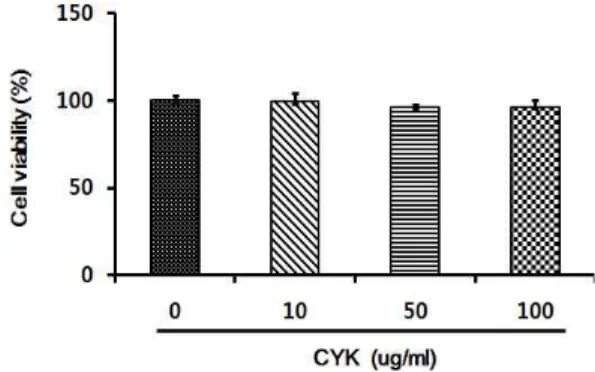
CYK에 의한 RAW 264.7 세포의 ROS 및 NO 생성감소가 세 포독성에 기인한 것인지를 알아보기 위하여 10, 50, 100 ug/ml로 처리하고 24시간 후 MTT assay를 실시하여 세포생존율을 측정 하였다. 실험결과 대조군에 비하여 99±4.6 % (10 ug/ml), 96±1.7
% (25 ug/ml), 96± 4 % (50 ug/ml)의 세포 생존율을 나타내었 다(Fig. 1).
Fig. 1. Effect of CYK on viability of RAW 264.7 macrophage. RAW 264.7 cells were treated with CYK and the cells were further incubated for 48 hr.
Each bar represents the mean ± S.D. from three independent experiments and shown as percentage cell viability compared with the untreated control cells.
Fig. 2. Effect of CYK on LPS-induced reactive oxygen species production in RAW 264.7 macrophage. Each bar represents the mean±
S.D. from three independent experiments and asterisks indicate significantly different from treatment with LPS alone (*: P< 0.05, **: P< 0.01 vs LPS alone)
2. RAW 264.7 세포의 ROS 생성에 미치는 영향
LPS로 유도된 Raw 264.7 세포에서 ROS 생성정도를 측정하
기 위하여 CYK 10, 50, 100 ug/ml의 농도로 처리하여 생성되는 ROS양을 측정하였다. LPS 군에서는 control 군에 비교하여 유의 성 있게 증가하였으며, CYK 처리군에서 88 % (10 ug/ml), 73%
(50 ug/ml), 51% (100 ug/ml) ROS 생성을 억제하였다(Fig. 2).
3. NO 생성에 미치는 영향
CYK의 10, 50, 100 ug/ml을 처리한 Raw 264.7 세포에서 NO 생성억제 효과를 살펴본 결과 27% (10 ug/ml), 38% (50 ug/ml) 및 42% (100 ug/ml)의 억제효과를 나타내었다(Fig. 3).
Fig. 3. Effect of CYK on LPS-induced nitric oxides production in RAW 264.7 macrophages.RAW 264.7 cells were treated with CYK and the cells were further incubated for 16 hr. The concentration of nitric oxide in culture medium were measured as described in the methods section. Each bar represents the mean ±S.D. from three independent experiments and asterisks indicate significantly different from treatment with LPS alone (*: P< 0.05, **: P< 0.01, ***: P<
0.001 vs LPS alone)
4. COX-2 억제에 미치는 영향
Arachidonic acid cascade에서 prostanglandin 등 염증매개 인자를 생성하는 주요 인자인 COX-2에 대한 CYK의 효과를 살 펴보았다. 그 결과 LPS에 의해 유도된 COX-2의 증가를 CYK의 처치에 의해 67% (10 ug/ml), 72% (50 ug/ml) 및 76% (100 ug/ml)로 나타났다(Fig. 4).
Fig. 4. Effect of CYK on COX-2 activity in LPS-induced RAW 264.7 macrophages.The activity of COX-2 were measured at 18 hr after treatment of cells with or without CYK. Each bar represents the mean ± S.D. from three independent experiments and asterisks indicate significantly different from treatment with LPS alone (*: P< 0.05, **: P< 0.01 vs LPS alone)
5. TNF-α 생성에 미치는 영향
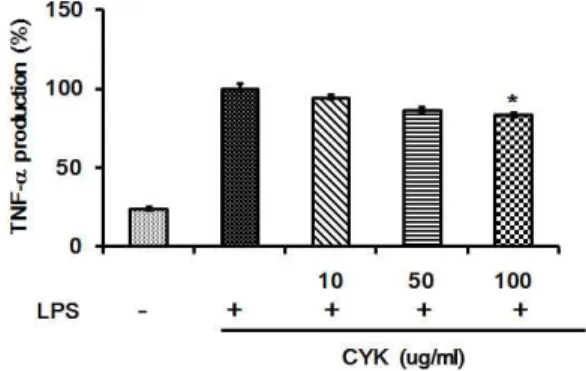
LPS에 의해 유도된 TNF-α는 CYK 100 ug/ml 농도에서만
유의성 있는 억제활성을 나타내었다(Fig. 5).
Fig. 5. Effect of CYK on TNF-a release in LPS-induced RAW 264.7 macrophages.Production of TNF-a was measured in the medium of Raw 246.7 cells cultured with or without CYK. Each bar represents the mean ± S.D. from three independent experiments and asterisks indicate significantly different from treatment with LPS alone (*: P< 0.05 vs LPS alone)
고 찰
淸營金飮(CYK)은 『溫病條辨』의 營分溫熱증을 치료하는 淸營湯方과 太陰溫病을 치료하는 銀翹散方의 주요 구성약물 중 항산화 및 항염증 효과가 기대되는 竹葉, 金銀花, 連翹, 牛蒡子와 이와 함께 임상에서 아토피성 피부질환에 응용되고 있는 白鮮皮, 桑白皮와 甘草를 가하여 재구성한 처방이다.
牛蒡子(Arctii Fructus)는 leukotrienes의 LTC4, LTD4, LTE4 를 억제하며11), 부탄올 추출물은 Th2 cytokine인 IL-4, IL-5를 억제 하는 기능이 있으며, 또한 extracellular-signal-regulated kinases (ERK 1/2)와 nuclear factor (NF)-κB를 억제시키고 있다12.
白鮮皮(Dictamni Radicis Cortex)은 활성물질인 Coumarins, 플라보노이드를 많이 함유하고 있다. 플라보노이드계 물질인 Fraxinellone은 가려움을 유도하는 histamine과 LTB4, LTE4을 포함하여 iNOS, COX-2에 대하여도 강한 억제력을 가지고 있다.
이는 전사인자인 NF-κB의 활성에 관여하는 IKK과 ERK1/2의 활 성을 억제하기 때문이다13).
甘草(Glycyrrhizae Radix)는 콩과에 속한 다년생 초본생이며 triterpenoid saponin인 glycyrrhizin, isoliquiritin을 함유하고 있 으며 補脾益氣, 淸熱解毒, 潤肺止咳, 緩急止痛의 효능으로 이미 아토피 치료에 널리 활용되고 있다14). 최근 isoliquiritin에서 당을 제거한 Isoliquiritigenin은 iNOS, COX-2에 대한 강한 활성 억제 능력을 가지고 있다15).
金銀花(Lonicerae Flos)는 인동과에 속한 다년생 반상록 덩 굴성 관목인 인동(Lonicera japonica) 또는 그 변종의 꽃봉오리를 건조한 것으로, 淸熱解毒, 風熱解毒이 알려져 있고, 염증매개인 자의 억제에 의한 아토피성 피부염 효과가 보고되었으며16) 플라 보노이드, iridoid 유도체들, 사포닌 및 기타 유기산이 주요 활성 물질로 간주되고 있으며17), ERK1/2, Phosphatidylinositol 3-kinases (PI3Ks) 신호전달의 활성을 억제하고 있다18).
桑白皮( Morus Cortex)는 prenylated 플라보노이드와 벤조 퓨란계통의 활성물질을 포함하고 있다19). 외인성 항원에 의하여
활성화된 Th2 cytokines인 IL-4 과 IL-5등을 억제하는데, 아토피 성 염증을 완화시키는데 유용한 자원이 되고 있다20).
連翹(Forsythiae Fructus)는 개나리 종류의 열매를 말린 것인 데, 寒熱·發熱· 화농성질환·림프선염·소변불리·종기·신장염·습진 등에 처방한다. 연교의 Arctigenin은 AA의 대사산물과 ROS의 제거능을 가지고 있다21).
竹葉(Phyllostachys Folium)은 chlorogenic acid, caffeic acid, luteolin 7-glucoside이 자유산소라디칼을 억제하는 항산화력을 가지고 있으며22) IL-12을 억제하는 능력도 가지고 있다23).
본 실험에서는 가려움증을 동반한 아토피피부염에 효과가 관찰된 CYK 한약구성물이 Raw 264.7 세포에서 염증성 매개 인 자들에 어떤 영향을 미치는지 살펴보았다. CYK 처치 후 ROS의 억제 활성을 확인한 결과 10, 50, 100 ug/ml 에서 농도 의존적 활성이 관찰되었다. 생성감소가 세포독성에 기인한 것인지를 알 아보기 위한 MTT assay에서 세포 생존율이 감소하지 않아, CYK의 항산화 및 NO생성 억제 효과는 세포독성에 기인하지 않 은 것으로 생각되었다. 과량의 ROS생성은 노화24), 암생성 및 전 이25), 뇌혈관질환, 아토피 천식을 포함하여 중요 질환에 관여하 고 있음이 널리 알려져 있고, 특히 염증반응에 있어서 NO 생성 과 함께 중요한 역할을 담당하고 있다26).
ROS는 외부항원, xenobiotics 혹은 TNF-α와 같은 염증매개 인자에 의해 유도가 되며 superoxide dismutase(SOD)에 의해 과 산화수소(H2O2)로 변환되며, catalase, glutathione peroxidase, peroxiredoxin 등에 의해 물(H2O)로 전환되어 라디칼이 소거된
다. 또한 생성된 과산화수소는 산화철 등에 의해
hydroxyperoxide가 형성되면 DNA, protein, lipid 등에 산화적 손상을 입히게 된다27). 이는 아토피관련 질환과 무관하지 않다.
아토피 천식 동물모델에서 ROS가 많이 증가되어 있으며, 이에 따라 α-Lipoic acid28), N-acetyl cysteine과 같은 항산화제 투여만 으로도 천식을 경감 효과를 보여주고 있다. 이는 항산화제가 아 토피 억제 효과를 보여주는 것으로 항산화제가 ROS에 의한 활 성화된 NF-kB를 억제하는 것과 관련이 있다29).
NO의 대사에는 NADPH 의존적 효소인 endothelial NOS (eNOS), neuronal NOS(nNOS) 및 inducible NOS (iNOS) 등이 관여하는데 특히 iNOS는 염증자극에 있어서 지속적으로 생성되 는 것으로 알려져 있다30). 세균 등의 외인성 인자의 침입에 의해 macrophage에서의 TNF-α, INF-γ 등의 생성은 iNOS를 유도하게 된다31). NO의 생성억제 효과가 관찰된 CYK가 대식세포와 활막 세포등 염증관련세포에서 AA cascade에 관여하는 지를 확인하 기 위하여 COX-2의 발현을 EIA방법을 이용하여 실험하였다.
AA cascade의 과정에는 COX-1, COX-2, 5-lipoxygenase등의 효 소들이 염증매개 지질들인 prostaglandin 및 leukotrien 합성에 관여한다32). 특히 아토피성 피부염의 경우 staphylococcus, 집먼 지 진드기 등 외인성인자에 의해 protease activated receptor-2 (PAR-2)가 활성화되고 이에 따라 피부의 ceramide 장벽이 붕괴 된다33). 피부장벽의 붕괴로 Th1과 Th2 면역조절의 불균형을 유 발하게 되며 이 과정에서 ceramide 유도체들이 AA cascade과정 을 거쳐서 염증매개 인자인 prosglandins과 leukotrienes등을 생
성하게 된다. 본실험에서의 LPS 처치에 따라 증가된 COX-2는 CYK 처치에 따라 농도 의존적으로 감소하는 경향이 나타나는 것을 확인하였다.
아토피성 피부염은 helper T 세포의 autoimmunity (Th1)의 TNF-α, INF-γ 와 humoral immunity (Th2)의 IL-4, IL-5, IL-13 등 cytokine들의 불균형에 기인하는데 , IL-4 등은 IgE와 histamine 을 증가시켜 가려움증을 유발하는 원인이 되고 있다34). 우방자와 상백피는 과하게 유리되고 있는 IL-4, IL-5, IL-13에 대한 억제력 을 가지고 있다. TNF-α는 ROS를 포함하여 염증을 매개하기도 하며, 피부장벽의 보호물질인 ceramide를 생성하는데도 중요한 역할을 한다.
LPS에 의해 유도된 TNF-α 는 CYK에 100 ug/ml에서 억제 효과를 보여주었고, ROS, NO, COX-2의 억제 효과는 비교적 농 도 의존적으로 활성억제를 보여주고 있다. 이로써 한방구성물인 CYK가 ROS를 제거하는 항산화력과 염증매개인자들에 대하여 억제효과가 있음을 확인하였다.
결 론
임상에서 아토피성 피부염을 경감시킬 수 있는 항산화 및 항염증에 유효한 것으로 보고된 약재를 선정하여 재구성한 淸營 金飮의 약리적 특성을 알아보기 위하여 DPPH를 이용한 항산화 력, NO, COX-2, TNF-ɑ 등의 염증관련 매개인자들에 대한 억제 효과를 조사하여 다음과 같은 결론을 얻었다.
淸營金飮은 LPS로 유도된 Raw 264.7 세포에서 ROS의 생성 을 농도 의존적으로 각 각 88 % (10 ug/ml), 73% (50 ug/ml), 51% (100 ug/ml)로 유의성있게 억제하였다. 淸營金飮은 264.7 세포에서 NO 생성을 농도 의존적으로 각 각 27% (10 ug/ml), 38% (50 ug/ml) 및 42% (100 ug/ml)로 유의성있게 억제하였다.
淸營金飮은 LPS에 의해 유도된 COX-2를 농도 의존적으로 각 각 67% (10 ug/ml), 72% (50 ug/ml) 및 76% (100 ug/ml)로 억제하 였다. 淸營金飮은 LPS에 의해 유도된 TNF-α를 100 ug/ml 농도 에서만 억제하였다.
이상의 결과로 부터 淸營金飮은 항산화와 항염증에 유의성 있는 결과를 보임으로 이를 응용한 임상제제의 활용에 도움이 될 것으로 사료된다.
감사의 글
이 논문은 부산대학교 자유과제 학술연구비(2년)에 의하여 연구되었음
참고문헌
1. Wolfe, M.M., Lichtenstein, D.R., Singh, G. Gastroinstestinal toxicity of nonsteroidal antiflammatory drugs. N Engl J Med 340: 1888-1899, 1999.
2. O'Leary, K.A., de Pascual-Tereasa, S., Needs, P.W., Bao,
Y.P., O'Brien, N.M., Williamson, G. Effect of flavonoids and Vitamin E on cyclooxygenase-2 (COX-2) transcription.
Mutat Res 551: 245-254, 2004.
3. Kujubu, D.A., Fletcher, B.S., Varmum, B.C., Lim, R.W., Herschman, H.R. TIS10, a phorbol ester tumor promoter-inducible mRNA from Swiss 3T3 cells, encodes a novel prostaglandin synthase/cyclooxygenase homologue. J biol chem. 266: 12866-12872, 1991.
4. Capone, ml, Tacconelli, S., Di Francesco, L., Sacchetti, A., Sciulli, M.G., Patrignani, P. Pharmacodynamic of cyclooxygenase inhibitors in humans. Prostaglandins Other Lipid Mediat. 82: 85-94, 2007.
5. Barland, C.O., Aettersten, E., Brown, B.S. Imiquimod induced interleukin-1 alpha stimualtion improves barrier homeostasis in aged murine epidermis. J Invest Dermatol.
122: 330-336, 2004.
6. Heinzmann, A., Daser, A. Mouse models for the genetic dissection of atopy. Int Arch Allergy Immunol. 127:
170-180, 2002.
7. Surh, Y.J., Chun, K.S., Cha, H.H., Han, S.S., Keum, Y.S., Park, K.K., Lee, S.S. Molecular mechanisms underlying chemopreventive activities of anti-inflammatory phytochemicals: down-regulation of COX-2 and iNOS through suppression of NF-kappa B activation. Mutat Res.
480-481 243-268, 2001.
8. Bowie, A., O'Neill, L.A. Oxidative stress and nuclear factor-kappaB activation: a reassessment of the evidence in the light of recent discoveries. Biochem Pharmacol.
59(1):13-23, 2000.
9. Seo, J.Y., Lee, J.H., Kim, .N.W, Her, E., Chang, S.H., Ko, N.Y., Yoo, Y.H., Kim, J.W., Seo, D.W., Han, J.W., Kim, Y.M., Choi, W.S. Effect of a fermented ginsing extract, BST 204, on the expression of cyclooxygenase-2 in murine macrophages. Int. Immunopharmacol. 5(5):929-936, 2005.
10. Blos, M.S. Antioxidant determinations by the use of a stable free radical. Nature. 181: 1199, 1958.
11. Knipping, K., van Esch, E.C., Wijering, S.C., van der Heide, S., Dubois, A.E., Garssen, J. In vitro and in vivo anti-allergic effects of Arctium lappa L. Exp Biol Med.
233(11):1469-1477, 2008.
12. Sohn, E.H., Jang, S.A., Joo, H., Park, S., Kang, S.C., Lee, C.H., Kim, S.Y. Anti-allergic and anti-inflammatory effects of butanol extract from Arctium Lappa L. Clin Mol Allergy. 9(1):4, 2011.
13. Kim, J.H., Park, Y.M., Shin, J.S., Park, S.J., Choi, J.H., Jung, H.J., Park, H.J., Lee, K.T. Fraxinellone inhibits lipopolysaccharide-induced inducible nitric oxide synthase and cyclooxygenase-2 expression by negatively regulating
nuclear factor-kappa B in RAW 264.7 macrophages cells.
Biol Pharm Bull. 32(6):1062-1068, 2009.
14. Saeedi, M., Morteza-Semnani, K., Ghoreishi, M.R. The treatment of atopic dermatitis with licorice gel. J Dermatolog Treat. 14(3):153-157, 2003.
15. Kim, J.Y., Park, S.J., Yun, K.J., Cho, Y.W., Park, H.J., Lee, K.T. Isoliquiritigenin isolated from the roots of Glycyrrhiza uralensis inhibits LPS-induced iNOS and COX-2 expression via the attenuation of NF-kappaB in RAW 264.7 macrophages. Eur J Pharmacol. 584(1):175-184, 2008.
16. Chan, B.C., Hon, K.L., Leung, P.C., Sam, S.W., Fung, K.P., Lee, M.Y., Lau, H.Y. Traditional Chinese medicine for atopic eczema: PentaHerbs formula suppresses inflammatory mediators release from mast cells. J Ethnopharmacol. 120(1):85-91, 2008.
17. Shang, X., Pan, H., Li, M., Miao, X., Ding, H. Lonicera japonica Thunb.: ethnopharmacology, phytochemistry and pharmacology of an important traditional Chinese medicine. J Ethnopharmacol. 138(1):1-21, 2011.
18. Kwon, S.H., Hong, S.I., Jung, Y.H., Kim, M.J., Kim, S.Y., Kim, H.C., Lee, S.Y., Jang, C.G. Lonicera japonica THUNB.
protects 6-hydroxydopamine-induced neurotoxicity by inhibiting activation of MAPKs, PI3K/Akt, and NF-κB in SH-SY5Y cells. Food Chem Toxicol. 50(3-4):797-807, 2012.
19. Lee, H.J., Lyu da H., Koo, U., Nam, K.W., Hong, S.S., Kim, K.O., Kim, K.H., Lee, D., Mar, W. Protection of prenylated flavonoids from Mori Cortex Radicis (Moraceae) against nitric oxide-induced cell death in neuroblastoma SH-SY5Y cells. Arch Pharm Res. 35(1):163-170, 2012.
20. Kim, H.J., Lee, H.J., Jeong, S.J., Lee, H.J., Kim, S.H., Park, E.J. Cortex Mori Radicis extract exerts antiasthmatic effects via enhancement of CD4(+)CD25(+)Foxp3(+) regulatory T cells and inhibition of Th2 cytokines in a mouse asthma model. J Ethnopharmacol. 138(1):40-46, 2011.
21. Kang, H.S., Lee, J.Y., Kim, C.J. Anti-inflammatory activity of arctigenin from Forsythiae Fructus. J Ethnopharmacol.
116(2):305-312, 2008.
22. Hu, C., Zhang, Y., Kitts, D.D. Evaluation of antioxidant and prooxidant activities of bamboo Phyllostachys nigra var.
Henonis leaf extract in vitro. Agric Food Chem.
48(8):3170-3176, 2000.
23. Kim, S.H., Kim, T.S., Kim, S.J., Seong, C.N., Lee, O.H., Lee, H.J., Yoo, J.C. Inhibition of interleukin-12 production in mouse macrophages via suppression of nuclear factor- kappaB binding activity by Phyllostachys nigra var. henonis.
Immunopharmacol Immunotoxicol. 29(1):131-139, 2007.
24. Edman, U., Garcia, A.M., Busuttil, R.A., Sorensen, D., Lundell, M., Kapahi, P., Vijg, J. Lifespan extension by dietary restriction is not linked to protection against somatic DNA damage in Drosophila melanogaster. Aging Cell. 8(3): 331-338, 2009.
25. Lawless, M.W., O'Byrne, K.J., Gray, S.G. Oxidative stress induced lung cancer and COPD: opportunities for epigenetic therapy. J Cell Mol Med. 2009; 13(9A):2800-2821, 2009.
26. Csiszar, A., Labinskyy, N., Jimenez, R., Pinto, J.T., Ballabh, P., Losonczy, G., Pearson, K.J., de Cabo, R., Ungvari, Z.
Anti-oxidative and anti-inflammatory vasoprotective effects of caloric restriction in aging: role of circulating factors and SIRT1. Mech Ageing Dev. 130(8):518-527, 2009.
27. Rao, K.S. Free radical induced oxidative damage to DNA:
relation to brain aging and neurological disorders. Indian J Biochem Biophys. 46(1):9-15, 2009.
28. Kim, G.D., Kim, T.H., Jang, A.H., Ahn, H.J., Park, Y.S., Park, C.S. α-Lipoic acid suppresses the development of DNFB-induced atopic dermatitis-like symptoms in NC/Nga mice. Exp Dermatol. 20(2):97-101, 2011.
29. Lee, K.S., Kim, S.R., Park, H.S., Park, S.J., Min, K.H., Lee, K.Y., Choe, Y.H., Hong, S.H., Han, H.J., Lee, Y.R., Kim, J.S., Atlas, D., Lee, Y.C. A novel thiol compound, N-acetylcysteine amide, attenuates allergic airway disease by regulating activation of NF-kappaB and hypoxia-inducible factor-1alpha. Exp Mol Med.
39(6):756-768, 2007.
30. Nathan, C. Nitric oxide as a secretory product of mammalian cells. FASEB J. 6(12):3051-3064, 1992.
31. Weisz, A., Cicatiello, L., Esumi, H. Regulation of the mouse inducible-type nitric oxide synthase gene promoter by interferon-gamma, bacterial lipopolysaccharide and NG-monomethyl-L-arginine, Biochem J. 316: 209-215, 1996.
32. Fredenburgh, L.E., Ma, J., Perrella, M.A. Cyclooxygenase-2 inhibition and hypoxia-induced pulmonary hypertension:
effects on pulmonary vascular remodeling and contractility. Trends Cardiovasc Med. 19(2):31-37, 2009.
33. Steinhoff, M., Neisius, U., Ikoma, A., Fartasch, M., Heyer, G., Skov, P.S., Luger, T.A., Schmelz, M.
Proteinase-activated receptor-2 mediates itch: a novel pathway for pruritus in human skin. J Neurosci.
23(15):6176-6180, 2003.
34. Elias, P.M., Schmuth, M. Abnormal skin barrier in the etiopathogenesis of atopic dermatitis. Curr Allergy Asthma Rep. 9(4):265-272, 2009.