Antioxidant and Anti-inflammatory Effects of Bletilla striata Reichenbach fil . Fractions as Cosmetic
Ji-Hun Yoon
1, Seong-Geun Park
1, Mi-Ji Lee
1, Jin-Young Park
2, Kyo-Seong Seo
3, Kyung-Chul Woo
4and Chang-Eon Lee
1*
1
Department of Cosmeceutical Science, Daegu Haany University, Gyeongsan 712-715, Korea
2
Skin science R&D Center, Cosmelab Co. Ltd., Gyeongsan 712-210, Korea
3
Small and Medium Business Administration, Daegu 704-833, Korea
4
Korean Research institute for Skin science, Newlife Cosmetics Ltd., Gyeongsan 712-210, Korea Received March 30, 2013 /Revised August 13, 2013 /Accepted September 10, 2013
The antioxidant and anti-inflammatory effects of active ingredients in cosmetics are very important.
The effects are closely related to the prevention of skin aging. Among medicinal plants, Bletilla striata Reichenbach fil. has well-known pharmacological activity. Extracted samples were prepared using se- quential fractionation of ethyl acetate, butanol, and water. The antioxidant effect of the fractions was confirmed by DPPH and ABTS+ radical scavenging. Among the various fractions of B. striata Reichenbach fil., ethyl acetate was associated with a reduction in nitric oxide production, which was induced by LPS (lipopolysaccharide) treatment in a dose-dependent manner. In addition, the pro- duction of iNOS (inducible nitric oxide synthase) and COX-2 (cyclooxygenase-2), which are upstream regulators of nitric oxide production, was also inhibited. Thus, the ethyl acetate fraction of B. striata Reichenbach fil. appears to be a potential active ingredient for use in cosmetics.
Key words : Anti-oxidant, Induced-Nitric oxide synthase (iNOS), cyclooxygenase-2 (COX-2), fraction, Bletilla striata Reichenbach fil.
*Corresponding author
*Tel : +82--53-819-1594, Fax : +82-53-819-1594
*E-mail : [email protected]
This is an Open-Access article distributed under the terms of the Creative Commons Attribution Non-Commercial License (http://creativecommons.org/licenses/by-nc/3.0) which permits unrestricted non-commercial use, distribution, and reproduction in any medium, provided the original work is properly cited.
Journal of Life Science 2013 Vol. 23. No. 9. 1073~1078 DOI : http://dx.doi.org/10.5352/JLS.2013.23.9.1073
서 론
백급(Bletilla striata Reichenbach fil.)은 난초 과 자란 속에 속 하는 여러해살이 풀이다. 자란 속은 동아시아에 여러 종이 있 으며 우리나라에는 대암풀(백급)이 자라고 있다. 전남지방의 해남이나 진도 및 유달산에 많이 자생한다고 보고되어 있으며 산과 들, 계곡 등의 다습하고 양지쪽에 잘 자라며 다육질인 달걀형의 알뿌리에서 나온 5~6개의 잎이 서로 감싸면서 줄기 처럼 된다. 가을에 덩이줄기를 캐서 물에 씻어 증기에 쪄서 햇빛에 말려 한약재로 사용되고 있으며 약리작용으로는 지혈 작용, 위 및 십이지장궤양 치료, 옹종, 화상, 손발이 트는데 사용한다고 예부터 알려져 왔으며 연구되어있다[1]. 백급의 성 분에 대한 연구로서 bibenzyl과 dihydrophenanthrene, bleti- lol A, B, C가 보고되어 있다[13, 15]. 백급의 피부안정성과 독 성에 관하여 안정하다는 연구가 되어있다[19]. 그리고 백급의 효능으로서 백급 메탄올추출물이 멜라닌 형성을 억제한다는
보고가 되어있다[18].
생체 내의 free radical은 반응성이 강하고 여러 생체물질과
쉽게 화학반응을 일으켜 세포에 손상 및 염증을 유발하며, 고
혈압, 동맥경화, 심부전, 류마티스 관절염, 알레르기, 암, 노화
등에 영향을 준다. 인체는 산화촉진물질(pro-oxidant)과 산화
억제물질(antioxidant)이 균형을 이루고 있으나 여러 가지 요
인들에 의하여 이런 균형상태가 불균형을 이루게 되고 산화촉
진 쪽으로 기울게 되면, 산화적 스트레스(oxidative stress)가
유발되어 잠재적인 세포손상 및 병리적 질환을 일으키게 된
다.[8] 이러한 산화적 스트레스의 직접적 원인이 되는 활성 산
소 종(reactive oxygen species, ROS)은 불안정하고 반응성이
높아 여러 생체물질과 쉽게 반응하고, 체내 고분자들을 공격
하여 세포와 조직에 비가역적인 손상을 일으키거나 돌연변이,
세포독성 및 발암 등을 초래하게 된다[12]. -NO, HNO
2,
ONOO
-등과 같은 활성 질소 종(reactive nitrogen species,
RNS)은 염증 반응 시 대식세포 호중구 및 다른 면역 세포들의
면역반응으로 인해 다량 생성되며, 이때 ROS도 같이 생성된
다[14]. 염증 반응의 조절은 대단히 복잡한 것으로 알려져 있는
데, 이는 생체 내 복구체계의 증강 및 손상을 감소시키기 위한
것으로 알려져 있다. 그러나 반복되는 조직의 손상이나 재생
에 의해 염증반응이 지속되면 염증관련 세포에서 ROS와 RNS
가 과다 생성되고 그 결과로 영구적인 유전적의 변형이 야기
된다[8]. 이처럼 ROS와 RNS는 생체 내 여러 가지 세포의 작용
을 조절하는 염증반응과 깊이 관련되어 있다. 염증 과정 중
Fig. 1. Procedure for fraction of Methanol-extracts from B. striata Reichenbach fil.
에서 많은 양의 염증유도 cytokine (pro-inflammatory cyto- kine), nitric oxide (NO) 그리고 prostaglandin E2 (PEG2)가 inducible nitric oxide synthase (NO)와 cyclooxygenanse-2 (COX-2)에 의해 생성되며, 포유세포에서 NO는 neuronal NOS (nNOS), endothelial NOS (eNOS) 그리고 iNOS 세가지 형태의 NOS에 의해 합성된다. nNOS와 eNOS는 세포 내에 항상 존재하지만, iNOS는 interferon-γ, lipopolysaccharide (LPS) 그리고 다양한 염증유도 cytokine에 노출되는 경우에만 발현된다[2, 13].
일반적으로 염증 반응뿐만 아니라 발암, 심장병, 노화 등의 문제를 억제하기 위해 항산화제를 사용하며, 특히 경제성과 우수한 항 산화력으로 인한 BHT (butylated hydroxy tolune), BHA (butylated hydroxy anisole), PG (propyl gallate) 등의 항산화제가 널리 사용되고 있다. 그러나 이 같은 합성 항산화 제를 장기간 섭취 시 간, 폐, 건강, 순환계 등에 심각한 독성을 일으키는 것으로 알려져 있어, 독성과 부작용이 적은 허브나 약용식물 등을 이용한 항산화제 및 항 아토피치료제의 개발이 요구된다. 따라서 본 연구에서는 현재 피부에 대한 약리작용 에 대한 연구가 부족한 백급 분획물의 항 산화 및 항 염증 활성을 검증한 후 우수한 분획물이 항 노화, 피부염증 개선 화장품소재로서의 가능성을 검증하고자 한다.
재료 및 방법
시료 제조
본 연구에 사용한 백급은 다년생 풀인 대암풀의 덩이줄기부 분을 말린 것을 ㈜옴니허브에서 구입하여 사용하였다. 음건되 어 있는 백급을 70% 메탄올에 추출하였다. 이후 감압 농축하 여 동결건조를 한 건조된 분체를 분획 재료로 사용하였다. 시 료의 분획은 Fig. 1과 같은 순서로 분획하였다. 백급 70% 메탄 올추출물을 다음과 같은 용매인 에틸아세테이트(Ethyl ace- tate), 부탄올(Butanol), 물(Water)로 분획하였다. 분획물은 에
틸아세테이트 층에서 3.9 g, 부탄올 층에서 3.1 g, 물 층에서 12.2 g을 얻었으며, 분획물의 수율은 각각 19.5%, 15.5%, 61%
이다. 분획을 통해 얻은 모든 시료는 초저온냉장고(-70℃)에 보관하면서 본 실험의 시료로 사용하였다.
시약
항산화 효과 실험에 사용된 시약인 1,1-Diphenyl-2-picryl- hydrazyl (DPPH), 2,2'-Azino-bis(3-ethylbenzthiazoline-6- sulphonic acid), ascorbic acid, 3-[4,5-dimethylthiazol-2-yl]- 2,5-diphenyl-tetrazoliumbromide (MTT), lipopolysaccharide (LPS), 등은 Sigma Chemical Co. (St. Louis, MO, USA)에서 구입하여 사용하였다. 세포 주는 macrophage 세포인 Raw 264.7을 한국 세포 주 은행(KCLB, Korea)에서 구입하여 사용 하였다. DMEM high glucose, fetal bovine serum (FBS), pen- icillin/streptomycin, trypsin-EDTA solution 등은 PAA Lab.
(PAA, Pasching, Austria)에서 구입하여 사용하였으며, bo- vine serum albumin (BSA) 등은 Bio basic Inc. (Markham, Ontario, Canada)에서 구입하여 사용하였으며, protein assay reagent 등은 Bio-rad Laboratories, Inc. (Hercules, CA, USA) 에서 구입하여 사용하였으며, COX-2, B-actin 등은 Santa Cruz biotechnology, inc. (Santa Cruz, CA, USA)에서 구입하여 사 용하였으며, iNOS primary antibody, iNOS secondary anti- body는 BD Transduction Laboratories (Sanjose, CA, USA)에 서 구입하여 사용하였다.
항산화 효과 측정 전자공여능 효과 측정
전자공여능(electron donating ability, EDA)은 Blois의 방법 [3]을 변형하여 측정하였다. 각 시료용액 100 ul에 0.2 mM의 2,2-diphenyl-1-picryl hydrazyl (DPPH) 0.05 ml 넣고 상온에 서 30분간 방치한 다음 515 nm에서 흡광도를 측정하였다. 전 자공여능은 시료용액의 첨가 군과 무 첨가 군의 흡광도 감소 율로 나타내었다.
ABTS radical 소거능 측정
ABTS radical을 이용한 항 산화력 측정은 Roberta 방법[11]
에 의하여 측정하였다. 7 mM 2,2-azino-bis (3-ethylbenzthia- zoline- 6-sulphonic acid)와 2.4 mM potassium persulfate를 혼합하여 실온인 암소에서 24시간 동안 방치하여 ABTS+
∙을 형성시킨 후 Ethanol로 희석 하여 ABTS+
∙0.1 ml에 시료 0.1 ml를 가하여 7분 동안 방치한 후 734 nm에서 흡광도를 측정하 였다.
항염증 효과 측정 세포배양
본 실험에 사용한 세포(Raw 264.7l)는 한국세포주은행(KCLB,
Korea)에서 구입하여 사용하였다. 세포 배양은 DMEM high
Fig. 2. Electron donating ability of fractions of Bletilla striata Reichenbach fil. fraction. Results are means±S.D. of tripli- cate data. (WMB: Water fraction of Methanol extracts from Bletilla striata Reichenbach fil. , BMB: Butanol fraction of Methanol extracts from Bletilla striata Reichenbach fil. , EMB: Ethyl acetate fraction of Methanol extracts from Bletilla striata Reichenbach fil. , Vit.C: Ascorbic acid).
glucose 배지에 FBS 10%와 penicillin/streptomycin 1%를 첨 가하여 사용하였으며, 37℃, 5% CO
2incubator에 적응시켜 배 양하였다.
MTT assay에 의한 세포 생존율 측정
세포 생존율 측정은 Carmichael의 방법[5]에 따라 측정하였 다. Raw 264.7를 96 well plate에 hemocytometer를 이용해 0.6~8×10
3cells/well이 되게 분주하여 24시간 동안 배양하고, 12시간 후 시료를 농도 별로 조제하여 첨가한 후 37℃, 5%
CO
2incubator에서 24시간 동안 배양하였다. 대조 군은 시료 와 동량의 시료용매를 첨가하여 동일한 조건으로 배양하였다.
여기에 5 mg/ml 농도로 제조한 MTT용액 0.02 ml을 첨가하여 4시간 배양한 후 배양액을 제거하고 각 well당 DMSO : etha- nol (1:1) 0.1 ml를 가하여 실온에서 30분간 반응시킨 후 550 nm에서 흡광도를 측정하였다. 세포 생존율 측정은 시료용액 의 첨가 군과 무 첨가 군의 흡광도 감소율로 나타내었다.
Nitric Oxide 소거능 측정
Nitric Oxide 소거능 측정은 Gray와 Dugan의 방법[6]으로 측정하였다. 농도 별로 제조한 각 시료용액 0.05 ml에 20 mM phosphate buffer 0.05 ml과 20 mM phosphate buffer에 용해 한 sodium nitroferricyanide (Ⅲ) dihydrate 0.05 ml을 첨가하 였다. 이 반응용액을 37℃에서 150분간 반응한 다음, griess reagent 0.1 ml을 첨가하였다. 실온에서 150분간 방치하고 542 nm에서 흡광도를 측정하여 잔존하는 아질산염 양을 측정하 였다. Nitrite 소거능은 시료용액의 첨가 군과 무첨가 군의 흡 광도 감소율로 나타내었다.
Western blot분석을 통한 iNOS, COX-2 단백질의 발현 측정
항염증 관련 단백질을 측정하기 위하여 Raw 264.7 세포를 FBS 10%와 phenicillin/streptomycin 1%를 첨가한 DMEM high glucose 배지에 100mm tissue culture dish 2×10
6개의 cell/well이 되도록 분주하고 24시간 동안 배양하였다. Con- fluence가 80%일 때, serum free MEM 9 ml로 12시간 이상 적응시킨 후 lipopolysaccharide (LPS) 1 μg/ml을 control 군 을 뺀 모든 dish에 넣어서 자극시켰다. 1시간 후에 시료를 농도 별로 1 ml 처리하여 24시간 후 배지를 제거하고 PBS로 3회 세척 후 각 dish에서 세포를 수확하여 cell lysis buffer를 첨가 한 후 단백질을 Bradford법[4]을 통하여 정량하였다. 시료를 SDS-polyacrylamide gel에 전기영동 후 nitrocellulose mem- brane으로 transfer하였다[11]. Primary antibody를 항 염증 관 련 단백질인 iNOS를 1/1,000로 희석하였고, COX-2를 1/3,000 으로 희석하여 membrane과 함께 over night 한 다음 TBST로 10분간 5회 세척 후 secondary antibody 1/1,000으로 희석하 여 membrane과 함께 실온에서 1시간 넣어 두었다. 이에 TBST 로 10분간 5회 세척 후 X-ray film에 감광하여 ECL (enhanced chemiluminescence) Kit를 사용하여 만든 발색시약으로 band
를 확인하였다.
결과 및 고찰
항산화 효과 측정
전자공여능 효과 측정
백급 메탄올 추출물의 물 분획 층, 부탄올 분획 층 그리고 에틸아세테이트 분획층 중 항 산화 활성이 가장 높은 분획 층을 확인하기 위하여 전자공여능 효과를 측정한 결과 Fig.
2와 같다. 대조 군으로 천연 항산화제인 Vitamin C를 사용하 였다. 백급 메탄올 추출물의 물 분획 층의 경우 10 μg/ml에서 4.6%, 50 μg/ml에서는 8.3%, 100 μg/ml에서는 10.7%, 500 μg/
ml에서 17.2% 그리고 1,000 μg/ml에서는 25.1%로 매우 낮은 활성을 나타내었다. 반면 에틸아세테이트 분획 층의 경우 11.6%, 14.5%, 39.6%, 80.4%, 89.3%로 Vitamin C에 비해 저 농도에서는 낮은 활성을 보였지만 500 μg/ml부터 80% 이상으 로 Vitamin C (88.7%)와 유사한 높은 활성을 나타내었다. 따라 서 물, 부탄올, 에틸아세테이트 분획 층 중 에틸아세테이트 분획 층이 가장 우수한 전자공여능 효과를 나타내는 것으로 확인하였다. 따라서 백급 메탄올 추출물의 에틸아세테이트 분 획 층에 항산화 효과가 우수한 물질이 다량 존재하는 것으로 사료된다.
ABTS radical 소거능 측정
백급 메탄올 추출물의 물 분획 층, 부탄올 분획 층 그리고
에틸아세테이트 분획층 중 항 산화 활성이 가장 높은 분획
층을 확인하기 위하여 ABTS+free radical 소거활성 측정법을
이용하여 측정한 결과 Fig. 3과 같다. 대조군으로 천연 항산화
제인 Vitamin C를 사용하였다. 백급 메탄올 추출물의 물 분획
층의 경우 10 μg/ml에서 1.5%, 50 μg/ml에서는 2.3%, 100 μg/
Fig. 3. ABTS radical cation scavenging activity of Bletilla striata Reichenbach fil. fraction. Results are means ± S.D. of tripli- cate data. (WMB: Water fraction of Methanol extracts from Bletilla striata Reichenbach fil. , BMB: Butanol fraction of Methanol extracts from Bletilla striata Reichenbach fil. , EMB: Ethyl acetate fraction of Methanol extracts from Bletilla striata Reichenbach fil. , Vit.C: Ascorbic acid)
Fig. 4. Cell viability rate of EMB on RAW 264.7 cell. Cells were treated with EMB (50, 100, 250 μg/ml) and the cells were further incubated for 24 hr. Cell viability was measured by MTT assay. Results are means ± S.D. of triplicate data.
(EMB: Ethyl acetate fraction of Methanol extracts from Bletilla striata Reichenbach fil. )
Fig. 5. The effects of EMB on NO production in RAW 264.7 cells. Raw 264.7 cells were cultured with LPS (1 μg/ml) in the presence or absence of EMB (50, 100, 250 μg/ml) for 24 hr to determine the level of NO. NO production was determined in culture supernatant by Griess reagent.
"*" indicates p <0.05, "**" indicates p <0.001 and "NS" in- dicates not statistically significant with respect to un- treated control. (EMB: Ethyl acetate fraction of Methanol extracts from Bletilla striata Reichenbach fil. )
ml에서는 3.5%, 500 μg/ml에서 9.4% 그리고 1,000 μg/ml에서 는 15.3%로 매우 낮은 활성을 나타내었다. 반면 에틸아세테이 트 분획 층의 경우 17.2%, 38.2%, 55.4%, 90.3%, 95.8%로 Vitamin C에 비해 저 농도에서는 낮은 활성을 보였지만 500 μ g/ml부터 80% 이상으로 Vitamin C (99.1%)와 유사한 높은 활성을 나타내었다. 따라서 물, 부탄올, 에틸아세테이트 분획 층 중 에틸아세테이트 분획 층이 가장 우수한 ABTS+ free rad- ical 소거효과를 나타내는 것으로 확인하였으며 백급 메탄올 추출물의 에틸아세테이트 분획 층에 항산화 효과가 우수한 물질이 다량 존재하는 것으로 사료된다.
항 염증 효과 측정
Mouse macrophage cell (RAW 264.7)의 세포생존율 EMB에 대한 세포독성을 확인하기 위하여 RAW 264.7 cell 에 EMB을 처리하고 24시간 이후 MTT assay를 측정한 결과, Fig. 4와 같다. EMB을 처리하지 않은 세포(100%)와 비교하였 을 때 EMB를 50, 100, 250 μg/ml 처리한 세포에서 각각 99.4%, 98.7%, 96.1%로 세포생존율을 나타내었으며 85% 이하의 세포 생존율의 감소는 나타나지 않았다. 따라서 EMB의 50, 100, 250 μ g/ml 농도에서 모두 세포독성은 나타나지 않은 것으로 확인 하였다. 이후 RAW 264.7 cell을 대상으로 하는 항 염증 관련 실험에서는 EMB 농도를 위와 같이 50, 100, 250 μg/ml 농도를 실험에 사용하였다.
Nitric Oxide 소거능 측정
Nitric Oxide (NO)는 면역기능에 관여하지만, 과량 존재할 경우 인체에 유해한 영향을 미치게 되어 세포손상 및 염증 반응으로 이어지게 된다고 보고되어 있다[9]. 또한 superoxide 음이온(O
2-)과 쉽게 반응하여 매우 반응성이 높고 독성이 강한
산화제인 peroxynitrite를 생성한다. 본 실험에서는 EMB이 염
증을 유발하는 NO을 소거하는 활성을 확인하기 위하여 LPS
로 NO의 발생을 유도 한 후, 이후 EMB을 처리하여 NO의
감소하는 양을 다음과 같이 Fig. 5에 나타내었다. LPS를 처리
하지 않은 cell에서는 NO의 양이 0.5 μM/ml으로 측정되었고,
LPS를 처리한 cell은 NO의 양이 21.1 μM/ml으로 높아지는
것을 확인하였다. 이후 EMB을 50, 100, 250 μg/ml 처리한 cell
에서는 각각 19.23, 12.36, 5.34 μM/ml으로 농도 의존적으로
NO의 양이 감소하는 것을 확인하였다. 따라서 EMB의 우수한
아질산염 소거 능으로 보아 EMB에 항염증과 관련된 활성물질
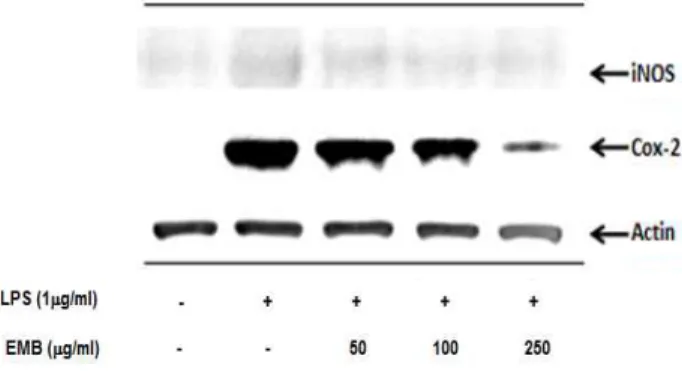
Fig. 6. The effects of EMB on iNOS and COX-2 protein ex- pression in RAW 264.7 cells. The RAW 264.7 cells (2×10
6cells/ml) were incubated 24 hr and the cells were stimu- lated with lipopolysaccharide (1 μg/ml) for 1hr. And then treated with EMB (50, 100, 250 μg/ml) for 24 hr.
Expression of β-actin is shown as loading control (Control: Untreated LPS, EMB: Ethyl acetate fraction of Methanol extracts from Bletilla striata Reichenbach fil. , iNOS: Inducible Nitric oxide synthase, COX-2:
Cyclooxygenase-2)
이 다량 존재하는 것으로 사료된다.
Western blotting을 통한 iNOS, COX-2 단백질의 발현 측정 체내 염증과정에서는 과량의 nitric oxide (NO) 및 prosta- glandin E2 (PEG2) 등의 염증인자는 유도형 NO synthase (iNOS)와 cyclooxygenase (COX-2)에 의해 생성된다고 알려져 있다[6]. 따라서 세포에서 LPS와 같은 독소 및 특수한 자극제 들에 노출될 경우 생성되는 iNOS와 COX-2 단백질을 LPS로 유도 시킨 후, EMB을 처리하여 그 발현량의 감소를 western blot을 통해 확인하였다. Fig. 6과 같이 LSP를 처리하지 않은 cell에 비해 LPS를 처리하여 자극한 cell의 iNOS와 COX-2의 발현량이 높아진 것을 확인 할 수 있다. 반면 LPS를 처리하고 EMB을 처리한 cell에서는 그 감소 양이 농도의존적으로 감소 하는 것으로 나타났다. 따라서 LPS에 의해 증가된 iNOS와 COX-2의 발현량을 EMB이 감소시킴으로 인해 염증반응과 관 련된 NO의 생성량을 감소시키고 따라서 항 염증 효과를 가진 것으로 사료된다.
감사의 글
본 연구는 중소기업청 지원사업(과제번호: 0046975, C0035644) 의 지원을 받아 수행되었으며 이에 감사 드립니다.
References