20
양측 손목에 착용한 Actigraphy와 야간수면다원검사 간의 수면지수 비교
Comparison of Sleep Indices between Both Wrist Actigraphies and Nocturnal Polysomnography
신병학1·박두흠2·이현권3·유재학2·유승호2·하지현2·신현실1·홍석찬4
Byung-Hak Shin,
1Doo-Heum Park,
2Hyun-Kwon Lee,
3Jaehak Yu,
2Seung-Ho Ryu,
2Ji-Hyeon Ha,
2Hyeon-Sil Shin,
1Seok-Chan Hong
4■
ABSTRACT
The present study compared the actigraphic indices between both wrist actigraphies (WATGs), and the sleep estimates between each WATG and nocturnal polysomnography (NPSG) to assess their differences and consistencies. We studied 22 right-handed subjects (mean age 43.9±13.3 years, M:F=14:8) with untreated primary sleep disorders (primary insomnia=8, simple snorer=2, obstruc- tive sleep apnea=12) undergone by overnight both WATGs and NPSG, simultaneously. Comparison and correlation were analyzed between right and left wrist actigraphic data. In the sleep estimates of both WATGs and NPSG, each WATG was compared and correlated with NPSG in sleep period time (SPT), total sleep time (TST), sleep latency (SL), sleep efficiency (SE) and wake time (WT).
Sleep indices between both WATGs showed significant positive correlations with no correlations in SL and fragmentation index (FI).
There were no differences in sleep indices between both WATGs. SPTs of both WATGs, SL of left WATG, and TST of right WATG showed positively significant correlations, and SE of right WATG did negatively significant correlation in sleep indices between each WATG and NPSG. As each WATG was compared to PSG, SPTs of both WATGs and WT of right WATG were decreased, and TST and SE of right WATG and SL of left WATG were increased. Inconsistent SL and FI between both WATGs indicate that the activities between both WATGs can differentially happen during wake or arousal. Inconsistent sleep estimates between each WATG and NPSG may in- dicate the limited usefulness in measuring and analyzing one-night sleep by using WATG. Sleep Medicine and Psychophysiology 2007;14(1):20-25
Key words: Wrist actigraph·Polysomnograph·Handedness.
서 론
1970년대 이후부터 신체의 손목, 발 등에 장착한 소형의 액티그라프(actigraph)를 이용하여 신체의 활동량(activity) 을 수치화 하여 수면의 각성을 측정해 왔다. 특히 손목에 착 용하는 손목 액티그라프(wrist actigraph:이하 WATG) 가 인간 연구나 임상 연구에서 가장 보편적으로 사용되었 고, 손목에 착용할 수 없는 경우에는 배나 발목에도 착용할
수 있다(1,2).
또한 과민성 대장증후군 환자 연구(3), 불면증 환자군 연구(4), 지속적 양압기(continuous positive airway pre - ssure, CPAP)를 사용 중인 수면 무호흡 환자군 연구(5), 교대근무자 연구(6), 그리고 WATG의 수면과 각성 판정 에 대한 정확성에 관한 연구(7) 등 WATG를 이용한 많은 연구들이 발표되었다. 특히 야간수면다원검사(nocturnal po - lysomnography:이하 NPSG)와 비교해서 WATG의 장 점은 24시간에서부터 수주, 수개월까지도 지속적인 측정이
•••••••••••••••••••••••••••••••••••••••••••••••••••••••••••••••••••••••••••••••••••••••••••••••••••••••••••••••••••••••••••••••••••••••••••••••••••••••••••••••••••••••••••••••••••••••••••••••••••••••••••••••••••••••••••••••••••••••••••••••
본 논문은 2006년 9월 20일 The 5th Asian Sleep Research Society Seoul Congress 학술대회에서 일부 발표되었음.
1건국대학교병원 신경정신과 Department of Neuropsychiatry, Konkuk University Hospital, Seoul, Korea
2건국대학교 의학전문대학원 정신과학교실 Department of Psychiatry, Konkuk University School of Medicine, Seoul, Korea
3국립서울병원 신경정신과 Department of Psychiatry, Seoul National Mental Hospital, Seoul, Korea
4건국대학교 의학전문대학원 이비인후과학교실 Department of Otorhinolaryngology, Konkuk University School of Medicine, Seoul, Korea Corresponding author: Doo-Heum Park, Department of Psychiatry, Konkuk University School of Medicine, 4-12 Hwayang-dong, Gwangjin-gu, Seoul 143-914, Korea
Tel: 02) 2030-7568, Fax: 02) 2030-7749 E-mail: [email protected]
21 가능하다는 것이다(8). WATG는 특수한 수면 장애를 평가
하는 데에 중요한 역할을 하며, 비용-효과적인 측면에서 유 용한 방법이고, 연구뿐 아니라 임상에서도 사용될 수 있다 는 것이다(9,10). 수집된 자료는 활동과 비-활동을 분석하 고, 인터페이스로 컴퓨터에 연결하여 다운받아 분석할 수 있 으며, 나아가 각성과 수면의 상태로 일주기리듬(circadian rhythm)을 알아내는 데에 적절하다(1,2). 이는 수면 시 움 직임이 적고, 각성 시 움직임이 많다는 것을 WATG에 적 용한 것이다(1,10). AASM(American Academy of Sleep Medicine)의 임상 지침에는 아직까지 WATG를 이용하여 과도한 졸음현상이나, 일주기리듬 이상 및 수면 장애 정도 등을 진단할 수 있는 명확한 지침이 없었다(11).
WATG를 이용하여 측정한 신체 활동량(activity)을 분 석하여 얻은 수면지수와 NPSG에 의한 수면지수 간에 높 은 일치율을 보였다(12,13). 주간 활동 시 손잡이(hand - edness)에 따라 양측 손목의 활동량이 달라질 수 있어 액 티그라프는 비 우성 측(non-dominant) 손목에 착용된다.
손잡이에 따른 활동도 차이가 있는가를 보기 위한 연구들 에서 한 연구에서는 양측 간의 차이가 없었고(14), 또 다 른 연구에서는 차이가 있었다고 한다(15). 특히 양측 손목 활동도 간의 차이가 발생된 후자의 연구에서는 총 활동량 자체의 차이보다는 활동 패턴의 차이가 더 크다는 것을 제 시하였다. 좌측과 우측 우성 양측 간의 손목 활동량을 이용 한 수면 및 각성 분석 결과가 손잡이에 따라 차이가 있었 다(16). 따라서 양측 WATG 각각과 NPSG 간에 수면지 수의 양적 차이 및 상관관계가 차이가 발생될 수 있다. 본 연구는 양측 WATG와 NPSG를 동시에 측정하여 양측 WATG 간 및 각 WATG와 NPSG 간의 수면지수를 비교 하여 각 측정방법에 따른 차이 및 일치도를 보고자 하였다.
연구대상 및 방법
1. 연구대상
건국대학교 병원 수면검사실을 내원한 환자들을 대상으 로 양측 WATG를 착용시킨 후 당일 저녁 9시부터 익일 6 시까지 NPSG를 실시하였다. 그 중 22명의 환자(primary insomnia=8, simple snorer=2, obstructive sleep ap - nea=12)를 선정하였다. 선정된 22명의 환자 중 남자는 14명, 여자는 8명이었고, 나이는 43.9±13.3세, 체질량지 수(body mass index)는 23.66±3.57 kg/meter
2, 피검자 모두 오른손잡이였다(표 1). 오른손잡이는 손잡이 편측지 수(laterality score)가 18점 만점 중 16점 이상인 경우로
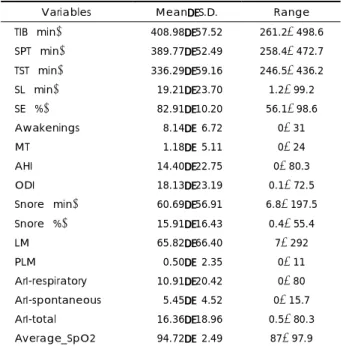
하였다(17). 대상자들의 NPSG 수면지수 결과는 표 2에 있다.
2. 연구방법
대상자의 활동도 측정은 Actiwatch
®(Mini-mitter Co, Inc, USA)를 이용하였다. 신체 활동도(activity)에 따른 수면 및 각성 판독을 위해 sampling rate는 분당 216회로 하였 고, 30초를 1 sampling epoch 단위로 하였고, 역치의 민감 도(threshold sensitivity)는 40(1 epoch 당 40회 이상의 activity를 보이면 각성)으로 하는데 5 epoch를 평균하여 상기 역치값 이상이면 central epoch를 각성으로 판독하고
Table 1. Demographic data in the right-handed subjects with primary sleep disorders (n=22)
Variables Mean±S.D. Range Age (years) 043.91±13.32 22-770 Education (years) 013.45±03.73 06-180 Systolic BP (mmHg) 118.95±13.13 83-139 Diastolic BP (mmHg) 079.64±09.82 59-950 BMI (kg/meter2) 023.66±03.57 17.2-31.6 Right handedness 017.86±00.35 17-180 Left handedness 000.14±00.35 00-100 BP:blood pressure, BMI:body mass index
Table 2. Polysomnographic data in the right-handed subjects with primary sleep disorders (n=22)
Variables Mean±S.D. Range TIB (min) 408.98±57.52 261.2-498.6 SPT (min) 389.77±52.49 258.4-472.7 TST (min) 336.29±59.16 246.5-436.2
SL (min) 019.21±23.70 1.2-99.2
SE (%) 082.91±10.20 56.1-98.6
Awakenings 008.14±06.72 0-31
MT 001.18±05.11 0-24
AHI 014.40±22.75 0-80.3
ODI 018.13±23.19 0.1-72.5
Snore (min) 060.69±56.91 6.8-197.5 Snore (%) 015.91±16.43 0.4-55.4
LM 065.82±66.40 7-292
PLM 000.50±02.35 0-11
ArI-respiratory 010.91±20.42 0-80 ArI-spontaneous 005.45±04.52 0-15.7 ArI-total 016.36±18.96 0.5-80.3 Average_SpO2 094.72±02.49 87-97.9 TIB:time in bed, SPT:sleep period time, TST:total sleep time, SL:sleep latency, SE:sleep efficiency, MT:movement time, AHI:apnea/hypopnea index, ODI:oxygen desaturation index, LM:leg movement, PLM:periodic leg movement, ArI:arousal index, ArI-respiratory:ArI generated by respiratory event, ArI- spontaneous:spontaneously generated ArI, ArI-total:the sum of ArI-respiratory and ArI-spontaneous
22
그 이하이면 수면으로 판독하였다. 취침시간(bed time)은 환자가 침대에 누운 시간을 기준으로 하였고 기상시간(get up time)은 환자가 침대에서 일어난 시각을 기준으로 하였 으며, WATG 데이터의 분석은 Mini-mitter사의 Acti - ware software 3.4를 사용하여 자동 분석하였으며, 분석 변인은 다음과 같았다. 1) 수면잠복기(sleep latency;the period of time required for sleep onset after going to bed), 2) 가정수면시간(assumed sleep time;the period of time between sleep start and sleep end), 3) 실제수 면시간(actual sleep time;the amount of time scored on sleep between sleep start and sleep end), 4) 수면효 율(sleep efficiency;an index of the amount of time in bed that is actually spent sleeping), 5) 실제수면시간백 분율(actual sleep time percentage;an index of the amount of the assumed sleep time that is actually sleep), 6) 실제각성시간(actual wake time;the amount of time scored on wake between sleep start and sleep end), 7) 실제각성시간백분율(actual wake time percen - tage;an index of the amount of the assumed sleep time that is actually wake), 8) 연속수면시간수(sleep bouts;the number of continuous blocks of sleep cal - culated between sleep start and sleep end), 9) 연속각
성시간수(wake bouts;the number of continuous blo - cks of wake calculated between sleep start and sleep end), 10) 수면기간중총활동지수(total activity score;
summation of all activity counts during the sleep pe - riod), 11) 수면기간중평균활동지수(mean activity score;
the magnitude of activity on a per-epoch-basis during sleep, determined by dividing the total activity score by the number of epochs during the assumed sleep period), 12) 수면분절지수(fragmentation index;an in - dex of restlessness calculated by summing the number of minutes moving percentage with the immobility ph - ases of 1 minute percentage).
NPSG는 Embla N7000, Embllette A10(Medcare, Ice - land)을 이용하여 실시하였으며, 수면다원기록의 판독은 국 제판독기준(18)에 따랐으며 1 epoch를 30초로 하여 수면 단계를 수기(manual)로, 판독한 후 수면기간시간(sleep pe - riod time), 총수면시간(total sleep time), 수면잠복기(sleep latency), 수면효율성(sleep efficiency) 및 각성시간(wake time)을 계산하였다. WATG의 가정수면시간(assumed sl - eep time)간과 NPSG의 수면기간시간(sleep period time) 은 정의상 같다. 즉, 두 지표는 수면시작(sleep onset)과 수 면종결(sleep offset) 사이의 시간을 의미한다. 통계방법은
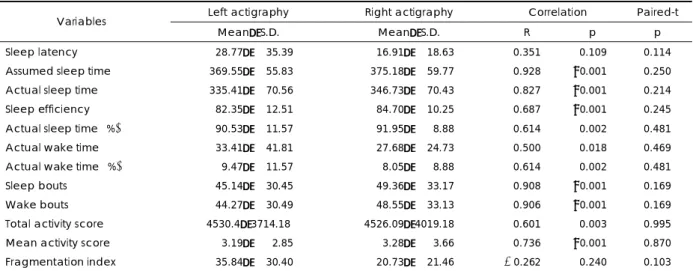
Table 3. Correlation and comparison between left and right actigraphic data of the right-handed subjects with primary sleep disorders (n=22)
Left actigraphy Right actigraphy Correlation Paired-t Variables
Mean±S.D. Mean±S.D. R p p
Sleep latency 0028.77±0035.39 0016.91±0018.63 0.351 0.109 0.114
Assumed sleep time 0369.55±0055.83 0375.18±0059.77 0.928 <0.001 0.250
Actual sleep time 0335.41±0070.56 0346.73±0070.43 0.827 <0.001 0.214
Sleep efficiency 0082.35±0012.51 0084.70±0010.25 0.687 <0.001 0.245
Actual sleep time (%) 0090.53±0011.57 0091.95±0008.88 0.614 0.002 0.481
Actual wake time 0033.41±0041.81 0027.68±0024.73 0.500 0.018 0.469
Actual wake time (%) 0009.47±0011.57 0008.05±0008.88 0.614 0.002 0.481
Sleep bouts 0045.14±0030.45 0049.36±0033.17 0.908 <0.001 0.169
Wake bouts 0044.27±0030.49 0048.55±0033.13 0.906 <0.001 0.169
Total activity score 4530.4±3714.18 4526.09±4019.18 0.601 0.003 0.995
Mean activity score 0003.19±0002.85 0003.28±0003.66 0.736 <0.001 0.870
Fragmentation index 0035.84±0030.40 0020.73±0021.46 -0.262 0.240 0.103
Sleep latency:the period of time required for sleep onset after going to bed, Assumed sleep time:the period of time between sleep start and sleep end, Actual sleep time:the amount of time scored on sleep between sleep start and sleep end, Sleep efficiency:an index of the amount of time in bed that is actually spent sleeping, Actual sleep time percentage:an index of the amount of the assumed sleep time that is actually sleep, Actual wake time:the amount of time scored on wake between sleep start and sleep end, Actual wake time percentage:an index of the amount of the assumed sleep time that is actually wake, Sleep bouts:the number of continuous blocks of sleep calculated between sleep start and sleep end, Wake bouts:the number of continuous blocks of wake calculated between sleep start and sleep end, Total activity score:summation of all activity counts during the sleep period, Mean activity score:the magnitude of activity on a per-epoch-basis during sleep determined by dividing the total activity score by the number of epochs during the assumed sleep period, Fragmentation index:an index of restlessness calculated by summing the number of minutes moving percentage with the immobility phases of 1 minute percentage
23 양측 WATG 수면지수 간과 각 WATG와 NPSG 수면지수
간의 상관관계 및 비교 분석을 위해 Pearson correlation 및 paired-test를 하였다.
결 과
1. 양측 WATG 수면지수 간의 상관관계 및 비교
양측 WATG 수면지수 간의 상관관계 및 비교는 표 3에 서 보여주고 있다. 상관관계 분석에서 수면잠복기와 수면 분절지수에서 유의한 상관관계가 없었고, 그 외의 다른 수 면지수들에서는 통계적으로 유의한 수준으로 양의 상관관 계가 있었다(p<0.05). 양측 수면지수 간의 양적 비교에서 는 통계적으로 유의한 차이가 없었다.
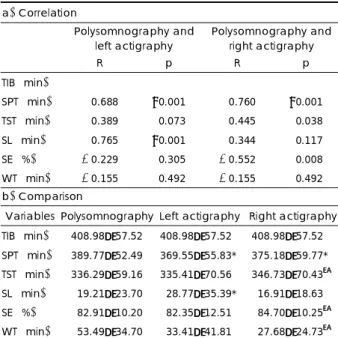
2. 각 WATG와 NPSG의 수면지수 간의 상관관계 및 비교 각 WATG와 NPSG의 수면지수 간의 상관관계 및 비교 는 표 4에서 보여주고 있다. 상관관계 분석에서 양측 WATG 의 수면기간시간, 좌측 WATG의 수면잠복기 그리고 우측 WATG의 총수면시간이 유의한 양의 상관관계를 보였고, 우측 WATG의 수면효율은 유의한 음의 상관관계를 보였 다. NPSG에 비해 WATG에서 양측의 수면기간시간(p<
0.001, p<0.001)과 우측의 각성시간(p<0.05)은 감소되었 으며, 좌측의 수면잠복기(p<0.001)와 우측의 총수면시간
과 수면효율(p<0.05, p<0.05)은 증가되었다.
고 찰
Actigraph를 이용하여 측정한 활동량(activity)과 NPSG 에서 측정된 수면잠복기, 수면효율성과 총수면시간 등과 같은 수면지수를 비교한 결과 매개변수간의 높은 일치률을 보였으나(9,10), 대부분의 연구가 우성 측 손잡이(dominant handedness)에 WATG를 착용한 상태로 NPSG를 시행하 였다. 양측 WATG를 착용하여 NPSG와 비교한 연구는 본 연구가 최초 시도였다는 것은 여러 측면에서 의의가 있다.
좌측과 우측 WATG중 즉, 우성과 비 우성 측 중 어떤 측 이 더 NPSG와 일치되는가를 볼 수가 있고, 또한 수면 중 양손의 활동도 차이가 있는가를 알아볼 수가 있었다.
양측 WATG 수면지수 간의 상관관계에서 수면잠복기와 수면분절지수 외에는 유의한 양의 상관관계를 보였고 모든 지수에 양측 간의 양적 차이가 없었다. 양측 WATG 수면 지수 간의 상관관계에서 수면잠복기와 수면분절지수의 불 일치는 각성시간 동안 WATG의 활동도가 양측간에 차별 적으로 발생할 수 있다는 것을 의미한다. 우성 측 손목(do - minant hand;right hand)에서 측정된 수면지수들의 결과 가 비 우성 측 손목(non-dominant hand)에서 측정된 결 과보다 NPSG 수면지수에 더 일치된 결과들을 보여 주고 있으므로 actigraph를 이용해 수면과 각성을 판단하기 위 해서는 우성 측 손목(dominant hand)에 착용하는 것이 보 다 정확한 결과를 얻을 수 있을 것으로 생각된다. 그러나 비우성 검지에 산소포화도 감지기를 착용하지 않고 측정을 하여 우성 WATG가 비우성 WATG보다 NPSG 수면지수 간의 더 높은 일치율과 양적 비교에서 차이가 없다는 것에 대해 추후 연구를 더 할 필요는 있다.
NPSG와 각 WATG의 수면지수 간의 상관관계가 일치되 지 않고 양적으로 차이가 있는 수면지수가 관찰되었고, 또 한 이러한 불일치와 차이의 발생이 각 WATG 수면지수에 서 동일하지 않았다. NPSG와 WATG의 수면기간시간이 현저한 양의 상관 관계를 보였으며, 수면잠복기는 비 우성 측 좌측 WATG에서만, 총수면시간은 우성 측인 우측 WATG 에서만 유의한 양의 상관 관계가 있었다. 이와 같은 불일치 및 양적 차이의 발생은 양측 WATG 간의 수면잠복기와 수면분절지수가 상관관계를 보이지 않았던 것이 원인이 될 수 있다. 우측 WATG와 NPSG 간에 수면잠복기와 각성시 간이 상관관계가 없었고 심지어는 수면효율은 음의 상관관 계를 보였다. 또한 좌측 WATG에서는 예상과 달리 수면잠 복기가 NPSG와 상관관계를 보이기도 하였다. 이러한 결과
Table 4. Correlation and comparison between each actigra- phic and polysomnographic data of the right-handed subjects with primary sleep disorders (n=22)
a) Correlation
Polysomnography and left actigraphy
Polysomnography and right actigraphy
R p R p TIB (min)
SPT (min) -0.688 <0.001 -0.760 <0.001 TST (min) -0.389 <0.073 -0.445 <0.038 SL (min) -0.765 <0.001 -0.344 <0.117 SE (%) -0.229 <0.305 -0.552 <0.008 WT (min) -0.155 <0.492 -0.155 <0.492 b) Comparison
Variables Polysomnography Left actigraphy Right actigraphy TIB (min) 408.98±57.52 408.98±57.52 408.98±57.52 SPT (min) 389.77±52.49 369.55±55.83* 375.18±59.77*
TST (min) 336.29±59.16 335.41±70.56 346.73±70.43† SL (min) 019.21±23.70 028.77±35.39* 016.91±18.63 SE (%) 082.91±10.20 082.35±12.51 084.70±10.25† WT (min) 053.49±34.70 033.41±41.81 027.68±24.73† TIB:time in bed, SPT:sleep period time, TST:total sleep time, SL:sleep latency, SE:sleep efficiency, WT:wake time. The data were analyzed by Pearson correlation in a) and by paired t-test in b). The values represent mean±standard deviation. *:
p<0.001, †:p<0.05
24
는 WATG를 이용하여 측정한 활동량(activity)과 NPSG 에서 측정된 결과들의 매개변수를 비교한 결과 매개변수간 의 높은 일치율을 보인 연구(12,13)와는 차이가 있었다.
과거 연구와 차이는 WATG에서 수면과 각성을 정하는 알 고리즘의 차이로 발생되었을 가능성도 있다. NPSG와 각 WATG의 수면지수 상관관계에서 보여주고 있는 불일치는 일일밤 수면분석을 위해 NPSG를 대신하여 WATG를 이 용하는 것에 제한된 점이 있다는 것을 시사한다.
WATG의 수면잠복기는 NPSG와 가장 불일치할 가능성 이 높은데, 각성이 되어 있는 상태에서 손목이 움직이지 않 고 WATG의 경우 NPSG와 달리 수면으로 판독될 가능성 이 높기 때문이다. 이러한 이유가 수면분절지수에서도 적용 될 수 있다. 실제 다른 연구들에서도 NPSG와 WATG 간의 높은 일치율이 수면잠복기에서는 현저히 저하된다(7). 이는 수면잠복기 동안 활동량이 현저히 저하되기 때문에 WATG 는 수면잠복기를 분석할 때 시간을 축소시킬 가능성이 높 다. 이러한 현상은 아침 또는 새벽에 기상할 무렵에 수면중 임에도 불구하고 활동량이 많아지면서 각성상태로 판독될 가능성이 높다. 따라서 대상자에 따라 수면잠복기와 기상 시간 무렵에 따른 활동도가 개인적으로 차이가 날 경우에 는 수면효율 분석 등에 NPSG와 WATG 간의 차이가 발 생될 수 있다. 본 연구에서는 수면잠복기가 긴 환자들이 있 어 우측 WATG에서 수면잠복기는 NPSG에 비해 유의하 게 단축되어 있고 수면효율은 증가되어 있다. 이러한 현상 이 좌측 WATG에서는 관찰되지 않았고 오히려 수면잠복 기는 증가되었다. 그 이유는 좌측 손에 산소포화도 감지기 가 검지손가락에 부착되어 이로 인해 수면잠복기 동안 좌 측 손의 활동도가 증가되었을 가능성이 있다. 위의 결과들 을 통해 WATG를 이용하여 수면잠복기, 수면효율성과 총 수면시간을 측정할 수 있으나, actigraph의 경우는 뇌파를 측정할 수 없는 단점이 있으므로 환자의 수면의 질 저하를 평가하기에는 다소 무리가 있을 것이다.
WATG와 NPSG의 수면지수를 비교한 여러 연구들이 진행되어왔으나, 대부분의 연구가 우성 측 손목(dominant hand) 또는 비 우성 측 손목(non-dominant hand)에 한 쪽에만 actigraph를 착용한 상태로 이루어진 반면, 본 연구 는 양측 손목에 착용한 actigraph와 NPSG간의 수면지수 를 비교한 최초로 연구라는 점에서 의의가 있다. 하지만 연 구의 대상이 된 환자수가 적었으며, 나이가 30, 40대의 환 자들에 국한되어 있으며, 여러 수면 장애를 가진 일차성 수 면장애 환자를 대상으로 연구가 이루어졌다는 한계점을 지 니고 있다. 향후 이러한 점을 고려하여 좀더 다양한 연령과 많은 수의 대상을 통한 연구를 통해 남녀간의 차이, 연령간
의 차이 및 수면장애 간의 차이에 관한 연구가 필요할 것 으로 보인다.
요 약
목 적 :본 연구는 양측 손목 액티그라프(wrist actigra - phy:WATG) 간의 WATG 지수와 각각의 WATG와 야 간수면다원검사(nocturnal polysomnography:NPSG) 간 의 수면지수를 비교 분석하여 차이와 일치도를 보고자 하 였다.
방 법 :우수 우성인 22명(평균연령 43.9±13.3세, 남:
여=14:8)의 치료받지 않은 일차성 수면장애를 가진 환 자(primary insomnia=8, simple snorer=2, obstructive sleep apnea=12)를 대상으로 선정하였다. 대상자들은 양 측 손목에 WATG를 착용한 채 1일밤 NPSG를 시행하였 다. 양측 WATG 지수간을 상관관계 및 차이를 분석하였다.
각 WATG와 NPSG 간의 수면기간시간, 총수면시간, 수면 잠복기, 수면효율 및 각성 시간에 대하여 상관관계 및 차이 를 분석하였다.
결 과 :양측 WATG 지수간의 상관관계 분석에서 수면 잠복기와 수면분절지수에서 유의한 상관관계가 없었고, 그 외의 다른 수면지수들에서는 통계적으로 유의한 수준으로 양의 상관관계가 있었다(p<0.05). 양측 WATG의 수면지 수 간의 양적 비교에서는 통계적으로 유의한 차이가 없었 다. 각 WATG와 NPSG 수면지수 간의 상관관계 분석에서 양측 WATG 수면기간시간, 좌측 WATG의 수면잠복기 그 리고 우측 WATG의 총수면시간이 유의한 양의 상관관계 를 보였고, 우측 WATG의 수면효율은 유의한 음의 상관관 계를 보였다. 각 WATG와 NPSG 수면지수 간의 양적 비 교에서 NPSG에 비해 WATG에서 양측의 수면기간시간 (p<0.001, p<0.001)과 우측의 각성시간(p<0.05)은 감소 되었으며, 좌측의 수면잠복기(p<0.001)와 우측의 총수면 시간과 수면효율(p<0.05, p<0.05)은 증가되었다.
결 론 :양측 WATG 수면지수 간의 상관관계에서 수면 잠복기와 수면분절지수의 불일치는 각성시간 동안 WATG 의 활동도가 양측간에 차별적으로 발생할 수 있다는 것을 의미한다. NPSG와 각 WATG의 수면지수 상관관계에서 보여주고 있는 불일치는 일일밤 수면분석을 위해 NPSG를 대신하여 WATG를 이용하는 것에 제한된 점이 있다는 것 을 시사한다.
중심 단어 :액티그라프·야간수면다원검사·손잡이.
25
REFERENCES
1. Webster JB, Kripke DF, Messin S, Mullaney DJ, Wyborney G. An ac- tivity-based sleep monitor system for ambulatory use. Sleep 1982;
5:389-399
2. Chesson AL Jr, Berry RB, Pack A. Practice parameters for the use of portable monitoring devices in the investigation of suspected obstru- ctive sleep apnea in adults. Sleep 2003;26:907-913
3. Rotem AY, Sperber AD, Krugliak P, Freidman B, Tal A, Tarasiuk A.
Polysomnographic and actigraphic evidence of sleep fragmentation in patients with irritable bowel syndrome. Sleep 2003;26:747-752 4. Hauri PJ, Wisbey J. Wrist actigraphy in insomnia. Sleep 1992;15:
293-301
5. Gagnadoux F, Nguyen XL, Rakotonanahary D, Vidal S, Fleury B.
Wrist-actigraphic estimation of sleep time under nCPAP treatment in sleep apnoea patients. Eur Respir J 2004;23:891-895
6. Park YM, Matsumoto PK, Seo YJ, Cho YR, Noh TJ. Sleep-wake be- havior of shift workers using wrist actigraph. Psychiatry Clin Neuro- sci 2000;54:359-360
7. Pollak CP, Tryon WW, Nagaraja H, Dzwonczyk R. How accurately does wrist actigraphy identify the states of sleep and wakefulness?
Sleep 2001;24:957-965
8. Tamaki M, Nittono H, Hayashi M, Hori T. Examination of the first- night effect during the sleep-onset period. Sleep 2005;28:195-202 9. Cole RJ, Kripke DF, Gruen W, Mullaney DJ, Gillin JC. Automatic
sleep/wake identification from wrist activity. Sleep 1992;15:461-469
10. Sadeh A, Sharkey KM, Carskadon MA. Activity-based sleep-wake identification: an empirical test of methodological issues. Sleep 1994;
17:201-207
11. Standards of Practice Committee. Practice parameters for the use of actigraphy in the clinical assessment of sleep disorders. American Sleep Disorders Association. Sleep 1995;18:285-287
12. Kripke DF, Mullaney DJ, Messin S, Wyborney VG. Wrist actigra- phic measures of sleep and rhythms. Electroencephalogr Clin Neu- rophysiol 1978;44:674-676
13. Mullaney DJ, Kripke DF, Messin S. Wrist-actigraphic estimation of sleep time. Sleep 1980;3:83-92
14. Van Hilten JJ, Middelkoop HA, Kuiper SI, Kramer CG, Roos RA.
Where to record motor activity: an evaluation of commonly used sites of placement for activity monitors. Electroencephalogr Clin Neuro- physiol 1993;89:359-362
15. Nagels G, Marion P, Pickut BA, Timmermans L, De Deyn PP. Acti- graphic evaluation of handedness. Electroencephalogr Clin Neuro- physiol 1996;101:226-232
16. Lehnkering H, Strauss A, Wegner B, Siegmund R. Actigraphic inve- stigations on the activity-rest behavior of right- and left-handed stu- dents. Chronobiol Int 2006;23:593-605
17. Annett M. A classification of hand preference by association analysis.
Br J Psychol 1970;61:303-321
18. Rechtschaffen A, Kales A. A Manual of Standardized Terminology, Technique and Scoring System for Sleep Stages of Human Subjects.
Los Angeles, Brain Information Service/Brain Research Institute, UCLA;1968