• 검색 결과가 없습니다.

Oocyte maturation under a biophoton generator improves preimplantation development of pig embryos derived by parthenogenesis and somatic cell nuclear transfer

N/A
N/A
Protected

Academic year: 2021

Share "Oocyte maturation under a biophoton generator improves preimplantation development of pig embryos derived by parthenogenesis and somatic cell nuclear transfer"

Copied!
7
0
0

로드 중.... (전체 텍스트 보기)

전체 글

(1)

Korean J Vet Res(2017) 57(2) : 89~95 https://doi.org/10.14405/kjvr.2017.57.2.89

89

<Original Article>

Oocyte maturation under a biophoton generator improves preimplantation development of pig embryos derived by parthenogenesis

and somatic cell nuclear transfer

Joohyeong Lee

1,2

, Hyeji Shin

1

, Wonyou Lee

3

, Seung Tae Lee

4

, Geun-Shik Lee

1,2

, Sang-Hwan Hyun

5

, Eunsong Lee

1,2,

*

1

Laboratory of Theriogenology, College of Veterinary Medicine,

4

Department of Animal Life Science and Division of Applied Animal Science, College of Animal Life Science, and

2

Institute of Veterinary Science, Kangwon National University, Chuncheon 24341, Korea

3

Biolight Corporation, Seoul 05839, Korea

5
Laboratory of Veterinary Embryology and Biotechnology, Veterinary Medical Center and College of Veterinary Medicine, Chungbuk National University, Cheongju 28644, Korea

(Received: January 24, 2017; Revised: March 24, 2017; Accepted: May 19, 2017)

Abstract: This study was conducted to determine the effects of biophoton treatment during in vitro maturation (IVM) and/or in vitro culture (IVC) on oocyte maturation and embryonic development in pigs. An apparatus capable of generating homogeneous biophoton energy emissions was placed in an incubator. Initially, immature pig oocytes were matured in the biophoton-equipped incubator in medium 199 supplemented with cysteine, epidermal growth factor, insulin, and gonadotrophic hormones for 22 h, after which they were matured in hormone-free medium for an additional 22 hr. Next, IVM oocytes were induced for parthenogenesis (PA) or provided as cytoplasts for somatic cell nuclear transfer (SCNT). Treatment of oocytes with biophoton energy during IVM did not improve cumulus cell expansion, nuclear maturation, intraoocyte glutathione content, or mitochondrial distribution of oocytes. However, biophoton-treated oocytes showed higher ( p < 0.05) blastocyst formation after PA than that in untreated oocytes (50.7% vs. 42.7%). In an additional experiment, SCNT embryos produced from biophoton-treated oocytes showed a greater ( p < 0.05) number of cells in blastocysts (52.6 vs. 43.9) than that in untreated oocytes. Taken together, our results demonstrate that biophoton treatment during IVM improves developmental competence of PA- and SCNT-derived embryos.

Keywords: biophoton, embryonic development, oocyte maturation, somatic cell nuclear transfer

Introduction

Alterations in embryo culture environments have been shown to influence embryonic development and the later out- comes of assisted reproductive technologies (ARTs) includ- ing in vitro maturation (IVM) and in vitro fertilization (IVF) in livestock species. There has been an improvement in the developmental competence of embryos achieved from in vitro production (IVP) that can mostly be attributed to improved embryo culture systems based on improved knowl- edge of the in vivo environment, as well as the metabolic requirements of embryonic development. After extensive studies, many of the in vitro culture (IVC) conditions for IVP of mammalian embryos, such as composition of culture media, culture temperature, and atmospheric conditions, have been relatively standardized in both human and livestock species [1, 7, 12]. Nevertheless, developmental potential of

IVC embryos is still much lower than that of those produced in vivo.

Biophotons are photons of light in the low visible and ultraviolet light range that are produced by a biological sys- tem. Several groups have investigated the effects or roles of biophoton emissions in live organisms, including mamma- lian cells in the last few decades. However, there is still little information available regarding the significance of the bio- photon phenomenon. It is well known that organisms sponta- neously emit ultraweak photons without any photoexcitation [4].

Typically, biological tissues produce a radiant emittance in the visible and ultraviolet frequencies [15]. Previous studies showed that photon emissions from human skin, mouse liv- ers and fibroblasts are associated with the oxidative reaction of biomolecules [18]. In addition, leakage of a very small amount of photons from external sources has been shown to alter ultraweak photon emissions and cell-to-cell communica-

*Corresponding author

Tel: +82-33-250-8670, Fax: +82-33-259-5625

E-mail: [email protected]

(2)

tion [16]. However, no studies have investigated the relation between biophotons and mammalian germ cells to date.

In this study, an apparatus capable of generating energy homogeneous with a biophoton was placed in an incubator, after which immature pig cumulus-oocyte complexes (COCs) and embryos were cultured under this apparatus during IVM and/or IVC. The biophoton energy projector (BEP) was designed based on the effects of photons on live cells and their mutual relationship with resonance energy. The mechanism of the biophoton energy projector is based on biophoton theory. In contrast to conventional therapeutic methods employing light, the BEP is likely to have the potency of feasibility of in vivo effectiveness of ultraweak photons. In this study, we evalu- ated the effects of mechanical biophoton treatment on nuclear maturation and embryonic development after parthenogene- sis (PA) and somatic cell nuclear transfer (SCNT) in pigs.

Materials and Methods

Culture media

All chemicals were obtained from Sigma-Aldrich (USA) unless specified otherwise. The base medium for IVM of oocytes in this study was medium-199 (M-199) added with 10% (v/v) pig follicular fluid, 0.91 mM pyruvate, 0.6 mM cysteine, 10 ng/mL epidermal growth factor, 1 µg/mL insu- lin, and 75 µg/mL kanamycin. The IVC medium for embry- onic development was porcine zygote medium (PZM)-3 containing 0.3% (w/v) bovine serum albumin (BSA) [23], which was further supplemented with 0.34 mM tri-sodium citrate, 2.77 mM myo-inositol, and 10 µM β-mercaptoetha- nol [24].

Oocyte collection and IVM

Pig ovaries were collected at a local abattoir. Ovaries were washed two times in a warm physiological saline and trans- ported to the laboratory. Follicular contents were aspirated from antral follicles (3–8 mm in diameter) in the ovaries.

COCs that had more than three layers of compact cumulus cells were selected. COCs were washed three times in HEPES-buffered Tyrode’s medium (TLH) containing 0.05%

(w/v) polyvinyl alcohol (PVA) (TLH-PVA), placed into each well of a four-well multi-dish (Nunc, Denmark), and cul- tured in IVM medium with 80 µg/mL follicle-stimulating hormone (Antrin R-10; Kyoritsu Seiyaku, Japan) and 10 IU/

mL human chorionic gonadotropin (Intervet International, the Nederlands) at 39

o

C under a humidified atmosphere of 5% CO

2

and 95% air as previously reported [11]. After 22 h of maturation culture, the COCs were washed in fresh hor- mone-free IVM medium, then further cultured for 22 h in a hormone-free medium.

Preparation of donor cells

Fetal fibroblasts were used as nuclei donors for SCNT.

Cells were seeded into four-well dishes and cultured in Dul- becco’s modified Eagle’s medium (DMEM) with the nutrient

mixture F-12 (Invitrogen, USA) and 15% (v/v) fetal bovine serum until a complete monolayer of cells had formed.

Donor cells were induced to synchronize at the G0/G1 stage of the cell cycle by contact inhibition for 72–96 h. On the day of SCNT, confluent cells were trypsinized to prepare a single-cell suspension, washed, and resuspended in TLH con- taining 0.4% (w/v) BSA (TLH-BSA).

SCNT and PA

After IVM, oocytes were freed from cumulus cells and incubated for 10–15 min in a calcium-free TLH-BSA (manipulation medium) supplemented with 5 µg/mL bisben- zimide (Hoechst 33342). Then, the oocytes were washed sev- eral times in a fresh manipulation medium and transferred into a droplet of manipulation medium containing 5 µg/mL cytochalasin B (CB) under warm mineral oil. For enucle- ation, the polar body and metaphase II (MII) chromosomes were removed using a 17-µm beveled glass pipette (ORIGO Humagen Pipets, USA). Enucleation was checked under an epifluorescence microscope (IX73; Olympus, Japan). A sin- gle cell was placed into the perivitelline space of each enu- cleated oocyte. Cell-cytoplast couplets were placed on a fusion electrode chamber (NepaGene) overlaid with 280 mM mannitol solution supplemented with 1 µM CaCl

2

and 50 µM MgCl

2

, as previously described [21]. To induce fusion of cell- cytoplast couplets, an alternating-current field of 2 V cycling at 1 MHz for 2 sec and then two pulses of 170 V/mm direct current (DC) for 30 µsec were applied using a cell fusion generator (LF101; NepaGene, Japan). Then, oocytes were washed several times and incubated for 30 min in TLH-BSA, after which they were examined for fusion. Reconstructed oocytes were activated by applying two DC pulses of 120 V/

mm for 60 µsec in a 280 mM mannitol solution with 100 µM CaCl

2

and 50 µM MgCl

2

. For PA, the MII oocytes having polar bodies were electrically activated using a pulse sequence identical to that used for activation of SCNT oocytes.

Post-activation treatment and embryo culture After electrical activation, the PA embryos were treated for 4 h with 5 µg/mL CB in IVC medium and the SCNT embryos were treated for 4 h in IVC medium with 0.4 µg/

mL demecolcine and 1.9 mM 6-dimethylaminopurine. Then, SCNT and PA embryos were then washed properly in a fresh IVC medium, placed to 30-µL IVC droplets under mineral oil, and cultured for 7 days at 39

o

C in a humidified atmo- sphere of 5% CO

2

, 5% O

2

, and 90% N

2

. Embryonic develop- ment to the cleavage and the blastocyst stages were observed on Days 2 and 7, respectively (Day 0 was the day of SCNT or PA). Blastocysts developed on Day 7 were stained with bisbenzimide and then stained nuclei were counted under an epifluorescence microscope [11].

Measurement of oocyte diameter after IVM

To measure the size of IVM oocytes, images of MII

oocytes were recorded using a digital camera (DS-L3; Nikon,

(3)

Japan) attached to an inverted microscope (TE-300; Nikon).

The size of each part of oocytes was taken using image anal- ysis software (ImageJ 1.46r; National Institutes of Health, USA) as reported previously [11].

Measurement of intraoocyte glutathione (GSH) con- tent in IVM oocytes

GSH content in IVM oocytes was measured as previously described [8, 20]. Briefly, a total of 7–10 oocytes per repli- cate were treated for 30 min in TLH-PVA supplemented with 10 µM Cell Tracker CMF2HC (Invitrogen) in the dark. Then, treated oocytes were incubated for 30 min in PZM-3 at 39

o

C.

After incubation, oocytes were washed with D-PBS (Invitro- gen) containing 0.1% (w/v) PVA, then placed into 2- μL droplets and observed for fluorescence using an epifluores- cence microscope with a UV filter (370 nm). The fluores- cence intensities of oocytes were analyzed with the ImageJ software and normalized to untreated control oocytes.

Observation of mitochondrial distribution

For the examination of mitochondrial distribution, MII- stage oocytes that had been untreated or treated with BEP during IVM were incubated for 15 min in PBS containing 0.1% (w/v) PVA supplemented with 10 µg/mL rhodamine- 123 at 39

o

C. After wash three times in TLH-PVA, 3-5 oocytes were placed into 2- μL droplets of D-PBS (Invitrogen) con- taining 0.1% (w/v) PVA, and the stained oocytes were observed under an epifluorescent microscope.

Blastocyst differential staining

Zona-intact blastocysts were stained with 5 µg/mL Hoe- chst 33342 for 1 h after rinsing in PZM-3 medium, the blas- tocysts were treated with 0.04% (v/v) Triton X-100 for 3 min and then with 0.005% (w/v) propidium iodide for 10 min.

Stained blastocysts were mounted on glass slides and observed for fluorescence. The propidium iodide and Hoechst 33342- labeled trophectoderm nuclei appeared pink or red and bis- benzimide-labeled inner cell mass (ICM) nuclei appeared blue.

Experimental design

In Experiments 1 and 2, we investigated the effects of mechanical biophoton treatment during IVM of oocytes on nuclear maturation and embryonic development after PA (Experiment 1) and SCNT (Experiment 2). The effects of IVM culture under BEP (BEP-AN15; Biolight, Korea) on cumulus cell expansion, diameter of ooplasm, and intraoo- cyte GSH content in IVM oocytes were examined in Experi- ment 3. The effects of biophoton treatment during IVM on mitochondrial distribution in MII oocytes were examined in Experiment 4. In Experiments 5 and 6, oocytes were cul- tured under BEP during the IVM and/or IVC, and the effects of biophoton treatment on embryonic development and qual- ity of PA blastocyst in terms of ICM and trophectoderm cell number were examined.

Statistical analysis

Statistical significance of biophoton treatment was exam- ined using the Statistical Analysis System (ver. 9.4; SAS Institute, USA). Data were analyzed using a general linear model procedure, followed by the least-significant-difference mean separation procedure when the treatments differed at p < 0.05. The results are expressed as the means ± SEM.

Results

Experiment 1. Effects of biophoton treatment during IVM on embryonic development after PA

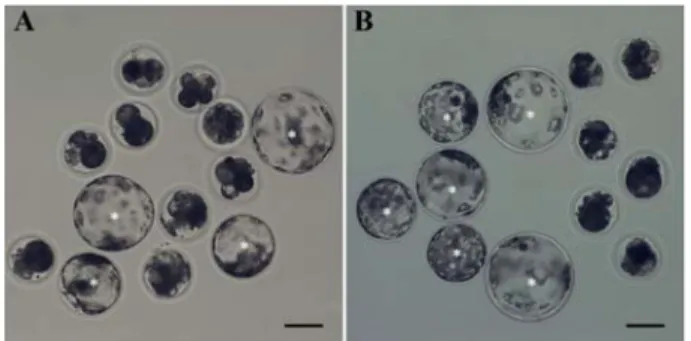
Biophoton-treated oocytes showed higher ( p < 0.05) rates of blastocyst formation after PA (50.7% vs. 42.7%) than untreated oocytes (Fig. 1). However, no significant differences in the nuclear maturation of oocytes (88.7–90.9%), embry- onic cleavage (97.1–97.2%) or mean cell number in blasto- cysts (34.6–35.5 cells/blastocyst) were observed between the untreated control and biophoton treatment groups (Table 1).

Experiment 2. Effects of biophoton treatment during IVM on embryonic development after SCNT

Biophoton-treated oocytes showed higher ( p < 0.05) mean cell numbers in blastocysts after SCNT (52.6 vs. 43.9%) than untreated oocytes. However, embryonic development to the cleavage stage (82.3–87.5%) and blastocyst formation (29.2–

37.4%) were influenced by biophoton treatment during IVM (Table 2).

Experiment 3. Cumulus cell expansion, diameter of ooplasm, and intraoocyte GSH content after biophoton treatment

As listed in Table 3, the cumulus cell expansion and diam- eter of ooplasm were not altered by the IVM culture under biophoton treatment (3.42–3.47; 114.7–115.6 µm, respectively).

In addition, biophoton treatment did not influence intraoo- cyte GSH contents in MII oocytes compared to untreated oocytes (1.00–1.05 pixels/oocyte).

Fig. 1. Photomicrographs of blastocysts (asterisks) produced by parthenogenetic activation using oocytes that were untreated (A) and treated with biophoton (B) during in vitro maturation (IVM).

Scale bars = 100 μm.

(4)

Experiment 4. Effects of biophoton treatment on mito- chondrial distribution of MII-stage oocytes

As previously described [5], mitochondrial distribution was classified into two categories, normal and abnormal dis- tribution. Intact mitochondria evenly distributed in the oop- lasm of MII oocytes was considered normal distribution, while mitochondrial reduced uneven distribution or mito- chondrial broken distribution was considered abnormal distri- bution. As shown in Table 4, the proportion of oocytes showing normal distribution of mitochondria in ooplasm (80.0–83.3%) did not differ significantly between the control and biopho- ton treatment groups.

Experiment 5. Effects of biophoton treatment during IVM and/or IVC on embryo development after PA

Biophoton-treated oocytes during IVM showed a higher

( p < 0.05) blastocyst rate after PA compared to untreated oocytes (52.7 vs. 40.9%), but no significant differences in the rates of blastocyst formation (47.8–49.5%) were observed among biophoton-treated oocytes during IVC (Table 5). Bio- photon-treated oocytes during IVM and IVC showed a higher ( p < 0.05) number of cells in blastocysts than biophoton-treated oocytes during only IVM or only IVC (45.5 vs. 40.7–40.9).

Experiment 6. Effects of biophoton treatment during IVM and/or IVC on the number of ICM and trophec- toderm cells in PA blastocysts

Incubation of PA-derived embryos with biophotons during IVM and/or IVC did not affect the ICM ratio. Additionally, biophoton-treated oocytes during IVM and/or IVC showed no significant differences in the number of inner cell mass nuclei (10.2–12.6), the number of TE nuclei (28.7–33.4), or Table 1. Effects of biophoton treatment during IVM of oocytes on embryonic development after parthenogenesis (PA)

Biophoton treatment

% of oocytes that reached metaphase II

Number of PA oocytes cultured*

% of embryos developed to Number of cells in blastocyst

≥ 2-cells Blastocyst

No 88.7 ± 2.1 141 97.1 ± 0.1 42.7 ± 2.8

a

34.6 ± 1.5

Yes 90.9 ± 1.5 142 97.2 ± 1.2 50.7 ± 1.4

b

35.5 ± 1.3

*Four replicates.

a,b

Values in the same column with different superscript letters are different ( p < 0.05).

Table 2. Effects of biophoton treatment during IVM of oocytes on embryonic development after somatic cell nuclear transfer (SCNT) Biophoton

treatment

% of oocytes that reached metaphase II

Membrane fusion (%)

Number of SCNT oocytes cultured*

% of embryos developed to Number of cells in blastocyst

≥ 2-cells Blastocyst

No 91.7 ± 1.8 77.4 ± 2.1 166 82.3 ± 2.1 29.2 ± 3.6 43.9 ± 3.3

a

Yes 93.2 ± 1.8 77.4 ± 2.2 155 87.5 ± 5.6 37.4 ± 5.3 52.6 ± 2.8

b

*Four replicates.

a,b

Values in the same column with different superscript letters are different ( p < 0.05).

Table 3. Effects of biophoton treatment during IVM on cumulus cell expansion, diameter of ooplasm and intraoocyte glutathione (GSH) content

Biophoton treatment

Number of oocytes examined for cumulus

cell expansion

Cumulus cell expansion score*

Number of oocytes examined for diameter

and GSH

Diameter (µm) of ooplasm

Relative level (pixels/oocyte) of GSH

No 43 3.42 34 114.7 ± 0.5 1.00 ± 0.09

Yes 36 3.47 34 115.6 ± 0.7 1.05 ± 0.10

*Cumulus cell expansion was scored as 0 (no response), 1 (minimum observable response with the cells in the outermost layer of the cumu- lus becoming round and glistening), 2 (expansion of outer cumulus cell layers), 3 (expansion of all cumulus cell layers except the corona radiata), and 4 (expansion of all cumulus cell layers).

Table 4. Effects of biophoton treatment during IVM on mitochondrial distribution of pig oocytes Biophoton

treatment Number of oocytes examined Density of mitochondria Number of oocytes showing normal distribution of mitochondria (%)*

No 60 1.00 ± 0.04 50 (83.3)

Yes 60 1.01 ± 0.05 48 (80.0)

*Normal distribution, intact mitochondria evenly distributed in the ooplasm of MII oocytes; abnormal distribution, mitochondrial reduced

uneven distribution or mitochondrial broken distribution.

(5)

the proportion of ICM nuclei (25.7–28.2%) compared to the untreated control (Table 6).

Discussion

A variety of exogenous factors affecting oocyte matura- tion and embryonic development have been evaluated to obtain information necessary for improving an IVP system in mammalian species. However, the developmental compe- tence of in vitro-produced embryos still remains low relative to their in vivo counterparts [3, 14]. Accordingly, improving the quality of IVM oocytes makes it possible to produce embryos with higher developmental competence and will greatly increase the efficiency of ARTs in terms of offspring production in livestock species.

In this study, we found that IVM of pig oocytes under the biophoton energy generator improved blastocyst formation of PA embryos and increased the embryonic cell number of SCNT blastocysts. Although the physiological mechanism of action was not clarified in this study, this improved develop- mental competence was most likely due to the altered IVM culture environments by an artificial treatment with ultraweak biophotons, which might be beneficial for later embryonic development. Several previous studies [4, 16] have demon- strated that a system exists for controlling cell-to-cell com- munication in various living organisms via electromagnetic or ultraweak photon emission, through which cell division and neutrophil activation has been stimulated and develop- ment of loach embryos has been altered. As previously reported [17], living cells or tissues of plants and animals radiate ultraweak biophotons, and it is possible to detect these photons using special equipment. Although biophotons are associated with the physiological status of cells and

organs, the origin of the photon emissions remains unclear.

Over decades of research in this field, several studies in humans have led to progress in determining biophoton emis- sions in both basic and applied research. Boveris et al. [2]

first demonstrated the potential usefulness of ultraweak pho- ton detection as a non-invasive tool to monitor the oxidative processes in living cells. Furthermore, several studies have repeatedly illustrated that the intensity of photon emission changes in a state of a certain disease [9], and that diseased cells emit significantly more biophotons than healthy cells.

Changes in biophotonic activity have also been shown to be indicative of the changes in mitochondrial ATP energy pro- duction that manifested under physiological and pathological conditions [22]. To the best of our knowledge, this study is the first study to apply a biophoton energy generator to the IVM and IVC of mammalian oocytes. In this study, several indicators of oocyte maturation were used to evaluate how artificially generated biophotons influence the developmen- tal competence of oocytes and embryos in pigs. Evaluation of oocyte quality is traditionally based on morphological char- acteristics such as cumulus cell expansion, size of the perivi- telline space, and size of oocytes after IVM [6, 11]. We evaluated the morphological features of oocytes as a non- invasive method to predict maturational and developmental competence of pig oocytes matured in vitro. Although artifi- cial biophoton treatment during IVM of immature COCs did not alter cumulus cell expansion or ooplasm diameter after IVM, embryonic development after PA was significantly improved. It is not known why or how embryonic develop- ment was increased by the biophoton treatment despite the unaltered morphological criteria.

It is believed that the origin of photon emissions is related to cellular metabolic processes such as respiratory activity or Table 5. Effect of biophoton treatment during IVM and in vitro culture (IVC) on embryonic development after PA

Biophoton treatment during % of oocytes that reached MII

Number of PA oocytes cultured*

% of embryos developed to Number of cells in blastocyst

IVM IVC ≥ 2-cells Blastocyst

No No 90.6 ± 2.2 161 91.8 ± 2.2 40.9 ± 1.9

a

41.9 ± 1.9

ab

No Yes 91.1 ± 1.6 197 93.4 ± 1.7 49.5 ± 3.7

ab

40.7 ± 1.7

a

Yes No 91.2 ± 2.9 195 91.8 ± 1.6 52.7 ± 2.9

b

40.9 ± 1.4

a

Yes Yes 91.2 ± 2.9 196 95.2 ± 1.6 47.8 ± 3.5

ab

45.5 ± 1.9

b

*Five replicates.

a,b

Values in the same column with different superscript letters are different ( p < 0.05).

Table 6. Number of inner cell mass and trophectoderm cells in PA blastocysts derived after treatment with biophotons during IVM and/or IVC

Biophoton treatment Number of blastocysts examined

Cell number of blastocysts Proportion of inner cell mass

IVM IVC Inner cell mass Trophectoderm

No No 28 10.7 ± 1.2 29.9 ± 2.4 26.0 ± 1.7

No Yes 30 11.7 ± 1.5 30.2 ± 2.3 28.2 ± 2.0

Yes No 37 10.2 ± 0.9 28.7 ± 1.4 25.7 ± 1.5

Yes Yes 34 12.6 ± 1.2 33.4 ± 3.0 27.6 ± 1.6

(6)

oxidative stress [10, 13], although the biochemical processes or associated molecules are not fully understood. Accord- ingly, mitochondrial status and distribution have been reported as useful indicators of oocyte competence and embryo qual- ity. Thus, we investigated the possibility that biophotons might induce changes in biochemical properties such as intraoocyte GSH content and mitochondria distribution in IVM oocytes. However, treatment of oocytes with biopho- tons during IVM did not alter intraoocyte GSH contents in MII stage oocytes. In addition, no significant differences were observed in the mitochondrial distribution patterns of the non-treatment and biophoton groups in this study. Addi- tional studies should be conducted to detect probable cellular or molecular changes that were not identified in this study.

Biophoton emission has been found to be associated with oxidative metabolic processes in the mitochondria such as free radical reactions with biomolecules, proteins, and DNA.

These emissions have also been shown to be related to the generation of reactive oxygen species [19]. Although we could not find clear evidence of the effects of biophoton treatment on redox state in oocytes, biophoton emissions may be used as a tool for the control of oxidative stress on animal cells. In summary, our results demonstrate that biophoton treatment during IVM improves developmental competence of PA and SCNT embryos in pigs. To enable practical application of the IVC system using this biophoton energy generator, further studies are needed to identify the physiological mechanism by which biophoton treatment influenced the developmental ability of pig oocytes and embryos.

Acknowledgments

This research was supported by Basic Science Research Program through the National Research Foundation of Korea (NRF) funded by the Ministry of Science, ICT and Future Planning (grant No. 2015R1A2A2A01005490).

References

1. Abeydeera LR, Wang WH, Prather RS, Day BN. Effect of incubation temperature on in vitro maturation of porcine oocytes: nuclear maturation, fertilisation and developmental competence. Zygote 2001, 9, 331-337.

2. Boveris A, Cadenas E, Chance B. Ultraweak chemilumines- cence: a sensitive assay for oxidative radical reactions. Fed Proc 1981, 40, 195-198.

3. Brad AM, Bormann CL, Swain JE, Durkin RE, Johnson AE, Clifford AL, Krisher RL. Glutathione and adenosine triphosphate content of in vivo and in vitro matured porcine oocytes. Mol Reprod Dev 2003, 64, 492-498.

4. Cifra M, Fields JZ, Farhadi A. Electromagnetic cellular interactions. Prog Biophys Mol Biol 2011, 105, 223-246.

5. Dai J, Wu C, Muneri CW, Niu Y, Zhang S, Rui R, Zhang D. Changes in mitochondrial function in porcine vitrified MII-stage oocytes and their impacts on apoptosis and developmental ability. Cryobiology 2015, 71, 291-298.

6. de Matos DG, Furnus CC, Moses DF. Glutathione synthesis

during in vitro maturation of bovine oocytes: role of cumulus cells. Biol Reprod 1997, 57, 1420-1425.

7. Gardner DK. Changes in requirements and utilization of nutrients during mammalian preimplantation embryo develop- ment and their significance in embryo culture. Theriogenology 1998, 49, 83-102.

8. King N, Korolchuk S, McGivan J, Suleiman MS. A new method of quantifying glutathione levels in freshly isolated single superfused rat cardiomyocytes. J Pharmacol Toxicol Methods 2004, 50, 215-222.

9. Kobayashi M, Kikuchi D, Okamura H. Imaging of ultraweak spontaneous photon emission from human body displaying diurnal rhythm. PLoS One 2009, 4, e6256.

10. Kobayashi M, Takeda M, Sato T, Yamazaki Y, Kaneko K, Ito K, Kato H, Inaba H. In vivo imaging of spontaneous ultraweak photon emission from a rat’s brain correlated with cerebral energy metabolism and oxidative stress. Neurosci Res 1999, 34, 103-113.

11. Lee J, You J, Lee GS, Hyun SH, Lee E. Pig oocytes with a large perivitelline space matured in vitro show greater developmental competence after parthenogenesis and somatic cell nuclear transfer. Mol Reprod Dev 2013, 80, 753-762.

12. Lim JM, Reggio BC, Godke RA, Hansel W. Development of in-vitro-derived bovine embryos cultured in 5% CO

2

in air or in 5% O

2

, 5% CO

2

and 90% N

2

. Hum Reprod 1999, 14, 458-464.

13. Maccarrone M, Salucci ML, Melino G, Rosato N, Finazzi- Agro A. The early phase of apoptosis in human neuroblastoma CHP100 cells is characterized by lipoxygenase-dependent ultraweak light emission. Biochem Biophys Res Commun 1999, 265, 758-762.

14. Nagashima H, Grupen CG, Ashman RJ, Nottle MB.

Developmental competence of in vivo and in vitro matured porcine oocytes after subzonal sperm injection. Mol Reprod Dev 1996, 45, 359-363.

15. Popp FA. Properties of biophotons and their theoretical implications. Indian J Exp Biol 2003, 41, 391-402.

16. Prasad A, Rossi C, Lamponi S, Pospíšil P, Foletti A. New perspective in cell communication: potential role of ultra- weak photon emission. J Photochem Photobiol B 2014, 139, 47-53.

17. Rahnama M, Tuszynski JA, Bókkon I, Cifra M, Sardar P, Salari V. Emission of mitochondrial biophotons and their effect on electrical activity of membrane via microtubules. J Integr Neurosci 2011, 10, 65-88.

18. Rastogi A, Pospíšil P. Effect of exogenous hydrogen peroxide on biophoton emission from radish root cells. Plant Physiol Biochem 2010, 48, 117-123.

19. Rizzo NR, Hank NC, Zhang J. Detecting presence of cardiovascular disease through mitochondria respiration as depicted through biophotonic emission. Redox Biol 2016, 8, 11-17.

20. Sakatani M, Suda I, Oki T, Kobayashi S, Kobayashi S, Takahashi M. Effects of purple sweet potato anthocyanins on development and intracellular redox status of bovine preimplantation embryos exposed to heat shock. J Reprod Dev 2007, 53, 605-614.

21. Song K, Hyun SH, Shin T, Lee E. Post-activation treatment

with demecolcine improves development of somatic cell

nuclear transfer embryos in pigs by modifying the remodeling

(7)

of donor nuclei. Mol Reprod Dev 2009, 76, 611-619.

22. Sun Y, Wang C, Dai J. Biophotons as neural communication signals demonstrated by in situ biophoton autography.

Photochem Photobiol Sci 2010, 9, 315-322.

23. Yoshioka K, Suzuki C, Tanaka A, Anas IM, Iwamura S.

Birth of piglets derived from porcine zygotes cultured in a

chemically defined medium. Biol Reprod 2002, 66, 112-119.

24. You J, Lee J, Hyun SH, Lee E. L-carnitine treatment

during oocyte maturation improves in vitro development of

cloned pig embryos by influencing intracellular glutathione

synthesis and embryonic gene expression. Theriogenology

2012, 78, 235-243.

수치

Fig. 1. Photomicrographs of blastocysts (asterisks) produced by parthenogenetic activation using oocytes that were untreated (A) and treated with biophoton (B) during  in vitro maturation (IVM).
Table 3. Effects of biophoton treatment during IVM on cumulus cell expansion, diameter of ooplasm and intraoocyte glutathione (GSH) content
Table 6. Number of inner cell mass and trophectoderm cells in PA blastocysts derived after treatment with biophotons during IVM and/or IVC

참조

관련 문서

Na, Prediction of Hydrogen Concentration in Nuclear Power Plant Containment under Severe Accidents using Cascaded Fuzzy Neural Networks, Nuclear Engineering

In this paper, defect of nuclear energy pipe and composite material were, measured using dual-beam shearography and infrared thermography, quantitatively

That is, the dry powder of the sludge wastes, generated during the decommissioning of nuclear power plants, were compacted, and a study, focused on

The expression of reporter genes driven by the ZAT1 promoter was observed in the tissues undergoing maturation such as border cell of root cap, endodermis,

▪ Passive safety injection system (PECCS: Passive Emergency core cooling system) – Hybrid SIT. ➢ Depressurization event

region above the central cavity in KSNP steam generator, and the main 

1 John Owen, Justification by Faith Alone, in The Works of John Owen, ed. John Bolt, trans. Scott Clark, &#34;Do This and Live: Christ's Active Obedience as the

renewable energy sources (renewables), nuclear power; carbon capture, utilization and storage (CCUS); hydrogen derived from low-carbon energy sources; technologies that
