Natural Product Sciences 23(3) : 213-216 (2017)
https://doi.org/10.20307/nps.2017.23.3.213
213
A new 3, 4-epoxyfurocoumarin from Heracleum moellendorffii Roots
Sang Yeol Park 1,† , Nara Lee 1,† , SunKyoung Lee 1,† , Myong Jo Kim 2 , Wanjoo Chun 3 , Hyun Pyo Kim 1 , Hee Jung Yang 1 , Ho Sun Lee 4 , and Yongsoo Kwon 1, *
1
College of Pharmacy, Kangwon National University, Chuncheon 24341, Korea
2
College of Agriculture and Life science, Kangwon National University, Chuncheon 24341, Korea
3
School of Medicine, Kangwon National University, Chuncheon 24341, Korea
4
Yanggu Agricultural Technology Center, Yanggu 24522, Korea
Abstract – Activity-guided isolation of Heracleum moellendorffii roots led to four coumarin derivatives as acetylcholinesterase inhibitors. The structures of these isolates were characterized by spectroscopic method to be angelicin (1), isobergapten (2), pimpinellin (3), and (3S, 4R)-3, 4-epoxypimpinellin (4). All the isolated compounds 1, 2, 3, and 4 showed moderate inhibition activities against acetylcholinesterase with the IC
50values of 10.2, 18.1, 21.5 and 22.9 µM, respectively. (3S, 4R)-3, 4-Epoxypimpinellin (4) was newly isolated from the plant source.
Keywords – Heracleum moellendorffii, Angular furanocoumarins, (3S, 4R)-3, 4-epoxypimpinellin, Acetylcho- linesterase inhibition
Introduction
Heracleum moellendorffii is distributed in Korea and China. 1 The roots of this plant has been used as a common cold, headache and analgesics in China. 2 Young and Tender aerial parts of this plant has been used as an edible vegetable in Korea. Coumarins, 3,4 flavonoids, 5 polyacetylenes 6 and essential oils 7 have been isolated from this plant, possessing anti-inflammatory activity, peroxynitrite-scavenging effect, and antiproliferative activity.
To the best of our knowledge the acetylcholinesterase inhibitory activity of Heracelum moellendorffii, though it is a good source of coumarins, has not been reported, meanwhile some Herecleum species has been reported on their anticholinesterase activity. 8-10 Therefore, we focused on the isolation of acetylcholinesterase inhibitors from the roots of H. moellendorffii. This study deals with isolation, structure elucidation and determination of acetylcholinesterase inhibitory activity of compounds from the roots of H.
moelledorffii.
Experimental
General experimental procedures – Melting point was determined using a Fisher-Johns melting point apparatus (uncorrected) (Fisher-Johns, USA), UV/Vis spectra were recorded using a V-530 spectrophotometer (JASCO, Tokyo, Japan). MS spectra were measured using an API 3200 LC/MS/MS system (AB Sciex, Concord, Canada) and JMS-700 (JEOL, Tokyo, Japan). NMR spectra were recorded using a Bruker AVANCE 600 (Bruker, Rheinstetten, Germany). The chemical shifts are represented as parts per million (ppm) using the residual solvent signal as an internal standard. Optical rotation was recorded using a DIP-1000 digital polarimeter (JASCO, Tokyo, Japan). CD spectrum was recorded using a Chira- scan ECD spectrometer (Applied Photophysics, Leatherhead, UK).Column chromatography was carried out using a Kieselgel 60, 63 - 200 μm and 40 - 63 μm (Merck, Dar- mstadt, Germany) and YMC gel ODS-A, 150 μm (YMC, Kyoto, Japan). Flash column chromatography was carried out using CombiFlash®, Retrieve TM (Teledyne Isco Inc., NE, USA). Medium pressure liquid chromatography was carried out using a Buchi 682 chromatography pump system (Buchi, Flawil, Switzerland). TLC was performed on a glass backed Kieselgel 60 F 254 and RP F 254s plates.
All other chemicals and reagents used were of analytical grade. Electric eel acetylcholinesterase, acetylthiocholine
*Author for correspondence
Yongsoo Kwon, College of Pharmacy, Kangwon National Univer- sity, Chuncheon, 24341, Korea
Tel: +82-033-259-5631; E-mail: [email protected]
†
These authors contributed equally to this work.
214 Natural Product Sciences
iodide, and 5-5-thiobis-2-nitrobenzoic acid (DTNB) were purchased from Sigma (St. Louis, Mo, USA.).
Plant materials – The roots of Heracleum moelldendorffii were collected at the Yanggu agricultural technology center, Yanggu, Korea in September, 2015 and identified by professor Yongsoo Kwon (College of Pharmacy, Kangwon National University). A voucher specimen (KNUH-R-1509-1) was deposited in the Herbarium of College of Pharmacy, Kangwon National University, Korea.
Extraction and isolation – The air dried roots of Heracleum moelldendorffii was meshed into the rough powder and extracted with hot MeOH (1.4 kg, 3 L × 3) for 4hrs. The extracts were combined and concentrated in vacuo at 40 ºC. The MeOH extract (179 g) was suspended in water and successively partitioned with n-hexane, CHCl 3 , and n-BuOH, leaving a residual water soluble fraction. Each soluble fraction was evaporated in vacuo to yield the residues of n-hexane fraction (fr.) (19.9 g), CHCl 3 fr. (16.9 g), and n-BuOH fr. (15.4 g). Among the extract and solvent soluble fractions, the CHCl 3 fraction showed an acetylcholinesterase inhibitory activity with IC 50 value of 63.1 μg/mL. Among the three fractions, n- hexane and CHCl 3 fraction showed very similar patterns by TLC analysis. These two fractions were combined and purified by various chromatography. Two fractions (35 g) were applied to silica gel column (63 - 200 μm, 10 × 50 cm, 1.0 kg) using stepwise gradient elution with n-hexane : EtOAc (4:1 → 3:1 → 2:1; 2 L each), to divide it into five fractions (Fr. 1 – Fr. 5). Fr. 3 (12.8 g) was applied to ODS medium pressure liquid chromatography (Buchi 680 pump; 45 × 5 cm; 400 g) using an isocratic elution with MeOH : H 2 O (65 : 35) to yield ten sub-fractions (Fr. 3-1 –
Fr. 3-10). Fr. 3-1 was further purified by n-hexane-EtOA to give compound 1 (300 mg). Fr. 3-3 (1.2 g) was applied to normal phase flash column chromatography (RediSep®, 80 g) using an isocratic elution with CHCl 3 : MeOH (99 : 1) to yield four sub-fractions (Fr. 3-3-1 – Fr. 3-3-4). Fr. 3- 3-1 (0.7 g) was applied to silica gel column chromato- graphy (40 - 63 μm, 100 g, 3 × 20 cm) using isocratic elution with CHCl 3 to give compounds 2 (170 mg) and 3 (580 mg). Fr. 3-9 (4.3 g) was applied to silica gel column chro- matography (40 - 63 μm, 80 g, 3 × 40 cm) using isocratic elution with CHCl 3 : MeOH (19:1) to yield four sub- fractions (Fr. 3-9-1 – Fr. 3-9-4). Fr. 3-9-2 (2.4 g) was re- chromatographed on a silica gel (40 - 63 μm, 100 g, 3 × 20 cm) using elution with n-hexane : EtOAc (4:1) to yield four sub-fractions (Fr. 3-9-2-1 – Fr. 3-9-2-4). Fr. 3-9-2-3 (0.5 g) was purified by Sephadex LH20 using isocratic elution with MeOH : H 2 O (70:30) to give compound 4 (197 mg).
Compound 1 – 1 H-NMR (600 MHz, CDCl 3 ) δ : 7.82 (1H, d, J = 9.5 Hz, H-4), 7.70 (1H, d, J = 2.1 Hz, H-2'), 7.45 (1H, d, J = 8.6 Hz, H-5), 7.39 (1H, d, J = 8.6 Hz, H- 6), 7.14 (1H, d, J = 2.1 Hz, H-3'), 6.40 (1H, J = 9.5 Hz, H-3); 13 C-NMR (150 MHz, CDCl 3 ) δ : see Table 1; ESI- MS (positive mode) m/z : 209 [M+H] + .
Compound 2 − 1 H-NMR (600 MHz, CDCl 3 ) δ : 8.16 (1H, d, J = 9.7 Hz, H-4), 7.57 (1H, d, J = 2.2 Hz, H-2'), 7.02 (1H, d, J = 2.2 Hz, H-3'), 6.89 (1H, s, H-6), 6.31 (1H, J = 9.7 Hz, H-3), 3.97 (3H, s, OCH 3 ); 13 C-NMR (150 MHz, CDCl 3 ) δ : see Table 1; ESI-MS (positive mode) m/z : 239 [M+H] + .
Compound 3 − 1 H-NMR (600 MHz, CDCl 3 ) δ : 8.07 (1H, d, J = 9.7 Hz, H-4), 7.65 (1H, d, J = 2.0 Hz, H-2'),
Table 1.
13C-NMR data of 1 - 4 (150 MHz, CDCl
3)
No 1 2 3 4 5,8-dimethoxyetane 3,4-epoxy-furanocoumarin
122 160.89 161.02 160.84 164.69 164.7
3 114.12 112.21 113.72 39.80 37.5
4 144.55 139.89 139.92 38.25 39.1
4a 113.52 105.81 109.44 106.45 107.5
5 123.83 154,27 144.44 147.55 133.8
6 108.83 90.53 135.12 134.56 112.9
7 157.37 157,98 149.80 148.19 147.2
8 116.94 110.06 114.09 113.81 147.4
8a 148.50 148.79 143.17 139.53 139.1
2' 145.89 144.32 145.39 144.58 145.8
3' 104.11 103.73 104.29 103.97 103.4
OCH
356.31 62.38 60.77 60.4
OCH
361.23 60.77 60.4
Chemical shifts are represented parts per million ( δ)
Vol. 23, No. 3, 2017 215
7.07 (1H, d, J = 2.0 Hz, H-3'), 6.36 (1H, J = 9.7 Hz, H-3), 4.13 (3H, s, OCH 3 ), 4.03 (3H, s, OCH 3 ); 13 C-NMR (150 MHz, CDCl 3 ) δ : see Table 1; ESI-MS (positive mode) m/
z : 269 [M+H] + .
Compound 4 – White needles; mp : 248~250 o C; [ α] D 22°C :
−1.8° (c 1.0, CHCl 3 ); CD (c 0.1, CHCl 3 ) λ max ( Δε) : 238 (0.25), 210 (-0.36); UV (MeOH, λ max , log ε) nm : 225 (3.34), 253 (s, 2.55), 289 (0.55); IR (ATR, ν max ) cm −1 ; 1756 (C=O), 1480, 1406, 1360 (C=C), 1215, 120, 1046 (C-O); 1 H-NMR (600 MHz, CDCl 3 ) δ : 7.47 (1H, d, J = 2.1 Hz, H-2'), 6.75 (1H, d, J = 2.1 Hz, H-3'), 4.40 (1H, J = 9.6 Hz, H-4), 4.04 (1H, d, J = 9.6 Hz, H-3), 3.85 (3H, s, OCH 3 ), 3.69 (3H, s, OCH 3 ); 13 C-NMR (150 MHz, CDCl 3 ) δ : see Table 1; HR-EI-MS m/z : 262.0474 (calcd for C 13 H 10 O 6 , 262.0477); EI-MS (rel. int. %) m/z : 262 (M + , 0.22), 246 (100), 231 (99.79), 216 (8.05), 203 (12.99), 188 (15.13), 175 (23.76), 160 (25.50), 147 (30.78), 132 (7.11), 119 (7.26), 109 (3.00), 104 (9.66), 91 (7.59), 76 (5.28).
Determination of acetylcholinesterase inhibitory activity − The acetylcholinesterase inhibition assay was measured according to the method of Ellman et. al. 11 with slight modification.
Result and Discussion
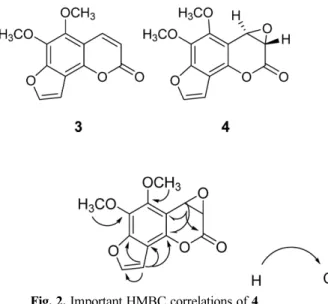
Compounds 1, 2, and 3 were identified as angelicin, 3 isobergapten, 3 and pimpinellin, 9 respectively, by comparing their physico-chemical and spectral data with those of literature values. The 1 H-NMR spectrum of 4 exhibited two pairs of doublets at δ 7.47 and 6.75 (each 1H, J = 2.1 Hz), and δ 4.40 and 4.04 (each 1H, J = 9.6 Hz). Two methoxyl signals showed at δ 3.85 and 3.69. These signals are very similar to those of 5, 8-dimethoxyetane 3, 4-epoxy-furanocoumarin. 12 The 13 C-NMR and HMBC spectra of 4 were slightly different to that of 5, 8- dimethoxyetane 3, 4-epoxyfuranocoumarin. In the HMBC spectrum of 4, C-3' proton at δ H 6.75 correlated to C-2' carbon at δ C 144.58 and C-7 carbon at δ C 148.19, C-8 carbon at δ C 113.81, and C-8a carbon at δ C 139.53. The C-4 proton at δ H 4.40 correlated to C-2 carbon at δ C
164.69, C-3 carbon at δ C 39.80, C-4a carbon at δ C 106.45, and C-8a at δ C 139.53. Furthermore, the two methoxyl groups are attached at C-5 ( δ C 144.58) and C-6 ( δ C 134.56), which were assigned by HSQC and HMBC spectra.
These result strongly suggested that 4 is an angular furanocoumarin derivative. 13,14 The HR-EIMS spectrum showed a molecular ion peak at m/z 262.0474, consistent with C 13 H 10 O 6 (calcd for 262.0477). The large coupling constants (J = 9.6 Hz) between H-3 and H-4 showed a 3, 4 – trans configuration of 4. The CD spectrum of 4 showed a positive cotton effect at 238 nm and a negative cotton effect at 210 nm, respectively. These data indicated 4 β-oriented epoxy moiety. 15,16 Based on the above data, the absolute configuration of C-3 and C-4 could be determined as 3S, 4R. Thus, the structure of 4 identified as (3S, 4R)-3,4-epoxypimpinellin, which is newly isolated from the plant sources. All the isolated compounds 1, 2, 3, and 4 were tested for acetylcholinesterase inhibition activity, showing inhibition activities against acetylcholi- nesterase with the IC 50 values of 10.2, 18.1, 21.5 and 22.9 Fig. 1. Structures of 1 - 4.
Fig. 2. Important HMBC correlations of 4.
Table 2. Acetylcholinesterase inhibitory activity of compounds 1 - 4.
Tested compounds IC
50a)(μg/ml) IC
50(μM)
1 1.9 10.2
2 3.9 18.1
3 5.3 21.5
4 6.0 22.9
Eserine
b)0.007 0.03
a)
The inhibitory activity dose that reduced 50% of acetylcho- linesterase activity and expressed as mean of two different experi- ments.
b)