거머리 요법에 대한 연구동향
The literature review of Leech therapy
Research Articles
Jang Hyo-kil (Directed by Prof. Heo Dong-seok, O.M.D., Ph.D.)
Dept. of Oriental Medicine Graduate school, Daejeon University
ABSTRACT
Objective : To review the trend of the study related to Leech therapy and to establish the hereafter direction for the study on Leech therapy.
Methods : I reviewed and analyzed all the theses published in Domestic and Foreign research institu- tion from 1990 to 2009.
Results : The following results were obtained in this study.
1. Analyzed number of theses published, there was no significance per year.
2. Classified by theme of journal, journals related to surgery were most(41 journals, 75.92%) among 54 kinds.
3. Classified by theses by research method and thesis types, case report accounted for nearly twothirds (52 pieces, 68.42%) of all theses and consideration of document was next(9 pieces, 11.84%).
4. With the most case of venous congestion after plastic and reconstructive surgery(33 pieces, 63.46%), leech therapy was effective on illnesses such as haematoma, macroglossia, purpura, vari- cous vein, avulsion injury, neurovascular compression, diabetic neuropathy, penoscrotal oedema, buerger's disease, rheumatoid arthritis.
5. Two most appeared adverse effects were anemia and infection. Immediate blood transfusion was done for recovering anemia and prophylactic 3rd generation antibiotics to infection were empha- sized in more than half of case reports.
6. All of consideration of documents was retrospective study of cases related leech therapy and 3 pieces of them emphasized prophyratic antibiotic treatment for preventing infection.
7. The study of clinical trail type started first in 2002 and osteoarthritis of knee and carpometacarpal joint were main target.
As see above result, Leech therapy was effective cure and could be used in disease induced by venous congestion. And I think that it is necessary to perform additional study related to solution of problems about leech therapy and protocol for using in clinical practice.
※Corresponding author : Heo Dong-seok, Dept. of Oriental Rehabilitation Medicine, Daejeon Oriental Hospital of Daejeon University, Daeheung-dong, Jung-gu, Daejeon, Korea
Tel : 042-229-6813 E-mail : [email protected] Key Words:
Leech therapy, Hirudo medicinalis, Medicinal leech, Hirudotherapy Received : 09. 12. 28 Accepted : 10. 02. 02
장효길, 허동석
대전한방병원 한방재활의학과
I
. 서론거머리는 한약명으로 水蛭이라고 하며 破血, 逐瘀, 通經 의 효능이 있어 痂 塊, 血瘀經閉, 跌打損傷등의 치료
에 이용된다1). ≪神農本草經≫2)에“主逐惡血, 瘀血, 月閉, 破血 積聚, 無子, 利水道”라고 기재되어 있고 ≪本草拾
遺≫3)에서는“人患赤白游及癰腫毒腫, 取十餘枚令啖病處, 取皮皺肉白”이라 하였으며, ≪東醫寶鑑≫4)에서는 鍼法 이라 하여 거머리를 환부에 시술하여 癰腫, 癰癤 등의 질 환에 응용하였다.
국외에서는
1981
년Bunker
등5)이periorbital hema- toma
제거 목적으로 사용하였으며, 그 후Foucher
등6)이 정맥 문합이 불가능한 수지 재접합술 후 정맥 울혈의 제거 목적으로 거머리를 사용하여 성공적인 결과를 보고한 후 부터 피판술이나 미세 수술 후 정맥 울혈의 제거 목적으로 사용이 일반화 되었으며7), 엄격한 과정을 거쳐 의료용으로 쓰이는 거머리는 여러 종이 있으나 그 중hirudo medici- nalis
가 가장 다용되고 있다8).미국식품의약국(`
Food and Drug Administration, FDA
)이2004
년에 정맥 순환을 회복시켜 손상된 이식조 직 치유에 도움을 주는 효과를 인정하여 거머리를 의료기 구로 국제적 승인9)을 하게 되면서 그 효능과 안정성이 인 정되었다.국제적으로 인정된 의료행위로, 국내 한방 및 양방 의료 기관에서도 거머리를 환부에 시술하여 임상에 활용하고 있으나 거머리 요법의 적응증, 부작용 및 예방적 처치 등 활용 방안에 대한 연구는 부족한 실정이다.
이에 저자는 거머리 요법의 활용 방안을 모색하기 위하 여
1990
년1
월부터2009
년10
월까지 국내외에서 발표된 거머리를 환부에 시술한 임상 논문들과 거머리 시술시의 부작용 및 예방적 처치에 관한 논문들을 고찰하여 약간의 지견을 얻었기에 이에 보고하는 바이다.II
. 본론1
. 조사대상국내, 외 대학과 연구기관에서
1990
년1
월부터2009
년10
월까지 발표된 거머리를 환부에 시술한 임상 논문들과 거머리 시술시의 부작용 및 예방적 처치에 관한 논문만을 대상으로 하였다.2
. 자료수집국립의학도서관(`
National Library of Medicine
)이 제 공하는 검색시스템인 미국Pub-med
(http://www.ncbi.
nlm.nih.gov/pubmed
)와 국내의 한국의학논문데이터베 이스(`http://kmbase.medric.or.kr
)의 홈페이지에 접속하여
1990
년부터2009
년10
월까지 발표된 논문을 대상으 로, "Leech therapy
", "Hirudo medicinalis
", "Hirudo- therapy
", "거머리", "기침", " 鍼", "수질", "水蛭"을 제목으 로 하여 검색 후 원문download
및 원문 복사의 방법으로 자료를 수집하였다. 단, 원문 및 요약을 확인할 수 없는 것, 거머리의 타액 성분에 대한 연구, 거머리 요법의 역사적 변 화 과정만을 서술한 논문은 제외하였다.3
. 자료분석1
) 연도별로 논문 발표 수 및 동향을 알아보았다.2
) 연구방법별로 문헌고찰, 임상시험 및 증례보고, 기타 논문으로 대별하여 시기에 따른 논문 발표 수 및 연구동향 을 개괄하였다.3
) 증례 논문을 질환별, 원인별, 부위별로 분류하여 거머 리를 환부에 시술하는 적응증을 분석하였다.4
) 증례 논문 중 시술 시의 부작용, 예방적 처치에 대한 내용을 살펴보았다.III
. 총괄 및 고찰水蛭은 거머리의 한약명으로 活血去瘀 효능을 이용하여 뇌혈관 질환, 심혈관 질환, 고지혈증, 호흡기 질환 등의 치 료에 광범위하게 응용되고 있다85).
거머리의 타액에는 항응고 성분이 있으며 다양한 종의 거머리로부터
fibrin
분해효소인hementin, factor Xa
저해제인antistasin, ghilanten, plasminortrypsin
의 저 해제인bdellin, thrombin
의 특이적 저해제인hirudin
등 이 분리되며 이 중성분이hirudin
에 대한 연구가 가장 활 발하게 이루어지고 있다86).기존에 사용되는 항응고제인
heparin
은 인체 투여 시bleeding
과thrombocytopaenia
와 같은 심각한 부작용 을 보이는데 비해,hirudin
은 과량 투여하여도bleeding
현상이 나타나지 않고87)tPA
(`tissue specific plasmino-
gen activator
)나streptokinase
등과 같은 혈전용해제에 의해 용해된clot
내에서 이탈된thrombin
의 활성을 억제 함으로써 혈관 내에서 다시 혈전이 형성되는 것을 효과적으로 방지한다88). 또한
heparin
은thrombin
합성을 억제 하기 위해서co-factor
로antithrombin
III(`AT-
III)이 필 요하지만hirudin
은thrombin
에 직접적으로 작용하기 때 문에 유전적으로AT-
III가 결실된 환자에게 효과적으로 사용될 수 있다89).송 등90)은 좌심방 혈전을 동반한 승모판협착증 및 삼첨 판 폐쇄부전이 진단된 환자에게
heparin
을 주입하였으나heparin
기인성 혈소판 감소증을 보여,heparin
대체약물 인hirudin
을 주입한 뒤 수술 후 과다 출혈 및 전신적 혈전 색전증 등의 합병증이 발생하지 않았다고 보고한 바 있다.임상에서 거머리 요법을 시행할 시에는 타액의 항응고 성 분을 이용한 정맥 울혈 해소를 통하여 손상된 조직의 산소 와 영양 공급을 회복시켜 주는 기전이 이용되며 한방에서 도 이런 기전을 이용하여 실제 임상에 시술할 수 있는 가 능성이 있다고 생각된다.
이에 저자는 거머리를 환부에 시술한 논문 및 그와 관련 된 부작용, 예방적 처치 등에 대해 고찰해보고자 한다.
((``1)) 전전체체 논논문문
1) 연도별 분석
연도별로 분석하였을 때1990년Braga 등10)의 논문을 시작으로 지속적으로 증감을 반복하는 경향이나 전체적으 로는 증가 추세를 보였고2004, 2005년도에는 가장 많이 연구된 이후2009년까지는 증감을 반복하는 추세를 보이 고 있다. 전체적으로는1998년 이후에 가장 많은 논문이 발표되었고(`80.26%), 2007년 2편, 2009년 3편이 발표 된 것을 제외하면2002년 이후로는 매년5편 이상의 논문 이 발표되었다(Fig. 1).
2) Journal별 분석
총54종의Journal에서76편의 논문이 발표되었고5편 을 보고한 저널이1개, 4편이2개, 3편이3개, 2편이7개 였으며 나머지40개에서 각각1편씩을 발표하였다.
저널 종류별로는 외과 수술 관련 저널23곳에서41편 (`53.94%)을 발표하여 대부분을 차지하였다(`Fig. 2). 다양 한 저널에서 연구되는 것처럼 보이나 실제로 수술 관련 저 널을 제외한 나머지31개Journal의 논문35편 중14편 은 주로 수술 후의 정맥 울혈에 대하여 시술한 경우를 사 례로 들고 있어 현재까지는 거머리 시술은 주로 정맥 울혈 을 대상으로 시행하고 있음을 확인할 수 있었다. 국내 논
문은 총11편(`14.47%)으로 국외의65편에 비하여 거머리 환부 시술 관련 연구가 미흡하였다.
((``2)) 연연구구 방방법법 및및 논논문문 형형태태에에 따따른른 분분석석
논문을 문헌고찰, 임상시험, 증례보고, 상기조건에 부합 하지 않는 경우 기타 항목으로 분류하였다. 단, 중복되는 경우에는 문헌고찰과 임상시험 및 증례 보고 여부를 우선 적으로 분류하여 복수처리 되지 않도록 하였다
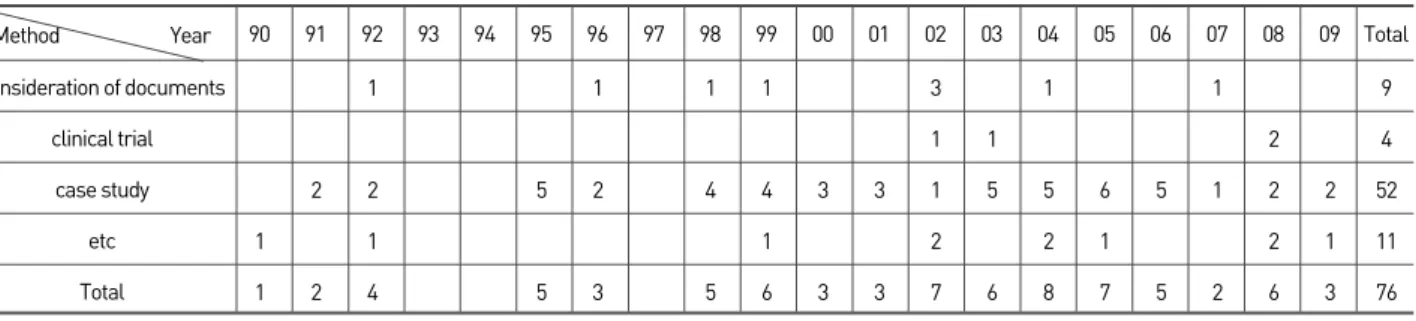
연구방법별로 구분한 결과 증례보고 방식의 연구는 총 논문 76편 중 52편(`68.42%), 문헌고찰논문은 9편 (`11.84%), 임상시험 4편(`5.26%), 기타11편(`14.47%)이 었다(`Table Ⅱ).
1) 문헌고찰(`TableⅡ)
문헌고찰 방식으로 연구된 논문은 총9편(`11.84%)으로 모두 거머리 시술의 증례 고찰이었으며 그 중3편은 감염 증례에 대한 고찰이었다. 연도별로 큰 증감이 없었으며 2002년도에3편이 발표된 것을 제외하면 매년0~1편 정 도로 발표되었다. 감염 사례3편은 모두 예방적 항생제 처 치를 강조한 공통점이 있었다. 국내에서는 윤 등7)의 논문 이 유일하였다.
2) 증례 보고
증례 보고는 총52편(`68.42%)으로 그 중 국내 논문은 10편, 국외 논문은42편이었다. 거머리 관련 논문 중 국내 논문은11개로 그 중10개가 모두 증례보고로 편중된 양 상을 보여 거머리 환부 시술에 대한 연구가 부족하였고 국 내 논문10개 중 한의학 분야 논문은3편으로 양방에 비하 여 연구가 적게 이루어졌다.
증례 보고는3년 또는5년마다 증감을 반복하는 경향이 있었고 2005년도에6편으로 가장 활발하게 연구되었다.
20년 동안 총90명을 대상으로38종의 학회지에서 총52 편의 증례 보고가 있었으며 이식 및 재건 수술 후의 정맥 부전 증례가 대부분을 차지하고 있었다.
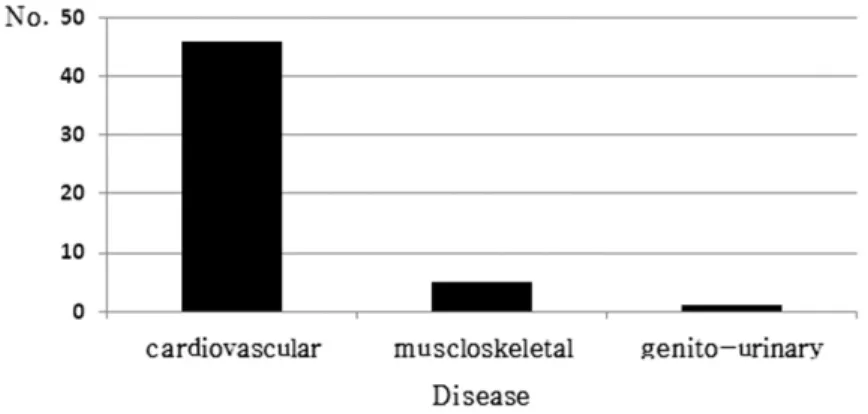
증례 보고를 질환별로 구분하였을 경우, 심혈관계 질환 이 대다수를 차지하여 거머리 자체의 한의학적 적응증인 어혈과의 관련성을 보였다. 근골격계 질환에 대한 증례 중 유 등83)을 제외한 나머지4례는 모두 거머리 요법 시술 후 부작용이 발생하여 임상적 활용성이 적었다(`Fig. 5).
시술 질환의 병인은 크게 정맥 울혈, 통증, 기타로 분류 되었으며 성형 및 재건 수술 후 발생한 정맥 울혈에 대하
여 거머리 시술을 한 논문은
52
편중33
편(`63.46
%), 단순 외상 후 발생한 정맥 울혈에 시행한 경우는8
편(`15.38
%), 타 기저질환에 의하여 속발성으로 발생한 경우가3
편 (`5.76
%), 원인 미상인 경우가1
편(1.92
%)이었다. 통증에 시술한 경우는 총5
편(`9.61
%)이고 그 중 류마티스 관절염 1례를 제외한 나머지4
편은 진단을 받지 않은 원인 미상의 통증이었다. 기타 질환으로는 감염에 의하여 속발된 자반 증에 관한 증례2
편(`3.84
%)이 있었다(`Fig. 6
).재건술을 시행 뒤 거머리 요법을 시술한 경우 부위별로 는 하지가
17
편으로 가장 많았다. 그 외에도 손 및 수지, 귀, 유방, 입술, 구강, 두피 등의 순으로 시술되었다(`Fig.
7
). 주로 외상에 의하여 손상받기 쉬운 돌출된 부위나 연 부조직이 재건술 및 거머리 시술의 부위였으며, 한의학적 임상에서도 사지말단 및 돌출 부위의 울혈에 대해서는 적 응할 수 있는 가능성이 있다고 사료된다.통증에 대하여 시술한 경우는
5
편으로 하지에 시술한 경우가4
편, 견갑 간 부위에 시행한 경우가1
곳이었으며 자반증에 시행한 경우는 증상이 외부적으로 관찰되는 곳 에 시행하였다. 환자가 증상을 호소하는 환부 근처에 시행 하였으며 원위부에 시술한 경우는 없었다. 다만Ouderkirk
등55)은 중추신경계의 근위부에 시술할 경우 신 경계의 감염이 일어날 가능성이 있으므로 신중을 기해야 함을 강조하였고 이는 환부에 시술 시 근위부에 직접 시술 하는 것을 피해야 할 경우도 있음을 의미한다. 따라서 거 머리 시술은 환부 근위부의 시술이 다용되나 원위부에 시 술할 시의 효과에 대해서도 연구가 필요하다고 사료된다.외과 수술 후 발생한 정맥 울혈의 경우를 제외한 질환에 거머리 시술을 하여 호전이 된 경우는 외국의 경우 혈종, 거설증, 자반증, 하지 정맥류, 반지로 인한 수지결찰손상, 신경혈관 압박, 음경 및 음낭의 부종 등이 있었다(`
Fig. 9
).국내 증례
10
편 중 양방의7
편은 모두 외과 수술 후 발생 한 정맥 울혈에 거머리를 시술하였으며 한방의 경우 나49) 의 당뇨발, 곽 등82)의 버거씨 병 증례와 유 등83)의 류마티스 성 관절염에 대한 보고가 있었다(`Fig. 10
). 외국의 경우는 국내에 비하여 다양한 질환에 대하여 거머리 요법을 시술 하였으며, 국내에서는 종류는 적으나 외국에서 시행되지 않은 당뇨발과 버거씨 병에 대한 증례 보고가 있었다.상기 증례들은 정맥의 울혈 및 그로 인한 부종, 괴사 등 의 제반증상이 체외에서 관찰되었을 때, 항응고제 투여를 할 경우가 아니거나 투여해도 효과를 기대하기 어려운 경 우 외부적인 처치로 거머리를 사용하는 경우라고 사료되 며 이와 같은 질환에 대해서는 한의학계에서 이용 가능성
이 높다고 생각된다. 정맥 울혈이 아닌 근골격계 통증과 관련하여 류마티스성 관절염에 시술한 증례도 1례가 있으 나 아직은 연구가 부족하며, 나머지 4례는 의사의 처방 없 이 시술한 후 부작용이 발생했다는 점에서 임상적 활용도 가 적었다.
거머리 시술 후 발생할 수 있는 부작용 중 가장 흔한 것 은 빈혈이었으며 상기 증례 중 빈혈로 인하여 수혈 처치를 받은 경우는
52
편 중12
편(`23.07
%)에서 언급이 되어 있 었다. 이는 거머리의 타액 성분 중 강력한 항응고 작용을 가진 히루딘으로부터 기인한다.Mortenson
등27)은 거머 리 시술 시에 혈액검사를 매일 실시하여 이상 여부를 확인 하기도 하였으나 한의학적 임상에서는 이러한 처치에 제 한이 있으므로 거머리 시술 시에 補血劑를 이용하는 등 대 체방안을 모색할 필요가 있다.두 번째로 흔한 부작용은 감염으로 이는 거머리의 장내 에서 공생하는 미생물 중 대부분을 차지하는
Aeromonas hydrophilia
로 인해 주로 발생한다. 최근에는Vibrio fluvialis
23)및Serratia marcescens
26)로 인한 감염 사례 도 보고되고 있으며Bauters
등75)은 감염 증상이 국소 농 양 및 봉와직염부터 심각한 조직 손상과 패혈증까지 있었 다고 보고한 바 있다. 상기 증례에서 감염사례를 언급한 논문은 총10
편(`19.23
%)이었으며 감염 증상으로는 봉와 직염, 다발성 가성림프종 및 뇌수막염, 혈전성 미세혈관병 증등이 있었다.일단 감염이 되면 감염 치료와 괴사부의 제거 및 재건이 필요하므로 전체적인 치료기간이 길어지고 치료 비용의 증가는 물론 기능 회복이 현저히 떨어지게 된다. 전체
52
편 중29
편(`55.76
%)에서 감염을 방지하기 위하여 예방적 항생제를 강조하였으며Bauter
등75)은 거머리에서 검출된 미생물을 대상으로 실험한 후 자체적인 항생제 대책 위원 회를 구성하여fluoroquinolone
를 주 항생제로 선정하여 이용하였다.상기 증례 논문 중 감염을 막기 위하여 실제로 예방적 항생제 처치를 시행한 논문은
52
편중14
편(`26.92
%)으로 예방적 항생제를 강조한29
편(`55.76
%)과 모순되는 상황 이 관찰된다. 이에 대해Whitaker
등81)은2009
년에 영국 과 아일랜드 공화국에서5
년간의 후향적 설문조사를 시행 한 결과, 거머리에 의한 감염이 널리 알려져 있음에도 많 은 병원에서 적절한 항생제 처치를 시행해오지 않았으며 거머리 시술에 대한 프로토콜이 정해져 있지 않아 시술자 마다 서로 다른 방식으로 시술을 하게 되는 것이 원인이라 파악하였다. 이는Lineaweaver
등14)이 이미1990
년도에지적한 점으로 그는 증례 문헌 고찰 시에 거머리의 시술 방식에 대한 서술이 생략이 되는 부분이 많으며 시술 방식 자체도 시술자마다 달라 연구에 어려움이 있음을 지적하 였다.
Chalain
등24)도 거머리에 대한 임상 논문 고찰 후 거머리 시술에 대한 개별적인 논문의 내용과 논문들을 고 찰한 내용이 모순되는 점이 있어 통계학적인 분석을 시도 할 수 없었다고 하였다.상기의 증례 논문에서도 항생제 사용에 대한 정확한 실 태 파악이 어려웠으나 절반 이상의 증례 논문에서 예방적 항생제 처치는 감염방지를 위해 중요하다고 강조하여 실 제 임상에서는 항생제를 시술하는 것이 안정적인 치료를 위해서 필요하다고 사료된다. 그러나 실제 한의원 및 한방 병원에서 항생제를 일괄적으로 시술하기에는 현실적으로 무리가 있으며 이에 대해서는 감염을 막을 수 있는 대체 방안의 연구가 필요하다. 또는 병원급 한, 양방 협진의 시 스템 하에서 거머리 시술을 하는 것도 하나의 대안이 될 수 있을 것이다.
감염 방지를 위하여
Mumcuoglu
등84)은 자체 제작한 장치를 이용하여 의료용 거머리에ciprofloxacin
을 복용 하게 하여 그 결과로 흡인 기능은 정상으로 유지된 상태로 배양 검사 상Aeromonas
종이 알아채지 못할 정도로 줄 었으며, 매주 시행한 검사에서Aeromonas
음성 판정을 받았다고 보고하였다. 다만Aeromonas
종과 거머리는 강 한 연계관계가 있어Germ-free
거머리는 힘들다고 하였 으며ciprofloxacin
투여 후 제거가 된 것이 아닌 배양만 억제되었을 가능성도 있다고 하였다. 하지만 거머리 시술 자체에 대하여 감염방지를 하려는 노력 자체는 계속 시도 되어야 한다고 하여 지속적으로 행해져야 하는 연구임을 강조하였다.그러나
Michalsen
등53)은 기존의 거머리 시술 후 감염 이 있었던 사례는 미생물의 침입이 용이한 상황이라고 하 며 관절염에 시술 시에는 그런 조건이 배제되므로 감염의 위험이 적다고 주장하였다. 이는 거머리 시술 부위의 상태 에 따라 감염의 발생률이 달라질 수 있다는 주장으로 시술 시 환부의 감염 가능성이 높다면 항생제 등의 예방적 처치 가 선행되어야 함을 나타낸다.3
) 임상시험임상시험은
2000
년도 이후에 본격적으로 시도 되어 현 재까지 총 4편이 보고되었으며 편수 자체가 적어 년도 별 로 특이성은 없었다. 임상시험논문 중3
편은Michalsen
등45,53,79)에 의하여 주도되었다.
Michalsen
은 슬부의 골관절염 환자와 수근중수골의 증후성 관절증을 호소하는 여 성에 대하여 무작위 대조군 연구를 시행하여 거머리를 시 행한 군이 유의한 호전을 보였다고 하였다.
Andereya
등78)은
2008
년경 슬부의 골관절염을 호소하는110
명을 대 상으로artificial leech
를 이용한 이중맹검 및 무작위 대 조군 연구를 시행한 뒤KOOS, WOMAC, VAS score
상 유효한 효과를 얻었다고 보고하였다. 하지만 대상 환자 들의 대부분이 실제 거머리와artificial leech
를 구분할 수 있었다는 점을 지적하며 대조군의bias
를 제거하기 위 한 추가적인 노력이 필요하다고 하였다.임상시험은
2000
년도 이후에 시작 되어 논문 편수 자 체는 많지 않았으나 시술 관절의 다양화 및 대상 환자군의 증가를 시도하려는 경향이 있었다. 임상시험은 거머리 환 부 시술에 대한 치료의 근거를 제공해준다는 점에서 바람 직한 시도로 판단되지만 문헌적, 학술적으로 연구되어진 기반에서 시작되는 것이 일반적인 점을 생각해봤을 때, 문 헌 고찰 및 증례 논문에서 빈도가 낮았던 질환에 대하여 임상시험을 곧바로 실시한 점은 이례적이라고 사료된다.임상시험이 주로 통증과 관련된 것에 관하여
Michals- en
등53)과Andereya
등78)은 거머리의 진통 작용을 관문효 과, 플라시보 효과, 그리고 거머리가 분비하는 타액의 진 통성분의 복합적인 작용이라고 추측하였으며 정확한 기전 은 알기 힘들다고 하였다. 제반 통증 질환에 거머리를 이 용하기 위해서는 추후 임상시험과 동반하여 거머리의 진 통기전에 대한 연구가 필요할 것으로 생각된다.국내에서는 임상 시험 논문이 한 편도 없어 근골격계 질 환의 비중이 큰 한방병원 및 한의원에서의 거머리 시술을 위해서는 치료수단의 효율성을 입증할 필요가 있으므로 한 방병원 급에서 한의원과 연계하여 임상시험을 실시할 필요 가 있다고 사료된다. 앞으로의 거머리 시술에 대한 임상시 험은 대상 인원의 증가 및 시술 관절의 다양화, 시술 질환 의 다양화를 추구하는 동시에 결과에 영향을 미치는 환자 의
bias
를 최소화하려는 방향으로 진행되야 할 것이다.4
) 기타기타로 분류한
11
편은 거머리 치료의 대체 기구, 실험 실 논문, 설문조사 논문으로 분류되었다.Cottler
등34)은 거머리 시술 이후의 출혈량을 늘리도록 자체 제작한 기구 를 실험용 쥐에 시술한 뒤 거머리 요법 시행 군과 비교하 여, 정맥 부전 피판에서 생존 피부의 범위의 증가에 의료 기구가 의료용 거머리만큼 효과적이라고 보고하였다.Conforti
등46)은 거머리의 혐오스러운 외양으로 인한 거부감, 감염의 위험성, 거머리 관리의 비용 및 시술중의 지 속적인
monitoring
이 필요한 점을 보완하기 위하여 의료 기구를 제작하여 시험해 본 결과, 의료 기구는 정맥 울혈 의 치료에 의료용 거머리를 대신할 수 있는 가능성이 있다 고 보고하였다. 치료 수단의 개선이라는 측면에서 한의학 계에서도 관심을 가져야 되는 부분이며 다만 단순한 울혈 의 제거가 실제적인 조직 손상의 회복으로 연결되는지에 대한 기초 연구가 동반이 되어야 한다고 사료된다.실험 논문 중
Braga
등10)은 환자에게 발생할 수 있는 감 염을 낮추기 위하여 거머리의 장내 세균에 대한 항생제 감 수성을 시험한 뒤 가장 효과가 있는 항생제는ciproflox- acin, tetracycline, trimethoprim-sulfamethoxasole
라고 보고하였으며Lee
등16)은 실험용 쥐에게 피판을 이식 시킨 뒤 거머리를 환부에 시술하여 유의한 피판 복구결과 를 얻었다.Schlaudraff
등80)은 동정맥 부전의 실험용 쥐 에 대하여 거머리를 시술한 뒤 동맥 부전 상황에서는 거머 리 시술의 효과가 없으며 순수한 정맥의 울혈일 경우 효과 가 있다고 보고하여 거머리 시술 시 환부에 대한 면밀한 조사가 동반된 이후에 거머리를 시술하는 것이 환자에게 적절한 치료를 실시할 수 있게 함을 보고하였다.Michalsen
등66)은 거머리 치료를 받은 슬부의 골관절 염 환자를 대상으로 설문조사를 하여 길게는12
개월까지 지속되는 효과가 있다고 보고하여 근골격계 질환에 거머 리가 효과가 있다고 보고하였다.Whitaker
등82)은 거머리 의 시술 상황을 파악하기 위하여 영국 및 아일랜드의 병원 을 대상으로 설문조사를 시행한 뒤 병원마다 명확한 프로 토콜이 없고 예방적 항생제 처치를 시행하지 않는 곳이 다 수 있음을 비판하였다.전반적으로 거머리에 관한 연구가 활발했던
2004
년 및2005
년에 활발한 양상을 보였으며 거머리 시술 시에 치료 의 효율적인 측면 보다는 환자의 편의를 목적으로 다양한 방식의 연구가 진행되었다.전체
76
편의 논문 중 거머리 환부 시술에 대한 프로토 콜을 제시한 것은4
편7,24,44,51)에 지나지 않았으며 각각의 병 원에서 자체적으로 시행하는 방법을 제시한 정도였다. 거 머리를 환부에 시술하는 시간 및 간격, 기간 등이 거머리 개체간의 차이, 환자 상태의 특이성 및 시술자가 증상 호 전을 판단하는 기준에 따라 다양하여 프로토콜도 시술 방 식 자체에 대한 것은 적었다. 그러나 거머리 요법 시행 시 발생 가능한 문제점 제기 및 이에 대한 대안을 제시하는 연구가 지속적으로 이뤄지고 있었고 실제로 프로토콜을제시한
4
편7,24,44,51)에서는 거머리 환부 시술의 적응증 및 부적응증, 보관 방법, 부작용, 감염 방지를 위한 예방적 항생 제 처치 등에 관련된 내용을 포함하고 있었다.
76
편의 논문 고찰을 통하여 저자는 다음과 같은 프로토 콜을 제안할 수 있었다.첫째, 의료용 거머리를 보관하는 수조의 오염으로 인하 여 거머리 요법 시 발생할 수 있는 감염을 방지하기 위해 정기적인 교환 및 소독이 필요하다. 둘째, 거머리 요법은 동맥의 공급이 확실한 상황에서 정맥의 울혈 및 그로 인한 부종, 괴사 등의 제반증상이 체외에서 관찰되었을 때, 항 응고제 투여를 할 경우가 아니거나 투여해도 효과를 기대 하기 어려운 경우 외부적인 처치로 시술할 수 있다. 셋째, 환부의 감염 발생률을 최소화하기 위하여 찰과상, 개방성 상처 등에는 시술을 피해야 한다. 넷째, 감염 예방을 위하 여 제 3세대 항생제를 이용하여 예방적 항생제 처치를 시 행하는 것이 안전하며 한방병원 및 한의원에서는 양방병 원과의 협진도 하나의 대안이 될 수 있다. 다섯째, 거머리 를 조작할 때 강제로 떼어낼 경우 구토가 유발되어 장내세 균인
Aeromonas hydrophilia
로 인한 감염이 발생할 수 있으므로, 거머리가 흡혈하는 중에는 만지거나 움직이지 않는다. 여섯째, 감염, 빈혈, 응고장애등의 부작용 방지를 위하여 정기적으로 혈액검사를 시행하여야 한다. 일곱째, 사용된 의료용 거머리의 폐기에는70
% 에탄올 용액을 이 용한다. 여덟째, 거머리 요법의 시술이 적합하지 않은 경 우는 동맥부전이 동반되거나 거머리에게 과거에 노출이 되었던 자, 면역억제치료를 받고 있거나 수혈을 거부하는 자, 거머리 요법 자체에 대하여 거부감을 가진 자, 의학적 으로 불안정한 상황에 있는 자이다.본 연구는 거머리 요법과 관련된 국내 및 국외의 논문을 고찰하였으나, 거머리 요법에 대한 연구는 치료법의 유효 성의 검증에 집중되어 있었으며, 부작용과 안전성을 검증 하는 연구는 미흡한 점이 아쉬웠다. 이는 아직 거머리 요 법이 치료적 측면에서 보조적인 수단으로만 이용되기 때 문으로 생각된다. 시술 질환도 정맥울혈에 편중되어 있었 으며, 정맥울혈 이외의 질환에 대한 증례는 적었다. 또한 국산 거머리는 크기도 작고 흡입력도 약하여 외국의 대형 거머리를 이용하는 현 상황은 국산 거머리 종의 개량 등을 통한 개선이 필요하다고 생각된다. 향후 거머리 요법의 임 상 활용도를 높이기 위해서는 정맥울혈 이외의 질환에 대 한 시술 가능성에 대한 연구 및 부작용을 줄일 수 있는 방 안의 모색이 필요하다.
IV
. 결론거머리 요법의 연구경향을 알아보기 위하여
1990
년1
월부터2009
년10
월까지 국내 및 국외에서 발표된 거머 리 시술과 관련된 논문76
편을 고찰한 결과 다음과 같은 결론을 얻었다.1
. 전체 논문의 년도 별 발표 수는 특이성이 없었다.2
. 발표 저널은 총54
개였으며, 그 중 외과 관련 저널이41
편으로 가장 많았다.3
. 논문유형은 증례보고52
편, 문헌고찰9
편, 임상시 험4
편 등이었다.4
. 증례 보고는 이식 및 재건 수술 후 발생한 정맥 울혈 에 대한 증례가33
편으로 대부분을 차지하였고, 나머지는 거설증, 자반증, 신경혈관 압박, 당뇨병성 말초신경병증, 음경 및 음낭의 부종, 버거씨병, 류마티스성 관절염이었다.5
. 거머리 시술 후 빈혈과 감염 부작용이 발생한 경우, 빈혈에 대해서는 즉각적인 수혈 처치를 시행하였고, 감염 에 대해서는 제3
세대 항생제를 이용한 예방적 처치를 강 조하였다.6
. 문헌고찰9
편 모두 거머리 환부 시술에 대한 후향적 연구였으며, 그 중3
편은 거머리 시술 후 발생할 수 있는 감염에 대한 예방적 항생제 처치를 강조하였다.7
. 임상시험은2000
년 이후 처음 시작되어, 슬관절 및 수근중수관절의 관절염에 주로 활용되었다.이상을 종합해보면, 거머리 요법은 타박 및 수술 이후에 발생 가능한 정맥울혈 증상에 사용될 수 있을 것으로 생각 되며, 부작용을 최소화할 수 있는 방안 및 임상 프로토콜 의 정립이 필요할 것으로 생각된다.
V
. 참고문헌1
. 全國韓醫科大學 本草學敎授 共編著. 本草學. 서울:圖書出版 永林社.
1995:430-3.
2.
著者未詳. 神農本草經. 太原.:山西科學技術出版社.1991:118.
3.
김창민, 신민교, 이경순, 안덕균 역. 中藥大辭典. 정 담.2004:2566.
4.
許浚 原著, 趙憲泳, 金東日 外10
人 共譯. 東醫寶鑑.서울:여강출판사.
1994:2207.
5. Bunker TD. The contemporary use of the med- icinal leech. Injury. 1981;12(5):430-2.
6. Foucher G, Henderson H, Maneau M, Merie M, Braun F. Distal digital replantation. Interna- tional Journal of Microsurgery. 1981;3:263-70.
7. Yun HH, Jeong DS, Choe J. Measures to Reduce Aeromonas hydrophilia Infection that May Occur after Leech Application. The jour- nal of the Korean Microsurgical Society.
2002;11(1):73-7.
8. Trontelj P, Sotler M, Verovnik R. Genetic dif- ferentiation between two species of the medici- nal leech, Hirudo medicinalis and the neglect- ed H. verbana, based on random-amplified polymorphic DNA. Parasitolog Research.
2004;94(2):118-124.
9. Celia M. Indications for Use. Food and Drug Administration. 2004 Jun 21:1. Available from: URL : http://www. accessdata.fda.gov/
cdrh_docs /pdf4/k040187.pdf.
10. Braga A, Lineaweaver WC, Whitney TM, Follansbee S, Buncke HJ. Sensitivities of Aeromonas hydrophilia cultured from medici- nal leeches to oral antibiotics. Journal of reconstructive microsurgery. 1990;6(2):135-7.
11. Menage MJ, Wright G. Use of leeches in a case of severe periorbital haematoma. British Journal of Ophthalmology. 1991;75(12):755-6.
12. Regan PJ, Roberts JO, Sabapathy SR, Roberts AH. Use of the medicinal leech to salvage spe- cialized skin jeopardized by venous impair- ment. Injury.1991;22(2):161-3.
13. Dabb RW, Malone JM, Leverett LC. The use
of medicinal leeches in the salvage of flaps
with venous congestion. Annals of Plastic
Surgery. 1992;29(3):250-6.
14. Lineaweaver WC, Hill MK, Buncke GM, Follansbee S, Buncke HJ, Wong RK, Manders EK, Grotting JC, Anthony J, Mathes SJ. Aero- monas hydrophilia infections following use of medicinal leeches in replantation and flap surgery. Annals of plastic surgery.
1992;29(3):238-44.
15. Gross MP, Apesos J. The use of leeches for tre- atment of venous congestion of the nipple fol- lowing breast surgery. Aesthetic Plastic Surge- ry. 1992;16(4):343-8.
16. Lee C, Mehran RJ, Lessard ML, Kerrigan CL.
Leeches : controlled trial in venous comprom- ised rat epigastric flaps. British journal of plas- tic surgery. 1992;45(3):235-8.
17. Iafolla AK. Medicinal leeches in the postoper- ative care of bladder exstrophy. Journal of Per- inatology. 1995;15(2):135-8.
18. Smeets IM, Engelberts I. The use of leeches in a case of post-operative life-threatening macr- oglossia. The Journal of Laryngology and Ot- ology. 1995;109(5):442-4.
19. de Chalain T, Cohen SR, Burstein FD. Succe- ssful Use of Leeches in the Treatment of Purpura Fulminans. Annals of Plastic Surgery.
1995;35(3):300-4.
20. Rivera ML, Gross JE. Scalp replantation after traumatic injury. AORN journal.
1995;62(2):175-80.
21. Haycox CL, Odland PB, Coltrera MD, Raugi GJ. Indications and complications of medicinal leech therapy. Journal of the American Academy of Dermatology. 1995;33(6):1053-5.
22. Pantuck AJ, Lobis MR, Ciocca R, Weiss RE.
Penile replantation using the leech Hirudo medicinalis. Urology. 1996;48(6):953-6.
23. Varghese MR, Farr RW, Wax MK, Chafin BJ, Owens RM. Vibrio fluvialis wound infection associated with medicinal leech therapy.
Clinical Infectious Diseases.
1996;22(4):709-10.
24. de Chalain TM. Exploring the use of the
medicinal leech : a clinical risk-benefit analy- sis. Journal of reconstructive microsurgery.
1996;12(3):165-72.
25. Bapat RD, Acharya BS, Juvekar S, Dahanukar SA, Leech therapy for complicated varicose veins. Indian Journal of Medcal Research.
1998;107:281-4.
26. Pereira JA, Greig JR, Liddy H, Ion L, Moss AL. Leech-borne Serratia marcescens infection following complex hand injury. British Journal of Plastic Surgery. 1998;51(8):640-1.
27. Mortenson BW, Dawson KH, Murakami C.
Medicinal leeches used to salvage a traumatic nasal flap. British Journal of Oral and Maxillofacial Surgery. 1998;36(6):462-4.
28. Weinfeld AB, Kattash M, Grifka R, Friedman JD. Leech therapy in the management of acute venous congestion of an infant's lower limb.
Plastic & Reconstructive Surgery.
1998;102(5):1611-4.
29. Utley DS, Koch RJ, Goode RL. The failing flap in facial plastic and reconstructive sur- gery: role of the medicinal leech. The Laryng- oscope. 1998;108(8):1129-35.
30. Yoon ID, Kim YK, Kim JO, Park JH, Baek RM, Choe J. Leech Therapy in Digital Repla- ntation of Children. Journal of the Korean Microsurgical Society. 1999;8(1):64-70.
31. Ahn HB, Cho GS, Kim DY, Microsurgical Replantation of A Partial Ear with Arteriole Anastomosis. Journal of the Korean Microsur- gical Society. 1999;8(1):10-4.
32. Cho BH, Ahn HB. Microsurgical Replantation of a Partial Ear, With Leech Therapy. Annals of Plastic Surgery. 1999;43(4):427-9.
33. Friedman J, Fabre J, Netscher D, Jaksic T.
Treatment of acute neonatal vascular injuries-- the utility of multiple interventions. Journal of pediatric surgery. 1999;34(6):940-5.
34. Cottler PS, Gampper TJ, Rodeheaver GT.
Evaluation of clinically applicable exsanguina-
tion treatments to alleviate venous congestion
in an animal skin flap model. Wound repair and regeneration : official publication of the Wound Healing Society [and] the European Tissue Repair Society. 1999;7(3):187-195.
35. Fenollar F, Fournier PE, Legre R. Unusual case of Aeromonas sobria Cellulitis Associated with the Use of Leeches. European journal of clini- cal microbiology & infectious diseases : offi- cial publication of the European Society of Clinical Microbiology. 1999;18(1):72-3.
36. Smolle J, Cerroni L, Kerl H. Multiple pseu- dolymphomas caused by Hirudo medicinalis therapy. Journal of the American Academy of Dermatology. 2000;43(5):867-9.
37. Baek CH, Shin JH, Park JH. Medicinal leech therapy for salvage of the failing flap. Korean journal of head & neck oncology.
2000;16(1):20-25.
38. G neren E, Erolu L, Akba H, Uysal OA, H ke-lek M, Erolu C. The use of Hirudo medici- nalis in nipple-areolar congestion. Annals of Plastic Surgery. 2000;45(6):679-80.
39. Byrne PJ, Bernstein PE. The use of medicinal leeches to treat macroglossia secondary to blunt trauma. Otolaryngology-head and neck surgery : official journal of American Academ- y of Otolaryngology-Head and Neck Surgery.
2001;125(6):649-50.
40. Noh JH, Minn KW, Lee HT, Yoo WI. Microsu- rgical Replantation of the Amputated Ear with- out Venous Repair : Clinical Experience with Leech. Journal of the Korean society of plastic and reconstructive surgeons.
2001;28(6):667-70 .
41. Talbi M, Stussi JD, Meley M. Microsurgical Replantation of a Totally Amputated Ear Without Veonus Repair. Journal of reconstruc- tive microsurgery. 2001;17(6):417-20.
42. Guven, H, Akbas, H. The use of leeches in the management of a ring avulsion injury. Europe- an journal of plastic surgery. 2002;25(3):162-4.
43. Sartor C, Limouzin-Perotti F, Legr R, Casan-
ova D, Bongrand MC, Sambuc R, Drancourt M. Nosocomial Infections with Aeromonas hydrophilia from leeches. Clinical infectious diseases : an official publication of the Infecti- ous Diseases Society of America.
2002;35(1):1-5.
44. Chepeha DB, Nussenbaum B, Bradford CR, Teknos TN. Leech therapy for patients with surgically unsalvageable venous obstruction after revascularized free tissue transfer.
Archives of otolaryngology--head & neck surgery. 2002;128(8):960-5.
45. Michalsen A, Deuse U, Esch T, Dobos G, Moebus S. Effect of leeches therapy (Hirudo medicinalis) in painful osteoarthritis of the knee: a pilot study. Annals of the rheumatic diseases: the official journal. 2001;60(10):986.
46. Conforti ML, Connor NP, Heisey DM, Vand- erby R, Kunz D, Hartig GK. Development of mechanical devint to replace medicinal leech for tce tment of venous congestion. Journal of rehabilitation research and development.
2002;39(4):497-504.
47. Connor NP, Conforti ML, Heisey DM, Vande- rby R, Kunz D, Hartig GK. Augmented blood removal after medicinal leech feeding in con- gested tissue flaps. Journal of rehabilitation research and development. 2002;39(4):505-12.
48. Avci G, Akan M, Yildirim S, Ak z T. Digital neurovascular compression due to a forgotten tourniquet. Hand Surgery. 2003;8(1):133-6.
49. NA HJ. The Effects of Live Leech (Hirudo Medicinalis) Therapy on Diabetic Foot : a Clinical Case Report. Korean Journal of Oriental Medicine. 2003;24(4):136-8.
50. Philip J, Armitage DW, Phillips KR. Leech therapy for penoscrotal oedema in patients with hormone-refractory prostate carcinoma.
BJU international. 2003;91(6):579-80.
51. Dixon M. Leeches in PICU. Pediatric nursing.
2003;29(3):216-8.
52. Gideroglu K, Yildirim S, Akan M, Akoz T.
Immediate use of medicinal leeches to salvage venous congested reverse pedicled neurocuta- neous flaps. Scandinavian journal of plastic and reconstructive surgery and hand surgery.
2003;37(5):277-82.
53. Michalsen A, Klotz S, L dtke R, Moebus S, Spahn G, Dobos GJ. Effectiveness of leech therapy in osteoarthritis of the knee : a ran- domized, controlled trial. Annals of internal medicine. 2003;139(9):724-30.
54. Tuncali D, Terzioglu A, Cigsar B, Aslan G.
The value of medical leeches in the treatment of class IIC ring avulsion injuries : report of 2 cases. The Journal of hand surgery.
2004;29(5):943-9.
55. Ouderkirk JP, Bekhor D, Turett GS, Murali R.
Aeromonas meningitis complicating medicinal leech therapy. Clinical infectious diseases : an official publication of the Infectious Diseases Society of America. 2004;38(4):36-7.
56. Duroure F, Simon E, Fadhul S. Microsurgical lip replantation : Evaluation of functional and aesthetic results of three cases. Microsurgery.
2004;24(4):265-9.
57. Mineo M, Jolley T, Rodriguez G. Leech thera- py in penile replantation : a case of recurrent penile self-amputation. Urology.
2004;63(5):981-3.
58. Frodel JL, Barth P, Wagner J. Salvage of par- tial facial soft tissue avulsions with medicinal leeches. Otolaryngology-head and neck surger- y : official journal of American Academ-y of Otolaryngology-Head and Neck Surgery.
2004;131(6):934-9.
59. Hartig GK, Connor NP, Heisey DM, Conforti ML. Comparing a mechanical device with medicinal leeches for treating venous conge- sion. Otolaryngology--head and neck surgery : official journal of American Academy of Otolaryngology-Head and Neck Surgery.
2003;129(5):556-64.
60. Whitaker IS, Izadi D, Oliver DW, Monteath G,
Butler PE. Hirudo Medicinalis and the plastic surgeon. British journal of plastic surgery.
2004;57(4):348-53.
61. Ikizceli I, Avsarogullari L, S z er E, Y r mez Y, Akdur O. Bleeding due to a medicinal leech bite. Emergency medicine journal.
2005;22(6):458-60.
62. Heckmann JG, D tsch M, Neund rfer B, D tsch F, Hartung U. Leech therapy in the treat- ment of median nerve compression due to fore- arm haematoma. Journal of neurology, neuro- surgery, and psychiatry. 2005;76(10):146.
63. Steer A, Daley AJ, Curtis N. Suppurative sequelae of symbiosis. The Lancet.
2005;365(9454):188.
64. Kumar N, Mohindra R, Mohan B, Wander GS.
Gastrointestinal bleed after leeching in a patient on aspirin therapy. Indian journal of gastroenterology : official journal of the Indian Society of Gastroenterology. 2005;24(4):170.
65. Peter S, Ron Winokur BS, Greg A, Edmund P.
Successful Non-Microvascular Nasal Tip Replantation After Traumatic Avulsion. The Internet Journal of Plastic Surgery. 2006;2(2).
Available from : URL:http://www.ispub.com 66. Yim YM, Kwon H, Oh DY, Lee JY, Jung SN.
Replantation of Nose Amputation by Use of Medical Leech. Journal of the Korean Society of Plastic and Reconstructive Surgeons.
2005;32(1):124-130.
67. Spahn, G, Rieckmann, T, Michalsen, A. Long term results and adverse effects of leech thera- py in osteoarthritis. Complementary health care. 2005:34.
68. Ardehali B, Hand K, Nduka C, Holmes A, Wood S. Delayed leech-borne infection with Aeromonas hydrophilia in escharotic flap wound. Journal of plastic, reconstructive &
aesthetic surgery. 2006;59(1):94-5.
69. Dippenaar R, Smith J, Goussard P, Walters E.
Meningococcal purpura fulminans treated with
medicinal leeches. Pediatric critical care
medicine : a journal of the Society of Critical Care Medicine and the World Federation of Pediatric Intensive and Critical Care Societies.
2006;7(5):476-8.
70. Kim KC, Chung C, Kim SE, Kim HS, Rhyou IH, Reconstruction of Soft Tissue Defect of Lower Extremity with Anterolateral Thigh Perforator Flap. Journal of the Korean Micro- surgical Society. 2006;15(2):70-6.
71. Orsini J, Sakoulas G. Surgical site infection complicating Leech Therapy. The Internet Journal of Plastic Surgery. 2006;3(1). Availab- le from : URL:http://www.ispub.com.
72. Durrant C, Townley WA, Ramkumar S, Khoo CT. Forgotten digital tourniquet salvage of an ischaemic finger by application of medicinal leeches. Annals of the Royal College of Surge- ons of England. 2006;88(5):462-4.
73. Hullett JS, Spinnato GG, Ziccardi V. Treatment of an Ear Laceration With Adjunctive Leech Therapy : A Case Report. Journal of oral and maxillofacial surgery : official journal of the American Association of Oral and Maxillofac- ial Surgeons. 2007;65(10):2112-4.
74. Flores RL, Bastidas N, Galiano RD. Successful replantation of an amputated nose after dog bite injury. Otolaryngology-head and neck surgery : official journal of American Academ- y of Otolaryngology-Head and Neck Surgery.
2007;136(2):326-7.
75. Bauters TG, Buyle FM, Verschraegen G, Vermis K, Vogelaers D, Claeys G, Robays H.
Infection risk related to the use of medicinal leeches. Pharmacy world & science.
2007;29(3):122-5.
76. O'Toole G, Bhatti K, Masood S. Replantation of an avulsed ear, using a single arterial anasta- mosis. Journal of plastic, reconstructive & aes- thetic surgery. 2008;61(3):326-9.
77. Etemadi J, Ardalan MR, Motavali R, Tubbs RS, Shoja MM. Thrombotic microangiopathy as a complication of medicinal leech therapy.
Southern medical journal. 2008;101(8):845-7.
78. Andereya S, Stanzel S, Maus U, Mueller-Rath R, Mumme T, Siebert CH, Stock F, Schneider U. Assessment of leech therapy for knee osteo- arthritis : a randomized study. Alternative ther- apies in health and medicine. 2002;8(5):84-8.
79. Michalsen A, Ludtke R, Cesur O. Effectiven- ess of leech therapy in women with symp- tomatic arthrosis of the first carpometacarpal joint : a randomized controlled trial. Pain.
2008;137(2):452-59.
80. Schlaudraff KU, Bezzola T, Montandon D, Pepper MS, Pittet B. Mixed Arterio Venous insufficiency in random skin flaps in the rat is the application of medicinal leeches beneficial.
The Journal of surgical research.
2008;150(1):85-91.
81. Whitaker IS, Kamya C, Azzopardi EA, Graf J, Kon M, Lineaweaver WC. Preventing infective complications following leech therapy : Is pra- ctice keeping pace with current research
?Mic- rosurgery. 2009;29(8):619-25.
82. Kwak BM, Hong KE. Case of buerger's dis- ease Improve by Gi-Chim Treatment (Leech Therapy). Journal of Korean Pharmacopunct- ure Institute. 2009;12(2):91-8
83. Yoo CK, Lee YJ, A Case of Live Leech(Hiru- do Medicinalis) Therapy with Herbal Medica- tion on Regional Rheumatoid Arthritis. The Journal of Oriental Rehabilitation Medicine.
2009;19(3):135-146.
84. Mumcuoglu KY, Huberman L, Cohen R, Temper V, Adler A, Galun R, Block C. Elimi- nation of symbiotic Aeromonas spp. from the intestinal tract of the medicinal leech, Hirudo medicinalis, using ciprofloxacin feeding.
Clinical microbiology and infection. 2009:1-5.
85.
武繼彪, 紅兵, 文海.3
種水蛭製品 調脂作用比 較. 中國中藥雜誌.1994;19(6):343-5
86.
이상권, 이상기, 손정훈, 최의성. 한국산 거머리로부 터 항혈전단백질의 검색과 분리, 정제. 한국생화학 회지.1993;26(3):228-34.
87. Rubsamen K, Eschenfelder V. Blood coagula- tion and fibrinolysis. Haemostasis. 1991;2:97- 100.
88. Kaiser B, Simon A, Markwardt F. Antithrom- botic effects of recombinant hirudin in experi- mental angioplasty and intravascular thrombol- ysis. Thrombosis and haemostasis.
1990;63(1):44-7.
89.
이상기, 최의성, 김철호, 정붕현, 손정훈, 강현아, 김 화영, 배정훈, 김원경,K.J. Rao, Ter-Avanesyan.
항혈전성 재조합 히루딘의 생산 및 분리정제 기술개 발. 한국생명공학연구원.
1997:2-3
90. Song SW, Hong YS, Kwak YL, Ahn SK. Open Heart Surgery in Patient with Heparin-Induced Thrombocytopenia. Korean Journal of Thora- cic Cardiovascular Surgery. 2002;35:475-8.
Number 1
2
3
4
5
6
7
8 9
10 11 12
13 14
15
Title
Sensitivities of Aeromonas hydrophilia cultured from medicinal leeches to oral antibiotics10)
Use of leeches in a case of severe periorbital haematoma11)
Use of the medicinal leech to salvage specialized skin jeopardized by venous impairment12)
The use of medicinal leeches in the salvage of flaps with venous conges- tion13)
Aeromonas hydrophilia infections following use of medicinal leeches in replantation and flap surgery14)
The use of leeches for treatment of venous congestion of the nipple fol- lowing breast surgery15)
Leeches: controlled trial in venous compromised rat epigastric flaps16)
Medicinal leeches in the postoperative care of bladder exstrophy17) The use of leeches in a case of post-operative life-threatening macroglos- sia18)
Successful Use of Leeches in the Treatment of Purpura Fulminans19) Scalp replantation after traumatic injury20)
Indications and complications of medicinal leech therapy21)
Penile replantation using the leech Hirudo medicinalis22)
Vibrio fluvialis wound infection a wociated with medicinal leech therapy23)
Exploring the use of the medicinal leech A clinical risk-benefit analysis24)
Author Braga A etc.
Menage MJ etc.
Regan PJ etc.
Dabb RW etc.
Lineaweaver WC etc.
Gross MP etc.
Lee C etc.
Iafolla AK Smeets IM etc.
de Chalain TM etc.
Rivera ML etc.
Haycox CL etc.
Pantuck AJ etc.
Varghese MR etc.
de Chalain TM
Journal Journal of Reconstructive Microsurgery
British Journal of Ophthalmology British Journal of Accident Surgery Annals of Plastic Surgery
Annals of Plastic Surgery
Aesthetic plastic surgery
British journal of plastic surgery
Journal of Perinatology The Journal of Laryngology and Otology Annals of Plastic Surgery AORN journal
Journal of the American Academy of Dermatology Urology
Clinical Infectious Diseases
Journal of Reconstructive Microsurgery
Year 1990
1991
1991
1992
1992
1992
1992
1995 1995
1995 1995 1995
1996 1996
1996 Table Ⅰ. List of Theses of Application of Leech on Lesion Published from 1990 to 2009
16
17
18
19
20
21
22
23 24
25
26
27
28
29 30
31
32
33
34
35 Number
Leech therapy for complicated varicose veins25)
Leech-borne Serratia marcescens infection following complex hand injury26)
Medicinal leeches used to salvage a traumatic nasal flap27)
Leech therapy in the management of acute venous congestion of an infant's lower limb28)
The failing flap in facial plastic and reconstructive surgery: Role of the medicinal leech29)
Leech Therapy in Digital Replantation of Children30)
Microsurgical Replantation of A Partial Ear with Arteriole Anastomosis31)
Microsurgical Replantation of a Parial Ear, With Leech Therapy32) Treatment of acute neonatal vascular injuries--the utility of multiple interventions33)
Evaluation of clinically applicable exsanguination treatments to alleviate venous congestion in an animal skin flap model34)
Unusual case of Aeromonas sobria Cellulitis Associated with the Use of Leeches35)
Multiple pseudolymphomas caused by Hirudo medicinalis therapy36)
Medicinal leech therapy for salvage of the failing flap37)
The use of Hirudo medicinalis in nipple-areolar congestion38) The use of medicinal leeches to treat macroglossia secondary to blunt trauma39)
Microsurgical Replantation of the Amputated Ear without Venous Repair:
Clinical Experience with Leech40)
Microsurgical Replantation of a Totally Amputated Ear Without Veonus Repair41)
The use of leeches in the management of a ring avulsion injury42)
Nosocomial Infections with Aeromonas hydrophilia from leeches43)
Measures to Reduce Aeromonas hydrophilia Infection that May Occur after Leech Application7)
Title
Bapat RD etc.
Pereira JA etc.
Mortenson BW etc.
Weinfeld AB etc.
Utley DS etc.
Yoon ID etc.
Ahn HB etc.
Cho BH etc.
Friedman J etc.
Cottler PS etc.
Fenollar F etc.
Smolle J etc.
Baek CH etc.
Guneren E etc.
Byrne PJ etc.
Noh JH etc.
Talbi M etc.
Guven H etc.
Sartor C etc.
Yun HH etc.
Author
Indian Journal of Medical Research.
British Journal of Plastic Surgery
British Journal of Oral and Maxillofacial Surgery Plastic & Reconstructive Surgery
The Laryngoscope
The Korean Microsurgical Society
The Korean Microsurgical Society
Annals of Plastic Surgery Journal of Pediatric Surgery
Wound repair and regen- eration
European journal of clini- cal microbiology & infec- tious diseases
Journal of the American Academy of Dermatology The Korean Society for Head and Neck Oncology Annals of Plastic Surgery Otoalryngology- Head and Neck Surgery Journal of the Korean society of plastic and reconstructive surgeons Journal of Reconstructive Microsurgery
European Journal of Plastic Surgery Clinical infectious dis- eases
The Korean Microsurgical Society
Journal
1998
1998
1998
1998
1998
1999
1999
1999 1999
1999
1999
2000
2000
2000 2001
2001
2001
2002
2002
2002 Year